POLYMERASE CHAIN REACTION
(PCR)
Prepared by:
Ibrahim mussa
B.pharmacy 6th semester
POLYMERASE CHAIN REACTION
(PCR)
• Polymerase chain reaction (PCR) is technique for
generating large quantities of a specified DNA.
• PCR is a cell free amplification technique for
synthesizing multiple identical copies of any DNA of
interest
PRINCIPLE OF PCR
 The double-stranded DNA of interest is denatured to
separate into 2 individual strands.
 Each strand is allowed to hybridize with a primer
(renaturation).
 The primer-template duplex is used for DNA
synthesis (DNA polymerase).
 Denaturation, renaturation & synthesis are repeated
again & again to generate multiple forms of target
DNA.
TECHNIQUE FOR PCR
Requirements for PCR:
a. A target DNA (100-35,000 bp in length).
b. Two primers (synthetic oligonucleotides of 17-30
nucleotides length) that are complementary to
regions flanking the target DNA.
c. Four deoxyribonucleotides (dATP, dCTP, dGTP,
dTTP).
d. A DNA polymerase that can withstand at a
temperature up to 95˚C.
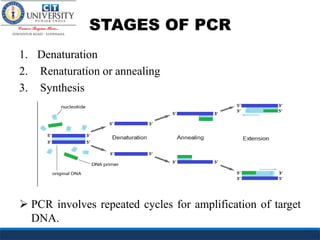
STAGES OF PCR
1. Denaturation
2. Renaturation or annealing
3. Synthesis
 PCR involves repeated cycles for amplification of target
DNA.
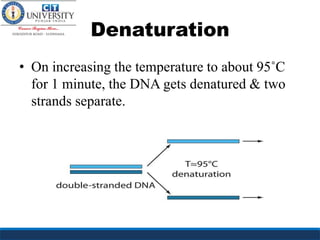
Denaturation
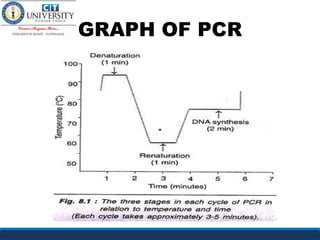
• On increasing the temperature to about 95˚C
for 1 minute, the DNA gets denatured & two
strands separate.
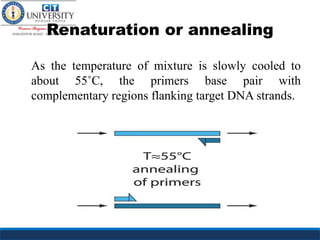
Renaturation or annealing
As the temperature of mixture is slowly cooled to
about 55˚C, the primers base pair with
complementary regions flanking target DNA strands.
Synthesis:
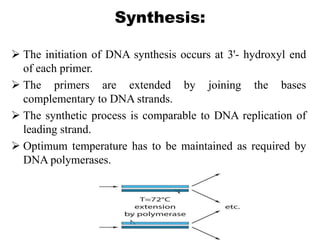
 The initiation of DNA synthesis occurs at 3'- hydroxyl end
of each primer.
 The primers are extended by joining the bases
complementary to DNA strands.
 The synthetic process is comparable to DNA replication of
leading strand.
 Optimum temperature has to be maintained as required by
DNA polymerases.
GRAPH OF PCR
example
• Taq DNA polymerase, optimum temperature is
around 75˚C & E.coli DNA polymerase around
37˚C.
• The reaction can be stopped by raising the
temperature (about 95˚C).
Sources of dna polymarase
• Klenow fragment of E.coli DNA polymerase is used
in original technique. This enzyme, gets denatured at
higher temperature, therefore, fresh enzyme had to be
added for each cycle.
• Taq DNA polymerase (Thermus aquaticus) is heat
resistant, not necessary to freshly add this enzyme for
each cycle.
APPLICATIONS
• Prenatal diagnosis of inherited diseases: PCR is used
for prenatal diagnosis of various diseases by using
chorionic villus samples or cells from amniocentesis.
• Sickle-cell anemia, β-thelassema & PKU can be
detected.
• Diagnosis of retroviral diseases: Used for diagnosis
of HIV infection
 Diagnosis of bacterial infections: Used for the
detection of bacterial infections like tuberculosis.
 Diagnosis of cancers:Used for the detection of
cervical cancer.
 PCR in forensic medicine: Used for the identification
of criminals.
Polymerase chain reaction

Polymerase chain reaction

  • 1.
    POLYMERASE CHAIN REACTION (PCR) Preparedby: Ibrahim mussa B.pharmacy 6th semester
  • 2.
    POLYMERASE CHAIN REACTION (PCR) •Polymerase chain reaction (PCR) is technique for generating large quantities of a specified DNA. • PCR is a cell free amplification technique for synthesizing multiple identical copies of any DNA of interest
  • 3.
    PRINCIPLE OF PCR The double-stranded DNA of interest is denatured to separate into 2 individual strands.  Each strand is allowed to hybridize with a primer (renaturation).  The primer-template duplex is used for DNA synthesis (DNA polymerase).  Denaturation, renaturation & synthesis are repeated again & again to generate multiple forms of target DNA.
  • 4.
    TECHNIQUE FOR PCR Requirementsfor PCR: a. A target DNA (100-35,000 bp in length). b. Two primers (synthetic oligonucleotides of 17-30 nucleotides length) that are complementary to regions flanking the target DNA. c. Four deoxyribonucleotides (dATP, dCTP, dGTP, dTTP). d. A DNA polymerase that can withstand at a temperature up to 95˚C.
  • 5.
    STAGES OF PCR 1.Denaturation 2. Renaturation or annealing 3. Synthesis  PCR involves repeated cycles for amplification of target DNA.
  • 6.
    Denaturation • On increasingthe temperature to about 95˚C for 1 minute, the DNA gets denatured & two strands separate.
  • 7.
    Renaturation or annealing Asthe temperature of mixture is slowly cooled to about 55˚C, the primers base pair with complementary regions flanking target DNA strands.
  • 8.
    Synthesis:  The initiationof DNA synthesis occurs at 3'- hydroxyl end of each primer.  The primers are extended by joining the bases complementary to DNA strands.  The synthetic process is comparable to DNA replication of leading strand.  Optimum temperature has to be maintained as required by DNA polymerases.
  • 9.
  • 10.
    example • Taq DNApolymerase, optimum temperature is around 75˚C & E.coli DNA polymerase around 37˚C. • The reaction can be stopped by raising the temperature (about 95˚C).
  • 11.
    Sources of dnapolymarase • Klenow fragment of E.coli DNA polymerase is used in original technique. This enzyme, gets denatured at higher temperature, therefore, fresh enzyme had to be added for each cycle. • Taq DNA polymerase (Thermus aquaticus) is heat resistant, not necessary to freshly add this enzyme for each cycle.
  • 12.
    APPLICATIONS • Prenatal diagnosisof inherited diseases: PCR is used for prenatal diagnosis of various diseases by using chorionic villus samples or cells from amniocentesis. • Sickle-cell anemia, β-thelassema & PKU can be detected. • Diagnosis of retroviral diseases: Used for diagnosis of HIV infection
  • 13.
     Diagnosis ofbacterial infections: Used for the detection of bacterial infections like tuberculosis.  Diagnosis of cancers:Used for the detection of cervical cancer.  PCR in forensic medicine: Used for the identification of criminals.