What is Prime Numbers?
By Mhd Imran CHAMIEH
Outline
• Prime number definition
• Example from real life
• Cryptography
• Prime number form
• Conclusion
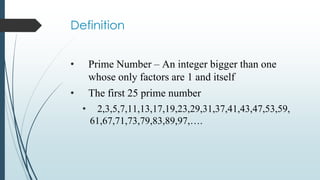
Definition
• Prime Number – An integer bigger than one
whose only factors are 1 and itself
• The first 25 prime number
• 2,3,5,7,11,13,17,19,23,29,31,37,41,43,47,53,59,
61,67,71,73,79,83,89,97,….
Prime numbers in nature
Prime numbers in natural
• The usage of prime number in natural selection is
shown in Cicada lifecycle that may be periods of
either 17 or 13 years, which are prime numbers
that in necessarily will trick the predators to predict
and synchronize its lifecycle with Cicada`s
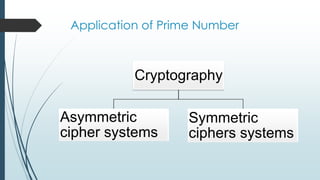
Application of Prime Number
Cryptography
Asymmetric
cipher systems
Symmetric
ciphers systems
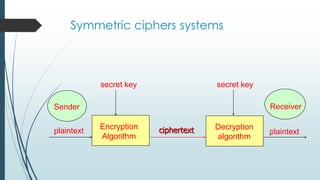
Symmetric ciphers systems
ciphertext
secret key secret key
plaintextplaintext
Sender
Decryption
algorithm
Encryption
Algorithm
Receiver
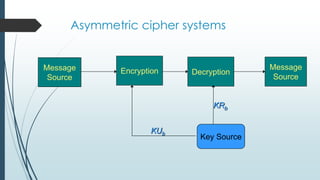
Asymmetric cipher systems
Message
Source
Encryption Message
Source
Decryption
Key Source
KUb
KRb
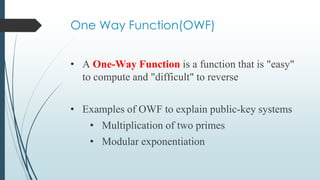
One Way Function(OWF)
• A One-Way Function is a function that is "easy"
to compute and "difficult" to reverse
• Examples of OWF to explain public-key systems
• Multiplication of two primes
• Modular exponentiation
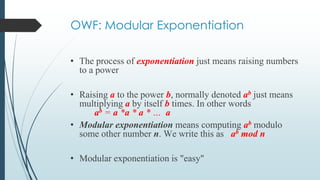
OWF: Modular Exponentiation
• The process of exponentiation just means raising numbers
to a power
• Raising a to the power b, normally denoted ab just means
multiplying a by itself b times. In other words
ab = a *a * a * … a
• Modular exponentiation means computing ab modulo
some other number n. We write this as ab mod n
• Modular exponentiation is "easy"
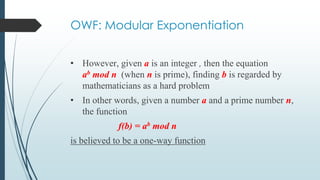
OWF: Modular Exponentiation
• However, given a is an integer , then the equation
ab mod n (when n is prime), finding b is regarded by
mathematicians as a hard problem
• In other words, given a number a and a prime number n,
the function
f(b) = ab mod n
is believed to be a one-way function
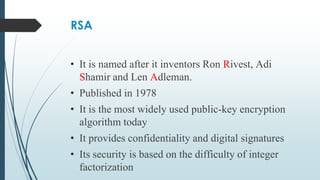
RSA
• It is named after it inventors Ron Rivest, Adi
Shamir and Len Adleman.
• Published in 1978
• It is the most widely used public-key encryption
algorithm today
• It provides confidentiality and digital signatures
• Its security is based on the difficulty of integer
factorization
Example: Confidentiality
• Generate two large (at least 512 bits) primes p and q
• Take p = 7, q = 11
• Compute n=pq and (n)=(p-1)(q-1) .
• so n = 77 and (77) =(7-1)(11-1)= 60
• Choose e < (n) relatively prime to (n) (i.e. gcd (e, 60)=1)
• Say I choose (KUb) e = 17
• 17 x d mod 60 = 1 (KRb) d = 53
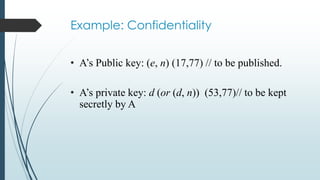
Example: Confidentiality
• A’s Public key: (e, n) (17,77) // to be published.
• A’s private key: d (or (d, n)) (53,77)// to be kept
secretly by A
Example: Confidentiality
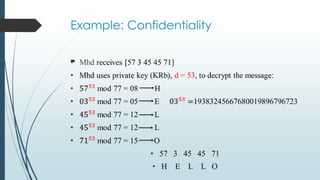
• Imran wants to secretly send Mhd the message "HELLO"
• H E L L O
• 08 05 12 12 15
• 0817 mod 77 = 57
• 0517 mod 77 = 03
• 1217 mod 77 = 45
• 1217 mod 77 = 45
• 1517 mod 77 = 71
• Imran sends ciphertext [57 3 45 45 71]
Example: Confidentiality

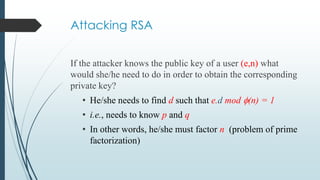
Attacking RSA
If the attacker knows the public key of a user (e,n) what
would she/he need to do in order to obtain the corresponding
private key?
• He/she needs to find d such that e.d mod (n) = 1
• i.e., needs to know p and q
• In other words, he/she must factor n (problem of prime
factorization)
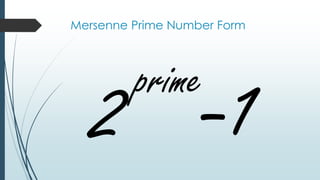
Mersenne Prime Number Form
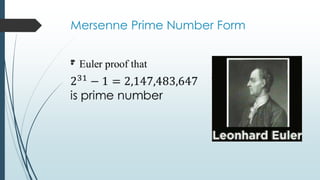
prime
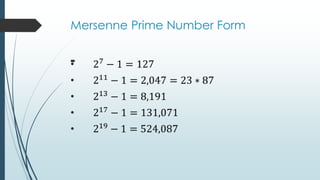
Mersenne Prime Number Form
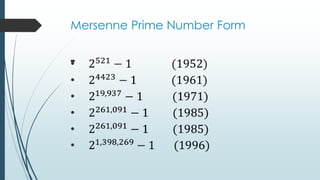

Mersenne Prime Number Form

Mersenne Prime Number Form

The largest Prime Number
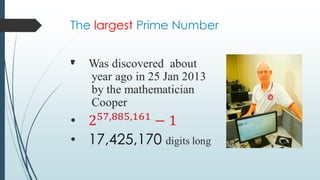

Finally
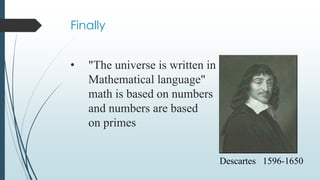
Descartes 1596-1650
• "The universe is written in
Mathematical language"
math is based on numbers
and numbers are based
on primes
Conclusion
• Definition of prime number
• Cicada lifecycle and how protect it self
• Application of prime number in security
• Mersenne form of prime number
• The largest discovered prime number
The End
Imran.shamia@gmail.com
6/4/2014

Prime numbers

  • 1.
    What is PrimeNumbers? By Mhd Imran CHAMIEH
  • 2.
    Outline • Prime numberdefinition • Example from real life • Cryptography • Prime number form • Conclusion
  • 3.
    Definition • Prime Number– An integer bigger than one whose only factors are 1 and itself • The first 25 prime number • 2,3,5,7,11,13,17,19,23,29,31,37,41,43,47,53,59, 61,67,71,73,79,83,89,97,….
  • 4.
  • 5.
    Prime numbers innatural • The usage of prime number in natural selection is shown in Cicada lifecycle that may be periods of either 17 or 13 years, which are prime numbers that in necessarily will trick the predators to predict and synchronize its lifecycle with Cicada`s
  • 6.
    Application of PrimeNumber Cryptography Asymmetric cipher systems Symmetric ciphers systems
  • 7.
    Symmetric ciphers systems ciphertext secretkey secret key plaintextplaintext Sender Decryption algorithm Encryption Algorithm Receiver
  • 8.
    Asymmetric cipher systems Message Source EncryptionMessage Source Decryption Key Source KUb KRb
  • 9.
    One Way Function(OWF) •A One-Way Function is a function that is "easy" to compute and "difficult" to reverse • Examples of OWF to explain public-key systems • Multiplication of two primes • Modular exponentiation
  • 10.
    OWF: Modular Exponentiation •The process of exponentiation just means raising numbers to a power • Raising a to the power b, normally denoted ab just means multiplying a by itself b times. In other words ab = a *a * a * … a • Modular exponentiation means computing ab modulo some other number n. We write this as ab mod n • Modular exponentiation is "easy"
  • 11.
    OWF: Modular Exponentiation •However, given a is an integer , then the equation ab mod n (when n is prime), finding b is regarded by mathematicians as a hard problem • In other words, given a number a and a prime number n, the function f(b) = ab mod n is believed to be a one-way function
  • 12.
    RSA • It isnamed after it inventors Ron Rivest, Adi Shamir and Len Adleman. • Published in 1978 • It is the most widely used public-key encryption algorithm today • It provides confidentiality and digital signatures • Its security is based on the difficulty of integer factorization
  • 13.
    Example: Confidentiality • Generatetwo large (at least 512 bits) primes p and q • Take p = 7, q = 11 • Compute n=pq and (n)=(p-1)(q-1) . • so n = 77 and (77) =(7-1)(11-1)= 60 • Choose e < (n) relatively prime to (n) (i.e. gcd (e, 60)=1) • Say I choose (KUb) e = 17 • 17 x d mod 60 = 1 (KRb) d = 53
  • 14.
    Example: Confidentiality • A’sPublic key: (e, n) (17,77) // to be published. • A’s private key: d (or (d, n)) (53,77)// to be kept secretly by A
  • 15.
    Example: Confidentiality • Imranwants to secretly send Mhd the message "HELLO" • H E L L O • 08 05 12 12 15 • 0817 mod 77 = 57 • 0517 mod 77 = 03 • 1217 mod 77 = 45 • 1217 mod 77 = 45 • 1517 mod 77 = 71 • Imran sends ciphertext [57 3 45 45 71]
  • 16.
  • 17.
    Attacking RSA If theattacker knows the public key of a user (e,n) what would she/he need to do in order to obtain the corresponding private key? • He/she needs to find d such that e.d mod (n) = 1 • i.e., needs to know p and q • In other words, he/she must factor n (problem of prime factorization)
  • 18.
  • 19.
  • 20.
  • 21.
  • 22.
  • 23.
    Finally Descartes 1596-1650 • "Theuniverse is written in Mathematical language" math is based on numbers and numbers are based on primes
  • 24.
    Conclusion • Definition ofprime number • Cicada lifecycle and how protect it self • Application of prime number in security • Mersenne form of prime number • The largest discovered prime number
  • 25.

Editor's Notes

  • #21 2^127 -1 عدد اولي مؤلف من 39 رقم اثبتت من قبل العالوملوكش عام1876 كما اثبت لوكش ان 2^67-1 عدد غير اولي بطول 21 رقم