Cryptography and
Network Security
Chapter 8
Fourth Edition
by William Stallings
Lecture slides by Lawrie Brown
Modified – Tom Noack
Chapter 8 – Introduction to
Number Theory
The Devil said to Daniel Webster: "Set me a task I can't carry out, and
I'll give you anything in the world you ask for."
Daniel Webster: "Fair enough. Prove that for n greater than 2, the
equation an + bn = cn has no non-trivial solution in the integers."
They agreed on a three-day period for the labor, and the Devil
disappeared.
At the end of three days, the Devil presented himself, haggard, jumpy,
biting his lip. Daniel Webster said to him, "Well, how did you do at
my task? Did you prove the theorem?'
"Eh? No . . . no, I haven't proved it."
"Then I can have whatever I ask for? Money? The Presidency?'
"What? Oh, that—of course. But listen! If we could just prove the
following two lemmas—"
—The Mathematical Magpie, Clifton Fadiman
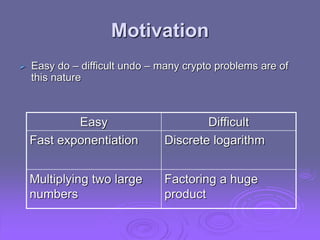
Motivation
 Easy do – difficult undo – many crypto problems are of
this nature
Easy Difficult
Fast exponentiation Discrete logarithm
Multiplying two large
numbers
Factoring a huge
product
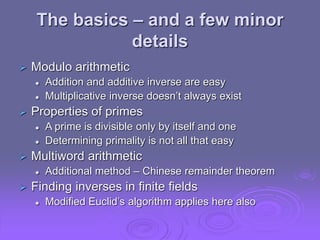
The basics – and a few minor
details
 Modulo arithmetic
 Addition and additive inverse are easy
 Multiplicative inverse doesn’t always exist
 Properties of primes
 A prime is divisible only by itself and one
 Determining primality is not all that easy
 Multiword arithmetic
 Additional method – Chinese remainder theorem
 Finding inverses in finite fields
 Modified Euclid’s algorithm applies here also
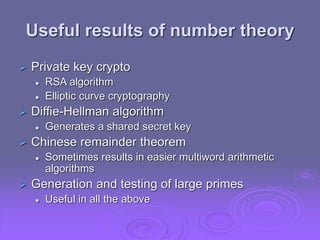
Useful results of number theory
 Private key crypto
 RSA algorithm
 Elliptic curve cryptography
 Diffie-Hellman algorithm
 Generates a shared secret key
 Chinese remainder theorem
 Sometimes results in easier multiword arithmetic
algorithms
 Generation and testing of large primes
 Useful in all the above
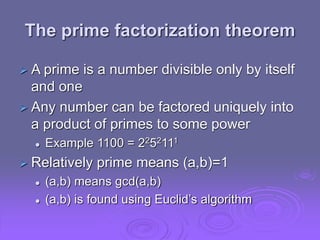
The prime factorization theorem
 A prime is a number divisible only by itself
and one
 Any number can be factored uniquely into
a product of primes to some power
 Example 1100 = 2252111
 Relatively prime means (a,b)=1
 (a,b) means gcd(a,b)
 (a,b) is found using Euclid’s algorithm
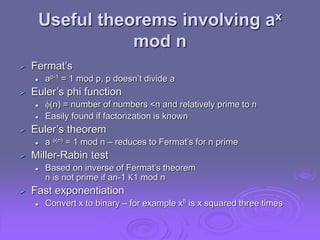
Useful theorems involving ax
mod n
 Fermat’s
 ap-1 = 1 mod p, p doesn’t divide a
 Euler’s phi function
 (n) = number of numbers <n and relatively prime to n
 Easily found if factorization is known
 Euler’s theorem
 a (n) = 1 mod n – reduces to Fermat’s for n prime
 Miller-Rabin test
 Based on inverse of Fermat’s theorem
n is not prime if an-1 K1 mod n
 Fast exponentiation
 Convert x to binary – for example x8 is x squared three times
Prime Numbers
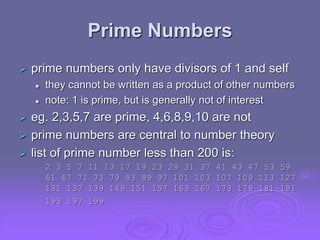
 prime numbers only have divisors of 1 and self
 they cannot be written as a product of other numbers
 note: 1 is prime, but is generally not of interest
 eg. 2,3,5,7 are prime, 4,6,8,9,10 are not
 prime numbers are central to number theory
 list of prime number less than 200 is:
2 3 5 7 11 13 17 19 23 29 31 37 41 43 47 53 59
61 67 71 73 79 83 89 97 101 103 107 109 113 127
131 137 139 149 151 157 163 167 173 179 181 191
193 197 199
Prime Factorisation
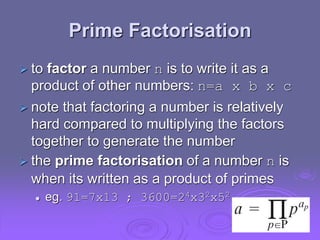
 to factor a number n is to write it as a
product of other numbers: n=a x b x c
 note that factoring a number is relatively
hard compared to multiplying the factors
together to generate the number
 the prime factorisation of a number n is
when its written as a product of primes
 eg. 91=7x13 ; 3600=24x32x52
Relatively Prime Numbers &
GCD
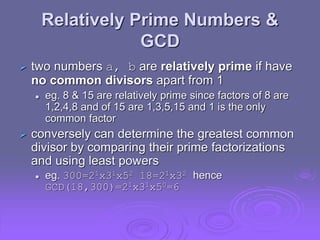
 two numbers a, b are relatively prime if have
no common divisors apart from 1
 eg. 8 & 15 are relatively prime since factors of 8 are
1,2,4,8 and of 15 are 1,3,5,15 and 1 is the only
common factor
 conversely can determine the greatest common
divisor by comparing their prime factorizations
and using least powers
 eg. 300=21x31x52 18=21x32 hence
GCD(18,300)=21x31x50=6
Fermat's Theorem
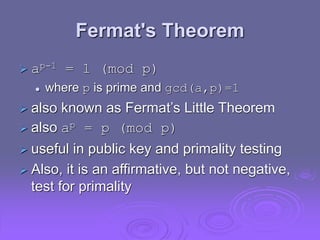
 ap-1 = 1 (mod p)
 where p is prime and gcd(a,p)=1
 also known as Fermat’s Little Theorem
 also ap = p (mod p)
 useful in public key and primality testing
 Also, it is an affirmative, but not negative,
test for primality
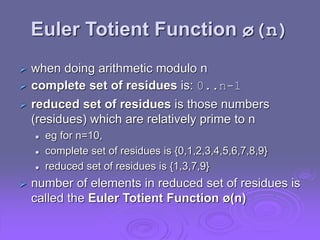
Euler Totient Function ø(n)
 when doing arithmetic modulo n
 complete set of residues is: 0..n-1
 reduced set of residues is those numbers
(residues) which are relatively prime to n
 eg for n=10,
 complete set of residues is {0,1,2,3,4,5,6,7,8,9}
 reduced set of residues is {1,3,7,9}
 number of elements in reduced set of residues is
called the Euler Totient Function ø(n)
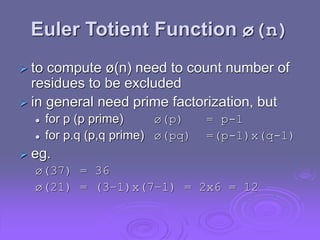
Euler Totient Function ø(n)
 to compute ø(n) need to count number of
residues to be excluded
 in general need prime factorization, but
 for p (p prime) ø(p) = p-1
 for p.q (p,q prime) ø(pq) =(p-1)x(q-1)
 eg.
ø(37) = 36
ø(21) = (3–1)x(7–1) = 2x6 = 12
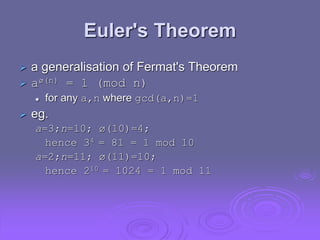
Euler's Theorem
 a generalisation of Fermat's Theorem
 aø(n) = 1 (mod n)
 for any a,n where gcd(a,n)=1
 eg.
a=3;n=10; ø(10)=4;
hence 34 = 81 = 1 mod 10
a=2;n=11; ø(11)=10;
hence 210 = 1024 = 1 mod 11
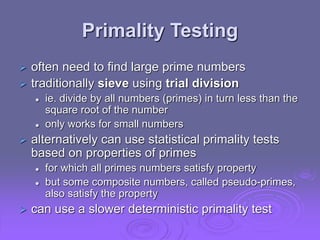
Primality Testing
 often need to find large prime numbers
 traditionally sieve using trial division
 ie. divide by all numbers (primes) in turn less than the
square root of the number
 only works for small numbers
 alternatively can use statistical primality tests
based on properties of primes
 for which all primes numbers satisfy property
 but some composite numbers, called pseudo-primes,
also satisfy the property
 can use a slower deterministic primality test
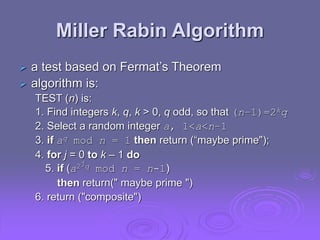
Miller Rabin Algorithm
 a test based on Fermat’s Theorem
 algorithm is:
TEST (n) is:
1. Find integers k, q, k > 0, q odd, so that (n–1)=2kq
2. Select a random integer a, 1<a<n–1
3. if aq mod n = 1 then return (“maybe prime");
4. for j = 0 to k – 1 do
5. if (a2jq mod n = n-1)
then return(" maybe prime ")
6. return ("composite")
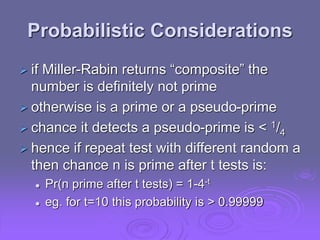
Probabilistic Considerations
 if Miller-Rabin returns “composite” the
number is definitely not prime
 otherwise is a prime or a pseudo-prime
 chance it detects a pseudo-prime is < 1/4
 hence if repeat test with different random a
then chance n is prime after t tests is:
 Pr(n prime after t tests) = 1-4-t
 eg. for t=10 this probability is > 0.99999
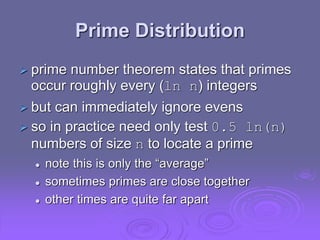
Prime Distribution
 prime number theorem states that primes
occur roughly every (ln n) integers
 but can immediately ignore evens
 so in practice need only test 0.5 ln(n)
numbers of size n to locate a prime
 note this is only the “average”
 sometimes primes are close together
 other times are quite far apart
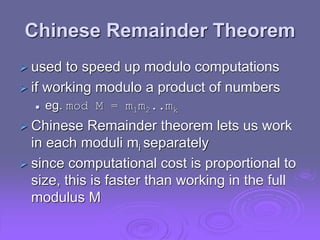
Chinese Remainder Theorem
 used to speed up modulo computations
 if working modulo a product of numbers
 eg. mod M = m1m2..mk
 Chinese Remainder theorem lets us work
in each moduli mi separately
 since computational cost is proportional to
size, this is faster than working in the full
modulus M
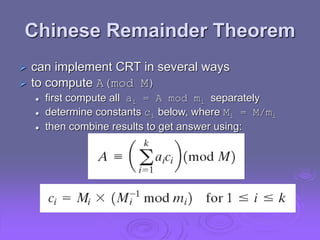
Chinese Remainder Theorem
 can implement CRT in several ways
 to compute A(mod M)
 first compute all ai = A mod mi separately
 determine constants ci below, where Mi = M/mi
 then combine results to get answer using:
Primitive Roots
 from Euler’s theorem have aø(n)mod n=1
 consider am=1 (mod n), GCD(a,n)=1
 must exist for m = ø(n) but may be smaller
 once powers reach m, cycle will repeat
 if smallest is m = ø(n) then a is called a
primitive root
 if p is prime, then successive powers of a
"generate" the group mod p
 these are useful but relatively hard to find
Discrete Logarithms
 the inverse problem to exponentiation is to find
the discrete logarithm of a number modulo p
 that is to find x such that y = gx (mod p)
 this is written as x = logg y (mod p)
 if g is a primitive root then it always exists,
otherwise it may not, eg.
x = log3 4 mod 13 has no answer
x = log2 3 mod 13 = 4 by trying successive powers
 whilst exponentiation is relatively easy, finding
discrete logarithms is generally a hard problem
Summary
 have considered:
 prime numbers
 Fermat’s and Euler’s Theorems & ø(n)
 Primality Testing
 Chinese Remainder Theorem
 Discrete Logarithms

ch08 modified.pptmodified.pptmodified.ppt

  • 1.
    Cryptography and Network Security Chapter8 Fourth Edition by William Stallings Lecture slides by Lawrie Brown Modified – Tom Noack
  • 2.
    Chapter 8 –Introduction to Number Theory The Devil said to Daniel Webster: "Set me a task I can't carry out, and I'll give you anything in the world you ask for." Daniel Webster: "Fair enough. Prove that for n greater than 2, the equation an + bn = cn has no non-trivial solution in the integers." They agreed on a three-day period for the labor, and the Devil disappeared. At the end of three days, the Devil presented himself, haggard, jumpy, biting his lip. Daniel Webster said to him, "Well, how did you do at my task? Did you prove the theorem?' "Eh? No . . . no, I haven't proved it." "Then I can have whatever I ask for? Money? The Presidency?' "What? Oh, that—of course. But listen! If we could just prove the following two lemmas—" —The Mathematical Magpie, Clifton Fadiman
  • 3.
    Motivation  Easy do– difficult undo – many crypto problems are of this nature Easy Difficult Fast exponentiation Discrete logarithm Multiplying two large numbers Factoring a huge product
  • 4.
    The basics –and a few minor details  Modulo arithmetic  Addition and additive inverse are easy  Multiplicative inverse doesn’t always exist  Properties of primes  A prime is divisible only by itself and one  Determining primality is not all that easy  Multiword arithmetic  Additional method – Chinese remainder theorem  Finding inverses in finite fields  Modified Euclid’s algorithm applies here also
  • 5.
    Useful results ofnumber theory  Private key crypto  RSA algorithm  Elliptic curve cryptography  Diffie-Hellman algorithm  Generates a shared secret key  Chinese remainder theorem  Sometimes results in easier multiword arithmetic algorithms  Generation and testing of large primes  Useful in all the above
  • 6.
    The prime factorizationtheorem  A prime is a number divisible only by itself and one  Any number can be factored uniquely into a product of primes to some power  Example 1100 = 2252111  Relatively prime means (a,b)=1  (a,b) means gcd(a,b)  (a,b) is found using Euclid’s algorithm
  • 7.
    Useful theorems involvingax mod n  Fermat’s  ap-1 = 1 mod p, p doesn’t divide a  Euler’s phi function  (n) = number of numbers <n and relatively prime to n  Easily found if factorization is known  Euler’s theorem  a (n) = 1 mod n – reduces to Fermat’s for n prime  Miller-Rabin test  Based on inverse of Fermat’s theorem n is not prime if an-1 K1 mod n  Fast exponentiation  Convert x to binary – for example x8 is x squared three times
  • 8.
    Prime Numbers  primenumbers only have divisors of 1 and self  they cannot be written as a product of other numbers  note: 1 is prime, but is generally not of interest  eg. 2,3,5,7 are prime, 4,6,8,9,10 are not  prime numbers are central to number theory  list of prime number less than 200 is: 2 3 5 7 11 13 17 19 23 29 31 37 41 43 47 53 59 61 67 71 73 79 83 89 97 101 103 107 109 113 127 131 137 139 149 151 157 163 167 173 179 181 191 193 197 199
  • 9.
    Prime Factorisation  tofactor a number n is to write it as a product of other numbers: n=a x b x c  note that factoring a number is relatively hard compared to multiplying the factors together to generate the number  the prime factorisation of a number n is when its written as a product of primes  eg. 91=7x13 ; 3600=24x32x52
  • 10.
    Relatively Prime Numbers& GCD  two numbers a, b are relatively prime if have no common divisors apart from 1  eg. 8 & 15 are relatively prime since factors of 8 are 1,2,4,8 and of 15 are 1,3,5,15 and 1 is the only common factor  conversely can determine the greatest common divisor by comparing their prime factorizations and using least powers  eg. 300=21x31x52 18=21x32 hence GCD(18,300)=21x31x50=6
  • 11.
    Fermat's Theorem  ap-1= 1 (mod p)  where p is prime and gcd(a,p)=1  also known as Fermat’s Little Theorem  also ap = p (mod p)  useful in public key and primality testing  Also, it is an affirmative, but not negative, test for primality
  • 12.
    Euler Totient Functionø(n)  when doing arithmetic modulo n  complete set of residues is: 0..n-1  reduced set of residues is those numbers (residues) which are relatively prime to n  eg for n=10,  complete set of residues is {0,1,2,3,4,5,6,7,8,9}  reduced set of residues is {1,3,7,9}  number of elements in reduced set of residues is called the Euler Totient Function ø(n)
  • 13.
    Euler Totient Functionø(n)  to compute ø(n) need to count number of residues to be excluded  in general need prime factorization, but  for p (p prime) ø(p) = p-1  for p.q (p,q prime) ø(pq) =(p-1)x(q-1)  eg. ø(37) = 36 ø(21) = (3–1)x(7–1) = 2x6 = 12
  • 14.
    Euler's Theorem  ageneralisation of Fermat's Theorem  aø(n) = 1 (mod n)  for any a,n where gcd(a,n)=1  eg. a=3;n=10; ø(10)=4; hence 34 = 81 = 1 mod 10 a=2;n=11; ø(11)=10; hence 210 = 1024 = 1 mod 11
  • 15.
    Primality Testing  oftenneed to find large prime numbers  traditionally sieve using trial division  ie. divide by all numbers (primes) in turn less than the square root of the number  only works for small numbers  alternatively can use statistical primality tests based on properties of primes  for which all primes numbers satisfy property  but some composite numbers, called pseudo-primes, also satisfy the property  can use a slower deterministic primality test
  • 16.
    Miller Rabin Algorithm a test based on Fermat’s Theorem  algorithm is: TEST (n) is: 1. Find integers k, q, k > 0, q odd, so that (n–1)=2kq 2. Select a random integer a, 1<a<n–1 3. if aq mod n = 1 then return (“maybe prime"); 4. for j = 0 to k – 1 do 5. if (a2jq mod n = n-1) then return(" maybe prime ") 6. return ("composite")
  • 17.
    Probabilistic Considerations  ifMiller-Rabin returns “composite” the number is definitely not prime  otherwise is a prime or a pseudo-prime  chance it detects a pseudo-prime is < 1/4  hence if repeat test with different random a then chance n is prime after t tests is:  Pr(n prime after t tests) = 1-4-t  eg. for t=10 this probability is > 0.99999
  • 18.
    Prime Distribution  primenumber theorem states that primes occur roughly every (ln n) integers  but can immediately ignore evens  so in practice need only test 0.5 ln(n) numbers of size n to locate a prime  note this is only the “average”  sometimes primes are close together  other times are quite far apart
  • 19.
    Chinese Remainder Theorem used to speed up modulo computations  if working modulo a product of numbers  eg. mod M = m1m2..mk  Chinese Remainder theorem lets us work in each moduli mi separately  since computational cost is proportional to size, this is faster than working in the full modulus M
  • 20.
    Chinese Remainder Theorem can implement CRT in several ways  to compute A(mod M)  first compute all ai = A mod mi separately  determine constants ci below, where Mi = M/mi  then combine results to get answer using:
  • 21.
    Primitive Roots  fromEuler’s theorem have aø(n)mod n=1  consider am=1 (mod n), GCD(a,n)=1  must exist for m = ø(n) but may be smaller  once powers reach m, cycle will repeat  if smallest is m = ø(n) then a is called a primitive root  if p is prime, then successive powers of a "generate" the group mod p  these are useful but relatively hard to find
  • 22.
    Discrete Logarithms  theinverse problem to exponentiation is to find the discrete logarithm of a number modulo p  that is to find x such that y = gx (mod p)  this is written as x = logg y (mod p)  if g is a primitive root then it always exists, otherwise it may not, eg. x = log3 4 mod 13 has no answer x = log2 3 mod 13 = 4 by trying successive powers  whilst exponentiation is relatively easy, finding discrete logarithms is generally a hard problem
  • 23.
    Summary  have considered: prime numbers  Fermat’s and Euler’s Theorems & ø(n)  Primality Testing  Chinese Remainder Theorem  Discrete Logarithms