Subhrajeet Praharaj.
Shubham Kumar Parida.
Manoranjan Rath.
Anshuman Pati.
1. THEOREM SLIDE-4
2. PROOF OF F.T.A. SLIDE-5
3. APPLICATION OF F.T.A. SLIDE-7
4. TOTAL NUMBER OF DIVISORS SLIDE-8
5. SUM OFTOTAL NUMBER OF DIVISORS SLIDE-9
6. INFINITELY MANY PRIMES SLIDE-10
7. PRIME OR COMPOSITE SLIDE-11
8. PROVING IRRATIONALS SLIDE-12
9. PRODUCT OF CONSECUTIVE NO. SLIDE-13
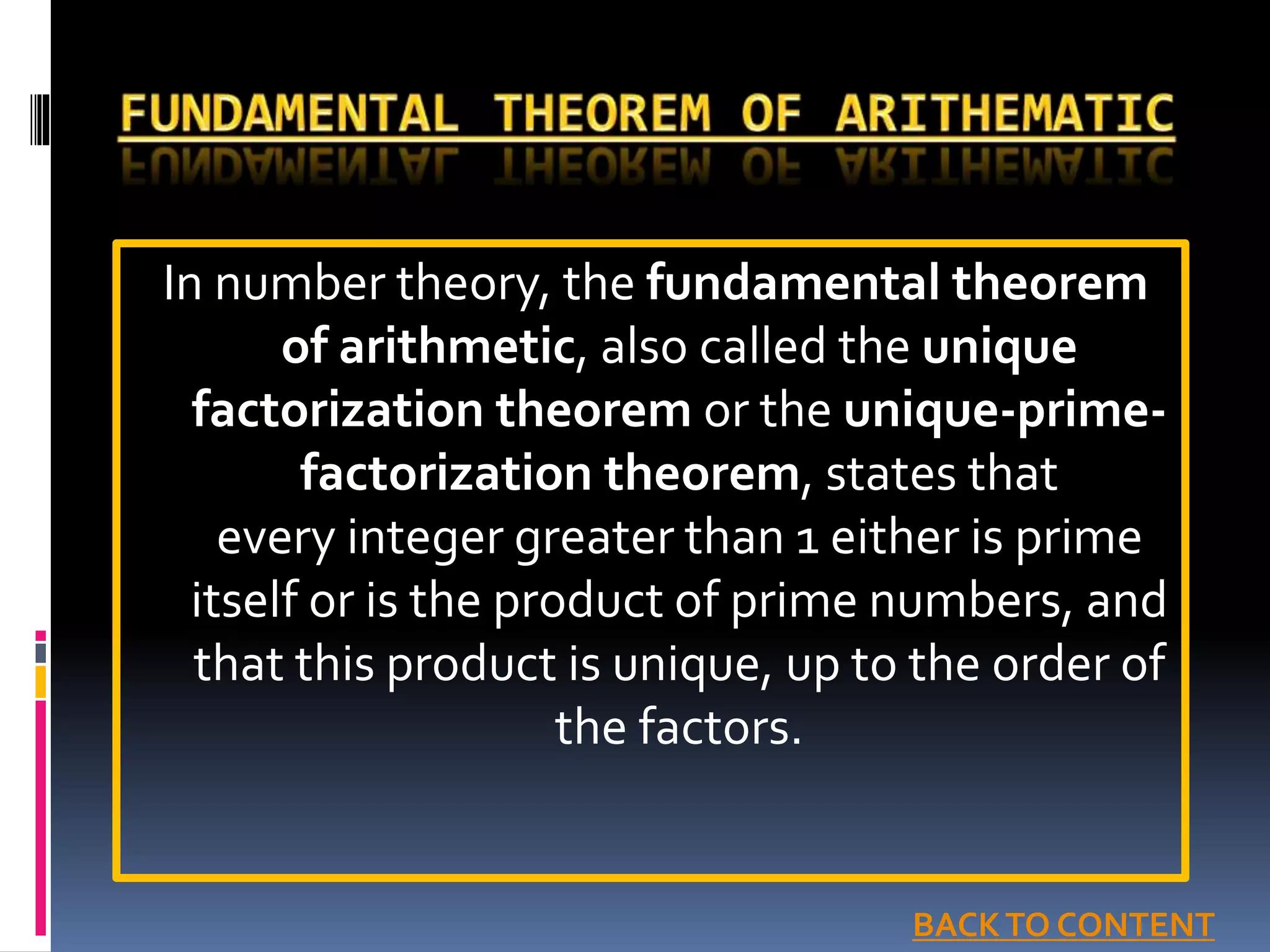
In number theory, the fundamental theorem
of arithmetic, also called the unique
factorization theorem or the unique-prime-
factorization theorem, states that
every integer greater than 1 either is prime
itself or is the product of prime numbers, and
that this product is unique, up to the order of
the factors.
BACKTO CONTENT
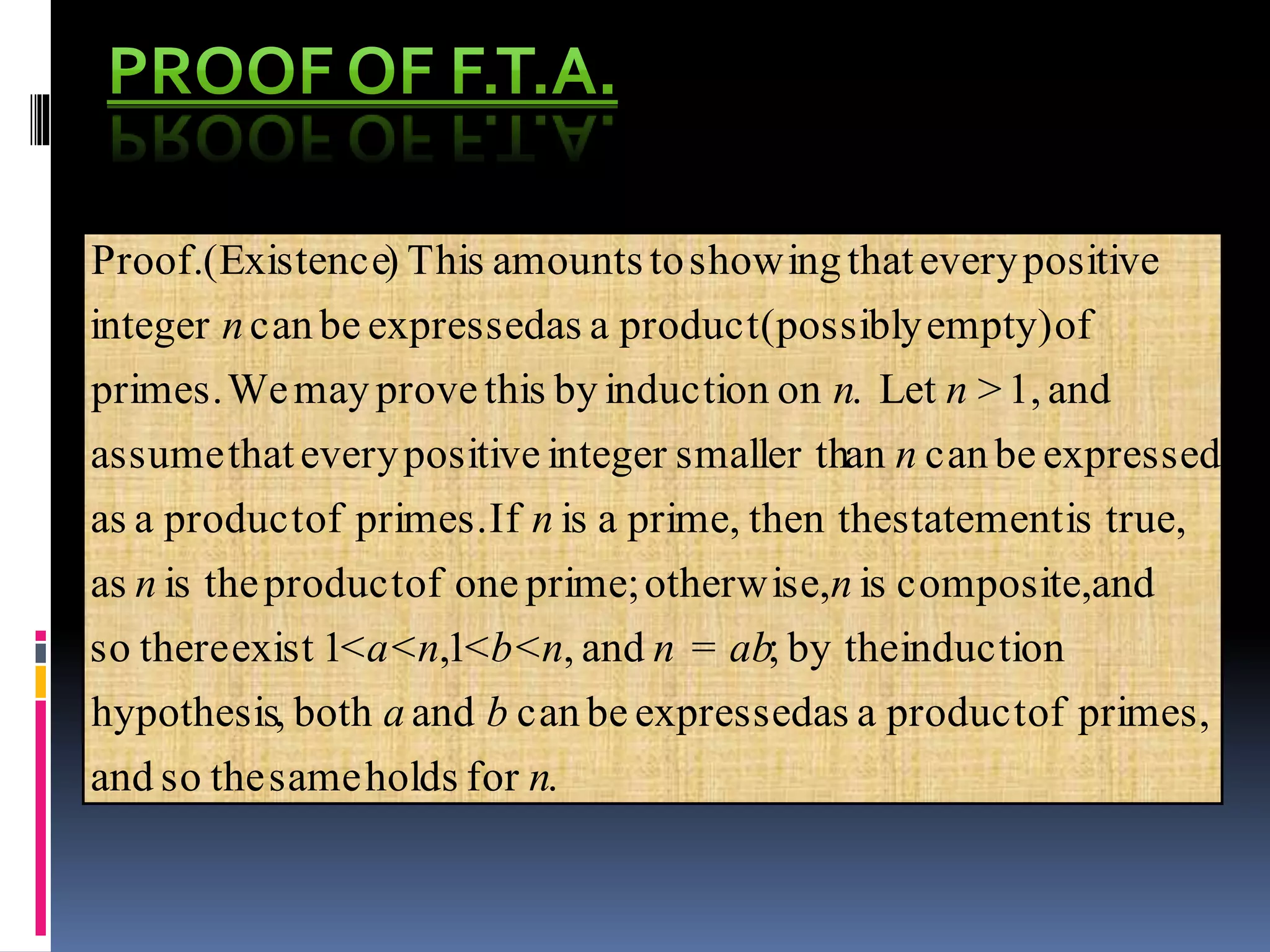
.forholdssamethesoand
primes,ofproductaasexpressedbecanandboth,hypothesis
inductionby the;and,1,1existthereso
andcomposite,isotherwise,prime;oneofproducttheisas
true,isstatementthen theprime,aisIfprimes.ofproductaas
expressedbecanansmaller thintegerpositiveeverythatassume
and1,>Let.oninductionbythisprovemayWeprimes.
ofempty)(possiblyproductaasexpressedbecaninteger
positiveeverythatshowingtoamountsThis)(ExistenceProof.
n
ba
n = ab<b<n<a<n
nn
n
n
nn
n
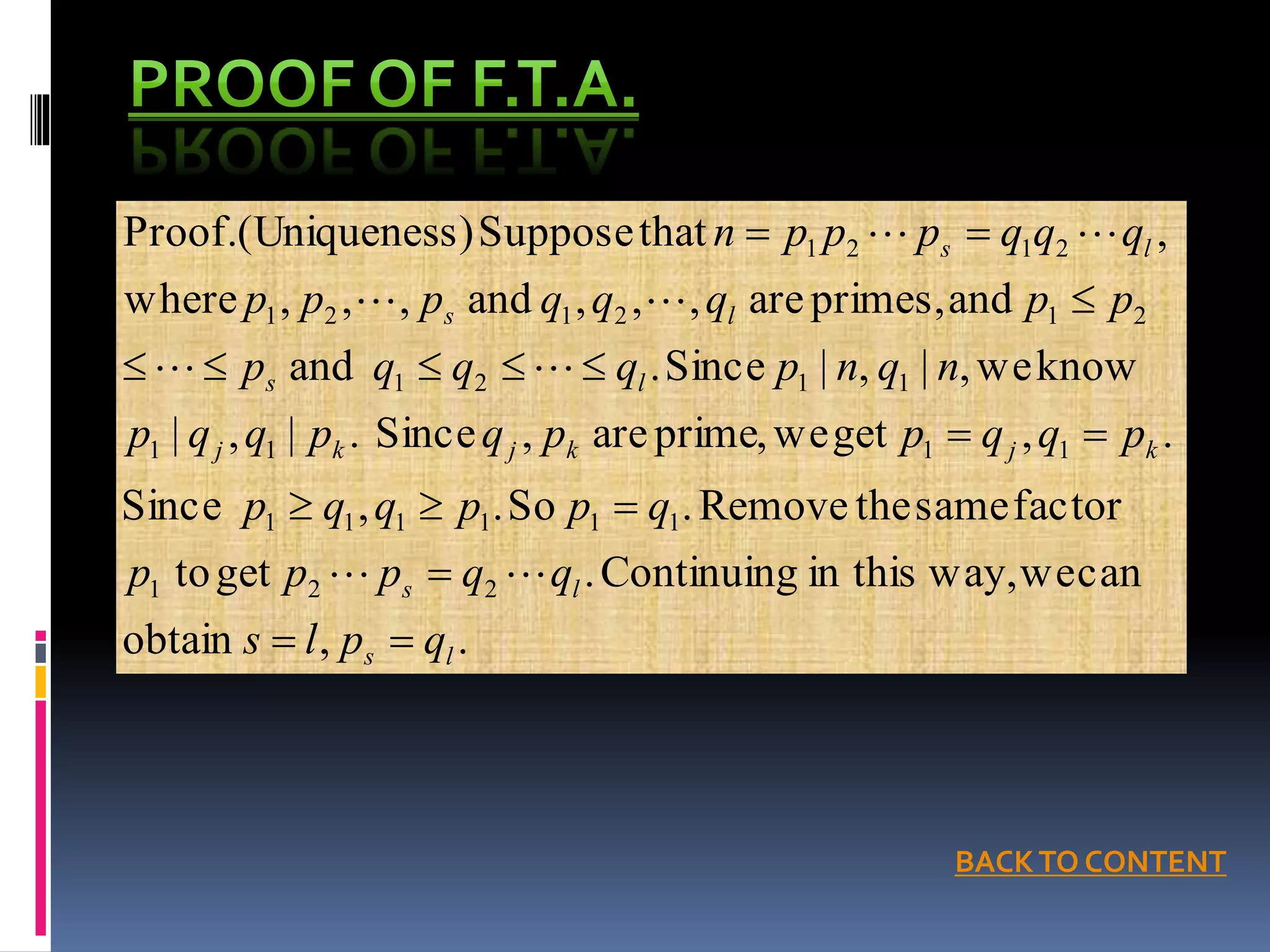
.,obtain
canweway,in thisContinuing.getto
factorsametheRemove.So.,Since
.,getwe,primeare,Since.|,|
knowwe,|,|Since.and
andprimes,are,,,and,,,where
,thatSupposes)(UniquenesProof.
221
111111
1111
1121
212121
2121
ls
ls
kjkjkj
ls
ls
ls
qpls
qqppp
qppqqp
pqqppqpqqp
nqnpqqqp
ppqqqppp
qqqpppn











BACKTO CONTENT
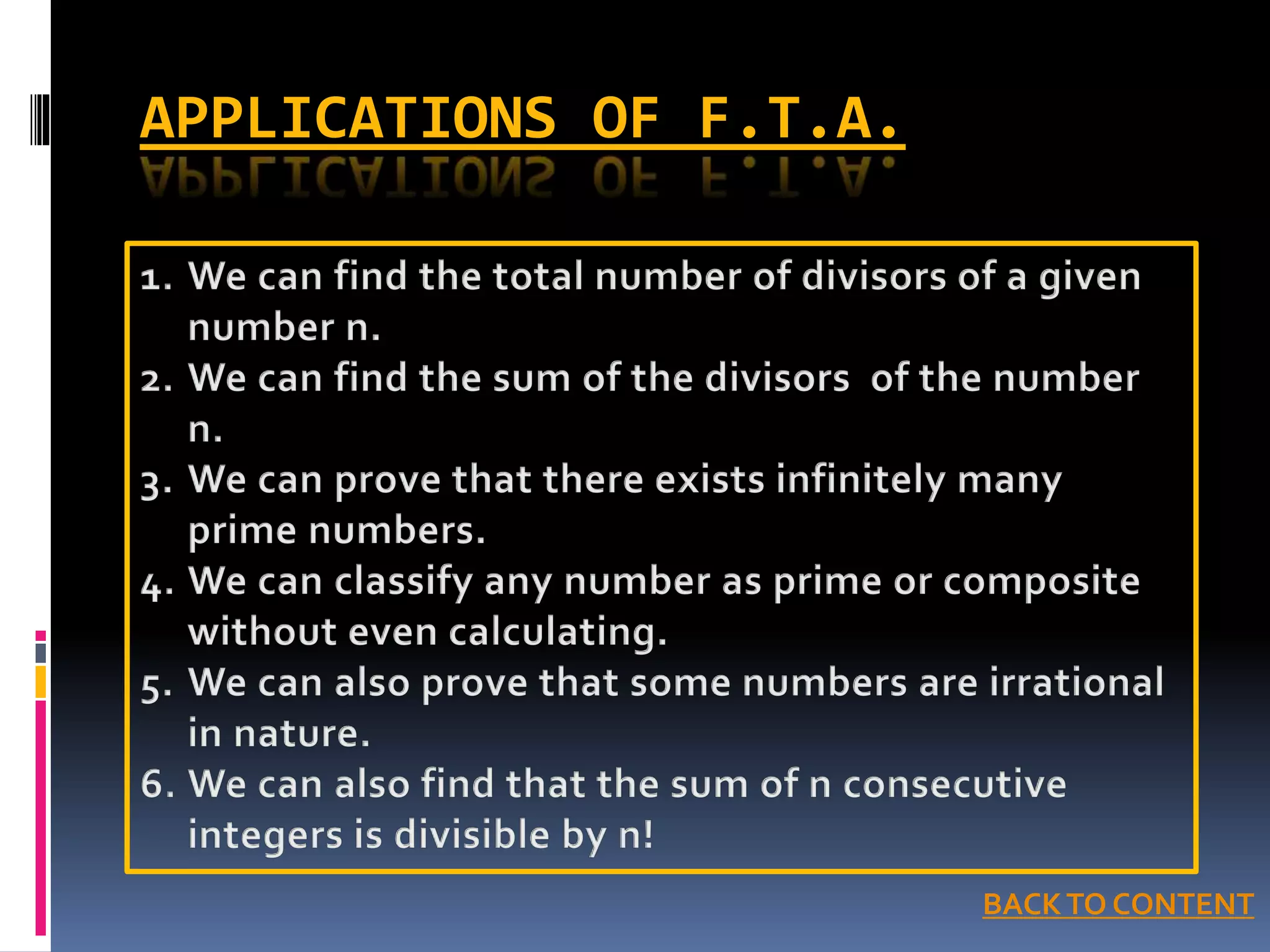
APPLICATIONS OF F.T.A.
BACKTO CONTENT
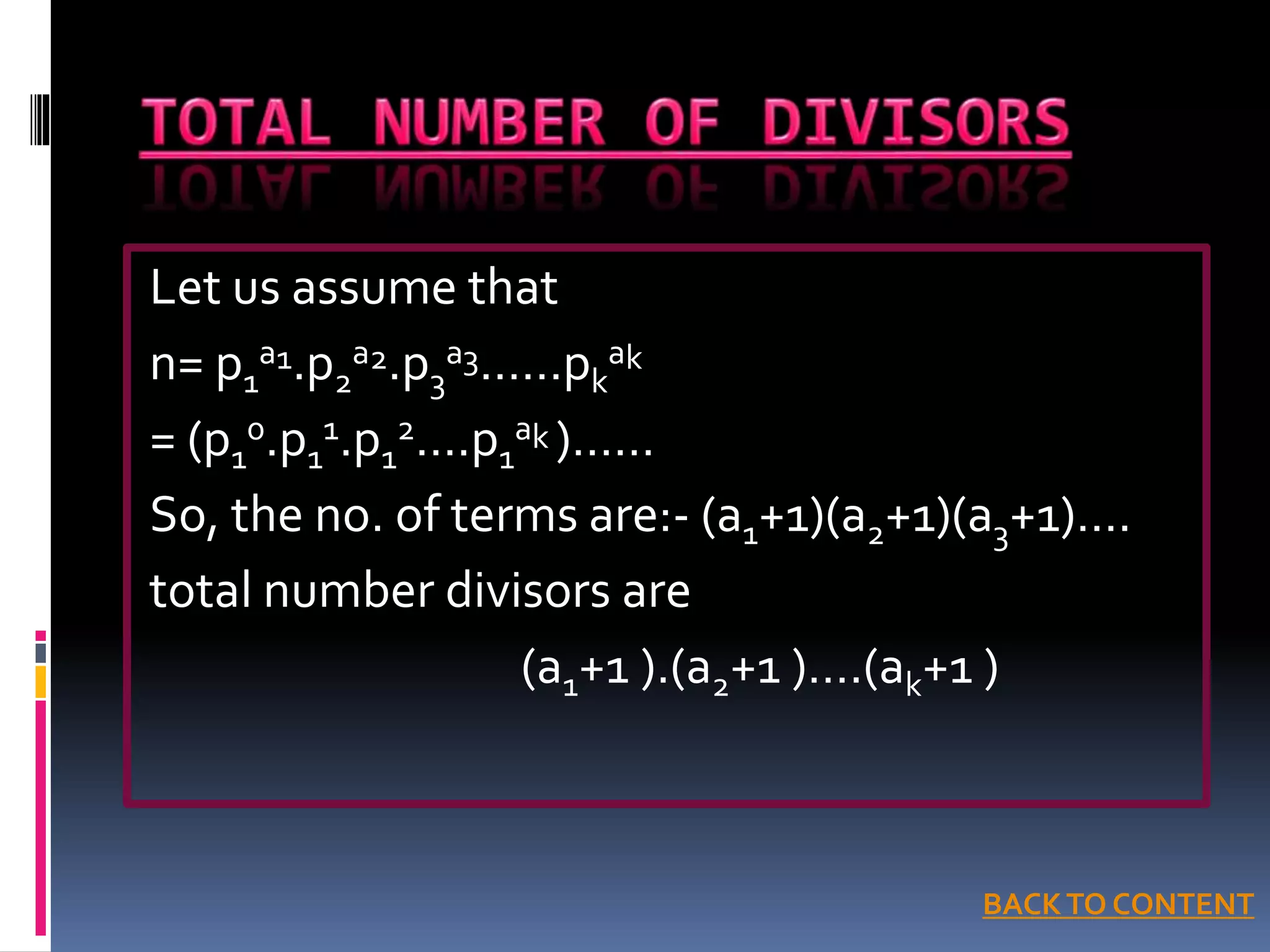
Let us assume that
n= p1
a1.p2
a2.p3
a3……pk
ak
= (p1
0.p1
1.p1
2….p1
ak )……
So, the no. of terms are:- (a1+1)(a2+1)(a3+1)….
total number divisors are
(a1+1 ).(a2+1 )….(ak+1 )
BACKTO CONTENT
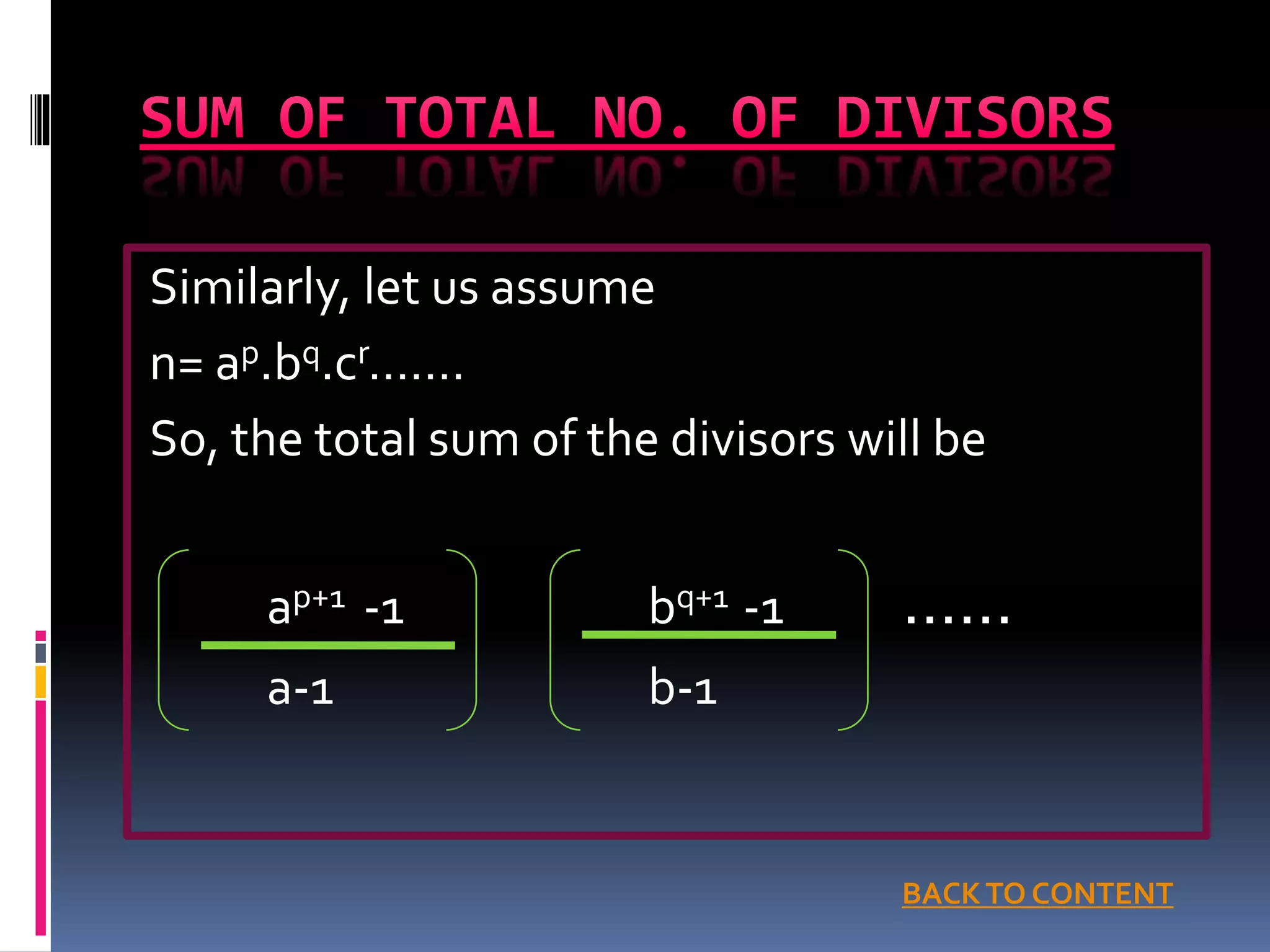
Similarly, let us assume
n= ap.bq.cr…….
So, the total sum of the divisors will be
ap+1 -1 bq+1 -1 ……
a-1 b-1
BACKTO CONTENT
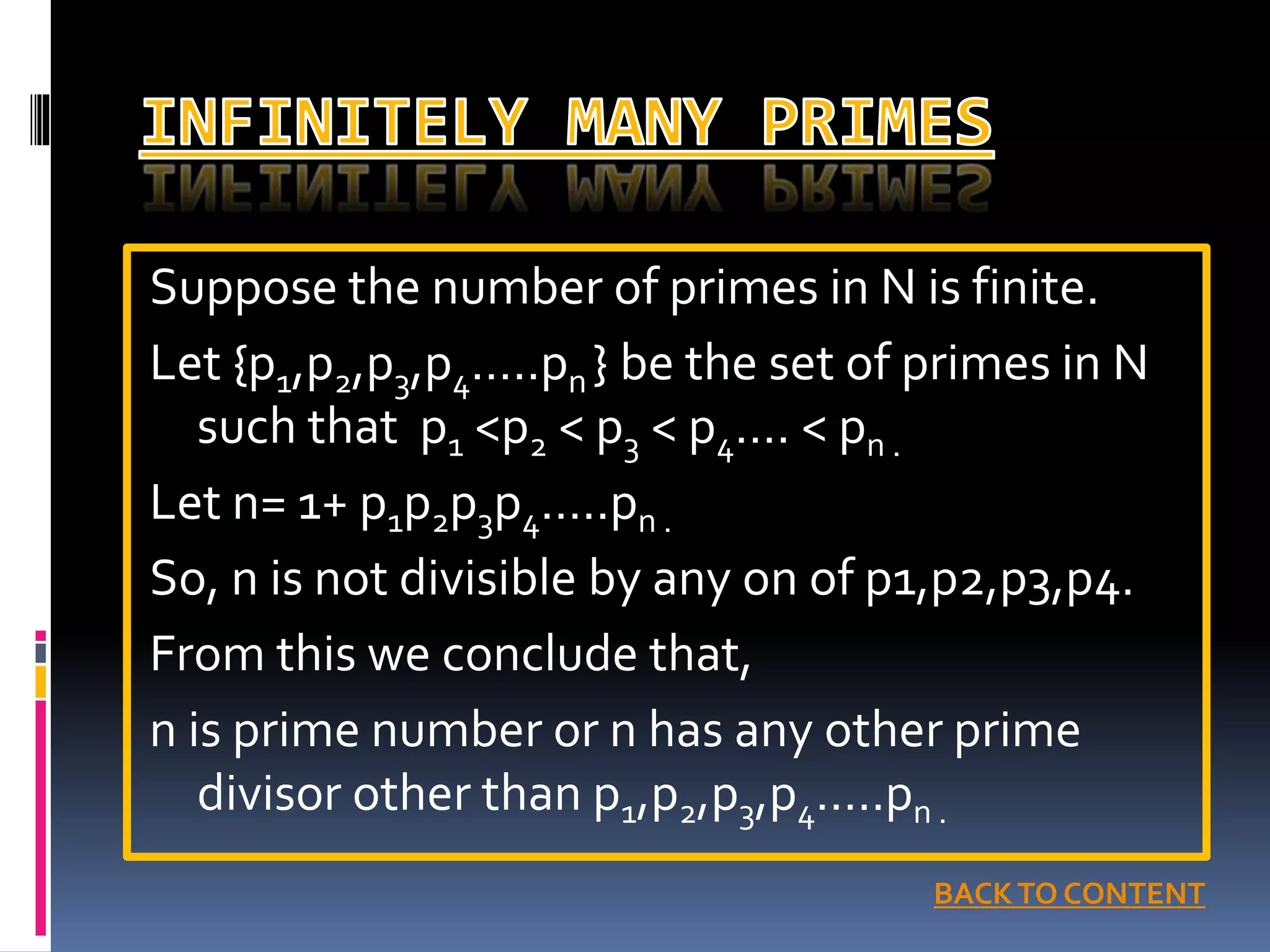
Suppose the number of primes in N is finite.
Let {p1,p2,p3,p4…..pn } be the set of primes in N
such that p1 <p2 < p3 < p4…. < pn .
Let n= 1+ p1p2p3p4…..pn .
So, n is not divisible by any on of p1,p2,p3,p4.
From this we conclude that,
n is prime number or n has any other prime
divisor other than p1,p2,p3,p4…..pn .
BACKTO CONTENT
BACKTO CONTENT
BACKTO CONTENT
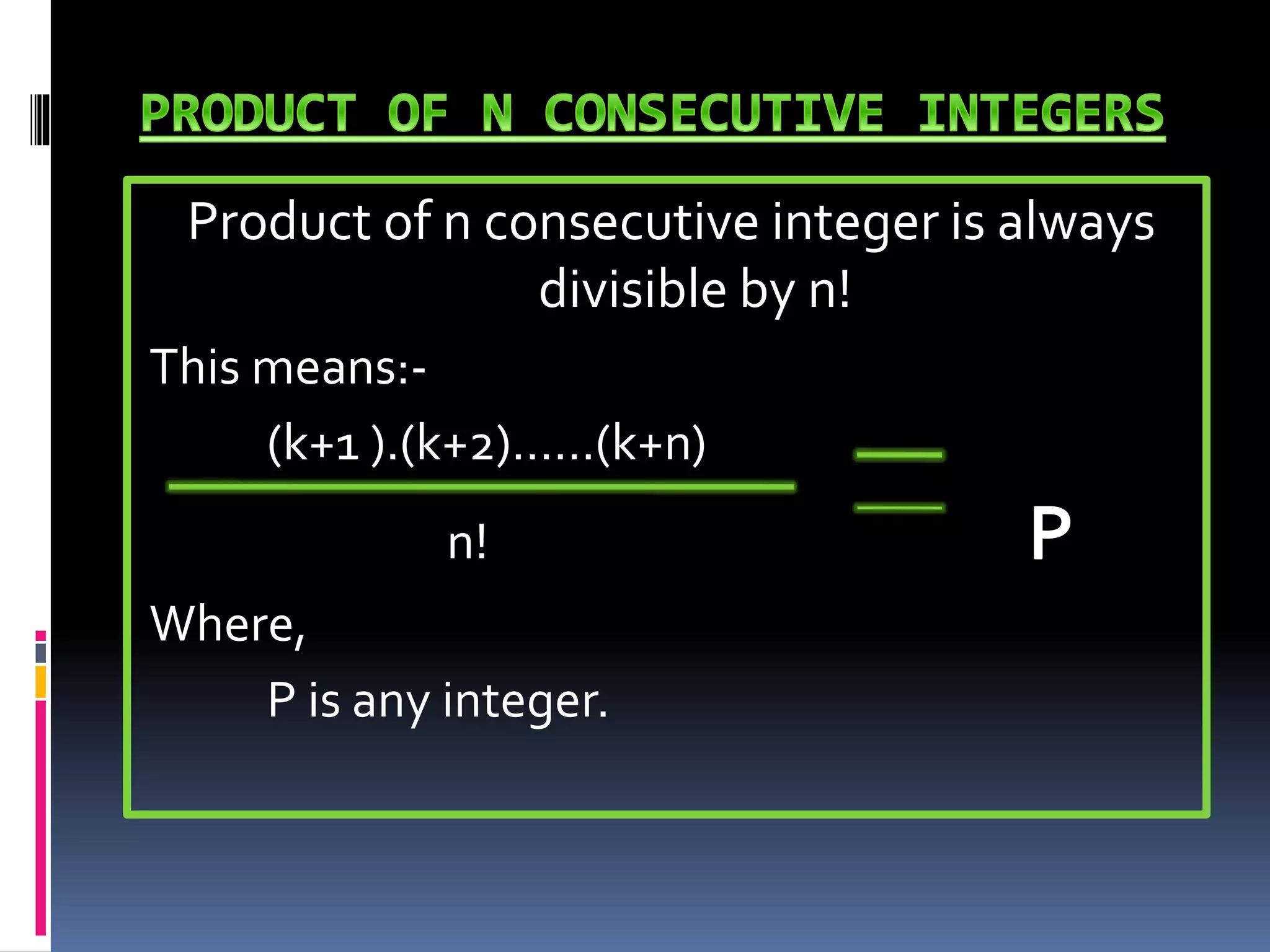
Product of n consecutive integer is always
divisible by n!
This means:-
(k+1 ).(k+2)……(k+n)
n!
Where,
P is any integer.
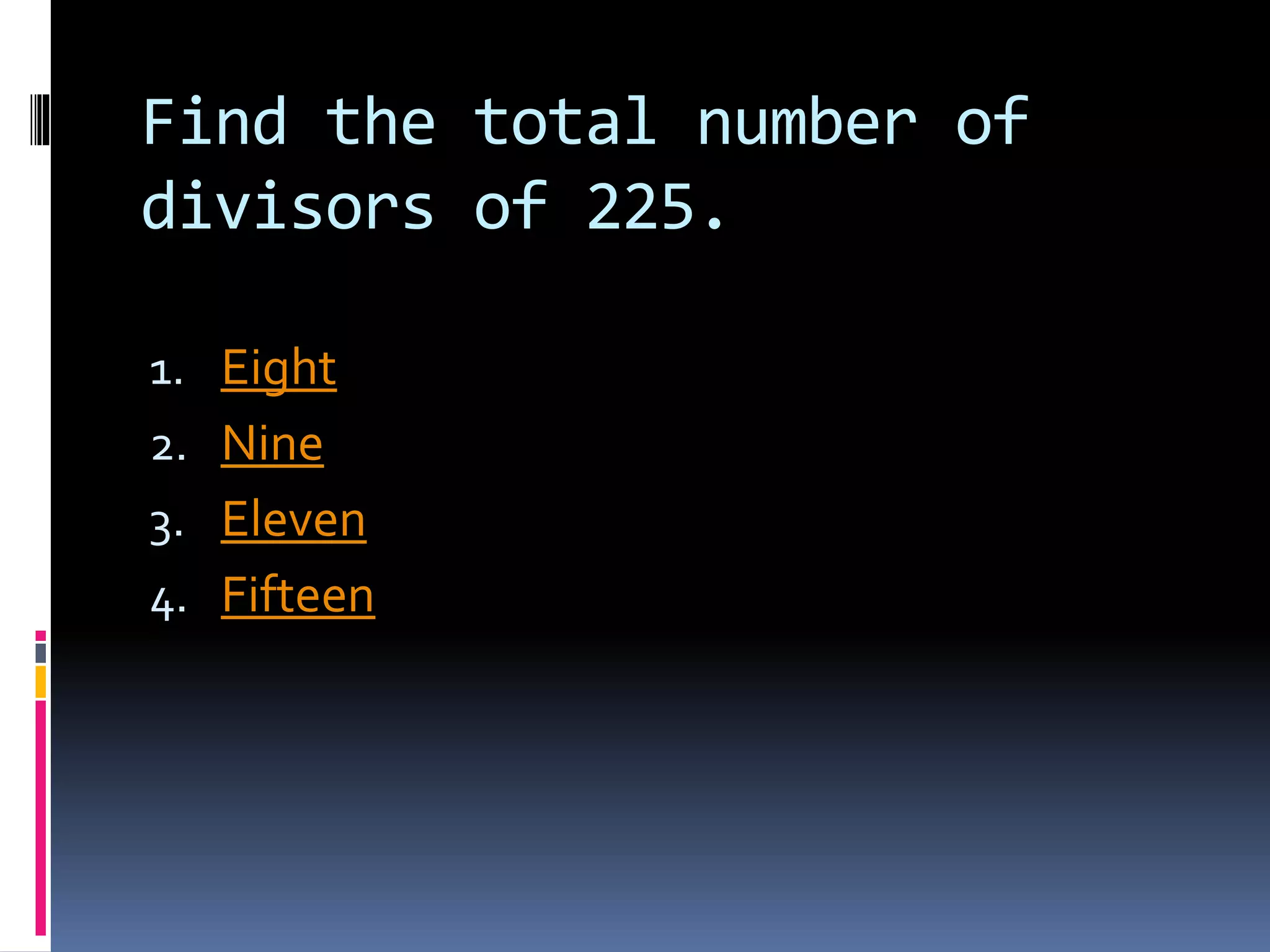
Find the total number of
divisors of 225.
1. Eight
2. Nine
3. Eleven
4. Fifteen
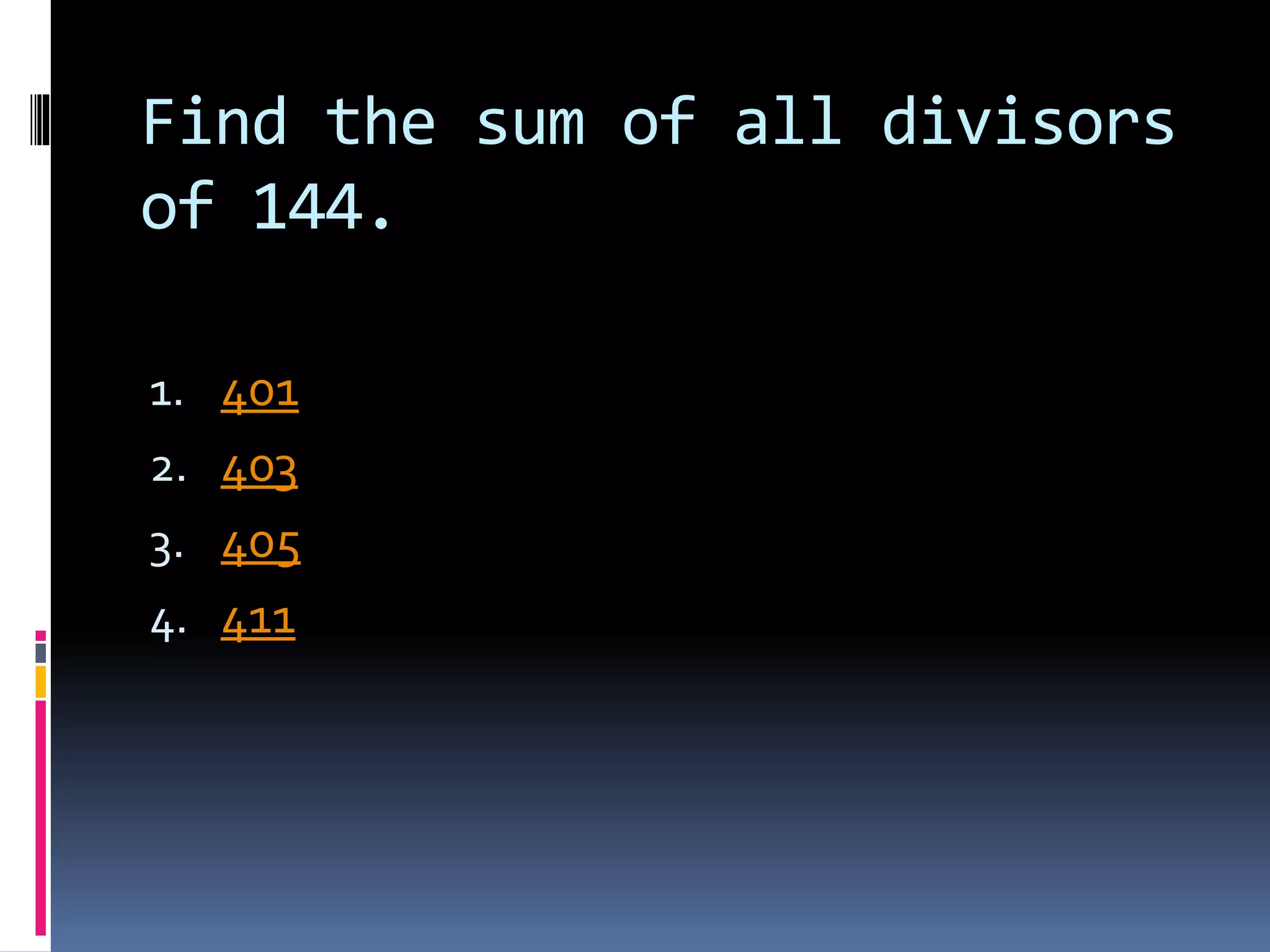
Find the sum of all divisors
of 144.
1. 401
2. 403
3. 405
4. 411
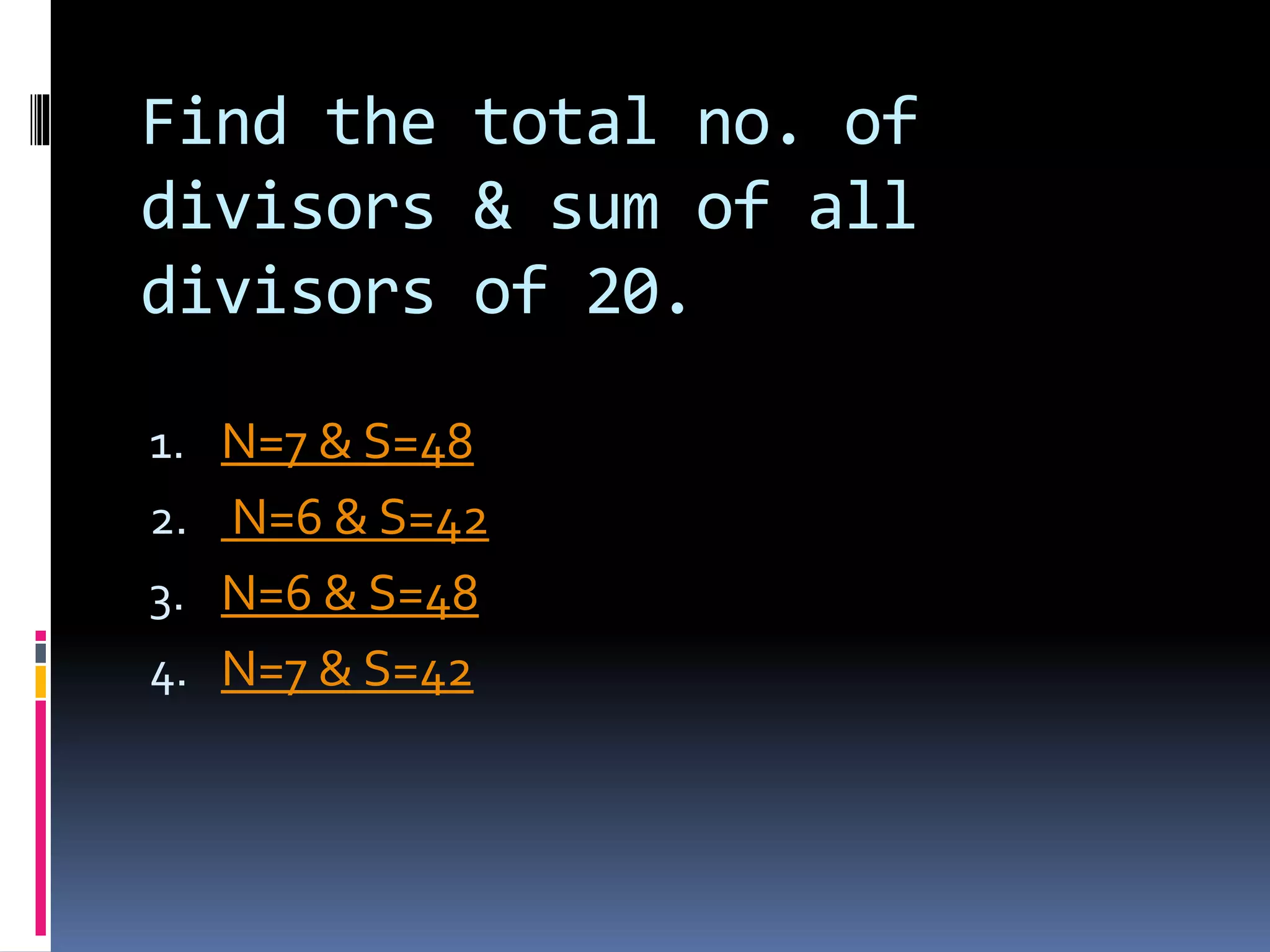
Find the total no. of
divisors & sum of all
divisors of 20.
1. N=7 & S=48
2. N=6 & S=42
3. N=6 & S=48
4. N=7 & S=42
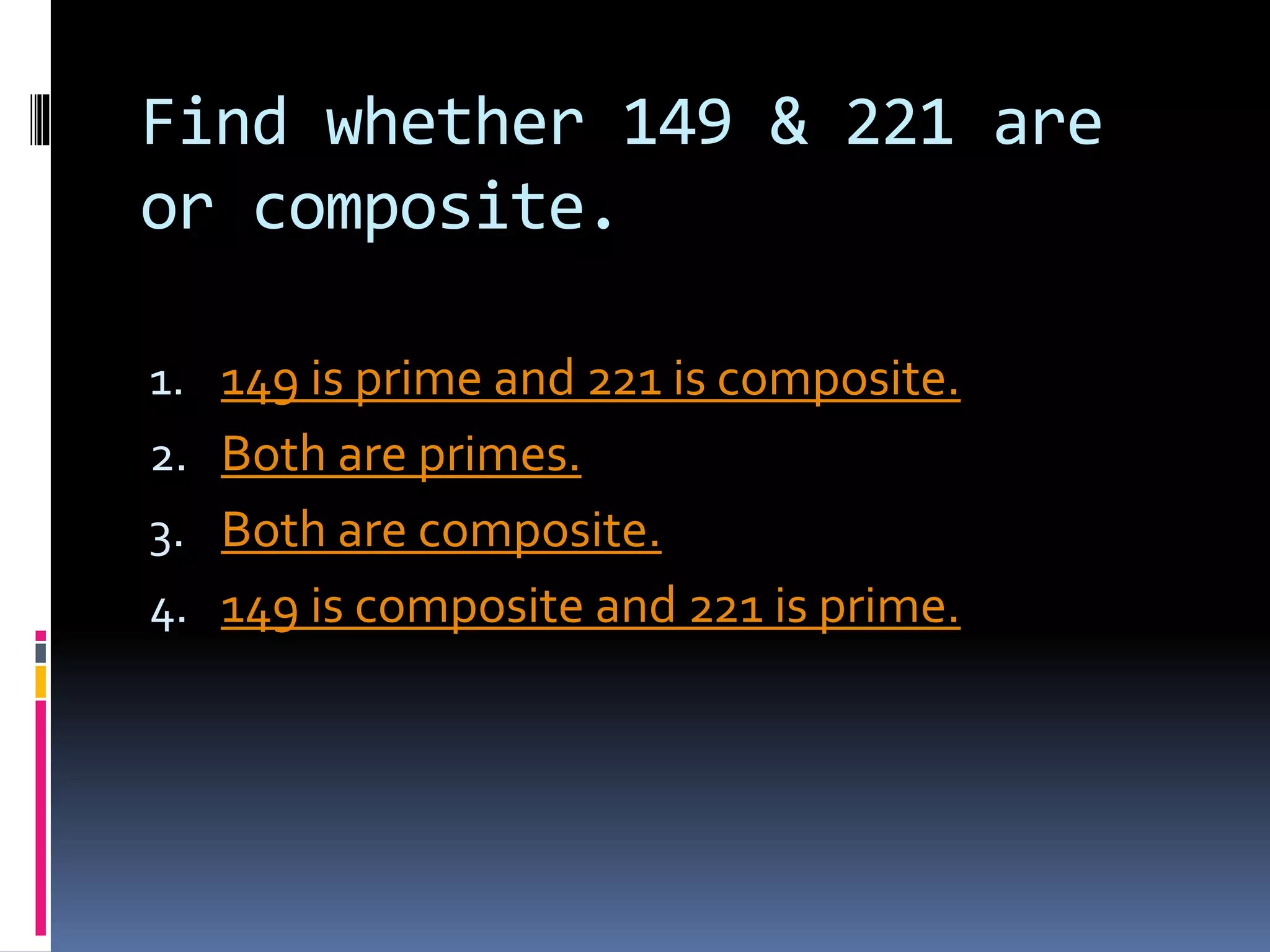
Find whether 149 & 221 are
or composite.
1. 149 is prime and 221 is composite.
2. Both are primes.
3. Both are composite.
4. 149 is composite and 221 is prime.
LAST SLIDE
GOTO QUESTION NO. 1
GOTO QUESTION NO. 2
GOTO QUESTION NO. 3
GOTO QUESTION NO. 4
LAST SLIDE
GOTO QUESTION NO. 1
GOTO QUESTION NO. 2
GOTO QUESTION NO. 3
GOTO QUESTION NO. 4
Fundamental theorem of arithmatic

Fundamental theorem of arithmatic