Prime numbers Composite numbers Neither prime nor composite How to know?
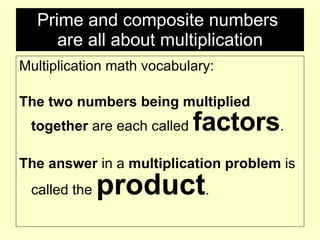
Prime and composite numbers  are all about multiplication Multiplication math vocabulary: The two numbers being multiplied together  are each called  factors . The answer  in a  multiplication problem  is called the  product .
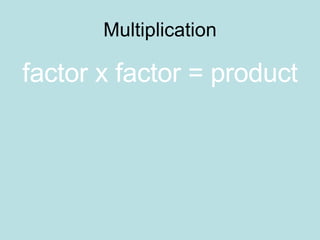
Multiplication factor x factor = product
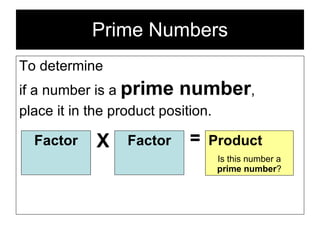
Prime Numbers To determine  if a number is a  prime number ,  place it in the product position. Product Is this number a  prime number ? Factor X Factor =
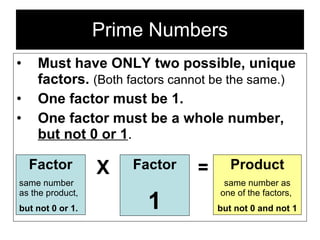
Prime Numbers Must have ONLY two possible, unique factors.  (Both factors cannot be the same.) One factor must be 1. One factor must be a whole number,  but not 0 or 1 . Factor same number as the product, but not 0 or 1. X Factor 1 = Product same number as one of the factors,  but not 0 and not 1
Whole numbers In case you forgot: Whole numbers  are the the number   0,  and the  natural numbers  which start at positive one— { 0, 1, 2, 3... }
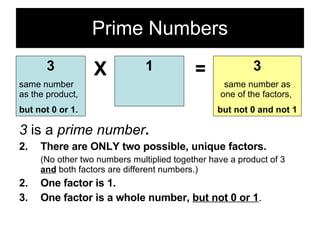
Prime Numbers 3  is a  prime number . There are ONLY two possible, unique factors. (No other two numbers multiplied together have a product of 3  and  both factors are different numbers.) 2. One factor is 1. 3. One factor is a whole number,  but not 0 or 1 . 3 same number as the product, but not 0 or 1. X 1 = 3 same number as one of the factors,  but not 0 and not 1
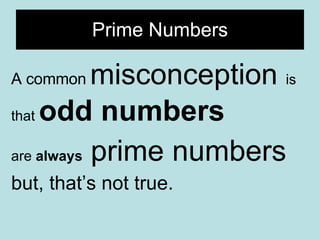
Prime Numbers A common   misconception  is  that  odd numbers   are  always  prime numbers but, that’s not true.
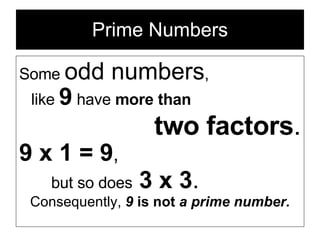
Prime Numbers Some  odd numbers ,  like  9  have  more than two factors . 9 x 1 = 9 ,   but so does   3 x 3 . Consequently,   9  is not  a prime number.
Prime Numbers 51 is tricky!   It is an odd number. It looks like only 51 x 1 = 51, but 17 x 3 = 51 too . 51   is not  a prime number . HINT :   Divisibility rules  and  multiplication tables  can help you discover that a number that seems like a prime number really isn’t.
Prime Numbers However ,  even numbers   are  never   prime numbers  with one exception—  the number 2 .
Prime Numbers 2   is a   prime number , because the  only two factors of  2   are  2  x  1  = 2.  Every other  even number  has 2 as a factor too (that’s why  no other even number  is a prime number).
Composite Numbers Numbers  with more than two factors  are called  composite numbers .   Numbers that aren’t prime numbers  are composite numbers.
The special case of the  number 1 The  number 1  is not   a  prime number and,  it is   not   a  composite number. Why ?  because, the  number 1   only  has  one factor ,  not   two different factors . 1  x  1  =  1
The special case of the number 0. Zero is another special number. Zero  can not  be a prime number because,  every number is a factor of 0 .  0 x 1 does equal 0,  but 0 x anything at all = 0 Zero  is not  a composite number either.
Only 0 and 1 are  neither prime  nor composite numbers. All other whole numbers are either  prime or composite numbers.
Congratulations! That’s how to tell a prime number from a composite number. Remember, if in doubt; with big numbers, use divisibility rules. With smaller products, use multiplication tables.  And all even numbers, except 2, are always composite.
Notes for teachers on texts correlation: Correlates with Glencoe Mathematics (Florida Edition) texts:  Mathematics: Applications and Concepts Course 1: (red book) Chapter 1 Lesson 3: Prime Factors Mathematics: Applications and Concepts Course 2: (blue book) Chapter 5 Lesson 1: Prime Factorization Pre-Algebra: (green book) Chapter 4 Lesson 3: Prime Factorization For more information on my math class see  http:// walsh.edublogs.org
Notes for teachers on design This slide presentation was created using Microsoft Office PowerPoint 2003 part of Microsoft Office Standard Version for Students and Teachers.  Finally, thank you. I hope this is of help to your students. Taleese

Prime Numbers

  • 1.
    Prime numbers Compositenumbers Neither prime nor composite How to know?
  • 2.
    Prime and compositenumbers are all about multiplication Multiplication math vocabulary: The two numbers being multiplied together are each called factors . The answer in a multiplication problem is called the product .
  • 3.
    Multiplication factor xfactor = product
  • 4.
    Prime Numbers Todetermine if a number is a prime number , place it in the product position. Product Is this number a prime number ? Factor X Factor =
  • 5.
    Prime Numbers Musthave ONLY two possible, unique factors. (Both factors cannot be the same.) One factor must be 1. One factor must be a whole number, but not 0 or 1 . Factor same number as the product, but not 0 or 1. X Factor 1 = Product same number as one of the factors, but not 0 and not 1
  • 6.
    Whole numbers Incase you forgot: Whole numbers are the the number 0, and the natural numbers which start at positive one— { 0, 1, 2, 3... }
  • 7.
    Prime Numbers 3 is a prime number . There are ONLY two possible, unique factors. (No other two numbers multiplied together have a product of 3 and both factors are different numbers.) 2. One factor is 1. 3. One factor is a whole number, but not 0 or 1 . 3 same number as the product, but not 0 or 1. X 1 = 3 same number as one of the factors, but not 0 and not 1
  • 8.
    Prime Numbers Acommon misconception is that odd numbers are always prime numbers but, that’s not true.
  • 9.
    Prime Numbers Some odd numbers , like 9 have more than two factors . 9 x 1 = 9 , but so does 3 x 3 . Consequently, 9 is not a prime number.
  • 10.
    Prime Numbers 51is tricky! It is an odd number. It looks like only 51 x 1 = 51, but 17 x 3 = 51 too . 51 is not a prime number . HINT : Divisibility rules and multiplication tables can help you discover that a number that seems like a prime number really isn’t.
  • 11.
    Prime Numbers However, even numbers are never prime numbers with one exception— the number 2 .
  • 12.
    Prime Numbers 2 is a prime number , because the only two factors of 2 are 2 x 1 = 2. Every other even number has 2 as a factor too (that’s why no other even number is a prime number).
  • 13.
    Composite Numbers Numbers with more than two factors are called composite numbers . Numbers that aren’t prime numbers are composite numbers.
  • 14.
    The special caseof the number 1 The number 1 is not a prime number and, it is not a composite number. Why ? because, the number 1 only has one factor , not two different factors . 1 x 1 = 1
  • 15.
    The special caseof the number 0. Zero is another special number. Zero can not be a prime number because, every number is a factor of 0 . 0 x 1 does equal 0, but 0 x anything at all = 0 Zero is not a composite number either.
  • 16.
    Only 0 and1 are neither prime nor composite numbers. All other whole numbers are either prime or composite numbers.
  • 17.
    Congratulations! That’s howto tell a prime number from a composite number. Remember, if in doubt; with big numbers, use divisibility rules. With smaller products, use multiplication tables. And all even numbers, except 2, are always composite.
  • 18.
    Notes for teacherson texts correlation: Correlates with Glencoe Mathematics (Florida Edition) texts: Mathematics: Applications and Concepts Course 1: (red book) Chapter 1 Lesson 3: Prime Factors Mathematics: Applications and Concepts Course 2: (blue book) Chapter 5 Lesson 1: Prime Factorization Pre-Algebra: (green book) Chapter 4 Lesson 3: Prime Factorization For more information on my math class see http:// walsh.edublogs.org
  • 19.
    Notes for teacherson design This slide presentation was created using Microsoft Office PowerPoint 2003 part of Microsoft Office Standard Version for Students and Teachers. Finally, thank you. I hope this is of help to your students. Taleese