4:-
Chapter 4:-
Number Theory


 By:- Sarthak Patel (www.sarthakpatel.in)
Outline
       Prime And Relative Prime Numbers
       Modular Arithmetic,
       Euler’s Theorem
       Euclid’s Algorithm
       Discrete Logarithm Tics


2   Sarthak Patel (www.sarthakpatel.in)
Prime Numbers
       An integer p > 1 is a prime number if and only if its only
       divisors are ± 1 and ±p. Prime numbers play a critical role in
       number theory and in the techniques like RSA, Deffie-
       Hellman key exchange.


3   Sarthak Patel (www.sarthakpatel.in)
Contd…
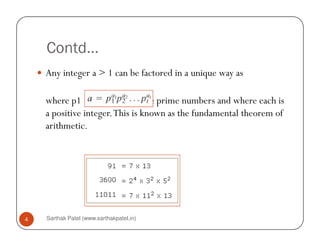
    Any integer a > 1 can be factored in a unique way as

    where p1 < p2 < ... < pt are prime numbers and where each is
    a positive integer. This is known as the fundamental theorem of
    arithmetic.


4   Sarthak Patel (www.sarthakpatel.in)
Contd...
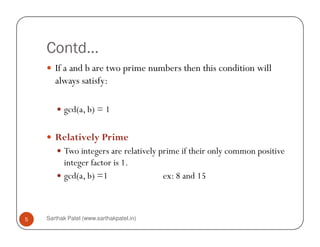
       If a and b are two prime numbers then this condition will
       always satisfy:

          gcd(a, b) = 1

       Relatively Prime
          Two integers are relatively prime if their only common positive
          integer factor is 1.
          gcd(a, b) =1                 ex: 8 and 15


5   Sarthak Patel (www.sarthakpatel.in)
Divisibility & The Division Algorithm
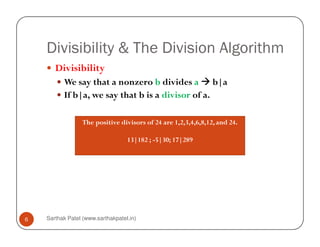
       Divisibility
          We say that a nonzero b divides a b|a
          If b|a, we say that b is a divisor of a.

                  The positive divisors of 24 are 1,2,3,4,6,8,12, and 24.

                                   13|182 ; -5|30; 17|289


6   Sarthak Patel (www.sarthakpatel.in)
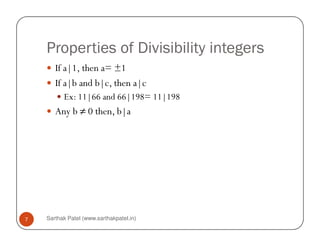
Properties of Divisibility integers
       If a|1, then a= ±1
       If a|b and b|c, then a|c
          Ex: 11|66 and 66|198= 11|198
       Any b ≠ 0 then, b|a


7   Sarthak Patel (www.sarthakpatel.in)
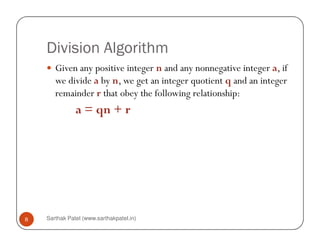
Division Algorithm
       Given any positive integer n and any nonnegative integer a, if
       we divide a by n, we get an integer quotient q and an integer
       remainder r that obey the following relationship:
               a = qn + r


8   Sarthak Patel (www.sarthakpatel.in)
Modular Arithmetic
      Modular arithmetic properties:
    1. [(a mod n) + (b mod n)] mod n = (a+b) mod n
    2. [(a mod n) - (b mod n)] mod n = (a-b) mod n
    3. [(a mod n) × (b mod n)] mod n = (a×b) mod n

             11 mod 8 = 3; 15 mod 8 = 7
             [(11 mod 8) + (15 mod 8)] mod 8 = 10 mod 8 = 2
             (11 + 15) mod 8 = 26 mod 8 = 2
             [(11 mod 8) - (15 mod 8)] mod 8 = - 4 mod 8 = - 4
             (11 -15) mod 8 = - 4 mod 8 = - 4
             [(11 mod 8) x (15 mod 8)] mod 8 = 21 mod 8 = 5
             (11 x 15) mod 8 = 165 mod 8 = 5


9   Sarthak Patel (www.sarthakpatel.in)
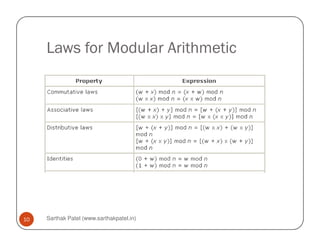
Laws for Modular Arithmetic


10   Sarthak Patel (www.sarthakpatel.in)
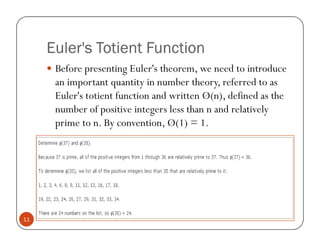
Euler's Totient Function
        Before presenting Euler's theorem, we need to introduce
        an important quantity in number theory, referred to as
        Euler's totient function and written Ø(n), defined as the
        number of positive integers less than n and relatively
        prime to n. By convention, Ø(1) = 1.


11   Sarthak Patel (www.sarthakpatel.in)
Euler's Theorem
       Euler’s play important roles in public-key cryptography .

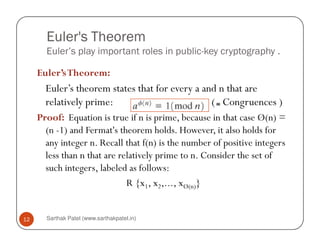
     Euler’s Theorem:
       Euler’s theorem states that for every a and n that are
       relatively prime:                         ( Congruences )
     Proof: Equation is true if n is prime, because in that case Ø(n) =
       (n -1) and Fermat's theorem holds. However, it also holds for
       any integer n. Recall that f(n) is the number of positive integers
       less than n that are relatively prime to n. Consider the set of
       such integers, labeled as follows:
                              R {x1, x2,..., xØ(n)}


12     Sarthak Patel (www.sarthakpatel.in)
Contd...
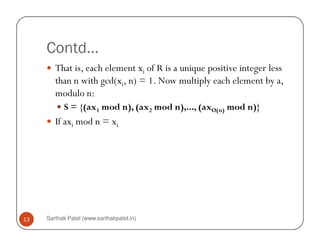
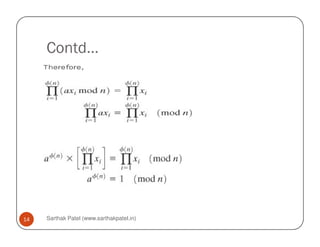
        That is, each element xi of R is a unique positive integer less
        than n with gcd(xi, n) = 1. Now multiply each element by a,
        modulo n:
           S = {(ax1 mod n), (ax2 mod n),..., (axØ(n) mod n)}
        If axi mod n = xi


13   Sarthak Patel (www.sarthakpatel.in)
Contd…


14   Sarthak Patel (www.sarthakpatel.in)
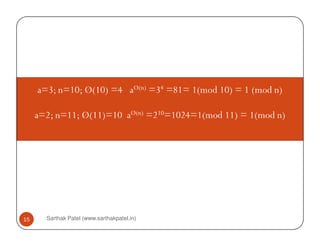
a=3; n=10; Ø(10) =4 aØ(n) =34 =81= 1(mod 10) = 1 (mod n)

     a=2; n=11; Ø(11)=10 aØ(n) =210=1024=1(mod 11) = 1(mod n)


15     Sarthak Patel (www.sarthakpatel.in)
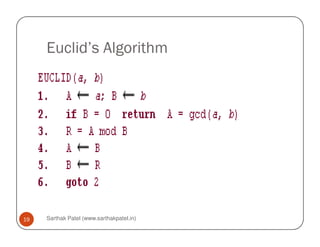
The Euclid’s Algorithm
        One of the basic techniques of number theory is the
        Euclidean algorithm, which is a simple procedure for
        determining the greatest common divisor of two positive
        integers.


16   Sarthak Patel (www.sarthakpatel.in)
Contd…
     We will use the notation gcd(a, b) to mean the greatest
     common divisor of a and b. The positive integer c is said
     to be the greatest common divisor of a and b if
     1.    c is a divisor of a and of b;
     2.    any divisor of a and b is a divisor of c.
     An equivalent definition is the following:
     gcd(a, b) = max[k, such that k|a and k|b]


                         gcd(60, 24) = gcd(60, 24) = 12

17   Sarthak Patel (www.sarthakpatel.in)
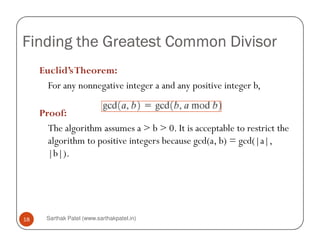
Finding the Greatest Common Divisor
     Euclid’s Theorem:
       For any nonnegative integer a and any positive integer b,

     Proof:
       The algorithm assumes a > b > 0. It is acceptable to restrict the
       algorithm to positive integers because gcd(a, b) = gcd(|a|,
       |b|).


18    Sarthak Patel (www.sarthakpatel.in)
Euclid’s Algorithm


19   Sarthak Patel (www.sarthakpatel.in)
Discrete Logarithm Tics
        Discrete logarithms are fundamental to a number of public-
        key algorithms, including Diffie-Hellman key exchange and
        the digital signature algorithm (DSA).
        Logarithms for Modular Arithmetic
        Calculation of Discrete Logarithms


20   Sarthak Patel (www.sarthakpatel.in)
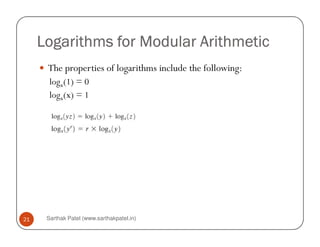
Logarithms for Modular Arithmetic
      The properties of logarithms include the following:
       logx(1) = 0
       logx(x) = 1


21    Sarthak Patel (www.sarthakpatel.in)
Contd…

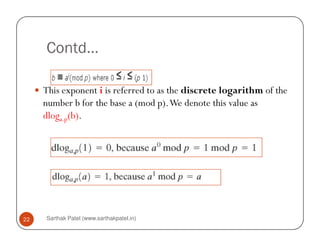
     This exponent i is referred to as the discrete logarithm of the
     number b for the base a (mod p). We denote this value as
     dloga.p(b).


22   Sarthak Patel (www.sarthakpatel.in)
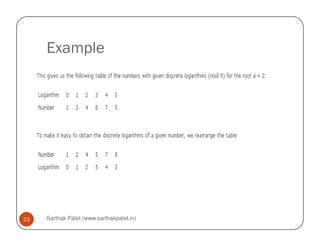
Example


23   Sarthak Patel (www.sarthakpatel.in)
Calculation of Discrete Logarithms

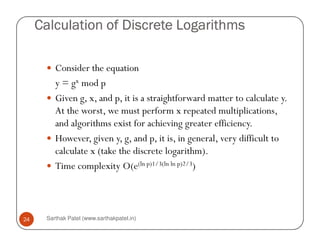
         Consider the equation
         y = gx mod p
         Given g, x, and p, it is a straightforward matter to calculate y.
         At the worst, we must perform x repeated multiplications,
         and algorithms exist for achieving greater efficiency.
         However, given y, g, and p, it is, in general, very difficult to
         calculate x (take the discrete logarithm).
         Time complexity O(e(ln p)1/3(ln ln p)2/3)


24    Sarthak Patel (www.sarthakpatel.in)
THE END
25   Sarthak Patel (www.sarthakpatel.in)

Is unit 4_number_theory

  • 1.
    4:- Chapter 4:- Number Theory By:- Sarthak Patel (www.sarthakpatel.in)
  • 2.
    Outline Prime And Relative Prime Numbers Modular Arithmetic, Euler’s Theorem Euclid’s Algorithm Discrete Logarithm Tics 2 Sarthak Patel (www.sarthakpatel.in)
  • 3.
    Prime Numbers An integer p > 1 is a prime number if and only if its only divisors are ± 1 and ±p. Prime numbers play a critical role in number theory and in the techniques like RSA, Deffie- Hellman key exchange. 3 Sarthak Patel (www.sarthakpatel.in)
  • 4.
    Contd… Any integer a > 1 can be factored in a unique way as where p1 < p2 < ... < pt are prime numbers and where each is a positive integer. This is known as the fundamental theorem of arithmetic. 4 Sarthak Patel (www.sarthakpatel.in)
  • 5.
    Contd... If a and b are two prime numbers then this condition will always satisfy: gcd(a, b) = 1 Relatively Prime Two integers are relatively prime if their only common positive integer factor is 1. gcd(a, b) =1 ex: 8 and 15 5 Sarthak Patel (www.sarthakpatel.in)
  • 6.
    Divisibility & TheDivision Algorithm Divisibility We say that a nonzero b divides a b|a If b|a, we say that b is a divisor of a. The positive divisors of 24 are 1,2,3,4,6,8,12, and 24. 13|182 ; -5|30; 17|289 6 Sarthak Patel (www.sarthakpatel.in)
  • 7.
    Properties of Divisibilityintegers If a|1, then a= ±1 If a|b and b|c, then a|c Ex: 11|66 and 66|198= 11|198 Any b ≠ 0 then, b|a 7 Sarthak Patel (www.sarthakpatel.in)
  • 8.
    Division Algorithm Given any positive integer n and any nonnegative integer a, if we divide a by n, we get an integer quotient q and an integer remainder r that obey the following relationship: a = qn + r 8 Sarthak Patel (www.sarthakpatel.in)
  • 9.
    Modular Arithmetic Modular arithmetic properties: 1. [(a mod n) + (b mod n)] mod n = (a+b) mod n 2. [(a mod n) - (b mod n)] mod n = (a-b) mod n 3. [(a mod n) × (b mod n)] mod n = (a×b) mod n 11 mod 8 = 3; 15 mod 8 = 7 [(11 mod 8) + (15 mod 8)] mod 8 = 10 mod 8 = 2 (11 + 15) mod 8 = 26 mod 8 = 2 [(11 mod 8) - (15 mod 8)] mod 8 = - 4 mod 8 = - 4 (11 -15) mod 8 = - 4 mod 8 = - 4 [(11 mod 8) x (15 mod 8)] mod 8 = 21 mod 8 = 5 (11 x 15) mod 8 = 165 mod 8 = 5 9 Sarthak Patel (www.sarthakpatel.in)
  • 10.
    Laws for ModularArithmetic 10 Sarthak Patel (www.sarthakpatel.in)
  • 11.
    Euler's Totient Function Before presenting Euler's theorem, we need to introduce an important quantity in number theory, referred to as Euler's totient function and written Ø(n), defined as the number of positive integers less than n and relatively prime to n. By convention, Ø(1) = 1. 11 Sarthak Patel (www.sarthakpatel.in)
  • 12.
    Euler's Theorem Euler’s play important roles in public-key cryptography . Euler’s Theorem: Euler’s theorem states that for every a and n that are relatively prime: ( Congruences ) Proof: Equation is true if n is prime, because in that case Ø(n) = (n -1) and Fermat's theorem holds. However, it also holds for any integer n. Recall that f(n) is the number of positive integers less than n that are relatively prime to n. Consider the set of such integers, labeled as follows: R {x1, x2,..., xØ(n)} 12 Sarthak Patel (www.sarthakpatel.in)
  • 13.
    Contd... That is, each element xi of R is a unique positive integer less than n with gcd(xi, n) = 1. Now multiply each element by a, modulo n: S = {(ax1 mod n), (ax2 mod n),..., (axØ(n) mod n)} If axi mod n = xi 13 Sarthak Patel (www.sarthakpatel.in)
  • 14.
    Contd… 14 Sarthak Patel (www.sarthakpatel.in)
  • 15.
    a=3; n=10; Ø(10)=4 aØ(n) =34 =81= 1(mod 10) = 1 (mod n) a=2; n=11; Ø(11)=10 aØ(n) =210=1024=1(mod 11) = 1(mod n) 15 Sarthak Patel (www.sarthakpatel.in)
  • 16.
    The Euclid’s Algorithm One of the basic techniques of number theory is the Euclidean algorithm, which is a simple procedure for determining the greatest common divisor of two positive integers. 16 Sarthak Patel (www.sarthakpatel.in)
  • 17.
    Contd… We will use the notation gcd(a, b) to mean the greatest common divisor of a and b. The positive integer c is said to be the greatest common divisor of a and b if 1. c is a divisor of a and of b; 2. any divisor of a and b is a divisor of c. An equivalent definition is the following: gcd(a, b) = max[k, such that k|a and k|b] gcd(60, 24) = gcd(60, 24) = 12 17 Sarthak Patel (www.sarthakpatel.in)
  • 18.
    Finding the GreatestCommon Divisor Euclid’s Theorem: For any nonnegative integer a and any positive integer b, Proof: The algorithm assumes a > b > 0. It is acceptable to restrict the algorithm to positive integers because gcd(a, b) = gcd(|a|, |b|). 18 Sarthak Patel (www.sarthakpatel.in)
  • 19.
    Euclid’s Algorithm 19 Sarthak Patel (www.sarthakpatel.in)
  • 20.
    Discrete Logarithm Tics Discrete logarithms are fundamental to a number of public- key algorithms, including Diffie-Hellman key exchange and the digital signature algorithm (DSA). Logarithms for Modular Arithmetic Calculation of Discrete Logarithms 20 Sarthak Patel (www.sarthakpatel.in)
  • 21.
    Logarithms for ModularArithmetic The properties of logarithms include the following: logx(1) = 0 logx(x) = 1 21 Sarthak Patel (www.sarthakpatel.in)
  • 22.
    Contd… This exponent i is referred to as the discrete logarithm of the number b for the base a (mod p). We denote this value as dloga.p(b). 22 Sarthak Patel (www.sarthakpatel.in)
  • 23.
    Example 23 Sarthak Patel (www.sarthakpatel.in)
  • 24.
    Calculation of DiscreteLogarithms Consider the equation y = gx mod p Given g, x, and p, it is a straightforward matter to calculate y. At the worst, we must perform x repeated multiplications, and algorithms exist for achieving greater efficiency. However, given y, g, and p, it is, in general, very difficult to calculate x (take the discrete logarithm). Time complexity O(e(ln p)1/3(ln ln p)2/3) 24 Sarthak Patel (www.sarthakpatel.in)
  • 25.
    THE END 25 Sarthak Patel (www.sarthakpatel.in)