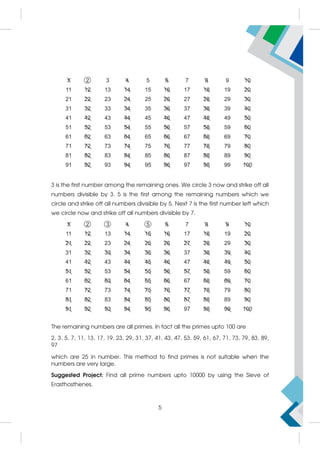
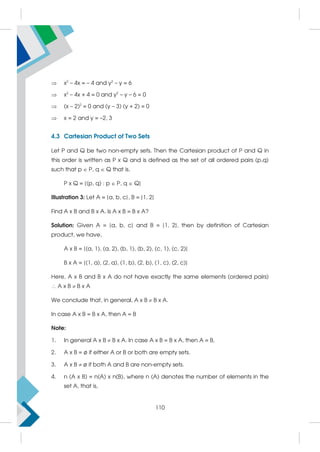
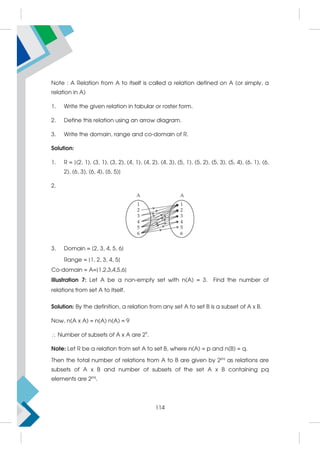
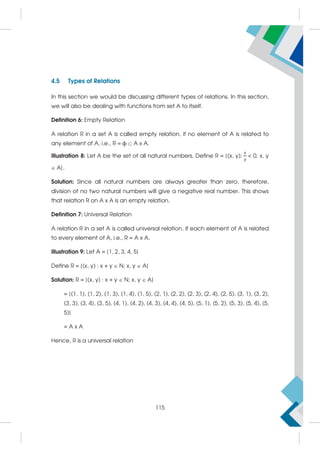
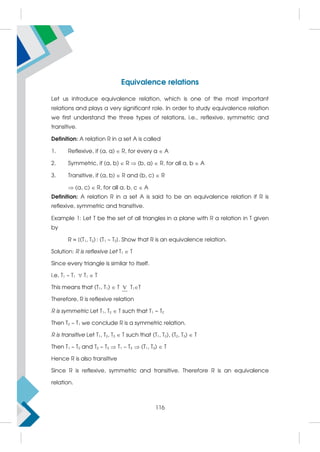
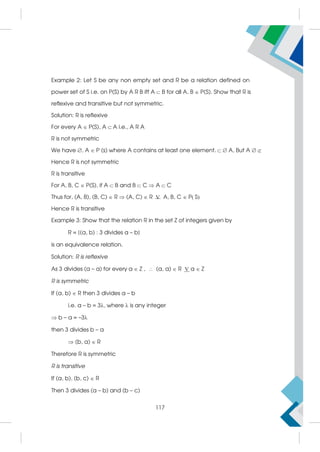
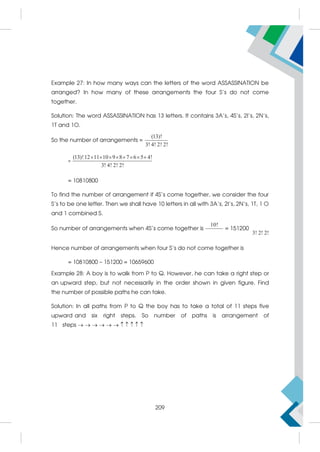
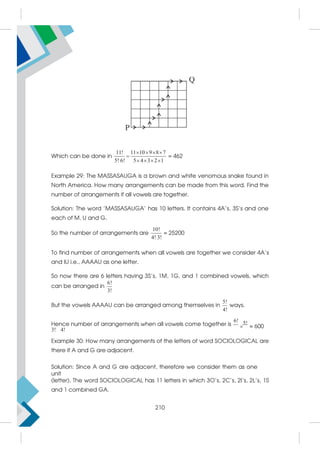
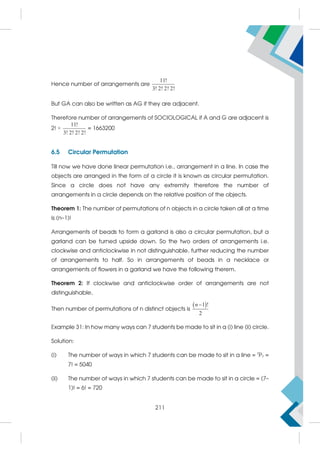
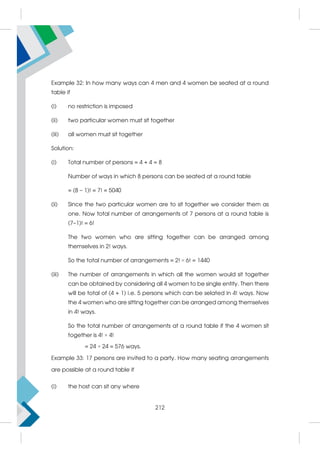
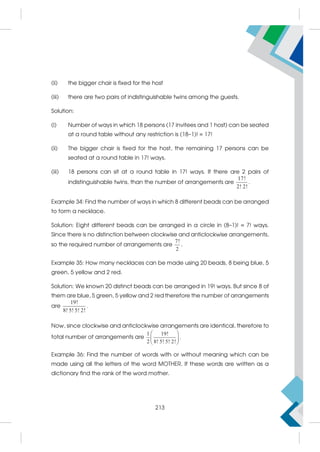
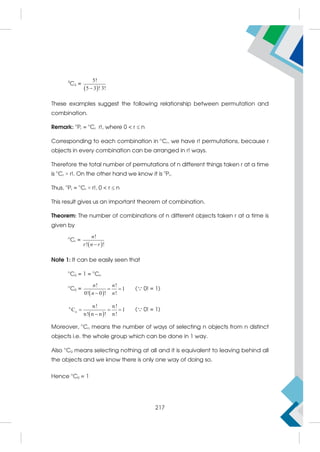
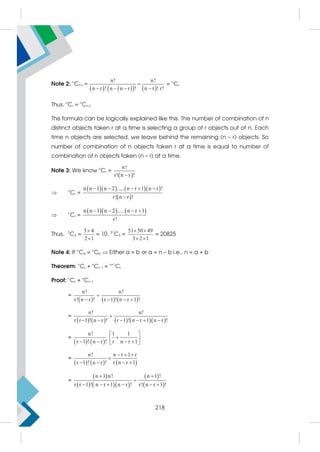
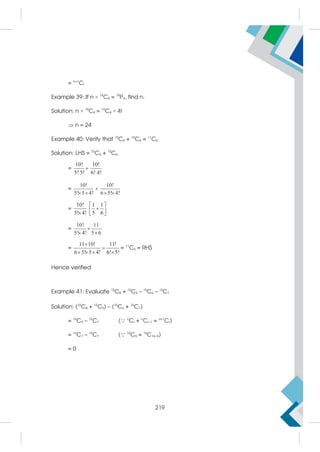
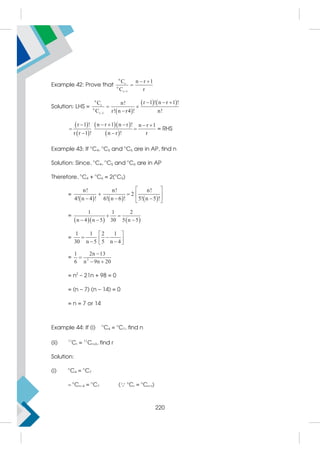
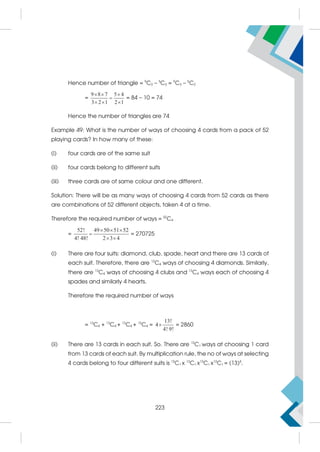
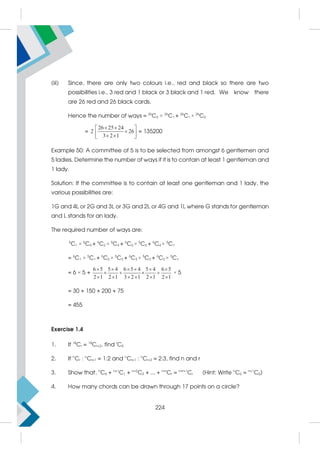
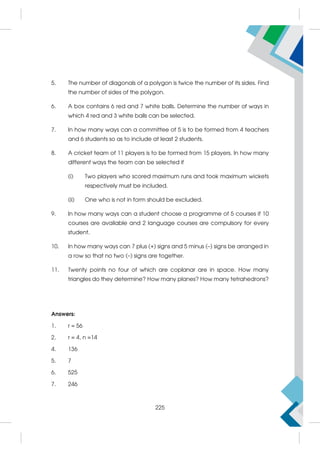
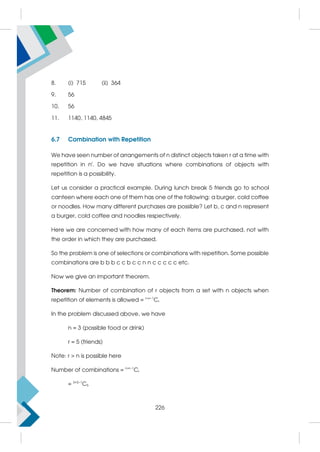
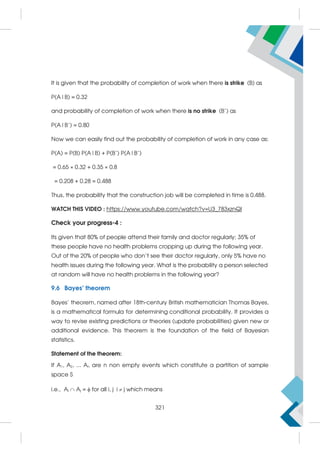
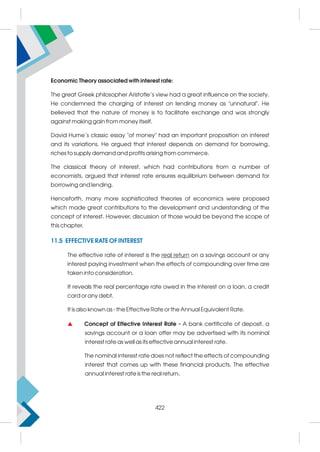
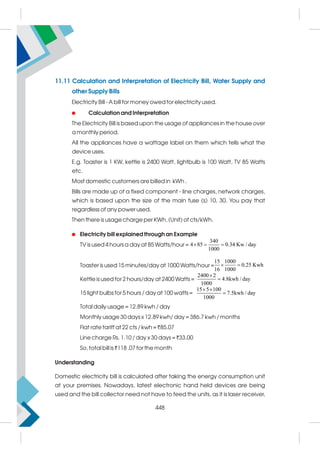
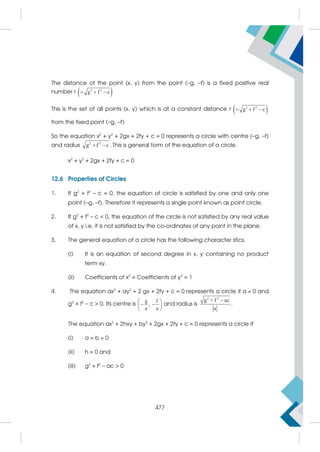
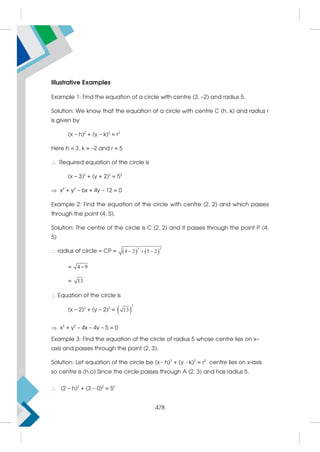
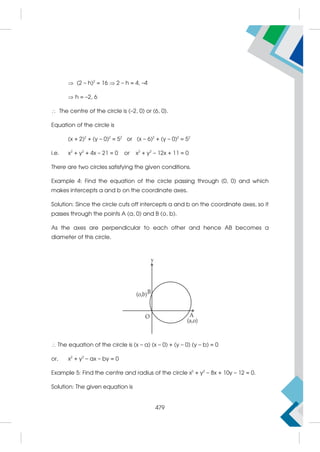
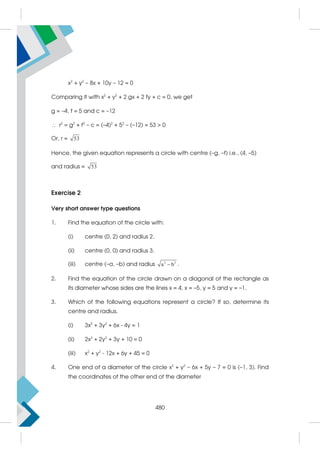
Sh. Pramod Kumar T.K.
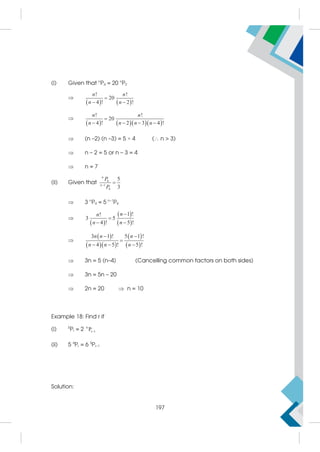
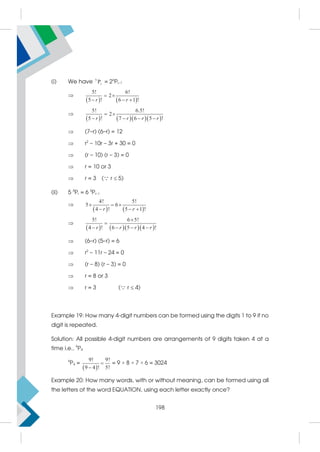
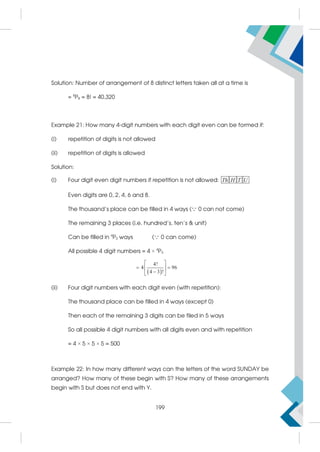
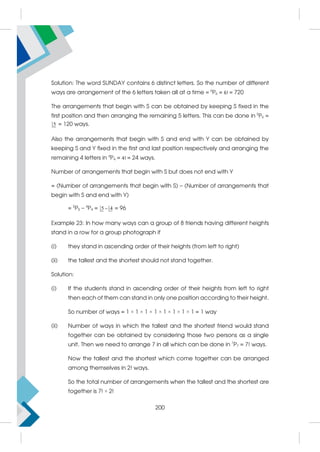
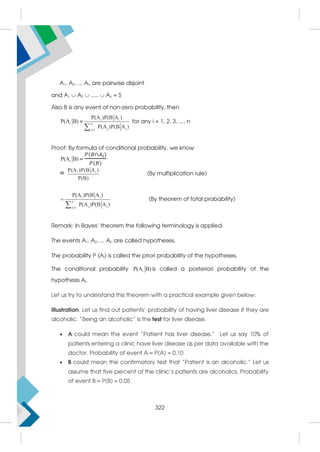
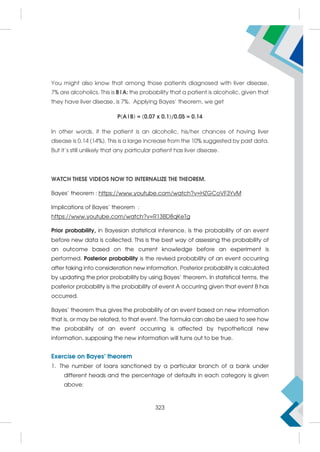
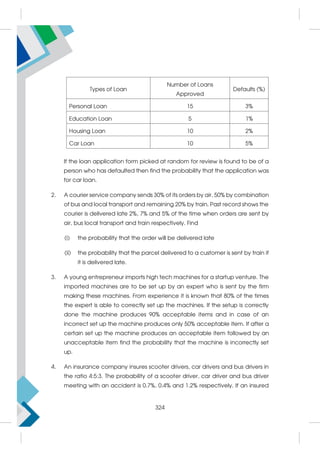
(15th April 1971 to 25th May 2021)
Joint Secretary (Academics)
Central Board of Secondary Education
You will always be in our memories...
Dedicated to:
1
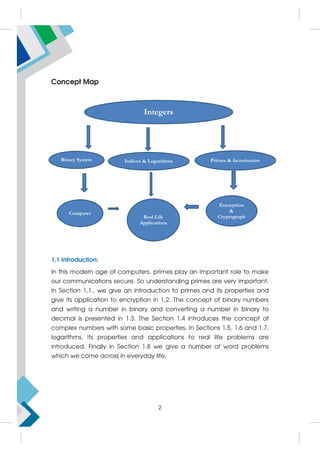
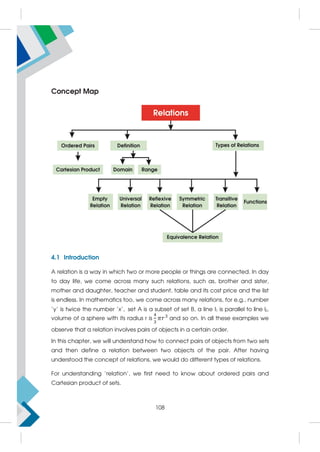
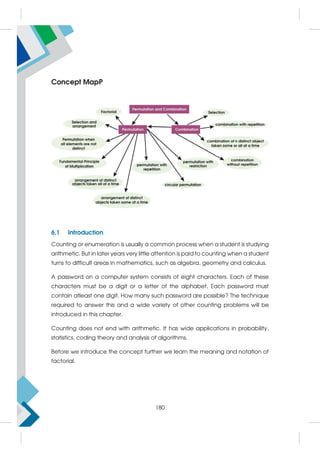
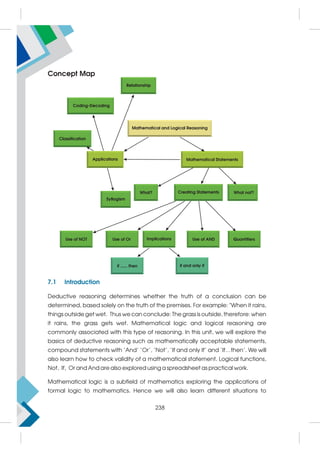
Concept Map
1.1 Introduction:
In this modern age of computers, primes play an important role to make
our communications secure. So understanding primes are very important.
In Section 1.1., we give an introduction to primes and its properties and
give its application to encryption in 1.2. The concept of binary numbers
and writing a number in binary and converting a number in binary to
decimal is presented in 1.3. The Section 1.4 introduces the concept of
complex numbers with some basic properties. In Sections 1.5, 1.6 and 1.7.
logarithms, its properties and applications to real life problems are
introduced. Finally in Section 1.8 we give a number of word problems
which we come across in everyday life.
Integers
Binary System Primes & factorisation
Computer
Encryption
&
Cryptograph
Indices & Logarithms
Real Life
Applications
2
1.2 Prime Numbers
We say integer a divides b, and write a|b in symbols, if b = ac with c ∈ Z. For
example 9|27. If a|b, we say a is a factor or a is divisor of b. And we also say b
is a multiple of a. It is easy to see that 1 and –1 are divisors of any integer and
every non-zero integer is a divisor of 0. We write a|b if a does not divide b. For
example 5|13.
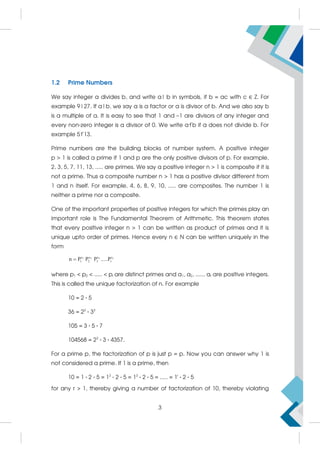
Prime numbers are the building blocks of number system. A positive integer
p > 1 is called a prime if 1 and p are the only positive divisors of p. For example,
2, 3, 5, 7, 11, 13, ..... are primes. We say a positive integer n > 1 is composite if it is
not a prime. Thus a composite number n > 1 has a positive divisor different from
1 and n itself. For example, 4, 6, 8, 9, 10, ..... are composites. The number 1 is
neither a prime nor a composite.
One of the important properties of positive integers for which the primes play an
important role is The Fundamental Theorem of Arithmetic. This theorem states
that every positive integer n > 1 can be written as product of primes and it is
unique upto order of primes. Hence every n ∈ N can be written uniquely in the
form
3
1 2 r
a
a a a
1 2 3 r
n P P P .....P

where p1 < p2 < ..... < pr are distinct primes and a1, a2, ....., ar are positive integers.
This is called the unique factorization of n. For example
10 = 2 · 5
36 = 22
· 32
105 = 3 · 5 · 7
104568 = 23
· 3 · 4357.
For a prime p, the factorization of p is just p = p. Now you can answer why 1 is
not considered a prime. If 1 is a prime, then
10 = 1 · 2 · 5 = 12
· 2 · 5 = 13
· 2 · 5 = ..... = 1r
· 2 · 5
for any r > 1, thereby giving a number of factorization of 10, thereby violating
3
the Fundamental Theorem of Arithmetic. Also 1 cannot be a considered a
composite number. (Why?)
A consequence of the Fundamental Theorem of Arithmetic is that every n > 1
has a prime divisor p. Clearly n itself is the unique prime divisor p if n is a prime
and 1 < p < n if n is composite. This consequence implies one of the first theorem
in Mathematics, which is well-known as Euclid’s Theorem.
Theorem 1.1.1. Euclid’s Theorem: There are infinitely many prime numbers.
Proof. Suppose there are finitely many prime numbers, viz., p1, p2, ...... , pr.
Consider the number.
N = p1p2 ..... pr + 1
Clearly N > 1. Hence by the Fundamental Theorem of Arithmetic, it has prime
divisor p. Then p = pi for some 1 ≤ i ≤ r. However none of the primes pi|N for each
1 ≤ i ≤ r.
Also N z pi for any i. This is a contradiction which proves that there are infinitely
many primes.
Though Euclid’s Theorem tells us that there are infinitely many primes, finding
large numbers is a challenge. In fact the largest known prime number as of
today is the 24862048 digit prime
282589933
– 1
which was discovered in 2018. This is a special kind of primes called Mersenne
Primes.
One of the ways to check whether a given number is a prime is the well-known
Sieve of Erasthosthenes. This works on the principle that n > 1 is composite if has
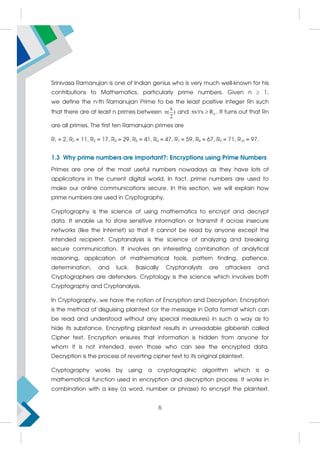
a prime divisor p ≤ n. We illustrate this Sieve and find all primes upto 100. We list
all positive integers upto 100. A numbers 1  n ≤ 100 is a composite if n has a
prime divisor ≤ n = 100 = 10.
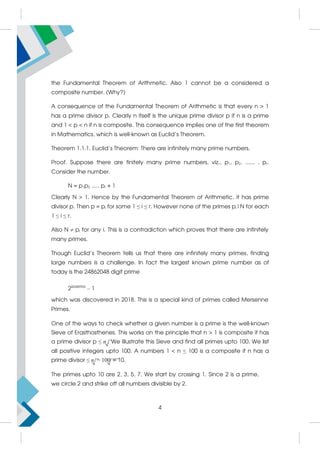
The primes upto 10 are 2, 3, 5, 7. We start by crossing 1. Since 2 is a prime,
we circle 2 and strike off all numbers divisible by 2.
4
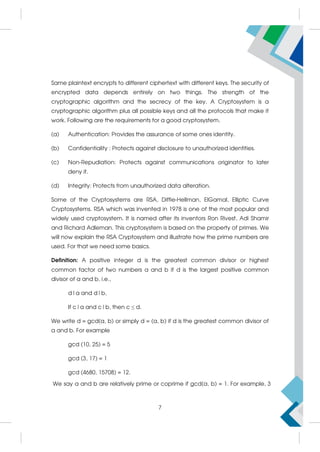
3 is the first number among the remaining ones. We circle 3 now and strike off all
numbers divisible by 3. 5 is the first among the remaining numbers which we
circle and strike off all numbers divisible by 5. Next 7 is the first number left which
we circle now and strike off all numbers divisible by 7.
The remaining numbers are all primes. In fact all the primes upto 100 are
2, 3, 5, 7, 11, 13, 17, 19, 23, 29, 31, 37, 41, 43, 47, 53, 59, 61, 67, 71, 73, 79, 83, 89,
97
which are 25 in number. This method to find primes is not suitable when the
numbers are very large.
Suggested Project: Find all prime numbers upto 10000 by using the Sieve of
Erasthosthenes.
5
Srinivasa Ramanujan is one of Indian genius who is very much well-known for his
contributions to Mathematics, particularly prime numbers. Given n  1,
we define the n-th Ramanujan Prime to be the least positive integer Rn such
that there are at least n primes between
x
( )
2
 and n
x x R
   . It turns out that Rn
are all primes. The first ten Ramanujan primes are
R1 = 2, R2 = 11, R3 = 17, R4 = 29, R5 = 41, R6 = 47, R7 = 59, R8 = 67, R9 = 71, R10 = 97.
1.3 Why prime numbers are important?: Encryptions using Prime Numbers
Primes are one of the most useful numbers nowadays as they have lots of
applications in the current digital world. In fact, prime numbers are used to
make our online communications secure. In this section, we will explain how
prime numbers are used in Cryptography.
Cryptography is the science of using mathematics to encrypt and decrypt
data. It enable us to store sensitive information or transmit it across insecure
networks (like the Internet) so that it cannot be read by anyone except the
intended recipient. Cryptanalysis is the science of analyzing and breaking
secure communication. It involves an interesting combination of analytical
reasoning, application of mathematical tools, pattern finding, patience,
determination, and luck. Basically Cryptanalysts are attackers and
Cryptographers are defenders. Cryptology is the science which involves both
Cryptography and Cryptanalysis.
In Cryptography, we have the notion of Encryption and Decryption. Encryption
is the method of disguising plaintext (or the message in Data format which can
be read and understood without any special measures) in such a way as to
hide its substance. Encrypting plaintext results in unreadable gibberish called
Cipher text. Encryption ensures that information is hidden from anyone for
whom it is not intended, even those who can see the encrypted data.
Decryption is the process of reverting cipher text to its original plaintext.
Cryptography works by using a cryptographic algorithm which is a
mathematical function used in encryption and decryption process. It works in
combination with a key (a word, number or phrase) to encrypt the plaintext.
6
Same plaintext encrypts to different ciphertext with different keys. The security of
encrypted data depends entirely on two things. The strength of the
cryptographic algorithm and the secrecy of the key. A Cryptosystem is a
cryptographic algorithm plus all possible keys and all the protocols that make it
work. Following are the requirements for a good cryptosystem.
(a) Authentication: Provides the assurance of some ones identity.
(b) Confidentiality : Protects against disclosure to unauthorized identities.
(c) Non-Repudiation: Protects against communications originator to later
deny it.
(d) Integrity: Protects from unauthorized data alteration.
Some of the Cryptosystems are RSA, Diffie-Hellman, ElGamal, Elliptic Curve
Cryptosystems. RSA which was invented in 1978 is one of the most popular and
widely used cryptosystem. It is named after its inventors Ron Rivest, Adi Shamir
and Richard Adleman. This cryptosystem is based on the property of primes. We
will now explain the RSA Cryptosystem and illustrate how the prime numbers are
used. For that we need some basics.
Definition: A positive integer d is the greatest common divisor or highest
common factor of two numbers a and b if d is the largest positive common
divisor of a and b, i.e.,
d|a and d|b,
If c|a and c|b, then c ≤ d.
We write d = gcd(a, b) or simply d = (a, b) if d is the greatest common divisor of
a and b. For example
gcd (10, 25) = 5
gcd (3, 17) = 1
gcd (4680, 15708) = 12.
We say a and b are relatively prime or coprime if gcd(a, b) = 1. For example, 3
7
and 17 are relatively prime. Note that gcd(a, b) = gcd(b, a). If a|b. then gcd(a,
b) = a.
One of the ways to find gcd(a, b) is to compute the unique factorization of a
and b. If we know the factorizations
1 2 r
1 2 r
a a a
1 2 r
b b b
1 2 r
a P P .....P and
b P P .....P


then
d = gcd (a, b) = p1
min(a1, b1)
p2
min(a2, b2)
...... pr
min(ar, br )
For example, let a = 4680 and b = 15708. Then
a = 4680 = 23
· 32
· 5 · 13 = 23
· 32
· 51
· ·70
· 110
· 131
· 170
b = 15708 = 22
· 3 · 7 · 11 · 17 = 22
· 31
· 50
· 71
· 111
· 130
· 171
so that
gcd (4680, 15708) = 2min(2, 3)
· 3min(2, 1)
· 5min(1, 0)
· 7min(0, 1)
· 11min(0, 1)
· 13min(1, 0)
· 17min(0, 1)
= 22
· 31
= 12.
For large numbers, finding factorization is not easy. For that we use Euclid’s GCD
Algorithm.
Given positive integers a  0 and b, there exist unique quotient q and remainder
r with
b = aq + r, 0 ≤ r  |b|.
Note that r = 0 if and only if b|a. Also q = r = 0 when b = 0 and we have 0 = a . 0
+ 0. We use the following fact.
gcd (a, b) = gcd (a, b − aq) for any q
Now we define Euclid’s GCD Algorithm and also illustrate with an example. Let
b  a and a|b. Then
8
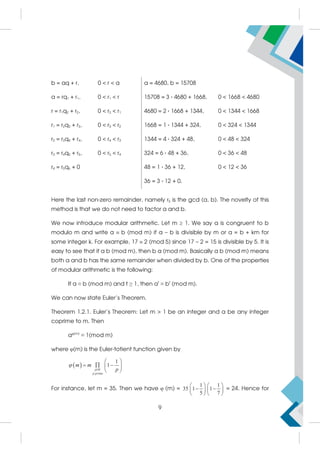
b = aq + r, 0  r  a a = 4680, b = 15708
a = rq1 + r1, 0  r1  r 15708 = 3 · 4680 + 1668, 0  1668  4680
r = r1q2 + r2, 0  r2  r1 4680 = 2 · 1668 + 1344, 0  1344  1668
r1 = r2q3 + r3, 0  r3  r2 1668 = 1 · 1344 + 324, 0  324  1344
r2 = r3q4 + r4, 0  r4  r3 1344 = 4 · 324 + 48, 0  48  324
r3 = r4q5 + r5, 0  r5  r4 324 = 6 · 48 + 36, 0  36  48
r4 = r5q6 + 0 48 = 1 · 36 + 12, 0  12  36
36 = 3 · 12 + 0.
Here the last non-zero remainder, namely r5 is the gcd (a, b). The novelty of this
method is that we do not need to factor a and b.
We now introduce modular arithmetic. Let m  1. We say a is congruent to b
modulo m and write a  b (mod m) if a – b is divisible by m or a = b + km for
some integer k. For example, 17  2 (mod 5) since 17 – 2 = 15 is divisible by 5. It is
easy to see that if a b (mod m), then b a (mod m). Basically a b (mod m) means
both a and b has the same remainder when divided by b. One of the properties
of modular arithmetic is the following:
If a ≡ b (mod m) and t ≥ 1, then at
≡ bt
(mod m).
We can now state Euler’s Theorem.
Theorem 1.2.1. Euler’s Theorem: Let m  1 be an integer and a be any integer
coprime to m. Then
aφ(m)
≡ 1(mod m)
where φ(m) is the Euler-totient function given by
  |
1
1
p M
p prime
m m
p

 
  
 
 
For instance, let m = 35. Then we have φ (m) =
1 1
35 1 1
5 7
   
 
   
   
= 24. Hence for
9
any a coprime to 35, we have a24
 1 (mod 35). In particular 324
has a remainder
1 when divided by 35. For our application in RSA, we will be considering m of the
form m = pq where p, q are distinct primes. Then φ(m) = φ (pq) = (p – 1)(q –1).
We state the RSA Cryptosystem now.
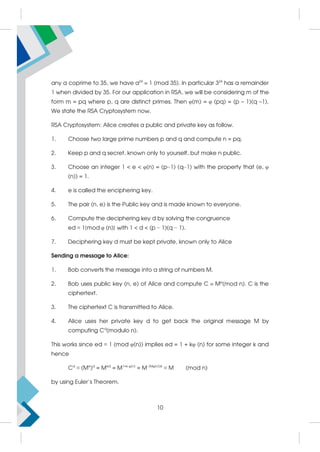
RSA Cryptosystem: Alice creates a public and private key as follow.
1. Choose two large prime numbers p and q and compute n = pq.
2. Keep p and q secret, known only to yourself, but make n public.
3. Choose an integer 1  e  φ(n) = (p−1) (q−1) with the property that (e, φ
(n)) = 1.
4. e is called the enciphering key.
5. The pair (n, e) is the Public key and is made known to everyone.
6. Compute the deciphering key d by solving the congruence
ed ≡ 1{mod φ (n)} with 1  d  (p − 1)(q − 1).
7. Deciphering key d must be kept private, known only to Alice
Sending a message to Alice:
1. Bob converts the message into a string of numbers M.
2. Bob uses public key (n, e) of Alice and compute C  Me
(mod n). C is the
ciphertext.
3. The ciphertext C is transmitted to Alice.
4. Alice uses her private key d to get back the original message M by
computing Cd
(modulo n).
This works since ed ≡ 1 (mod φ(n)) implies ed = 1 + kφ (n) for some integer k and
hence
Cd
≡ (Me
)d
= Med
= M1+k φ(n)
= M (Mφ(n))k
≡ M (mod n)
by using Euler’s Theorem.
10
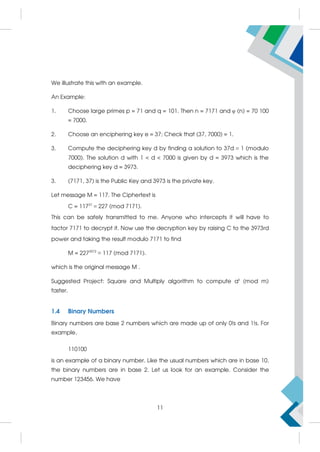
We illustrate this with an example.
An Example:
1. Choose large primes p = 71 and q = 101. Then n = 7171 and φ (n) = 70 100
= 7000.
2. Choose an enciphering key e = 37; Check that (37, 7000) = 1.
3. Compute the deciphering key d by finding a solution to 37d ≡ 1 (modulo
7000). The solution d with 1  d  7000 is given by d = 3973 which is the
deciphering key d = 3973.
3. (7171, 37) is the Public Key and 3973 is the private key.
Let message M = 117. The Ciphertext is
C = 11737
≡ 227 (mod 7171).
This can be safely transmitted to me. Anyone who intercepts it will have to
factor 7171 to decrypt it. Now use the decryption key by raising C to the 3973rd
power and taking the result modulo 7171 to find
M = 2273973
≡ 117 (mod 7171).
which is the original message M .
Suggested Project: Square and Multiply algorithm to compute ak
(mod m)
faster.
1.4 Binary Numbers
Binary numbers are base 2 numbers which are made up of only 0!s and 1!s. For
example,
110100
is an example of a binary number. Like the usual numbers which are in base 10,
the binary numbers are in base 2. Let us look for an example. Consider the
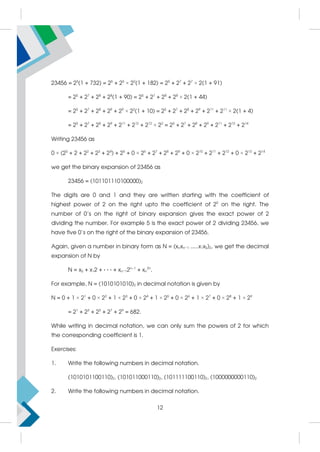
number 123456. We have
11
23456 = 25
(1 + 732) = 25
+ 25
× 22
(1 + 182) = 25
+ 27
+ 27
× 2(1 + 91)
= 25
+ 27
+ 28
+ 28
(1 + 90) = 25
+ 27
+ 28
+ 28
× 2(1 + 44)
= 25
+ 27
+ 28
+ 29
+ 29
× 22
(1 + 10) = 25
+ 27
+ 28
+ 29
+ 211
+ 211
× 2(1 + 4)
= 25
+ 27
+ 28
+ 29
+ 211
+ 212
+ 212
× 22
= 25
+ 27
+ 28
+ 29
+ 211
+ 212
+ 214
Writing 23456 as
0 × (20
+ 2 + 22
+ 23
+ 24
) + 25
+ 0 × 26
+ 27
+ 28
+ 29
+ 0 × 210
+ 211
+ 212
+ 0 × 213
+ 214
we get the binary expansion of 23456 as
23456 = (101101110100000)2
The digits are 0 and 1 and they are written starting with the coefficient of
highest power of 2 on the right upto the coefficient of 20
on the right. The
number of 0's on the right of binary expansion gives the exact power of 2
dividing the number. For example 5 is the exact power of 2 dividing 23456, we
have five 0's on the right of the binary expansion of 23456.
Again, given a number in binary form as N = (xnxn−1 .....x1x0)2, we get the decimal
expansion of N by
N = x0 + x12 + · · · + xn−12n−1
+ xn
2n
.
For example, N = (1010101010)2 in decimal notation is given by
N = 0 + 1 × 21
+ 0 × 22
+ 1 × 23
+ 0 × 24
+ 1 × 25
+ 0 × 26
+ 1 × 27
+ 0 × 28
+ 1 × 29
= 21
+ 23
+ 25
+ 27
+ 29
= 682.
While writing in decimal notation, we can only sum the powers of 2 for which
the corresponding coefficient is 1.
Exercises:
1. Write the following numbers in decimal notation.
(1010101100110)2, (101011000110)2, (101111100110)2, (1000000000110)2
2. Write the following numbers in decimal notation.
12
654321, 1000001, 56237801, 2468097531, 963258741
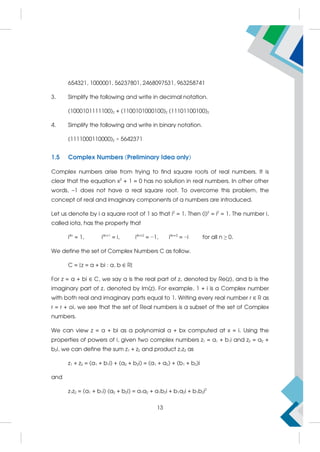
3. Simplify the following and write in decimal notation.
(1000101111100)2 + (1100101000100)2 (11101100100)2
4. Simplify the following and write in binary notation.
(1111000110000)2 × 5642371
1.5 Complex Numbers (Preliminary Idea only)
Complex numbers arise from trying to find square roots of real numbers. It is
clear that the equation x2
+ 1 = 0 has no solution in real numbers. In other other
words, –1 does not have a real square root. To overcome this problem, the
concept of real and imaginary components of a numbers are introduced.
Let us denote by i a square root of 1 so that i2
= 1. Then (i)2
= i2
= 1. The number i,
called iota, has the property that
i4n
= 1, i4n+1
= i, i4n+2
= −1, i4n+3
= −i for all n ≥ 0.
We define the set of Complex Numbers C as follow.
C = {z = a + bi : a, b ∈ R}
For z = a + bi ∈ C, we say a is the real part of z, denoted by Re(z), and b is the
imaginary part of z, denoted by Im(z). For example, 1 + i is a Complex number
with both real and imaginary parts equal to 1. Writing every real number r ∈ R as
r = r + oi, we see that the set of Real numbers is a subset of the set of Complex
numbers.
We can view z = a + bi as a polynomial a + bx computed at x = i. Using the
properties of powers of i, given two complex numbers z1 = a1 + b1i and z2 = a2 +
b2i, we can define the sum z1 + z2 and product z1z2 as
z1 + z2 = (a1 + b1i) + (a2 + b2i) = (a1 + a2) + (b1 + b2)i
and
z1z2 = (a1 + b1i) (a2 + b2i) = a1a2 + a1b2i + b1a2i + b1b2i2
13
= a1a2 + (a1b2 + a2b1)i − b1b2 = (a1a2 − b1b2) + (a1b2 + a2b1)i
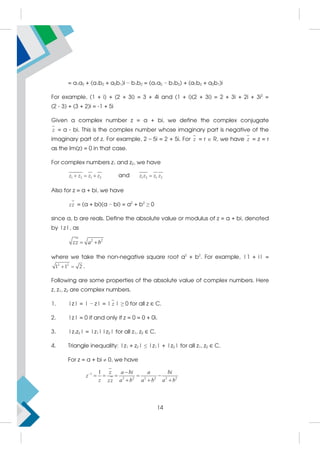
For example, (1 + i) + (2 + 3i) = 3 + 4i and (1 + i)(2 + 3i) = 2 + 3i + 2i + 3i2
=
(2 - 3) + (3 + 2)i = -1 + 5i
Given a complex number z = a + bi, we define the complex conjugate
z = a - bi. This is the complex number whose imaginary part is negative of the
imaginary part of z. For example, 2 – 5i = 2 + 5i. For z = r  R, we have z = z = r
as the Im(z) = 0 in that case.
For complex numbers z1 and z2, we have
1 2 1 2
z z z z
   and 1 2 1 2
z z z z

Also for z = a + bi, we have
zz = (a + bi)(a − bi) = a2
+ b2
≥ 0
since a, b are reals. Define the absolute value or modulus of z = a + bi, denoted
by |z|, as
2 2
zz a b
 
where we take the non-negative square root a2
+ b2
. For example, |1 + i| =
2 2
1 1 2
  .
Following are some properties of the absolute value of complex numbers. Here
z, z1, z2 are complex numbers.
1. |z| = | − z| = | z | ≥ 0 for all z ∈ C.
2. |z| = 0 if and only if z = 0 = 0 + 0i.
3. |z1z2| = |z1||z2| for all z1, z2 ∈ C.
4. Triangle inequality: |z1 + z2| ≤ |z1| + |z2| for all z1, z2 ∈ C.
For z = a + bi  0, we have
1
2 2 2 2 2 2
1 z a bi a bi
z
z a b a b a b
zz
 
    
  
14
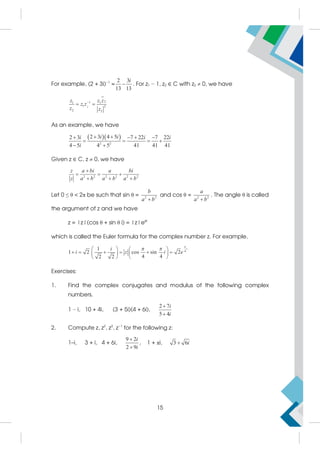
For example, (2 + 3i)−1
=
2 3
13 13
i
 . For z1 − 1, z2 ∈ C with z2  0, we have
2
2
1
1 1
1 2
2 2
z z z
z z
z z

 
As an example, we have
  
2 2
2 3 4 5
2 3 7 22 7 22
4 5 4 5 41 41 41
 
   
   
 
i i
i i i
i
Given z ∈ C, z  0, we have
2 2 2 2 2 2
z a bi a bi
z a b a b a b

  
  
Let 0 ≤ θ  2π be such that sin θ = 2 2
b
a b

and cos θ = 2 2
a
a b

. The angle θ is called
the argument of z and we have
z = |z|(cos θ + sin θ i) = |z|eθi
which is called the Euler formula for the complex number z. For example,
4
1 2 cos sin 2
4 4
2 2

   
     
 
 
 
 
i
i
i z i e

 
Exercises:
1. Find the complex conjugates and modulus of the following complex
numbers.
1 − i, 10 + 4i, (3 + 5i)(4 + 6i),
2 7
5 4
i
i


2. Compute z, z2
, z3
, z−1
for the following z:
1–i, 3 + i, 4 + 6i,
9 2
2 9
i
i


, 1 + πi, 3 6i

15
1.6 Indices, Logarithm and Antilogarithm
Indices
A power of a number is the product of a certain number of factors, all of which
are the same. For example, 59
is a power, in which the number 5 is called the
base and the number 9 is called the index or exponent. In fact, for any a, we
have
a1
= a
a2
= a · a
a3
= a · a · a
.....
an
= a · a · a · a · a..... n times
for any n. We have 24
= 2.2.2.2 = 16 for example.
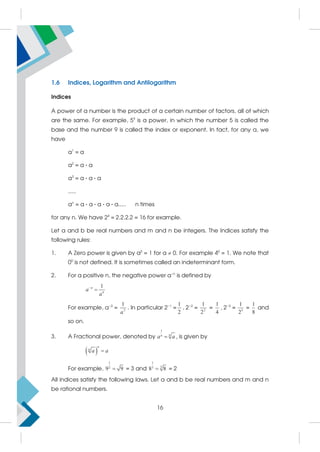
Let a and b be real numbers and m and n be integers. The Indices satisfy the
following rules:
1. A Zero power is given by a0
= 1 for a  0. For example 40
= 1. We note that
00
is not defined. It is sometimes called an indeterminant form.
2. For a positive n, the negative power a−n
is defined by
1
n
n
a
a


For example, a−3
= 3
1
a
. In particular 2−1
=
1
2
, 2−2
= 2
1
2
=
1
4
, 2−3
= 3
1
2
=
1
8
and
so on.
3. A Fractional power, denoted by
1
n
n
a a
 , is given by
 
n
n
a a

For example,
1
2
9 9
 = 3 and
1
3
3
8 8
 = 2
All indices satisfy the following laws. Let a and b be real numbers and m and n
be rational numbers.
16
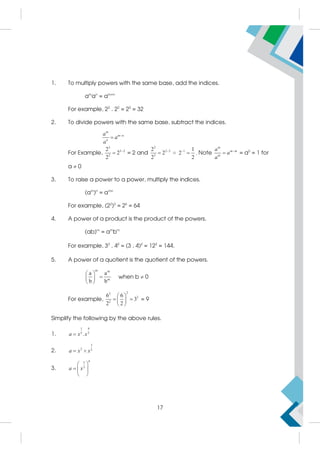
1. To multiply powers with the same base, add the indices.
am
an
= am+n
For example, 23
. 22
= 25
= 32
2. To divide powers with the same base, subtract the indices.
m
m n
n
a
a
a


For Example,
3
3 2
2
2
2
2

 = 2 and
2
2 3
3
2
2
2

 = 1 1
2
2

 . Note
m
m m
m
a
a
a

 = a0
= 1 for
a  0
3. To raise a power to a power, multiply the indices.
(am
)n
= amn
For example, (22
)3
= 26
= 64
4. A power of a product is the product of the powers.
(ab)m
= am
bm
For example, 32
. 42
= (3 . 4)2
= 122
= 144.
5. A power of a quotient is the quotient of the powers.
m m
m
a a
b b
 

 
 
when b  0
For example,
2
2
2
2
6 6
3
2 2
 
 
 
 
= 9
Simplify the following by the above rules.
1.
1 4
5 5
.
a x x

2.
3
2 2
a x x
 
3.
6
5
3
a x
 
  
 
17
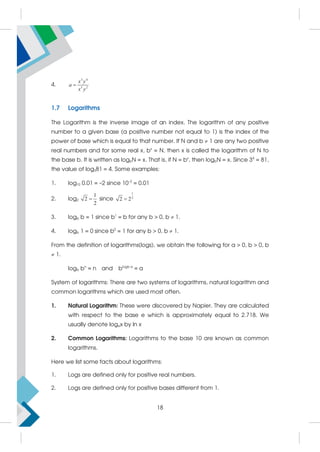
4.
3 4
5 2
x y
a
x y

1.7 Logarithms
The Logarithm is the inverse image of an index. The logarithm of any positive
number to a given base (a positive number not equal to 1) is the index of the
power of base which is equal to that number. If N and b  1 are any two positive
real numbers and for some real x, bx
= N, then x is called the logarithm of N to
the base b. It is written as logbN = x. That is, if N = bx
, then logbN = x. Since 34
= 81,
the value of log381 = 4. Some examples:
1. log10 0.01 = –2 since 10–2
= 0.01
2. log2
1
2
2
 since
1
2
2 2

3. logb b = 1 since b1
= b for any b  0, b  1.
4. logb 1 = 0 since b0
= 1 for any b  0, b  1.
From the definition of logarithms(logs), we obtain the following for a  0, b  0, b
 1.
logb bn
= n and blogb a
= a
System of logarithms: There are two systems of logarithms, natural logarithm and
common logarithms which are used most often.
1. Natural Logarithm: These were discovered by Napier. They are calculated
with respect to the base e which is approximately equal to 2.718. We
usually denote logex by ln x
2. Common Logarithms: Logarithms to the base 10 are known as common
logarithms.
Here we list some facts about logarithms:
1. Logs are defined only for positive real numbers.
2. Logs are defined only for positive bases different from 1.
18
3. In logb a, neither a nor b is negative but the value of logb a can be
negative. For example, log100.01 = −2 since 10−2
= 0.01.
4. Logs of different numbers to the same base are different, i.e. if a  c, then
logb a  logb c.
In other words, if logb a = logb c, then a = c.
5. Logs of the same number to different bases have different values i.e.
if a  b, then loga c  logb c. In other words, if loga c = logb c, then a = b.
Some important properties of logarithms:
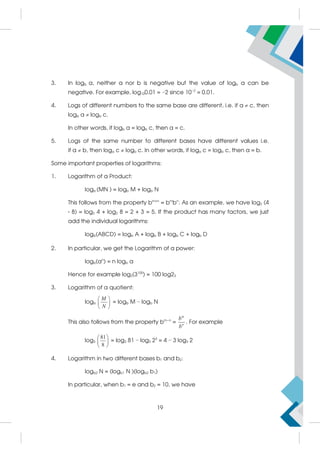
1. Logarithm of a Product:
logb (MN ) = logb M + logb N
This follows from the property bm+n
= bm
bn
. As an example, we have log2 (4
· 8) = log2 4 + log2 8 = 2 + 3 = 5. If the product has many factors, we just
add the individual logarithms:
logb(ABCD) = logb A + logb B + logb C + logb D
2. In particular, we get the Logarithm of a power:
logb(an
) = n logb a
Hence for example log2(3100
) = 100 log23
3. Logarithm of a quotient:
logb
M
N
 
 
 
= logb M − logb N
This also follows from the property bm−n
=
m
n
b
b
. For example
log3
81
8
 
 
 
= log3 81 − log3 23
= 4 − 3 log3 2
4. Logarithm in two different bases b1 and b2:
logb2 N = (logb1 N )(logb2 b1)
In particular, when b1 = e and b2 = 10, we have
19
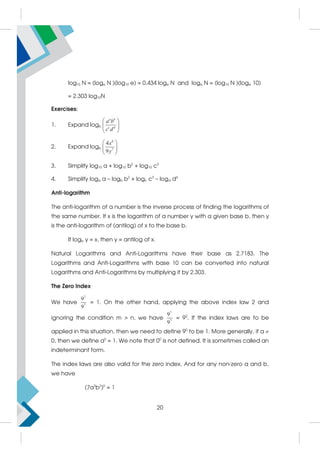
log10 N = (loge N )(log10 e) = 0.434 loge N and loge N = (log10 N )(loge 10)
= 2.303 log10N
Exercises:
1. Expand logb
a b
c d
a b
c d
 
 
 
2. Expand logb
6
7
4
9
x
y
 
 
 
3. Simplify log10 a + log10 b2
+ log10 c3
4. Simplify loga a – logb b2
+ logc c3
– logd d4
Anti-logarithm
The anti-logarithm of a number is the inverse process of finding the logarithms of
the same number. If x is the logarithm of a number y with a given base b, then y
is the anti-logarithm of (antilog) of x to the base b.
If logb y = x, then y = antilog of x.
Natural Logarithms and Anti-Logarithms have their base as 2.7183. The
Logarithms and Anti-Logarithms with base 10 can be converted into natural
Logarithms and Anti-Logarithms by multiplying it by 2.303.
The Zero Index
We have
7
7
9
9
= 1. On the other hand, applying the above index law 2 and
ignoring the condition m  n, we have
7
7
9
9
= 90
. If the index laws are to be
applied in this situation, then we need to define 90
to be 1. More generally, if a 
0, then we define a0
= 1. We note that 00
is not defined. It is sometimes called an
indeterminant form.
The index laws are also valid for the zero index. And for any non-zero a and b,
we have
(7a3
b2
)0
= 1
20
Negative Exponents
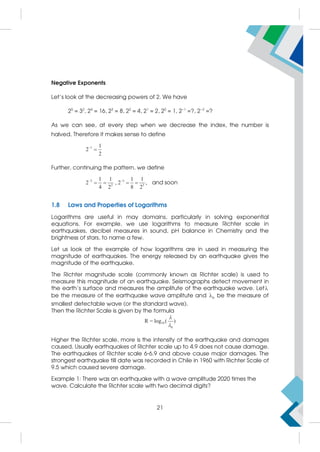
Let's look at the decreasing powers of 2. We have
25
= 32
, 24
= 16, 23
= 8, 22
= 4, 21
= 2, 20
= 1, 2−1
=?, 2−2
=?
As we can see, at every step when we decrease the index, the number is
halved. Therefore it makes sense to define
1 1
2
2


Further, continuing the pattern, we define
2 3
2 3
1 1 1 1
2 , 2 ,
4 2 8 2
 
    and soon
1.8 Laws and Properties of Logarithms
Logarithms are useful in may domains, particularly in solving exponential
equations. For example, we use logarithms to measure Richter scale in
earthquakes, decibel measures in sound, pH balance in Chemistry and the
brightness of stars, to name a few.
Let us look at the example of how logarithms are in used in measuring the
magnitude of earthquakes. The energy released by an earthquake gives the
magnitude of the earthquake.
The Richter magnitude scale (commonly known as Richter scale) is used to
measure this magnitude of an earthquake. Seismographs detect movement in
the earth's surface and measures the amplitute of the earthquake wave. Let
be the measure of the earthquake wave amplitute and 0
 be the measure of
smallest detectable wave (or the standard wave).
Then the Richter Scale is given by the formula
10
0
R = log ( )


Higher the Richter scale, more is the intensity of the earthquake and damages
caused. Usually earthquakes of Richter scale up to 4.9 does not cause damage.
The earthquakes of Richter scale 6-6.9 and above cause major damages. The
strongest earthquake till date was recorded in Chile in 1960 with Richter Scale of
9.5 which caused severe damage.
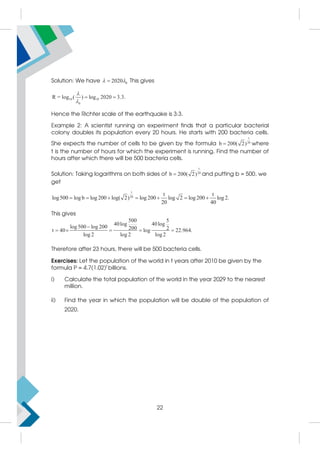
Example 1: There was an earthquake with a wave amplitude 2020 times the
wave. Calculate the Richter scale with two decimal digits?
21
Solution: We have 0
2020
 
 This gives
10 10
0
R = log ( ) log 2020 3.3.


 
Hence the Richter scale of the earthquake is 3:3.
Example 2: A scientist running an experiment finds that a particular bacterial
colony doubles its population every 20 hours. He starts with 200 bacteria cells.
She expects the number of cells to be given by the formula
t
20
b 200( 2)
 where
t is the number of hours for which the experiment is running. Find the number of
hours after which there will be 500 bacteria cells.
Solution: Taking logarithms on both sides of
t
20
b 200( 2)
 and putting b = 500, we
get
t
20
t t
log500 log b log 200 log( 2) log 200 log 2 log 200 log 2.
20 40
      
This gives
500 5
40log 40log
log500 log 200 200 2
t 40 log 22.964.
log 2 log 2 log2

    
Therefore after 23 hours, there will be 500 bacteria cells.
Exercises: Let the population of the world in t years after 2010 be given by the
formula P = 4.7(1.02)t
billions.
i) Calculate the total population of the world in the year 2029 to the nearest
million.
ii) Find the year in which the population will be double of the population of
2020.
22
23
24
25
26
27
28
29
30
31
32
33
34
35
36
37
38
39
40
41
42
43
44
45
46
47
48
49
50
51
52
53
54
55
56
57
58
59
60
61
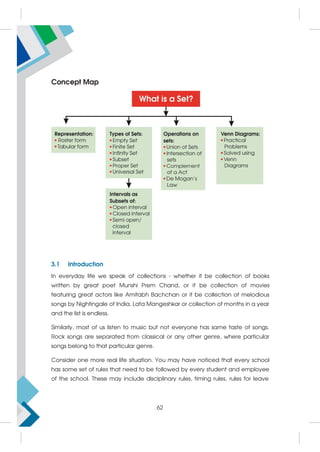
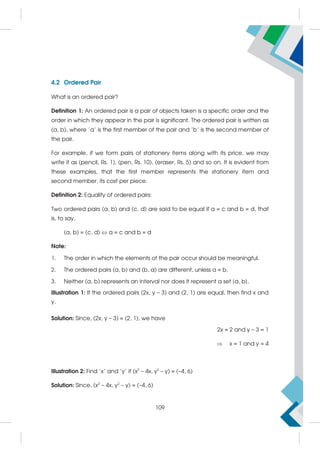
Concept Map
3.1 Introduction
In everyday life we speak of collections - whether it be collection of books
written by great poet Munshi Prem Chand, or it be collection of movies
featuring great actors like Amitabh Bachchan or it be collection of melodious
songs by Nightingale of India, Lata Mangeshkar or collection of months in a year
and the list is endless.
Similarly, most of us listen to music but not everyone has same taste of songs.
Rock songs are separated from classical or any other genre, where particular
songs belong to that particular genre.
Consider one more real life situation. You may have noticed that every school
has some set of rules that need to be followed by every student and employee
of the school. These may include disciplinary rules, timing rules, rules for leave
62
etc. Hence all different types of rules are separated from each other, thus
forming different categories or sets.
In Mathematics too, we come across collection of numbers, functions etc., for
example, natural numbers, integers, trigonometric functions, algebraic functions
and so on.
To learn sets we often talk about such collection of objects. The concept of sets
is used in the foundation of various topics in Mathematics.
Now, the above collection of objects or numbers or functions is well-defined as
we can identify and decide whether a particular object belongs to the
collection or not.
3.1 What is a Set?
Definition 1 : A set is a well-defined collection of distinct objects.
The word 'well-defined' refers to a specific property or some definite rule on the
basis of which it is easy to identify and decide whether the given object belongs
to the set or not. The word ‘distinct’ implies that the objects of the set must be all
different.
For example, consider the collection of all the students in your class whose
names begin with letter 'S'. Then this collection represents a set as, the rule of
the names beginning with 'S' has been clearly specified.
However, the collection of all the intelligent students in your class does not
represent a set because the word 'intelligent' is relative and degree of
intelligence of a student may be measured in different spheres. Whosoever may
appear intelligent to one person may not appear the same to another person.
63
Illustration 1: Which of the following collections is not a set? Give reason for your
answers.
(i) The collection of all boys of your class.
(ii) The collection of all monuments in Delhi made by Mughal emperor Akbar.
(iii) The collection of all the rivers in Delhi and Uttar Pradesh.
(iv) The collection of most talented singers of India.
(v) The collection of measures of central tendency of a given data.
(vi) The solution of the equation x2
– 6x + 8 = 0
Solution: (iv)
This is because it is not a well-defined collection as the criteria for determining
the talented singer may vary from person to person.
In (i), (ii), (iii), (v) and (vi) we can list the objects belonging to the given
collection.
For example, in part (vi), x = 4 and x = 2 belong to the collection which satisfy
the given equation x2
– 6x + 8 = 0,
In fact, no real number except x = 2, 4 belongs to this collection.
Note:
1. The objects that belongs to a particular collection or set are also known
as its members or elements.
2. Sets are usually denoted by capital letters, say, A, B, C, X, Y etc.
3.2 Representation of Sets
There are two methods of representing a set:
1. Roster form or Tabular form
2. Set builder form
Let us discuss both of them in detail.
64
1. Roster Form or Tabular Form
In Roster form, all the elements of a set are listed, separated by commas and
enclosed within curly braces { }.
For example, the set of vowels of English Alphabet may be described in roster
form as:
V = {a, e, i, o, u}
Since 'a' is an element of a set A, we say that ‘-“a belongs to A’ and the Greek
symbol '' (epsilon) is used to denote the phrase 'belongs to'.
Thus, mathematically, we may write the above statement as:
aA
Similarly, eA, iA, oA, and uA.
Also, since 'b' is not an element of set A, we write, bA and is read as 'b does
not belong to A'.
Let us consider some more examples of representing a set in roster form:
(a) The set of all even natural numbers less than 10 may be written as:
A = {2, 4, 6, 8}
(b) The set of letters forming the word 'NUMBERS' is B = {N, U, M, B, E, R, S}
Note 1: While writing the set in roster form, the element is not repeated, that is,
all the elements in the set are distinct. Please note that the repetition of the
elements of a set does not alter the set.
For example, the set of letters of the word 'FOLLOW' is written as:
A = {F, O, L, W}
Interestingly, when we consider the set of letters of the word 'WOLF', it is given
by B = {W, O, L, F}. Please note that the elements of set A are exactly the same
as set B. Such are called equal sets, which would be discussed later. Moreover,
a set of particular alphabets may form different words, as noticed above.
65
Similarly, the set of alphabets of the word, 'ABLE' is given by X = {A, B, L, E} and
the set of alphabets of the word 'LABEL' is also Y = {A, B, L, E}.
So, we may understand from this now that the set comprising of different
alphabets may form different words, depending on the repetition of alphabets
in the words. Moreover, the elements in the set may be written in any order. So,
X = {A,B,L,E} is equal to the set Z = {B,E,A,L}.
2. Set-Builder Form
In this form, a set is described by a characterising property of its elements.
For example, in the set A = {1, 2, 3, 4, 5}, all the elements possess a common
property, that is, each of them is a natural number less than 6. So, this set can be
written as:
A = {x : x is a natural number and x  6} and is read as the set of all 'x' such that
x is a natural number and x is less than 6.
Hence, the numbers 1, 2, 3, 4 and 5 are the elements of the set A.
Illustrations 2: Write the following sets in roster form:
(i) A = {x : x is a letter in the word 'MATHEMATICS'}
(ii) B = {x : x is a letter in the word 'STATISTICS'}
(iii) C = {x : x is a two digit number such that the product of its digits is 12}
(iv) D = {x : x is a solution of the equations x2
– 4 = 0}
Solution:
(i) A = {M, A, T, H, E, I, C, S}
(ii) B = {S, T, A, I, C}
(iii) C = {26, 34, 43, 62}
(iv) D = {–2, 2}
Illustrations 3: Write the following sets in the set-builder form:
(i) A = {1, 4, 9, 16}
(ii) B = {2, 3, 5, 7, 11}
(iii) C = {–2, 0, 2}
66
Solution:
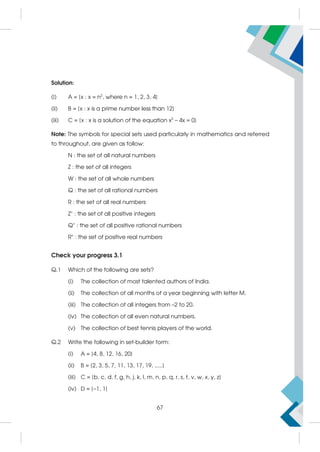
(i) A = {x : x = n2
, where n = 1, 2, 3, 4}
(ii) B = {x : x is a prime number less than 12}
(iii) C = {x : x is a solution of the equation x3
– 4x = 0}
Note: The symbols for special sets used particularly in mathematics and referred
to throughout, are given as follow:
N : the set of all natural numbers
Z : the set of all integers
W : the set of all whole numbers
Q : the set of all rational numbers
R : the set of all real numbers
Z+
: the set of all positive integers
Q+
: the set of all positive rational numbers
R+
: the set of positive real numbers
Check your progress 3.1
Q.1 Which of the following are sets?
(i) The collection of most talented authors of India.
(ii) The collection of all months of a year beginning with letter M.
(iii) The collection of all integers from –2 to 20.
(iv) The collection of all even natural numbers.
(v) The collection of best tennis players of the world.
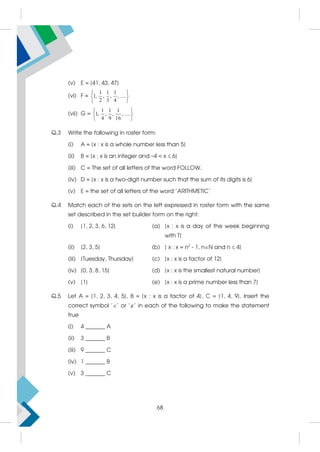
Q.2 Write the following in set-builder form:
(i) A = {4, 8, 12, 16, 20}
(ii) B = {2, 3, 5, 7, 11, 13, 17, 19, .....}
(iii) C = {b, c, d, f, g, h, j, k, l, m, n, p, q, r, s, t, v, w, x, y, z}
(iv) D = {–1, 1}
67
(v) E = {41, 43, 47}
(vi) F =
1 1 1
1, , , , ....
2 3 4
 
 
 
(vii) G =
1 1 1
1, , , , ....
4 9 16
 
 
 
Q.3 Write the following in roster form:
(i) A = {x : x is a whole number less than 5}
(ii) B = {x : x is an integer and –4  x  6}
(iii) C = The set of all letters of the word FOLLOW.
(iv) D = {x : x is a two-digit number such that the sum of its digits is 6}
(v) E = the set of all letters of the word 'ARITHMETIC'
Q.4 Match each of the sets on the left expressed in roster form with the same
set described in the set builder form on the right:
(i) {1, 2, 3, 6, 12} (a) {x : x is a day of the week beginning
with T}
(ii) {2, 3, 5} (b) { x : x = n2
- 1, nN and n  4}
(iii) {Tuesday, Thursday} (c) {x : x is a factor of 12}
(iv) {0, 3, 8, 15} (d) {x : x is the smallest natural number}
(v) {1} (e) {x : x is a prime number less than 7}
Q.5 Let A = {1, 2, 3, 4, 5}, B = {x : x is a factor of 4}, C = {1, 4, 9}. Insert the
correct symbol '' or '' in each of the following to make the statement
true
(i) 4 _______ A
(ii) 3 _______ B
(iii) 9 _______ C
(iv) 1 _______ B
(v) 3 _______ C
68
3.3 Types of Sets
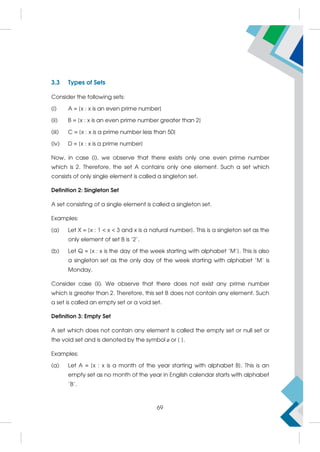
Consider the following sets:
(i) A = {x : x is an even prime number}
(ii) B = {x : x is an even prime number greater than 2}
(iii) C = {x : x is a prime number less than 50}
(iv) D = {x : x is a prime number}
Now, in case (i), we observe that there exists only one even prime number
which is 2. Therefore, the set A contains only one element. Such a set which
consists of only single element is called a singleton set.
Definition 2: Singleton Set
A set consisting of a single element is called a singleton set.
Examples:
(a) Let X = {x : 1  x  3 and x is a natural number}. This is a singleton set as the
only element of set B is '2'.
(b) Let Q = {x : x is the day of the week starting with alphabet 'M'}. This is also
a singleton set as the only day of the week starting with alphabet 'M' is
Monday.
Consider case (ii). We observe that there does not exist any prime number
which is greater than 2. Therefore, this set B does not contain any element. Such
a set is called an empty set or a void set.
Definition 3: Empty Set
A set which does not contain any element is called the empty set or null set or
the void set and is denoted by the symbol ø or { }.
Examples:
(a) Let A = {x : x is a month of the year starting with alphabet B}. This is an
empty set as no month of the year in English calendar starts with alphabet
'B'.
69
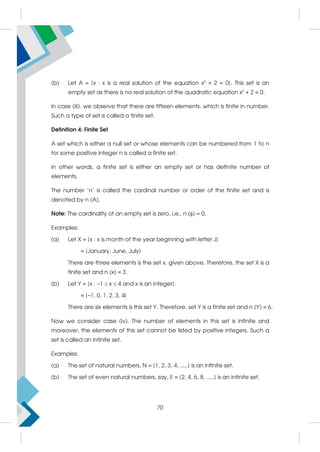
(b) Let A = {x : x is a real solution of the equation x2
+ 2 = 0}. This set is an
empty set as there is no real solution of the quadratic equation x2
+ 2 = 0.
In case (iii), we observe that there are fifteen elements, which is finite in number.
Such a type of set is called a finite set.
Definition 4: Finite Set
A set which is either a null set or whose elements can be numbered from 1 to n
for some positive integer n is called a finite set.
In other words, a finite set is either an empty set or has definite number of
elements.
The number 'n' is called the cardinal number or order of the finite set and is
denoted by n (A).
Note: The cardinality of an empty set is zero, i.e., n () = 0.
Examples:
(a) Let X = {x : x is month of the year beginning with letter J}
= {January, June, July}
There are three elements is the set x, given above. Therefore, the set X is a
finite set and n (x) = 3.
(b) Let Y = {x : –1  x  4 and x is an integer}.
= {–1, 0, 1, 2, 3, 4}
There are six elements is this set Y. Therefore, set Y is a finite set and n (Y) = 6.
Now we consider case (iv). The number of elements in this set is infinite and
moreover, the elements of this set cannot be listed by positive integers. Such a
set is called an infinite set.
Examples:
(a) The set of natural numbers, N = {1, 2, 3, 4, .....} is an infinite set.
(b) The set of even natural numbers, say, E = {2, 4, 6, 8, .....} is an infinite set.
70
Note: All infinite sets cannot be described in roster form. For example, the set of
real numbers cannot be described in this form as between any two given real
numbers, there exists infinite number of real numbers. So, it is not possible to list
them in roster form.
Illustration 4: State which of one following sets are finite and which are infinite.
(i) {x : x  Z and satisfies the equation (x+1) (x+2) = 0}
(ii) {x : x  N and x2
– 1 = 3}
(iii) {x : x is an odd natural number}
(iv) {x : x is an integer and –1  x  0}
(v) {x : x is an integer less than 0}
(vi) {x : x satisfies the identity cos2
x + sin2
x = 1}
Solution:
(i) A = {–1, –2}, is a finite set as it consists of only two elements.
(ii) B = {2}, is a finite set having only one element.
(iii) C = {1, 3, 5, 7, 9, .....} is an infinite set as it doesn't have a definite number
of elements.
(iv) , which is a finite set.
(v) D = {....., –3, –2, –1} is an infinite set as all its elements cannot be listed.
(vi) There are infinite real numbers that satisfy the identity cos2
x + sin2
x = 1.
Therefore, it is an infinite set.
3.4 Subsets
Consider the following sets:
E = set of all students in your school.
F = set of all students in your school who have taken up commerce as their
subject stream.
We note that every element (student) in set F is a student of your school itself,
which is described by set E.
71
In other words, every element of F is also an element of E. The set F is said to be
a subset of E and in symbols it is expressed as F  E. The symbol ' ' stands for 'is
a subset of' or 'is contained in'.
Definition 5 : Subset
Let A and B be two sets. If every element of set A is an element of set B also,
then A is called a subset of B and is written as A  B.
In other words, A  B, if whenever a  A, then a  B. Using the symbol '' which
means 'implies', we can write the definition of subset as:
A  B if a  A  a  B
If A is not a subset of B, we write A  B
Note:
1. The empty set is a subset of every set.
2. Every set is a subset of itself.
3. The symbol ' ' suggests that either A B or A = B. A B implies that A is a
proper subset of B, that is,
A has lesser number of elements than B.
A = B implies that A and B are equal sets, that is, they have exactly the
same elements.
In other words, two sets are said to be equal if every element of A is a
member of B and every element of B is an element of A.
That is, to say, A = B  A  B and B  A.
Illustration 5: Consider the sets ; A = {1, 2, 3}; B = {1, 4, 5}; C = {1, 2, 3, 4 5}; D = {x :
x  N and x  4}.
Insert the symbol ' ', ' ' or '=' between the following pair of sets:
(i) ø __ B
(ii) A ______ B
(iii) B ______ C
72
(iv) A ______ D
Solutions:
(i)  B as , the empty set is a subset of every set.
(ii) A  B as 2A but 2 B.
(iii) B C as 1, 4, 5  B and they also belong to C.
(iv) A = D as sets A and D have exactly the same elements which are 1, 2 and
3.
Illustration 6: Let A {1, 2, 3, {4}, 5}. Which of the following are incorrect? Give
reasons.
(i) 1A
(ii) {1, 2}  A
(iii) {1, 2, 4}  A
(iv) {4}  A
(v)  A
(vi) {4}  A
Solutions:
(i) Correct. This is because 1 is an element of A. Therefore, 1  A.
(ii) Correct. Every element belonging to the set {1, 2} also belongs to A.
Therefore, {1, 2}  A.
(iii) Incorrect. This is because, 4 is not an element of A but {4} is an element of
A.
 {1, 2, {4}}  A but {1, 2, 4}  A
(iv) Correct. {4} is one of the elements of A. Therefore, {4}  A.
(v) Correct. Empty set is a subset of every set.
(vi) Incorrect. This is because {4} is an element of set A. Therefore {{4}}  A but
{4}  A.
73
3.5 Power Set
Consider the set A = {1, 2, 3}
Now  A as empty set is a subset of every set. Also, A A, as every set is a
subset of itself.
The other subsets of A are: {1}, {2}, {3}, {1, 2}, {2, 3}, {1, 3}.
The set of all these subsets of set A is called the power set of A.
Definition 6: Let A be set. Then, the set of all the subsets of A is called the
power set of A and is denoted by P(A).
Thus, in the above example, if A = {1, 2, 3}, then,
P(A) = { {1}, {2}, {3}, {1, 2}, {2, 3}, {1, 3}, {1, 2, 3}}
Note: n (P(A)) = 23
= 8
Therefore, n (P(A)) = 2n
, where 'n' is the number of elements in A. In other words,
the number of subsets of any set A are given by 2n
, where, 'n' is the number of
elements in A.
Also, the number of proper subsets of A having 'n' elements is given by 2n
–1,
which excludes the set itself.
3.6 Universal Set
A set that contains all the objects or elements in a given context is called the
universal set and is denoted by U.
For example, let A = set of all even natural numbers and B = set of odd natural
numbers. Then the universal set in this context, may be the set which contains all
the elements, that is,
U = set of natural numbers
Universal set in this case can also be taken as whole numbers or integers or real
numbers.
74
Note:
1. Universal set is the superset of all the sets under consideration.
2. N Z Q R. This relation explains that every natural number is an
integer, every integer can be put is the form of p/q, where q  0, hence
every integer is a rational number and all rational numbers are real
numbers.
3.7 Intervals as Subset of the set of Real Numbers R
Consider the solution set of the equation x2
– 5x + 6 = 0. In tabular form it is
written as A = {2, 3}
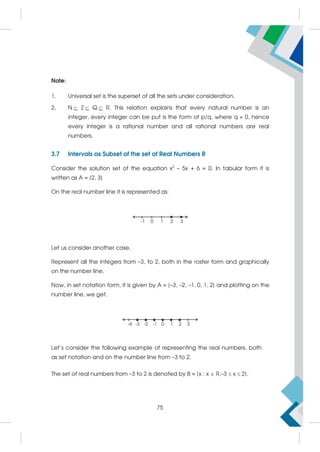
On the real number line it is represented as:
Let us consider another case.
Represent all the integers from –3, to 2, both in the roster form and graphically
on the number line.
Now, in set notation form, it is given by A = {–3, –2, –1, 0, 1, 2} and plotting on the
number line, we get,
Let's consider the following example of representing the real numbers, both
as set notation and on the number line from –3 to 2.
The set of real numbers from –3 to 2 is denoted by B = {x : x  R,–3  x  2}.
75
In this set it is impossible to list the real numbers, as between any two real
numbers lie infinite real numbers, as real number cannot be separated by
commas and listed. Therefore, in order to denote the above set we introduce
the concept of intervals.
What is an Interval?
An interval is a set of real numbers between a given pair of real numbers,
excluding or including one or both these real numbers.
It can be considered as a segment of the real number line, where in, the end
points of the interval mark the end points of that segment. Let us now
understand different types of intervals.
3.8 Types of Intervals
1. Closed Interval
Let a, b  R and a  b. Then the set of all real numbers from a to b, in the set
builder form is written as A = {x : x  R, a  x  b}.
In interval form, this set is represented as [a, b], indicating that it includes all real
numbers form a to b, including the end points 'a' and 'b'. This type of interval
which includes the end points in the set of real numbers between a given pair of
real numbers is called a closed interval. The inclusion of the end points is
indicated by square brackets [ ] in the interval notation.
Illustration 7: The interval notation for all real numbers from –3 to 2 is written as:
[–3, 2] = {x : x  R,–3  x  2}
As a segment of the real number line, the representation is given by:
76
2. Open Interval
Let's now consider the set of real numbers between 'a' and 'b', where a, b  R
and a  b.
This set of real numbers in set-builder form is written as:
B = {x : a  x  b}
In interval form, it is expressed as (a, b), indicating that it includes all real
numbers between 'a' and 'b', excluding the end points 'a' and 'b'.
This type of interval which does not includes the end points in the set of real
numbers is called an open interval and exclusion of the points is indicated by
round brackets ( ) in the interval notation.
Illustration 8: The interval of real numbers between –3 and 2 is written as:
(–3, 2) = {x : x  R,–3  x  2}
As a segment of the real number line, the representation is given by:
where the exclusion of end points –3 and 2 is illustrated by an open dot.
3. Semi-Open/Closed Interval
In the above cases, we had intervals where either both the end points are
included or both excluded.
But there are intervals where either of the end points is included or excluded.
Consider the following set of real numbers: A = {x : a  x  b; a, b  R and a  b}
This set consists of all real numbers between 'a' and 'b' but 'b' is included in the
set and 'a' is excluded from it. So, in interval notation, it is expressed as:
(a, b] = {x : x  R, a  x  b}
77
Illustration 9: Consider the interval  
3, 2
 .
Now,  
3, 2
 = {x : x  R,–3  x  2} represents the set of real numbers between –3
and 2 where '2' is included in the interval but–3 is excluded from it.
As a segment on the real number line, the representation is given by:
Now consider the set of real numbers:
{x : a  x  b; a , b  R, a  b}
This set consists of all real numbers between 'a' and 'b' but 'a' is included in the
set and 'b' is excluded from it. So in interval rotation, it is expressed as:
 
,
a b = {x : x  R, a  x  b}
Example:  
3, 2
 = {x : x  R, –3  x  2} represents the set of real numbers
between –3 and 2 where, –3 is included and 2 is excluded from the set.
As a segment of the real number line, the representation is given by:
Note: The number (b – a) is called the length of the interval (a, b), (a, b], [a, b)
or [a, b].
Illustration 10: The length of the interval (2, 7) is 5 and the length of the interval [–
3, 4] is (4 – (–3)) = 7.
Let us consider brief summary of the context discussed pertaining to intervals.
Table 1.1.1
S. No. Interval Description Graphical Representation
1. Closed interval:
[a, b]
{x : x  R, a  x  b}
2. Semi-open closed
interval
78
[a, b)
(a, b]
{x : x  R,a  x  b}
{x : x  R,a  x  b}
3. Open Interval:
(a, b)
{x : x  R,a  x  b}
4. (a, ) {x : x  R, x  a}
5. (– ,b) {x : x  R, x  b}
6. [a, ) {x : x  R, x  a}
7. (–, b] {x : x  R, x  b}
8. (–, ) R (real numbers)
Check your progress 3.2
Q.1 Which of the following sets are finite and which are infinite? In case of
finite sets, write its cardinality.
(i) {x : x is a natural number less than 100}.
(ii) The set of all prime numbers.
(iii) The set of the days of the week.
(iv) {x : x = n2
, where n is a natural number}.
(v) The set of all lines in a plane parallel to the line 2y = 3x + 7.
(vi) {x : x is a real number and 0  x  1}.
Q.2 Which of the following sets are empty and which are singleton sets?
(i) {x : x is an even prime number}.
(ii) {x : x is a natural number and –1  x  1}.
(iii) {x : x is an integer and –1  x  1}.
(iv) {x : x is a vowel in the word 'EYE'}.
(v) {x : x + 10 = 0; x  N}.
Q.3 Which of the following pairs of sets are equal? Give reasons.
(i) A = {–2, 3}, B = {x is a solution, of x2
– x – 6 = 0}
79
(ii) A = {x : x is a letter of the word 'FOLLOW'}
B = {y : y is a letter of the word 'WOLF'}
(iii) A = {x : x is a letter of the word 'ASSET'}
B = {y : y is a letter of the word 'EAST'}
(iv) A = {–1, 1}; B = {x : x is a real number satisfying the equation x2
+ 1 = 0}
(v) A = {1, 4, 9}; B = {x : x = n2
where 'n' is a natural number less than 5}
Q.4 Let A = {1, 2, {3, 4}, 5}. Put the correct symbol in each of the following.
(i) {3, 4} _______ A
(ii) {1} _______ A
(iii) {3} _______ A
(iv) {{3, 4}} _______ A
(v) {1, 3} _______ A
(vi) {1, 5} _______ A
(vii)  _______ A
Q.5 Write the following in set-builder form.
(i) (1, 3)
(ii) [–1, 3]
(iii) (–4, 0]
(iv) [–1, 1)
(v) [0, )
Q.6 Let A = . Find P (P(A))
Q.7 Find the number of subsets of the set B = {a,b,c,d}.
80
3.9 Venn Diagrams
Venn diagrams are the pictorial representation of the relationships between
sets. They are named after the English logician John Venn.
In Venn diagrams, the universal set is usually denoted by a rectangle and its
subsets by circles or ellipses. It is denoted by U.
Illustration 10: Let U = {1, 2, 3, 4, 5} and A = {2, 4}. Represent the relationship
between U and A using Venn diagram.
Solution: Set U = {1, 2, 3, 4, 5} is the universal set of which A = {2, 4} is a subset.
Therefore, in set notation we can express the relationship between A and U as
A U.
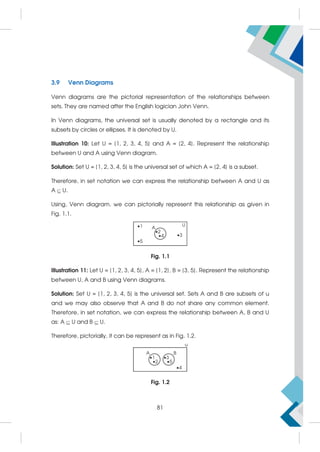
Using, Venn diagram, we can pictorially represent this relationship as given in
Fig. 1.1.
Fig. 1.1
Illustration 11: Let U = {1, 2, 3, 4, 5}, A = {1, 2}, B = {3, 5}. Represent the relationship
between U, A and B using Venn diagrams.
Solution: Set U = {1, 2, 3, 4, 5} is the universal set. Sets A and B are subsets of u
and we may also observe that A and B do not share any common element.
Therefore, in set notation, we can express the relationship between A, B and U
as: A  U and B  U.
Therefore, pictorially, it can be represent as in Fig. 1.2.
Fig. 1.2
81
Illustration 12: Let U = {1, 2, 3, 4, 5}, A = {1, 2, 3} and B = {1, 2}. Represent the
relationship between U, A and B using Venn diagrams.
Solution: Set U = {1, 2, 3, 4, 5} is the universal set of which A = {1, 2, 3} and B = {1,
2} are subsets. Moreover, in this case we also observe further that B  A.
Pictorially, we represent this as given in Fig. 1.3.
Fig. 1.3
We will further see the extensive use of Venn diagrams when we discuss
operations on sets, which are union, intersection and difference of sets.
3.10 Operations on Sets
In previous classes we have applied the basic operation of addition,
subtraction, multiplication and division on real numbers. Each of these
operations on an pair of numbers gives us another number.
For example, when we perform the operation of multiplication on two numbers
say 8 and 11, we get a number 88. Now, when we apply the operation of
addition on these numbers 8 and 11, we get a number 19.
Similarly, there are some operations which when performed on two or more
given sets gives rise to another set.
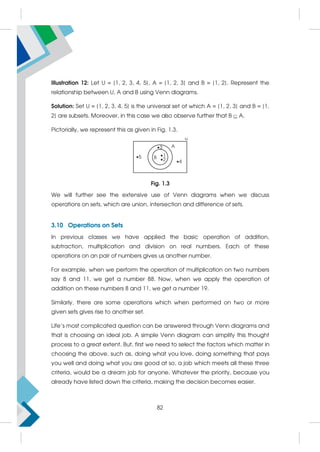
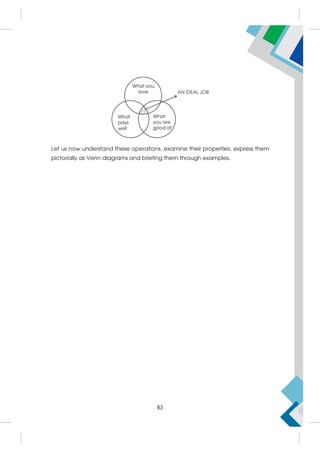
Life’s most complicated question can be answered through Venn diagrams and
that is choosing an ideal job. A simple Venn diagram can simplify this thought
process to a great extent. But, first we need to select the factors which matter in
choosing the above, such as, doing what you love, doing something that pays
you well and doing what you are good at so, a job which meets all these three
criteria, would be a dream job for anyone. Whatever the priority, because you
already have listed down the criteria, making the decision becomes easier.
82
Let us now understand these operations, examine their properties, express them
pictorially as Venn diagrams and briefing them through examples.
83
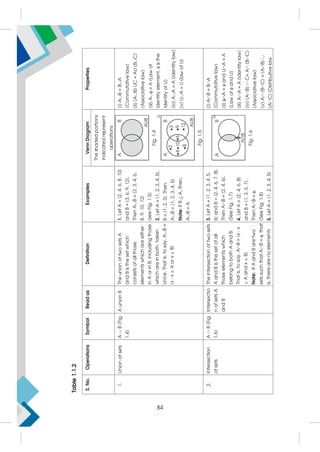
Table
1.1.2
S.
No.
Operations
Symbol
Read
as
Definition
Examples
Venn
Diagram
Properties
The
shaded
portions
indicated
represent
operations
1.
Union
of
sets
A

B
(Fig.
1.4)
A
union
B
The
union
of
two
sets
A
and
B
is
the
set
which
consists
of
all
those
elements
which
are
either
in
A
or
in
B,
including
those
which
are
in
both,
taken
once.
That
is,
to
say,
AB
=
{x
:
x

A
or
x

B}
1.
Let
A
=
{2,
4,
6,
8,
10}
and
B
=
{3,
6,
9,
12}.
Then
AB
=
{2,
3,
4,
6,
8,
9,
10,
12}
(see
Fig.
1.5)
2.
Let
A
=
{1,
2,
3,
4,
5},
B
=
{1,
2,
3}.
Then,
AB
=
{1,
2,
3,
4,
5}
Note:
If
B
A,
then,
AB
=
A
Fig.
1.4
Fig.
1.5
(i)
AB
=
BA
(Commutative
law)
(ii)
(AB)
UC
=
AU
(BC)
(Associative
law)
(iii)
A
=
A
(Law
of
identity
element,

is
the
identity
of
U)
(iv)
AA
=
A
(identity
law)
(v)
UA
=
U
(law
of
U)
2.
Intersection
of
sets
A

B
(Fig.
1.6)
Intersectio
n
of
sets
A
and
B
The
intersection
of
two
sets
A
and
B
is
the
set
of
all
those
elements
which
belong
to
both
A
and
B.
That
is,
to
say,
AB
=
{x
:
x

A
and
x

B}
Note:
If
A
and
B
are
two
sets
such
that
AB
=
,
that
is,
there
are
no
elements
3.
Let
A
=
{1,
2,
3,
4,
5,
6}
and
B
=
{2,
4,
6,
7,
8}.
Then
AB
=
{2,
4,
6}.
(See
Fig.
1.7)
4.
Let
A
=
{2,
4,
6,
8}
and
B
=
{1,
3,
5,
7}.
Then
AB
=
.
(See
Fig.
1.8)
5.
Let
A
=
{1,
2,
3,
4,
5}
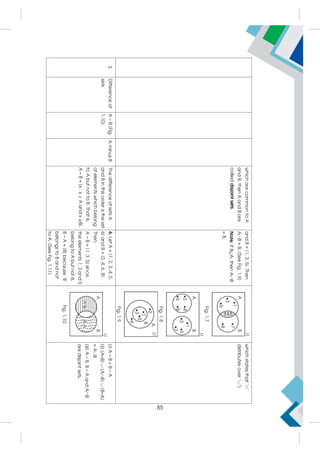
Fig.
1.6
(i)
AB
=
BA
(Commutative
law)
(ii)
A
=

and
UA
=
A
(Law
of

and
U)
(iii)
AA
=
A
(identity
law)
(iv)
(AB)

C=
A
(BC)
(Associative
law)
(v)
A
(BC)
=
(AB)

(AC)
(Distributive
law
84
which
are
common
to
A
and
B,
then
A
and
B
are
called
disjoint
sets.
and
B
=
{1,
3,
5}.
Then
AB
=
B.
(See
Fig.
1.9)
Note:
If
BA,
then
AB
=
B.
Fig.
1.7
Fig.
1.8
Fig.
1.9
which
states
that
''
distributes
over
'')
3.
Difference
of
sets
A
–
B
(Fig.
1.10)
A
minus
B
The
difference
of
sets
A
and
B
in
this
order
is
the
set
of
elements
which
belong
to
A
but
not
to
B.
That
is,
A
–
B
=
{x
:
x

A
and
x
B}.
6.
Let
A
=
{1,
2,
3,
4,
5,
6}
and
B
=
{2,
4,
6,
8}.
Then,
A
–
B
=
{1,
3,
5}
since
the
elements
1,
3
and
5
belong
to
A
but
not
B.
B
–
A
=
{8}
because
'8'
belongs
to
B
and
not
to
A.
(See
Fig.
1.11)
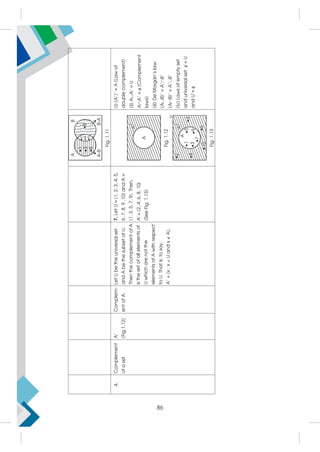
Fig.
1.10
(i)
A
–
B

B
–
A
(ii)
(A–B)

(AB)

(B–A)
=
AB
(iii)
A
–
B,
B
–
A
and
AB
are
disjoint
sets.
85
Fig.
1.11
4.
Complement
of
a
set
A'
(Fig.1.12)
Complem-
ent
of
A.
Let
U
be
the
universal
set
and
A
be
the
subset
of
U.
Then
the
complement
of
A
is
the
set
of
all
elements
of
U
which
are
not
the
elements
of
A
with
respect
to
U.
That
is,
to
say,
A'
=
{x
:
x

U
and
x

A}.
7.
Let
U
=
{1,
2,
3,
4,
5,
6,
7,
8,
9
,10}
and
A
=
{1,
3,
5,
7,
9}.
Then,
A'=
{2,
4,
6,
8,
10}
(See
Fig.
1.13)
Fig.
1.12
Fig.
1.13
(i)
(A')'
=
A
(Law
of
double
complement)
(ii)
AA'
=
U
AA'
=

(Complement
laws)
(iii)
De
Morgan's
law:
(AB)’
=
A’B’
(AB)’
=
A’B’
(iv)
Laws
of
empty
set
and
universal
set:
'=
U
and
U'=

86
Check your progress 3.3
Q.1 For the following sets, find their union and intersection.
(i) A = {x : x is the letter of the word 'MATHEMATICS'}.
B = {x : x is the letter of the word 'TRIGONOMETRY'}.
(ii) A = {x : x is a natural number less than 6}.
B = {x : x is a multiple of 2 from 1 to 10.}
(iii) A = {x : x = 2n - 1, nN} and B = {x : x = 2n, nN}
(iv) A = {2, 4, 6, 8, 10} and B = {2, 4}
(v) A = {x : x = sin  where 0    /2}
B = {x : x = cos  where 0    /2}
Q.2 Let U = {1, 2, 3, 4, 5, 6, 7, 8}; A = {1, 2, 3, 4}; B = {3, 4, 6}; C = {5, 6, 7, 8}, find:
(i) A – (B  C)
(ii) A  C'
(iii) B'  C'
(iv) B' A'
(v) A – (B  C)'
Q.3 Let U = {1, 2, 3, 4, 5, 6, 7, 8}; A = {1, 2, 3}; B = {2, 4, 6}, C = {3, 6, 9, 12}. Verify.
(i) (A  B)' = A'  B'
(ii) (A  B)' = A'  B'
(iii) A'  (B  C) = (A'  B)  (A' C)
(iv) A'  B = (A  B')'
(v) A' – B' = B – A
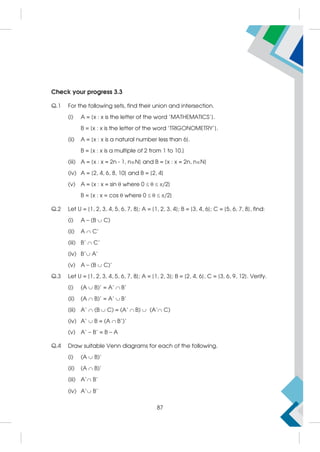
Q.4 Draw suitable Venn diagrams for each of the following.
(i) (A  B)'
(ii) (A  B)'
(iii) A' B'
(iv) A' B'
87
Q.5 Two finite sets have 'm' and 'n' elements. The total number of subsets of
the first set is 56 more than the total number of subsets of the second set.
Find the values of 'm' and 'n'.
Q.6 Let A = {a, b, c} and B = {a, b, c, d}. Is A B? What is AB? What is AB?
Q.7 Fill in the blanks.
(i) A'   = ___________
(ii) A  '= ___________
(iii) A  U' = ___________
(iv) A  U' = ___________
(v) A  ' = ___________
(vi) U'   = ___________
(vii) U'  ' = ___________
(viii) U'   = ___________
(ix) U'  ' = ___________
(x) U  ' = ___________
Q.8 If A = {1, 2, 3, 4}, then the number of subsets of set A containing element
3, is:
(i) 24
(ii) 28
(iii) 8
(iv) 16
Q.9 If A = {1, 2, 3, 4, 5}, B = {2, 4, 6} and C = {3, 4, 6}, then (A  B)  C is
(i) {3, 4, 6}
(ii) {1, 2, 3}
(iii) {1, 4, 3}
(iv) None of these
88
3.11 Practical Problems on Operations on Sets
In this section, we will now apply the concept of sets to our daily life situations
and solve some problems.
Let A, B and C be finite sets.
(i) n (A  B) = n (A) + n (B); if A  B =  i.e. A and B are disjoint.
(ii) n (A  B) = n (A) + n (B) – n (A  B) in general
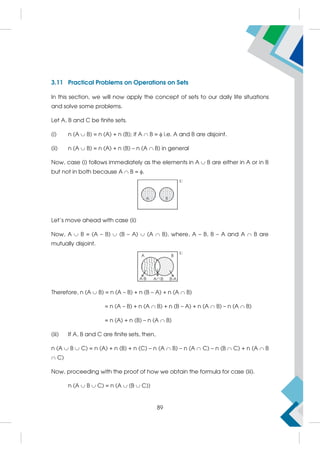
Now, case (i) follows immediately as the elements in A  B are either in A or in B
but not in both because A  B = .
Let's move ahead with case (ii)
Now, A  B = (A – B)  (B – A)  (A  B), where, A – B, B – A and A  B are
mutually disjoint.
Therefore, n (A  B) = n (A – B) + n (B – A) + n (A  B)
= n (A – B) + n (A  B) + n (B – A) + n (A  B) – n (A  B)
= n (A) + n (B) – n (A  B)
(iii) If A, B and C are finite sets, then,
n (A  B  C) = n (A) + n (B) + n (C) – n (A  B) – n (A  C) – n (B  C) + n (A  B
 C)
Now, proceeding with the proof of how we obtain the formula for case (iii).
n (A  B  C) = n (A  (B  C))
89
= n (A) + n (B  C) – n (A  (B  C)) (from case ii)
= n (A) + n (B) + n (C) – n (B  C) – n (A  (B  C)]
Since, A  (B  C) = (A  B)  (A  C)
 n (A  (B  C)) = n (A  B)  (A  C))
= n (A  B) + n (A  C) – n ((A  B)  (A  C))
= n (A  B) + n (A  C) – n (A  B  C)
 n (A  B  C) = n (A) + n (B) + n (C) – n (B  C) – n (A  C) – n (A  B) + n
(A  B  C)
Illustration 13: Out of 20 members in a family, 12 like tea and 15 like coffee.
Assume that each one likes atleast one of the two drinks, how many like.
(i) Both coffee and tea.
(ii) Only tea and not coffee
(iii) Only coffee and not tea
Solution:
(i) Let T denote the set of people who like tea and C be the set of people
who like coffee.
Therefore, n (T) = 12, n (C) =15 and n (T  C) = 20
Using the formula, n (T  C) = n (T) + n (C) – n (T  C)
20 = 12 + 15 – n (T  C)
 n (T  C) = 12 + 15 – 20 = 7
Hence 7 people like both tea and coffee.
90
(ii) n (T  C') = n (T) – n (T  C) = 12 – 7 = 5
Therefore, 5 people like to take tea but not coffee.
(iii) Now, n (C  T') = n (C) – n (T  C) = 15 – 7 = 8
Therefore, 8 people like to take coffee and not tea.
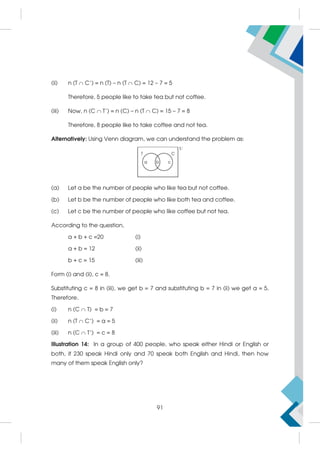
Alternatively: Using Venn diagram, we can understand the problem as:
(a) Let a be the number of people who like tea but not coffee.
(b) Let b be the number of people who like both tea and coffee.
(c) Let c be the number of people who like coffee but not tea.
According to the question,
a + b + c =20 (i)
a + b = 12 (ii)
b + c = 15 (iii)
Form (i) and (ii), c = 8.
Substituting c = 8 in (iii), we get b = 7 and substituting b = 7 in (ii) we get a = 5.
Therefore,
(i) n (C  T) = b = 7
(ii) n (T  C') = a = 5
(iii) n (C  T') = c = 8
Illustration 14: In a group of 400 people, who speak either Hindi or English or
both, if 230 speak Hindi only and 70 speak both English and Hindi, then how
many of them speak English only?
91
Solution:
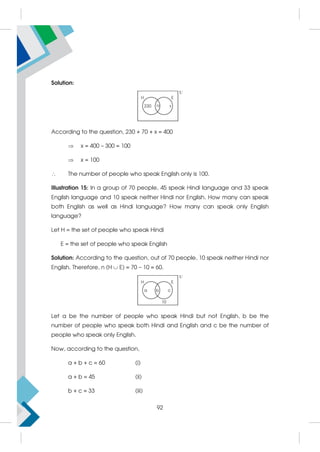
According to the question, 230 + 70 + x = 400
 x = 400 – 300 = 100
 x = 100
 The number of people who speak English only is 100.
Illustration 15: In a group of 70 people, 45 speak Hindi language and 33 speak
English language and 10 speak neither Hindi nor English. How many can speak
both English as well as Hindi language? How many can speak only English
language?
Let H = the set of people who speak Hindi
E = the set of people who speak English
Solution: According to the question, out of 70 people, 10 speak neither Hindi nor
English. Therefore, n (H  E) = 70 – 10 = 60.
Let a be the number of people who speak Hindi but not English, b be the
number of people who speak both Hindi and English and c be the number of
people who speak only English.
Now, according to the question,
a + b + c = 60 (i)
a + b = 45 (ii)
b + c = 33 (iii)
92
Therefore, from (i) and (ii), the number of people speaking English language
only is c = 15. Now, substituting c = 15 in (iii) we get number of people speaking
English and Hindi is b = 18.
Illustration 16: In a certain town, 25% of the families own a phone. 15% own a
car and, 65% families own neither a phone nor a car. 2000 families own both a
car and a phone. Find how much percentage of families own either a car or a
phone. Also, find how many families live in the town.
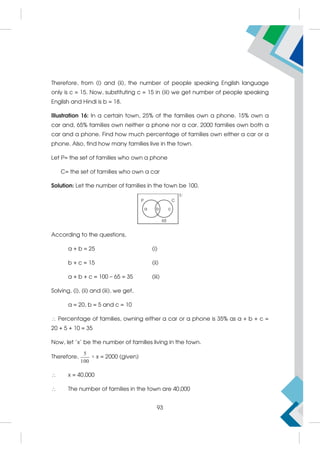
Let P= the set of families who own a phone
C= the set of families who own a car
Solution: Let the number of families in the town be 100.
According to the questions,
a + b = 25 (i)
b + c = 15 (ii)
a + b + c = 100 – 65 = 35 (iii)
Solving, (i), (ii) and (iii), we get,
a = 20, b = 5 and c = 10
 Percentage of families, owning either a car or a phone is 35% as a + b + c =
20 + 5 + 10 = 35
Now, let 'x' be the number of families living in the town.
Therefore,
5
100
× x = 2000 (given)
 x = 40,000
 The number of families in the town are 40,000
93
Illustration 17: Out of 500 car owners investigated, 400 owned car A and 200
owned car B, 50 owned both A and B cars. Is the data correct?
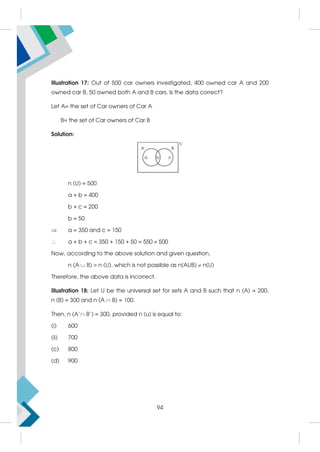
Let A= the set of Car owners of Car A
B= the set of Car owners of Car B
Solution:
n (U) = 500
a + b = 400
b + c = 200
b = 50
 a = 350 and c = 150
 a + b + c = 350 + 150 + 50 = 550  500
Now, according to the above solution and given question,
n (A  B)  n (U), which is not possible as n(AUB)  n(U)
Therefore, the above data is incorrect.
Illustration 18: Let U be the universal set for sets A and B such that n (A) = 200,
n (B) = 300 and n (A  B) = 100.
Then, n (A' B') = 300, provided n (u) is equal to:
(i) 600
(ii) 700
(c) 800
(d) 900
94
Solution:
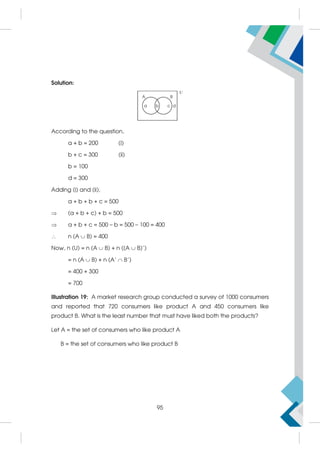
According to the question,
a + b = 200 (i)
b + c = 300 (ii)
b = 100
d = 300
Adding (i) and (ii),
a + b + b + c = 500
 (a + b + c) + b = 500
 a + b + c = 500 – b = 500 – 100 = 400
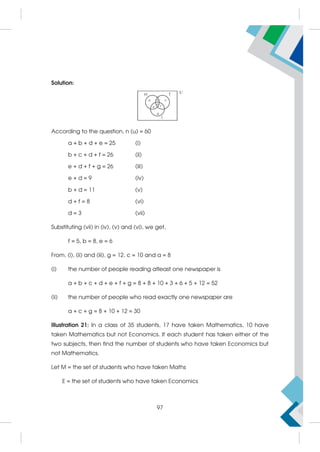
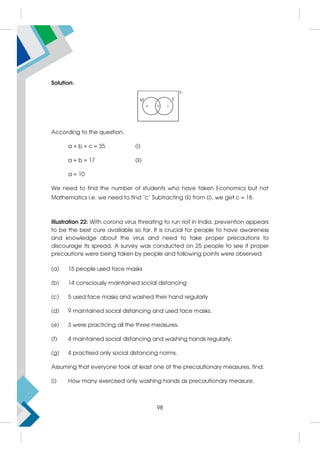
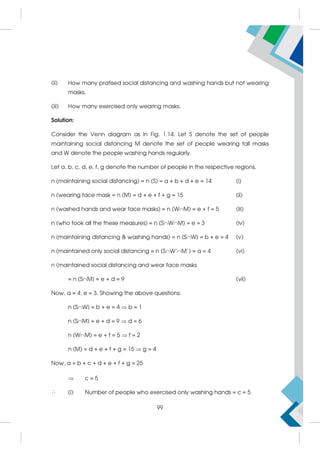
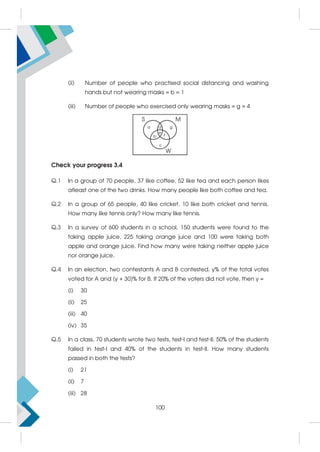
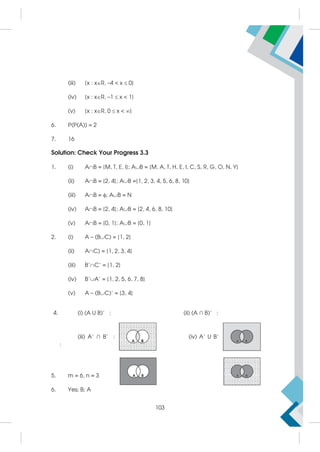
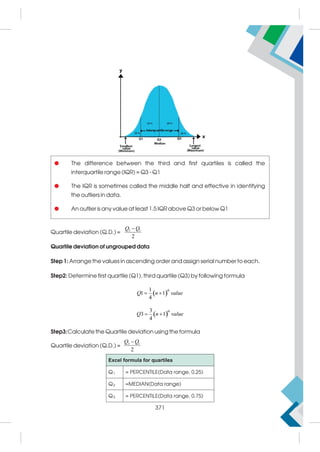
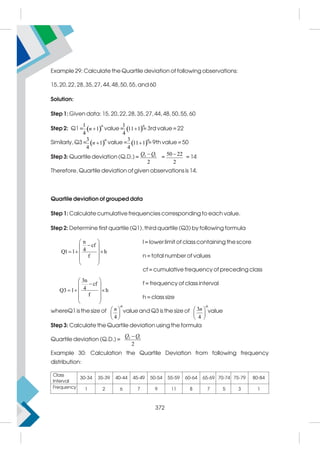
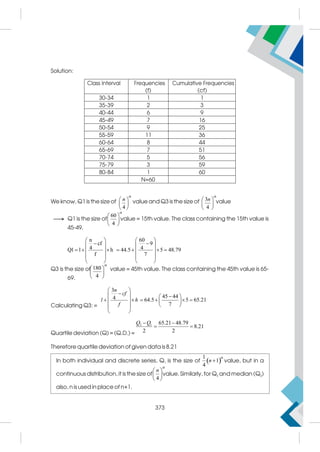
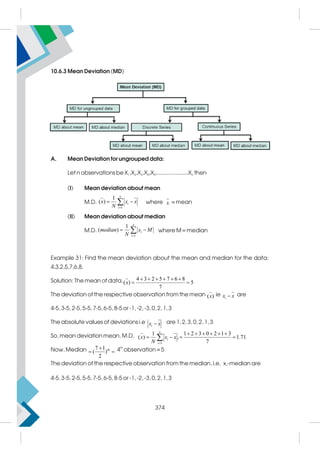
 n (A  B) = 400
Now, n (U) = n (A  B) + n ((A  B)')
= n (A  B) + n (A'  B')
= 400 + 300
= 700
Illustration 19: A market research group conducted a survey of 1000 consumers
and reported that 720 consumers like product A and 450 consumers like
product B. What is the least number that must have liked both the products?
Let A = the set of consumers who like product A
B = the set of consumers who like product B
95
Solution:
n (U) = 1000, let n (A) = x + y, n (b) = y + z and n (A  B) = y
 x + y = 720 (i)
y + z = 450 (ii)
Now, n (A  B)  n (U)
 x + y + z  1000 (iii)
Adding (i) and (ii) we get
(x + y + z) + y = 1170
Now from (iii), as x + y + z  1000
 (x + y + z) + y  1000 + y (adding y on both sides)
 1170  1000 + y
 y  170
Therefore, the least number that liked both the products is 170.
Illustration 20: In a survey of 60 people, it was found that 25 people read
newspaper H; 26 read newspaper T, 26 read newspapers I, 9 read both H and I,
11 read both H and T, 8 read both T and I and, 3 read all three newspapers.
Find:
(i) the number of people who read atleast one of the newspapers.
(ii) the number of people who read exactly one newspaper.
Let H = the set of people who read newspaper H
T = the set of people who read newspaper T
I = the set of people who read newspaper I
96
Solution:
According to the question, n (u) = 60
a + b + d + e = 25 (i)
b + c + d + f = 26 (ii)
e + d + f + g = 26 (iii)
e + d = 9 (iv)
b + d = 11 (v)
d + f = 8 (vi)
d = 3 (vii)
Substituting (vii) in (iv), (v) and (vi), we get,
f = 5, b = 8, e = 6
From, (i), (ii) and (iii), g = 12, c = 10 and a = 8
(i) the number of people reading atleast one newspaper is
a + b + c + d + e + f + g = 8 + 8 + 10 + 3 + 6 + 5 + 12 = 52
(ii) the number of people who read exactly one newspaper are
a + c + g = 8 + 10 + 12 = 30
Illustration 21: In a class of 35 students, 17 have taken Mathematics, 10 have
taken Mathematics but not Economics. If each student has taken either of the
two subjects, then find the number of students who have taken Economics but
not Mathematics.
Let M = the set of students who have taken Maths
E = the set of students who have taken Economics
97
Solution:
According to the question,
a + b + c = 35 (i)
a + b = 17 (ii)
a = 10
We need to find the number of students who have taken Economics but not
Mathematics i.e. we need to find 'c' Subtracting (ii) from (i), we get c = 18.
Illustration 22: With corona virus threating to run riot in India, prevention appears
to be the best cure available so far. It is crucial for people to have awareness
and knowledge about the virus and need to take proper precautions to
discourage its spread. A survey was conducted on 25 people to see if proper
precautions were being taken by people and following points were observed:
(a) 15 people used face masks
(b) 14 consciously maintained social distancing
(c) 5 used face masks and washed their hand regularly
(d) 9 maintained social distancing and used face masks.
(e) 3 were practicing all the three measures.
(f) 4 maintained social distancing and washing hands regularly.
(g) 4 practised only social distancing norms.
Assuming that everyone took at least one of the precautionary measures, find:
(i) How many exercised only washing hands as precautionary measure.
98
(ii) How many pratised social distancing and washing hands but not wearing
masks.
(iii) How many exercised only wearing masks.
Solution:
Consider the Venn diagram as in Fig. 1.14. Let S denote the set of people
maintaining social distancing M denote the set of people wearing fall masks
and W denote the people washing hands regularly.
Let a, b, c, d, e, f, g denote the number of people in the respective regions.
n (maintaining social distancing) = n (S) = a + b + d + e = 14 (i)
n (wearing face mask = n (M) = d + e + f + g = 15 (ii)
n (washed hands and wear face masks) = n (WM) = e + f = 5 (iii)
n (who took all the these measures) = n (SWM) = e = 3 (iv)
n (maintaining distancing  washing hands) = n (SW) = b + e = 4 (v)
n (maintained only social distancing = n (SW'M') = a = 4 (vi)
n (maintained social distancing and wear face masks
= n (SM) = e + d = 9 (vii)
Now, a = 4, e = 3. Showing the above questions:
n (SW) = b + e = 4  b = 1
n (SM) = e + d = 9  d = 6
n (WM) = e + f = 5  f = 2
n (M) = d + e + f + g = 15  g = 4
Now, a + b + c + d + e + f + g = 25

 c = 5
(i) Number of people who exercised only washing hands = c = 5
99
(ii) Number of people who practised social distancing and washing
hands but not wearing masks = b = 1
(iii) Number of people who exercised only wearing masks = g = 4
Check your progress 3.4
Q.1 In a group of 70 people, 37 like coffee, 52 like tea and each person likes
atleast one of the two drinks. How many people like both coffee and tea.
Q.2 In a group of 65 people, 40 like cricket, 10 like both cricket and tennis.
How many like tennis only? How many like tennis.
Q.3 In a survey of 600 students in a school, 150 students were found to the
taking apple juice, 225 taking orange juice and 100 were taking both
apple and orange juice. Find how many were taking neither apple juice
nor orange juice.
Q.4 In an election, two contestants A and B contested. y% of the total votes
voted for A and (y + 30)% for B. If 20% of the voters did not vote, then y =
(i) 30
(ii) 25
(iii) 40
(iv) 35
Q.5 In a class, 70 students wrote two tests, test-I and test-II. 50% of the students
failed in test-I and 40% of the students in test-II. How many students
passed in both the tests?
(i) 21
(ii) 7
(iii) 28
100
(iv) 14
Solution: Check Your Progress 3.1
1. (ii), (iii), (iv) are sets.
2. (i) A = {x : x = 4n, where n = 1, 2, 3, 4, 5}
(ii) B = {x : x is a prime number}
(iii) C = {x : x is a consonant}
(iv) D = {x : x is a solution of the equation x2
– 1 = 0}
(v) E = {x : x is a prime number between 40 and 50}
(vi) F={x:x=
1
n
, where n  N
(vii) G = {x : x = 2
1
n
where n  N
3. (i) A = {1, 2, 3, 4}
(ii) B = {–3, –2, –1, 0, 1, 2, 3, 4, 5, 6}
(iii) C = {F, O, L, W}
(iv) D = {15, 24, 33, 42, 51, 60}
(v) E = {A, R, I, T, H, M, E, C}
4. (i) c
(ii) e
(iii) a
(iv) b
(v) d
5. (i) 
(ii) 
(iii) 
(iv) 
101
(v) 
Solution: Check Your Progress 3.2
1. (i) Finite; cordiality : 99
(ii) Infinite
(iii) Finite; cordiality : 7
(iv) Infinite
(v) Infinite
(vi) Infinite
2. (i) Singleton
(ii) Empty set
(iii) Singleton
(iv) Singleton
(v) Empty
3. (i), (ii), (iii)
4. (i) 
(ii) 
(iii) 
(iv) 
(v) 
(vi) 
 vii 
5. (i) {x : xR, 1  x  3}
(ii) {x : xR, –1  x  3}
102
(iii) {x : xR, –4  x  0}
(iv) {x : xR, –1  x  1}
(v) {x : xR, 0  x  }
6. P(P(A)) = 2
7. 16
Solution: Check Your Progress 3.3
1. (i) AB = {M, T, E, I}; AB = {M, A, T, H, E, I, C, S, R, G, O, N, Y}
(ii) AB = {2, 4}; AB ={1, 2, 3, 4, 5, 6, 8, 10}
(iii) AB = ; AB = N
(iv) AB = {2, 4}; AB = {2, 4, 6, 8, 10}
(v) AB = {0, 1}; AB = {0, 1}
2. (i) A – (BC) = {1, 2}
(ii) AC) = {1, 2, 3, 4}
(iii) B'C' = {1, 2}
(iv) B'A' = {1, 2, 5, 6, 7, 8}
(v) A – (BC)' = {3, 4}
4. (i) (A U B)’ : (ii) (A ∩ B)’ :
(iii) A’ ∩ B’ : (iv) A’ U B’
:
5. m = 6, n = 3
6. Yes; B; A
103
7. (i)  (ii) A
(iii) A (iv) 
(v) A (vi) 
(vii)  (viii) 
(ix) U (x) U
8. (iii) 8
9. (i) {3, 4, 6}
Solution: Check Your Progress 1.4
1. 19
2. 25; 35
3. 325
4. (iii) 25
5. (ii) 7
104
Summary
This chapter deals with basic definitions, operations and practical problems
involving sets. These are summarised below:
 A set is a well-defined collection of distinct objects.
 Representation of sets in Roster or Tabular form and set builder form.
 Types of sets:
(a) A set which does not contain any element is called an empty set.
(b) A set which contains only one element is called a singleton set.
(c) A set which contains definite number of elements is called a finite
set, otherwise it is called an infinite set.
(d) Two sets are said to be equal if they have exactly the same
elements.
(e) A set 'A' is said to be a subset of a set 'B', if every element of A is
also an element of B.
(f) Power set of a set A is the set of all the subsets of A and is denoted
by P(A).
(g) A set that contains all the elements in a given context is called a
universal set and is denoted by U.
(h) Intervals are also subsets of R, set of real numbers.
 Venn diagrams
 Operations on set
(a) Union of two sets A and B is the set of all those elements which are
either in A or in B.
(b) Intersection of two sets A and B is the set of all elements which are
common to both A and B.
105
(c) Difference of sets A and B in this order is the set of elements which
belong to A but not to B.
(d) The complement of a set A, which is a subset of U, the universal set,
is the set of all elements of U which are not the elements of A.
 De Morgan's Law: For any two sets A  B, (AB)' = A'B' and (AB)' = A'
 B'.
 If A and B are finite sets, then if:
(a) A  B = , then n (AB) = n (A) + n (B)
(b) A  B  , then n (AB) = n (A) + n (B) – n(AB)
106
107
Concept Map
4.1 Introduction
A relation is a way in which two or more people or things are connected. In day
to day life, we come across many such relations, such as, brother and sister,
mother and daughter, teacher and student, table and its cost price and the list
is endless. In mathematics too, we come across many relations, for e.g., number
'y' is twice the number 'x', set A is a subset of set B, a line l1 is parallel to line l2,
volume of a sphere with its radius r is 𝜋𝑟 and so on. In all these examples we
observe that a relation involves pairs of objects in a certain order.
In this chapter, we will understand how to connect pairs of objects from two sets
and then define a relation between two objects of the pair. After having
understood the concept of relations, we would do different types of relations.
For understanding 'relation', we first need to know about ordered pairs and
Cartesian product of sets.
108
4.2 Ordered Pair
What is an ordered pair?
Definition 1: An ordered pair is a pair of objects taken is a specific order and the
order in which they appear in the pair is significant. The ordered pair is written as
(a, b), where 'a' is the first member of the pair and 'b' is the second member of
the pair.
For example, if we form pairs of stationery items along with its price, we may
write it as (pencil, Rs. 1), (pen, Rs. 10), (eraser, Rs. 5) and so on. It is evident from
these examples, that the first member represents the stationery item and
second member, its cost per piece.
Definition 2: Equality of ordered pairs:
Two ordered pairs (a, b) and (c, d) are said to be equal if a = c and b = d, that
is, to say,
(a, b) = (c, d)  a = c and b = d
Note:
1. The order in which the elements of the pair occur should be meaningful.
2. The ordered pairs (a, b) and (b, a) are different, unless a = b.
3. Neither (a, b) represents an interval nor does it represent a set {a, b}.
Illustration 1: If the ordered pairs (2x, y – 3) and (2, 1) are equal, then find x and
y.
Solution: Since, (2x, y – 3) = (2, 1), we have
2x = 2 and y – 3 = 1
 x = 1 and y = 4
Illustration 2: Find 'x' and 'y' if (x2
– 4x, y2
– y) = (–4, 6)
Solution: Since, (x2
– 4x, y2
– y) = (–4, 6)
109
 x2
– 4x = – 4 and y2
– y = 6
 x2
– 4x + 4 = 0 and y2
– y – 6 = 0
 (x – 2)2
= 0 and (y – 3) (y + 2) = 0
 x = 2 and y = –2, 3
4.3 Cartesian Product of Two Sets
Let P and Q be two non-empty sets. Then the Cartesian product of P and Q in
this order is written as P x Q and is defined as the set of all ordered pairs (p,q)
such that p  P, q  Q that is,
P x Q = {(p, q) : p  P, q  Q}
Illustration 3: Let A = {a, b, c}, B = {1, 2}
Find A x B and B x A. Is A x B = B x A?
Solution: Given A = {a, b, c} and B = {1, 2}, then by definition of Cartesian
product, we have,
A x B = {(a, 1), (a, 2), (b, 1), (b, 2), (c, 1), (c, 2)}
B x A = {(1, a), (2, a), (1, b), (2, b), (1, c), (2, c)}
Here, A x B and B x A do not have exactly the same elements (ordered pairs)
 A x B  B x A
We conclude that, in general, A x B  B x A.
In case A x B = B x A, then A = B
Note:
1. In general A x B  B x A. In case A x B = B x A, then A = B.
2. A x B = ø if either A or B or both are empty sets.
3. A x B  ø if both A and B are non-empty sets.
4. n (A x B) = n(A) x n(B), where n (A) denotes the number of elements in the
set A, that is,
110
if n (A) = p and n (B) = q, then
n (A x B) = pq
5. A x B x C = {(a, b, c) : a  A, b  B, c  C}
Here, (a, b, c) is called an ordered triplet and n(A x B x C) = n(A) x n(B) x
n(C)
6. If A and B are non-empty sets and either A or B is infinite then (A x B) is also
an infinite set.
Let us understand Cartesian product of two sets, say, A and B, through arrow
diagrams.
Let A = {1, 2, 3} and B = {a, b}. Then n(A x B) = 3 x 2 = 6
A x B = {(1, a), (1, b), (2, a), (2, b), (3, a), (3, b)}
Illustration 4: Let A = {2, 3} and B = {4, 5}. Find:
1. A x B
2. B x A
3. n (A x B)
4. number of subsets of A x B
Solution: Now, A = {2, 3}, B = {4, 5}
1. A x B = {(2, 4), (2, 5), (3, 4), (3, 5)}
2. B x A = {(4, 2), (4, 3), (5, 2), (5, 3)}
3. n (A x B) = n (A) x n(B) = 2 x 2 = 4
4. Now n(A x B) = 4
111
 Number of subsets of A x B are 24
= 16
Note: A x B and B x A are equivalent sets as the n(A x B) = n(B x A)
Illustration 5: If A x B = {(a, x), (a, y), (b, x), (b, y)}, then find A and B.
Solution: A x B = {(a, x), (a, y), (b, x), (b, y)}
Then, A = {a, b} and B = {x, y}
Illustration 6: If (–1, 1), (2, 3), (1, 0), (2, 1) are some of the elements of A x B, then
find A and B. Also find the remaining elements of A x B.
Solution: Given (–1, 1), (2, 3), (1, 0), (2, 1)  A B
 A = {–1, 1, 2}, B = {0, 1, 3}
 n (A x B) = 9
Therefore, there are 5 remaining elements which are:
(–1, 3), (–1, 0), (2, 0), (1, 1) and (1, 3)
4.4 Relations
Consider two non-empty sets, say, A = {a, b, c} and set B = {apple, apricot,
banana, custard apple, mango}.
Now, the Cartesian product of A and B, i.e., A x B has 15 elements, listed as
A x B = {(a, apple), (a, apricot), (a, banana)..... (c, mango)}
Refer to Fig. 1 to depict A x B using arrow diagram
112
We can now obtain a subset of A x B by defining a relation R between the first
element belonging to A and second belonging to B of each ordered pair (a, b)
as:
R = {(a, b) : a is the first letter of the name of the fruit in B, a  A, b  B}
Therefore, R = {(a, apple), (a, apricot), (b, banana), (c, custard apple)}
Here, R is said to be a ‘Relation from the set A to the set B’
An arrow diagram of this relation R is as shown in Figure 2.
R:
Note: A Relation 'R' from a set A to a set B is a subset of A x B.
Definition 3: A relation 'R' from a non-empty set A to a non-empty set B is
defined to be a subset of Cartesian product A x B. If (a,b) R, then the second
elements is called the image of the first element a. Further, we say that a is
R - related to b and we write a R b.
Definition 4: The set of all the first elements of the ordered pairs in a relation 'R'
from set A to a set B is called the domain of the relation R.
Definition 5: The set of all second elements in a relation R from a set A to a set B
is called the range of the relation R. The entire set B is called the co-domain of
the relation R.
Note: Range  co-domain
Illustration 6: Let A = {1, 2, 3, 4, 5, 6}. Define a relation R from A to A by:
R = {(x, y) : x  y}
113
Note : A Relation from A to itself is called a relation defined on A (or simply, a
relation in A)
1. Write the given relation in tabular or roster form.
2. Define this relation using an arrow diagram.
3. Write the domain, range and co-domain of R.
Solution:
1. R = {(2, 1), (3, 1), (3, 2), (4, 1), (4, 2), (4, 3), (5, 1), (5, 2), (5, 3), (5, 4), (6, 1), (6,
2), (6, 3), (6, 4), (6, 5)}
2.
3. Domain = {2, 3, 4, 5, 6}
Range = {1, 2, 3, 4, 5}
Co-domain = A={1,2,3,4,5,6}
Illustration 7: Let A be a non-empty set with n(A) = 3. Find the number of
relations from set A to itself.
Solution: By the definition, a relation from any set A to set B is a subset of A x B.
Now, n(A x A) = n(A) n(A) = 9
 Number of subsets of A x A are 29
.
Note: Let R be a relation from set A to set B, where n(A) = p and n(B) = q.
Then the total number of relations from A to B are given by 2pq
as relations are
subsets of A x B and number of subsets of the set A x B containing pq
elements are 2pq
.
114
4.5 Types of Relations
In this section we would be discussing different types of relations. In this section,
we will also be dealing with functions from set A to itself.
Definition 6: Empty Relation
A relation R in a set A is called empty relation, if no element of A is related to
any element of A, i.e., R = ϕ A x A.
Illustration 8: Let A be the set of all natural numbers. Define R = {(x, y);  0; x, y
 A}.
Solution: Since all natural numbers are always greater than zero, therefore,
division of no two natural numbers will give a negative real number. This shows
that relation R on A x A is an empty relation.
Definition 7: Universal Relation
A relation R in a set A is called universal relation, if each element of A is related
to every element of A, i.e., R = A x A.
Illustration 9: Let A = {1, 2, 3, 4, 5}
Define R = {(x, y) : x + y  N; x, y  A}
Solution: R = {(x, y) : x + y  N; x, y  A}
= {(1, 1), (1, 2), (1, 3), (1, 4), (1, 5), (2, 1), (2, 2), (2, 3), (2, 4), (2, 5), (3, 1), (3, 2),
(3, 3), (3, 4), (3, 5), (4, 1), (4, 2), (4, 3), (4, 4), (4, 5), (5, 1), (5, 2), (5, 3), (5, 4), (5,
5)}
= A x A
Hence, R is a universal relation
115
Equivalence relations
Let us introduce equivalence relation, which is one of the most important
relations and plays a very significant role. In order to study equivalence relation
we first understand the three types of relations, i.e., reflexive, symmetric and
transitive.
Definition: A relation R in a set A is called
1. Reflexive, if (a, a)  R, for every a  A
2. Symmetric, if (a, b)  R  (b, a)  R, for all a, b  A
3. Transitive, if (a, b)  R and (b, c)  R
 (a, c)  R, for all a, b, c  A
Definition: A relation R in a set A is said to be an equivalence relation if R is
reflexive, symmetric and transitive.
Example 1: Let T be the set of all triangles in a plane with R a relation in T given
by
R = {(T1, T2) : (T1  T2}. Show that R is an equivalence relation.
Solution: R is reflexive Let T1  T
Since every triangle is similar to itself.
i.e, T1  T1  T1  T
This means that (T1, T1)  T V T1T
Therefore, R is reflexive relation
R is symmetric Let T1, T2  T such that T1 ~ T2
Then T2  T1 we conclude R is a symmetric relation.
R is transitive Let T1, T2, T3  T such that (T1, T2), (T2, T3)  T
Then T1  T2 and T2  T3  T1  T3  (T1, T3)  T
Hence R is also transitive
Since R is reflexive, symmetric and transitive. Therefore R is an equivalence
relation.
116
Example 2: Let S be any non empty set and R be a relation defined on
power set of S i.e. on P(S) by A R B iff A  B for all A, B  P(S). Show that R is
reflexive and transitive but not symmetric.
Solution: R is reflexive
For every A  P(S), A A i.e., A R A
R is not symmetric
We have , A  P (s) where A contains at least one element.  A, But A  
Hence R is not symmetric
R is transitive
For A, B, C  P(S), if A  B and B  C  A  C
Thus for, (A, B), (B, C)  R  (A, C)  R V A, B, C  PS
Hence R is transitive
Example 3: Show that the relation R in the set Z of integers given by
R = {(a, b) : 3 divides a – b}
is an equivalence relation.
Solution: R is reflexive
As 3 divides (a – a) for every a  Z ,  (a, a)  R Va  Z
R is symmetric
If (a, b)  R then 3 divides a – b
i.e. a – b = 3, where  is any integer
 b – a = –3
then 3 divides b – a
 (b, a)  R
Therefore R is symmetric
R is transitive
If (a, b), (b, c)  R
Then 3 divides (a – b) and (b – c)
117
a – b = 3 and b – c = 3, where  and  are intergers
a – c = (a – b) + (b – c) = 3 + 3
a – c = 3(+)
a – c = 3k  a – c = 3 (an Integer)
3 divides a – c  (a, c)  R
This shows R is transitive
Thus, R is an equivalence relation in Z.
Exercise
1. Determine whether each of the following relations are reflexive,
symmetric and transitive.
(i) Relation R in a set S = {1, 2, 3, 4, 5} as R = {(x, y) : y is divisible by x}
(ii) Relation R in a set L of all lines in a plane as R = {(L1, L2) : L1  L2}
2. Show that the relation R in the set R of real numbers, defined as R = {(a, b)
: a  b2
} is neither reflexive nor symmetric nor transitive.
3. Show that the relation R in the set Z of integers given by R = {(a, b) : 2
divides a – b} is an equivalence relation.
4. If X = {1, 2, 3, 4}, give an example on X which is
(i) reflexive and symmetric but not transitive.
(ii) Symmetric and transitive but not reflexive.
(iii) Neither reflexive, nor symmetric but transitive.
5. If R1 and R2 are equivalence relations in set A, show that R1  R2 is also an
equivalence relation.
Solution:
1. (i) reflexive, not symmetric, transitive
(ii) not reflexive, symmetric, not transitive
118
Functions
After having understood the concept of relations, let's now briefly try to
understand special type of relations called functions, which will later be
discussed in detail in calculus.
Definition: Let A and B be two non-empty sets. A function 'f' from set A to set B is
a special type of relation from A to B which assigns to every element in A a
unique image in B. Set A, is called the domain of 'f' and elements of set B which
have pre-image in A is called the range of 'f'. Set B is called co-domain of ‘f’.
Therefore, Range  co-domain
The function 'f' from A to B is denoted by f: A  B. Consider the following
example.
Example: Examine each of the following relations given below and state, giving
reasons whether it is a function or not?
(i) R = {(2, 1), (3, 2), (4, 1), (5, 2), (3, 3)}
(ii) R = {(1, 2), (2, 3), (3, 4), (4, 5)}
(iii) R = {(1, 1), (2, 1), (3, 1), (4, 1)}
(iv) R = {(1, 1), (1, 2), (1, 3)}
Solution: In this case, domain of R, say, A = {2, 3, 4, 5} and range, say,
B = {1, 2, 3}.
Consider the following arrow diagram from set A to set B.
The given relation is not a function from A to B as there exists an element '3' in
the domain which does not have a unique image. (It has two images 2 and 3)
119
(ii) In this case, domain of R, say, P = {1, 2, 3, 4} and range, say, Q = {2, 3, 4, 5}
According to the arrow diagram, depicting this relation, is given below:
R is a function as every element in P has a unique image in Q.
(iii) Consider set A={1,2,3,4} and set B={1} Representing the relation by arrow
diagram
Relation R is a function from A to B as every element of set A have unique
image in set B. Domain of function is A = {1,2,3,4} and range B = {1}
Consider case
(iv). Here, domain of the relation R, is, say A = {1} and range, say B = {1, 2, 3}.
Representing this relation pictorially, we get:
120
This relation R is not a function from A to B as the element '1' in the domain
doesn't have a unique image in B.
Example: Consider the following arrow diagrams depicting relations from set A
to set B. Which amongst them are functions? Give reasons.
(i) (ii)
(iii) (iv)
(v)
Solution: Only Fig. (i) and Fig. (iii) depict functions as every element in set A has
a unique image in set B.
In Fig. (ii), the relation is not a function as '3' doesn't have an image in B. Hence,
not a function.
In Fig. (iv) element 'a' has two images in set B. Hence, not a function.
121
In Fig. (v), element 'a' has two images in B and also element 'c' has no image in
'B'. Hence, not a function.
Example: Find the domain and range of each of the following real functions:
(i) f(x) = x2
(ii) f(x) =
Solution:
(i) f(x) = x2
Domain: R, set of real numbers
Range: [0, ) or non-negative real numbers.
(ii) f(x) =
Domain: R – {0}, Range: R – {0}
122
Summary :
The main features of this section are :
 Ordered pair : A pair of object or elements in a specific order
 Cartesian product of A x B of two sets A and B is given by
A x B ={(a,b) : a  A and b  B.
 If n(a) = p and n(B) = q then n (A x B) = pq and number of relations possible
from A to B are 2pq
 In general, A x B  B x A. In case A x B = B x A, then A = B.
 Relation ‘R’ from a non-empty set A to a non-empty set B is a subset of
Cartesian product A x B, which is derived by defining a relationship
between the first element and the second element of the ordered pair
A x B.
 Image is the second element of the ordered pairs in the given relation
 The domain of a relation R is the set of all the first elements of ordered pairs
in a relation R.
 The range of a relation R is the set of all second elements of ordered pairs
in relation R.
 A Relation R in a set A is called an empty relation if no element of A is
related to any element of A.
 A relation R in a set A is called a universal relation if each element of A is
related to every element of A
 A relation R on a set A is said to be:
i) Reflexive if (a,a)  R, for every a  A
ii) Symmetric if (a,b)  R  (b,a)  R, where a, b  A
iii) Transitive if (a,b)  R and (b,c)  R then (a,c)  R where a,b,c  A
 A relation R which is reflexive, symmetric and transitive is called an
equivalence relation.
123
125
Concept Map :
5.1 Introduction
As in ordinary English, in mathematics too, sequence means a particular order in
which one thing follow another.
This in turn means as in that ordered collection, we would be able to identify
first, second, third members and so on. For example, the house numbers when
you walk down the street, the population growth whether it be in human beings
or bacteria, the amount of money deposited in bank, all form a sequence;
hence conforming that sequences do have important applications in many
spheres of life.
Sequence, following a specific pattern is called progression. In standard tenth,
you have studied about arithmetic progression or A.P. In this chapter in addition
to A.P., we would be discussing about arithmetic mean, geometric progression,
geometric mean and relationship between arithmetic mean and geometric
mean.
126
5.2 Sequences
Let us consider the following example:
A TV manufacturer has produced 1200 TVs in his first year of production.
Assuming the production increases uniformly by a fixed number every year, say
200 per year. Find the number of TV sets produced in 5th year.
Now here, starting from the first year, the number of TV sets produced in 1st,
2nd, 3rd, 4th  5th year would be 1200, 1400, 1600, 1800 and 2000 respectively.
These numbers form a sequence.
Moreover, this type of sequence which has countable number of terms is called
a finite sequences, otherwise it is an infinite sequence, where the number of
elements is uncountable.
The various numbers occurring in the sequence are called terms and are
denoted by a1, a2, .... an, where the subscripts denote the position of the term in
the squence. The nth
term is the number at the nth
position of the sequence and
is denoted by an.
This nth
term is called the general term of the sequence. So, in the above
example,
a1 = 1200, a2 = 1400, ..... a5 = 2000
A sequence may not only be obtained by adding a fixed constant to the
preceding term as seen in the above example, but it may also be obtained by
multiplying a fixed non-zero real number to the preceding term.
For example, a child has 2 parents, further those parents have two parents, and
so continuing in this manner, the child has 4 grandparents, 8 great
grandparents, and so on. Now, in this case the sequence formed may be noted
as 2, 4, 8, ..... and so on.
This type of sequence is obtained by multiplying the preceding term by non-
zero constant 2. This type of sequence is called a geometric progression. Here,
a1 = 2, a2 = 4 and so on and the multiplying factor 2 is called the common ratio.
127
Series
Let a1, a2, ..... an be a given sequence. Then the expression a1 + a2 + a3 + ..... + an
+ ..... is called the series associated with a given sequence.
5.3 Arithmetic Progression
5.3.1 Definition 1: A sequence a1, a2, a3, ....., an, ..... is called an arithmetic
progression (A.P.), if the difference of any term and its immediate preceding
term is always the same, i.e.
an+1 – an = constant, say, 'd', for all nN,
or an+1 = an + d.  nN
This constant difference ’d’ is called the common difference. The term 'a1' in
the above sequence is called the first term.
Let us consider all the terms of the sequence a1, a2, ..... an, ..... in terms of only
the first term and the common difference.
Let the first term 'a1' be denoted by 'a' and common difference by 'd'.
Therefore,
a2 = a1 + d = a + d = a + (2 – 1)d
a3 = a2 + d = (a + d) + d = a + 2d = a + (3 – 1)d
a4 = a3 + d = (a +2d) + d = a + 3d = a + (4 – 1)d
an = a + (n – 1)d
Hence, the nth
term (general term) of the AP is:
an = a + (n – 1)d
Illustration 1: Find the first three terms of the arithmetic progressions whose nth
term is given. Also find the common difference and the 20th term in each case.
128
(i) an = 2n + 5
Now a = a1 = 2(1) + 5 = 7
a2 = 2(2) + 5 = 9
a3 = 2(3) + 5 = 11
Therefore, d = a2 – a1 = 9 – 7 = 2
 a20 can either be found from 'an'=2n+5 putting n=20 or given by
substituting the value of 'a'  'd' in an.
 either; a20 = 2(20) + 5 = 45
or a20 = a + (n – 1) d = 7 + (20 – 1) × 2
= 7 + 2 × 19 = 45
(ii) an = 3 – 4n
a1 = 3 – 4 (1) = –1
a2 = 3 – 4 (2) = –5
a3 = 3 – 4 (3) = –9
Therefore, d = a2 – a1 = –5 – (–) = –4
You, may also calculate d as d = a3 – a2 = –9 – (–5) = –4
Hence, a20 = a + (n – 1)d = –1 + 19 (–4) = –77
(iii) an =
3
4
n
a1 =
1 3 1
4 2

 
a2 =
2 3 1
4 4

 
a3 =
3 3
4

= 0
129
Therefore, d = a2 – a1 =
1 1 1 1 1
4 2 4 2 4

 
     
 
 
or d = a3 – a2 =
1 1
0
4 4
 
  
 
 
Here a20 =
20 3 17
4 4


Hence, from above Illustration we may note that the terms of an AP or the
common difference, both can be any real number.
Let's Check on Some Properties of an A.P.
5.3.2 Properties of an A.P.
Property (i): If a constant is added to each term of an A.P., the resulting
sequence is also an A.P. with same common difference as the
previous one.
Example: Let us consider an AP: 1, 3, 5, 7, .....
In this sequence, d = 2
Now add a constant, say, 5, to each term,
We get a new sequence, 6, 8, 10, 12, ..... which is also an A.P.
with common difference d = 2.
Note that though the terms in the two sequences change, but
the common difference remains the same.
Property (ii): If a constant is subtracted from each term of an A.P., the
resulting sequence is also an A.P., again, with same common
difference as the previous sequence.
Example: Let us consider an A.P.: 8, 5, 2, –1, –4, .....
In this sequence, d = –3
Now subtract a constant, say, 5, from each term.
130
We get a new sequence: 3, 0, –3, –6, –9, ....., which is again A.P.,
an with the same common difference d = –3.
Property (iii): Similarly if each term of an AP is multiplied by a constant, then
the resulting sequence is also an A.P.
Example: Let us consider the sequence: 5, 9, 13, 17, ....., an A.P.
Here, d = 4
Now, multiply each term by, say, –4, we get a new sequence.
–20, –36, –52, –68, ..... which is again an A.P., with d = –16
Please note in this case the common difference is –4d.
So, we may conclude that the common difference in this case is
the product of the common difference and the number with
which each term is multiplied.
So, if in an A.P., with common difference, 'd', each term is
multiplied with a non-zero constant, say ' b', then the common
difference of new AP would be 'bd'.
Property (iv): If each term of an A.P. is divided by a non-zero constant, then,
the resulting sequence is also an A.P. In this case, the common
difference of the new A.P. will be obtained by dividing the
common difference of the original sequence by the non-zero
constant with which each term was divided.
Property (v): A sequence is an A.P. if its nth
term is a unique linear expression in
n i.e., an = An + B. In such cases, the coefficient of 'n' i.e. A is
always the common difference.
Property (vi): In a finite A.P., a1, a2, a3, ..... an the sum of the terms equidistant
from the beginning and end is always the same and is equal to
the sum of its first and last term.
131
i.e. if a1, a2, a3, ....., an–2, an–1, an is an A.P. then
a1 + an = a2 + an–1 = a3 + an–2 = ......
Property (vii): If the terms of an A.P. are chosen at regular intervals, then they
form an A.P.
i.e. if a1, a2, a3, a4, a5, a6, a7 are in AP, then
a1, a3, a5, a7, chosen at same interval are also in A.P.
Property (viii): Three numbers a, b, c are in A.P. if 2b = a + b
This is because, b – a = c – b  2b = a + c
Let us understand, what are the applications of arithmetic progression in daily
life.
(a) The Saving Schemes: When you save some amount of money in the
bank, you earn an increment to it. For example, if you deposit Rs. 1000
and every year you earn an increment of Rs. 100 this would make an A.P..
You can also calculate the total amount received by you in a particular
year that you require.
(b) A Taxi Fare: A taxi ride can cost you fixed change. For example, for the
first one kilometer, it can cost you Rs. 25 and the next subsequent
kilometer that you cover, it would cost you additional Rs. 10. For each
kilometer. Therefore, Rs. 25, Rs. 35, Rs. 45, ..... would make an A.P.
Illustration 2: In a sequence, the nth
term is an = 2n2
+ 5. Show that it is not an A.P.
Solution: Given: an = 2n2
+ 5
a1 = 7, a2 = 13, a3 = 23, a4 = 37......
Now, a2 – a1 = 6
a3 – a2 = 10
Since the common difference between any two consecutive terms is not the
same, therefore it is not an A.P.
132
Illustration 3: Find the number of identical terms in the two sequences:
1, 5, 9, 13, 17, ....., 197 and 1, 4, 7, 10, 13, ..... 196
Solution: We will first find the number of terms in the two sequences.
Let the number of terms in first sequence be 'n'.
Therefore, 197 = a + (n - 1)d, as 197 is the last nth
term of the sequence.
 197 = 1+ (n – 1) × 4 = 1 + 4 (n-1)

196
4
= n – 1  n = 50
Let the number of terms in the second sequence be 'm'.
This implies, 196 = a + (m-1)d
 196 = 1+ (m – 1) × 3 = 1+3(m-1)

195
3
= m – 1
 m = 66
Now, According to the question, let pth
term of first sequence be equal to the
qth
term of the second sequence.
 a1 + (p – 1) d1 = A1 + (q – 1) D1
1+ 4(p – 1) = 1 + 3(q – 1)

1
3
p 
=
1
4
q
= k (say)
 p = 3k + 1, q = 4k + 1
Now since first A.P. contains 50 terms, therefore,
p  50  3k + 1  50  K 
49
3
 k 
1
16
3
133
Since second A.P. contains 66 terms, therefore,
q  66  4k + 1  66
 k 
65
4
=
1
16
4
But since k is a natural number, therefore, k  16
 k = 1, 2, 3,..... 16
Hence, there are 16 identical terms in the given sequence.
Illustration 4: Find the 10th
term from the end of the sequence 7, 10, 13, ....., 130
Solution: The given sequence is an A.P. with common difference d = 3 and first
term a = 7
Now, since 130 is the last term of the sequence, therefore,
an = 130
 a + (n – 1) d = 130
 7 + (n – 1) × 3 = 130
 123 = 3 (n – 1)
 n = 42
Now, 10th
term from the end of the sequence 7, 10, 13, .... 13, would be the 10th
term from the beginning of the sequence 130, ....., 13, 10, 7, obtained by
reversing the order.
In this case, a = 130, d = –3, n = 42
 a10 = a + (n – 1) d
= 130 + (10 – 1) (–3)
= 130 – 27 = 103
Illustration 5: If p times the pth
term of an A.P. is q times then qth
term, the show
that its (p + q)th
term is zero.
134
Solution: Given p ap = q aq
To prove: ap+q = 0
Now, let 'a' be the first term and 'd' be the common difference of the
sequence.
 ap = a + (p –1)d
aq = a + (q –1)d
According to the question,
p(ap) = q(aq)
 p{a + (p – 1)d} = q{a + (q–1)d}
 ap + p(p – 1)d = aq + q(q – 1)d
 a(p – q) + d(p2
– p – q2
+ q) = 0
 a (p – q) + d ((p – q (p + q) – (p – q)) = 0
 a(p – q) + d ((p – q) (p + q – 1)) = 0
 (p – q) (a + d(p + q – 1)) = 0
 a + (p + q –1)d = 0 (as p – q  0 as p  q)
 ap+q = 0
Hence Proved.
Illustration 6: If the numbers a, b, c, d, e form an A.P., then the value of a – 4b +
6c – 4d + e is:
(1) 1 (b) 2
(c) 0 (d) non of these
Solution: Let D be the common difference of the A.P. Then,
b = a+D, C = a+2D, d = 3D, e = a+4D
135
So a – 4b + 6c – 4d + e
= a – 4 (a + D) + 6 (a + 2D) – 4 (a + 3D) + (a + 4D)
= a – 4a – 4D + 6a + 12D – 4a – 12D + a + 4D
= 0
Illustration 7: If an be the nth
term of an A.P. and if a7 = 15, then the value of the
common difference that would make the product a2 a7 a12 greatest is:
(1) 9 (b) 9/4
(c) 0 (d) 18
Solution: Let d be the common difference of the A.P. Then,
a2 a7 a12 = (15 – 5d) 15 (15 + 5d) = 375 (9 – d2
) (1)
Therefore, if a7 = 15, a2 = 15 – 5d, a15 = 15 + 5d
Hence, RHS is greatest when d = 0 (as d2
 0)
Therefore, a2 a7 a12 is greatest for d = 0
5.3.3 Selection of Terms of an A.P.
Sometimes, we require only certain number of terms of an A.P. The following
ways of selecting terms are often convenient to find the solution of the problem.
136
Table 5.3.1
Number of Terms Terms in an A.P. Common Difference
3 a – d, a, a + d d
4 a – 3d, a – d, a + d, a + 3d 2d
5 a – 2d, a – d, a, a + d, a + 2d d
6 a – 5d, a – 3d, a – d, a + d, a + 3d, a + 5d 2d
Please note that in case of odd number of terms, the middle term is ‘a’ and
common difference is d while in case of an even number of terms the middle
terms are a – d and a + d and the common difference is 2d.
5.3.4 Sum of First 'n' Terms of an A.P.
Consider the terms of the A.P. a1, a2, a3, ....., an, with common difference d.
Now, a1 = a (first term)
a2 = a + d
a3 = a + 2d
an = a + (n – 1)d
Adding these terms together we get,
a1 + a2 + a3 ..... + an = a + (a + d) + (a + 2d) + ..... + (a + (n – 1)d)
= na + (1 + 2 + ..... + (n – 1))d
= na +
 
1
2
n n 
d
=  
2 1
2
n
a n d
 
 
 
 Sum of first 'n' terms of an A.P., denoted by Sn, is given by
Sn =  
2 1
2
n
a n d
 
 
 
137
This can further be re-written as:
Sn =  
2 1
2
n
a n d
 
 
 
=  
1
2
n
a a n d
  
 
 
=  
2
n
a  , where ' ' denotes the last term an
 Sn =  
2
n
a 
Note: If Sn denotes the sum of 'n' terms, then S2 – S1 = a2 as S1 = a1 (first term) and
S2 is the sum of first two terms a1 and a2.
Hence, S1 = a1; S2 = a1 + a2
 S2 – S1 = a2
If we generalise, Sn – Sn–1 = an
Illustration 8: Find the sum of first 100 even natural number.
Solution: Consider the sequence 2, 4, 6, 8,..... of even natural numbers.
Now the first term is a = 2, first term and the common difference is d = 2
 a100 = a + (n – 1)d
= 2 + 99 × 2
= 200
Now, S100 =
100
2
[2 × 2 + 99 × 2]
= 50 × [4 + 198]
= 50 × 202
= 10100
After a100 = 200
138
As Sn =  
2
n
a 
 S100 =
100
2
[2 + 200]
= 50 × 202 = 10100
Illustration 9: How many terms of the A.P. 17, 15, 13, are need to give the
sum 72. Explain the double answer.
Solution: Let the number of terms to give the sum 72 be 'n'.
 Sn =
2
n
[2 × 17 + (n – 1) × (–2)]
Now, according to the question
Sn = 72
 72 =
2
n
[34 – 2n + 2]
=
2
n
[36 – 2n] = 72
= n [18 – n] = 72
 n (n – 18) + 72 = 0
= n2
– 18n + 72 = 0
 n = 12, 6
The double answer is due to the fact that some terms in the A.P. are negative
and these terms on addition with positive numbers gives zero.
Illustration 10: The sum of three numbers in A.P. is 24 and their product is 440.
Find the numbers.
139
Solution: According to the table, 1.3.1 let the three numbers in A.P. be a – d, a,
a + d.
According to the question, a – d + a + a + d = 24.
3a = 24  a = 8
Also, (a – d) a (a + d) = 440
a (a2
– d2
) = 440
8 (a2
– d2
) = 440
a2
– d2
=
440
8
= 55
64 – d2
= 55
d2
= 9  d =  3
When a = 8, d = 3, then the numbers are 5, 8, 11
When a = 8, d = –3, then the numbers are 11, 8, 5
Therefore, the required numbers are 5, 8, 11
Illustration 11: Solve for x: 1 + 4 + 7 + 10 + ..... + x = 590
Solution: The given series is an arithmetic series, with a = 1 and d = 3.
Now, 'x' in the question represents the last term of the series and let us consider
the number of terms to be 'n'. Therefore, x = an
According to the question,  
2 1
2
n
a n d
 
 
  = 590
  
2 1 1 3
2
n
n
   
 
  = 590
 n [2 + 3n – 3] = 590 × 2
 n [3n – 1] = 1180
 3n2
– n – 1180 = 0
140
 (n – 20) (3n + 59) = 0
 n = 20, n =
59
3

n =
59
3
 is not possible as 'n' is a natural number.
 n = 20
 x = an = a + (n – 1)d = 1+ (20 – 1) × 3
= 1 + 57 = 58
Illustration 12: If the first, second and last terms of an A.P. are a, b  c
respectively, then show that the sum of terms in A.P. is
  
 
2
2
a c b c a
b a
  

.
Solution: Let the number of terms in the given A.P. be in 'n' and common
difference be 'd'
Therefore, according to the question,
a1 = a
a2 = b = a + d  d = b – a
an = c = a + (n – 1) d
 c = a+ (n – 1) (b – a)
 c – a = (n – 1) (b – a)

c a
b a


= n – 1

c a
b a


+ 1 = n
 n =
2
b c a
b a
 

Now, the sum of all the terms in the given A.P. is Sn =  
2
n
a 
141
 Sn =  
2
n
a c

=
 
 
 
2
2
b c a
a c
b a
 


Illustration 13: The sum of n terms of two APs are in the ratio (3n + 8) : (7n + 15).
Find the ratio of their 12th
terms.
Solution: Let a1, a2 and d1, d2 be the first terms and common difference of the
first and second A.P. respectively. According to the question,
sum of n terms of first A.P.
sum of n terms of second A.P.
=
3 8
7 15
n
n



 
 
1 1
2 2
2 1
2
2 1
2
n
a n d
n
a n d
 
 
 
 
 
 
=
3 8
7 15
n
n



 
 
1 1
2 2
2 1
2 1
a n d
a n d
 
 
=
3 8
7 15
n
n


(1)
Now, we need to find the ratio of 12th
terms

th
th
12 terms of first A.P.
12 terms of second A.P.
= 1 1
2 2
11
11
a d
a d


= 1 1
2 2
2 22
2 22
a d
a d


=
 
 
1 1
2 2
2 23 1
2 23 1
a d
a d
 
 
(2)
From (1) and (2)
 
 
1 1
2 2
2 23 1
2 23 1
a d
a d
 
 
=
 
 
3 23 8
7 23 15
 
 
(Put n = 23)

th
th
12 terms of first A.P.
12 terms of second A.P.
=
7
16
142
5.3.5 Arithmetic Mean
If between any two number say 'a' and 'b', we insert a number, say 'A' such
that a, A, b is an A.P., then this number A is called the arithmetic mean of the
number 'a' and 'b' i.e.,
A – a = b – A

2
a b
A


From this we may interpret that the AM between two numbers 'a' and 'b' is
their average
2
a b

For example, consider two number 5 and 15. We may observe that 10 =
15 5
2

=
2
a b

is the AM between 5 and 15.
More generally, given two numbers a and b, we need not restrict to only one
arithmetic mean between any two given number. We can insert as many AMs
between any two numbers as we like such that the resulting sequence is an A.P.
Let A1, A2, A3, ..... An be 'n' numbers between 'a' and 'b' such that a, A1, A2, A3,
.... An, b forms an AP. These A1, A2, ...., An are called the AMs of the given
sequence. Note that the first AM is the second term of the sequence, second
AM is the third term of the sequence and so on.
Illustration 14: Insert 6 numbers between 3 and 24 such that the resulting
sequence is an A.P.
Solution: Let A1, A2, A3, A4, A5 and A6 be six numbers between 3 and 24 such that
3, A1, A2, A3, A4, A5, A6, 24 are in A.P.
Here a = 3, n = 8 and a8 = 24
Now, to find A1, which is the second term of the sequence, we need to find the
common difference first.
a8 = 24
143
 a + 7d = 24
 3 + 7d = 24
 d = 3
 A1 = a + d = 3 + 3 = 6
A2 = a + 2d = 3 + 6 = 9
A3 = a + 3d = 3 + 9 = 12
A4 = a + 4d = 3 + 12 = 15
A5 = a + 5d = 3 + 15 = 18
and A6 = a + 6d = 3 + 6 × 3 = 21
Hence the six numbers between 3 and 23 are 6, 9, 12, 15, 18 and 21.
We may also observe that in general, an arithmetic mean An = a + nd; where a
is the first term and d is the common difference.
Illustration 15: If 1 1
 


n n
n n
a b
a b
is the A.M. between ‘a’ and ‘b’, then find the value
of 'n'.
Solution: Since 1 1
 


n n
n n
a b
a b
in the A.M. between ‘a’ and ‘b’,
then, 1 1
 


n n
n n
a b
a b
=
2
a b

 2(an
+ bn
) = (an–1
+ b n–1
) (a + b)
 2an
+ 2bn
= an
+ abn–1
+ an–1
b + bn
an
+ bn
= abn–1
+ an–1
b
 an
– an–1
b = abn–1
– bn
 an–1
(a – b) = bn–1
(a – b)
 an–1
= bn–1
(as a – b  0)
144

1
n
a
b

 
 
 
= 1
 n – 1 = 0
 n = 1
Check Your Progress 1
Multiple Choice Questions:
Choose the correct answer from the given four options.
1. If for a sequence Sn = 2n – 3, then the common difference is;
(a) –1 (b) 2
(c) –2 (d) 3
2. The number of integers from 100 to 500 that are divisible by 5 are:
(a) 80 (b) 81
(c) 75 (d) none of these
3. The number of two digit numbers divisible by 6 are:
(a) 24 (b) 14
(c) 15 (d) 20
4. If the fourth term of an A.P. is 4, then the sum of its 7 terms is:
(a) 28 (b) 26
(c) 32 (d) none of these
5. Which of the following terms are not the term of the A.P. –3, –7, –11, –15,
..... –403, ....., –799.
(a) –500 (b) –399
(c) –503 (d) –51
145
Short Answer Type Questions:
6. If each term in a given A.P. is doubled, then is the new sequence
obtained an A.P. If yes, then find its common difference.
7. Find the middle term in the A.P. 20, 16, 12, ....., –176.
8. In an A.P., if a4 : a7 = 2 : 3, then find a6 : a8
9. Find the sum of integers from 100 to 500 that are divisible by 2 and 3.
10. Find the sum of 20 terms of the A.P. whose nth
terms is 2n + 1.
Long Answer Type Questions:
11. Inert 'n' arithmetic means between 1 and 31 such that the ratio of the 7th
mean and the (n-1)th
mean is 5 : 9. Find the value of n and the resulting
A.P.
12. Find the sum of the following series.
(a) 4 + 7 + 10 + ..... to 100 terms
(b) 1 +
4
3
+
5
3
+ 2 + ..... to 19 terms
(c) 0.5 + 0.51 + 0.52 ..... to 1000 terms
13. If the sum of term is an A.P. is 72, find the number of terms given that the
first term of the sequence is 17 and common difference is –2.
14. If the sum of first p terms of an A.P. is equal to the sum of the first q terms,
then proven that the sum of the first (p + q) terms is zero.
15. Find the first negative term in the given A.P..
19,
91
5
,
87
5
, .....
16. If pth
, qth
and rth
terms of an A.P. are a, b, c respectively, then prove that.
(a – b)r + (b – c)p + (c – a)q
146
17. Find the middle terms in the A.P. 5, 8, 11, 14,..... whose last term is 95.
18. In an A.P., if pth
terms is
1
q
and qth
term is
1
p
then prove that the sum of first
pq terms is  
1
1
2
pq , where p  q
19. The sum of 'n' term of two A.P.s are in the ratio 5n + 4 : 9n + 6. Find the
ratio of the their 18th
terms.
20. On a certain day in a hospital, during covid crisis, the patients in the OPD
were 1000. Due to efforts of the doctors and health care warriors and
precautions taken by general public numbers declined by 50 per day. As
per the decline in the number of patients, do you think that there would
be a day with no patients in the OPD? If yes, which day would it be from
the day when there were 1000 patients.
5.4 Geometric Progression (GP)
5.4.1 Definition
A sequence a1, a2, a3, ...an, ... is called a geometric progression, if each term is
non-zero and 1
k
k
a
a

= r (constant) for k  1.
By letting a1 = a, we obtain the geometric progression a, ar, ar2
, ar3
, ....., where a
is called the first term and r is called the common ratio of the G.P.
Thus we define, GP is sequence in which each term except the first is obtained
by multiplying the previous term by a non-zero constant. The first term is
denoted by a and the constant number by which we multiply any term to
obtain the next term is called common ratio and is denoted by r.
Some example of GP are:
(i) 3, 6, 12, 24, ..... Here, a = 3, r = 2
1
6
3
a
a
 = 2
(ii)
1
2
,
1
6
 ,
1
18
, ..... Here, a =
1
2
, r = 2
1
1
3
a
a
 
147
5.4.2 General Term of a G.P.
Let a be the first term and the r be the common ratio of a G.P.
Hence the G.P. is a, ar, ar2
, ar3
, ar4
, ...
also
a1 = a = ar1–1
a2 = ar = ar2–1
a3 = ar2
= ar3–1
a4 = ar3
= ar4–1
Do you see a pattern. What will be the 17th
term.
a17 = ar17–1
Therefore continuing the pattern we get
an = arn–1
Thus, a, GP can be written as a, ar, ar2
, ar3
, .....arn–1
if it is finite or a, ar, ar2
, .....arn–1
..... if it is infinite. The corresponding geometric series are a + ar + ar2
+ ..... + arn–1
and a + ar + ar2
+ ..... + arn–1
+ ... respectively.
Illustration 16 : Find the 10th
and nth
terms of the G.P.
2, 4, 8, 16, ...
Solution: Here a = 2, r = 2
1
4
2
a
a
 = 2
Thus, a10 = ar9
= 2(2)9
= 210
= 1024
and an = arn–1
= 2 (2n–1
) = 2n
5.4.3 Selection of Terms of a G.P.
148
Sometimes, we require only certain number of terms of an A.P. The following
ways of selecting terms are often convenient to find the solution of the problem:
Table 1.3.3
Number of Terms Terms in a G.P. Common Ratio
3 , ,
a
a ar
r
r
4
3
3
, , ,
a a
ar ar
r r
r2
5
2
2
, ,a, ,
a a
ar ar
r r
r
6
3 5
5 3
, , , , ,
a a a
ar ar ar
r r r
r2
Please note that in case of odd number of terms, the middle terms is ‘a’ and
common ratio is ‘r’ while in case of an even number of term two middle terms
are ,
a
ar
r
and the common ratio is r2
Illustration 17: The third term of a G.P. is 12. Find the product of its first five terms.
Solution: Let the first term and common ratio of the GP be a and r respectively.
Given that, t3 = ar2
= 12 (1)
Now, t1 t2 t3 t4 t5 = a (ar) (ar2
) (ar3
) (ar4
)
=
4 5
5 2
a r

= a5
r10
= (ar2
)5
= (12)5
Using (1)
= 248832
149
Illustration 18: If the mth
and nth
terms of a G.P are n and m respectively, show
that its (m+n)th
term is
1
m m n
n
n
m

 
 
 
Solution: Let a be the first term and r the common ratio of the G.P
tm = arm–1
= n (1)
tn = arn–1
= m (2)
Dividing (1) by (2) we get
1
1
m
n
ar n
ar m


  (r)m–n
=
n
m
 r =


 
 
 
m n
n
m
(3)
Now, tm+n = arm+n–1
= arm–1
× rn
=
1 n
m n
n
n
m

 
 
 
  
 
 
 
Using (iii)
=
1
1
n m
m
m n m n m n
n n n
m n m n
n n n
m
m m

  
 
 
   
 
Hence proved
5.4.4 Sum of n Terms of a G.P
Let the first term of a G.P be a and the common ratio be r. Let Sn denote the
sum of first n terms of the G.P. Then
Sn = a + ar + ar2
+ ..... + arn–1
(1)
If r  1, multiplying equation (1) by r, we get
150
rSn = ar + ar2
+ ar3
+ ..... + arn–1
+ arn
(2)
Subtracting (2) from (1), we get
(1–r) Sn = a – arn
 Sn
 
1
1
n
a r
r


or
 
1
1
n
a r
r


Note: If r = 1, we obtain
Sn = a + a + a + .....+ a (n terms)
i.e., Sn = na
Illustration 19: Find the sum of indicated number of terms in the following G.P.
(i) 3, 6, 9, .....10 terms, n terms
(ii) 1, –3, 9, –27, .....8 terms, p terms
Solution:
(i) Here a = 3, r =
6
3
= 2
Sn =
 
1
1
n
a r
r


= 3 (2n
– 1)
S10 =
10
3 2 1
2 1
 

 

= 3 × 1023 = 3069
(ii) Here a = 1, r = –3
Sn =
 
1
1
n
a r
r


=
 
 
1 3 1
3 1
n
 
 
Sn =
 
3 1
4
n
 

So, Sp =
 
1 3
4
p
 
151
and S8 =
 
8
1 3
4
 
= – 1640
Illustration 20: How many terms of the G.P. 32, 16, 8, ..... are needed to give the
sum
3
63
4
?
Solution: Let n terms of the G.P. be needed to give the sum
3
63
4
or
255
4
Now, a = 32, r =
16 1
32 2
 and Sn =
255
4
 Sn =
 
1
1


n
a r
r

1
32 1
2
255
1
4 1
2
n
 
 

 
 
 
 
 



255 1
64 1
4 2
n
 
 
 
 
 
 
 
 

1 255
1
2 256
n
 
 
 
 

8
1 1
2 2
n
   

   
   
 n = 8
Illustration 21: The sum of three consecutive terms of a G.P. is 26 and their
product is 216. Find the common ratio and the terms.
Solution: Let three consecutive terms of the G.P. be
a
r
, a and ar
Then,   
a
a ar
r
 
 
 
= 216  a3
= 216 = 63
152
i.e., a = 6
Since,
a
r
+ a + ar = 26

1
6 1 r
r
 
 
 
 
= 26
 3r2
– 10r + 3 = 0
 (3r–1) (r–3) = 0
 r =
1
3
, 3
If r =
1
3
, the numbers are 18, 6, 2
If r = 3, the numbers are 2, 6, 18.
Illustration 22: Find the sum of the sequence
4, 44, 444, ..... to n terms
Solution: Let Sn be the sum of n terms of the sequence.
Observe carefully it is not a G.P., but can be converted into one as shown
below:
Sn = 4 + 44 + 444 + .....n terms
Sn = 4 [1 + 11 + 111 + .....n terms]
Sn =
4
9
[9 + 99 + 999 + .....to n terms]
Sn =
4
9
[(10–1) + (102
–1) + (103
–1) + .....n terms]]
Sn =
4
9
[(10 +102
+103
+.....n terms] – (1+1+1+.....n terms)]
Sn =
 
10 10 1
4
9 10 1
n
n
 

 


 
 
153
Sn =  
4 10
10 1
9 9
n
n
 
 
 
 
Illustration 23: An insect population is growing in such a way that each
generation is 2.5 times as large as the previous one. If there are 10,000 insects in
the first generation, how many are there in the 5th
generation.
Solution: Here, a = 10000 and r = 2.5
Number of insects in the 5th
generation is given by
t5
= ar4
= 10000 × (2.5)4
= 390625
Illustration 24: The population of a country is 114 million at present. If the
population is growing at the rate of 10% per year. What will be the population of
the country in 5 years?
Solution: The population of different consecutive years forms a G.P. A growth of
10% per year, when added to the previous year makes value of r = 110% = 1.1
The value of a1 = 114 million and n = 5.
Therefore the population of the country in 5 years is given by:
a5 = a1 r4
= 114 × (1.1)4
= 114 × 1.4641
= 166.9074 = 166.91 million (app.)
Illustration 25: A manufacturer reckons that the value of a machine, which costs
him Rs. 56200, will depreciate each year by 20%. Find the estimated value at the
end of 3 years.
154
Solution: The value of the machine in various years will form a G.P. with first term
a = Rs. 56200 and common ratio, r = 80% = 0.8 (a depreciation of 20% when
subtracted from the previous year).
The estimated value at the end of 3 years is given by its value in the 4th year.
So, a4 = ar3
= 56200 × (0.8)3
= 56200 × 0.512
= 28,774.4
Hence the value of the machine at the end of 3 years is Rs.28774.4
Illustration 26: A man saves ` 500 in the first month and in successive months he
saves twice as much as in the previous month. This process continued for 6
months. From the seventh month and onwards he is able to save Rs. 500 less
than previous month. Find his total savings for the year.
Solution: For first 6 months the savings forms a G.P. with first term 500 and
common ratio r = 2.
 Total savings in the first six months.
S6 =
   
6
1 500 2 1
1 2 1
n
a r
r
 

 
= 500 × 63 = Rs. 31,500
During the next 6 months the savings forms an A.P. with first term ` 500 less than
the savings of the 6th month i.e., a6 = ar5
= 500 (2)5
So the first term of the AP is a = 16000
Hence for next 6 months his total savings will be
Snext 6 =  
2 1
2
n
a n d
 
 
 
=  
6
2 16000 5x (500)
2
  
155
=  
6
32000 25000 21000
2
 
So the total savings for the year
= Rs. 31,500 + Rs. 21,000
= Rs. 52,500
5.4.5 Geometric Mean
The geometric mean of two positive real numbers a and b is the number

G ab
Therefore the geometric mean of 4 and 9 is 4 9 6.
  We observe that 4,6,9 are
consecutive terms of a GP. This leads to a generalisation of the concept of
geometric mean of two numbers.
Given any two positive numbers a and b, we can insert as many numbers as we
want between them to make the resulting sequence a G.P.
Illustration 27: Insert 3 numbers between 1and 256 so that the resulting
sequence is a G.P.
Solution : Let G1, G2, G3, be three numbers between 1 and 256 such that 1, G1,
G2, G3, 256 forms a G.P. Now 256 is the (3+2) i.e., 5th
term of the GP having
first term 1
Let r be the common ration
So t5 = 256 = ar4
=256=1r4
=256
r=4 or -4
If r=4, the G.P. is 1,4,16,64,256 and
If r =-4, the G.P. is 1,-4,16,-64,256
So the three numbers are 4,16,,64 or -4,16,-64.
156
5.5 Relationship between AM and GM
Let a and b be two given positive real numbers.
Also let their AM and GM be A and G respectively.
Then,
2
a b
A

 and G ab

Thus, we have
A – G =
2
a b
ab


=
2
2
a b ab
 
=
 
2
0
2
a b

 (1)
From (1), we obtain A – G  0, i.e., A  G
Note:
1. A = G holds if a = b
2. For three positive real numbers a, b and c
 
1
3
3
a b c
abc
 
 ( AM  GM)
Likewise the result can be generalised to n non-negative real numbers.
Illustration 28: If AM and GM of two positive numbers x and y are 13 and 12
respectively, find the numbers.
Solution: Given
AM =
2
x y

= 13  x + y = 26 (1)
GM = xy = 12  xy = 144 (2)
157
Substituting value of x+y and xy from (1) and (2) in the identity,
(x + y)2
– (x – y)2
= 4xy
We get, 262
– (x – y)2
= 4 × 144
 (x – y)2
= 100
 x – y =  10 (3)
Solving (1) and (3), we obtain
x = 18, y = 8 or x = 8, y = 18
Thus the numbers x and y are 18, 8 or 8, 18 respectively.
Illustration 29: For any two positive real numbers a and b, prove that 2
a b
b a
 
Solution: Let
a
b
= x and
b
a
= y
Now,
2
x y
xy

 ( AM  GM)
2
a b
a b
b a
b a

  
 2
a b
b a
 
Illustration 30: If xR, find the minimum value of 3x
+ 3(1–x)
.
Solution: Since AM  GM
Therefore,
1
1
3 3
3 3
2



 
x x
x x

1
3 3
3
2



x x
158
 3x
+ 3(1–x)
 2 3
Hence the minimum value of 3x
+ 31–x
is 2 3
Illustration 31: If a, b, c and d are four distinct positive numbers in G.P then
prove that a + d  b + c.
Solution:
 a, b, c, d are in GP
 a, b, c are in GP
 a c = b2
Now for a and c,
2


a c
ac ( AM  GM)

2


a c
b ( ac = b2
)
 a + c  2b (1)
Again a, b, c, d are in GP
 b, c, d are in GP
 c d = c2
Now for numbers b and d,

2


b d
bd ( AM  GM)

2


b d
c ( bd = c2
)
 b + d  2c (2)
Adding (1) and (2) we get
a + c + b + d  2 (b + c)
159
 a + b + c + d  2b + 2c
 a + d  b + c
Illustration 32: For positive real numbers a, b and c if a + b + c = 18, find the
maximum value of abc?
Solution: Since, AM  GM
Therefore,  
1
3
3
a b c
abc
 

  
1
3
18
3
abc

  
1
3 6
abc 
 abc  63
 abc  216
Hence the maximum value of abc is 216.
5.6 Infinite Geometric Progression
Infinite Geometric Progression is given as a, ar, ar2
, ar3
, ……
We know sum of GP a, ar, ar2
, ar3
, ..... to n terms is given by
Sn =
 
1
1
n
a r
r


=  
1 1
n
a a
r
r r

 
If |r|  1, as n  , rn
 0
Therefore, Sn 
1
a
r

as n  
160
Symbolically if sum to infinity is denoted by S or S
Then, S = S =
1
a
r

For example:
(i) 2
1 1 1 3
1 .....
1
3 3 2
1
3
    

(ii) 2 3
1 1 1 1 2
1 .....
1
2 2 2 3
1
2
     
 
 
 
 
Illustration 33: Find the sum to infinity of the G.P.
(i) 10, –8, 6.4, .....
(ii) a, br, ar2
, br3
, ar4
, br5
, .....; |r||
Solution:
(i)  |r||,
 S =
10 10 50
9
4
1 9
1
5
5
a
r
  
  
 
 
 
(ii) S = (a + ar2
+ ar4
+ .....) + (br + br3
+ br5
+ ......)
= a (1 + r2
+ r4
+ ......) + br (1+ r2
+ r4
+ .....)
= 2 2
1 1
1 1
a br
r r
   

   
 
   
= 2
1
a br
r


161
Illustration 34: Represent the following as rational number
0.34
Solution: Let S = 0.34
S = 0.3 + 0.04 + 0.004 + .....
S =
3 4 4
.....
10 100 1000
 
  
 
 
S = 2
3 4 1 1
1 .....
10 100 10 10
 
   
 
 
S =
3 4 1
1
10 100 1
10
 
 
  
 

 
 
S =
3 4 10 3 2 31
10 100 9 10 45 90
    
Illustration 35: A substance initially weighing 64 grams is decaying at a rate such
that after 8 hours there are only 32 grams remaining. In another 4 hours there
are only 16 grams left, and after 2 more hours only 8 grams remain. How much
time passes before none of the substance remains?
Solution: The weights of substance forms a GP given by 64 g, 32 g, 16 g, 8 g, .....
with common ratio
1
2
. It is clear that an  0 as n  .
So the whole of substance will decay in S = 8 + 4 + 2 + ... hours which is again a
G.P. with first term 8 and r =
1
2
.
Hence S =
8 8
1 1
1
2 2


= 16 hours.
Illustration 36: A pendulum swings through an arc of 25 cm. On each successive
swing, the pendulum covers an arc equal to 90% of the previous swing. Find the
162
length of the arc on the sixth swing and the total distance the pendulum travels
before coming to rest.
Solution: Here a = 25 cm and r =
9
10
The length of the arc on 6th swing = ar5
= 25 × (0.9)5
= 14.76 cm
Let the pendulum comes to rest after travelling a total distances
S =
25 25
1
1 1 0.9
10
a
r
 
 
= 250 cm
Illustration 37: A square is drawn by joining the mid-points of the sides of a
square. A third square is drawn inside the second square by joining the mid-
points of the second square and the process is continued indefinitely. If the side
of the original square is 8 cm, find the sum of the areas of all the square thus
formed.
Solution: Given that AB = 8 cm,
HE = 2 2 2 2
4 4 4 2
AE AH
   
Also LI =    
2 2
2 2
2 2 2 2
HI HL
  
= 4
and so on
163
Sum of the areas of all the squares is given below:
S = 82
+  
2
4 2 + (4)2
+ .....
= 64 + 32 + 16 + .....
=
64
1
1
2

= 128 cm2
Illustration 38: A ball is dropped from a height of 90 feet and always rebounds
one-third the distance from which it falls. Find the total vertical distance the ball
travelled when it hits the ground for the 3rd
time. Also find the total distance
travelled by the ball before it comes to rest.
Solution: First the ball falls 90 feet. Then the ball rebounds
1
3
rd
the distance i.e., 30
feet and falls 30 feet to hit the ground for the second time. On next rebound the
ball rises 10 feet and falls back 10 feet to hit the ground for 3rd
time as shown in
the following figure.
Total distance travelled by the ball when it hits the ground for the 3rd
time
= 90 + 2 (30) + 2 (10) = 170 feet
Total distance travelled before coming to rest:
164
90 + 2 [30 + 10 +
10
3
+ .....] = 90 + 2
30
1
1
3
 
 

 
 
= 180 feet
Check your Progress - 2
1. Find the indicated terms in each of the Geometric progressions given
below:
(i) 4, 12, 36, .....; 5th
term
(ii) 3, –1,
1
3
,
1
9
 , .....; 4th
term, nth term
2. Which term of the following sequences.
(i) 5, 10, 20, 40, ..... is 5120
(ii) 2, 2 2 , 4, ..... is 128
(iii) 2, 1,
1
2
,
1
4
, ...... is
1
128
3. Find the sum to indicated number of terms in each of the geometric
progressions
(i) 3 , 3, 3 3 , ..... 6 terms
(ii) 0.15 + 0.015 + 0.0015 + ..... 20 terms.
4. Evaluate
10
1
(3 2 )


 k
R
5. The sum of the first two terms of a G.P. is 36 and the product of first term
and third term is 9 times the second term. Find the sum of first 8 terms.
6. Find the sum to n terms of the sequence.
7, 77, 777, 7777, .....
7. The sum of first three terms of a G.P. is
39
10
and their product is 1. Find the
common ratio and the terms.
165
8. Find four numbers forming a G.P. in which the third term is greater than
the first term by 9, and the second term is greater than the 4th
by 18.
9. Insert 6 geometric means between 27 and
1
81
.
10. If the AM of two unequal positive real numbers a and b (a  b), be twice
as much as their G.M., show that
a : b = (2 + 3 ) : (2 – 3 )
11. If a, b, c, d are in G.P., show that
(i) a2
+ b2
, b2
+ c2
, c2
+ d2
are n G.P.
(ii) 2 2
1
a b

, 2 2
1
b c

, 2 2
1
c d

are in G.P.
12. Let S be the sum, P the product and R the sum of reciprocals of n terms of
a G.P. Prove that P2
Rn
= Sn
.
13. What will Rs. 5000 amount to in 10 years after it is deposited in a bank
which pays annual interest of 8% compounded annually?
14. If the first and the nth
term of a G.P. are a and b, respectively, and if P is
the product of n terms, prove that P2
= (ab)n
.
15. A certain type of bacteria doubles its population every 20 minutes.
Assuming no bacteria die, how many bacteria will be there after 3 hours if
there are 1 million bacteria at present.
16. One side of an equilateral triangle is 24 cm. The mid points of its sides are
joined to form another triangle whose mid points are joined to form yet
another triangle and so on. This process continues indefinitely. Find the
sum of the perimeters of all the triangles.
17. After striking a floor a certain ball rebounds
4
5
th
of the height from which it
has fallen. If the ball is dropped from a height of 240 cm, find the total
distance the ball travels before coming to rest.
166
18. An object decelerates such that it travels 60 m during the first second, 20
m during the second and
2
6
3
m during the third second. Determine the
total distance the object travels before coming to rest.
19. Suppose a person mails a letter to five of his friends. He asks each one of
them to mail it further to five additional friends with instruction that they
move the chain further. Assuming the chain is not broken and no person
receives the mail more than once, determine the amount spent on
postage when the 8th
set of letters is mailed, if cost of postage of each
letter is 50 paisa.
20. Due to reduced taxes an individual has an extra Rs. 30,000 in spendable
income. If we assume that an individual spends 70% of this on consumer
goods and the producers of these goods in turn spends 70% on consumer
goods and this process continues indefinitely. What is the total amount
spent on consumer goods.
21. A machine depreciates in value by one-fifth each year. If the machine is
now worth Rs. 51000, how much will it be worth 3 years from now.
22. The sum of an infinite G.P. is 3 and the sum of the squares of its terms is
also 3, than its first term and common ratio are:
(i) 1,
1
2
(ii)
1 3
,
2 2
(iii)
3 1
,
2 2
(iv) 1,
1
4
23. An antiques present worth is Rs. 9000. If its value appreciates at the rate of
10% per year. Its worth 3 years from now is:
(i) Rs. 6561
(ii) Rs. 10,890
167
(iii) Rs. 11,979
(iv) Rs. 12,000
24. Venessa invests Rs. 5000 in a bond that pays 6% interest compounded
semi-annually. The value of the bond in rupees after 5 years is:
(i) 5000 (1.06)5
(ii) 5000 (1.03)5
(iii) 5000 (1.06)10
(iv) 5000 (1.03)10
Illustration - 39
Economy Stimulation
The government through a subsidy program infuses 10 lakh crore to boost the
sagging economy. If we assume each state or UT spends 80% of what is
received on infrastructure, health and industry and in turn each institution or
agency spends 80% of what is received and so on. How much total increase in
spending results from this government action?
Solution: According to the multiplier principle in economics, the effect of
stimulus of 10 lakh crore on the economy is multiplied many times.
To find the amount spent if the process continues as given is obtained by
applying infinite G.P. whose first term a1 is the first amount spend i.e.,
a1 =
80
100
× 10 lakh crore = 8 lakh crore
Also, r = 0.8
Hence S = 8 + 8 (0.8) + 8 (0.8)2
+ .....
S =
8 8
1 0.8 0.2


= 40 lakh crore
168
So an economic stimulus of 10 lakh crore would result in spending of about 40
lakh crore.
Illustration - 40
Facing the Pandemic (The Virus Spread)
The population of a certain city is 51,20,000. Let us assume 5000 persons in the
city are infected by corona-virus. The virus is so contagious that the number of
infected persons doubles every 12 days. If the rate of doubling remains constant
then in how many days 50% of the population gets infected.
Solution: Here, the first term is the initial number of persons infected by the virus.
i.e., a1 = 5000
Since the number of patients doubles every 12 days
So r = 2
If the required number of infected persons be denoted by an then
a1 rn–1
= an
 5000 (2)n–1
=
1
2
× 5120000
 2n
= 1024 = 210
 n =10
Number of days required to infect half the entire population is
= 12 (n–1) = 12 × 9 = 108 days
Summary
 A sequence means arrangement of numbers in a definite order
according to some rule. A sequence having countable number of terms is
called finite sequence and a sequence is called infinite if it is not a finite
sequence
 Let a1, a2, a3, … be a given sequence, Then a1+a2+a3+… is called a series
169
 An arithmetic progression (AP) is a sequence in which each term except
the first is obtained by adding a constant number to the previous term.
The first term is denoted by a, common difference by d and the last term
by l.
 The general term of the AP is given by an=a+(n-1) d
 The sum of n terms of the AP is given by
 
2 (n 1)d (a R)
2 2
    
n n
Sn a
 Arithmetic Mean of two positive real numbers a and b is the number
2


a b
A
 A sequence is said to be geometric progression (GP) if the ratio of any
term to its preceding term is same throughout. The first term and common
ratio of the GP is denoted by a and r respectively.
 The general term of teh GP is given by
1

 n
n
a ar
 The sum sn of the first n terms of the GP is given by
( 1) (1 )
1 1
 

 
n n
n
a r a r
S or
r r
 Relation between arithmetic mean A and Geometric mean G is given by
A  G
 Sum of infinite GP a, ar, ar2
,… where 1

r is denoted by 
S sm and is
given by
1
 

a
S
r
 Application problems based on GP.
Solution to check your progress
Check your Progress - 1
1 (d) 2(b) 3(c) 4(a) 5(a) 6 Yes; common difference is twice the common
difference of original sequence
7. a25 and a26 are the middle terms.
170
a25 = -76, a26 = -080
8. a6 : a8 = 4 : 5
9. 20100
10. 440
11. 14, 1, 3, 5, 7, 9, 11, ….., 31
12 5495
13 n=6, n=12
15 25 term =
1
5

17 50, the 16th
term
19 179 : 321
20 on 21st
day there would be no Covid Patient report in the hospital
Check your Progress-2
Q1 (i) 324 (ii)
n 1
2
1 ( 1)
,
9 3



 n
Q2 (i) 11 (ii) 13 (iii) 9
Q3 (i) 39 13 3
 ii
20
1
1 (0.1)
6
 

 
Q4 28+211
Q5
3280
81
Q6
70 7
(10 1)
81 9
 
n n
Q7
5 2 2 5 5 2
; ,1, ,1,
2 5 5 2 2 5

r or term are or
Q8 3, -6, 12, -24
171
Q9 9, 3, 1,
1 1 1
, ,
3 9 27
Q13 Rs 5000 (1.08)10
Q15 512 million
Q16 144 cm
Q17 21.6m
Q18 90m
Q19 Rs 24,4140.60
Q20 Rs 70,000
Q21 Rs 26,112
Q22 (iii)
Q23 (iii)
Q24 (iv)
Practice Questions:
Multiple Choice Questions:
1) Find the sum of the G.P.: 8/10, 8/100, 8/1000, 8/10000, … to n terms.
a) 8 1
1
9 10
  

 
 
n
b) 8 1
1
81 10
 

 
 
n
c) 9 1
1
8 10
 

 
 
n
d) 8 1
1
90 10
 

 
 
n
2) If the first term of a GP be 5 and common ratio is (-5) then which term is
3125.
a) 6th
172
b) 8th
c) 5th
d) 4th
3) Which number should be added to the numbers 3, 8, 13 to make the
resulting numbers should be GP.
a) 4
b) 2
c) 5
d) -2
4) If the third term of a G.P. is 6 then the product of its first 5 term is
a) 56
b) 65
c) 52
d) 62
5) If a, b and c are in A.P. as well as in G.P., then which of the following is
true.
a) a=b c
b) a b c
c) a=b=c
d) a b =c
Problems:
1) You friend has invested in a 'Grow Your Money Scheme' that promises to
return Rs 11,000 after a year if you invest 1,000 at the rate of 10%
compounded annually. You are bit skeptic about the claim of this
scheme. Your Friend shows the calculation done by the agent of the
scheme as follows. Would you be willing to invest in this scheme? Explain.
173
2) Write the first four terms of a geometric series for which S8 = 39,360 and r
=3. (Adopted from augusta.k.12)
3) Using Geometric series write 0.175175175175…. in fraction.
4) In a mock test of Sequence  Series, Rohan  Shweta have solved a
question in the following manner. Find the 10th
term of the Geometric
series 9,3,1, ……….
a) Who is correct explain your reasoning?
174
b) Can you guess the correct answer without solving? If yes what
argument would you use?
5) On the first day, a music video of Arjit Singh was posted online, got 120
views in Delhi. The number of viewership gets increased by 5% per day.
How many total views did the video get over the course of the first 29
days? Express your answer in exponential form. (From Delta Math)
6) In the book of Harry Potter and Deathly Hallows, Harry traced his family
history and got to know that he is related with Peverell brothers. Let’s
assume that he had traced his family back for 15 generations starting with
his parents, how many ancestors he had in total. Try this exercise at home.
To make it more interesting you could draw the family tree with the
photos of your relative. See if you have more relatives than Harry Potter.
(Adopted from augusta.k12.va.us)
7) You and your sibling decide to ask for a raise in your pocket money from
your Dad. Your Dad gives both of you a choice. You two could have
1000 Rs at once or can get Rs 2 on day one, Rs.4 on day two so on
receiving twice as many rupees each day as the previous day, for 12
days. While you opted for getting Rs 1000 at once your brother opted for
the later. Which one of you made a better decision and why?
8) If ax
= by
= cz
such that a, b and c are in GP and x, y and z are unequal
positive integer then show that
2 1 1
 
y x z
.
9) A person sends a fake news on WhatsApp to 4 of his friends on Monday.
Each of those friends forward the fake news on to the four of their friends
on Tuesday. Each person who receives the fake news on Tuesday send it
four more people by Wednesday and this process goes on for a week.
After a week a leading news agency verifies the news and finds it to be
fake. Find how many people have received the fake news on WhatsApp
175
till then? Usually the fake news is shared and forwarded on a bigger
scale. Try this question.
10) Three positive numbers form an increasing G.P. If the middle term of the
series is doubled then the new numbers are in A.P. Find the common ratio
of the G.P.
11) Priyanka invested Rs. 1300 in an account that pays 4% interest
compounded annually. Assuming no deposits or withdrawals are made,
find how much money she would have in the account 6 years after her
initial investment. (Adapted from DeltaMath)
12) Dividend: A sum of money paid regularly by a company to its
shareholders out of its profits.
A financial analyst is analyzing the prospects of a certain company. The
company pays an annual dividend on its stock. A dividend of Rs. 500 has
just been paid and the analyst estimates that the dividends will grow by
20% per year for the next 3 years, followed by annual growth of 10% per
year for 2 years. (Adapted from Finance and Growth)
(a) Complete the following table:
(b) Then calculate the total dividend that will be paid for the next five
years.
13) In general, it has been assumed that compound interest is compounded
once a year. In reality, interest may be compounded several times a
Year 1 2 3 4 5
Dividend
176
year, e.g. daily, weekly, quarterly, semi-annually or even continuously. The
value of an investment at the end of m compounding periods is:
Pt = P0[1 + r/m]m * t
where m is the number of compounding periods per year and t is the
number of years.
Using this information, solve the following problem:
(a) Rs.1,000 is invested for three years at 6% per annum compounded
semi-annually. Calculate the total return after three years.
(b) What would the answer be if the interest was compounded
annually?
(c) Using your answers of (a-b), what can you infer about the frequency
of compounding and the size of the total return? (From Finance and
Growth)
14) From this graph, what conclusion can be drawn regarding the frequency
of compounding? (Adapted from Finance and Growth)
15) A small country emits 130,100 kilotons of carbon dioxide per year. In a  
recent global agreement, the country agreed to cut its carbon emissions
by 3.1% per year for the next 3 years. In the first year by as per a special
agreement, the country will keep its emissions at 130,000 kilotons and the
177
emissions will decrease 3.1% in each of the next two years. How many
kilotons of carbon dioxide would the country emit over the course of the
3-year period? (Geometric Series- Deltamath.com)
16) https://www.khanacademy.org/math/geometry-home/geometry-
volume-surface-area/koch-snowflake/v/koch-snowflake-fractal
17) A stock begins to pay dividends with the first dividend, one year from
now, expected to be Rs. 100. Each year the dividend is 10% larger than
the previous year’s dividend. In what year the dividend paid is larger than
Rs. 1000?
(Use concept of logarithm to solve the question)
178
179
Concept MapP
6.1 Introduction
Counting or enumeration is usually a common process when a student is studying
arithmetic. But in later years very little attention is paid to counting when a student
turns to difficult areas in mathematics, such as algebra, geometry and calculus.
A password on a computer system consists of eight characters. Each of these
characters must be a digit or a letter of the alphabet. Each password must
contain atleast one digit. How many such password are possible? The technique
required to answer this and a wide variety of other counting problems will be
introduced in this chapter.
Counting does not end with arithmetic. It has wide applications in probability,
statistics, coding theory and analysis of algorithms.
Before we introduce the concept further we learn the meaning and notation of
factorial.
180
6.2 Factorial
The product of first n natural numbers is called 'n factorial' and is denoted by n!
i.e., the product
1 × 2 × 3 × .... × (n –1) × n is denoted by n! and we read this symbol as 'n factorial'.
In particular
1 = 1!
1 × 2 = 2!
1 × 2 × 3 = 3!
1 × 2 × 3 × 4 = 4!
1 × 2 × 3 × 4 × 5 = 5! and so on
Thus 1 × 2 × 3 × ... × (n–1) × n = n!
Further we define 0! = 1
Note: The factorial of a negative integer or a fraction is not defined.
We can write 7! = 7 × 6! = 7 × 6 × 5! = 7 × 6 × 5 × 4! and so on
Thus clearly, for a natural number n
n! = n (n–1)!
= n (n–1) (n–2)! (provided n  2)
= n (n–1) (n–2) (n–3)! (provided n  3)
and so on
Example 1: Evaluate (i) 5! (ii) 7! (iii) 7! – 5!
Solution:
(i) 5! = 1 × 2 × 3 × 4 × 5 = 120
(ii) 7! = 1× 2 × 3 × 4 × 5 × 6 × 7 = 5040
(iii) 7! – 5! = 7 × 6 × 5! – 5! = (42–1) 5!
181
= 41 × 5! = 4920
Example 2: Compute (i)
11!
9!
(ii)
  
13!
2! 11!
Solution:
(i)
11! 11 10 9!
110
9! 9!
 
  (ii)
  
 
 
13 12 11!
13!
78
2! 11! 2 11!
 
 

Example 3: Find the LCM of 5!, 6! and 7!
Solution: LCM of 5!, 6! and 7!
= LCM of 5!, 6 × 5! and 7 × 6 × 5!
= 7 × 6 × 5! = 7!
Example 4: Express the following in factorial notation.
(i) 6 × 7 × 8 × 9
(ii) 4 × 5 × 62
× 7 × 8
Solution:
(i) 6 × 7 × 8 × 9 =
 
1 2 3 4 5 6 7 8 9 9!
1 2 3 4 5 5!
       

   
(ii) 4 ×5 × 62
× 7 × 8 = 6 X (4 × 5 × 6 × 7 × 8)
= 1 × 2 × 3 × (4 × 5 × 6 × 7 × 8)
= 8!
Example 5: If
1 1
9! 10! 11!
x
  , find x
Solution: We have,
1 1
9! 10 9! 11 10 9!
 
  
x
182
1
1
10 110
  
x
11
10 110
 
x
i.e., x = 121
Example 6: Convert the following products into factorial notation
(i) 2.4.6.8... (2n)
(ii) 1.3.5... (2n–1)
Solution:
(i) 2.4.6.8 (2n)
= (2.1) × (2.2) × (2.3) × (2.4)x... × (2.n)
= 2n
[1.2.3.4...n]
= 2n
(n!)
(ii) 1.3.5... (2n –1)
=
  
 
1.2.3.4.5... 2 1 2
2.4.6... 2
n n
n

=
 
 
 
 
2 ! 2 !
2 1.2.3... 2 !
n n
n n
n n

Example 7: Show that, 41! + 1 is not divisible by any number from 2 to 41.
Solution: Clearly 41! is divisible by every integer from 2 to 41. Thus 41! + 1 leaves 1
as remainder when divided by any integer from 2 to 41. Hence 41! + 1 is not
divisible by any integer from 2 to 41.
183
Exercise 1.1
1. Evaluate
(i) 6!
(ii)
20!
18!
(iii)
9! 8!
7!

2. Is 4! + 5! = 9!
3. Compute
 
!
!

n
n r
when
(i) n = 8, r = 2
(ii) n = 12, r = 3
4. If
1 1
6! 7! 8!
x
  , find x
5. Evaluate
m!
r!(n r)!

, when
(i) n = 13, r = 2
(ii) n = 8, r = 5
6. Show that (n+2) n! = n! + (n+1)!
7. Find n if
(i) (n+1)! = 20 (n–1)!
(ii) (n+2)! = 12 (n!)
8. Show that, n (n–1) (n–2) ... (n–r+1) =
 
n!
n r !

9. If
   
n! n!
2,
2! n 2 ! 4! n 4 !
 
 
find the value of n.
Answers:
1. (i) 720 (ii) 380 (iii) 64
2. No
184
3. (i) 56 (ii) 1320
4. 64
5. (i) 78 (ii) 56
7. (i) 4 (ii) 2
9. 5
6.3 Fundamental Principles of Counting
The study of permutation and combination begins with two basic principles of
counting the rules of sum and product. We will begin with simple applications of
these rules. While solving difficult problems, we decompose them into simple parts
solve them and finally obtain the final answer.
Our first principle of counting can be stated as follows:
The Rule of Sum (Fundamental Principle of Addition) A job occurs if either event E
occurs or event F occurs exclusively.
If event E can occur in m ways and event F can occur in n ways, then the job
can occur in (m + n) ways.
This rule can be further extended
Example 8: A school library has 13 and 7 books available on financial
mathematics written by Indian and foreign authors respectively. A student wants
to learn more about the subject and has only 1 ticket to borrow the book. In how
many ways the book can be borrowed.
Solution: By rule of sum (i.e., the fundamental principle of addition) a student can
select the book in = 13+7 = 20 ways.
Example 9: A man is advised to go in for a knee replacement surgery. This facility
is available in 5 private or 3 government hospitals. Alternatively he can go abroad
where his son who is an orthopedic surgeon can operate. Find the number of
options available to him.
185
Solution: By rule of sum (i.e., the fundamental principle of addition) there are = 5
+ 3 + 1, i.e., 9 options available to the person.
The solution of the following problem help us introduce second principle of
counting.
Anirudh goes to a stadium to watch a cricket match. If there are 3 independent
gates to enter the stadium and 2 independent gates to exit. List the different ways
Anirudh can enter and exit the stadium if there is no restriction on the gate, one
can use.
Let us name the three entrance gates as E1, E2, E3 and the two exit gates as X1,
and X2.
How many different pairs of entering and exciting the stadium are possible? There
are 3 ways in which Anirudh can enter the stadium. For every choice of entering
gate there are two choices of exiting. Therefore there are 3 × 2 = 6 different ways
in which one can enter and exit the stadium.
Then the various possibilities of entering and exiting the stadium are illustrated in
the following figure.
There are six possibilities as illustrated in the above figure.
Let us consider the following example to show that the rule can be extended to
more than two tasks or events.
186
Reema goes to the market to buy school bag, lunch box and water bottle for her
younger sister for the new academic session. The school bag can be chosen in 3
different ways. After the school bag is chosen, a lunch box can be chosen in 2
different ways. Hence, there are 3 × 2 = 6 pairs of school bag and lunch box to
choose from. For each of these pairs a water bottle can be chosen in 2 different
ways. Hence, there are 6 × 2 = 12 different ways in which, Reema can buy these
items for her sister.
If we name the 3 school bags as B1, B2 and B3, the two lunch boxes as L1, L2 and
the two water bottles as W1, W2, then the various possibilities can be shown with
the arrow diagram shown below.
Total = 12 possibilities
In fact the problem of the above type can be solved by applying the following
principle known as fundamental principle of multiplication or the Rule of Product.
The Rule of Product (Fundamental Principle of Multiplication)
187
If an event can occur in m different ways, following which another event can
occur in n different ways, then the total number of ways in which the two events
can occur in the given order is m × n.
The above principle can be generalized for any finite number of events. For
example, for 3 events, the principle is as follows:
If an event can occur m in the different ways, following which another event can
occur in n different ways, following which a third event can occur in p different
ways, them the total number of ways of occurrence of the events in the given
order is m x n x p.
In the first problem the number of ways of visiting the stadium consists of the
occurrence of the following events in succession.
(i) the event of choosing the entrance gate i.e., 3
(ii) the event of choosing the exit gate i.e., 2
There are various possible ways in which one can enter and exit the stadium. We
have to choose any one of the possible ways which can be done by counting
the different ways of occurrence of the events in succession.
We observe the number of possible ways the product of number of ways of
occurrence of the successive events.
So the number of possible ways = 3 × 2 i.e. = 6 ways
By similar argument, we can conclude that the number of possible ways of
choosing a school bag, lunch box and water bottle is 3 × 2 × 2 = 12 ways.
Example 10: In a class there are 20 boys and 15 girls. The teacher wants to select
either a boy or a girl to represent the class in a competition. In how many ways
can this be done.
Solution: By fundamental principle of addition the teacher can select a boy or a
girl in = 20 + 15 i.e. = 35 ways.
188
Example 11: The dramatics club of a college has selected six boys and five girls
for a play. From this group the director can cast his leading couple (a boy and a
girl) in how many ways?
Solution: The director can cast a boy for leading role in = 6 ways
The director can cast a girl for leading role in = 5 ways
By fundamental principle of multiplication the director can cast the couple in 6 ×
5 = 30 ways.
Example 12: The chairs in an auditorium are to be labelled with a letter and a
positive integer not exceeding 10. What is the largest number of chairs that can
be put in the auditorium?
Solution: The letter can be assigned in 26 ways.
The number can be assigned in 10 ways.
The different ways the chair can be labelled is = 26 × 10 i.e., 260 ways
Hence the capacity of the auditorium if all possible labelled chairs are there is
260.
Example 13: How many different license plates are possible, if each plate
contains a sequence of three letters starting with D followed by four digit - non
zero number.
Solution: Since the number plate starts with D, so there is only one choice for the
first letter. There are 26 choices for each of the remaining 2 letters and 10 choices
for each of the four digits (i.e., 0 to 9)
By fundamental principle of multiplication the total possibilities are
= 1 × 26 × 26 × 10 × 10 × 10 × 10 = 6760000
The sequence of letters followed by four zeros
= 1 × 26 × 26 × 1 × 1 × 1 × 1
= 676
189
The license plates with 4 digit non zero numbers
= 6760000 – 676
= 6759324
Example 14: An investment banker finalizes the list of specific entities worthy of
investment in each of the three instruments mentioned below:
– 3 Public Ltd. companies for direct equity investment.
– 5 Mutual fund schemes
– 2 Banks for Fixed Deposit (F.D)
In how many ways the investment can be made if the board decides to.
(i) invest the entire fund in one entity (i.e., company, scheme or bank)
(ii) invest in one entity of each of the three instruments.
Solution:
(i) If the entire fund is invested in one entity.
By fundamental principle of addition (the rule of sum) the investment can
be made in 3 + 5 + 2 = 10 ways
(ii) Investment in one entity of each instruments
By fundamental principle of multiplication or (the rule of product)
Public Ltd. company can be chosen in = 3 ways
Mutual Fund scheme can be selected in = 5 ways
Bank can be selected in = 2 ways
Total number of ways = 3 × 5 × 2 = 30 ways
Example 15: How many three digit numbers can be formed using the digits 0, 1,
3, 5 and 8.
(i) If repetition of digits is not allowed
190
(ii) If repetition of digits is allowed.
Solution:
There be as many numbers as there are ways of filling 3 vacant places H T U in
succession by the digits. Since 0 cannot come in hundred's (run on) place so it
can be filled in = 4 ways
The ten's place can be filled in (as 0 can come) = 4 ways
The one's place can be filled in = 3 ways
Therefore, by fundamental principle of multiplication the required number of 3
digit numbers = 4 × 4 × 3 = 48
(i) If repetition of digits is allowed H T U
The hundred's place can be filled in = 4 ways
The ten's place can be filled in = 5 ways
The unit's place can be filled in = 5 ways
Therefore by fundamental principle of multiplication the required number
of 3 digit numbers = 4 × 5 × 5 = 100
Example 16: Find the number of different signals that can be generated by
arranging at least 4 flags in order (one below the other) on a vertical staff, if 5
different flags are available.
Solution: A signal can consist of either 4 flags or 5 flags. Now, let us count the
possible number of signals consisting of 4 flags and 5 flags separately and then
add the respective numbers.
There will be as many 4 flag signals as there are ways of filling in 4 vacant place
in succession by the 5 flags available.
By fundamental principle of multiplication, the number of ways is 5×4×3×2 = 120
Counting the same way the number of 5 flag signals is 5×4×3×2×1 = 120
Therefore, the required number of signals = 120 + 120 = 240
191
Exercise 1.2
1. Find the number of 4 letter words, with or without meaning, which can be
formed using the letters of the word HONEST, when the repetition of the
letters is not allowed.
2. How many 3 digit even numbers can be formed from the digits 1, 2, 3, 4, 5
if the digits can be repeated?
3. How many 4-letter code can be formed using the first 10 letters of the
English alphabet, if
(i) no letter is repeated
(ii) repetition of letters is allowed
4. A tennis club consists of 8 boys and 11 girls. In how many ways can a mixed
doubles team be chosen?
5. There are 5 vacant seats in a row. In how many ways can 3 men sit.
6. Find the total number of ways of answering 6 multiple choice questions, if
each question has 4 choices.
7. Find the number of three digit even positive integers.
8. Find the number of different signals that can be generated by arranging
at least 2 flags in order (one below the other) on a vertical staff, if 5 different
flags are available.
9. A coin is tossed 4 times and the outcomes are recorded. How many
different outcomes are possible?
10. There are 5 true-false questions in a test. If no two students have answered
the same sequence of answers and no student has given all correct
answers. How many students are there is the class for this to happen?
11. If each user on a computer system has a password which is eight
characters long where each character is an upper case letter or a digit.
192
Each password must contain at least one digit. How many password are
possible.
12. In a class test a teacher decides to give 5 questions one each from first five
exercises of the textbook. If the first five exercises have 7, 12, 6, 10 and 3
questions respectively. Find the number of ways in which the question
paper can be set.
13. How many numbers are there between 100 and 1000 such that 7 is in the
units place.
14. How many numbers having 5 digits can be formed with the digits 0, 2, 3, 4
and 5 if repetition of digits is not allowed. How many of these are divisible
by 5?
15. There are 21 towns in district connected by railways. Find the number of
tickets required by the railways so that a passenger can travel from one
town to another.
Answers:
1. 720
2. 50
3. (i) 5040
(ii) 10000
4. 88
5. 60
6. 4096
7. 450
8. 320
9. 16
10. 31
11. (36)8
– (26)8
12. 15120
193
13. 90
14. 96, 42
15. 420
6.4 Permutations
Definition 1: A permutation is an arrangement of objects in a definite order taken
some or all at a time.
The word permutation means arrangements. Each of the different arrangements
that can be made by taking some or all of a given set of objects at a time is
known as their permutation.
Let us understand this with the help of an example.
The postal department has to inscribe different codes on the consignment being
shipped using digits 5, 7 and alphabet A. How many different codes can be
generated using one or more character out of 5, 7 and A.
(i) Codes using one character : 5, 7, A
(ii) Codes using two character : 57, 75, 5A, A5, 7A, A7
(iii) Codes using three character : 57A, 5A7, 75A, 7A5, A57, A75
Now each of the above three gives us number of permutations of 3 characters
(2 digits and 1 alphabet) taken one, two or all three at a time.
If we have to select two characters from 5, 7 and A. It can be done by writing 57,
5A, 7A. Thus the number of ways of selecting two characters is 3. Now each of
these selections made above give rise to two arrangements i.e., 57 can be
arranged in two ways as 57 and 75; similarly 5A can be arranged as 5A and A5;
7A as 7A and A7. Thus the total number of arrangement of 3 characters taken
two at a time is 6, there are:
57, 75, 5A, A5, 7A, A7
194
Thus we have two types of classification (i) selection (ii) arrangement. Selections
of objects are called combinations and arrangements of objects are called
permutations.
Note: Permutation of objects taken some or all at a time, not only includes every
combination of those objects but all other arrangements which each of these
combination give rise to.
The number of permutations of n different things taken r at a time where repetition
is not allowed is denoted by n
Pr or P(n r) where n and r are positive integers and r
 n.
Permutations when all the objects are distinct.
Theorem 1: The number of permutations of n different objects taken r at a time,
where o  r  n and objects do not repeat is
n
Pr = n (n–1) (n–2)..... (n–r+1) =
 
!
!
n
n r

Proof: There will be as many permutations as there are ways of filling r vacant
places by n distinct objects.
The first place can be filled in n ways, following which the second place can be
filled in (n–1) ways and then the third place can be filled in (n–2) ways.
Continuing so on the rth
place can be filled in (n–(r–1)) ways.
Therefore, the number of ways of filling r vacant places in succession is
195
n (n–1) (n–2) ..... (n–r+1)
= !,
n if r = n
         
   
–1 – 2 ... – 1 1 3. 2. 1
1 3.2.
, i r n
1
f o
    
   
 
n n n n r n r n r
n r n r
This expression for n
Pr on simplifying gives
 
!
P
!
n
r
n
n r
 

, where 0  r  n
Note : As 0! = 1
 
n
r
n!
P
n r !


stands true even for r=n
Counting permutations is merely counting the number of ways in which some or
all objects at a time are arranged. Arranging no objects is same as leaving all
objects behind and we knows this can be done in only one way. Hence, n
o
P 1

makes sense. So
n
r
n!
P
(n r)!


stands true even for r = 0 Hence,
n
r
n!
P
(n r)!


, o  r  n.
Theorem 2: The number of permutations of n different objects taken r at a time,
when repetition is allowed, is nr
.
Proof: Since each of the r vacant places can be filled in n ways. Therefore the
number of ways are
n × n × n × .... × n = nr
Example 17: Find the value of n such that
(i) n
P4 = 20 n
P2, n  3
(ii) 4
1
4
5
3
n
n
P
P

 , n  4
Solution:
196
(i) Given that n
P4 = 20 n
P2

   
! !
20
4 ! 2 !
n n
n n

 

     
! !
20
4 ! 2 3 4 !
n n
n n n n

   
 (n –2) (n –3) = 5 × 4 ( n  3)
 n – 2 = 5 or n – 3 = 4
 n = 7
(ii) Given that 4
1
4
5
3
n
n
P
P


 3 n
P4 = 5 n–1
P4

 
 
 
1 !
!
3 5
4 ! 5 !
n
n
n n


 

 
  
 
 
3 1 ! 5 1 !
4 5 ! 5 !
n n n
n n n
 

  
 3n = 5 (n–4) (Cancelling common factors on both sides)
 3n = 5n – 20
 2n = 20  n = 10
Example 18: Find r if
(i) 5
Pr = 2 6
r 1
P
(ii) 5 4
Pr = 6 5
Pr–1
Solution:
197
(i) We have 5
r
P = 26
Pr–1

   
5! 6!
2
5 ! 6 1 !
r r
 
  

     
5! 6.5!
2
5 ! 7 6 5 !
r r r r
 
   
 (7–r) (6–r) = 12
 r2
– 10r – 3r + 30 = 0
 (r – 10) (r – 3) = 0
 r = 10 or 3
 r = 3 ( r  5)
(ii) 5 4
Pr = 6 5
Pr–1

   
4! 5!
5 6
4 ! 5 1 !
r r
  
  

     
5! 6 5!
4 ! 6 5 4 !
r r r r


   
 (6–r) (5–r) = 6
 r2
– 11r – 24 = 0
 (r – 8) (r – 3) = 0
 r = 8 or 3
 r = 3 ( r  4)
Example 19: How many 4-digit numbers can be formed using the digits 1 to 9 if no
digit is repeated.
Solution: All possible 4-digit numbers are arrangements of 9 digits taken 4 at a
time i.e., 9
P4
9
P4 =
 
9! 9!
9 4 ! 5!


= 9 × 8 × 7 × 6 = 3024
Example 20: How many words, with or without meaning, can be formed using all
the letters of the word EQUATION, using each letter exactly once?
198
Solution: Number of arrangement of 8 distinct letters taken all at a time is
= 8
P8 = 8! = 40,320
Example 21: How many 4-digit numbers with each digit even can be formed if:
(i) repetition of digits is not allowed
(ii) repetition of digits is allowed
Solution:
(i) Four digit even digit numbers if repetition is not allowed: Th H T U
Even digits are 0, 2, 4, 6 and 8.
The thousand's place can be filled in 4 ways ( 0 can not come)
The remaining 3 places (i.e. hundred's, ten's  unit)
Can be filled in 4
P3 ways ( 0 can come)
All possible 4 digit numbers = 4 × 4
P3
 
4!
4 96
4 3 !
 
 
 

 
(ii) Four digit numbers with each digit even (with repetition):
The thousand place can be filled in 4 ways (except 0)
Then each of the remaining 3 digits can be filed in 5 ways
So all possible 4 digit numbers with all digits even and with repetition
= 4 × 5 × 5 × 5 = 500
Example 22: In how many different ways can the letters of the word SUNDAY be
arranged? How many of these begin with S? How many of these arrangements
begin with S but does not end with Y.
199
Solution: The word SUNDAY contains 6 distinct letters. So the number of different
ways are arrangement of the 6 letters taken all at a time = 6
P6 = 6! = 720
The arrangements that begin with S can be obtained by keeping S fixed in the
first position and then arranging the remaining 5 letters. This can be done in 5
P5 =
5 = 120 ways.
Also the arrangements that begin with S and end with Y can be obtained by
keeping S and Y fixed in the first and last position respectively and arranging the
remaining 4 letters in 4
P4 = 4! = 24 ways.
Number of arrangements that begin with S but does not end with Y
= (Number of arrangements that begin with S) – (Number of arrangements that
begin with S and end with Y)
= 5
P5 – 4
P4 = 5 4
 = 96
Example 23: In how many ways can a group of 8 friends having different heights
stand in a row for a group photograph if
(i) they stand in ascending order of their heights (from left to right)
(ii) the tallest and the shortest should not stand together.
Solution:
(i) If the students stand in ascending order of their heights from left to right
then each of them can stand in only one position according to their height.
So number of ways = 1 × 1 × 1 × 1 × 1 × 1 × 1 × 1 = 1 way
(ii) Number of ways in which the tallest and the shortest friend would stand
together can be obtained by considering those two persons as a single
unit. Then we need to arrange 7 in all which can be done in 7
P7 = 7! ways.
Now the tallest and the shortest which come together can be arranged
among themselves in 2! ways.
So the total number of arrangements when the tallest and the shortest are
together is 7! × 2!
200
Number of arrangements when the tallest and the shortest are not together
= (All possible arrangements of 8 friends) – (Arrangements when tallest and
shortest are together)
= 8! – 7! × 2!
= 8.7! – 7! × 2
= 7! (8–2)
= 6 × 7!
Example 24: Find the number of arrangements of the letters of the word FRAGILE.
In how many of these arrangements
(i) do all the vowels occur together.
(ii) do all the vowels occur together and all the consonants occur together.
(iii) do all the vowels never occur together.
(iv) do the vowels occupy only even places.
(v) do the vowels occupy only odd places.
Solution: Number of arrangements of the letters of the word FRAGILE = 7
P7 = 7!
(i) There are 7 letters in the word FRAGILE, in which there are 3 vowels, namely
A, I and E. Since the vowels have to occur together, we can assume them
as single object (AIE). This single object along with 4 remaining letters
(objects) will be counted as 5 objects.
Permutation of these 5 objects taken all at a time = 5
P5 = 5!
But A, I, E can be arranged among themselves in = 3
P3 = 3!
Hence by multiplication principle number of permutation
= 5! × 3! = 120 × 6 = 720
201
(ii) One of the arrangement of all vowels coming together and all consonants
coming together is (AIE) (FRGL)
Considering (AIE) to be one group and (FRGL) to be another group the two
objects can be arranged in 2
P2 = 2! ways
The vowels A, I, E can be arranged among themselves in = 3
P3 = 3! ways
The consonants F, R, G, L can be arranged among themselves in = 4
P4 = 4!
ways
So by multiplication rule the total number of arrangements are = 2! × 3! ×4!
= 2 × 6 × 24 = 288 ways
(iii) All vowels never occur together = (All the arrangements of the word
FRAGILE) – (the arrangements with all vowels together)
= 7! – 5! × 3!
= 7 × 6 × 5! – 5! × 6
= 5! (42 – 6)
= 120 × 36 = 4320
(iv) The word FRAGILE consists of 7 letters of which 3 are vowels and 4 are
consonants.
1 2 3 4 5 6 7
The vowels can occupy even places if they occur at second, fourth and
sixth positions.
The three vowels can occupy the three positions in 3
P3 = 3! ways
The remaining four positions can be filled up by 4 consonants in 4
P4 = 4!
ways
So the required number of ways = 3! × 4! = 144
202
(v) The three vowels can occupy the 4 odd places in 4
P3 ways. The remaining
4 places can be filled up by 4 consonants in 4
P4 ways.
So the required arrangements = 4
P3 × 4
P4 =
 
4!
4 3 !

× 4!
= 4! × 4! = 24 × 24 = 576
Exercise 1.3
1. Find n if n–1
P3 : n
P4 = 1 : 9
2. Find r if
(i) 9
Pr = 3024
(ii) 5
Pr = 2 6
Pr–1
3. Prove the following:
(i) n
Pn = 2 . n
Pn–2
(ii) n–1
Pr + r . n–1
Pr–1 = n
Pr
4. How many 3-digit numbers are there with no digit repeated?
5. How many 4-digit even numbers can be formed using the digits 1, 2, 3, 5, 7
and 8 if repetition of digits is not allowed?
6. How many numbers between 6000 and 7000 formed with the digits 0, 1, 5,
6, 7 and 9 are divisible by 5 if
(i) repetition of digits is allowed
(ii) repetition of digits is not allowed
7. A family of 6 brothers and 4 sisters is to be arranged for a photograph in
one row. In how many ways can they be seated so that
(i) all the sisters sit together
(ii) no two sisters sit together
203
8. How many words, with or without meaning can be made from the letters
of the word TUESDAY, assuming that no letter is repeated, if
(i) all letters are used at a time
(ii) 5 letters are used at a time
(iii) all letters are used but first and last letter is a vowel
9. In how many ways can the letters of the word PERMUTATIONS be arranged
if the
(i) words start with P and end with S
(ii) there are 5 letters between P and S
(iii) vowels are all together
10. How many words with or without meaning can be formed using all the
letters of the word LAUGHTER if
(i) the words start with L but does not end with R
(ii) no two vowels come together
(iii) the relative positions of vowels and consonants remains unchanged
11. In how many ways can 5 Mathematics, 4 English and 3 Accountancy books
can be arranged in a shelf if
(i) all books on the same subject are together
(ii) No two books on the same subject are together
12. Find the rank of the word LATE, if the letters of the word LATE are permuted
and words so formed are arranged as in dictionary.
13. Find the numbers of words with or without meaning which can be made
using all the letters of the word AGAIN. If all these words are arranged as in
dictionary what will be the 49th
word, 50th
word?
204
14. Determine the number of paths in the xy–plane from (1, 2) to (7, 5), where
each such path is made up of individual steps going one unit to the right
(R) or one unit upwards (U)
15. How many positive integers greater than 5,000,000 can be formed using
the digits 2, 3, 3, 5, 5, 6, 8?
16. The board of directors of a pharmaceutical company has 10 members. An
upcoming stockholder's meeting is scheduled to approve a new president,
vice president, secretary and a treasurer. How many different ways the four
can be appointed.
17. In how many ways can 9 people be arranged around a circular table if
two people insist on sitting next to each other.
18. If the letters of the word ADINI are arranged as in dictionary, then what is
the 46th
word?
19. If the letters of the word SCHOOL are arranged as in dictionary, then find
the rank of the word SCHOOL.
Answers:
1. n = 9
2. (i) r = 4 (ii) r = 3
4. 648
5. 120
205
6. (i) 71 (ii) 24
7. (i) 7 4
 = 120960
(ii) 7
4
6 P
 = 604800
8. (i) 5040 (ii) 2520 (iii) 720
9. (i) 1814400 (ii) 21,772,800 (iii) 2419200
10. (i) 4320 (ii) 5!×6
P3 =14400 (iii) 3!×5! = 6×120 = 720
11. (i) 103680 (ii) 5
P5 × 6
P4 × 10
P3 = 31104000
12. 14
13. NAAGI  NAAIG
14. 84
15. 720
16. 5040
17. 7! × 2 = 10,080
18. INDIA
19. 303
We can state without proof the following theorems:
Theorem 1: The number of permutations of n objects, where p objects are of the
same kind and rest, if any, are all different =
!
!
n
p
We have a more general theorem.
Theorem 2: The number of permutations of n objects, where p1 objects are of one
kind, p2 objects are of second kind, ....., pk objects are of kth
kind and rest if any,
are all distinct is
1 2
!
! !... !
k
n
p p p
.
Example 25: Find the number of permutations of the letters of the following words.
(i) COMMERCE
206
(ii) MATHEMATICS
Solution:
(i) The word COMMERCE has 8 letters, in which C appears twice, M appears
twice, E appears twice and the remaining letters only once.
So total number of arrangements =
8!
2! 2! 2!
= 5040
(ii) The word MATHEMATICS has 11 letters, in which A, M and T occurs twice
and remaining letters are distinct.
So total number of arrangements =
11!
2! 2! 2!
= 4989600
Example 26: Find the number of permutations of the letters of the word
ENGINEERING. In how many of these arrangements:
(i) do the words begin with E and end with G
(ii) do all the vowels come together
(iii) do all the vowels never come together
(iv) no two vowels come together
Solution: The word ENGINEERING has 11 letters. Writing all identical letters together
we get ÉEEIINNNGGR'.
It contains 3E's, 2I's, 3N's, 2G's and 1R
So the number of arrangements =
11!
3! 2! 3! 2!
= 277200
(i) If we fix the first and last letter as E and G the remaining 9 letters contains
2E's, 3N's, 2I's, 1G and 1R.
So the number of arrangements =
9!
3! 2! 2!
= 15,120
207
(ii) Let us consider all vowels as one letter (i.e. object). So in all we have 7 letters
in which we have 3N's, 2G's, 1R and combination of vowels EEEII as 1
object.
The number of ways these 7 letters can be arranged among themselves in
=
7!
3! 2!
ways and for each of these arrangements the 5 vowels can be
arranged among themselves =
5!
2! 3!
ways.
So all vowels can come together in =
7! 5!
3! 2! 2! 3!
 = 4200
(iii) All vowels not coming together = All arrangements – Arrangements when
all vowels come together
= 277200 – 4200
(iv) The word ENGINEERING consists of 5 vowels EEEII and 6 consonants
NNNGGR.
Let us arrange the 6 consonants first. Since it contains 3N's, 2G's and IR,
therefore the number of arrangements are
6!
3! 2!
= 60 ways.
* C *
C *
C *
C *
C *
C *
Now once the consonants 'C' are arranged the vowels EEEII can be
placed in any of the 5 positions out of 7 shown by * symbol in 7
C5 ways.
Further the vowels can be arranged among themselves in
5!
3! 2!
ways.
So the number of ways in which vowels can be arranged is
7
C5 ×
5!
3! 2!
= 21 × 10 = 210 ways
By multiplication rule the arrangements of the word ENGINEERING in which
all vowels come together is
60 × 210 = 12600
208
Example 27: In how many ways can the letters of the word ASSASSINATION be
arranged? In how many of these arrangements the four S's do not come
together.
Solution: The word ASSASSINATION has 13 letters. It contains 3A's, 4S's, 2I's, 2N's,
1T and 1O.
So the number of arrangements =
(13)!
3! 4! 2! 2!
=
(13)!12 11 10 9 8 7 6 5 4!
3! 4! 2! 2!
       
= 10810800
To find the number of arrangement if 4S's come together, we consider the four
S's to be one letter. Then we shall have 10 letters in all with 3A's, 2I's, 2N's, 1T, 1 O
and 1 combined S.
So number of arrangements when 4S's come together is
10!
= 151200
3!2!2!
Hence number of arrangements when four S's do not come together is
= 10810800 – 151200 = 10659600
Example 28: A boy is to walk from P to Q. However, he can take a right step or
an upward step, but not necessarily in the order shown in given figure. Find
the number of possible paths he can take.
Solution: In all paths from P to Q the boy has to take a total of 11 steps five
upward and six right steps. So number of paths is arrangement of
11 steps           
209
Which can be done in
11! 11 10 9 8 7
5! 6! 5 4 3 2 1
   

   
= 462
Example 29: The MASSASAUGA is a brown and white venomous snake found in
North America. How many arrangements can be made from this word. Find the
number of arrangements if all vowels are together.
Solution: The word 'MASSASAUGA' has 10 letters. It contains 4A's, 3S's and one
each of M, U and G.
So the number of arrangements are
10!
4! 3!
= 25200
To find number of arrangements when all vowels are together we consider 4A's
and IU i.e., AAAAU as one letter.
So now there are 6 letters having 3S's, 1M, 1G, and 1 combined vowels, which
can be arranged in
6!
3!
But the vowels AAAAU can be arranged among themselves in
5!
4!
ways.
Hence number of arrangements when all vowels come together is
6!

5!
= 600
3! 4!
Example 30: How many arrangements of the letters of word SOCIOLOGICAL are
there if A and G are adjacent.
Solution: Since A and G are adjacent, therefore we consider them as one
unit
(letter). The word SOCIOLOGICAL has 11 letters in which 3O's, 2C's, 2I's, 2L's, 1S
and 1 combined GA.
210
Hence number of arrangements are
11!
3! 2! 2! 2!
But GA can also be written as AG if they are adjacent.
Therefore number of arrangements of SOCIOLOGICAL if A and G are adjacent is
2! ×
11!
3! 2! 2! 2!
= 1663200
6.5 Circular Permutation
Till now we have done linear permutation i.e., arrangement in a line. In case the
objects are arranged in the form of a circle it is known as circular permutation.
Since a circle does not have any extremity therefore the number of
arrangements in a circle depends on the relative position of the objects.
Theorem 1: The number of permutations of n objects in a circle taken all at a time
is (n–1)!
Arrangements of beads to form a garland is also a circular permutation, but a
garland can be turned upside down. So the two orders of arrangements i.e.
clockwise and anticlockwise in not distinguishable, further reducing the number
of arrangements to half. So in arrangements of beads in a necklace or
arrangements of flowers in a garland we have the following therem.
Theorem 2: If clockwise and anticlockwise order of arrangements are not
distinguishable,
Then number of permutations of n distinct objects is
 
1 !
2
n
Example 31: In how many ways can 7 students be made to sit in a (i) line (ii) circle.
Solution:
(i) The number of ways in which 7 students can be made to sit in a line = 7
P7 =
7! = 5040
(ii) The number of ways in which 7 students can be made to sit in a circle = (7–
1)! = 6! = 720
211
Example 32: In how many ways can 4 men and 4 women be seated at a round
table if
(i) no restriction is imposed
(ii) two particular women must sit together
(iii) all women must sit together
Solution:
(i) Total number of persons = 4 + 4 = 8
Number of ways in which 8 persons can be seated at a round table
= (8 – 1)! = 7! = 5040
(ii) Since the two particular women are to sit together we consider them as
one. Now total number of arrangements of 7 persons at a round table is
(7–1)! = 6!
The two women who are sitting together can be arranged among
themselves in 2! ways.
So the total number of arrangements = 2! × 6! = 1440
(iii) The number of arrangements in which all the women would sit together
can be obtained by considering all 4 women to be single entity. Then there
will be total of (4 + 1) i.e. 5 persons which can be selated in 4! ways. Now
the 4 women who are sitting together can be arranged among themselves
in 4! ways.
So the total number of arrangements at a round table if the 4 women sit
together is 4! × 4!
= 24 × 24 = 576 ways.
Example 33: 17 persons are invited to a party. How many seating arrangements
are possible at a round table if
(i) the host can sit any where
212
(ii) the bigger chair is fixed for the host
(iii) there are two pairs of indistinguishable twins among the guests.
Solution:
(i) Number of ways in which 18 persons (17 invitees and 1 host) can be seated
at a round table without any restriction is (18–1)! = 17!
(ii) The bigger chair is fixed for the host, the remaining 17 persons can be
seated at a round table in 17! ways.
(iii) 18 persons can sit at a round table in 17! ways. If there are 2 pairs of
indistinguishable twins, than the number of arrangements are
17!
2! 2!
.
Example 34: Find the number of ways in which 8 different beads can be arranged
to form a necklace.
Solution: Eight different beads can be arranged in a circle in (8–1)! = 7! ways.
Since there is no distinction between clockwise and anticlockwise arrangements,
so the required number of arrangements are
7!
2
.
Example 35: How many necklaces can be made using 20 beads, 8 being blue, 5
green, 5 yellow and 2 red.
Solution: We known 20 distinct beads can be arranged in 19! ways. But since 8 of
them are blue, 5 green, 5 yellow and 2 red therefore the number of arrangements
are
19!
8! 5! 5! 2!
.
Now, since clockwise and anticlockwise arrangements are identical, therefore to
total number of arrangements are
1 19!
2 8! 5! 5! 2!
 
 
 
.
Example 36: Find the number of words with or without meaning which can be
made using all the letters of the word MOTHER. If these words are written as a
dictionary find the rank of the word mother.
213
Solution: There are 6 letters in the word MOTHER, all of which are distinct. So the
required number of words is 6
P6 = 6! = 720. The letters of the word MOTHER
in alphabetical order are E, H, M, O, R and T.
To obtain the number of words starting with E, we fix the letter E at the extreme
left position, we then rearrange the remaining 5 letters taken all at a time in 5
P5 =
= 5! ways. The same number of words we will obtain if we start with H. So before
the first letter starting with M, we have 2 × 5! = 240 words.
Now considering the first two letters of the words starting with M, we get ME, MH
before MO.
So to obtain the number of words starting with ME we fix the first two letters ME
and arrange the remaining 4 letter taken all at a time in 4
P4 = 4! ways. The same
number of words we will obtain with MH. So before MO, the number of words
starting with ME and MH are 2 × 4! = 48 words.
Now the sequence of first three letters before MOT will be MOE, MOH and MOR,
each one of these when fixed will give 3
P3 = 3! words. Thus the number of words
starting with MOE, MOH and MOR are 3 × 3! = 18. Next, the first 3 words starting
with MOT are MOTEHR, MOTERH  MOTHER.
Thus rank of word MOTHER = 240 + 48 + 18 + 3 = 309
6.5 Permutations with Restrictions
A restricted permutation is one in which certain objects are always included
or excluded. It also includes those permutations in which some objects have to
be placed in designated place or certain objects come together.
Let us state some of these theorems.
Theorem 1: The number of permutations of n different things taken r at a time in
which m particular things never occur is obtained by arranging r objects out of
the remaining n – m objects in n–m
Pr ways, where n – m  r.
214
Example 37: Find the number of ways of selecting a president, secretary and a
treasurer from a board of 8 members, if 2 members who were holding one of
these posts earlier cannot be nominated again.
Solution: Since 2 members are ruled out, so number of ways of selecting a
president, secretary and a treasurer from among 6 members is number of
arrangements of 6 members taken 3 at a time i.e., 6
P3 =
 
6!
6 3 !

= 120.
Theorem 2: The number of permutations of n different things taken r at a time in
which m particular things always occur is r
Pm × n–m
Pr–m ways.
Example 38: Find how many 4 digit numbers with distinct digits can be formed
using the digits 1, 2, 3, 4, 5, 7 and 9 if each number contains two even digits.
Solution: Since 2 and 4 are the only two even digits given, so all number should
contain them. So these two even digits can be placed in a 4 digit number in 4
P2
ways.
Now once these even digits are placed, the remaining 2 digits can be arranged
in 5
P2 ways. So the number of 4 digit numbers are:
4
P2 × 5
P2
=
   
4! 5! 4! 5!
4 2 ! 5 2 ! 2! 3!
  
 
= 3 × 4 × 4 × 5 = 240
6.6 Combination
A school library offers two books for an academic year from a list of 12 books. If
you have to put a right mark  against a pair of books you desire in a list
mentioning all possible pairs of books. Can you think of the number of choices
you have to choose from.
What difference the order will make if you borrow the same two books. Give it a
thought! Clearly, in this case the order is not important. Such an arrangement of
objects in which order makes no difference is called a combination.
215
Let us consider some more illustrations.
On the first day of a class each of the 25 students shook hands with each other.
How many handshakes took place. X shaking hands with Y and Y with X are not
two different handshakes. Here again order is not important. There will be as
many handshakes as there are combinations of 25 different students taken 2 at
a time.
Now, we obtain the formula for finding the number of combinations of n different
objects taken r at a time, denoted by n
Cr.
Let us assume there are 4 students A, B, C, D of a school who actively participates
in various quiz competitions. A team of two students is to be selected to represent
the school in an inter school quiz contest. In how many ways can we do so?
In fact the various possibilities of selecting the 2 students of the team are AB, AC,
AD, BC, BD and CD. Here AB and BA are the same combination as order does
not alter the combination. This is the reason we have not included BA and likewise
some other arrangements in the list.
Here each selection is a combination of 4 different objects taken 2 at a time.
There are as many as 6 combinations of 4 different objects taken 2 at a time, i.e.,
4
C2 = 6.
Corresponding to each combination in the list, we can arrive at 2! permutations
as 2 objects in each combination can be arranged in 2! ways.
Hence the number of permutations = 4
C2 × 2!
On the other hand, the number of permutations of 4 different things taken 2 at a
time = 4
P2
Therefore 4
P2 = 4
C2 × 2!  4
C2 =
4
2
2!
P
or 4
C2 =
 
4!
4 2 ! 2!

Similarly, if we have 5 different objects and we have to make combinations taking
3 at a time, we can show
216
5
C3 =
 
5!
5 3 ! 3!

These examples suggest the following relationship between permutation and
combination.
Remark: n
Pr = n
Cr r!, where 0  r  n
Corresponding to each combination in n
Cr, we have r! permutations, because r
objects in every combination can be arranged in r! ways.
Therefore the total number of permutations of n different things taken r at a time
is n
Cr × r!. On the other hand we know it is n
Pr.
Thus, n
Pr = n
Cr × r!, 0  r  n
This result gives us an important theorem of combination.
Theorem: The number of combinations of n different objects taken r at a time is
given by
n
Cr =
 
!
! !
n
r n r

Note 1: It can be easily seen that
n
C0 = 1 = n
Cn
n
C0 =
 
! !
1
0! 0 ! !
n n
n n
 

( 0! = 1)
 
n
n
n! n!
C 1
n! n n ! n!
  

( 0! = 1)
Moreover, n
Cn means the number of ways of selecting n objects from n distinct
objects i.e. the whole group which can be done in 1 way.
Also n
C0 means selecting nothing at all and it is equivalent to leaving behind all
the objects and we know there is only one way of doing so.
Hence n
C0 = 1
217
Note 2: n
Cn–r =
   
   
n! n!
n r ! r!
n r ! n n r !


  
= n
Cr
Thus, n
Cr = n
Cn–r
This formula can be logically explained like this. The number of combination of n
distinct objects taken r at a time is selecting a group of r objects out of n. Each
time n objects are selected, we leave behind the remaining (n – r) objects. So
number of combination of n objects taken r at a time is equal to number of
combination of n objects taken (n – r) at a time.
Note 3: We know n
Cr =
 
n!
r! n r !

 n
Cr =
     
 
n n 1 n 2 ..... n r 1 n r !
r! n r !
    

 n
Cr =
    
n n 1 n 2 ..... n r 1
r!
   
Thus, 5
C2 =
5 4
2 1


= 10, 51
C3 =
51 50 49
3 2 1
 
 
= 20825
Note 4: If n
Ca = n
Cb  Either a = b or a = n – b i.e., n = a + b
Theorem: n
Cr + n
Cr–1 = n+1
Cr
Proof: n
Cr + n
Cr–1
=
     
n! n!
r! n r ! r 1 ! n r 1 !

   
=
        
n! n!
r r 1 ! n r ! r 1 ! n r 1 n r !

     
=
   
n! 1 1
r 1 ! n r ! r n r 1
 

 
   
 
=
     
n! n r 1 r
r 1 ! n r ! r n r 1
  

   
=
 
    
 
 
n 1 n! n 1 !
r r 1 ! n r 1 n r ! r! n r 1 !
 

     
218
= n+1
Cr
Example 39: If n × 19
C4 = 19
P4, find n.
Solution: n × 19
C4 = 19
C4 × 4!
 n = 24
Example 40: Verify that 10
C5 + 10
C6 = 11
C6
Solution: LHS = 10
C5 + 10
C6
=
10! 10!
5! 5! 6! 4!

=
10! 10!
5! 5 4! 6 5! 4!

   
=
10! 1 1
5! 4! 5 6
 

 
  
=
10! 11
5! 4! 5 6

 
=
11 10! 11!
6 5! 5 4! 6! 5!


   
= 11
C6 = RHS
Hence verified
Example 41: Evaluate 15
C8 + 15
C9 – 15
C6 – 15
C7
Solution: (15
C8 + 15
C9) – (15
C6 + 15
C7)
= 16
C9 – 16
C7 ( n
Cr + n
Cr–1 = n+1
Cr)
= 16
C7 – 16
C7 ( 16
C9 = 16
C16–9)
= 0
219
Example 42: Prove that
n
r
n
r 1
C n r 1
C r

 

Solution: LHS =
 
   
n
r
n
r 1
r 1 ! n r 1 !
C n!
C r! n r4 ! n!

  
 

 
 
  
 
r 1 ! n r 1 n r ! n r 1
r r 1 ! n r ! r
     
 
 
= RHS
Example 43: If n
C4, n
C5 and n
C6 are in AP, find n
Solution: Since, n
C4, n
C5 and n
C6 are in AP
Therefore, n
C4 + n
C6 = 2(n
C5)
=
     
n! n! n!
2
4! n 4 ! 6! n 6 ! 5! n 5 !
 
   
  
 
=
    
1 1 2
n 4 n 5 30 5 n 5
 
  
=
1 1 2 1
30 n 5 5 n 4
 
 
 
 
 
= 2
1 2n 13
6 n 9n 20


 
= n2
– 21n + 98 = 0
= (n – 7) (n – 14) = 0
= n = 7 or 14
Example 44: If (i) n
C4 = n
C7, find n
(ii) 11
Cr = 11
Cr+3, find r
Solution:
(i) n
C4 = n
C7
n
Cn–4 = n
C7 ( n
Cr = n
Cn–r)
220
 n – 4 = 7
 n = 11
(ii) 11
Cr = 11
Cr+3
 11 = r + (r + 3) ( r  r+3, for non-negative integer r)
 2r = 8
 r = 4
Example 45: In how many ways can one select a cricket team of eleven from 17
players? If only 7 players can bowl and the team must include exactly 5 bowlers
then how many different combinations are possible?
Solution: Number of combinations of 17 players taken 11 at a time is 17
C11 = 17
C6
=
17.16.15.14.13.12
6.5.4.3.2.1
= 12376
Further the team has 7 bowlers out of which we have to choose 5 and 10 other
players out of which we have to choose 6, which can be done in
7
C5 × 10
C6 ways
= 7
C2 × 10
C4
=
7 6 10 9 8 7
2 1 4 3 2 1
   

   
= 4410
Example 46: If there are seven distinct points on the circumference of a circle.
Find
(i) How many chords can be drawn joining the points in all possible ways.
(ii) How many triangles can be drawn using any 3 of these 7 points as vertices.
(iii) How many quadrilaterals can be drawn joining any 4 points on the circle.
221
Solution:
(i) Number of chords = 7
C2 =
7 6
2 1


= 21
(ii) Number of triangles = 7
C3 =
7 6 5
3 2 1
 
 
= 35
(iii) Number of quadrilaterals = 7
C4 = 35
Example 47: To attend a joint summit, two countries send 5 delegates each to a
negotiating table. A rectangular table is used with 5 chairs on each side. If each
country is assigned a long side of the table, how much seating arrangements are
possible.
Solution: No. of arrangements = 5! × 5! × 2
= 120 × 120 × 2 = 28800
Example 48: There are 9 points in a plane of which only 5 are collinear. Find the
number of
(i) straight lines that can be formed joining two points.
(ii) triangles that can be formed joining any three points.
Solution:
(i) A straight line is formed by combination of 2 points and combination of 9
points taken 2 at a time is 9
C2. But the 5 collinear points will contribute only
one line among themselves.
Hence the number of straight line = 9
C2 – 5
C2 + 1
=
9 8 5 4
2 1 2 1
 

 
+ 1 = 27
Hence 27 lines can be drawn
(ii) We know a triangle is formed by combination of 3 non collinear points and
combination of 9 points taken 3 at a time is 9
C3. But 5 collinear points
among themselves will not form any triangle as all 3 points in them will be
collinear.
222
Hence number of triangle = 9
C3 – 5
C3 = 9
C3 – 5
C2
=
9 8 7 5 4
3 2 1 2 1
  

  
= 84 – 10 = 74
Hence the number of triangles are 74
Example 49: What is the number of ways of choosing 4 cards from a pack of 52
playing cards? In how many of these:
(i) four cards are of the same suit
(ii) four cards belong to different suits
(iii) three cards are of same colour and one different.
Solution: There will be as many ways of choosing 4 cards from 52 cards as there
are combinations of 52 different objects, taken 4 at a time.
Therefore the required number of ways = 52
C4
=
52! 49 50 51 52
4! 48! 2 3 4
  

 
= 270725
(i) There are four suits: diamond, club, spade, heart and there are 13 cards of
each suit. Therefore, there are 13
C4 ways of choosing 4 diamonds. Similarly,
there are 13
C4 ways of choosing 4 clubs and 13
C4 ways each of choosing 4
spades and similarly 4 hearts.
Therefore the required number of ways
= 13
C4 + 13
C4 + 13
C4 + 13
C4 =
13!
4
4! 9!
 = 2860
(ii) There are 13 cards in each suit. So. There are 13
C1 ways at choosing 1 card
from 13 cards of each suit. By multiplication rule, the no of ways at selecting
4 cards belong to four different suits is 13
C1 x 13
C1 x13
C1 x13
C1 = (13)4
.
223
(iii) Since, there are only two colours i.e., red and black so there are two
possibilities i.e., 3 red and 1 black or 3 black and 1 red. We know there
are 26 red and 26 black cards.
Hence the number of ways = 26
C3 × 26
C1 + 26
C1 × 26
C3
=
26 25 24
2 26
3 2 1
 
 

 
 
 
= 135200
Example 50: A committee of 5 is to be selected from amongst 6 gentlemen and
5 ladies. Determine the number of ways if it is to contain at least 1 gentleman and
1 lady.
Solution: If the committee is to contain at least one gentleman and 1 lady, the
various possibilities are:
1G and 4L or 2G and 3L or 3G and 2L or 4G and 1L where G stands for gentleman
and L stands for an lady.
The required number of ways are:
6
C1 × 5
C4 + 6
C2 × 5
C3 + 6
C3 × 5
C2 + 6
C4 × 5
C1
= 6
C1 × 5
C1 + 6
C2 × 5
C2 + 6
C3 × 5
C2 + 6
C2 × 5
C1
= 6 × 5 +
6 5 5 4 6 5 4 5 4 6 5
2 1 2 1 3 2 1 2 1 2 1
     
   
     
× 5
= 30 + 150 + 200 + 75
= 455
Exercise 1.4
1. If 18
Cr = 18
Cr+2, find r
C5
2. If n
Cr : n
Cr+1 = 1:2 and n
Cr+1 : n
Cr+2 = 2:3, find n and r
3. Show that, n
C0 + n+1
C1 + n+2
C2 + ... + n+r
Cr = n+r+1
Cr (Hint: Write n
C0 = n+1
C0)
4. How many chords can be drawn through 17 points on a circle?
224
5. The number of diagonals of a polygon is twice the number of its sides. Find
the number of sides of the polygon.
6. A box contains 6 red and 7 white balls. Determine the number of ways in
which 4 red and 3 white balls can be selected.
7. In how many ways can a committee of 5 is to be formed from 4 teachers
and 6 students so as to include at least 2 students.
8. A cricket team of 11 players is to be formed from 15 players. In how many
different ways the team can be selected if
(i) Two players who scored maximum runs and took maximum wickets
respectively must be included.
(ii) One who is not in form should be excluded.
9. In how many ways can a student choose a programme of 5 courses if 10
courses are available and 2 language courses are compulsory for every
student.
10. In how many ways can 7 plus (+) signs and 5 minus (–) signs be arranged in
a row so that no two (–) signs are together.
11. Twenty points no four of which are coplanar are in space. How many
triangles do they determine? How many planes? How many tetrahedrons?
Answers:
1. r = 56
2. r = 4, n =14
4. 136
5. 7
6. 525
7. 246
225
8. (i) 715 (ii) 364
9. 56
10. 56
11. 1140, 1140, 4845
6.7 Combination with Repetition
We have seen number of arrangements of n distinct objects taken r at a time with
repetition in nr
. Do we have situations where combinations of objects with
repetition is a possibility.
Let us consider a practical example. During lunch break 5 friends go to school
canteen where each one of them has one of the following: a burger, cold coffee
or noodles. How many different purchases are possible? Let b, c and n represent
a burger, cold coffee and noodles respectively.
Here we are concerned with how many of each items are purchased, not with
the order in which they are purchased.
So the problem is one of selections or combinations with repetition. Some possible
combinations are b b b c c b c c n n c c c c c etc.
Now we give an important theorem.
Theorem: Number of combination of r objects from a set with n objects when
repetition of elements is allowed = n+r–1
Cr
In the problem discussed above, we have
n = 3 (possible food or drink)
r = 5 (friends)
Note: r  n is possible here
Number of combinations = n+r–1
Cr
= 3+5–1
C5
226
= 7
C5 =
7 6
2 1


= 21
Example 51: How many ways one can select three gift vouchers from a box
containing Rs. 100, Rs. 500, Rs. 1000 and Rs. 2000 gift vouchers? Assume that the
order in which the vouchers are chosen does not matter, the vouchers of each
denomination are identical and there are at least three gift vouchers of each
type.
Solution: Since the order in which the vouchers are selected does not matter and
vouchers of 4 different amounts are there and 3 gift vouchers have to be
selected.
This problem involves counting of 3-combinations with repetition from a set of four
elements.
Thus we have, n = 4, r = 3
Number of combinations = n+r–1
Cr = 4+3–1
C3
= 6
C3 =
6 5 4
3 2 1
 
 
= 20
Let us Recollect Formulas of Permutation and Combination
S. No. Type Repetition Formula
1. Permutation of n distinct
objects taken r at a time
Not allowed
 
r
!
P
!
n n
n r


2. Permutation of n distinct
objects taken r at a time
Allowed r
n
3. Combination of n distinct
objects taken r at a time
Not allowed
 
!
! !
n
r
n
C
r n r


4. Combination of n distinct
objects taken r at a time
Allowed  
 
1 1 !
! 1 !
n r
r
n r
C
r n
   


Note: A word of Advice!
227
When dealing with counting problem, we should think is order important in the
problem? When order is required we think in terms of permutations, arrangements
and fundamental principle of multiplication. When order is not relevant,
combination plays a key role in solving the problem.
Miscellaneous Examples
Example 52: How many words, with or without meaning, each of 2 vowels and 3
consonants can be formed from the letters of the word DAUGHTER?
Solution: In the word DAUGHTER, there are 3 vowels and 5 consonants.
The number of ways of selecting 2 vowels out of 3 = 3
C2
The number of ways of selecting 3 consonants out of 5 = 5
C3
Therefore, the number of combinations of 2 vowels and 3 consonants is
3
C2 × 5
C3 = 3
C1 × 5
C2 = 3 × 10 = 30
Now each of these combinations has 5 letters which can be arranged among
themselves in 5! ways.
Therefore the required number of words is 30 × 5! = 3600
Example 53: How many numbers greater than 2000000 can be formed using the
digits 1, 3, 0, 3, 2, 3, 2?
Solution: The numbers have to be greater than 2000000, so they can begin either
with 2 or 3.
The numbers beginning with 2 =
6!
3!
= 4 × 5 × 6 = 120
Total numbers beginning with 3 =
6!
2! 2!
=
   
6 5 4 3 2 1
2 1 2 1
    
  
= 180
The required number of numbers = 120 + 180 = 300
Example 54: From a group of 20 students of an environmental club 9 are to be
chosen for an educational tour. There are 3 friends among these students who
228
decide that either all of them will join or none of them will join. In how many ways
can be students for the educational tour be chosen?
Solution: Let us consider the case when the three students doesn't join. In that
case 9 students have to be chosen from the remaining 17 students, i.e.,
3
C0 × 17
C9 = 17
C9 ways
In case the three students join the tour we chose the remaining 6 students from
17 students, which can be done in 3
C3 × 17
C6 = 17
C6 ways.
Total number of combination satisfying the given condition = 17
C9 + 17
C6
= 24310 + 12376
= 36,686
Example 55: Find the number of (i) combinations and (ii) permutations of the
letters of the word ACCOUNTANCY taken 4 at a time.
Solution: The given letters of the word are
(CCC), (AA), (NN), O, U, T and Y. There are 11 letters of which 7 are distinct.
The various choices of 4 letters at a time are
(i) 3 identical and 1 different letter
3
C3 × 6
C1 = 1 × 6 = 6 ways
(ii) 2 pairs of identical letters
3
C2 = 3 ways (i.e., CCAA, CCNN, AANN)
(iii) One pair of identical letters and 2 different letters.
3
C1 × 6
C2 = 3 ×
6 5
2×1

= 45 ways
(iv) 4 different letters.
7C4 =
7 6 5 4
4 3 2 1
  
  
= 35 ways
229
So total number of combinations = 6 + 3 + 45 + 35 = 89
To find the permutations we have to arrange the letters in all the above cases:
(i) 6 ×
4!
3!
= 24
(ii) 3 ×
4!
2! 2!

= 18
(iii) 45 ×
4!
2!
= 540
(iv) 35 × 4! = 840
The total number of permutations are = 24 + 18 + 540 + 840 = 1422
Example 56: There are 8 members in a committee. In how many ways we can
choose:
(i) a subcommittee consisting of 3 members?
(ii) a chairperson, a secretary and a treasurer assuming that one person
cannot hold more than one position?
Solution:
(i) To form a subcommittee we have to choose 3 members out of 8 which can
be done in 8
C3 =
8 7 6
3 2 1
 
 
= 56 ways
(ii) To choose a chairperson, a secretary and a treasurer the order is also
important, so it can be done in 8
P3 =
 
8! 8!
8 3 ! 5!


= 8×7×6 = 336 ways
Example 57: A company has 5 senior officers and 7 junior commissioned officers
(JCO's). A team of 4 is to be sent on a special mission. In how many ways it can
be formed so that it comprises of
(i) any 4 officers?
(ii) 4 senior officers?
(iii) 2 senior and 2 junior officers (JCO's)
230
(iv) at least 2 senior officers
Solution:
(i) Any 4 officers can be selected in 12
C4 = 495 ways
(ii) 4 senior officers can be chosen in 5
C4 = 5 ways.
(iii) 2 senior and 2 junior officers can be selected in check for sub-script
5
C2 × 7
C2 =
5 4 7 6
2 1 2 1
 

 
= 10 × 21 = 210 ways
(iv) The team of At least 2 senior officers can constitute of 2S and 2J or 3S,
1J or 4S
 5
C2 × 7
C2 + 5
C3 × 7
C1 + 5
C4
=
5 4 7 6 5 4
2 1 2 1 2 1
  
 
  
× 7 + 5
= 10 × 21 + 70 + 5
= 210 + 70 + 5 = 285
Example 58: From a total of 9 players a basketball team of playing 5 is to be
selected. How many teams are possible if
(i) the distinct positions of the playing 5 are to be taken into consideration.
(ii) the distinct position of the playing 5 are not taken into consideration.
(iii) the distinct positions are not taken into consideration, but two players either
Krish or Rohit (but not both) should be in the playing 5.
Solution:
(i) If the distinct position of the playing 5 are to be taken into consideration,
then number of ways = 9
P5 =
9!
4!
= 15120
231
(ii) If the distinct position of the playing 5 are not taken into consideration, then
number of ways = 9
C5 = 126
(iii) Number of ways, when either Krish or Rohit (but not both) are in the playing
5
= 2 × 1
C1 × 7
C4
= 2 × 1 × 35 = 70
Example 59: Quality Control:
A medical store receives a shipment of 24 infrared temperature guns, including 5
that are defective. Three of these guns are to be sent to a private hospital.
(i) How many selections can be made
(ii) How many of these selections will contain no defective guns?
Solution:
(i) Number of selections = 24
C3 = 2024
(ii) Number of selections which contains no defective guns = 19
C3 = 969
Miscellaneous Exercise 1.5
1. An investment banker finalises the list of specific entities worthy of
investment in each of the 3 instruments given below:
3 private limited companies for direct equity investment
5 mutual fund schemes
2 banks for making fixed deposits
In how many ways the investment can be made if:
(i) the banker decides to invest the entire fund only in entity
(ii) the banker chooses to invest in one entity of each of the three
instruments.
232
2. A cookie shop has five different kind of cookies. How many different ways
can six cookies be chosen assuming that only the type of cookie and not
the individual cookies or the order in which they are chosen matters.
3. In an examination, a question paper consists of 12 questions divided into
two sections i.e. A and B, containing 7 and 5 questions, respectively. A
student is required to attempt 8 questions in all and first question of section
A is compulsory. In how many ways can be student select the questions if
at least 3 questions are to be attempted from each section.
4. How many 4 digit numbers can be formed from the digits 1, 1, 2, 2, 3, 3, 4
and 5?
5. How many 5 letter word can be formed using 3 letters of the word
ALGORITHM and 2 letters from the world DUES.
6. Life Sciences (Medicine): There are 8 standard classification of blood type.
An examination for prospective laboratory technicians consists of having
each candidate determine the type of 3 blood samples.
(i) How many different examinations can be given if no. 2 samples are
of the same type.
(ii) How many different examination papers can be given if 2 or more
samples can have the same type.
7. Find the number of parallelograms in the following figure.
8. The number of incorrect predictions of 4 successive football matches is
(i) 81 (ii) 64
233
(iii) 80 (iv) 63
9. Number of ways in which 15 different children can sit in a merry-go-round
relative to one another is
(i) 1/2 (14!) (ii) 14!
(iii) 1/2 (15!) (iv) 2 × 14!
10. Number of diagonals of a convex hexagon are:
(i) 3 (ii) 6
(iii) 9 (iv) 15
11. Number of divisors of 10,000,000 are:
(i) 7 (ii) 8
(iii) 49 (iv) 64
12. A donuts shop offers 20 kinds of donuts. The shop has at least a dozen
donuts of each kind if person enters the shop he can select dozen donuts
in
(i) 31
C12 ways (ii) 30
C12 ways
(iii) 32
C12 ways (iv) 240 ways
13. The number of permutations of n different things taken r at a time in which
m particular things are placed in m given places in definite order is:
(i) n–m
Pr–m × m! (ii) (n – m + 1)!
(iii) n–m
Pr–m (iv) n
Pr – m!
Answers:
1. (i) 10 (ii) 30
2. 5+6–1
C6 = 210
3. 265 ways
234
4. 354
5. 9
C3 × 4
C2 × 5! = 60480
6. (i) 56 (ii) 512
7. 4
C2 × 5
C2 = 60
8. (iii)
9. (ii)
10. (iii)
11. (iv)
12. (i)
13. (iii)
Summary

 There are two basic principles of counting
1) The Rule of Sum (Fundamental Principle of Addition)
If an event E can occur in m ways and another event F can occur in n
ways, further the two events cannot occur simultaneously, then the either
event E or F can occur in (m+n) ways.
2) The Rule of Product (Fundamental Principle of Multiplication)
If an event can occur in m different ways, following which another event
can occur in n different ways, then the total number of occurrence of
the events in the given order is mxn.
 Factorial
n! = 1 x 2 x 3 x … x (n-1) x n
n! = n x (n-1) !
 The number of permutations of n different objects taken r at a time, where
o  r  n and objects do not repeat is given by
!
(n r)!


n
r
n
P where o  r  n.
235

 The number of permutations of n different objects taken r at a time, when
repetition is allowed is nr
.
236
237
238
239
240
241
242
243
244
245
246
247
248
249
250
251
252
253
254
255
256
257
258
259
260
261
262
263
264
265
266
267
' '' '! ' ! '#''' '
  %' '! '''! ''''''! 
 %' ! '  '  ' %' ' %' ! 
 '! '  '! '$ '! 
!!'! '  ' '! ' !'! 
  ' ' ! ' %' '  %' ' ! 
' ''
 $' ' '' '' ! %
  '  !''# '  
 ' ! '  ' ' ' ! ' !'  ' 
 '!''' !
 '! '! ''  ' ' '!'!' 
269
Concept Map
Before you start:
You should know about numbers, polynomials, algebraic expressions
and plotting graphs.
8.1 Introduction
Calculus helps us in predictions in the instance of change. For example
velocity denotes a change in position with respect to time. We can
study this change using Calculus. It provides a way to construct simple
quantitative models of change, and to deduce their consequences. By
studying Calculus, we will come to know how to control the system to
do
270
make it do what we want it to do. The development of Calculus and its
applications to Physics and Engineering is probably the most
significant factor in the development of modern Science.
Study of changes tend to be simpler if we study it by considering
changes over tiny interval of time ( instantaneous) rather than studying
changes over a period of time.
When we talk about change, we talk about variation of one quantity
with respect to another. This can be represented by a function. In this
unit, we are going to learn about functions, its types and graphical
representations. While studying the instantaneous change, we will
develop the idea of instantaneous changing, the concept of limits and
continuity of a function. The basic process of differentiation is dealt
thereafter with derivatives of algebraic functions and Chain Rule.
Tangent lines and equations of tangent are also studied using the
concept of differentiation.
8.2 Functions
Quantities that change are called variables. For example,
temperature at a place is a variable as it changes over a period of
time. In case of a moving vehicle, speed is a variable. Calculus can
be applied to any quantity that varies. In nature if we see that one
quantity is connected to another. It means that variation in one
quantity affect another. If two variables are connected to each
other, one can be seen as a function of another.
Function, in mathematics is an expression, rule, or law that defines a
relationship between one variable (the independent variable) and
another variable (the dependent variable).
Let us look into the area A of a square. It depends on the length of the
side a of square(x). We write A = x2, Here, area (A) is called a
271
dependent variable and it is a function of side of the square (x),
which is an independent variable.
There are many ways to express the same function. A function can be
represented by an equation, a graph or a table. The function ‘area
of a square’ can be expressed with a table. This can also be plotted
on a graph with area on the y-axis and side on the x-axis as shown
below:
x ( cm)
A = x2
(cm2
)
0 0
1 1
2 4
3 9
4 16
5 25
Let us see how to express a function. In the above graph we have
seen that A depends on x. Let us write A = f(x) means A is a function of
(x)
What will happen if the value of x is negative? Can we have a
negative value of length? So the equation of this function will be
complete only with some additional information x ≥ 0.
Instead of using A let us take y as the dependent variable and x as
the independent variable. The equation can be written as: y=x2
, for x ≥
0.
272
The value of independent variable can be decided by us. The variable
y depends on the value of x that we take. This is only a convention. We
can also take x as independent and y as dependent variable. In this
case, we say that y is a function of x. Hence we can write: y= f(x),
for x ≥ 0.
It can also be written as: f(x) = x2
, for x ≥ 0.
We read that y equals to x2
for x greater than or equal to zero. In
general, f(x)=x2
is defined for any real number x.
Remember that in a function, the input value must have one and only one
value for the output. Vertical line test is used to determine whether a curve
represents a function or not. If any curve cuts a vertical line at more than one
points then the curve does not represent a function.
Let us see another function f (x) = x2
+1
The output value or value of f(x) when x=0 can be written as
f (0) = 02
+ 1 = 0 +1 =1.
Similarly we can find out the value of function when the input is x=-1 as
below:
f (-1) =(-1)2
+1 = 1+1 = 2
If you know how to do arithmetic operations of the polynomials you can
very well do the same with functions.
Addition f(x) + g(x) (f + g)(x)
Subtraction f(x) - g(x) (f – g)(x)
Multiplication f(x)  g(x) (f  g)(x)
Division
f (x)
g (x)
If g(x)
≠0
f
(x)
g
273
Illustration:
If f(x) = 2x+3 and g(x) =x2
+3
Then f(x)+g(x) = (f+g) (x) = x2
+2x+6
Where (f+g) is another function which operates on x to get x2
+2x+6
Now try to find out the function (f.g) which product of these two
functions.
Check your Progress 1 :
a) State whether y is a function of x in the following two cases. Justify
your answer.
(i)
x y
−3 −6
−2 −1
1 0
1 5
2 0
(ii)
x y
−3 4
−2 4
−1 4
2 4
3 4
b) If f(x) = x+1 and g(x) = x2
-2x+5 Find out (f+g) (x). Also plot
graphs of f(x), g(x) and (f+g) (x)
274
8.3 Graphical representation of functions:
Graphical representation of the function finds many applications. In Finance,
Science and Technology graphs are the tools used for many purposes. In the
simplest case one variable is plotted as a function of another, typically using
rectangular axes. It is therefore important that we understand the nature
of graph representing different functions. Let us plot the graph of function
f(x) = 3x+2
Graph of f(x) = 3x will be different in its y intercept and if we plot y =
5x+2 will be a straight line with a greater slope.
275
Check your Progress 2 :
Above graphs are plotted using GeoGebra Graphing calculator which is
available at : https://www.geogebra.org/graphing?lang=en.
Explore this useful tool in plotting different functions.
Plot the graph of following functions using GeoGebra Graphing calculator:
a) f(x) = x2
b) f(x) = x3
c) f(x) = 1/x
8.4 Domain and range of a function:
Functions assign outputs to inputs. The domain of a function is the set of all
possible inputs for the function. For example, the domain of f(x)=x² is all real
numbers, and the domain of g(x)=1/x is all real numbers except for x=0. We
can also define special functions whose domains are more limited.
Thus, the domain of a function is the set of all values the
independent variable can take.
The domain can be specified explicitly or implicitly. When it is
implicit, the domain is the set of all real numbers for which the
function makes sense.
Let us take an example:
f(x) x 4
 
276
If we plot a graph it will look like the one given below:
The domain of this function is x≥−4, since x cannot be less than −4.
If we try to put value less than -4 we cannot calculate the square
root.
The range of a function is the complete set of all possible resulting
values of the dependent variable after we have substituted the
domain.
We notice that the curve is either on or above the horizontal axis. For
x  - 4, we will always get a zero or positive value of y. We say the
range in this case is
y ≥ 0.
Similarly for y = sin x, we can see that range to be between −1
and 1.
277
A function can be considered as a machine that processes
elements of its domain to produce elements of its range. When
an element x of domain is fed into input of the machine, the
element f(x) of the range comes out in the output as illustrated in
the following diagram:
Check your Progress 3 :
a) Click on the following link of a GeoGebra applet to understand the
concept of range and domain of a function :
https://www.geogebra.org/m/VGCbyDfr
278
b) Plot a graph using a spreadsheet and find out the range of
the following functions :
f(x) = cos x and f(x) = tan x.
8.5 Types of functions:
There are different types of functions. We will try to explore some
functions
a) Polynomial Functions
A function f : R R is said to be a polynomial function, if for each
x R.
f(x) = a0xn
+ a1xn-1
+ a2xn-2
+ …. + an-1x + an
where a0, a1, a2, a3, , an are real numbers and n is a non-
negative integer. The degree of the polynomial is n if a0 0.
Example: 3 2
f (x) x – x 2x 3
   is a polynomial of degree 3.
3/2
f(x) x 2x 1
   is not a polynomial.
f(x) 3x 1
  is a linear polynomial.
0
f (x) 7x
  is polynomial of degree 0.
b) Rational Function:
A function defined by the quotient of two polynomials is
called a rational function.
Thus
f(x)
f(x) ,g(x) 0
g(x)
  is a rational function.
3
2
2x x 5
f(x)
x 3x
 


is a rational function.
279
Note: This function is not defined at x = 0 and x = 3. ( Why?)
c) Exponential Function:
Let x be any real number and a  0 but a 1, f(x) = ax is
called exponential function with base a. For different values
to the base a, the function f(x) = ax have different
characteristics.
If a  1, f(x) = ax is strictly increasing.
If o  a  1, f(x) = ax is strictly decreasing.
If a = 1, the graph of f(x) = a is a horizontal line.
280
The domain of ax (with given restrictions on a) is R.
The range of ax is R i.e., ax is always positive.
d) Logarithmic functions :
These functions are the inverses of exponential functions. The
logarithmic function y = logax is defined to be equivalent to the
exponential equation x = ay
only under the following
conditions: x = ay
, a  0, and a≠1. It is called the logarithmic function with
base a. The graphs of logarithmic functions with bases 2, e and 10 are
given below.
e) Greatest Integer Function
Let x be a real number. The function f(x) = ⌊ x ⌋ where f(x) = ⌊ x ⌋ is the
greatest integer ≤ x is
called greatest integer function. This is also called step function.
If we examine a number line with the integers and 2.7 plotted on
it, we see ⌊ x ⌋
281
If we plot f(x) = ⌊ x ⌋ we get the following graph
f) Modulus Function
For each non-negative value of x, f(x) is equal to x. But for
negative values of x, the value of f(x) is the negative of the value
of x.
f(x) x
 
x if x 0
x if x 0



 

It is also called the absolute value function. Graph of |x| is given
below:
282
g) Signum Function
The signum of a real number, also called sgn or signum, is -1 for a
negative number (i.e., one with a minus sign ), 0 for the number
zero, or +1 for a positive number (i.e., one with a plus sign). In
other words, for any real x
sgn (x) 
1 for x 0
0 for x 0
1 for x 0
 




 

Plot of signum function is given below:
283
Check your Progress 4:
Following are the graphs of h (x) = ex
, g(x) = 10x
and f(x) = 2x
plotted using
Geo Gebra graphing calculator. Identify the colour of the graph corres-
ponding to each function.
8.6 Limit of a function:
For understanding Calculus, we need to understand the concept of limit or
limiting process. The concept of limit was used to understand the area of a
circle in earlier days. The area enclosed by a circle of radius r is given by πr2
.
We can view the circle as a limit of a sequence of regular polygons as
shown above:
284
Area of a regular polygon can be obtained by multiplication of half of its
perimeter with the distance from the centre to its sides.
Thus area of circle can be calculated as below if the side of the polygon
tends to zero (limiting case).
A = 1/2 × 2πr × r = πr2
.
Let us understand the concept of limit in case of a function in intuitive way
before the formal definition. Note the behavior of each graph at x=2
285
2
x 4
f (x)
x 2



x 2
g(x)
x 2


 2
1
h(x)
(x 2)


(a) (b) (c)
We can easily find that these functions are undefined at x=2. Such a
statement does not give us a complete picture of the function at this
value. To explain the behaviour of graph near x=2 we need to introduce
the concept of limit.
Let us consider another function : f(x) = (x2
− 1)/(x − 1). When we put the
value of x= 1 we find that the function is undefined. Now let us put some
values other than x = 1 and find out the value of the function as given
below.
X (x2
− 1)/(x − 1)
0.5 1.50000
0.9 1.90000
0.99 1.99000
0.999 1.99900
0.9999 1.99990
0.99999 1.99999
... ...
1.0001 2.00010
1.001 2.00100
1.01 2.01000
1.1 2.10000
1.5 2.50000
286
It can be observed that as we get close to 1 we get the value of function
close to 2. It means that though the function at x=1 is not defined as we
get the value close to 1 we get the value of the function approaches 2. In
Mathematics we use a concept of limit to express this situation. This result
can be stated as :
The limit of (x2
−1)/ (x−1) as x approaches 1 is 2
Symbolically same can be written as :
2
x 1
x 1
lim 2
x 1




Illustrations:
Let us find out the limit of some functions:
1. Find the limit of f(x) 4x,
 as x approaches 3.
Substitute the value of x and we get f(3) = 4x3 =12
2. Let us now find out limit of another function as x tends to zero
2
x 0
6x 7x
lim
x


When we substitute x =0 we do not get a definite result.
Let us simplify and see what happens.
2
6x 7x x(6x 7)
6x 7
x x
 
  
Now when we put the value of x=0 we get
2
x 0
lim (6x 7) 7

  
287
Algebra of Limits:
The limit of a sum is the sum of
the limits.
x a x a x a
lim (f g)(x) lim f (x) lim g(x)
  
  
if both limits on the right-hand side exist and
are finite.
The limit of a product is the
product of the limits.
x a x a x a
lim (f .g)(x) lim f (x) lim g(x)
  
 
if both limits on the right-hand side exist and
are finite.
The limit of a quotient is the
quotient of the limits.
x a x a x a
lim (f/ g)(x) lim f (x) lim g(x)
  
 
if both limits on the right-hand side exist and
are finite and the limit in the denominator is
not zero
Check your progress: 5
a) Find :
2
x 2
lim (8 3x 12x )

 
b) Find:
2
x 8
2z 17z 8
lim
8 z

 

8.7 Continuity of a function:
In the case of f(x) = (x2
− 1)/(x − 1) discussed earlier, irrespective of value of x
approaches to 1 from a value less than one or greater than one, the value of
the limit of the function is 2. We may not always get a unique value in these two
cases. See the above example.
288
We can say that the limit of f(x) as x approaches 2 from the left is 2, and the limit of
f(x) as x approaches 2 from the right is 1. This can be written as:
x 2
lim f (x) 2



x 2
lim f (x) 1



The (-) sign indicates from the left, and (+) sign indicates from the right.
The function is said to be discontinuous. In other words we can say that limit of
this function does not exist at x=2.
On the other hand, for the function f(x) = x2, it can be easily verified
that at any point, x=a, lim f(x) = f(a) and the graph of the function is
smooth curve having no break anywhere.
289
The function f(x) is said to be continuous at the point x = a if its finite
value at x = a is equal to the limiting value of f(x) at the point x = a. Thus
for continuity at x = a
Left hand limit = right hand limit = value of the function
Check your progress 6:
a) Study the graph given below:
(i)
What y-value is the function approaching as x
approaches 3 from the left?
(ii)
What y-value is the function approaching as x
approaches 3 from the right?
(iii)
What (if any) is the actual y-value at x=3? What can you
conclude about the function?
b) Following are the examples of Some Continuous Functions. Reflect and
discuss with your friends.
(i) A constant function f(x) = c is continuous everywhere.
(ii) Function f(x) nxn; n ∈
∈ N is continuous on R.
(iii) sin x, cos x are continuous functions on R.
290
(iv) f(x) = |x| is continuous function on R.
(v) Polynomial functions are always continuous.
8.8 Instantaneous rate of change and derivative:
One of the important applications of the Calculus is the motion of a
particle along a straight line.
Consider a particle moving in a straight line from a fixed point O to a given
point P, and let t be the time elapsed. Then to each value of t there will
correspond a distance s, which will be a function of t:
s = s(t).
If the particle moves with a constant velocity of 22 m/s, we can write the
distance covered
s = 22 t
If we plot the function s(t) with respect of t we get the following graph:
291
Velocity, which is rate of change of s with respect of t can be calculated
by finding out the slope of the graph
s
22
t



meters per second
We can easily see that the value of the slope is constant as velocity is
constant in this case.
But in the following case where the velocity of the object is not constant.
One can find out average value of velocity over a period of time. But how
can we find out the velocity of an object at a particular instant t or when
Δt = 0
You may wonder how can we find the value of velocity when Δt = 0. Here
the concept of limit will help us in finding out a definite value of this
instantaneous velocity. We can define instantaneous velocity using slope
as the limiting value of Δs/ Δt when Δt tends to zero. This can be written as :
t 0
s
v(t) lim
t
 



It can also be said to be the value of slope of the tangent line at t.
292
Thus instantaneous velocity is said to be derivative of s with respect to t .
Differentiation is the action of computing a derivative.
The derivative of a function y = f(x) of a variable x is a measure of the rate at
which the value y of the function changes with respect to the change of
the variable x. It is called the derivative of f with respect to x. If x and y are
real numbers, and if the graph of f is plotted against x, the derivative is the
slope of the tangent to this graph at each point.
For example derivative of the function f at a can be written as :
h 0
f (a h) f (a)
f '(a) lim
h

 

When the limit exists, f is said to be differentiable at a. Here f′(a) is one of
several common notations for the derivative If f(x) is a function of x
derivative can also be written as:
df
dx
If we use this definition to obtain the derivative then we are using first
principle to find out derivative.
Illustration : Let us find out derivative of y = 2x2
+ 3x. using first principle:
2
2
2 2
2 2
f(x) 2x 3x so
f(x h) 2(x h) 3(x h)
2(x 2xh h ) (3x 3h)
2x 4xh 2h 3x 3h
 
    
    
    
We now need to find
293
h 0
2 2 2
h 0
h 0
h 0
dy f (x h) f(x)
lim
dx h
2x 4xh 2h 3x 3h 2x 3x
lim
h
4xh 2h2 3h
lim
h
lim (4 x 2h 3)
4 x 3




 

   
     
   

 

  
 
It will be worthwhile to know derivatives of certain functions.
Common Functions Function Derivative
Constant c 0
Line x 1
ax a
Square x2
2x
Square Root √x (½)x-½
Exponential ex
ex
ax
ln(a) ax
Logarithms ln(x) 1/x
loga(x) 1 / (x ln(a))
Check your Progress 7:
a) Show that the derivative of a constant is zero and derivate of ax with
respect to x is a.
b) Let function y=x2
that measures the area of a metallic square of side x.
If at any given time the side of the square is a, and we heat the square
uniformly increasing the side, what is the tendency of change of the
area in that moment?
294
Some rules which will be of help in finding derivatives are:
8.9 Derivatives of algebraic functions using chain rule :
A function is composite if you can write it as f(g(x). In other words, it is a
function within a function, or a function of a function. For example (5x-2)3
is
Rules Function Derivative
Multiplication by constant cf cf’
Power Rule xn
nxn−1
Sum Rule f + g f’ + g’
Difference Rule f - g f’ − g’
Product Rule fg f g’ + f’ g
Quotient Rule f/g (f’ g − g’ f )/g2
Reciprocal Rule 1/f −f’/f2
Trigonometry (x is radians)
sin(x) cos(x)
cos(x) −sin x
tan(x) sec2
x
295
composite function. Here 5x -2 can also be considered as a function.
Chain rule helps us in finding the derivative of a composite function.
If f is a composite function then derivative of f with respect x can be
written using chain rule as :
   
d
f g(x) f ' g(x) g ' (x)
x

 
 
Where g is the inner function and f is the outer function.
Let us find out the derivative (5x-2)3
using chain rule
(5x-2)3
is made up of g3
and 5x-2:
f(g) = g3
g(x) = 5x−2
The individual derivatives are:
f'(g) = 3g2
(by the Power Rule)
g'(x) = 5
Therefore derivative (5x-2)3
= 3 ( 5x-2)2
x5 = 15 ( 5x-2)2
One way to interpret the derivative f’ is to say that f’(k) at k is the rate of
change of f at x =k Let us say that a water tank is filled at constant rate and
the volume of water in the tank is a function of time given by V (t) =3/5 t . If
we plot a graph of V(t) with respect to t we get the following :
296
Here 3/5 (which is a constant) is the slope of the graph and can be
determined by finding the derivative of V(t) with respect to t. That means
the water tank is being filled at the rate of 3/5 liters per second. But the
situation may not be that simple. If the volume of water being filled in the
tank is non linear and is given by the V(t) = 0.2 t2
. Here we will not have
constant rate of change of volume. Let us plot the graph and see.
We can find instantaneous rate of change of volume of water in the tank
by finding the derivative of V(t), which comes out to be 0.2x2t = 0.4t. This
value changes with change in time (t). If we want to find the rate of
change of volume with respect to time at any instant we just substitute the
value. For example, the rate of change will with 2 L/s at t =5 second
297
Check your Progress 8 :
a) Find the rate of change of the area of a circle with respect to its radius r
when r = 5 cm.
b) On heating, the volume of a metal cube is increasing at a rate of 9
cubic centimeters per second. How fast is the surface area increasing
when the length of an edge is 10 centimeters?
8.10 Tangent line and equation of tangent :
A tangent line (or simply tangent) to a plane curve at a given point is a
straight line that just touches the curve at that point. More precisely a straight
line is said to be a tangent of a curve y = f(x) at point x = c if the line passes
through the point ( c, f ( c) ) on the curve and has a slope f’(c ) where f’ is the
derivative of f. In the following diagram a tangent is drawn at the point P.
When we say tangent line for a function can be found by computing the
derivative, it only means that “ the derivative measures the slope of the
tangent line”. Following step can be used to find the slop of the a tangent line
for a function f(x) at a given point x = a.
1. Find the derivative f’(x)
2. Put the value of x =a to get the slope. i.e slope m = f’(a)
3. Find out the y coordinate of the point which is b = f(a)
298
Use the formula y = m(x-a) +b and put values of m,a and b to get the
equation of tangent line at point ( a,b) Let us take a concrete example to
understand this procedure. For a function f(x) = x3
+ 3x2
+ 1. We’ll find the
tangent lines at a few different points. Plot of the graph is as under:
Let us find out the equation of tangent lines at the points x = -3,
Case : 1 x = a = -3
The derivative of x3
+ 3x2
+ 1. Is 3x2
+ 6x
Slope m = f’(a) = 9
If the value of x = a= -3 value of y = b = 1
Thus equation of the tangent line is y =m (x-a)+b
Thus equation of tangent line at point ( -3,1) to the function f(x) = x3
+ 3x2
+ 1 is
y = 9(x+3)+1
If we draw this tangent line it will look like the one given below:
299
Check your Progress 9:
a. For the function f(x) = x3
+ 3x2
+ 1 given above, tangent line at point -3 is
drawn using GeoGebra graphing calculator. Draw the tangent line
using this application at x= -2 and x=1.
b. Find the equations of a line tangent to y = x3
-2x2
+x-3 at the point x=1.
Summary:
Function, in mathematics is an expression, rule, or law that
defines a relationship between one variable (the independent
variable) and another variable (the dependent variable).
In a function, the input value must have one and only one
value for the output.
The domain of a function is the set of all values, the
independent variable can take.
The range of a function is the complete set of all possible
300
resulting values of the dependent variable after we have
substituted the domain.
Different types of functions are Polynomial function, rational
function, Exponential function, Logarithmic function, Greatest
integer function, Signum functions etc. All these functions can
be plotted on a graph.
Concept of limit can be used to find out the value of function
when it is not defined at a particular value.
The function f(x) is said to be continuous at the point x = a if its
finite value at x = a is equal to the limiting value of f(x) at point x
= a. Thus for continuity at x = a, Left hand limit = right hand limit
= value of the function
The derivative of a function y = f(x) of variable x is a measure of
the rate at which the value y of the function changes with
respect to the change of the variable x. It is called
the derivative of f with respect to x.
If x and y are real numbers, and if the graph of f is plotted
against x, the derivative is the slope of the tangent to this
graph at each point.
Derivative of the function f at a can be written as :
h 0
f(a h) f(a)
f '(a) lim
h

 

If f is a composite function then derivative of f with respect
x can be written using chain rule as :
   
d
f g(x) f ' g(x) g'(x)
dx

 
 
Where g is the inner function and f is the outer function.
301
The concept of derivative can be used to find the slope of
the tangent line for a function f(x) at a given point x = a.
Steps are:
 Find the derivative f’(x)
 Put the value of x =a to get the slope. i.e slope m =
f’(a)
 Find out the y coordinate of the point which is b = f(a)
 Use the formula y = m(x-a) +b and put values of m,a
and b to get the equation of tangent line at point
(a, b)
Solutions to Check your Progress :
1 a (i) is not a function as input 1 has two outputs: 0 and 5.
(ii) is a function. Each input has only one output. Same output (4) for
same point does not matter.
b) (f+g) (x) = x2
-x+6 and the graphs are as under:
302
2. Graphs are as under :
a) b) c)
3.
4. Answers:
a)
2
x 2
lim (8 3x 12x ) 8 3(2) 12(4) 50

     
b)
2
z 8 z 8 z 8
(2z 17z 8) (2z 1)(z 8) 2z 1
lim lim lim 15
8 z (z 8) 1
  
    
   
   
5 a)
(i) y = -1
(ii) y=2
(iii) y = 2 , the function is not continuous at x=2
6 b) Rate of change of area with respect to side can be calculated by
finding the derivative of x2
with respect to x and if we find its value of at
‘a’ we get the tendency of change of the area in that moment. By
using first principle we get this value = 2a
303
7 a) Putting value of r in 2 π r we get 10π cm2
/ cm .
b) 3.6 cm2
/s
8. b) y’ = 3x2
– 4x + 1
At x=1 we get the value of slope = 3(1)2
-4(1) +1 = 3-4+1= 0.
Value of y at x =1 is b = (1)3
-2(1)2
+1-3 = 1-2+1-3 = -3.
Using the formula : y = m(x-a) +b = -3
y=-3 is the equation of tangent at x=1
304
305
Concept Map
9.1 Introduction
Probabilities are part and parcel of life. Some examples from daily life where
probability calculations are involved are the determination of premium of
insurance, the introduction of new medicines in the market, opinion and exit polls
and weather forecasts, In everyday life, many of us use probabilities in our
language and say things like “I am one hundred percent sure”.
Many important practical problems involving probability can be solved using
Total Probability Theorem and Bayes' theorem. These theorems can be used to
solve the problems related to insurances, to find out the rate of risk of lending
money to potential borrowers, determine the accuracy of medical test results
etc. In this unit we are going to discuss more about the practical applications of
these two theorems. To understand and apply these two theorems we should
know some basic concepts like random experiment, sample space, events,
mutually exclusive events, independent and dependent events.
306
9.2 Random experiment and sample space:
An experiment is called random if it has more than one possible outcome and it
is not possible to predict the outcome in advance. For example before rolling a
die, we do not know the result and hence is random in nature. Rolling a die,
therefore is an example of a random experiment.
A random experiment is a process by which we observe something uncertain.
After the experiment, the outcome of the random experiment is known.
An outcome is a result of a random experiment.
The set of all possible outcomes is called the sample space.
Sample space can be represented as a Set of all possible outcomes. Thus in the
context of a random experiment, the sample space is our universal set.
Here are some examples of random experiments and their sample spaces
represented in the form of sets.
Random experiment: Tossing a coin
Sample space: S={head, tail}
Random experiment: Rolling a die
Sample space: D={1,2,3,4,5,6}
307
Random experiment : Observing the
number of android phones sold by a
company in 2019.
Sample space: L={0,1,2,3,⋯}
Random experiment: Observing the
number of goals scored in a soccer
match.
Sample space: K={0,1,2,3,⋯}
When a random experiment consists of performance repeated several times, we
call each one of them a trial. Thus, a trial is a particular performance of a random
experiment. In tossing a coin, each trial will result in either heads or tails. Note that
the sample space is defined based on how you define the outcome of your
random experiment. For example, if we toss a coin three times and observe the
sequence of heads/tails as an outcome, which is usually the understanding, the
sample space may be defined as:
S={(H,H,H),(H,H,T),(H,T,H),(T,H,H),(H,T,T),(T,H,T),(T,T,H),(T,T,T)}.
And if the outcome of the experiment of tossing a coin three times is defined as
the number of heads, then S = {0,1,2,3}
Example 1 :
In each of the following experiments specify appropriate sample space
(i) A girl has a one rupee coin, a two rupee coin and a five rupee coin in her
pocket. She takes out two coins out of her pocket, one after the other.
308
(ii) A person is noting down the number of accidents along a busy road during
a year.
Solution:
(i) Let Q denote a 1 rupee coin, H denote a 2 rupee coin and R denote a 5
rupee coin. The first coin she takes out of her pocket may be any one of the
three coins Q, H or R. Corresponding to Q, the second draw may be H or R.
So the result of two draws may be QH or QR. Similarly, corresponding to H,
the second draw may be Q or R. Therefore, the outcomes may be HQ or HR.
Lastly, corresponding to R, the second draw may be H or Q. So, the
outcomes may be RH or RQ.
Thus, the sample space is S={QH, QR, HQ, HR, RH, RQ}
(ii) The number of accidents along a busy road during the year of observation
can be either 0 (for no accident) or 1 or 2, or some other positive integer.
Thus, a sample space associated with this experiment is S= {0,1,2,...}
Example-2 : A bag has 3 blue and 4 white balls in it. If a tossed coin shows head,
we draw a ball from the bag. If it shows tail we throw a die to show a number.
Describe the sample space of this experiment.
Solution: Let us denote blue balls by B1, B2, B3 and the white balls by W1, W2, W3,
W4.
Then a sample space of the experiment is
S = { HB1, HB2, HB3, HW1, HW2, HW3, HW4, T1, T2, T3, T4, T5, T6}.
Here HB1 means head on the coin and ball B1 HW1 means head on the coin and
ball W1. For any number i, HBi means head on the coin and ball Bi. HWi means
head on the coin and ball Wi. Similarly, Tj means tail on the coin and the number
j on the die. Here, i = 1, 2, 3; j = 1, 2, 3, 4, 5, 6
309
Check your Progress -1 :
1. Write down an experiment in practical life whose sample space is
S = {0,1,2,...}
2. Suppose 3 bulbs are selected at random from a lot of bulbs. Each bulb is
tested and classified as defective (D) or non – defective (N). Write the
sample space of this Experiment.
9.3 Event and its probability:
When we say Event associated with a random experiment we mean a set of
one (or more) outcomes. We have seen earlier that sample space of tossing a
coin three times is defined as.
S={(H,H,H),(H,H,T),(H,T,H),(T,H,H),(H,T,T),(T,H,T),(T,T,H),(T,T,T)}.
Suppose, we want to find only the outcomes which have at least two heads;
then the set of all such possibilities (outcomes) can be given as:
E={(H,H,H),(H,H,T),(H,T,H),(T,H,H)}.
E is an event associated with this experiment. Thus, an event is a subset of the
sample space, i.e., E is a subset of S. Even the empty set is a subset of S, hence
an event, called the Impossible event. The S, itself is a subset of S, hence an event,
called ‘Sure’ event.
There could be a lot of events associated with a Random Experiment. For any
event E to occur, the outcome of the experiment must be an element of the set
E. Then how to calculate the probability of an event?
The ratio of number of favourable outcomes to the total number of outcomes
is defined as the probability of occurrence of an event.
Note: This definition applies when the outcomes of the experiment are equally
likely to occur.
310
So, the probability that an event will occur is given as:
Number of Favourable Ou
P(E)
Total Number of Ou
tco
tc
mes
omes

Consider the event A = {2, 4, 6, 8} associated with the experiment of drawing a
card from a deck of ten cards numbered from 1 to 10. Clearly the sample space
is S = {1, 2, 3, ...,10}
If all the outcomes 1, 2, ...,10 are considered to be equally likely, then the
probability of each outcome is
1
10
Now the probability of event A is
P(A) = P(2) + P(4) + P(6) + P(8)
(Following an axiom of Probability theory)
1 1 1 1 4 2
10 10 10 10 10 5
     
We have calculated the probability of an event as sum of probabilities of each
outcome in that event. While calculating the probability of each outcome we
have taken into account sample space for finding the total number of outcomes.
Similarly we can also find an event which is not A. Let us write down the event
not A with reference to the example we have discussed earlier.
A′ = {1, 3, 5, 7, 9, 10}
P(A′) = P(1) + P(3) + P(5) + P(7) + P(9) + P(10) =
1 6 3
6
10 10 5
  
We can easily see that P(A’) = 1- P(A)
This means that , if the event A occurs event ‘not A’ cannot occur. They are
called mutually exclusive events.
Note : Two mutually exclusive events need not be compliment of each other.
311
Two events are said to be mutually exclusive if the occurrence of one rules out
the occurrence of the other. E and F are mutually exclusive if E  F = 
Some terms Similar to this term related to events are used in our future discussions.
Let us understand these terms.
Independent Events and Dependent Events:
If the probability of occurrence of an event is completely unaffected by the
occurrence (or non-occurrence) of another event, such events are termed as
independent events. The events that are not independent are called
dependent events.
Impossible and Sure Events:
If the probability of occurrence of an event is zero such an event is called
an impossible event. If the probability of occurrence of an event is 1, it is called
a sure event. In other words, the empty set ϕ represents an impossible event
and the sample space S represents a sure event.
Exhaustive Events:
A set of events is called exhaustive if all the events together consume the entire
sample space. Their union is the sample space.
Mutually Exclusive Events:
If the occurrence of one event excludes the simultaneous occurrence of
another event, then such events are called mutually exclusive events. For
example, if S = {1 , 2 , 3 , 4 , 5 , 6} and E1, E2 are two events such that E1 consists
of numbers less than 4 and E2 consists of a number greater than 5.
So, E1 = {1,2,3} and E2 = {6} .
Then, E1 and E2 are also called mutually exclusive events.
312
Dependent Events
Mr. Verma and Ms. Banerjee plan to invest some money in the shares of one of
the companies in the following sectors:
1. Banking
2. Software development
3. Metal
4. Automobiles
They approach the same financial analyst for advice and his recommendation
has definite influence on their decision.
The two events
E = Mr. Verma invests in shares of banking sector
F = Ms. Banerjee invests in metal stocks
are dependent events as they have the same financial advisor influencing their
decision.
Independent Events
A missile radar detective system consists of two radar screens 'RSO2A' and
'RQ54L'. The probability that these will detect an incoming missile are 0.9 and 0.85
respectively.
The two events
E = radar screen 'RS02A' detects the missile
F = radar screen 'RQ54L' detects the missile
are independent events as the probability of detection by any one is not
affected by the detection of missile by of the other.
Impossible and Sure Events
Impossible Event
The cut off list for centralized admission to B.Com program in various colleges is
as under:
313
College Minimum Percentage
Hindu College
St. Stephens
Hansraj
SRCC
95%
97%
95%
96%
If Sarthak who scored 92% in class 12 has applied for admission in B.Com program
then the event
E = Sarthak gets admission in one of these colleges
is an impossible event as his marks are less than the minimum cut off required
Sure Event
A manufacturer of earphone claims that not more than 2 pieces of every 1000
earphones manufactured are defective. It also states that a consignment of
earphones for export is rejected if it contains atleast 3 defective pieces per 1000.
The event:
A = The consignment for export by the manufacturer is accepted is a sure event.
Exhaustive Events
An inhabitant is selected at random from a city.
The events
S1 = The person selected is covid +ve
S1'= The person selected is not covid +ve
S2 = The person is diabetic
The events S1 and S1'are exhaustive events as they cover the whole sample
space.
Mutually Exclusive Events
A packet containing flower seeds contains 30 seeds of which 12 seeds are of red
flower, 8 seeds of yellows flowers and 10 seeds of blue flowers.
The two events
314
E1 = the seed produces red flower
E2 = the seed produces yellow flower
are mutually exclusive events as the flower can be either red or yellow in colour.
Mutually Exclusive and Exhaustive Events
A financial institution sanctioned the following type of loans in 2019.
Type of loans Number of Approvals
1. Business loan 18
2. Debit consolidation loan 15
3. Economic opportunity loan 17
If an application from approved loans is selected at random for review then the
events:
E1 = application for business loan
E2 = application for debit consolidation loan
E3 = application for economic opportunity loan
are mutually exclusive and exhaustive events as E1, E2 and E3 have nothing in
common and all the applications are of one of these types.
Check your progress-2:
Give real life examples of the following:
1. Independent Events and Dependent Events
2. Impossible and Sure Events
3. Exhaustive Events
4. Mutually Exclusive Events
Mutually exclusive and exhaustive Events
315
9.4 Conditional Probability
If we have two events associated with the same experiment, does the
information about the occurrence of one of the events affect the probability of
the other event? Let us try to answer this question by taking up a random
experiment in which the outcomes are equally likely to occur.
Consider the experiment of tossing three fair coins. The sample space of the
experiment is
S = {HHH, HHT, HTH, THH, HTT, THT, TTH, TTT}
Since the coins are fair, we can assign the probability
1
8
to each sample point
Let us consider two events E  F. Let E be the event where ‘at least two heads
appear’ and F be the event where ‘first coin shows tail’.
Now, suppose we are given that the first coin shows tail, i.e. F occurs, then
what is the probability of occurrence of E?
In the above example above we can clearly see that we have placed a
condition: When F occurs, then what is the probability of occurrence of E?
Do you think the probability of event E with the condition will be same or
different?
Let E be the event ‘at least two heads appear’ and F be the event ‘first coin
shows tail’.
Then we can write the sample spaces as:
E = {HHH, HHT, HTH, THH} and F = {THH, THT, TTH, TTT}
 P(E) = P (HHH) + P (HHT) + P (HTH) + P (THH)
=
1 1 1 1 1
8 8 8 8 2
   
316
P(F) = P ({THH}) + P ({THT}) + P ({TTH}) + P ({TTT})
=
1 1 1 1 1
8 8 8 8 2
   
Now we have to consider only those outcomes which are favourable to the
occurrence of the event F to answer the question “Suppose we are given that
the first coin shows tail, what is the probability of occurrence of E?”. That means
we have to find out what is common between E and F or the condition given in F
matches with that in the Event E. This can be found as given below.
E ∩ F = {THH}
Now, the sample point of F which is favourable to event E is THH.
Thus, Probability of E considering F as the sample space =
1
4
or Probability of E given that the event F has occurred =
1
4
This probability of the event E is called the conditional probability of E given
that F has already occurred, and is denoted by P (E|F).
Hence, P(E|F) =
1
4
Note that the elements of F which favour the event E are the common elements
of E and F, i.e. the sample points of E ∩ F.
If E and F are the two events associated with the same sample space of a
random experiment, the conditional probability of the event E given that F has
occurred is given by:
P(E|F) =
Number of elementary events favourable to E F
Number of elementary events which are favourable to F

 
 
 
P E F
P E F provide
( )
| , d P F 0
P F

 
317
Example: A family has two children. What is the probability that both the children
are boys given that at least one of them is a boy?
Solution :
Let E and F denote the following events :
E : both the children are boys
F : at least one of the children is a boy
Then E = {(b,b)} and F = {(b,b), (g,b), (b,g)}
Now E∩ F = {(b,b)}
Thus P(E|F) =
1
3
We have used the formula :
P(E|F) =
Number of elementary events favourable to E F
Number of elementary events which are favourable to F

You can also verify the following formula in the above case.
P(E|F) =
P(E F)
P(F)

provided P (F) ≠ 0
Check your progress-3
1. In a group of 100 sports car buyers, 40 bought alarm systems, 30 purchased
bucket seats, and 20 purchased an alarm system and bucket seats. If a
car buyer chosen at random, bought an alarm system, what is the
probability they also bought bucket seats?
2. From the given data, find out the probability that a randomly selected
person is male, given that he owns a pet?
318
9.5 Theorem of Total Probability
Theorem of total probability “expresses the total probability of an outcome
which can be realized via several distinct events”.
The collection of events A1, A2, . . . , An is said to be a partition in a sample space
S if
(a)A1U A2 U… U An = S
(b)Ai ∩ Aj =  for all i, j, i  j
(c ) Ai ≠  for all i
In essence, a partition is a collection of non-empty, non-overlapping subsets of
a sample space whose union is the sample space itself.
If B is any event within S then we can express B as the union of subsets:
B = (B ∩ A1) ∪ (B ∩ A2) ∪ · · · ∪ (B ∩ An)
This is illustrated in the diagram that follows in which an event B in S is
represented by the shaded region.
319
The bracketed events (B ∩A1),(B ∩A2). . .(B ∩An) are mutually exclusive (if one
occurs then none of the others can occur). Using the addition law of probability
for mutually exclusive events, we can write probability of event B as:
P(B) = P(B ∩ A1) + P(B ∩ A2) + · · · + P(B ∩ An)
Each of the probabilities on the right-hand side may be expressed in terms of
conditional probabilities:
P(B ∩ Ai) = P(B|Ai)P(Ai) for all I
P(B A)
as P(B A)
P(A)
 

 
 

Using these in the expression for P(B), above, gives:
P(B) = 1 1 2 2 n n
P(B A )P(A ) P(B A )P(A ) ... P(B A )P(A )
  
n
i i
i 1
P(B A )P(A )


Let us understand this theorem with an example. A person has undertaken a
construction job. The probabilities are 0.65 that there will be strike, 0.80 that the
construction job will be completed on time if there is no strike, and 0.32 that the
construction job will be completed on time if there is a strike. Now we have to
determine the probability that the construction job will be completed on time.
To solve this problem let us see if this comprise of two mutually exclusive events.
We can see that there is either strike (B) or there is no strike (B’) . The sum of these
probabilities should be 1 . If we have strike then we cannot have ‘no strike’ and
vice versa. That means events B and B’ form partition of the sample space.
Hence we can write probability of strike as
P(B) = 0.65,
P(B’) = P(no strike) = 1 −P(B) = 1 −0.65 = 0.35
Now there is another event : Completion of work A . This can happen when
there is strike and also when there is no strike for various reasons. This fits the
requirement of application of theorem of total probability, we have
320
It is given that the probability of completion of work when there is strike (B) as
P(A|B) = 0.32
and probability of completion of work when there is no strike (B’) as
P(A|B’) = 0.80
Now we can easily find out the probability of completion of work in any case as:
P(A) = P(B) P(A|B) + P(B’) P(A|B’)
= 0.65 × 0.32 + 0.35 × 0.8
= 0.208 + 0.28 = 0.488
Thus, the probability that the construction job will be completed in time is 0.488.
WATCH THIS VIDEO : https://www.youtube.com/watch?v=U3_783xznQI
Check your progress-4 :
Its given that 80% of people attend their family and doctor regularly; 35% of
these people have no health problems cropping up during the following year.
Out of the 20% of people who don’t see their doctor regularly, only 5% have no
health issues during the following year. What is the probability a person selected
at random will have no health problems in the following year?
9.6 Bayes’ theorem
Bayes' theorem, named after 18th-century British mathematician Thomas Bayes,
is a mathematical formula for determining conditional probability. It provides a
way to revise existing predictions or theories (update probabilities) given new or
additional evidence. This theorem is the foundation of the field of Bayesian
statistics.
Statement of the theorem:
If A1, A2, ... An are n non empty events which constitute a partition of sample
space S
i.e., Ai  Aj =  for all i, j i  j which means
321
A1, A2, ... An are pairwise disjoint
and A1  A2  .....  An = S
Also B is any event of non-zero probability, then
i
P(A B) = i i
n
j j
j 1
P(A )P(B A )
P(A )P(B A )


for any i = 1, 2, 3, ..., n
Proof: By formula of conditional probability, we know
i
P(A B) =
( ∩ )
( )
= i i
P(A )P(B A )
P(B)
(By multiplication rule)
i i
n
j j
j 1
P(A )P(B A )
P(A )P(B A )



(By theorem of total probability)
Remark: In Bayes’ theorem the following terminology is applied.
The events A1, A2, ... An are called hypotheses.
The probability P (Ai) is called the priori probability of the hypotheses.
The conditional probability i
P(A B) is called a posteriori probability of the
hypothesis Ai.
Let us try to understand this theorem with a practical example given below:
Illustration: Let us find out patients’ probability of having liver disease if they are
alcoholic. “Being an alcoholic” is the test for liver disease.
 A could mean the event “Patient has liver disease.” Let us say 10% of
patients entering a clinic have liver disease as per data available with the
doctor. Probability of event A = P(A) = 0.10
 B could mean the confirmatory test that “Patient is an alcoholic.” Let us
assume that five percent of the clinic’s patients are alcoholics. Probability
of event B = P(B) = 0.05
322
You might also know that among those patients diagnosed with liver disease,
7% are alcoholics. This is B|A: the probability that a patient is alcoholic, given that
they have liver disease, is 7%. Applying Bayes’ theorem, we get
P(A|B) = (0.07 x 0.1)/0.05 = 0.14
In other words, if the patient is an alcoholic, his/her chances of having liver
disease is 0.14 (14%). This is a large increase from the 10% suggested by past data.
But it’s still unlikely that any particular patient has liver disease.
WATCH THESE VIDEOS NOW TO INTERNALIZE THE THEOREM.
Bayes’ theorem : https://www.youtube.com/watch?v=HZGCoVF3YvM
Implications of Bayes’ theorem :
https://www.youtube.com/watch?v=R13BD8qKeTg
Prior probability, in Bayesian statistical inference, is the probability of an event
before new data is collected. This is the best way of assessing the probability of
an outcome based on the current knowledge before an experiment is
performed. Posterior probability is the revised probability of an event occurring
after taking into consideration new information. Posterior probability is calculated
by updating the prior probability by using Bayes' theorem. In statistical terms, the
posterior probability is the probability of event A occurring given that event B has
occurred.
Bayes' theorem thus gives the probability of an event based on new information
that is, or may be related, to that event. The formula can also be used to see how
the probability of an event occurring is affected by hypothetical new
information, supposing the new information will turns out to be true.
Exercise on Bayes’ theorem
1. The number of loans sanctioned by a particular branch of a bank under
different heads and the percentage of defaults in each category is given
above:
323
Types of Loan
Number of Loans
Approved
Defaults (%)
Personal Loan 15 3%
Education Loan 5 1%
Housing Loan 10 2%
Car Loan 10 5%
If the loan application form picked at random for review is found to be of a
person who has defaulted then find the probability that the application was
for car loan.
2. A courier service company sends 30% of its orders by air, 50% by combination
of bus and local transport and remaining 20% by train. Past record shows the
courier is delivered late 2%, 7% and 5% of the time when orders are sent by
air, bus local transport and train respectively. Find
(i) the probability that the order will be delivered late
(ii) the probability that the parcel delivered to a customer is sent by train if
it is delivered late.
3. A young entrepreneur imports high tech machines for a startup venture. The
imported machines are to be set up by an expert who is sent by the firm
making these machines. From experience it is known that 80% of the times
the expert is able to correctly set up the machines. If the setup is correctly
done the machine produces 90% acceptable items and in case of an
incorrect set up the machine produces only 50% acceptable item. If after a
certain set up the machine produces an acceptable item followed by an
unacceptable item find the probability that the machine is incorrectly set
up.
4. An insurance company insures scooter drivers, car drivers and bus drivers in
the ratio 4:5:3. The probability of a scooter driver, car driver and bus driver
meeting with an accident is 0.7%, 0.4% and 1.2% respectively. If an insured
324
person meets with an accident find the probability that the person is a
scooter driver.
5. Two cards from a pack of 52 cards are lost. From the remaining cards of the
pack a card is drawn at random and is found to be spade. Find the
probability that the lost cards are both spades.
6. A laboratory blood test is 99% effective in detecting a certain disease when
it is in fact, present. However, the test also yields a false positive result for 0.5%
of the healthy person tested. If 0.2% of the population actually has the
disease, what is the probability that a person has the disease given that his
test result is positive?
Check your progress - 5
1. Car Repair Diagnosis
The manager of a car repair workshop knows from past experience that
when a call is received from a person who is stuck up far away and has
problem starting the car, the probabilities of various troubles are as follows:
Event Trouble Probability
A1 Battery problem 0.4
A2 No petrol 0.3
A3 Flooded 0.1
A4 Some other reason 0.2
Assuming that no two faults occur simultaneously and E be the event that
the car starts if instructions given by the manager are followed by the driver
with probabilities:
P (E|A1) = 0.3, P (E|A2) = 0, P (E|A3) = 0.8, P (E|A4) = 0.5
(a) If a person follows the instructions given by the manager, what is the
probability that the car starts?
(b) If the car starts on following the instructions of the manager, find the
probability that car had a battery problem.
325
2. In a factory which manufactures bulbs, units A, B and C manufacture respectively
25%, 35% and 40% of the bulbs. Of their outputs, 5, 4 and 2 percent are respectively
defective bulbs. A bulbs is drawn at random from the product and is found to be
defective. What is the probability that it is manufactured by the unit B?
Summary
1. A random experiment is a process by which we observe something
uncertain
2. An outcome is a result of a random experiment.
3. The set of all possible outcomes is called the sample space. The sample
space is defined based on how you define your random experiment.
4. A trial is a particular performance of a random experiment.
5. An event is a subset of the sample space.
6. The ratio of number of favourable outcomes to the total number of
outcomes is defined as the probability of occurrence of an event.
7. We have Independent or dependent Events, Impossible and Sure Events,
Exhaustive Events, Mutually Exclusive Events according to the probabilities
with reference to the sample space.
8. If E and F are two events associated with the same sample space of a
random experiment, the conditional probability of the event E given that
F has occurred,
P(E|F) =
Number of elementary events favourable to E F
Number of elementary events which are favourable to F

P(E|F)=
 
P(E F
F
)
P

, provided P (F) ≠ 0
326
9. Theorem of total probability “expresses the total probability of an
outcome which can be realized via several distinct events”.
if
(a)A1UA2U…UAn = S
(b)Ai ∩Aj =  for all i, j
(c ) Ai ≠  for all i
Then :
P(B) = P(B|A1)P(A1) + P(B|A2)P(A2) + · · · + P(B|An)P(An)
n
1 i
i 1
P(B A )P(A )

 
10. Bayes’ Theorem If A1, A2,… An are n non empty events which constitute a
partition of sample space S. Also B is any event of non zero probability, then
i i
i n
j j
j 1
P(A )P(B A )
P(A B)
P(A )P(B A )



for any i = 1,2,3, …,n
Practical and project work
1. Find out different examples of practical applications of Total Probability
theorem and Bayes’ theorem in finance, research and industry
2. Search for data and frame a problem to be solved by Bayes’ theorem. Use
excel sheet to calculate the result.
Further exploration
1. https://www.cimt.org.uk/projects/mepres/alevel/stats_ch1.pdf
Solutions to Check your Progress - 1
1. Observing the Number of people voted in a constituency.
2. S= {DDD, DDN, DND, NDD, DNN, NDN, NND, NNN}
327
Solutions to check your Progress-2
1. Independent events
A : Person having black hair
B : Person working in a MNC
Dependent events : Traffic and Condition of road Accident
2. Impossible event : Sun rising in the west
Sure event : Getting sum of number 12 when a pair of dice are rolled
3. Exhaustive events
A: Getting a head in a single throw of a coin
B: Getting a tail in a single throw of a coin
4. Mutually exclusive events
A: A person running forward
B: A person running backward avB=0
5. Mutually exclusive and exhaustive events
A: getting an even number in a throw of a die
B: getting an odd number in a single throw of a die.
Solution to check your Progress - 3
1. Let A denotes the event of car buyer buying alarm system and B denotes
the event of car buyer buying bucket seat
P(A) = 40%, or 0.4.
P(A∩B) =
20
0.2
100

Substitude the values in the formula
328
P(B|A) =
P(A B) 0.2
0.5
P(A) 0.4

 
The probability that a buyer bought bucket seats, given that they purchased
an alarm system, is 50%.
2. Let M stands for event of person being male and P stands for a event that
person is a pet owner, we have:
P(M∩P) = 0.41.
P(P) = 0.86
Substituting in the formula:
P(M|P) =
P(M P) 0.41
0.477,or 47.7%
P(M) 0.86

 
Solution to check your Progress – 4
1. Let D denotes the event of seeing the doctor regularly and H denotes the event of
facing no health issues the following year.
Probability of those who see doctor regularly, P(D) = 0.80
Probability of those who do not see the doctor regularly, P( D’) =0.20
Probability of those who see the doctor given that have no health issues P(H|D)
=0.35
Probability of those who do not see doctor and have no health issues P(H|D’)
= 0.05
P(H) = P(D) P(H|D) + P(D’) P(H|D’)
= 0.80x0.35 +0.20x0.05 = 0.28+0.01
329
Answer to exercise on Baye’s Theorem
1. 5/12
2. 51/1000, 10/51
3. 25/61
4. 1/3
5. .051
6. 198/697
Solution to Check your Progress - 5
1 (a) We need to compute P(E)
Using theorem of total probability, we get
P(E) = P(A1) P (E|A1) + P(A2) P (E|A2) + P(A3) P (E|A3) + P(A4) P (E|A4)
= 0.4 × 0.3 + 0.3 × 0 + 0.1 × 0.8 + 0.2 × 0.5
= 0.12 + 0 + 0.08 + 0.10
= 0.3 … (1)
The probability that the car starts is 0.3
(b) We use Bayes' formula to compute the posteriori probability
P (A1|E):
  i i
1 4
j i
i 1
P(A )P(B A )
P A / E
P(A )P(B A )



0.4 0.3
0.3

 (Using 1)
= 0.4
Thus the probability that the car had battery problem if it started on following
managers instruction is 0.4.
2. Let B1, B2, B3 be the event that the bulb is manufactured by units A, B and C
respectively and E be the event that bulb manufactured is defective
P(B1) = 0.25, P (B2) = 0.35 and P(B3) = 0.40
P(E|B1) = Probability that the bolt drawn is defective given that it is
manufactured by unit A = 5% = 0.05
330
Also P(E|B2) = 0.04, P(E|B3) = 0.02.
2 2
2
1 1 2 2 3 3
P(B ) P(E B )
P(B E)
P(B ) P(E B ) P(B ) P(E B ) P(B ) P(E B )


    
0.35 0.04
0.25 0.05 0.35 0.04 0.40 0.02


    
0.014 28
0.0345 69
 
331
333
334
335
336
337
338
339
340
341
342
343
344
345
346
347
348
349
350
351
352
353
354
355
356
357
358
359
360
361
362
363
364
365
366
367
368
369
370
371
372
373
374
375
376
377
378
379
380
381
382
383
384
385
386
387
388
389
390
391
392
393
394
395
396
397
398
399
400
401
402
403
404
405
407
408
409
410
411
412
413
414
415
416
417
418
419
420
421
422
423
424
425
426
427
428
429
430
431
432
433
434
435
436
437
438
439
440
441
442
443
444
445
446
447
448
449
450
451
Concept Map
12.1 Straight Line
A straight line is a curve such that every point on the line segment joining any
two points on it lies on it.
Equation of a Line: The equation of a straight line is a linear relation between
two variables x and y, which is satisfied by the coordinates of each and every
point on the line and is not satisfied by any other point in the Cartesian plane.
452
Slope of a Line:
Inclination of a Line
The inclination of a line is the angle θ which the line makes with the positive
direction of the x-axis, measured in anticlockwise direction. Clearly 00
 θ  1800
.
If we are keeping θ unique thus 00
 θ  1800
.
Slope or Gradient of a Line: If θ is the inclination of a non-vertical line, then
tan θ is called the slope of the line and is denoted by m.
Remark 1: The slope of a horizontal line is 0, because tan 00
= 0.
Remark 2: The slope of a vertical line is not defined, because tan 900
is not
defined.
Let L1 and L2 be two non-vertical lines with slopes m1 and m2 respectively. Let
their inclinations be θ1 and θ2 respectively.
If L1 and L2 are parallel
 θ1 = θ2
 tan θ1 = tan θ2
 m1 = m2
453
12.2 Slopes of Perpendicular Lines
Let L1 and L2 be two non-vertical lines with slopes m1 and m2 respectively. Let
their inclinations be θ1 and θ2 respectively. Then m1 = tan θ1 and m2 = tan θ2
Let L1 and L2 be perpendicular to each other. Then θ2 = 900
+ θ1
 tan θ2 = tan (900
+ θ 1) = – cot θ1
 tan θ2 = –
1
tan


 m2 = –
1
1
m
 m1m2 = –1
Angle between Two Non-vertical and Non-perpendicular Lines
454
Slope of a Line Passing through Two given Points
Let us consider a non-vertical line CAB, passing through the points A (x1, y1) and
B (x2, y2). Let θ be its inclination Draw AL and BM perpendicular to x-axis and
AN  BM
Thus BAN = ACM = θ
From right triangle ANB, we have
tan θ = 2 1
2 1
BN BM NM BM AL
AN LM OM OL
y y
x x
  
  
 
 m = tan θ = 2 1
2 1
y y
x x


Hence, the slope of the line joining the points A (x1, y1) and B (x2, y2) is given by,
m = 2 1
2 1
y y
x x


455
12.3 Angle between two Lines
Let L1 and L2 be the two given non-vertical and non-perpendicular lines with
slopes m1 and m2 respectively. Let 1 and 2 be their respective inclinations.
Then m1 = tan 1 and m2 = tan 2.
Let  and (1800
– θ) be the angles between L1 and L2.
We have θ = 2 – 1 where 1, 2  900
 tan θ = tan (2 – 1) =
tan tan
1 tan tan
 
 
  
   
 tan θ = 2 1
1 2
m m
1 m m


where 1 + m1 m2  0
Also tan (1800
– θ) = – tan θ = – 2 1
1 2
m m
1 m m


Thus, tangent of the angle between given lines is
=  2 1
1 2
m m
1 m m


Let  = min. { θ, (180 – θ)}, then  is acute and so tan   0.
2 1
1 2
m m
tan
1 m m

  

456
12.4 Various Forms of the Equation of a Line
1. Equation of x-axis: We know that the ordinate of each point on the x-axis
is 0. If P (x, y) is any point on the x-axis, then y = 0.
Hence the equation of x-axis is y = 0.
2. Equation of y-axis: We know that the abscissa of each point on the y-axis
is 0. If P (x, y) is any point on the y-axis, then x = 0.
Hence the equation of y-axis is x = 0.
3. Equation of a line parallel to y-axis.
Let AB be a straight line parallel to the y-axis lying on its right hand side at
a distance a from it. Thus, the abscissa of each point on AB is a.
If P (x, y) is any point on AB, then x = a. Thus, the equation of a vertical line
at a distance a from the y-axis, lying on its right hand side is x = a.
Similarly, the equation of a vertical line at a distance a from the y-axis,
lying on its left-hand side is x = –a.
4. Equation of a line parallel to x-axis
457
Let AB be a straight line parallel to the x-axis, lying above it at a distance
b from it. Then ordinate of each point on AB is b. If P (x, y) is any point on
AB, then y = b. Thus the equation of a horizontal line at a distance b from
the x-axis, lying above the x-axis is y = b.
Similarly, the equation of a horizontal line at a distance b from the x-axis,
lying below the x-axis is y = –b.
Equation of a Line in Point-Slope Form
Let L be a non-vertical line with slope m and passing through a point A (x1, y1).
Let P (x, y) be an arbitrary point on L.
Then slope of the line L = 1
1
y y
x x


 m = 1
1
y y
x x


 y–y1 = m (x – x1) where m = tan θ
Equation of a Line in Two-Point Form
458
Let L be the line passing through the points A (x1, y1) and B (x2, y2) and let P (x, y)
be an arbitrary point on L. Then slope of AP = slope of AB.
 1
1
y y
x x


= 2 1
2 1


y y
x x
 y – y1 = 2 1
2 1
y y
x x


(x – x1)
which is the required equation.
Equation of a Line in Slope-Intercept Form
Let L be a given line with slope m, making an intercept c on the y-axis. Then, L
cuts the y-axis at the point (O,C).
(Remember C could be –ve, O or +ve. The y intercept of the line is C.)
Thus, the line L has slope m and it passes through the point C (o, c).
So by point-slope form, the equation of L is
y – c = m (x – 0)  y = mx + c
Equation of a Line in Intercept Form
459
Let AB be the line cutting the x-axis and the y-axis at A (a, o) and B (o, b)
respectively. Here, x – intercept and y – intercept of the line are a, b
respectively. Let us assume that none of a, b is 0.
So, the equation of line AB is given by
0 0
0
y b
x a a
 

 

y b
x a a

 
 b (x – a) = – ay
 bx + ay = ab

x y
a b
 = 1
(Division of both sides by ab is possible as none of a and b is 0)
Thus, the equation of a line making intercepts a and b on the x and y axis
respectively is 1
x y
a b
  .
Equation of a Line in Normal Form
Let L be the given line. Draw ON perpendicular to L. Let ON = p and let
the angle between positive direction of the x-axis and ON be  in anti-
clockwise sense.
Draw perpendicular NM on the x-axis. We have
460
OM
ON
= cos  and
NM
ON
= sin 
(In this figure  is acute. But,  could be such that 0    2 ) In all possible
cases, the co-ordinates of N are (p cos , sin )
3
( , )
2 2
 
   
 OM = p cos  and NM = p sin 
Thus the coordinates of N are (p cos , p sin )
Moreover, line L is perpendicular to ON.
 Slope of the line L =
1 1 cos
Slope of ON tan sin
   
 
 
Thus, the line L passes through the point N (p cos , p sin ) and has slope
m =
cos
sin



So, the equation of the line L is given by
y – p sin  =
cos
sin



(x – p cos )
 (y – p sin ) sin  = – cos  (x – p cos )
 x cos  + y sin  = p (cos2
 + sin2
)
 x cos  + y sin  = p
which is the required equation.
Theorem: Prove that the equation Ax + By + C = 0 always represents a line
provided A and B are not simultaneously zero.
Proof: Let Ax + By + C = 0 where A2
+ B2
 0
Case I: When A = 0 and B  0
In this case, the given equation becomes
461
By + C = 0  y =
C
B

which represents a line parallel to the x-axis
Case II: When A  0 and B = 0
In this case, the given equation becomes
Ax + C = 0  x =
C
A

which represents a line parallel to the y-axis
You may note that even if
3
or ,
2 2
 
  the equation would be of the form y = p or
– y = p which is of the form
3 3
x cos y sin p or x cos y sin p
2 2 2 2
   
    
Case III: When A  0 and B  0
In this case we have
Ax + By + C = 0
 By = – Ax + (–C)
 y =
A
B
 

 
 
x +
C
B
 

 
 
This is clearly an equation of a line in slope intercept form y = mx + c,
where m =
A
B
 

 
 
and
C
B
 

 
 
Thus Ax + By + C = 0 where A2
+ B2
 0 always represents a line.
Theorem: Prove that the length of perpendicular from a given point P (x1, y1) on
a line Ax + By + C = 0 is given by
d =
1 1
2 2
A B C
A B
x y
 

Proof: Let L be the line represented by the equation Ax + By + C = 0 and let
P (x1, y1) be a given point outside it.
462
Let us assume that none of A, B, C is 0
Let this line L intersect the x-axis and the y-axis at points Q and R respectively,
and let PM  QR.
Now, Ax + By + C = 0  Ax + By = –C

A B
C –C
x y


= 1

C C
–
A B
x y

   

   
   
= 1
Thus, the given line intersects the x-axis and the y-axis at the points Q
C
– , 0
A
 
 
 
and R
C
0, –
B
 
 
 
respectively.
Area of  PQR =  
1 1 1
1 -C -C C
0 0. 0 .
2 B A B
     
    
     
     
x y y
= 1 1
1 C
C
2 B A AB
 
  
 
 
x y
=  
1 1
1 C
A B C
2 AB
x y
 
=  
1 1
C
A B C
2AB
x y
  (1)
463
Also, area of  PQR =
1
2
× QR × PM
=
1
2
× PM ×    
2 2
OQ OR

=
1
2
× PM ×
2 2
C C
A B
   
  
   
   
=
1
2
× PM ×
2 2
2 2
C C
A B
 (2)
From equation (1) and (2), we get
1
2
× PM ×
2 2
2 2
C C
A B
 =  
1 1
C
A B
2AB
x y C
 
 2 2
1 C
A B PM
2 AB
    =  
1 1
C
A B
2AB
 
x y C
 PM =
1 1
2 2
A B C
A B
x y
 

Hence, d =
1 1
2 2
A B C
A B
x y
 

It may be easily seen that the formula stands true even if A = 0, B  0, C = 0 or
A  0, B = 0, C = 0 or A = 0, B  0, C  0 or A  0, B = 0, C  0.
Remarks: The length of perpendicular from the origin (0, 0) on the line
Ax + By + C = 0 is
2 2
C
A B

464
Distance between Two Parallel Lines
Theorem: Prove that the distance between two parallel lines Ax + By + C1 = 0
and Ax + By + C2 = 0 is given by
d =
2 1
2 2
C – C
A B

Solution: Let L1 and L2 be two given parallel lines represented by
Ax + By + C1 = 0 (1)
and Ax + By + C2 = 0 (2)
Putting y = 0 in equation (1), we get x = 1
C
A
 (assuming A  0)
Thus L1, intersects the x-axis at Q = 1
C
, 0
A
 

 
 
Let QR  L2 and let d = |QR|. Then
d = length of perpendicular from Q 1
C
, 0
A
 

 
 
on Ax + By + C2 = 0
 d =
1
2
2 1
2 2 2 2
C
A B 0 C
C C
A
A B A B
 
    
  
 

 
465
Illustrative Examples
Microeconomic applications: Demand curve
Example 1: Let us assume that the demand curve is described by the line
q = mp + b. Find its equations given that a promoter discovers that the demand
for theatre tickets is 1200 when the price is Rs. 400, but decreases to 900 when
the price is raised to Rs. 450.
Solution: The form of the equation q = mp + b indicates that the price p, is the
independent variable and the quantity q, is the dependent variable. The
problem gives us two points of the demand line as (400, 1200) and (450, 900).
We must identify the slope and the y-intercept of the line.
Slope m = 2 1
2 1
900 1200 300
450 400 50
q q q
p p p
   
  
  
= –6
The equation must, therefore, take on the form, q = –6p + b.
Now since (400, 1200) is a point on the demand curve it must satisfy the
equation q = –6 p + b. By substitution, we obtain
1200 = – 6 (400) + b
or 1200 = – 2400 + b
b = 3600
Now, since m = – 6 and b = 3600, the equation of the demand line is
q = – 6 p + 3600
Example 2: The equilibrium quantity and the equilibrium price of a product are
determined by the point where the supply and demand curves intersect. For a
given product, the supply is determined by the line.
q supply = 30 p – 45
and for the same product, the demand is determined by the line
q demand = – 15 p + 855
466
Determine the equilibrium price and the equilibrium quantity and trace the
supply and demand lines on the same graph.
Solution: We must determine the coordinates of point (q, p) situated at the
intersection of the two lines. This point must, therefore, satisfy both the supply
and the demand equations. The solution to this problem is to solve:
q = 30 p – 45 (1)
q = – 15 p + 855 (2)
Thus from equation (1) and (2)
30 p – 45 = – 15 p + 855
or 45 p = 900
p = 20
and q = 30 (20) – 45 = 555
The equilibrium price and the equilibrium quantity are, therefore, Rs. 20 and 555
resepctively.
Example 3: Find the equations of the lines parallel to the axes and passing
through the point (–3, 5).
467
Solution: We know that
(i) The equation of a line parallel to the x-axis and passing through (–3, 5) is
y = 5
(ii) The equation of a line parallel to the y-axis and passing through (–3, 5) is
x = –3
Example 4: Find the equation of the perpendicular bisector of the line segment
joining the points A (2, 3) and B (6, –5)
Solution: Here A (2, 3) and B (6, –5) are the end points of the given line segment.
The midpoint of AB is
2 6 3 5
M ,
2 2
 
 
 
 
i.e., M (4, –1)
Slope of AB =
5 3
6 2
 

= –2
Let LM AB
 and let the slope of LM be m.
Thus, mx (–2) = –1  m =
1
2
Now, LM is the perpendicular bisector of AB with slope =
1
2
and passing through
M (4, –1).
468
So, the required equation is
y + 1 =
1
2
(x – 4)
or 2y + 2 = x – 4
 x – 2y – 6 = 0
Example 5: Find the equation of the line whose y-intercept is –3 and which is
perpendicular to the line 3x – 2y + 5 = 0.
Solution: 3x – 2y + 5 = 0  2y = 3x + 5
 y =
3
2
x +
5
2
 Slope of the given line =
3
2
 Slope of a line perpendicular to the given line
= –
2
3
( m2 =
1
1
m
 )
Now, the equation of a line with slope
2
3
 and y-intercept –3 is given by
y =
2
3
x
 – 3
 2x + 3y + 9 = 0 which is the required equation.
Example 6: If M (a, b) is the midpoint of a line segment intercepted between
the axes, show that the equation of the line is
x y
a b
 = 2.
Solution: Let the equation of the line be
x y
c d
 = 1
469
Thus, it cuts the x-axis and y-axis at the points A (c, 0) and B (o, d). M (a, b) is the
midpoint of AB. So
0
2
c
= a and
0
2
d

= b.
 c = 2a and d = 2b.
So the required equation is
2 2
x y
a b
 = 1 
x y
a b
 = 2
Example 7: Find the equation of a line whose perpendicular distance from the
origin is 2 units and the angle between the perpendicular segment and the
positive direction of the x-axis is 2400
.
Solution: Let equation of the line be x cos  + y sin  = p
Here p = 2 units and  = 2400
470
cos 2400
= cos (1800
+ 600
) = – cos 600
= –
1
2
sin 2400
= sin (1800
+ 600
) = – sin 600
=
3
2

So, the equation of the line is
x cos 2400
+ y sin 2400
= 2
 x ×
1
2
 

 
 
+ y ×
3
2
 

 
 
 
= 2
 x + 3 y + 4 = 0
which is the required equation.
Example 8: Reduce the equation 3 x + y + 2 = 0 to the normal form x cos  + y
sin  = p and hence find the value of  and p.
Solution: We have
3 x + y + 2 = 0  – 3 x – y = 2
3
2
 

 
 
 
x +
1
2
 

 
 
y = 1
Normal form of the equation is x cos  + y sin  = p
Here, cos  =
3
2
 , sin  =
1
2
 , p = 1
Since cos   0 and sin   0,  lies in the third quadrant.
Now, tan  =
sin
cos


=
1 2
2 3
 
 
  
   
   
=
1
3
= tan (1800
+ 300
)
= tan 2100
  = 2100
471
Thus,  = 2100
and p = 1
Hence, the given equation in normal form is x cos 2100
+ y sin 2100
= 1.
Example 9: Find the distance between the parallel lines.
15x + 8y – 34 = 0 and 15x + 8y + 31 = 0
Solution: Converting each of the given equation to the form y = mx + c, we get
15 x + 8y – 34 = 0  y =
15
8
 x +
17
4
(1)
15 x + 8y + 31 = 0  y =
15
8
 x -
31
8
(2)
Clearly, the slopes of the given lines are equal and so they are parallel.
The given lines are of the form y = mx + c1 and y = mx + c2 where m =
15
8
 ,
c1 =
17
4
and c2 =
31
8

 Distance between the given lines
=
2
2 1
c c
1 m


=
2
31 17
8 4
15
1
8
 
 
 
 
 
=
65
8
225
1
64


=
65
8
289
64
=
65 8
8 17
 =
65
17
units
Hence, the distance between the given lines is
65
17
units.
472
Exercise 1
1. Find the equation of a line which is equidistant from the lines y = 8 and
y = –2.
2. If A (1, 4), B (2, –3) and C (–1, –2) are the vertices of a ABC, then find the
equation of
(i) the median through A
(ii) the altitude through A
(iii) the perpendicular bisector of BC
3. Find the equation of the bisector of the angle between the coordinate
axes.
4. Find the equation of the line passing through the point (2, 2) and cutting
off intercepts on the axes, whose sum is 9.
5. Find the equation of the line which is at a distance of 3 units from the
origin such that tan  =
5
12
, where  is the acute angle which this
perpendicular makes with the positive direction of the x-axis.
6. Reduce the equation 5x – 12y = 60 to intercept form. Hence find the
length of the portion of the line intercepted between the axes.
7. Reduce the equation x + y – 2 = 0 to the normal form.
8. What are the points on the x-axis whose perpendicular distance from the
line
3 4
x y
 = 1 is 4 units.
9. A company produces shoes. When 30 shoes are produced the total cost
of production is Rs. 1500. When 50 shoes are produced the costs increases
to Rs. 2000. What is the cost equation (C) if it varies linearly in function to
the number of shoes produced (q).
10. Consider a market characterised by the following supply and demand
curves:
473
q demand = – 10p + 1000
q supply = 0.2 p + 2986
Find the equilibrium price and quantity.
12.5 Circle
A circle is the set of all points in a plane, each of which is at a constant distance
from a fixed point in the plane.
The fixed point is called the centre and the constant distance is called the
radius. Radius is always positive.
It P1, P2, P3, ..... are points on the circle with center C, and radius r, then
CP1 = CP2 = CP3 = ..... = r
Equation of a Circle in Standard Form
Let O (0, 0) be the centre of the circle and r be its radius. Let P (x, y) be a point
in the plane, then P lies on the circle iff OP = r
i.e.,    
2 2
0 0
x y r
   
 x2
+ y2
= r2
474
This is standard form of the equation of a circle.
Equation of a Circle in Central Form
Let C (h, k) be the centre of the circle and r be its radius. Let P (x, y) be a point
in the plane, then P lies on the circle if CP = r
    
2 2
x h y k
   = r
 (x – h)2
+ (y – k)2
= r2
This is known as the central form of the equation of a circle.
Equation of a Circle in Diameter Form
Let A (x1, y1) and B (x2, y2) be the extremities of a diameter of the circle.
Let P (x, y), be any point on the circle. Thus
slope of the line AP = 1
1
y y
x x


and
slope of the line BP = 2
2
y y
x x


Now P lies on the circle, so APB = 900
The lines i.e. AP and BP are perpendicular to each other.
475
So 1
1
y y
x x


. 2
2
y y
x x


= –1
 (y – y1) (y – y2) = – (x – x1) (x – x2)
 (x – x1) (x – x2) + (y – y1) (y – y2) = 0
This is the equation of a circle in diameter form.
Equation of a circle in General Form
We know that the equation of the circle with centre (h, k) and radius r is
(x – h)2
+ (y – k)2
= r2
 x2
+ y2
– 2hx – 2ky + h2
+ k2
– r2
= 0
It can be written is
x2
+ y2
+ 2gx + 2fy + c = 0
where g = –h, f = –k and c = h2
+ k2
– r2
 r2
= h2
+ k2
– c
= (-g)2
+ (-f)2
– c
= g2
+ f2
– c
But r2
0, so g2
+ f2
– c  0
Now if we consider any equation
x2
+ y2
+ 2gx + 2fy + c = 0
with g2
+ f2
– c  0 then on adding g2
+ f2
on both the sides, we get
(x2
+ 2gx + g2
) + (y2
+ 2fg + f2
) + c = g2
+ f2
 (x + g)2
+ (y + f)2
= g2
+ f2
– c
 {x – (–g)}2
+ {y – (–f)}2
=  
2
2 2
g f c
 
  
   
 
2 2
g f
x y
     = 2 2
g f c
 
476
The distance of the point (x, y) from the point (–g, –f) is a fixed positive real
number r  
2 2
g f c
  
This is the set of all points (x, y) which is at a constant distance r  
2 2
g f c
  
from the fixed point (–g, –f)
So the equation x2
+ y2
+ 2gx + 2fy + c = 0 represents a circle with centre (–g, –f)
and radius 2 2
g f c
  . This is general form of the equation of a circle.
x2
+ y2
+ 2gx + 2fy + c = 0
12.6 Properties of Circles
1. If g2
+ f2
– c = 0, the equation of circle is satisfied by one and only one
point (–g, –f). Therefore it represents a single point known as point circle.
2. If g2
+ f2
– c  0, the equation of the circle is not satisfied by any real value
of x, y i.e. it is not satisfied by the co-ordinates of any point in the plane.
3. The general equation of a circle has the following character stics.
(i) It is an equation of second degree in x, y containing no product
term xy.
(ii) Coefficients of x2
= Coefficients of y2
= 1
4. The equation ax2
+ ay2
+ 2 gx + 2fy + c = 0 represents a circle if a  0 and
g2
+ f2
– c  0. Its centre is
g f
,
a a
 
 
 
 
and radius is
2 2
g + f ac
a

.
The equation ax2
+ 2hxy + by2
+ 2gx + 2fy + c = 0 represents a circle if
(i) a = b  0
(ii) h = 0 and
(iii) g2
+ f2
– ac  0
477
Illustrative Examples
Example 1: Find the equation of a circle with centre (3, –2) and radius 5.
Solution: We know that the equation of a circle with centre C (h, k) and radius r
is given by
(x – h)2
+ (y – k)2
= r2
Here h = 3, k = –2 and r = 5
 Required equation of the circle is
(x – 3)2
+ (y + 2)2
= 52
 x2
+ y2
– 6x + 4y – 12 = 0
Example 2: Find the equation of the circle with centre (2, 2) and which passes
through the point (4, 5).
Solution: The centre of the circle is C (2, 2) and it passes through the point P (4,
5)
 radius of circle = CP =    
2 2
4 2 5 2
  
= 4 9

= 13
 Equation of the circle is
(x – 2)2
+ (y – 2)2
=  
2
13
 x2
+ y2
– 4x – 4y – 5 = 0
Example 3: Find the equation of the circle of radius 5 whose centre lies on x–
axis and passes through the point (2, 3).
Solution: Let equation of the circle be (x - h)2
+ (y - k)2
= r2
centre lies on x-axis
so centre is (h,o) Since the circle passes through A (2, 3) and has radius 5.
 (2 – h)2
+ (3 – 0)2
= 52
478
 (2 – h)2
= 16  2 – h = 4, –4
 h = –2, 6
 The centre of the circle is (–2, 0) or (6, 0).
Equation of the circle is
(x + 2)2
+ (y – 0)2
= 52
or (x – 6)2
+ (y – 0)2
= 52
i.e. x2
+ y2
+ 4x – 21 = 0 or x2
+ y2
– 12x + 11 = 0
There are two circles satisfying the given conditions.
Example 4: Find the equation of the circle passing through (0, 0) and which
makes intercepts a and b on the coordinate axes.
Solution: Since the circle cuts off intercepts a and b on the coordinate axes, so it
passes through the points A (a, 0) and B (o, b).
As the axes are perpendicular to each other and hence AB becomes a
diameter of this circle.
 The equation of the circle is (x – a) (x – 0) + (y – 0) (y – b) = 0
or, x2
+ y2
– ax – by = 0
Example 5: Find the centre and radius of the circle x2
+ y2
– 8x + 10y – 12 = 0.
Solution: The given equation is
479
x2
+ y2
– 8x + 10y – 12 = 0
Comparing it with x2
+ y2
+ 2 gx + 2 fy + c = 0, we get
g = –4, f = 5 and c = –12
 r2
= g2
+ f2
– c = (–4)2
+ 52
– (–12) = 53  0
Or, r = 53
Hence, the given equation represents a circle with centre (–g, –f) i.e., (4, –5)
and radius = 53
Exercise 2
Very short answer type questions
1. Find the equation of the circle with:
(i) centre (0, 2) and radius 2.
(ii) centre (0, 0) and radius 3.
(iii) centre (–a, –b) and radius 2 2
a b
 .
2. Find the equation of the circle drawn on a diagonal of the rectangle as
its diameter whose sides are the lines x = 4, x = –5, y = 5 and y = –1.
3. Which of the following equations represent a circle? If so, determine its
centre and radius.
(i) 3x2
+ 3y2
+ 6x - 4y = 1
(ii) 2x2
+ 2y2
+ 3y + 10 = 0
(iii) x2
+ y2
- 12x + 6y + 45 = 0
4. One end of a diameter of the circle x2
+ y2
– 6x + 5y – 7 = 0 is (–1, 3). Find
the coordinates of the other end of the diameter
480
5. Find the equation of the circle passing through the points (2, 3) and (–1, 1)
and whose centre lies on the line x – 3y – 11 = 0.
6. Find the value of p so that x2
+ y2
+ 8x + 10y + p = 0 is the equation of a
circle of radius 7 units.
7. Find the value of k for which the circles x2
+ y2
– 3x + ky – 5 = 0 and 4x2
+
4y2
– 12x – y – 9 = 0 are concentric.
12.7 Parabola
A parabola is the set of all points in a plane which are equidistant from a fixed
line and a fixed point (not on the line) in the plane.
The fixed line (say ℓ) is called the directrix of the parabola and the fixed point
(say F) is called the focus of the parabola.
If P1, P2, P3.... are points on the parabola and M1P1, M2P2, M3P3 are perpendiculars
to the directrix ℓ, then
FP1 = M1P1, FP2 = M2P2, FP3 = M3P3 etc.
The line passing through the focus and perpendicular to the directrix is called
the axis of the parabola. The point of intersection of parabola with the axis is
481
called the vertex of the parabola. The equation of a parabola is simplest if its
vertex is at the origin and its axis lies along either x-axis or y-axis.
Equation of a parabola in the standard form
Let F be the focus, ℓ be the directrix and Z be the foot of perpendicular from F
to the line ℓ.
Take ZF as x-axis Let O be the mid-point of ZF. Take O as the origin. Then the line
through 0 and perpendicular to ZF becomes y-axis.
Let ZF = 2a (a  0) then
ZO = OF = a
Since F lies to the right of O and Z to the left of O, coordinates of F and Z are
(a, 0) and (–a, 0) respectively. Therefore, the equation of the line ℓ i.e., directrix is
x = –a or x + a = 0.
Let P (x,y) be any point in the plane of the line ℓ and the point F, and MP be the
perpendicular distance from P to the line ℓ then P lies on the parabola iff
FP = MP
or  
2 2
1

  
x a
x a y
482
or (x – a)2
+ y2
= (x + a)2
 x2
+ a2
- 2ax + y2
= x2
+ a2
+ 2ax
 y2
= 4ax
Hence, the equation of a parabola is y2
= 4ax, a  0, with the focus F (a, 0) and
directrix x + a = 0
It is called standard form of the equation of a parabola.
Some observations about the parabola y2
= 4ax, a  0
If (x, y) is a point on the parabola y2
= 4ax, then (x, –y) is also a point on the
parabola
So, the given parabola is symmetrical about x-axis.
(i) This line is the axis of symmetry of the parabola y2
= 4ax.
(ii) The focus is F (a, 0) and directrix is x + a = 0.
(iii) The point O (0, 0) where the axis of parabola meets the parabola is the
vertex of the parabola.
(iv) If x  0, then y2
= 4ax has no real solutions in y and so there is no point on
the curve with negative x coordinate i.e., on the left of y-axis.
When x = 0 we get y2
= 0  y = 0. Thus (0, 0) is the only point of the y-axis
which lies on it. Therefore the entire curve, except the origin, lies to the
right of y-axis.
(v) A chord passing through the focus F and perpendicular to the axis of the
parabola is called the latus rectum of the parabola.
12.8 Length of the Latus Rectum
Let chord LL' be the latus rectum of the parabola, then LL' passes through focus
F (a, 0) and is perpendicular to x-axis.
Let LF = k (k0), then the points L and L' are (a, k) and (a, –k) respectively.
483
As L (a, k) lies on the parabola y2
= 4ax, we get
k2
= 4a × a  k = 2a
 The points L and L' are (a, 2a), (a, –2a) and length of the latus
rectum = LL'= 2k = 4a. Also equation of the latus rectum is x = a or x – a = 0.
To find the other equations of a parabola in standard form
(i) Focus F (–a, 0), a  0 and the line x – a = 0 as directrix.
(ii) Focus F (0, a), a  0 and the line y + a = 0 as directrix.
(iii) Focus (0, –a), a  0 and the line y – a = 0 as directrix.
(i) Let P (x, y) be any point in the plane of directrix and focus and MP be the
perpendicular distance from P to the directrix.
484
Then P lies on parabola.
Iff FP = MP
  
2 2
x a y x a
   
 (x + a)2
+ y2
= (x – a)2
 x2
+ a2
+ 2ax + y2
= x2
+ a2
– 2ax
 y2
= –4ax, a  0
The axis is y = 0, equation of directrix x – a = 0, focus (–a, 0). Length of
latus rectum = 4a, equation of latus rectum x + a = 0.
(ii) The equation of the parabola opening upwards is x2
= 4ay, a  0.
Axis x = 0, directrix y + a = 0, Focus (0, a).
Length of the latus rectum = 4a
Equation of latus rectum is y – a = 0
(iii) The equation of the parabola opening downwards is
x2
= –4 ay, a  0
Axis x = 0, directrix y – a = 0, Focus (0,–a).
485
Length of the latus rectum = 4a
Equation of the latus rectum is y + a = 0
Illustrative Examples
Example 1: If a parabolic reflector is 20 cm in diameter and 5 cm deep, find the
focus.
Solution: Let AOB be the parabolic reflector which is 20 cm in diameter and 5
cm deep, then AB = 20 cm and OM = 5cm, where M is midpoint of AB.
The equation of the parabola can be taken as y2
= 4ax
486
Since the point A (5, 10) lies on the parabola, so
102
= 4a × 5  a = 5
 The coordinates of the focus are (a, 0) i.e., (5, 0).
Example 2: A beam is supported at its ends by supports which are 12 metres
apart. Since the load is concentrated at the centre of the beam there is a
deflection of 3 cm at the centre and the deflected beam is in the shape of a
parabola. How far from the centre is the deflection 1 cm?
Solution:
Let AOB be the beam in the shape of a parabola with vertex at the lowest point
O. The beam is supported at the points A and B.
Take the vertex O of the parabola as origin and the axis of the parabola as y-
axis. The equation of the parabola is x2
= 4 ay.
Given AB = 12 m and OM = 3 cm =
3
100
m.
As M is the midpoint of AB, MB = 6 m.
The coordinates of B are
3
6,
100
 
 
 
Since B lies on the parabola
487
504
62
= 4a ×
3
100
 a =
36 100
12

= 300
Let P be any point on the parabola whose deflection is 1 cm, then NP = 2 cm =
2
100
m. Let ON = x metre, then the coordinates of P are
2
,
100
x
 
 
 
.
Since P lies on the parabola, we get
x2
= 4 × 300 ×
2
100
 x2
= 24  x =  2 6 .
Hence, the points of the beam where the deflection is 1 cm are at a distance of
2 6 m from the centre.
Example 3: The girder of a railway bridge is a parabola with its vertex at the
highest point 10 metre above the ends. If the span is 100 metres, find height of
the girder at 20 metres from its mid-point.
Solution:
Take the vertex O of the parabola as origin and the axis of the parabola as y-
axis. Therefore, the equation of the parabola is x2
= – 4 ay.
Given OM = 10 metre and Q'Q = 100 metres
As M is the midpoint of Q'Q, MQ = 50 metres. Therefore coordinates of Q are
(50, –10).
488
505
Since Q lies on the parabola, so
502
= – 4a (– 10)  a =
125
2
Let MN = 20 metres, draw NR  MQ to meet the parabola at P.
As P lies below the x-axis, coordinates of P are (20, –p) where p = PR  0
Since P lies on the parabola, we get
202
= –4.
125
2
(–p)  p =
400
250
=
8
5
= 1.6
 The required height = NP = NR – PR
= 10 – 1.6 as NR = OM = 10 m
= 8.4 metres
Example 4: The cable of a uniformly loaded bridge hangs in the form of a
parabola. The roadway which is horizontal and 100 m long is supported by
vertical wires attached to the cable, the longest wire being 30 m and the
shortest being 6 m. Find the length of the supporting wire attached to the
roadway 18 m from the middle.
Solution:
The bridge is hung by supporting wires in a parabolic arc with vertex at the
lowest point and the axis vertical. The equation of the parabola can be taken
as
x2
= 4 ay.
489
506
Shortest supporting wire = OM = 6 m.
Longest supporting vertical wire = NB = 30 m.
 LB = 30 – 6 = 24 m.
Also OL =
1
2
× 100 m = 50 m.
 The point B is (50, 24) which lies on the parabola, and so we get
(50)2
= 4a × 24  a =
2500
96
Let PQ be the vertical supporting wire at a distance of 18 m from M. If PQ = k
metres, then the point P (18, k – 6) lies on parabola, we get
182
= 4 ×
2500
96
(k – 6) 
324 24
2500

= k – 6
 k =
324 24
2500

+ 6 = 9.11 metres (approx.)
Hence the length of the wire required = 9.11 metres (approx.)
Exercise 3
1. The focus of the parabolic mirror is at a distance of 5 cm from its vertex. If
the mirror is 45 cm deep, find the distance AB.
490
2. An arc is in the form of a parabola with its axis vertical. The arc is 10 m
high and 5 m wide at the base. How wide is it 2 m from the vertex of the
parabola?
3. The towers of a suspension bridge, hang in the form of a parabola, have
their tops 30 metres above the roadway and are 200 metres apart. If the
cable is 5 metres above the roadway at the centre of the bridge, find the
length of the vertical supporting cable 30 metres from the centre.
4. The girder of a railway bridge is in the form of a parabola with its vertex at
the highest point, 15 metres above the ends. If the span is 150 metres, find
its height at 30 metres from the midpoint.
5. A water jet from a fountain reaches its maximum height of 4 metres at a
distance of 0.5 metres from the vertical passing through the point O of the
water outlet. Find the height of the jet above the horizontal OX at a
distance 0.75 metre from the point O.
Answer Unit – VIII
Exercise – 1
1. Y = 3
2. (i) 13 9 0
  
x y (ii) 3 11 0
 
x y (iii) 3 4 0
  
x y
3.  
y x
4. 2 6
 
x y
5. 12 5 39
 
x y
6. 6
12 5
 

x y
, a = 12, b = -5
7. 0 0
os45 45 2
 
x C y Sin
8. (8, 0), (-2, 0)
9. 0
25 75
 
c
491
10. 68, 76 and 312, 35
Exercise – 2
1. (i) 2 2
4 0
  
x y y
(ii) 2 2
9 0
  
x y
(iii) 2 2 2
2 2 2 0 0
     
x y ax by b
2. 2 2
4 25 0
    
x y x y
3. (i) Circle, Centre
2
( 1, ),
3
 radius =
4
3
(ii) Not circle
(iii) A point circle with centre (6, -3) and radius zero
4. (7, -8)
5. 2 2
7 5 14 0
    
x y x y
6. -8
7.
1
4

Exercise – 3
1. 1.56 m approx.
2. 60 m
3. 2.23 m approx.
4. 7.25 m
5. 12.6 m
6. 13 m
492
494
495
496
497
498
499
500
501
502
503
504
505
506
507
508
509
510
511
512
513
514
515
11 Applied_Mathemathics HANDBOOK.pdf

11 Applied_Mathemathics HANDBOOK.pdf

  • 2.
    Sh. Pramod KumarT.K. (15th April 1971 to 25th May 2021) Joint Secretary (Academics) Central Board of Secondary Education You will always be in our memories... Dedicated to:
  • 11.
  • 12.
    Concept Map 1.1 Introduction: Inthis modern age of computers, primes play an important role to make our communications secure. So understanding primes are very important. In Section 1.1., we give an introduction to primes and its properties and give its application to encryption in 1.2. The concept of binary numbers and writing a number in binary and converting a number in binary to decimal is presented in 1.3. The Section 1.4 introduces the concept of complex numbers with some basic properties. In Sections 1.5, 1.6 and 1.7. logarithms, its properties and applications to real life problems are introduced. Finally in Section 1.8 we give a number of word problems which we come across in everyday life. Integers Binary System Primes & factorisation Computer Encryption & Cryptograph Indices & Logarithms Real Life Applications 2
  • 13.
    1.2 Prime Numbers Wesay integer a divides b, and write a|b in symbols, if b = ac with c ∈ Z. For example 9|27. If a|b, we say a is a factor or a is divisor of b. And we also say b is a multiple of a. It is easy to see that 1 and –1 are divisors of any integer and every non-zero integer is a divisor of 0. We write a|b if a does not divide b. For example 5|13. Prime numbers are the building blocks of number system. A positive integer p > 1 is called a prime if 1 and p are the only positive divisors of p. For example, 2, 3, 5, 7, 11, 13, ..... are primes. We say a positive integer n > 1 is composite if it is not a prime. Thus a composite number n > 1 has a positive divisor different from 1 and n itself. For example, 4, 6, 8, 9, 10, ..... are composites. The number 1 is neither a prime nor a composite. One of the important properties of positive integers for which the primes play an important role is The Fundamental Theorem of Arithmetic. This theorem states that every positive integer n > 1 can be written as product of primes and it is unique upto order of primes. Hence every n ∈ N can be written uniquely in the form 3 1 2 r a a a a 1 2 3 r n P P P .....P  where p1 < p2 < ..... < pr are distinct primes and a1, a2, ....., ar are positive integers. This is called the unique factorization of n. For example 10 = 2 · 5 36 = 22 · 32 105 = 3 · 5 · 7 104568 = 23 · 3 · 4357. For a prime p, the factorization of p is just p = p. Now you can answer why 1 is not considered a prime. If 1 is a prime, then 10 = 1 · 2 · 5 = 12 · 2 · 5 = 13 · 2 · 5 = ..... = 1r · 2 · 5 for any r > 1, thereby giving a number of factorization of 10, thereby violating 3
  • 14.
    the Fundamental Theoremof Arithmetic. Also 1 cannot be a considered a composite number. (Why?) A consequence of the Fundamental Theorem of Arithmetic is that every n > 1 has a prime divisor p. Clearly n itself is the unique prime divisor p if n is a prime and 1 < p < n if n is composite. This consequence implies one of the first theorem in Mathematics, which is well-known as Euclid’s Theorem. Theorem 1.1.1. Euclid’s Theorem: There are infinitely many prime numbers. Proof. Suppose there are finitely many prime numbers, viz., p1, p2, ...... , pr. Consider the number. N = p1p2 ..... pr + 1 Clearly N > 1. Hence by the Fundamental Theorem of Arithmetic, it has prime divisor p. Then p = pi for some 1 ≤ i ≤ r. However none of the primes pi|N for each 1 ≤ i ≤ r. Also N z pi for any i. This is a contradiction which proves that there are infinitely many primes. Though Euclid’s Theorem tells us that there are infinitely many primes, finding large numbers is a challenge. In fact the largest known prime number as of today is the 24862048 digit prime 282589933 – 1 which was discovered in 2018. This is a special kind of primes called Mersenne Primes. One of the ways to check whether a given number is a prime is the well-known Sieve of Erasthosthenes. This works on the principle that n > 1 is composite if has a prime divisor p ≤ n. We illustrate this Sieve and find all primes upto 100. We list all positive integers upto 100. A numbers 1 n ≤ 100 is a composite if n has a prime divisor ≤ n = 100 = 10. The primes upto 10 are 2, 3, 5, 7. We start by crossing 1. Since 2 is a prime, we circle 2 and strike off all numbers divisible by 2. 4
  • 15.
    3 is thefirst number among the remaining ones. We circle 3 now and strike off all numbers divisible by 3. 5 is the first among the remaining numbers which we circle and strike off all numbers divisible by 5. Next 7 is the first number left which we circle now and strike off all numbers divisible by 7. The remaining numbers are all primes. In fact all the primes upto 100 are 2, 3, 5, 7, 11, 13, 17, 19, 23, 29, 31, 37, 41, 43, 47, 53, 59, 61, 67, 71, 73, 79, 83, 89, 97 which are 25 in number. This method to find primes is not suitable when the numbers are very large. Suggested Project: Find all prime numbers upto 10000 by using the Sieve of Erasthosthenes. 5
  • 16.
    Srinivasa Ramanujan isone of Indian genius who is very much well-known for his contributions to Mathematics, particularly prime numbers. Given n  1, we define the n-th Ramanujan Prime to be the least positive integer Rn such that there are at least n primes between x ( ) 2  and n x x R    . It turns out that Rn are all primes. The first ten Ramanujan primes are R1 = 2, R2 = 11, R3 = 17, R4 = 29, R5 = 41, R6 = 47, R7 = 59, R8 = 67, R9 = 71, R10 = 97. 1.3 Why prime numbers are important?: Encryptions using Prime Numbers Primes are one of the most useful numbers nowadays as they have lots of applications in the current digital world. In fact, prime numbers are used to make our online communications secure. In this section, we will explain how prime numbers are used in Cryptography. Cryptography is the science of using mathematics to encrypt and decrypt data. It enable us to store sensitive information or transmit it across insecure networks (like the Internet) so that it cannot be read by anyone except the intended recipient. Cryptanalysis is the science of analyzing and breaking secure communication. It involves an interesting combination of analytical reasoning, application of mathematical tools, pattern finding, patience, determination, and luck. Basically Cryptanalysts are attackers and Cryptographers are defenders. Cryptology is the science which involves both Cryptography and Cryptanalysis. In Cryptography, we have the notion of Encryption and Decryption. Encryption is the method of disguising plaintext (or the message in Data format which can be read and understood without any special measures) in such a way as to hide its substance. Encrypting plaintext results in unreadable gibberish called Cipher text. Encryption ensures that information is hidden from anyone for whom it is not intended, even those who can see the encrypted data. Decryption is the process of reverting cipher text to its original plaintext. Cryptography works by using a cryptographic algorithm which is a mathematical function used in encryption and decryption process. It works in combination with a key (a word, number or phrase) to encrypt the plaintext. 6
  • 17.
    Same plaintext encryptsto different ciphertext with different keys. The security of encrypted data depends entirely on two things. The strength of the cryptographic algorithm and the secrecy of the key. A Cryptosystem is a cryptographic algorithm plus all possible keys and all the protocols that make it work. Following are the requirements for a good cryptosystem. (a) Authentication: Provides the assurance of some ones identity. (b) Confidentiality : Protects against disclosure to unauthorized identities. (c) Non-Repudiation: Protects against communications originator to later deny it. (d) Integrity: Protects from unauthorized data alteration. Some of the Cryptosystems are RSA, Diffie-Hellman, ElGamal, Elliptic Curve Cryptosystems. RSA which was invented in 1978 is one of the most popular and widely used cryptosystem. It is named after its inventors Ron Rivest, Adi Shamir and Richard Adleman. This cryptosystem is based on the property of primes. We will now explain the RSA Cryptosystem and illustrate how the prime numbers are used. For that we need some basics. Definition: A positive integer d is the greatest common divisor or highest common factor of two numbers a and b if d is the largest positive common divisor of a and b, i.e., d|a and d|b, If c|a and c|b, then c ≤ d. We write d = gcd(a, b) or simply d = (a, b) if d is the greatest common divisor of a and b. For example gcd (10, 25) = 5 gcd (3, 17) = 1 gcd (4680, 15708) = 12. We say a and b are relatively prime or coprime if gcd(a, b) = 1. For example, 3 7
  • 18.
    and 17 arerelatively prime. Note that gcd(a, b) = gcd(b, a). If a|b. then gcd(a, b) = a. One of the ways to find gcd(a, b) is to compute the unique factorization of a and b. If we know the factorizations 1 2 r 1 2 r a a a 1 2 r b b b 1 2 r a P P .....P and b P P .....P   then d = gcd (a, b) = p1 min(a1, b1) p2 min(a2, b2) ...... pr min(ar, br ) For example, let a = 4680 and b = 15708. Then a = 4680 = 23 · 32 · 5 · 13 = 23 · 32 · 51 · ·70 · 110 · 131 · 170 b = 15708 = 22 · 3 · 7 · 11 · 17 = 22 · 31 · 50 · 71 · 111 · 130 · 171 so that gcd (4680, 15708) = 2min(2, 3) · 3min(2, 1) · 5min(1, 0) · 7min(0, 1) · 11min(0, 1) · 13min(1, 0) · 17min(0, 1) = 22 · 31 = 12. For large numbers, finding factorization is not easy. For that we use Euclid’s GCD Algorithm. Given positive integers a 0 and b, there exist unique quotient q and remainder r with b = aq + r, 0 ≤ r |b|. Note that r = 0 if and only if b|a. Also q = r = 0 when b = 0 and we have 0 = a . 0 + 0. We use the following fact. gcd (a, b) = gcd (a, b − aq) for any q Now we define Euclid’s GCD Algorithm and also illustrate with an example. Let b a and a|b. Then 8
  • 19.
    b = aq+ r, 0 r a a = 4680, b = 15708 a = rq1 + r1, 0 r1 r 15708 = 3 · 4680 + 1668, 0 1668 4680 r = r1q2 + r2, 0 r2 r1 4680 = 2 · 1668 + 1344, 0 1344 1668 r1 = r2q3 + r3, 0 r3 r2 1668 = 1 · 1344 + 324, 0 324 1344 r2 = r3q4 + r4, 0 r4 r3 1344 = 4 · 324 + 48, 0 48 324 r3 = r4q5 + r5, 0 r5 r4 324 = 6 · 48 + 36, 0 36 48 r4 = r5q6 + 0 48 = 1 · 36 + 12, 0 12 36 36 = 3 · 12 + 0. Here the last non-zero remainder, namely r5 is the gcd (a, b). The novelty of this method is that we do not need to factor a and b. We now introduce modular arithmetic. Let m  1. We say a is congruent to b modulo m and write a  b (mod m) if a – b is divisible by m or a = b + km for some integer k. For example, 17  2 (mod 5) since 17 – 2 = 15 is divisible by 5. It is easy to see that if a b (mod m), then b a (mod m). Basically a b (mod m) means both a and b has the same remainder when divided by b. One of the properties of modular arithmetic is the following: If a ≡ b (mod m) and t ≥ 1, then at ≡ bt (mod m). We can now state Euler’s Theorem. Theorem 1.2.1. Euler’s Theorem: Let m 1 be an integer and a be any integer coprime to m. Then aφ(m) ≡ 1(mod m) where φ(m) is the Euler-totient function given by   | 1 1 p M p prime m m p           For instance, let m = 35. Then we have φ (m) = 1 1 35 1 1 5 7               = 24. Hence for 9
  • 20.
    any a coprimeto 35, we have a24  1 (mod 35). In particular 324 has a remainder 1 when divided by 35. For our application in RSA, we will be considering m of the form m = pq where p, q are distinct primes. Then φ(m) = φ (pq) = (p – 1)(q –1). We state the RSA Cryptosystem now. RSA Cryptosystem: Alice creates a public and private key as follow. 1. Choose two large prime numbers p and q and compute n = pq. 2. Keep p and q secret, known only to yourself, but make n public. 3. Choose an integer 1 e φ(n) = (p−1) (q−1) with the property that (e, φ (n)) = 1. 4. e is called the enciphering key. 5. The pair (n, e) is the Public key and is made known to everyone. 6. Compute the deciphering key d by solving the congruence ed ≡ 1{mod φ (n)} with 1 d (p − 1)(q − 1). 7. Deciphering key d must be kept private, known only to Alice Sending a message to Alice: 1. Bob converts the message into a string of numbers M. 2. Bob uses public key (n, e) of Alice and compute C  Me (mod n). C is the ciphertext. 3. The ciphertext C is transmitted to Alice. 4. Alice uses her private key d to get back the original message M by computing Cd (modulo n). This works since ed ≡ 1 (mod φ(n)) implies ed = 1 + kφ (n) for some integer k and hence Cd ≡ (Me )d = Med = M1+k φ(n) = M (Mφ(n))k ≡ M (mod n) by using Euler’s Theorem. 10
  • 21.
    We illustrate thiswith an example. An Example: 1. Choose large primes p = 71 and q = 101. Then n = 7171 and φ (n) = 70 100 = 7000. 2. Choose an enciphering key e = 37; Check that (37, 7000) = 1. 3. Compute the deciphering key d by finding a solution to 37d ≡ 1 (modulo 7000). The solution d with 1 d 7000 is given by d = 3973 which is the deciphering key d = 3973. 3. (7171, 37) is the Public Key and 3973 is the private key. Let message M = 117. The Ciphertext is C = 11737 ≡ 227 (mod 7171). This can be safely transmitted to me. Anyone who intercepts it will have to factor 7171 to decrypt it. Now use the decryption key by raising C to the 3973rd power and taking the result modulo 7171 to find M = 2273973 ≡ 117 (mod 7171). which is the original message M . Suggested Project: Square and Multiply algorithm to compute ak (mod m) faster. 1.4 Binary Numbers Binary numbers are base 2 numbers which are made up of only 0!s and 1!s. For example, 110100 is an example of a binary number. Like the usual numbers which are in base 10, the binary numbers are in base 2. Let us look for an example. Consider the number 123456. We have 11
  • 22.
    23456 = 25 (1+ 732) = 25 + 25 × 22 (1 + 182) = 25 + 27 + 27 × 2(1 + 91) = 25 + 27 + 28 + 28 (1 + 90) = 25 + 27 + 28 + 28 × 2(1 + 44) = 25 + 27 + 28 + 29 + 29 × 22 (1 + 10) = 25 + 27 + 28 + 29 + 211 + 211 × 2(1 + 4) = 25 + 27 + 28 + 29 + 211 + 212 + 212 × 22 = 25 + 27 + 28 + 29 + 211 + 212 + 214 Writing 23456 as 0 × (20 + 2 + 22 + 23 + 24 ) + 25 + 0 × 26 + 27 + 28 + 29 + 0 × 210 + 211 + 212 + 0 × 213 + 214 we get the binary expansion of 23456 as 23456 = (101101110100000)2 The digits are 0 and 1 and they are written starting with the coefficient of highest power of 2 on the right upto the coefficient of 20 on the right. The number of 0's on the right of binary expansion gives the exact power of 2 dividing the number. For example 5 is the exact power of 2 dividing 23456, we have five 0's on the right of the binary expansion of 23456. Again, given a number in binary form as N = (xnxn−1 .....x1x0)2, we get the decimal expansion of N by N = x0 + x12 + · · · + xn−12n−1 + xn 2n . For example, N = (1010101010)2 in decimal notation is given by N = 0 + 1 × 21 + 0 × 22 + 1 × 23 + 0 × 24 + 1 × 25 + 0 × 26 + 1 × 27 + 0 × 28 + 1 × 29 = 21 + 23 + 25 + 27 + 29 = 682. While writing in decimal notation, we can only sum the powers of 2 for which the corresponding coefficient is 1. Exercises: 1. Write the following numbers in decimal notation. (1010101100110)2, (101011000110)2, (101111100110)2, (1000000000110)2 2. Write the following numbers in decimal notation. 12
  • 23.
    654321, 1000001, 56237801,2468097531, 963258741 3. Simplify the following and write in decimal notation. (1000101111100)2 + (1100101000100)2 (11101100100)2 4. Simplify the following and write in binary notation. (1111000110000)2 × 5642371 1.5 Complex Numbers (Preliminary Idea only) Complex numbers arise from trying to find square roots of real numbers. It is clear that the equation x2 + 1 = 0 has no solution in real numbers. In other other words, –1 does not have a real square root. To overcome this problem, the concept of real and imaginary components of a numbers are introduced. Let us denote by i a square root of 1 so that i2 = 1. Then (i)2 = i2 = 1. The number i, called iota, has the property that i4n = 1, i4n+1 = i, i4n+2 = −1, i4n+3 = −i for all n ≥ 0. We define the set of Complex Numbers C as follow. C = {z = a + bi : a, b ∈ R} For z = a + bi ∈ C, we say a is the real part of z, denoted by Re(z), and b is the imaginary part of z, denoted by Im(z). For example, 1 + i is a Complex number with both real and imaginary parts equal to 1. Writing every real number r ∈ R as r = r + oi, we see that the set of Real numbers is a subset of the set of Complex numbers. We can view z = a + bi as a polynomial a + bx computed at x = i. Using the properties of powers of i, given two complex numbers z1 = a1 + b1i and z2 = a2 + b2i, we can define the sum z1 + z2 and product z1z2 as z1 + z2 = (a1 + b1i) + (a2 + b2i) = (a1 + a2) + (b1 + b2)i and z1z2 = (a1 + b1i) (a2 + b2i) = a1a2 + a1b2i + b1a2i + b1b2i2 13
  • 24.
    = a1a2 +(a1b2 + a2b1)i − b1b2 = (a1a2 − b1b2) + (a1b2 + a2b1)i For example, (1 + i) + (2 + 3i) = 3 + 4i and (1 + i)(2 + 3i) = 2 + 3i + 2i + 3i2 = (2 - 3) + (3 + 2)i = -1 + 5i Given a complex number z = a + bi, we define the complex conjugate z = a - bi. This is the complex number whose imaginary part is negative of the imaginary part of z. For example, 2 – 5i = 2 + 5i. For z = r  R, we have z = z = r as the Im(z) = 0 in that case. For complex numbers z1 and z2, we have 1 2 1 2 z z z z    and 1 2 1 2 z z z z  Also for z = a + bi, we have zz = (a + bi)(a − bi) = a2 + b2 ≥ 0 since a, b are reals. Define the absolute value or modulus of z = a + bi, denoted by |z|, as 2 2 zz a b   where we take the non-negative square root a2 + b2 . For example, |1 + i| = 2 2 1 1 2   . Following are some properties of the absolute value of complex numbers. Here z, z1, z2 are complex numbers. 1. |z| = | − z| = | z | ≥ 0 for all z ∈ C. 2. |z| = 0 if and only if z = 0 = 0 + 0i. 3. |z1z2| = |z1||z2| for all z1, z2 ∈ C. 4. Triangle inequality: |z1 + z2| ≤ |z1| + |z2| for all z1, z2 ∈ C. For z = a + bi  0, we have 1 2 2 2 2 2 2 1 z a bi a bi z z a b a b a b zz           14
  • 25.
    For example, (2+ 3i)−1 = 2 3 13 13 i  . For z1 − 1, z2 ∈ C with z2  0, we have 2 2 1 1 1 1 2 2 2 z z z z z z z    As an example, we have    2 2 2 3 4 5 2 3 7 22 7 22 4 5 4 5 41 41 41             i i i i i i Given z ∈ C, z  0, we have 2 2 2 2 2 2 z a bi a bi z a b a b a b        Let 0 ≤ θ 2π be such that sin θ = 2 2 b a b  and cos θ = 2 2 a a b  . The angle θ is called the argument of z and we have z = |z|(cos θ + sin θ i) = |z|eθi which is called the Euler formula for the complex number z. For example, 4 1 2 cos sin 2 4 4 2 2                    i i i z i e    Exercises: 1. Find the complex conjugates and modulus of the following complex numbers. 1 − i, 10 + 4i, (3 + 5i)(4 + 6i), 2 7 5 4 i i   2. Compute z, z2 , z3 , z−1 for the following z: 1–i, 3 + i, 4 + 6i, 9 2 2 9 i i   , 1 + πi, 3 6i  15
  • 26.
    1.6 Indices, Logarithmand Antilogarithm Indices A power of a number is the product of a certain number of factors, all of which are the same. For example, 59 is a power, in which the number 5 is called the base and the number 9 is called the index or exponent. In fact, for any a, we have a1 = a a2 = a · a a3 = a · a · a ..... an = a · a · a · a · a..... n times for any n. We have 24 = 2.2.2.2 = 16 for example. Let a and b be real numbers and m and n be integers. The Indices satisfy the following rules: 1. A Zero power is given by a0 = 1 for a  0. For example 40 = 1. We note that 00 is not defined. It is sometimes called an indeterminant form. 2. For a positive n, the negative power a−n is defined by 1 n n a a   For example, a−3 = 3 1 a . In particular 2−1 = 1 2 , 2−2 = 2 1 2 = 1 4 , 2−3 = 3 1 2 = 1 8 and so on. 3. A Fractional power, denoted by 1 n n a a  , is given by   n n a a  For example, 1 2 9 9  = 3 and 1 3 3 8 8  = 2 All indices satisfy the following laws. Let a and b be real numbers and m and n be rational numbers. 16
  • 27.
    1. To multiplypowers with the same base, add the indices. am an = am+n For example, 23 . 22 = 25 = 32 2. To divide powers with the same base, subtract the indices. m m n n a a a   For Example, 3 3 2 2 2 2 2   = 2 and 2 2 3 3 2 2 2   = 1 1 2 2   . Note m m m m a a a   = a0 = 1 for a  0 3. To raise a power to a power, multiply the indices. (am )n = amn For example, (22 )3 = 26 = 64 4. A power of a product is the product of the powers. (ab)m = am bm For example, 32 . 42 = (3 . 4)2 = 122 = 144. 5. A power of a quotient is the quotient of the powers. m m m a a b b        when b  0 For example, 2 2 2 2 6 6 3 2 2         = 9 Simplify the following by the above rules. 1. 1 4 5 5 . a x x  2. 3 2 2 a x x   3. 6 5 3 a x        17
  • 28.
    4. 3 4 5 2 xy a x y  1.7 Logarithms The Logarithm is the inverse image of an index. The logarithm of any positive number to a given base (a positive number not equal to 1) is the index of the power of base which is equal to that number. If N and b  1 are any two positive real numbers and for some real x, bx = N, then x is called the logarithm of N to the base b. It is written as logbN = x. That is, if N = bx , then logbN = x. Since 34 = 81, the value of log381 = 4. Some examples: 1. log10 0.01 = –2 since 10–2 = 0.01 2. log2 1 2 2  since 1 2 2 2  3. logb b = 1 since b1 = b for any b 0, b  1. 4. logb 1 = 0 since b0 = 1 for any b 0, b  1. From the definition of logarithms(logs), we obtain the following for a 0, b 0, b  1. logb bn = n and blogb a = a System of logarithms: There are two systems of logarithms, natural logarithm and common logarithms which are used most often. 1. Natural Logarithm: These were discovered by Napier. They are calculated with respect to the base e which is approximately equal to 2.718. We usually denote logex by ln x 2. Common Logarithms: Logarithms to the base 10 are known as common logarithms. Here we list some facts about logarithms: 1. Logs are defined only for positive real numbers. 2. Logs are defined only for positive bases different from 1. 18
  • 29.
    3. In logba, neither a nor b is negative but the value of logb a can be negative. For example, log100.01 = −2 since 10−2 = 0.01. 4. Logs of different numbers to the same base are different, i.e. if a  c, then logb a  logb c. In other words, if logb a = logb c, then a = c. 5. Logs of the same number to different bases have different values i.e. if a  b, then loga c  logb c. In other words, if loga c = logb c, then a = b. Some important properties of logarithms: 1. Logarithm of a Product: logb (MN ) = logb M + logb N This follows from the property bm+n = bm bn . As an example, we have log2 (4 · 8) = log2 4 + log2 8 = 2 + 3 = 5. If the product has many factors, we just add the individual logarithms: logb(ABCD) = logb A + logb B + logb C + logb D 2. In particular, we get the Logarithm of a power: logb(an ) = n logb a Hence for example log2(3100 ) = 100 log23 3. Logarithm of a quotient: logb M N       = logb M − logb N This also follows from the property bm−n = m n b b . For example log3 81 8       = log3 81 − log3 23 = 4 − 3 log3 2 4. Logarithm in two different bases b1 and b2: logb2 N = (logb1 N )(logb2 b1) In particular, when b1 = e and b2 = 10, we have 19
  • 30.
    log10 N =(loge N )(log10 e) = 0.434 loge N and loge N = (log10 N )(loge 10) = 2.303 log10N Exercises: 1. Expand logb a b c d a b c d       2. Expand logb 6 7 4 9 x y       3. Simplify log10 a + log10 b2 + log10 c3 4. Simplify loga a – logb b2 + logc c3 – logd d4 Anti-logarithm The anti-logarithm of a number is the inverse process of finding the logarithms of the same number. If x is the logarithm of a number y with a given base b, then y is the anti-logarithm of (antilog) of x to the base b. If logb y = x, then y = antilog of x. Natural Logarithms and Anti-Logarithms have their base as 2.7183. The Logarithms and Anti-Logarithms with base 10 can be converted into natural Logarithms and Anti-Logarithms by multiplying it by 2.303. The Zero Index We have 7 7 9 9 = 1. On the other hand, applying the above index law 2 and ignoring the condition m n, we have 7 7 9 9 = 90 . If the index laws are to be applied in this situation, then we need to define 90 to be 1. More generally, if a  0, then we define a0 = 1. We note that 00 is not defined. It is sometimes called an indeterminant form. The index laws are also valid for the zero index. And for any non-zero a and b, we have (7a3 b2 )0 = 1 20
  • 31.
    Negative Exponents Let's lookat the decreasing powers of 2. We have 25 = 32 , 24 = 16, 23 = 8, 22 = 4, 21 = 2, 20 = 1, 2−1 =?, 2−2 =? As we can see, at every step when we decrease the index, the number is halved. Therefore it makes sense to define 1 1 2 2   Further, continuing the pattern, we define 2 3 2 3 1 1 1 1 2 , 2 , 4 2 8 2       and soon 1.8 Laws and Properties of Logarithms Logarithms are useful in may domains, particularly in solving exponential equations. For example, we use logarithms to measure Richter scale in earthquakes, decibel measures in sound, pH balance in Chemistry and the brightness of stars, to name a few. Let us look at the example of how logarithms are in used in measuring the magnitude of earthquakes. The energy released by an earthquake gives the magnitude of the earthquake. The Richter magnitude scale (commonly known as Richter scale) is used to measure this magnitude of an earthquake. Seismographs detect movement in the earth's surface and measures the amplitute of the earthquake wave. Let be the measure of the earthquake wave amplitute and 0  be the measure of smallest detectable wave (or the standard wave). Then the Richter Scale is given by the formula 10 0 R = log ( )   Higher the Richter scale, more is the intensity of the earthquake and damages caused. Usually earthquakes of Richter scale up to 4.9 does not cause damage. The earthquakes of Richter scale 6-6.9 and above cause major damages. The strongest earthquake till date was recorded in Chile in 1960 with Richter Scale of 9.5 which caused severe damage. Example 1: There was an earthquake with a wave amplitude 2020 times the wave. Calculate the Richter scale with two decimal digits? 21
  • 32.
    Solution: We have0 2020    This gives 10 10 0 R = log ( ) log 2020 3.3.     Hence the Richter scale of the earthquake is 3:3. Example 2: A scientist running an experiment finds that a particular bacterial colony doubles its population every 20 hours. He starts with 200 bacteria cells. She expects the number of cells to be given by the formula t 20 b 200( 2)  where t is the number of hours for which the experiment is running. Find the number of hours after which there will be 500 bacteria cells. Solution: Taking logarithms on both sides of t 20 b 200( 2)  and putting b = 500, we get t 20 t t log500 log b log 200 log( 2) log 200 log 2 log 200 log 2. 20 40        This gives 500 5 40log 40log log500 log 200 200 2 t 40 log 22.964. log 2 log 2 log2       Therefore after 23 hours, there will be 500 bacteria cells. Exercises: Let the population of the world in t years after 2010 be given by the formula P = 4.7(1.02)t billions. i) Calculate the total population of the world in the year 2029 to the nearest million. ii) Find the year in which the population will be double of the population of 2020. 22
  • 33.
  • 34.
  • 35.
  • 36.
  • 37.
  • 38.
  • 39.
  • 40.
  • 41.
  • 42.
  • 43.
  • 44.
  • 45.
  • 46.
  • 47.
  • 48.
  • 49.
  • 50.
  • 51.
  • 52.
  • 53.
  • 54.
  • 55.
  • 56.
  • 57.
  • 58.
  • 59.
  • 60.
  • 61.
  • 62.
  • 63.
  • 64.
  • 65.
  • 66.
  • 67.
  • 68.
  • 69.
  • 70.
  • 71.
  • 72.
    Concept Map 3.1 Introduction Ineveryday life we speak of collections - whether it be collection of books written by great poet Munshi Prem Chand, or it be collection of movies featuring great actors like Amitabh Bachchan or it be collection of melodious songs by Nightingale of India, Lata Mangeshkar or collection of months in a year and the list is endless. Similarly, most of us listen to music but not everyone has same taste of songs. Rock songs are separated from classical or any other genre, where particular songs belong to that particular genre. Consider one more real life situation. You may have noticed that every school has some set of rules that need to be followed by every student and employee of the school. These may include disciplinary rules, timing rules, rules for leave 62
  • 73.
    etc. Hence alldifferent types of rules are separated from each other, thus forming different categories or sets. In Mathematics too, we come across collection of numbers, functions etc., for example, natural numbers, integers, trigonometric functions, algebraic functions and so on. To learn sets we often talk about such collection of objects. The concept of sets is used in the foundation of various topics in Mathematics. Now, the above collection of objects or numbers or functions is well-defined as we can identify and decide whether a particular object belongs to the collection or not. 3.1 What is a Set? Definition 1 : A set is a well-defined collection of distinct objects. The word 'well-defined' refers to a specific property or some definite rule on the basis of which it is easy to identify and decide whether the given object belongs to the set or not. The word ‘distinct’ implies that the objects of the set must be all different. For example, consider the collection of all the students in your class whose names begin with letter 'S'. Then this collection represents a set as, the rule of the names beginning with 'S' has been clearly specified. However, the collection of all the intelligent students in your class does not represent a set because the word 'intelligent' is relative and degree of intelligence of a student may be measured in different spheres. Whosoever may appear intelligent to one person may not appear the same to another person. 63
  • 74.
    Illustration 1: Whichof the following collections is not a set? Give reason for your answers. (i) The collection of all boys of your class. (ii) The collection of all monuments in Delhi made by Mughal emperor Akbar. (iii) The collection of all the rivers in Delhi and Uttar Pradesh. (iv) The collection of most talented singers of India. (v) The collection of measures of central tendency of a given data. (vi) The solution of the equation x2 – 6x + 8 = 0 Solution: (iv) This is because it is not a well-defined collection as the criteria for determining the talented singer may vary from person to person. In (i), (ii), (iii), (v) and (vi) we can list the objects belonging to the given collection. For example, in part (vi), x = 4 and x = 2 belong to the collection which satisfy the given equation x2 – 6x + 8 = 0, In fact, no real number except x = 2, 4 belongs to this collection. Note: 1. The objects that belongs to a particular collection or set are also known as its members or elements. 2. Sets are usually denoted by capital letters, say, A, B, C, X, Y etc. 3.2 Representation of Sets There are two methods of representing a set: 1. Roster form or Tabular form 2. Set builder form Let us discuss both of them in detail. 64
  • 75.
    1. Roster Formor Tabular Form In Roster form, all the elements of a set are listed, separated by commas and enclosed within curly braces { }. For example, the set of vowels of English Alphabet may be described in roster form as: V = {a, e, i, o, u} Since 'a' is an element of a set A, we say that ‘-“a belongs to A’ and the Greek symbol '' (epsilon) is used to denote the phrase 'belongs to'. Thus, mathematically, we may write the above statement as: aA Similarly, eA, iA, oA, and uA. Also, since 'b' is not an element of set A, we write, bA and is read as 'b does not belong to A'. Let us consider some more examples of representing a set in roster form: (a) The set of all even natural numbers less than 10 may be written as: A = {2, 4, 6, 8} (b) The set of letters forming the word 'NUMBERS' is B = {N, U, M, B, E, R, S} Note 1: While writing the set in roster form, the element is not repeated, that is, all the elements in the set are distinct. Please note that the repetition of the elements of a set does not alter the set. For example, the set of letters of the word 'FOLLOW' is written as: A = {F, O, L, W} Interestingly, when we consider the set of letters of the word 'WOLF', it is given by B = {W, O, L, F}. Please note that the elements of set A are exactly the same as set B. Such are called equal sets, which would be discussed later. Moreover, a set of particular alphabets may form different words, as noticed above. 65
  • 76.
    Similarly, the setof alphabets of the word, 'ABLE' is given by X = {A, B, L, E} and the set of alphabets of the word 'LABEL' is also Y = {A, B, L, E}. So, we may understand from this now that the set comprising of different alphabets may form different words, depending on the repetition of alphabets in the words. Moreover, the elements in the set may be written in any order. So, X = {A,B,L,E} is equal to the set Z = {B,E,A,L}. 2. Set-Builder Form In this form, a set is described by a characterising property of its elements. For example, in the set A = {1, 2, 3, 4, 5}, all the elements possess a common property, that is, each of them is a natural number less than 6. So, this set can be written as: A = {x : x is a natural number and x 6} and is read as the set of all 'x' such that x is a natural number and x is less than 6. Hence, the numbers 1, 2, 3, 4 and 5 are the elements of the set A. Illustrations 2: Write the following sets in roster form: (i) A = {x : x is a letter in the word 'MATHEMATICS'} (ii) B = {x : x is a letter in the word 'STATISTICS'} (iii) C = {x : x is a two digit number such that the product of its digits is 12} (iv) D = {x : x is a solution of the equations x2 – 4 = 0} Solution: (i) A = {M, A, T, H, E, I, C, S} (ii) B = {S, T, A, I, C} (iii) C = {26, 34, 43, 62} (iv) D = {–2, 2} Illustrations 3: Write the following sets in the set-builder form: (i) A = {1, 4, 9, 16} (ii) B = {2, 3, 5, 7, 11} (iii) C = {–2, 0, 2} 66
  • 77.
    Solution: (i) A ={x : x = n2 , where n = 1, 2, 3, 4} (ii) B = {x : x is a prime number less than 12} (iii) C = {x : x is a solution of the equation x3 – 4x = 0} Note: The symbols for special sets used particularly in mathematics and referred to throughout, are given as follow: N : the set of all natural numbers Z : the set of all integers W : the set of all whole numbers Q : the set of all rational numbers R : the set of all real numbers Z+ : the set of all positive integers Q+ : the set of all positive rational numbers R+ : the set of positive real numbers Check your progress 3.1 Q.1 Which of the following are sets? (i) The collection of most talented authors of India. (ii) The collection of all months of a year beginning with letter M. (iii) The collection of all integers from –2 to 20. (iv) The collection of all even natural numbers. (v) The collection of best tennis players of the world. Q.2 Write the following in set-builder form: (i) A = {4, 8, 12, 16, 20} (ii) B = {2, 3, 5, 7, 11, 13, 17, 19, .....} (iii) C = {b, c, d, f, g, h, j, k, l, m, n, p, q, r, s, t, v, w, x, y, z} (iv) D = {–1, 1} 67
  • 78.
    (v) E ={41, 43, 47} (vi) F = 1 1 1 1, , , , .... 2 3 4       (vii) G = 1 1 1 1, , , , .... 4 9 16       Q.3 Write the following in roster form: (i) A = {x : x is a whole number less than 5} (ii) B = {x : x is an integer and –4 x  6} (iii) C = The set of all letters of the word FOLLOW. (iv) D = {x : x is a two-digit number such that the sum of its digits is 6} (v) E = the set of all letters of the word 'ARITHMETIC' Q.4 Match each of the sets on the left expressed in roster form with the same set described in the set builder form on the right: (i) {1, 2, 3, 6, 12} (a) {x : x is a day of the week beginning with T} (ii) {2, 3, 5} (b) { x : x = n2 - 1, nN and n  4} (iii) {Tuesday, Thursday} (c) {x : x is a factor of 12} (iv) {0, 3, 8, 15} (d) {x : x is the smallest natural number} (v) {1} (e) {x : x is a prime number less than 7} Q.5 Let A = {1, 2, 3, 4, 5}, B = {x : x is a factor of 4}, C = {1, 4, 9}. Insert the correct symbol '' or '' in each of the following to make the statement true (i) 4 _______ A (ii) 3 _______ B (iii) 9 _______ C (iv) 1 _______ B (v) 3 _______ C 68
  • 79.
    3.3 Types ofSets Consider the following sets: (i) A = {x : x is an even prime number} (ii) B = {x : x is an even prime number greater than 2} (iii) C = {x : x is a prime number less than 50} (iv) D = {x : x is a prime number} Now, in case (i), we observe that there exists only one even prime number which is 2. Therefore, the set A contains only one element. Such a set which consists of only single element is called a singleton set. Definition 2: Singleton Set A set consisting of a single element is called a singleton set. Examples: (a) Let X = {x : 1 x 3 and x is a natural number}. This is a singleton set as the only element of set B is '2'. (b) Let Q = {x : x is the day of the week starting with alphabet 'M'}. This is also a singleton set as the only day of the week starting with alphabet 'M' is Monday. Consider case (ii). We observe that there does not exist any prime number which is greater than 2. Therefore, this set B does not contain any element. Such a set is called an empty set or a void set. Definition 3: Empty Set A set which does not contain any element is called the empty set or null set or the void set and is denoted by the symbol ø or { }. Examples: (a) Let A = {x : x is a month of the year starting with alphabet B}. This is an empty set as no month of the year in English calendar starts with alphabet 'B'. 69
  • 80.
    (b) Let A= {x : x is a real solution of the equation x2 + 2 = 0}. This set is an empty set as there is no real solution of the quadratic equation x2 + 2 = 0. In case (iii), we observe that there are fifteen elements, which is finite in number. Such a type of set is called a finite set. Definition 4: Finite Set A set which is either a null set or whose elements can be numbered from 1 to n for some positive integer n is called a finite set. In other words, a finite set is either an empty set or has definite number of elements. The number 'n' is called the cardinal number or order of the finite set and is denoted by n (A). Note: The cardinality of an empty set is zero, i.e., n () = 0. Examples: (a) Let X = {x : x is month of the year beginning with letter J} = {January, June, July} There are three elements is the set x, given above. Therefore, the set X is a finite set and n (x) = 3. (b) Let Y = {x : –1  x  4 and x is an integer}. = {–1, 0, 1, 2, 3, 4} There are six elements is this set Y. Therefore, set Y is a finite set and n (Y) = 6. Now we consider case (iv). The number of elements in this set is infinite and moreover, the elements of this set cannot be listed by positive integers. Such a set is called an infinite set. Examples: (a) The set of natural numbers, N = {1, 2, 3, 4, .....} is an infinite set. (b) The set of even natural numbers, say, E = {2, 4, 6, 8, .....} is an infinite set. 70
  • 81.
    Note: All infinitesets cannot be described in roster form. For example, the set of real numbers cannot be described in this form as between any two given real numbers, there exists infinite number of real numbers. So, it is not possible to list them in roster form. Illustration 4: State which of one following sets are finite and which are infinite. (i) {x : x  Z and satisfies the equation (x+1) (x+2) = 0} (ii) {x : x  N and x2 – 1 = 3} (iii) {x : x is an odd natural number} (iv) {x : x is an integer and –1 x 0} (v) {x : x is an integer less than 0} (vi) {x : x satisfies the identity cos2 x + sin2 x = 1} Solution: (i) A = {–1, –2}, is a finite set as it consists of only two elements. (ii) B = {2}, is a finite set having only one element. (iii) C = {1, 3, 5, 7, 9, .....} is an infinite set as it doesn't have a definite number of elements. (iv) , which is a finite set. (v) D = {....., –3, –2, –1} is an infinite set as all its elements cannot be listed. (vi) There are infinite real numbers that satisfy the identity cos2 x + sin2 x = 1. Therefore, it is an infinite set. 3.4 Subsets Consider the following sets: E = set of all students in your school. F = set of all students in your school who have taken up commerce as their subject stream. We note that every element (student) in set F is a student of your school itself, which is described by set E. 71
  • 82.
    In other words,every element of F is also an element of E. The set F is said to be a subset of E and in symbols it is expressed as F  E. The symbol ' ' stands for 'is a subset of' or 'is contained in'. Definition 5 : Subset Let A and B be two sets. If every element of set A is an element of set B also, then A is called a subset of B and is written as A  B. In other words, A  B, if whenever a  A, then a  B. Using the symbol '' which means 'implies', we can write the definition of subset as: A  B if a  A  a  B If A is not a subset of B, we write A  B Note: 1. The empty set is a subset of every set. 2. Every set is a subset of itself. 3. The symbol ' ' suggests that either A B or A = B. A B implies that A is a proper subset of B, that is, A has lesser number of elements than B. A = B implies that A and B are equal sets, that is, they have exactly the same elements. In other words, two sets are said to be equal if every element of A is a member of B and every element of B is an element of A. That is, to say, A = B  A  B and B  A. Illustration 5: Consider the sets ; A = {1, 2, 3}; B = {1, 4, 5}; C = {1, 2, 3, 4 5}; D = {x : x  N and x 4}. Insert the symbol ' ', ' ' or '=' between the following pair of sets: (i) ø __ B (ii) A ______ B (iii) B ______ C 72
  • 83.
    (iv) A ______D Solutions: (i)  B as , the empty set is a subset of every set. (ii) A  B as 2A but 2 B. (iii) B C as 1, 4, 5  B and they also belong to C. (iv) A = D as sets A and D have exactly the same elements which are 1, 2 and 3. Illustration 6: Let A {1, 2, 3, {4}, 5}. Which of the following are incorrect? Give reasons. (i) 1A (ii) {1, 2}  A (iii) {1, 2, 4}  A (iv) {4}  A (v)  A (vi) {4}  A Solutions: (i) Correct. This is because 1 is an element of A. Therefore, 1  A. (ii) Correct. Every element belonging to the set {1, 2} also belongs to A. Therefore, {1, 2}  A. (iii) Incorrect. This is because, 4 is not an element of A but {4} is an element of A.  {1, 2, {4}}  A but {1, 2, 4}  A (iv) Correct. {4} is one of the elements of A. Therefore, {4}  A. (v) Correct. Empty set is a subset of every set. (vi) Incorrect. This is because {4} is an element of set A. Therefore {{4}}  A but {4}  A. 73
  • 84.
    3.5 Power Set Considerthe set A = {1, 2, 3} Now  A as empty set is a subset of every set. Also, A A, as every set is a subset of itself. The other subsets of A are: {1}, {2}, {3}, {1, 2}, {2, 3}, {1, 3}. The set of all these subsets of set A is called the power set of A. Definition 6: Let A be set. Then, the set of all the subsets of A is called the power set of A and is denoted by P(A). Thus, in the above example, if A = {1, 2, 3}, then, P(A) = { {1}, {2}, {3}, {1, 2}, {2, 3}, {1, 3}, {1, 2, 3}} Note: n (P(A)) = 23 = 8 Therefore, n (P(A)) = 2n , where 'n' is the number of elements in A. In other words, the number of subsets of any set A are given by 2n , where, 'n' is the number of elements in A. Also, the number of proper subsets of A having 'n' elements is given by 2n –1, which excludes the set itself. 3.6 Universal Set A set that contains all the objects or elements in a given context is called the universal set and is denoted by U. For example, let A = set of all even natural numbers and B = set of odd natural numbers. Then the universal set in this context, may be the set which contains all the elements, that is, U = set of natural numbers Universal set in this case can also be taken as whole numbers or integers or real numbers. 74
  • 85.
    Note: 1. Universal setis the superset of all the sets under consideration. 2. N Z Q R. This relation explains that every natural number is an integer, every integer can be put is the form of p/q, where q  0, hence every integer is a rational number and all rational numbers are real numbers. 3.7 Intervals as Subset of the set of Real Numbers R Consider the solution set of the equation x2 – 5x + 6 = 0. In tabular form it is written as A = {2, 3} On the real number line it is represented as: Let us consider another case. Represent all the integers from –3, to 2, both in the roster form and graphically on the number line. Now, in set notation form, it is given by A = {–3, –2, –1, 0, 1, 2} and plotting on the number line, we get, Let's consider the following example of representing the real numbers, both as set notation and on the number line from –3 to 2. The set of real numbers from –3 to 2 is denoted by B = {x : x  R,–3  x  2}. 75
  • 86.
    In this setit is impossible to list the real numbers, as between any two real numbers lie infinite real numbers, as real number cannot be separated by commas and listed. Therefore, in order to denote the above set we introduce the concept of intervals. What is an Interval? An interval is a set of real numbers between a given pair of real numbers, excluding or including one or both these real numbers. It can be considered as a segment of the real number line, where in, the end points of the interval mark the end points of that segment. Let us now understand different types of intervals. 3.8 Types of Intervals 1. Closed Interval Let a, b  R and a b. Then the set of all real numbers from a to b, in the set builder form is written as A = {x : x  R, a  x  b}. In interval form, this set is represented as [a, b], indicating that it includes all real numbers form a to b, including the end points 'a' and 'b'. This type of interval which includes the end points in the set of real numbers between a given pair of real numbers is called a closed interval. The inclusion of the end points is indicated by square brackets [ ] in the interval notation. Illustration 7: The interval notation for all real numbers from –3 to 2 is written as: [–3, 2] = {x : x  R,–3  x  2} As a segment of the real number line, the representation is given by: 76
  • 87.
    2. Open Interval Let'snow consider the set of real numbers between 'a' and 'b', where a, b  R and a b. This set of real numbers in set-builder form is written as: B = {x : a x b} In interval form, it is expressed as (a, b), indicating that it includes all real numbers between 'a' and 'b', excluding the end points 'a' and 'b'. This type of interval which does not includes the end points in the set of real numbers is called an open interval and exclusion of the points is indicated by round brackets ( ) in the interval notation. Illustration 8: The interval of real numbers between –3 and 2 is written as: (–3, 2) = {x : x  R,–3 x 2} As a segment of the real number line, the representation is given by: where the exclusion of end points –3 and 2 is illustrated by an open dot. 3. Semi-Open/Closed Interval In the above cases, we had intervals where either both the end points are included or both excluded. But there are intervals where either of the end points is included or excluded. Consider the following set of real numbers: A = {x : a x  b; a, b  R and a b} This set consists of all real numbers between 'a' and 'b' but 'b' is included in the set and 'a' is excluded from it. So, in interval notation, it is expressed as: (a, b] = {x : x  R, a x  b} 77
  • 88.
    Illustration 9: Considerthe interval   3, 2  . Now,   3, 2  = {x : x  R,–3 x  2} represents the set of real numbers between –3 and 2 where '2' is included in the interval but–3 is excluded from it. As a segment on the real number line, the representation is given by: Now consider the set of real numbers: {x : a  x b; a , b  R, a b} This set consists of all real numbers between 'a' and 'b' but 'a' is included in the set and 'b' is excluded from it. So in interval rotation, it is expressed as:   , a b = {x : x  R, a  x b} Example:   3, 2  = {x : x  R, –3  x 2} represents the set of real numbers between –3 and 2 where, –3 is included and 2 is excluded from the set. As a segment of the real number line, the representation is given by: Note: The number (b – a) is called the length of the interval (a, b), (a, b], [a, b) or [a, b]. Illustration 10: The length of the interval (2, 7) is 5 and the length of the interval [– 3, 4] is (4 – (–3)) = 7. Let us consider brief summary of the context discussed pertaining to intervals. Table 1.1.1 S. No. Interval Description Graphical Representation 1. Closed interval: [a, b] {x : x  R, a  x  b} 2. Semi-open closed interval 78
  • 89.
    [a, b) (a, b] {x: x  R,a  x b} {x : x  R,a x  b} 3. Open Interval: (a, b) {x : x  R,a x b} 4. (a, ) {x : x  R, x a} 5. (– ,b) {x : x  R, x b} 6. [a, ) {x : x  R, x  a} 7. (–, b] {x : x  R, x  b} 8. (–, ) R (real numbers) Check your progress 3.2 Q.1 Which of the following sets are finite and which are infinite? In case of finite sets, write its cardinality. (i) {x : x is a natural number less than 100}. (ii) The set of all prime numbers. (iii) The set of the days of the week. (iv) {x : x = n2 , where n is a natural number}. (v) The set of all lines in a plane parallel to the line 2y = 3x + 7. (vi) {x : x is a real number and 0 x 1}. Q.2 Which of the following sets are empty and which are singleton sets? (i) {x : x is an even prime number}. (ii) {x : x is a natural number and –1 x 1}. (iii) {x : x is an integer and –1 x 1}. (iv) {x : x is a vowel in the word 'EYE'}. (v) {x : x + 10 = 0; x  N}. Q.3 Which of the following pairs of sets are equal? Give reasons. (i) A = {–2, 3}, B = {x is a solution, of x2 – x – 6 = 0} 79
  • 90.
    (ii) A ={x : x is a letter of the word 'FOLLOW'} B = {y : y is a letter of the word 'WOLF'} (iii) A = {x : x is a letter of the word 'ASSET'} B = {y : y is a letter of the word 'EAST'} (iv) A = {–1, 1}; B = {x : x is a real number satisfying the equation x2 + 1 = 0} (v) A = {1, 4, 9}; B = {x : x = n2 where 'n' is a natural number less than 5} Q.4 Let A = {1, 2, {3, 4}, 5}. Put the correct symbol in each of the following. (i) {3, 4} _______ A (ii) {1} _______ A (iii) {3} _______ A (iv) {{3, 4}} _______ A (v) {1, 3} _______ A (vi) {1, 5} _______ A (vii)  _______ A Q.5 Write the following in set-builder form. (i) (1, 3) (ii) [–1, 3] (iii) (–4, 0] (iv) [–1, 1) (v) [0, ) Q.6 Let A = . Find P (P(A)) Q.7 Find the number of subsets of the set B = {a,b,c,d}. 80
  • 91.
    3.9 Venn Diagrams Venndiagrams are the pictorial representation of the relationships between sets. They are named after the English logician John Venn. In Venn diagrams, the universal set is usually denoted by a rectangle and its subsets by circles or ellipses. It is denoted by U. Illustration 10: Let U = {1, 2, 3, 4, 5} and A = {2, 4}. Represent the relationship between U and A using Venn diagram. Solution: Set U = {1, 2, 3, 4, 5} is the universal set of which A = {2, 4} is a subset. Therefore, in set notation we can express the relationship between A and U as A U. Using, Venn diagram, we can pictorially represent this relationship as given in Fig. 1.1. Fig. 1.1 Illustration 11: Let U = {1, 2, 3, 4, 5}, A = {1, 2}, B = {3, 5}. Represent the relationship between U, A and B using Venn diagrams. Solution: Set U = {1, 2, 3, 4, 5} is the universal set. Sets A and B are subsets of u and we may also observe that A and B do not share any common element. Therefore, in set notation, we can express the relationship between A, B and U as: A  U and B  U. Therefore, pictorially, it can be represent as in Fig. 1.2. Fig. 1.2 81
  • 92.
    Illustration 12: LetU = {1, 2, 3, 4, 5}, A = {1, 2, 3} and B = {1, 2}. Represent the relationship between U, A and B using Venn diagrams. Solution: Set U = {1, 2, 3, 4, 5} is the universal set of which A = {1, 2, 3} and B = {1, 2} are subsets. Moreover, in this case we also observe further that B  A. Pictorially, we represent this as given in Fig. 1.3. Fig. 1.3 We will further see the extensive use of Venn diagrams when we discuss operations on sets, which are union, intersection and difference of sets. 3.10 Operations on Sets In previous classes we have applied the basic operation of addition, subtraction, multiplication and division on real numbers. Each of these operations on an pair of numbers gives us another number. For example, when we perform the operation of multiplication on two numbers say 8 and 11, we get a number 88. Now, when we apply the operation of addition on these numbers 8 and 11, we get a number 19. Similarly, there are some operations which when performed on two or more given sets gives rise to another set. Life’s most complicated question can be answered through Venn diagrams and that is choosing an ideal job. A simple Venn diagram can simplify this thought process to a great extent. But, first we need to select the factors which matter in choosing the above, such as, doing what you love, doing something that pays you well and doing what you are good at so, a job which meets all these three criteria, would be a dream job for anyone. Whatever the priority, because you already have listed down the criteria, making the decision becomes easier. 82
  • 93.
    Let us nowunderstand these operations, examine their properties, express them pictorially as Venn diagrams and briefing them through examples. 83
  • 94.
    Table 1.1.2 S. No. Operations Symbol Read as Definition Examples Venn Diagram Properties The shaded portions indicated represent operations 1. Union of sets A  B (Fig. 1.4) A union B The union of two sets A and B is the set which consists of all those elements which are either in A or in B, including those which are in both, taken once. That is, to say, AB = {x : x  A or x  B} 1. Let A = {2, 4, 6, 8, 10} and B = {3, 6, 9, 12}. Then AB = {2, 3, 4, 6, 8, 9, 10, 12} (see Fig. 1.5) 2. Let A = {1, 2, 3, 4, 5}, B = {1, 2, 3}. Then, AB = {1, 2, 3, 4, 5} Note: If B A, then, AB = A Fig. 1.4 Fig. 1.5 (i) AB = BA (Commutative law) (ii) (AB) UC = AU (BC) (Associative law) (iii) A = A (Law of identity element,  is the identity of U) (iv) AA = A (identity law) (v) UA = U (law of U) 2. Intersection of sets A  B (Fig. 1.6) Intersectio n of sets A and B The intersection of two sets A and B is the set of all those elements which belong to both A and B. That is, to say, AB = {x : x  A and x  B} Note: If A and B are two sets such that AB = , that is, there are no elements 3. Let A = {1, 2, 3, 4, 5, 6} and B = {2, 4, 6, 7, 8}. Then AB = {2, 4, 6}. (See Fig. 1.7) 4. Let A = {2, 4, 6, 8} and B = {1, 3, 5, 7}. Then AB = . (See Fig. 1.8) 5. Let A = {1, 2, 3, 4, 5} Fig. 1.6 (i) AB = BA (Commutative law) (ii) A =  and UA = A (Law of  and U) (iii) AA = A (identity law) (iv) (AB)  C= A (BC) (Associative law) (v) A (BC) = (AB)  (AC) (Distributive law 84
  • 95.
  • 96.
  • 97.
    Check your progress3.3 Q.1 For the following sets, find their union and intersection. (i) A = {x : x is the letter of the word 'MATHEMATICS'}. B = {x : x is the letter of the word 'TRIGONOMETRY'}. (ii) A = {x : x is a natural number less than 6}. B = {x : x is a multiple of 2 from 1 to 10.} (iii) A = {x : x = 2n - 1, nN} and B = {x : x = 2n, nN} (iv) A = {2, 4, 6, 8, 10} and B = {2, 4} (v) A = {x : x = sin  where 0    /2} B = {x : x = cos  where 0    /2} Q.2 Let U = {1, 2, 3, 4, 5, 6, 7, 8}; A = {1, 2, 3, 4}; B = {3, 4, 6}; C = {5, 6, 7, 8}, find: (i) A – (B  C) (ii) A  C' (iii) B'  C' (iv) B' A' (v) A – (B  C)' Q.3 Let U = {1, 2, 3, 4, 5, 6, 7, 8}; A = {1, 2, 3}; B = {2, 4, 6}, C = {3, 6, 9, 12}. Verify. (i) (A  B)' = A'  B' (ii) (A  B)' = A'  B' (iii) A'  (B  C) = (A'  B)  (A' C) (iv) A'  B = (A  B')' (v) A' – B' = B – A Q.4 Draw suitable Venn diagrams for each of the following. (i) (A  B)' (ii) (A  B)' (iii) A' B' (iv) A' B' 87
  • 98.
    Q.5 Two finitesets have 'm' and 'n' elements. The total number of subsets of the first set is 56 more than the total number of subsets of the second set. Find the values of 'm' and 'n'. Q.6 Let A = {a, b, c} and B = {a, b, c, d}. Is A B? What is AB? What is AB? Q.7 Fill in the blanks. (i) A'   = ___________ (ii) A  '= ___________ (iii) A  U' = ___________ (iv) A  U' = ___________ (v) A  ' = ___________ (vi) U'   = ___________ (vii) U'  ' = ___________ (viii) U'   = ___________ (ix) U'  ' = ___________ (x) U  ' = ___________ Q.8 If A = {1, 2, 3, 4}, then the number of subsets of set A containing element 3, is: (i) 24 (ii) 28 (iii) 8 (iv) 16 Q.9 If A = {1, 2, 3, 4, 5}, B = {2, 4, 6} and C = {3, 4, 6}, then (A  B)  C is (i) {3, 4, 6} (ii) {1, 2, 3} (iii) {1, 4, 3} (iv) None of these 88
  • 99.
    3.11 Practical Problemson Operations on Sets In this section, we will now apply the concept of sets to our daily life situations and solve some problems. Let A, B and C be finite sets. (i) n (A  B) = n (A) + n (B); if A  B =  i.e. A and B are disjoint. (ii) n (A  B) = n (A) + n (B) – n (A  B) in general Now, case (i) follows immediately as the elements in A  B are either in A or in B but not in both because A  B = . Let's move ahead with case (ii) Now, A  B = (A – B)  (B – A)  (A  B), where, A – B, B – A and A  B are mutually disjoint. Therefore, n (A  B) = n (A – B) + n (B – A) + n (A  B) = n (A – B) + n (A  B) + n (B – A) + n (A  B) – n (A  B) = n (A) + n (B) – n (A  B) (iii) If A, B and C are finite sets, then, n (A  B  C) = n (A) + n (B) + n (C) – n (A  B) – n (A  C) – n (B  C) + n (A  B  C) Now, proceeding with the proof of how we obtain the formula for case (iii). n (A  B  C) = n (A  (B  C)) 89
  • 100.
    = n (A)+ n (B  C) – n (A  (B  C)) (from case ii) = n (A) + n (B) + n (C) – n (B  C) – n (A  (B  C)] Since, A  (B  C) = (A  B)  (A  C)  n (A  (B  C)) = n (A  B)  (A  C)) = n (A  B) + n (A  C) – n ((A  B)  (A  C)) = n (A  B) + n (A  C) – n (A  B  C)  n (A  B  C) = n (A) + n (B) + n (C) – n (B  C) – n (A  C) – n (A  B) + n (A  B  C) Illustration 13: Out of 20 members in a family, 12 like tea and 15 like coffee. Assume that each one likes atleast one of the two drinks, how many like. (i) Both coffee and tea. (ii) Only tea and not coffee (iii) Only coffee and not tea Solution: (i) Let T denote the set of people who like tea and C be the set of people who like coffee. Therefore, n (T) = 12, n (C) =15 and n (T  C) = 20 Using the formula, n (T  C) = n (T) + n (C) – n (T  C) 20 = 12 + 15 – n (T  C)  n (T  C) = 12 + 15 – 20 = 7 Hence 7 people like both tea and coffee. 90
  • 101.
    (ii) n (T C') = n (T) – n (T  C) = 12 – 7 = 5 Therefore, 5 people like to take tea but not coffee. (iii) Now, n (C  T') = n (C) – n (T  C) = 15 – 7 = 8 Therefore, 8 people like to take coffee and not tea. Alternatively: Using Venn diagram, we can understand the problem as: (a) Let a be the number of people who like tea but not coffee. (b) Let b be the number of people who like both tea and coffee. (c) Let c be the number of people who like coffee but not tea. According to the question, a + b + c =20 (i) a + b = 12 (ii) b + c = 15 (iii) Form (i) and (ii), c = 8. Substituting c = 8 in (iii), we get b = 7 and substituting b = 7 in (ii) we get a = 5. Therefore, (i) n (C  T) = b = 7 (ii) n (T  C') = a = 5 (iii) n (C  T') = c = 8 Illustration 14: In a group of 400 people, who speak either Hindi or English or both, if 230 speak Hindi only and 70 speak both English and Hindi, then how many of them speak English only? 91
  • 102.
    Solution: According to thequestion, 230 + 70 + x = 400  x = 400 – 300 = 100  x = 100  The number of people who speak English only is 100. Illustration 15: In a group of 70 people, 45 speak Hindi language and 33 speak English language and 10 speak neither Hindi nor English. How many can speak both English as well as Hindi language? How many can speak only English language? Let H = the set of people who speak Hindi E = the set of people who speak English Solution: According to the question, out of 70 people, 10 speak neither Hindi nor English. Therefore, n (H  E) = 70 – 10 = 60. Let a be the number of people who speak Hindi but not English, b be the number of people who speak both Hindi and English and c be the number of people who speak only English. Now, according to the question, a + b + c = 60 (i) a + b = 45 (ii) b + c = 33 (iii) 92
  • 103.
    Therefore, from (i)and (ii), the number of people speaking English language only is c = 15. Now, substituting c = 15 in (iii) we get number of people speaking English and Hindi is b = 18. Illustration 16: In a certain town, 25% of the families own a phone. 15% own a car and, 65% families own neither a phone nor a car. 2000 families own both a car and a phone. Find how much percentage of families own either a car or a phone. Also, find how many families live in the town. Let P= the set of families who own a phone C= the set of families who own a car Solution: Let the number of families in the town be 100. According to the questions, a + b = 25 (i) b + c = 15 (ii) a + b + c = 100 – 65 = 35 (iii) Solving, (i), (ii) and (iii), we get, a = 20, b = 5 and c = 10  Percentage of families, owning either a car or a phone is 35% as a + b + c = 20 + 5 + 10 = 35 Now, let 'x' be the number of families living in the town. Therefore, 5 100 × x = 2000 (given)  x = 40,000  The number of families in the town are 40,000 93
  • 104.
    Illustration 17: Outof 500 car owners investigated, 400 owned car A and 200 owned car B, 50 owned both A and B cars. Is the data correct? Let A= the set of Car owners of Car A B= the set of Car owners of Car B Solution: n (U) = 500 a + b = 400 b + c = 200 b = 50  a = 350 and c = 150  a + b + c = 350 + 150 + 50 = 550  500 Now, according to the above solution and given question, n (A  B) n (U), which is not possible as n(AUB)  n(U) Therefore, the above data is incorrect. Illustration 18: Let U be the universal set for sets A and B such that n (A) = 200, n (B) = 300 and n (A  B) = 100. Then, n (A' B') = 300, provided n (u) is equal to: (i) 600 (ii) 700 (c) 800 (d) 900 94
  • 105.
    Solution: According to thequestion, a + b = 200 (i) b + c = 300 (ii) b = 100 d = 300 Adding (i) and (ii), a + b + b + c = 500  (a + b + c) + b = 500  a + b + c = 500 – b = 500 – 100 = 400  n (A  B) = 400 Now, n (U) = n (A  B) + n ((A  B)') = n (A  B) + n (A'  B') = 400 + 300 = 700 Illustration 19: A market research group conducted a survey of 1000 consumers and reported that 720 consumers like product A and 450 consumers like product B. What is the least number that must have liked both the products? Let A = the set of consumers who like product A B = the set of consumers who like product B 95
  • 106.
    Solution: n (U) =1000, let n (A) = x + y, n (b) = y + z and n (A  B) = y  x + y = 720 (i) y + z = 450 (ii) Now, n (A  B)  n (U)  x + y + z  1000 (iii) Adding (i) and (ii) we get (x + y + z) + y = 1170 Now from (iii), as x + y + z  1000  (x + y + z) + y  1000 + y (adding y on both sides)  1170  1000 + y  y  170 Therefore, the least number that liked both the products is 170. Illustration 20: In a survey of 60 people, it was found that 25 people read newspaper H; 26 read newspaper T, 26 read newspapers I, 9 read both H and I, 11 read both H and T, 8 read both T and I and, 3 read all three newspapers. Find: (i) the number of people who read atleast one of the newspapers. (ii) the number of people who read exactly one newspaper. Let H = the set of people who read newspaper H T = the set of people who read newspaper T I = the set of people who read newspaper I 96
  • 107.
    Solution: According to thequestion, n (u) = 60 a + b + d + e = 25 (i) b + c + d + f = 26 (ii) e + d + f + g = 26 (iii) e + d = 9 (iv) b + d = 11 (v) d + f = 8 (vi) d = 3 (vii) Substituting (vii) in (iv), (v) and (vi), we get, f = 5, b = 8, e = 6 From, (i), (ii) and (iii), g = 12, c = 10 and a = 8 (i) the number of people reading atleast one newspaper is a + b + c + d + e + f + g = 8 + 8 + 10 + 3 + 6 + 5 + 12 = 52 (ii) the number of people who read exactly one newspaper are a + c + g = 8 + 10 + 12 = 30 Illustration 21: In a class of 35 students, 17 have taken Mathematics, 10 have taken Mathematics but not Economics. If each student has taken either of the two subjects, then find the number of students who have taken Economics but not Mathematics. Let M = the set of students who have taken Maths E = the set of students who have taken Economics 97
  • 108.
    Solution: According to thequestion, a + b + c = 35 (i) a + b = 17 (ii) a = 10 We need to find the number of students who have taken Economics but not Mathematics i.e. we need to find 'c' Subtracting (ii) from (i), we get c = 18. Illustration 22: With corona virus threating to run riot in India, prevention appears to be the best cure available so far. It is crucial for people to have awareness and knowledge about the virus and need to take proper precautions to discourage its spread. A survey was conducted on 25 people to see if proper precautions were being taken by people and following points were observed: (a) 15 people used face masks (b) 14 consciously maintained social distancing (c) 5 used face masks and washed their hand regularly (d) 9 maintained social distancing and used face masks. (e) 3 were practicing all the three measures. (f) 4 maintained social distancing and washing hands regularly. (g) 4 practised only social distancing norms. Assuming that everyone took at least one of the precautionary measures, find: (i) How many exercised only washing hands as precautionary measure. 98
  • 109.
    (ii) How manypratised social distancing and washing hands but not wearing masks. (iii) How many exercised only wearing masks. Solution: Consider the Venn diagram as in Fig. 1.14. Let S denote the set of people maintaining social distancing M denote the set of people wearing fall masks and W denote the people washing hands regularly. Let a, b, c, d, e, f, g denote the number of people in the respective regions. n (maintaining social distancing) = n (S) = a + b + d + e = 14 (i) n (wearing face mask = n (M) = d + e + f + g = 15 (ii) n (washed hands and wear face masks) = n (WM) = e + f = 5 (iii) n (who took all the these measures) = n (SWM) = e = 3 (iv) n (maintaining distancing washing hands) = n (SW) = b + e = 4 (v) n (maintained only social distancing = n (SW'M') = a = 4 (vi) n (maintained social distancing and wear face masks = n (SM) = e + d = 9 (vii) Now, a = 4, e = 3. Showing the above questions: n (SW) = b + e = 4  b = 1 n (SM) = e + d = 9  d = 6 n (WM) = e + f = 5  f = 2 n (M) = d + e + f + g = 15  g = 4 Now, a + b + c + d + e + f + g = 25   c = 5 (i) Number of people who exercised only washing hands = c = 5 99
  • 110.
    (ii) Number ofpeople who practised social distancing and washing hands but not wearing masks = b = 1 (iii) Number of people who exercised only wearing masks = g = 4 Check your progress 3.4 Q.1 In a group of 70 people, 37 like coffee, 52 like tea and each person likes atleast one of the two drinks. How many people like both coffee and tea. Q.2 In a group of 65 people, 40 like cricket, 10 like both cricket and tennis. How many like tennis only? How many like tennis. Q.3 In a survey of 600 students in a school, 150 students were found to the taking apple juice, 225 taking orange juice and 100 were taking both apple and orange juice. Find how many were taking neither apple juice nor orange juice. Q.4 In an election, two contestants A and B contested. y% of the total votes voted for A and (y + 30)% for B. If 20% of the voters did not vote, then y = (i) 30 (ii) 25 (iii) 40 (iv) 35 Q.5 In a class, 70 students wrote two tests, test-I and test-II. 50% of the students failed in test-I and 40% of the students in test-II. How many students passed in both the tests? (i) 21 (ii) 7 (iii) 28 100
  • 111.
    (iv) 14 Solution: CheckYour Progress 3.1 1. (ii), (iii), (iv) are sets. 2. (i) A = {x : x = 4n, where n = 1, 2, 3, 4, 5} (ii) B = {x : x is a prime number} (iii) C = {x : x is a consonant} (iv) D = {x : x is a solution of the equation x2 – 1 = 0} (v) E = {x : x is a prime number between 40 and 50} (vi) F={x:x= 1 n , where n  N (vii) G = {x : x = 2 1 n where n  N 3. (i) A = {1, 2, 3, 4} (ii) B = {–3, –2, –1, 0, 1, 2, 3, 4, 5, 6} (iii) C = {F, O, L, W} (iv) D = {15, 24, 33, 42, 51, 60} (v) E = {A, R, I, T, H, M, E, C} 4. (i) c (ii) e (iii) a (iv) b (v) d 5. (i)  (ii)  (iii)  (iv)  101
  • 112.
    (v)  Solution: CheckYour Progress 3.2 1. (i) Finite; cordiality : 99 (ii) Infinite (iii) Finite; cordiality : 7 (iv) Infinite (v) Infinite (vi) Infinite 2. (i) Singleton (ii) Empty set (iii) Singleton (iv) Singleton (v) Empty 3. (i), (ii), (iii) 4. (i)  (ii)  (iii)  (iv)  (v)  (vi)   vii  5. (i) {x : xR, 1 x 3} (ii) {x : xR, –1  x  3} 102
  • 113.
    (iii) {x :xR, –4 x  0} (iv) {x : xR, –1  x 1} (v) {x : xR, 0  x } 6. P(P(A)) = 2 7. 16 Solution: Check Your Progress 3.3 1. (i) AB = {M, T, E, I}; AB = {M, A, T, H, E, I, C, S, R, G, O, N, Y} (ii) AB = {2, 4}; AB ={1, 2, 3, 4, 5, 6, 8, 10} (iii) AB = ; AB = N (iv) AB = {2, 4}; AB = {2, 4, 6, 8, 10} (v) AB = {0, 1}; AB = {0, 1} 2. (i) A – (BC) = {1, 2} (ii) AC) = {1, 2, 3, 4} (iii) B'C' = {1, 2} (iv) B'A' = {1, 2, 5, 6, 7, 8} (v) A – (BC)' = {3, 4} 4. (i) (A U B)’ : (ii) (A ∩ B)’ : (iii) A’ ∩ B’ : (iv) A’ U B’ : 5. m = 6, n = 3 6. Yes; B; A 103
  • 114.
    7. (i) (ii) A (iii) A (iv)  (v) A (vi)  (vii)  (viii)  (ix) U (x) U 8. (iii) 8 9. (i) {3, 4, 6} Solution: Check Your Progress 1.4 1. 19 2. 25; 35 3. 325 4. (iii) 25 5. (ii) 7 104
  • 115.
    Summary This chapter dealswith basic definitions, operations and practical problems involving sets. These are summarised below:  A set is a well-defined collection of distinct objects.  Representation of sets in Roster or Tabular form and set builder form.  Types of sets: (a) A set which does not contain any element is called an empty set. (b) A set which contains only one element is called a singleton set. (c) A set which contains definite number of elements is called a finite set, otherwise it is called an infinite set. (d) Two sets are said to be equal if they have exactly the same elements. (e) A set 'A' is said to be a subset of a set 'B', if every element of A is also an element of B. (f) Power set of a set A is the set of all the subsets of A and is denoted by P(A). (g) A set that contains all the elements in a given context is called a universal set and is denoted by U. (h) Intervals are also subsets of R, set of real numbers.  Venn diagrams  Operations on set (a) Union of two sets A and B is the set of all those elements which are either in A or in B. (b) Intersection of two sets A and B is the set of all elements which are common to both A and B. 105
  • 116.
    (c) Difference ofsets A and B in this order is the set of elements which belong to A but not to B. (d) The complement of a set A, which is a subset of U, the universal set, is the set of all elements of U which are not the elements of A.  De Morgan's Law: For any two sets A B, (AB)' = A'B' and (AB)' = A'  B'.  If A and B are finite sets, then if: (a) A  B = , then n (AB) = n (A) + n (B) (b) A  B  , then n (AB) = n (A) + n (B) – n(AB) 106
  • 117.
  • 118.
    Concept Map 4.1 Introduction Arelation is a way in which two or more people or things are connected. In day to day life, we come across many such relations, such as, brother and sister, mother and daughter, teacher and student, table and its cost price and the list is endless. In mathematics too, we come across many relations, for e.g., number 'y' is twice the number 'x', set A is a subset of set B, a line l1 is parallel to line l2, volume of a sphere with its radius r is 𝜋𝑟 and so on. In all these examples we observe that a relation involves pairs of objects in a certain order. In this chapter, we will understand how to connect pairs of objects from two sets and then define a relation between two objects of the pair. After having understood the concept of relations, we would do different types of relations. For understanding 'relation', we first need to know about ordered pairs and Cartesian product of sets. 108
  • 119.
    4.2 Ordered Pair Whatis an ordered pair? Definition 1: An ordered pair is a pair of objects taken is a specific order and the order in which they appear in the pair is significant. The ordered pair is written as (a, b), where 'a' is the first member of the pair and 'b' is the second member of the pair. For example, if we form pairs of stationery items along with its price, we may write it as (pencil, Rs. 1), (pen, Rs. 10), (eraser, Rs. 5) and so on. It is evident from these examples, that the first member represents the stationery item and second member, its cost per piece. Definition 2: Equality of ordered pairs: Two ordered pairs (a, b) and (c, d) are said to be equal if a = c and b = d, that is, to say, (a, b) = (c, d)  a = c and b = d Note: 1. The order in which the elements of the pair occur should be meaningful. 2. The ordered pairs (a, b) and (b, a) are different, unless a = b. 3. Neither (a, b) represents an interval nor does it represent a set {a, b}. Illustration 1: If the ordered pairs (2x, y – 3) and (2, 1) are equal, then find x and y. Solution: Since, (2x, y – 3) = (2, 1), we have 2x = 2 and y – 3 = 1  x = 1 and y = 4 Illustration 2: Find 'x' and 'y' if (x2 – 4x, y2 – y) = (–4, 6) Solution: Since, (x2 – 4x, y2 – y) = (–4, 6) 109
  • 120.
     x2 – 4x= – 4 and y2 – y = 6  x2 – 4x + 4 = 0 and y2 – y – 6 = 0  (x – 2)2 = 0 and (y – 3) (y + 2) = 0  x = 2 and y = –2, 3 4.3 Cartesian Product of Two Sets Let P and Q be two non-empty sets. Then the Cartesian product of P and Q in this order is written as P x Q and is defined as the set of all ordered pairs (p,q) such that p  P, q  Q that is, P x Q = {(p, q) : p  P, q  Q} Illustration 3: Let A = {a, b, c}, B = {1, 2} Find A x B and B x A. Is A x B = B x A? Solution: Given A = {a, b, c} and B = {1, 2}, then by definition of Cartesian product, we have, A x B = {(a, 1), (a, 2), (b, 1), (b, 2), (c, 1), (c, 2)} B x A = {(1, a), (2, a), (1, b), (2, b), (1, c), (2, c)} Here, A x B and B x A do not have exactly the same elements (ordered pairs)  A x B  B x A We conclude that, in general, A x B  B x A. In case A x B = B x A, then A = B Note: 1. In general A x B  B x A. In case A x B = B x A, then A = B. 2. A x B = ø if either A or B or both are empty sets. 3. A x B  ø if both A and B are non-empty sets. 4. n (A x B) = n(A) x n(B), where n (A) denotes the number of elements in the set A, that is, 110
  • 121.
    if n (A)= p and n (B) = q, then n (A x B) = pq 5. A x B x C = {(a, b, c) : a  A, b  B, c  C} Here, (a, b, c) is called an ordered triplet and n(A x B x C) = n(A) x n(B) x n(C) 6. If A and B are non-empty sets and either A or B is infinite then (A x B) is also an infinite set. Let us understand Cartesian product of two sets, say, A and B, through arrow diagrams. Let A = {1, 2, 3} and B = {a, b}. Then n(A x B) = 3 x 2 = 6 A x B = {(1, a), (1, b), (2, a), (2, b), (3, a), (3, b)} Illustration 4: Let A = {2, 3} and B = {4, 5}. Find: 1. A x B 2. B x A 3. n (A x B) 4. number of subsets of A x B Solution: Now, A = {2, 3}, B = {4, 5} 1. A x B = {(2, 4), (2, 5), (3, 4), (3, 5)} 2. B x A = {(4, 2), (4, 3), (5, 2), (5, 3)} 3. n (A x B) = n (A) x n(B) = 2 x 2 = 4 4. Now n(A x B) = 4 111
  • 122.
     Number ofsubsets of A x B are 24 = 16 Note: A x B and B x A are equivalent sets as the n(A x B) = n(B x A) Illustration 5: If A x B = {(a, x), (a, y), (b, x), (b, y)}, then find A and B. Solution: A x B = {(a, x), (a, y), (b, x), (b, y)} Then, A = {a, b} and B = {x, y} Illustration 6: If (–1, 1), (2, 3), (1, 0), (2, 1) are some of the elements of A x B, then find A and B. Also find the remaining elements of A x B. Solution: Given (–1, 1), (2, 3), (1, 0), (2, 1)  A B  A = {–1, 1, 2}, B = {0, 1, 3}  n (A x B) = 9 Therefore, there are 5 remaining elements which are: (–1, 3), (–1, 0), (2, 0), (1, 1) and (1, 3) 4.4 Relations Consider two non-empty sets, say, A = {a, b, c} and set B = {apple, apricot, banana, custard apple, mango}. Now, the Cartesian product of A and B, i.e., A x B has 15 elements, listed as A x B = {(a, apple), (a, apricot), (a, banana)..... (c, mango)} Refer to Fig. 1 to depict A x B using arrow diagram 112
  • 123.
    We can nowobtain a subset of A x B by defining a relation R between the first element belonging to A and second belonging to B of each ordered pair (a, b) as: R = {(a, b) : a is the first letter of the name of the fruit in B, a  A, b  B} Therefore, R = {(a, apple), (a, apricot), (b, banana), (c, custard apple)} Here, R is said to be a ‘Relation from the set A to the set B’ An arrow diagram of this relation R is as shown in Figure 2. R: Note: A Relation 'R' from a set A to a set B is a subset of A x B. Definition 3: A relation 'R' from a non-empty set A to a non-empty set B is defined to be a subset of Cartesian product A x B. If (a,b) R, then the second elements is called the image of the first element a. Further, we say that a is R - related to b and we write a R b. Definition 4: The set of all the first elements of the ordered pairs in a relation 'R' from set A to a set B is called the domain of the relation R. Definition 5: The set of all second elements in a relation R from a set A to a set B is called the range of the relation R. The entire set B is called the co-domain of the relation R. Note: Range  co-domain Illustration 6: Let A = {1, 2, 3, 4, 5, 6}. Define a relation R from A to A by: R = {(x, y) : x y} 113
  • 124.
    Note : ARelation from A to itself is called a relation defined on A (or simply, a relation in A) 1. Write the given relation in tabular or roster form. 2. Define this relation using an arrow diagram. 3. Write the domain, range and co-domain of R. Solution: 1. R = {(2, 1), (3, 1), (3, 2), (4, 1), (4, 2), (4, 3), (5, 1), (5, 2), (5, 3), (5, 4), (6, 1), (6, 2), (6, 3), (6, 4), (6, 5)} 2. 3. Domain = {2, 3, 4, 5, 6} Range = {1, 2, 3, 4, 5} Co-domain = A={1,2,3,4,5,6} Illustration 7: Let A be a non-empty set with n(A) = 3. Find the number of relations from set A to itself. Solution: By the definition, a relation from any set A to set B is a subset of A x B. Now, n(A x A) = n(A) n(A) = 9  Number of subsets of A x A are 29 . Note: Let R be a relation from set A to set B, where n(A) = p and n(B) = q. Then the total number of relations from A to B are given by 2pq as relations are subsets of A x B and number of subsets of the set A x B containing pq elements are 2pq . 114
  • 125.
    4.5 Types ofRelations In this section we would be discussing different types of relations. In this section, we will also be dealing with functions from set A to itself. Definition 6: Empty Relation A relation R in a set A is called empty relation, if no element of A is related to any element of A, i.e., R = ϕ A x A. Illustration 8: Let A be the set of all natural numbers. Define R = {(x, y); 0; x, y  A}. Solution: Since all natural numbers are always greater than zero, therefore, division of no two natural numbers will give a negative real number. This shows that relation R on A x A is an empty relation. Definition 7: Universal Relation A relation R in a set A is called universal relation, if each element of A is related to every element of A, i.e., R = A x A. Illustration 9: Let A = {1, 2, 3, 4, 5} Define R = {(x, y) : x + y  N; x, y  A} Solution: R = {(x, y) : x + y  N; x, y  A} = {(1, 1), (1, 2), (1, 3), (1, 4), (1, 5), (2, 1), (2, 2), (2, 3), (2, 4), (2, 5), (3, 1), (3, 2), (3, 3), (3, 4), (3, 5), (4, 1), (4, 2), (4, 3), (4, 4), (4, 5), (5, 1), (5, 2), (5, 3), (5, 4), (5, 5)} = A x A Hence, R is a universal relation 115
  • 126.
    Equivalence relations Let usintroduce equivalence relation, which is one of the most important relations and plays a very significant role. In order to study equivalence relation we first understand the three types of relations, i.e., reflexive, symmetric and transitive. Definition: A relation R in a set A is called 1. Reflexive, if (a, a)  R, for every a  A 2. Symmetric, if (a, b)  R  (b, a)  R, for all a, b  A 3. Transitive, if (a, b)  R and (b, c)  R  (a, c)  R, for all a, b, c  A Definition: A relation R in a set A is said to be an equivalence relation if R is reflexive, symmetric and transitive. Example 1: Let T be the set of all triangles in a plane with R a relation in T given by R = {(T1, T2) : (T1  T2}. Show that R is an equivalence relation. Solution: R is reflexive Let T1  T Since every triangle is similar to itself. i.e, T1  T1  T1  T This means that (T1, T1)  T V T1T Therefore, R is reflexive relation R is symmetric Let T1, T2  T such that T1 ~ T2 Then T2  T1 we conclude R is a symmetric relation. R is transitive Let T1, T2, T3  T such that (T1, T2), (T2, T3)  T Then T1  T2 and T2  T3  T1  T3  (T1, T3)  T Hence R is also transitive Since R is reflexive, symmetric and transitive. Therefore R is an equivalence relation. 116
  • 127.
    Example 2: LetS be any non empty set and R be a relation defined on power set of S i.e. on P(S) by A R B iff A  B for all A, B  P(S). Show that R is reflexive and transitive but not symmetric. Solution: R is reflexive For every A  P(S), A A i.e., A R A R is not symmetric We have , A  P (s) where A contains at least one element.  A, But A   Hence R is not symmetric R is transitive For A, B, C  P(S), if A  B and B  C  A  C Thus for, (A, B), (B, C)  R  (A, C)  R V A, B, C  PS Hence R is transitive Example 3: Show that the relation R in the set Z of integers given by R = {(a, b) : 3 divides a – b} is an equivalence relation. Solution: R is reflexive As 3 divides (a – a) for every a  Z ,  (a, a)  R Va  Z R is symmetric If (a, b)  R then 3 divides a – b i.e. a – b = 3, where  is any integer  b – a = –3 then 3 divides b – a  (b, a)  R Therefore R is symmetric R is transitive If (a, b), (b, c)  R Then 3 divides (a – b) and (b – c) 117
  • 128.
    a – b= 3 and b – c = 3, where  and  are intergers a – c = (a – b) + (b – c) = 3 + 3 a – c = 3(+) a – c = 3k  a – c = 3 (an Integer) 3 divides a – c  (a, c)  R This shows R is transitive Thus, R is an equivalence relation in Z. Exercise 1. Determine whether each of the following relations are reflexive, symmetric and transitive. (i) Relation R in a set S = {1, 2, 3, 4, 5} as R = {(x, y) : y is divisible by x} (ii) Relation R in a set L of all lines in a plane as R = {(L1, L2) : L1  L2} 2. Show that the relation R in the set R of real numbers, defined as R = {(a, b) : a b2 } is neither reflexive nor symmetric nor transitive. 3. Show that the relation R in the set Z of integers given by R = {(a, b) : 2 divides a – b} is an equivalence relation. 4. If X = {1, 2, 3, 4}, give an example on X which is (i) reflexive and symmetric but not transitive. (ii) Symmetric and transitive but not reflexive. (iii) Neither reflexive, nor symmetric but transitive. 5. If R1 and R2 are equivalence relations in set A, show that R1  R2 is also an equivalence relation. Solution: 1. (i) reflexive, not symmetric, transitive (ii) not reflexive, symmetric, not transitive 118
  • 129.
    Functions After having understoodthe concept of relations, let's now briefly try to understand special type of relations called functions, which will later be discussed in detail in calculus. Definition: Let A and B be two non-empty sets. A function 'f' from set A to set B is a special type of relation from A to B which assigns to every element in A a unique image in B. Set A, is called the domain of 'f' and elements of set B which have pre-image in A is called the range of 'f'. Set B is called co-domain of ‘f’. Therefore, Range  co-domain The function 'f' from A to B is denoted by f: A  B. Consider the following example. Example: Examine each of the following relations given below and state, giving reasons whether it is a function or not? (i) R = {(2, 1), (3, 2), (4, 1), (5, 2), (3, 3)} (ii) R = {(1, 2), (2, 3), (3, 4), (4, 5)} (iii) R = {(1, 1), (2, 1), (3, 1), (4, 1)} (iv) R = {(1, 1), (1, 2), (1, 3)} Solution: In this case, domain of R, say, A = {2, 3, 4, 5} and range, say, B = {1, 2, 3}. Consider the following arrow diagram from set A to set B. The given relation is not a function from A to B as there exists an element '3' in the domain which does not have a unique image. (It has two images 2 and 3) 119
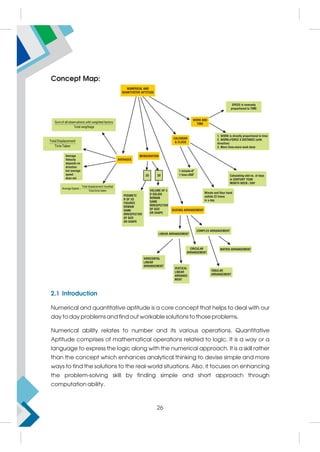
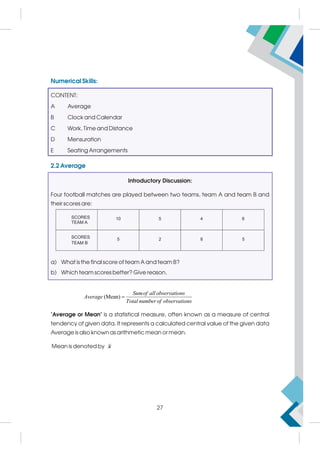
  • 130.
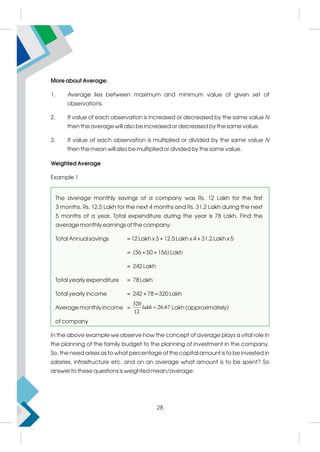
    (ii) In thiscase, domain of R, say, P = {1, 2, 3, 4} and range, say, Q = {2, 3, 4, 5} According to the arrow diagram, depicting this relation, is given below: R is a function as every element in P has a unique image in Q. (iii) Consider set A={1,2,3,4} and set B={1} Representing the relation by arrow diagram Relation R is a function from A to B as every element of set A have unique image in set B. Domain of function is A = {1,2,3,4} and range B = {1} Consider case (iv). Here, domain of the relation R, is, say A = {1} and range, say B = {1, 2, 3}. Representing this relation pictorially, we get: 120
  • 131.
    This relation Ris not a function from A to B as the element '1' in the domain doesn't have a unique image in B. Example: Consider the following arrow diagrams depicting relations from set A to set B. Which amongst them are functions? Give reasons. (i) (ii) (iii) (iv) (v) Solution: Only Fig. (i) and Fig. (iii) depict functions as every element in set A has a unique image in set B. In Fig. (ii), the relation is not a function as '3' doesn't have an image in B. Hence, not a function. In Fig. (iv) element 'a' has two images in set B. Hence, not a function. 121
  • 132.
    In Fig. (v),element 'a' has two images in B and also element 'c' has no image in 'B'. Hence, not a function. Example: Find the domain and range of each of the following real functions: (i) f(x) = x2 (ii) f(x) = Solution: (i) f(x) = x2 Domain: R, set of real numbers Range: [0, ) or non-negative real numbers. (ii) f(x) = Domain: R – {0}, Range: R – {0} 122
  • 133.
    Summary : The mainfeatures of this section are :  Ordered pair : A pair of object or elements in a specific order  Cartesian product of A x B of two sets A and B is given by A x B ={(a,b) : a  A and b  B.  If n(a) = p and n(B) = q then n (A x B) = pq and number of relations possible from A to B are 2pq  In general, A x B  B x A. In case A x B = B x A, then A = B.  Relation ‘R’ from a non-empty set A to a non-empty set B is a subset of Cartesian product A x B, which is derived by defining a relationship between the first element and the second element of the ordered pair A x B.  Image is the second element of the ordered pairs in the given relation  The domain of a relation R is the set of all the first elements of ordered pairs in a relation R.  The range of a relation R is the set of all second elements of ordered pairs in relation R.  A Relation R in a set A is called an empty relation if no element of A is related to any element of A.  A relation R in a set A is called a universal relation if each element of A is related to every element of A  A relation R on a set A is said to be: i) Reflexive if (a,a)  R, for every a  A ii) Symmetric if (a,b)  R  (b,a)  R, where a, b  A iii) Transitive if (a,b)  R and (b,c)  R then (a,c)  R where a,b,c  A  A relation R which is reflexive, symmetric and transitive is called an equivalence relation. 123
  • 135.
  • 136.
    Concept Map : 5.1Introduction As in ordinary English, in mathematics too, sequence means a particular order in which one thing follow another. This in turn means as in that ordered collection, we would be able to identify first, second, third members and so on. For example, the house numbers when you walk down the street, the population growth whether it be in human beings or bacteria, the amount of money deposited in bank, all form a sequence; hence conforming that sequences do have important applications in many spheres of life. Sequence, following a specific pattern is called progression. In standard tenth, you have studied about arithmetic progression or A.P. In this chapter in addition to A.P., we would be discussing about arithmetic mean, geometric progression, geometric mean and relationship between arithmetic mean and geometric mean. 126
  • 137.
    5.2 Sequences Let usconsider the following example: A TV manufacturer has produced 1200 TVs in his first year of production. Assuming the production increases uniformly by a fixed number every year, say 200 per year. Find the number of TV sets produced in 5th year. Now here, starting from the first year, the number of TV sets produced in 1st, 2nd, 3rd, 4th 5th year would be 1200, 1400, 1600, 1800 and 2000 respectively. These numbers form a sequence. Moreover, this type of sequence which has countable number of terms is called a finite sequences, otherwise it is an infinite sequence, where the number of elements is uncountable. The various numbers occurring in the sequence are called terms and are denoted by a1, a2, .... an, where the subscripts denote the position of the term in the squence. The nth term is the number at the nth position of the sequence and is denoted by an. This nth term is called the general term of the sequence. So, in the above example, a1 = 1200, a2 = 1400, ..... a5 = 2000 A sequence may not only be obtained by adding a fixed constant to the preceding term as seen in the above example, but it may also be obtained by multiplying a fixed non-zero real number to the preceding term. For example, a child has 2 parents, further those parents have two parents, and so continuing in this manner, the child has 4 grandparents, 8 great grandparents, and so on. Now, in this case the sequence formed may be noted as 2, 4, 8, ..... and so on. This type of sequence is obtained by multiplying the preceding term by non- zero constant 2. This type of sequence is called a geometric progression. Here, a1 = 2, a2 = 4 and so on and the multiplying factor 2 is called the common ratio. 127
  • 138.
    Series Let a1, a2,..... an be a given sequence. Then the expression a1 + a2 + a3 + ..... + an + ..... is called the series associated with a given sequence. 5.3 Arithmetic Progression 5.3.1 Definition 1: A sequence a1, a2, a3, ....., an, ..... is called an arithmetic progression (A.P.), if the difference of any term and its immediate preceding term is always the same, i.e. an+1 – an = constant, say, 'd', for all nN, or an+1 = an + d.  nN This constant difference ’d’ is called the common difference. The term 'a1' in the above sequence is called the first term. Let us consider all the terms of the sequence a1, a2, ..... an, ..... in terms of only the first term and the common difference. Let the first term 'a1' be denoted by 'a' and common difference by 'd'. Therefore, a2 = a1 + d = a + d = a + (2 – 1)d a3 = a2 + d = (a + d) + d = a + 2d = a + (3 – 1)d a4 = a3 + d = (a +2d) + d = a + 3d = a + (4 – 1)d an = a + (n – 1)d Hence, the nth term (general term) of the AP is: an = a + (n – 1)d Illustration 1: Find the first three terms of the arithmetic progressions whose nth term is given. Also find the common difference and the 20th term in each case. 128
  • 139.
    (i) an =2n + 5 Now a = a1 = 2(1) + 5 = 7 a2 = 2(2) + 5 = 9 a3 = 2(3) + 5 = 11 Therefore, d = a2 – a1 = 9 – 7 = 2  a20 can either be found from 'an'=2n+5 putting n=20 or given by substituting the value of 'a' 'd' in an.  either; a20 = 2(20) + 5 = 45 or a20 = a + (n – 1) d = 7 + (20 – 1) × 2 = 7 + 2 × 19 = 45 (ii) an = 3 – 4n a1 = 3 – 4 (1) = –1 a2 = 3 – 4 (2) = –5 a3 = 3 – 4 (3) = –9 Therefore, d = a2 – a1 = –5 – (–) = –4 You, may also calculate d as d = a3 – a2 = –9 – (–5) = –4 Hence, a20 = a + (n – 1)d = –1 + 19 (–4) = –77 (iii) an = 3 4 n a1 = 1 3 1 4 2    a2 = 2 3 1 4 4    a3 = 3 3 4  = 0 129
  • 140.
    Therefore, d =a2 – a1 = 1 1 1 1 1 4 2 4 2 4              or d = a3 – a2 = 1 1 0 4 4          Here a20 = 20 3 17 4 4   Hence, from above Illustration we may note that the terms of an AP or the common difference, both can be any real number. Let's Check on Some Properties of an A.P. 5.3.2 Properties of an A.P. Property (i): If a constant is added to each term of an A.P., the resulting sequence is also an A.P. with same common difference as the previous one. Example: Let us consider an AP: 1, 3, 5, 7, ..... In this sequence, d = 2 Now add a constant, say, 5, to each term, We get a new sequence, 6, 8, 10, 12, ..... which is also an A.P. with common difference d = 2. Note that though the terms in the two sequences change, but the common difference remains the same. Property (ii): If a constant is subtracted from each term of an A.P., the resulting sequence is also an A.P., again, with same common difference as the previous sequence. Example: Let us consider an A.P.: 8, 5, 2, –1, –4, ..... In this sequence, d = –3 Now subtract a constant, say, 5, from each term. 130
  • 141.
    We get anew sequence: 3, 0, –3, –6, –9, ....., which is again A.P., an with the same common difference d = –3. Property (iii): Similarly if each term of an AP is multiplied by a constant, then the resulting sequence is also an A.P. Example: Let us consider the sequence: 5, 9, 13, 17, ....., an A.P. Here, d = 4 Now, multiply each term by, say, –4, we get a new sequence. –20, –36, –52, –68, ..... which is again an A.P., with d = –16 Please note in this case the common difference is –4d. So, we may conclude that the common difference in this case is the product of the common difference and the number with which each term is multiplied. So, if in an A.P., with common difference, 'd', each term is multiplied with a non-zero constant, say ' b', then the common difference of new AP would be 'bd'. Property (iv): If each term of an A.P. is divided by a non-zero constant, then, the resulting sequence is also an A.P. In this case, the common difference of the new A.P. will be obtained by dividing the common difference of the original sequence by the non-zero constant with which each term was divided. Property (v): A sequence is an A.P. if its nth term is a unique linear expression in n i.e., an = An + B. In such cases, the coefficient of 'n' i.e. A is always the common difference. Property (vi): In a finite A.P., a1, a2, a3, ..... an the sum of the terms equidistant from the beginning and end is always the same and is equal to the sum of its first and last term. 131
  • 142.
    i.e. if a1,a2, a3, ....., an–2, an–1, an is an A.P. then a1 + an = a2 + an–1 = a3 + an–2 = ...... Property (vii): If the terms of an A.P. are chosen at regular intervals, then they form an A.P. i.e. if a1, a2, a3, a4, a5, a6, a7 are in AP, then a1, a3, a5, a7, chosen at same interval are also in A.P. Property (viii): Three numbers a, b, c are in A.P. if 2b = a + b This is because, b – a = c – b  2b = a + c Let us understand, what are the applications of arithmetic progression in daily life. (a) The Saving Schemes: When you save some amount of money in the bank, you earn an increment to it. For example, if you deposit Rs. 1000 and every year you earn an increment of Rs. 100 this would make an A.P.. You can also calculate the total amount received by you in a particular year that you require. (b) A Taxi Fare: A taxi ride can cost you fixed change. For example, for the first one kilometer, it can cost you Rs. 25 and the next subsequent kilometer that you cover, it would cost you additional Rs. 10. For each kilometer. Therefore, Rs. 25, Rs. 35, Rs. 45, ..... would make an A.P. Illustration 2: In a sequence, the nth term is an = 2n2 + 5. Show that it is not an A.P. Solution: Given: an = 2n2 + 5 a1 = 7, a2 = 13, a3 = 23, a4 = 37...... Now, a2 – a1 = 6 a3 – a2 = 10 Since the common difference between any two consecutive terms is not the same, therefore it is not an A.P. 132
  • 143.
    Illustration 3: Findthe number of identical terms in the two sequences: 1, 5, 9, 13, 17, ....., 197 and 1, 4, 7, 10, 13, ..... 196 Solution: We will first find the number of terms in the two sequences. Let the number of terms in first sequence be 'n'. Therefore, 197 = a + (n - 1)d, as 197 is the last nth term of the sequence.  197 = 1+ (n – 1) × 4 = 1 + 4 (n-1)  196 4 = n – 1  n = 50 Let the number of terms in the second sequence be 'm'. This implies, 196 = a + (m-1)d  196 = 1+ (m – 1) × 3 = 1+3(m-1)  195 3 = m – 1  m = 66 Now, According to the question, let pth term of first sequence be equal to the qth term of the second sequence.  a1 + (p – 1) d1 = A1 + (q – 1) D1 1+ 4(p – 1) = 1 + 3(q – 1)  1 3 p  = 1 4 q = k (say)  p = 3k + 1, q = 4k + 1 Now since first A.P. contains 50 terms, therefore, p  50  3k + 1  50  K 49 3  k  1 16 3 133
  • 144.
    Since second A.P.contains 66 terms, therefore, q  66  4k + 1  66  k  65 4 = 1 16 4 But since k is a natural number, therefore, k  16  k = 1, 2, 3,..... 16 Hence, there are 16 identical terms in the given sequence. Illustration 4: Find the 10th term from the end of the sequence 7, 10, 13, ....., 130 Solution: The given sequence is an A.P. with common difference d = 3 and first term a = 7 Now, since 130 is the last term of the sequence, therefore, an = 130  a + (n – 1) d = 130  7 + (n – 1) × 3 = 130  123 = 3 (n – 1)  n = 42 Now, 10th term from the end of the sequence 7, 10, 13, .... 13, would be the 10th term from the beginning of the sequence 130, ....., 13, 10, 7, obtained by reversing the order. In this case, a = 130, d = –3, n = 42  a10 = a + (n – 1) d = 130 + (10 – 1) (–3) = 130 – 27 = 103 Illustration 5: If p times the pth term of an A.P. is q times then qth term, the show that its (p + q)th term is zero. 134
  • 145.
    Solution: Given pap = q aq To prove: ap+q = 0 Now, let 'a' be the first term and 'd' be the common difference of the sequence.  ap = a + (p –1)d aq = a + (q –1)d According to the question, p(ap) = q(aq)  p{a + (p – 1)d} = q{a + (q–1)d}  ap + p(p – 1)d = aq + q(q – 1)d  a(p – q) + d(p2 – p – q2 + q) = 0  a (p – q) + d ((p – q (p + q) – (p – q)) = 0  a(p – q) + d ((p – q) (p + q – 1)) = 0  (p – q) (a + d(p + q – 1)) = 0  a + (p + q –1)d = 0 (as p – q  0 as p  q)  ap+q = 0 Hence Proved. Illustration 6: If the numbers a, b, c, d, e form an A.P., then the value of a – 4b + 6c – 4d + e is: (1) 1 (b) 2 (c) 0 (d) non of these Solution: Let D be the common difference of the A.P. Then, b = a+D, C = a+2D, d = 3D, e = a+4D 135
  • 146.
    So a –4b + 6c – 4d + e = a – 4 (a + D) + 6 (a + 2D) – 4 (a + 3D) + (a + 4D) = a – 4a – 4D + 6a + 12D – 4a – 12D + a + 4D = 0 Illustration 7: If an be the nth term of an A.P. and if a7 = 15, then the value of the common difference that would make the product a2 a7 a12 greatest is: (1) 9 (b) 9/4 (c) 0 (d) 18 Solution: Let d be the common difference of the A.P. Then, a2 a7 a12 = (15 – 5d) 15 (15 + 5d) = 375 (9 – d2 ) (1) Therefore, if a7 = 15, a2 = 15 – 5d, a15 = 15 + 5d Hence, RHS is greatest when d = 0 (as d2 0) Therefore, a2 a7 a12 is greatest for d = 0 5.3.3 Selection of Terms of an A.P. Sometimes, we require only certain number of terms of an A.P. The following ways of selecting terms are often convenient to find the solution of the problem. 136
  • 147.
    Table 5.3.1 Number ofTerms Terms in an A.P. Common Difference 3 a – d, a, a + d d 4 a – 3d, a – d, a + d, a + 3d 2d 5 a – 2d, a – d, a, a + d, a + 2d d 6 a – 5d, a – 3d, a – d, a + d, a + 3d, a + 5d 2d Please note that in case of odd number of terms, the middle term is ‘a’ and common difference is d while in case of an even number of terms the middle terms are a – d and a + d and the common difference is 2d. 5.3.4 Sum of First 'n' Terms of an A.P. Consider the terms of the A.P. a1, a2, a3, ....., an, with common difference d. Now, a1 = a (first term) a2 = a + d a3 = a + 2d an = a + (n – 1)d Adding these terms together we get, a1 + a2 + a3 ..... + an = a + (a + d) + (a + 2d) + ..... + (a + (n – 1)d) = na + (1 + 2 + ..... + (n – 1))d = na +   1 2 n n  d =   2 1 2 n a n d        Sum of first 'n' terms of an A.P., denoted by Sn, is given by Sn =   2 1 2 n a n d       137
  • 148.
    This can furtherbe re-written as: Sn =   2 1 2 n a n d       =   1 2 n a a n d        =   2 n a  , where ' ' denotes the last term an  Sn =   2 n a  Note: If Sn denotes the sum of 'n' terms, then S2 – S1 = a2 as S1 = a1 (first term) and S2 is the sum of first two terms a1 and a2. Hence, S1 = a1; S2 = a1 + a2  S2 – S1 = a2 If we generalise, Sn – Sn–1 = an Illustration 8: Find the sum of first 100 even natural number. Solution: Consider the sequence 2, 4, 6, 8,..... of even natural numbers. Now the first term is a = 2, first term and the common difference is d = 2  a100 = a + (n – 1)d = 2 + 99 × 2 = 200 Now, S100 = 100 2 [2 × 2 + 99 × 2] = 50 × [4 + 198] = 50 × 202 = 10100 After a100 = 200 138
  • 149.
    As Sn =  2 n a   S100 = 100 2 [2 + 200] = 50 × 202 = 10100 Illustration 9: How many terms of the A.P. 17, 15, 13, are need to give the sum 72. Explain the double answer. Solution: Let the number of terms to give the sum 72 be 'n'.  Sn = 2 n [2 × 17 + (n – 1) × (–2)] Now, according to the question Sn = 72  72 = 2 n [34 – 2n + 2] = 2 n [36 – 2n] = 72 = n [18 – n] = 72  n (n – 18) + 72 = 0 = n2 – 18n + 72 = 0  n = 12, 6 The double answer is due to the fact that some terms in the A.P. are negative and these terms on addition with positive numbers gives zero. Illustration 10: The sum of three numbers in A.P. is 24 and their product is 440. Find the numbers. 139
  • 150.
    Solution: According tothe table, 1.3.1 let the three numbers in A.P. be a – d, a, a + d. According to the question, a – d + a + a + d = 24. 3a = 24  a = 8 Also, (a – d) a (a + d) = 440 a (a2 – d2 ) = 440 8 (a2 – d2 ) = 440 a2 – d2 = 440 8 = 55 64 – d2 = 55 d2 = 9  d =  3 When a = 8, d = 3, then the numbers are 5, 8, 11 When a = 8, d = –3, then the numbers are 11, 8, 5 Therefore, the required numbers are 5, 8, 11 Illustration 11: Solve for x: 1 + 4 + 7 + 10 + ..... + x = 590 Solution: The given series is an arithmetic series, with a = 1 and d = 3. Now, 'x' in the question represents the last term of the series and let us consider the number of terms to be 'n'. Therefore, x = an According to the question,   2 1 2 n a n d       = 590    2 1 1 3 2 n n         = 590  n [2 + 3n – 3] = 590 × 2  n [3n – 1] = 1180  3n2 – n – 1180 = 0 140
  • 151.
     (n –20) (3n + 59) = 0  n = 20, n = 59 3  n = 59 3  is not possible as 'n' is a natural number.  n = 20  x = an = a + (n – 1)d = 1+ (20 – 1) × 3 = 1 + 57 = 58 Illustration 12: If the first, second and last terms of an A.P. are a, b c respectively, then show that the sum of terms in A.P. is      2 2 a c b c a b a     . Solution: Let the number of terms in the given A.P. be in 'n' and common difference be 'd' Therefore, according to the question, a1 = a a2 = b = a + d  d = b – a an = c = a + (n – 1) d  c = a+ (n – 1) (b – a)  c – a = (n – 1) (b – a)  c a b a   = n – 1  c a b a   + 1 = n  n = 2 b c a b a    Now, the sum of all the terms in the given A.P. is Sn =   2 n a  141
  • 152.
     Sn =  2 n a c  =       2 2 b c a a c b a     Illustration 13: The sum of n terms of two APs are in the ratio (3n + 8) : (7n + 15). Find the ratio of their 12th terms. Solution: Let a1, a2 and d1, d2 be the first terms and common difference of the first and second A.P. respectively. According to the question, sum of n terms of first A.P. sum of n terms of second A.P. = 3 8 7 15 n n        1 1 2 2 2 1 2 2 1 2 n a n d n a n d             = 3 8 7 15 n n        1 1 2 2 2 1 2 1 a n d a n d     = 3 8 7 15 n n   (1) Now, we need to find the ratio of 12th terms  th th 12 terms of first A.P. 12 terms of second A.P. = 1 1 2 2 11 11 a d a d   = 1 1 2 2 2 22 2 22 a d a d   =     1 1 2 2 2 23 1 2 23 1 a d a d     (2) From (1) and (2)     1 1 2 2 2 23 1 2 23 1 a d a d     =     3 23 8 7 23 15     (Put n = 23)  th th 12 terms of first A.P. 12 terms of second A.P. = 7 16 142
  • 153.
    5.3.5 Arithmetic Mean Ifbetween any two number say 'a' and 'b', we insert a number, say 'A' such that a, A, b is an A.P., then this number A is called the arithmetic mean of the number 'a' and 'b' i.e., A – a = b – A  2 a b A   From this we may interpret that the AM between two numbers 'a' and 'b' is their average 2 a b  For example, consider two number 5 and 15. We may observe that 10 = 15 5 2  = 2 a b  is the AM between 5 and 15. More generally, given two numbers a and b, we need not restrict to only one arithmetic mean between any two given number. We can insert as many AMs between any two numbers as we like such that the resulting sequence is an A.P. Let A1, A2, A3, ..... An be 'n' numbers between 'a' and 'b' such that a, A1, A2, A3, .... An, b forms an AP. These A1, A2, ...., An are called the AMs of the given sequence. Note that the first AM is the second term of the sequence, second AM is the third term of the sequence and so on. Illustration 14: Insert 6 numbers between 3 and 24 such that the resulting sequence is an A.P. Solution: Let A1, A2, A3, A4, A5 and A6 be six numbers between 3 and 24 such that 3, A1, A2, A3, A4, A5, A6, 24 are in A.P. Here a = 3, n = 8 and a8 = 24 Now, to find A1, which is the second term of the sequence, we need to find the common difference first. a8 = 24 143
  • 154.
     a +7d = 24  3 + 7d = 24  d = 3  A1 = a + d = 3 + 3 = 6 A2 = a + 2d = 3 + 6 = 9 A3 = a + 3d = 3 + 9 = 12 A4 = a + 4d = 3 + 12 = 15 A5 = a + 5d = 3 + 15 = 18 and A6 = a + 6d = 3 + 6 × 3 = 21 Hence the six numbers between 3 and 23 are 6, 9, 12, 15, 18 and 21. We may also observe that in general, an arithmetic mean An = a + nd; where a is the first term and d is the common difference. Illustration 15: If 1 1     n n n n a b a b is the A.M. between ‘a’ and ‘b’, then find the value of 'n'. Solution: Since 1 1     n n n n a b a b in the A.M. between ‘a’ and ‘b’, then, 1 1     n n n n a b a b = 2 a b   2(an + bn ) = (an–1 + b n–1 ) (a + b)  2an + 2bn = an + abn–1 + an–1 b + bn an + bn = abn–1 + an–1 b  an – an–1 b = abn–1 – bn  an–1 (a – b) = bn–1 (a – b)  an–1 = bn–1 (as a – b  0) 144
  • 155.
     1 n a b       = 1  n – 1 = 0  n = 1 Check Your Progress 1 Multiple Choice Questions: Choose the correct answer from the given four options. 1. If for a sequence Sn = 2n – 3, then the common difference is; (a) –1 (b) 2 (c) –2 (d) 3 2. The number of integers from 100 to 500 that are divisible by 5 are: (a) 80 (b) 81 (c) 75 (d) none of these 3. The number of two digit numbers divisible by 6 are: (a) 24 (b) 14 (c) 15 (d) 20 4. If the fourth term of an A.P. is 4, then the sum of its 7 terms is: (a) 28 (b) 26 (c) 32 (d) none of these 5. Which of the following terms are not the term of the A.P. –3, –7, –11, –15, ..... –403, ....., –799. (a) –500 (b) –399 (c) –503 (d) –51 145
  • 156.
    Short Answer TypeQuestions: 6. If each term in a given A.P. is doubled, then is the new sequence obtained an A.P. If yes, then find its common difference. 7. Find the middle term in the A.P. 20, 16, 12, ....., –176. 8. In an A.P., if a4 : a7 = 2 : 3, then find a6 : a8 9. Find the sum of integers from 100 to 500 that are divisible by 2 and 3. 10. Find the sum of 20 terms of the A.P. whose nth terms is 2n + 1. Long Answer Type Questions: 11. Inert 'n' arithmetic means between 1 and 31 such that the ratio of the 7th mean and the (n-1)th mean is 5 : 9. Find the value of n and the resulting A.P. 12. Find the sum of the following series. (a) 4 + 7 + 10 + ..... to 100 terms (b) 1 + 4 3 + 5 3 + 2 + ..... to 19 terms (c) 0.5 + 0.51 + 0.52 ..... to 1000 terms 13. If the sum of term is an A.P. is 72, find the number of terms given that the first term of the sequence is 17 and common difference is –2. 14. If the sum of first p terms of an A.P. is equal to the sum of the first q terms, then proven that the sum of the first (p + q) terms is zero. 15. Find the first negative term in the given A.P.. 19, 91 5 , 87 5 , ..... 16. If pth , qth and rth terms of an A.P. are a, b, c respectively, then prove that. (a – b)r + (b – c)p + (c – a)q 146
  • 157.
    17. Find themiddle terms in the A.P. 5, 8, 11, 14,..... whose last term is 95. 18. In an A.P., if pth terms is 1 q and qth term is 1 p then prove that the sum of first pq terms is   1 1 2 pq , where p  q 19. The sum of 'n' term of two A.P.s are in the ratio 5n + 4 : 9n + 6. Find the ratio of the their 18th terms. 20. On a certain day in a hospital, during covid crisis, the patients in the OPD were 1000. Due to efforts of the doctors and health care warriors and precautions taken by general public numbers declined by 50 per day. As per the decline in the number of patients, do you think that there would be a day with no patients in the OPD? If yes, which day would it be from the day when there were 1000 patients. 5.4 Geometric Progression (GP) 5.4.1 Definition A sequence a1, a2, a3, ...an, ... is called a geometric progression, if each term is non-zero and 1 k k a a  = r (constant) for k  1. By letting a1 = a, we obtain the geometric progression a, ar, ar2 , ar3 , ....., where a is called the first term and r is called the common ratio of the G.P. Thus we define, GP is sequence in which each term except the first is obtained by multiplying the previous term by a non-zero constant. The first term is denoted by a and the constant number by which we multiply any term to obtain the next term is called common ratio and is denoted by r. Some example of GP are: (i) 3, 6, 12, 24, ..... Here, a = 3, r = 2 1 6 3 a a  = 2 (ii) 1 2 , 1 6  , 1 18 , ..... Here, a = 1 2 , r = 2 1 1 3 a a   147
  • 158.
    5.4.2 General Termof a G.P. Let a be the first term and the r be the common ratio of a G.P. Hence the G.P. is a, ar, ar2 , ar3 , ar4 , ... also a1 = a = ar1–1 a2 = ar = ar2–1 a3 = ar2 = ar3–1 a4 = ar3 = ar4–1 Do you see a pattern. What will be the 17th term. a17 = ar17–1 Therefore continuing the pattern we get an = arn–1 Thus, a, GP can be written as a, ar, ar2 , ar3 , .....arn–1 if it is finite or a, ar, ar2 , .....arn–1 ..... if it is infinite. The corresponding geometric series are a + ar + ar2 + ..... + arn–1 and a + ar + ar2 + ..... + arn–1 + ... respectively. Illustration 16 : Find the 10th and nth terms of the G.P. 2, 4, 8, 16, ... Solution: Here a = 2, r = 2 1 4 2 a a  = 2 Thus, a10 = ar9 = 2(2)9 = 210 = 1024 and an = arn–1 = 2 (2n–1 ) = 2n 5.4.3 Selection of Terms of a G.P. 148
  • 159.
    Sometimes, we requireonly certain number of terms of an A.P. The following ways of selecting terms are often convenient to find the solution of the problem: Table 1.3.3 Number of Terms Terms in a G.P. Common Ratio 3 , , a a ar r r 4 3 3 , , , a a ar ar r r r2 5 2 2 , ,a, , a a ar ar r r r 6 3 5 5 3 , , , , , a a a ar ar ar r r r r2 Please note that in case of odd number of terms, the middle terms is ‘a’ and common ratio is ‘r’ while in case of an even number of term two middle terms are , a ar r and the common ratio is r2 Illustration 17: The third term of a G.P. is 12. Find the product of its first five terms. Solution: Let the first term and common ratio of the GP be a and r respectively. Given that, t3 = ar2 = 12 (1) Now, t1 t2 t3 t4 t5 = a (ar) (ar2 ) (ar3 ) (ar4 ) = 4 5 5 2 a r  = a5 r10 = (ar2 )5 = (12)5 Using (1) = 248832 149
  • 160.
    Illustration 18: Ifthe mth and nth terms of a G.P are n and m respectively, show that its (m+n)th term is 1 m m n n n m        Solution: Let a be the first term and r the common ratio of the G.P tm = arm–1 = n (1) tn = arn–1 = m (2) Dividing (1) by (2) we get 1 1 m n ar n ar m     (r)m–n = n m  r =         m n n m (3) Now, tm+n = arm+n–1 = arm–1 × rn = 1 n m n n n m                 Using (iii) = 1 1 n m m m n m n m n n n n m n m n n n n m m m               Hence proved 5.4.4 Sum of n Terms of a G.P Let the first term of a G.P be a and the common ratio be r. Let Sn denote the sum of first n terms of the G.P. Then Sn = a + ar + ar2 + ..... + arn–1 (1) If r  1, multiplying equation (1) by r, we get 150
  • 161.
    rSn = ar+ ar2 + ar3 + ..... + arn–1 + arn (2) Subtracting (2) from (1), we get (1–r) Sn = a – arn  Sn   1 1 n a r r   or   1 1 n a r r   Note: If r = 1, we obtain Sn = a + a + a + .....+ a (n terms) i.e., Sn = na Illustration 19: Find the sum of indicated number of terms in the following G.P. (i) 3, 6, 9, .....10 terms, n terms (ii) 1, –3, 9, –27, .....8 terms, p terms Solution: (i) Here a = 3, r = 6 3 = 2 Sn =   1 1 n a r r   = 3 (2n – 1) S10 = 10 3 2 1 2 1       = 3 × 1023 = 3069 (ii) Here a = 1, r = –3 Sn =   1 1 n a r r   =     1 3 1 3 1 n     Sn =   3 1 4 n    So, Sp =   1 3 4 p   151
  • 162.
    and S8 =  8 1 3 4   = – 1640 Illustration 20: How many terms of the G.P. 32, 16, 8, ..... are needed to give the sum 3 63 4 ? Solution: Let n terms of the G.P. be needed to give the sum 3 63 4 or 255 4 Now, a = 32, r = 16 1 32 2  and Sn = 255 4  Sn =   1 1   n a r r  1 32 1 2 255 1 4 1 2 n                   255 1 64 1 4 2 n                  1 255 1 2 256 n          8 1 1 2 2 n               n = 8 Illustration 21: The sum of three consecutive terms of a G.P. is 26 and their product is 216. Find the common ratio and the terms. Solution: Let three consecutive terms of the G.P. be a r , a and ar Then,    a a ar r       = 216  a3 = 216 = 63 152
  • 163.
    i.e., a =6 Since, a r + a + ar = 26  1 6 1 r r         = 26  3r2 – 10r + 3 = 0  (3r–1) (r–3) = 0  r = 1 3 , 3 If r = 1 3 , the numbers are 18, 6, 2 If r = 3, the numbers are 2, 6, 18. Illustration 22: Find the sum of the sequence 4, 44, 444, ..... to n terms Solution: Let Sn be the sum of n terms of the sequence. Observe carefully it is not a G.P., but can be converted into one as shown below: Sn = 4 + 44 + 444 + .....n terms Sn = 4 [1 + 11 + 111 + .....n terms] Sn = 4 9 [9 + 99 + 999 + .....to n terms] Sn = 4 9 [(10–1) + (102 –1) + (103 –1) + .....n terms]] Sn = 4 9 [(10 +102 +103 +.....n terms] – (1+1+1+.....n terms)] Sn =   10 10 1 4 9 10 1 n n            153
  • 164.
    Sn =  4 10 10 1 9 9 n n         Illustration 23: An insect population is growing in such a way that each generation is 2.5 times as large as the previous one. If there are 10,000 insects in the first generation, how many are there in the 5th generation. Solution: Here, a = 10000 and r = 2.5 Number of insects in the 5th generation is given by t5 = ar4 = 10000 × (2.5)4 = 390625 Illustration 24: The population of a country is 114 million at present. If the population is growing at the rate of 10% per year. What will be the population of the country in 5 years? Solution: The population of different consecutive years forms a G.P. A growth of 10% per year, when added to the previous year makes value of r = 110% = 1.1 The value of a1 = 114 million and n = 5. Therefore the population of the country in 5 years is given by: a5 = a1 r4 = 114 × (1.1)4 = 114 × 1.4641 = 166.9074 = 166.91 million (app.) Illustration 25: A manufacturer reckons that the value of a machine, which costs him Rs. 56200, will depreciate each year by 20%. Find the estimated value at the end of 3 years. 154
  • 165.
    Solution: The valueof the machine in various years will form a G.P. with first term a = Rs. 56200 and common ratio, r = 80% = 0.8 (a depreciation of 20% when subtracted from the previous year). The estimated value at the end of 3 years is given by its value in the 4th year. So, a4 = ar3 = 56200 × (0.8)3 = 56200 × 0.512 = 28,774.4 Hence the value of the machine at the end of 3 years is Rs.28774.4 Illustration 26: A man saves ` 500 in the first month and in successive months he saves twice as much as in the previous month. This process continued for 6 months. From the seventh month and onwards he is able to save Rs. 500 less than previous month. Find his total savings for the year. Solution: For first 6 months the savings forms a G.P. with first term 500 and common ratio r = 2.  Total savings in the first six months. S6 =     6 1 500 2 1 1 2 1 n a r r      = 500 × 63 = Rs. 31,500 During the next 6 months the savings forms an A.P. with first term ` 500 less than the savings of the 6th month i.e., a6 = ar5 = 500 (2)5 So the first term of the AP is a = 16000 Hence for next 6 months his total savings will be Snext 6 =   2 1 2 n a n d       =   6 2 16000 5x (500) 2    155
  • 166.
    =   6 3200025000 21000 2   So the total savings for the year = Rs. 31,500 + Rs. 21,000 = Rs. 52,500 5.4.5 Geometric Mean The geometric mean of two positive real numbers a and b is the number  G ab Therefore the geometric mean of 4 and 9 is 4 9 6.   We observe that 4,6,9 are consecutive terms of a GP. This leads to a generalisation of the concept of geometric mean of two numbers. Given any two positive numbers a and b, we can insert as many numbers as we want between them to make the resulting sequence a G.P. Illustration 27: Insert 3 numbers between 1and 256 so that the resulting sequence is a G.P. Solution : Let G1, G2, G3, be three numbers between 1 and 256 such that 1, G1, G2, G3, 256 forms a G.P. Now 256 is the (3+2) i.e., 5th term of the GP having first term 1 Let r be the common ration So t5 = 256 = ar4 =256=1r4 =256 r=4 or -4 If r=4, the G.P. is 1,4,16,64,256 and If r =-4, the G.P. is 1,-4,16,-64,256 So the three numbers are 4,16,,64 or -4,16,-64. 156
  • 167.
    5.5 Relationship betweenAM and GM Let a and b be two given positive real numbers. Also let their AM and GM be A and G respectively. Then, 2 a b A   and G ab  Thus, we have A – G = 2 a b ab   = 2 2 a b ab   =   2 0 2 a b   (1) From (1), we obtain A – G  0, i.e., A  G Note: 1. A = G holds if a = b 2. For three positive real numbers a, b and c   1 3 3 a b c abc    ( AM  GM) Likewise the result can be generalised to n non-negative real numbers. Illustration 28: If AM and GM of two positive numbers x and y are 13 and 12 respectively, find the numbers. Solution: Given AM = 2 x y  = 13  x + y = 26 (1) GM = xy = 12  xy = 144 (2) 157
  • 168.
    Substituting value ofx+y and xy from (1) and (2) in the identity, (x + y)2 – (x – y)2 = 4xy We get, 262 – (x – y)2 = 4 × 144  (x – y)2 = 100  x – y =  10 (3) Solving (1) and (3), we obtain x = 18, y = 8 or x = 8, y = 18 Thus the numbers x and y are 18, 8 or 8, 18 respectively. Illustration 29: For any two positive real numbers a and b, prove that 2 a b b a   Solution: Let a b = x and b a = y Now, 2 x y xy   ( AM  GM) 2 a b a b b a b a      2 a b b a   Illustration 30: If xR, find the minimum value of 3x + 3(1–x) . Solution: Since AM  GM Therefore, 1 1 3 3 3 3 2      x x x x  1 3 3 3 2    x x 158
  • 169.
     3x + 3(1–x) 2 3 Hence the minimum value of 3x + 31–x is 2 3 Illustration 31: If a, b, c and d are four distinct positive numbers in G.P then prove that a + d b + c. Solution:  a, b, c, d are in GP  a, b, c are in GP  a c = b2 Now for a and c, 2   a c ac ( AM GM)  2   a c b ( ac = b2 )  a + c 2b (1) Again a, b, c, d are in GP  b, c, d are in GP  c d = c2 Now for numbers b and d,  2   b d bd ( AM GM)  2   b d c ( bd = c2 )  b + d 2c (2) Adding (1) and (2) we get a + c + b + d 2 (b + c) 159
  • 170.
     a +b + c + d 2b + 2c  a + d b + c Illustration 32: For positive real numbers a, b and c if a + b + c = 18, find the maximum value of abc? Solution: Since, AM  GM Therefore,   1 3 3 a b c abc       1 3 18 3 abc     1 3 6 abc   abc  63  abc  216 Hence the maximum value of abc is 216. 5.6 Infinite Geometric Progression Infinite Geometric Progression is given as a, ar, ar2 , ar3 , …… We know sum of GP a, ar, ar2 , ar3 , ..... to n terms is given by Sn =   1 1 n a r r   =   1 1 n a a r r r    If |r| 1, as n  , rn  0 Therefore, Sn  1 a r  as n   160
  • 171.
    Symbolically if sumto infinity is denoted by S or S Then, S = S = 1 a r  For example: (i) 2 1 1 1 3 1 ..... 1 3 3 2 1 3       (ii) 2 3 1 1 1 1 2 1 ..... 1 2 2 2 3 1 2               Illustration 33: Find the sum to infinity of the G.P. (i) 10, –8, 6.4, ..... (ii) a, br, ar2 , br3 , ar4 , br5 , .....; |r|| Solution: (i)  |r||,  S = 10 10 50 9 4 1 9 1 5 5 a r             (ii) S = (a + ar2 + ar4 + .....) + (br + br3 + br5 + ......) = a (1 + r2 + r4 + ......) + br (1+ r2 + r4 + .....) = 2 2 1 1 1 1 a br r r                = 2 1 a br r   161
  • 172.
    Illustration 34: Representthe following as rational number 0.34 Solution: Let S = 0.34 S = 0.3 + 0.04 + 0.004 + ..... S = 3 4 4 ..... 10 100 1000          S = 2 3 4 1 1 1 ..... 10 100 10 10           S = 3 4 1 1 10 100 1 10               S = 3 4 10 3 2 31 10 100 9 10 45 90      Illustration 35: A substance initially weighing 64 grams is decaying at a rate such that after 8 hours there are only 32 grams remaining. In another 4 hours there are only 16 grams left, and after 2 more hours only 8 grams remain. How much time passes before none of the substance remains? Solution: The weights of substance forms a GP given by 64 g, 32 g, 16 g, 8 g, ..... with common ratio 1 2 . It is clear that an  0 as n  . So the whole of substance will decay in S = 8 + 4 + 2 + ... hours which is again a G.P. with first term 8 and r = 1 2 . Hence S = 8 8 1 1 1 2 2   = 16 hours. Illustration 36: A pendulum swings through an arc of 25 cm. On each successive swing, the pendulum covers an arc equal to 90% of the previous swing. Find the 162
  • 173.
    length of thearc on the sixth swing and the total distance the pendulum travels before coming to rest. Solution: Here a = 25 cm and r = 9 10 The length of the arc on 6th swing = ar5 = 25 × (0.9)5 = 14.76 cm Let the pendulum comes to rest after travelling a total distances S = 25 25 1 1 1 0.9 10 a r     = 250 cm Illustration 37: A square is drawn by joining the mid-points of the sides of a square. A third square is drawn inside the second square by joining the mid- points of the second square and the process is continued indefinitely. If the side of the original square is 8 cm, find the sum of the areas of all the square thus formed. Solution: Given that AB = 8 cm, HE = 2 2 2 2 4 4 4 2 AE AH     Also LI =     2 2 2 2 2 2 2 2 HI HL    = 4 and so on 163
  • 174.
    Sum of theareas of all the squares is given below: S = 82 +   2 4 2 + (4)2 + ..... = 64 + 32 + 16 + ..... = 64 1 1 2  = 128 cm2 Illustration 38: A ball is dropped from a height of 90 feet and always rebounds one-third the distance from which it falls. Find the total vertical distance the ball travelled when it hits the ground for the 3rd time. Also find the total distance travelled by the ball before it comes to rest. Solution: First the ball falls 90 feet. Then the ball rebounds 1 3 rd the distance i.e., 30 feet and falls 30 feet to hit the ground for the second time. On next rebound the ball rises 10 feet and falls back 10 feet to hit the ground for 3rd time as shown in the following figure. Total distance travelled by the ball when it hits the ground for the 3rd time = 90 + 2 (30) + 2 (10) = 170 feet Total distance travelled before coming to rest: 164
  • 175.
    90 + 2[30 + 10 + 10 3 + .....] = 90 + 2 30 1 1 3          = 180 feet Check your Progress - 2 1. Find the indicated terms in each of the Geometric progressions given below: (i) 4, 12, 36, .....; 5th term (ii) 3, –1, 1 3 , 1 9  , .....; 4th term, nth term 2. Which term of the following sequences. (i) 5, 10, 20, 40, ..... is 5120 (ii) 2, 2 2 , 4, ..... is 128 (iii) 2, 1, 1 2 , 1 4 , ...... is 1 128 3. Find the sum to indicated number of terms in each of the geometric progressions (i) 3 , 3, 3 3 , ..... 6 terms (ii) 0.15 + 0.015 + 0.0015 + ..... 20 terms. 4. Evaluate 10 1 (3 2 )    k R 5. The sum of the first two terms of a G.P. is 36 and the product of first term and third term is 9 times the second term. Find the sum of first 8 terms. 6. Find the sum to n terms of the sequence. 7, 77, 777, 7777, ..... 7. The sum of first three terms of a G.P. is 39 10 and their product is 1. Find the common ratio and the terms. 165
  • 176.
    8. Find fournumbers forming a G.P. in which the third term is greater than the first term by 9, and the second term is greater than the 4th by 18. 9. Insert 6 geometric means between 27 and 1 81 . 10. If the AM of two unequal positive real numbers a and b (a b), be twice as much as their G.M., show that a : b = (2 + 3 ) : (2 – 3 ) 11. If a, b, c, d are in G.P., show that (i) a2 + b2 , b2 + c2 , c2 + d2 are n G.P. (ii) 2 2 1 a b  , 2 2 1 b c  , 2 2 1 c d  are in G.P. 12. Let S be the sum, P the product and R the sum of reciprocals of n terms of a G.P. Prove that P2 Rn = Sn . 13. What will Rs. 5000 amount to in 10 years after it is deposited in a bank which pays annual interest of 8% compounded annually? 14. If the first and the nth term of a G.P. are a and b, respectively, and if P is the product of n terms, prove that P2 = (ab)n . 15. A certain type of bacteria doubles its population every 20 minutes. Assuming no bacteria die, how many bacteria will be there after 3 hours if there are 1 million bacteria at present. 16. One side of an equilateral triangle is 24 cm. The mid points of its sides are joined to form another triangle whose mid points are joined to form yet another triangle and so on. This process continues indefinitely. Find the sum of the perimeters of all the triangles. 17. After striking a floor a certain ball rebounds 4 5 th of the height from which it has fallen. If the ball is dropped from a height of 240 cm, find the total distance the ball travels before coming to rest. 166
  • 177.
    18. An objectdecelerates such that it travels 60 m during the first second, 20 m during the second and 2 6 3 m during the third second. Determine the total distance the object travels before coming to rest. 19. Suppose a person mails a letter to five of his friends. He asks each one of them to mail it further to five additional friends with instruction that they move the chain further. Assuming the chain is not broken and no person receives the mail more than once, determine the amount spent on postage when the 8th set of letters is mailed, if cost of postage of each letter is 50 paisa. 20. Due to reduced taxes an individual has an extra Rs. 30,000 in spendable income. If we assume that an individual spends 70% of this on consumer goods and the producers of these goods in turn spends 70% on consumer goods and this process continues indefinitely. What is the total amount spent on consumer goods. 21. A machine depreciates in value by one-fifth each year. If the machine is now worth Rs. 51000, how much will it be worth 3 years from now. 22. The sum of an infinite G.P. is 3 and the sum of the squares of its terms is also 3, than its first term and common ratio are: (i) 1, 1 2 (ii) 1 3 , 2 2 (iii) 3 1 , 2 2 (iv) 1, 1 4 23. An antiques present worth is Rs. 9000. If its value appreciates at the rate of 10% per year. Its worth 3 years from now is: (i) Rs. 6561 (ii) Rs. 10,890 167
  • 178.
    (iii) Rs. 11,979 (iv)Rs. 12,000 24. Venessa invests Rs. 5000 in a bond that pays 6% interest compounded semi-annually. The value of the bond in rupees after 5 years is: (i) 5000 (1.06)5 (ii) 5000 (1.03)5 (iii) 5000 (1.06)10 (iv) 5000 (1.03)10 Illustration - 39 Economy Stimulation The government through a subsidy program infuses 10 lakh crore to boost the sagging economy. If we assume each state or UT spends 80% of what is received on infrastructure, health and industry and in turn each institution or agency spends 80% of what is received and so on. How much total increase in spending results from this government action? Solution: According to the multiplier principle in economics, the effect of stimulus of 10 lakh crore on the economy is multiplied many times. To find the amount spent if the process continues as given is obtained by applying infinite G.P. whose first term a1 is the first amount spend i.e., a1 = 80 100 × 10 lakh crore = 8 lakh crore Also, r = 0.8 Hence S = 8 + 8 (0.8) + 8 (0.8)2 + ..... S = 8 8 1 0.8 0.2   = 40 lakh crore 168
  • 179.
    So an economicstimulus of 10 lakh crore would result in spending of about 40 lakh crore. Illustration - 40 Facing the Pandemic (The Virus Spread) The population of a certain city is 51,20,000. Let us assume 5000 persons in the city are infected by corona-virus. The virus is so contagious that the number of infected persons doubles every 12 days. If the rate of doubling remains constant then in how many days 50% of the population gets infected. Solution: Here, the first term is the initial number of persons infected by the virus. i.e., a1 = 5000 Since the number of patients doubles every 12 days So r = 2 If the required number of infected persons be denoted by an then a1 rn–1 = an  5000 (2)n–1 = 1 2 × 5120000  2n = 1024 = 210  n =10 Number of days required to infect half the entire population is = 12 (n–1) = 12 × 9 = 108 days Summary  A sequence means arrangement of numbers in a definite order according to some rule. A sequence having countable number of terms is called finite sequence and a sequence is called infinite if it is not a finite sequence  Let a1, a2, a3, … be a given sequence, Then a1+a2+a3+… is called a series 169
  • 180.
     An arithmeticprogression (AP) is a sequence in which each term except the first is obtained by adding a constant number to the previous term. The first term is denoted by a, common difference by d and the last term by l.  The general term of the AP is given by an=a+(n-1) d  The sum of n terms of the AP is given by   2 (n 1)d (a R) 2 2      n n Sn a  Arithmetic Mean of two positive real numbers a and b is the number 2   a b A  A sequence is said to be geometric progression (GP) if the ratio of any term to its preceding term is same throughout. The first term and common ratio of the GP is denoted by a and r respectively.  The general term of teh GP is given by 1   n n a ar  The sum sn of the first n terms of the GP is given by ( 1) (1 ) 1 1      n n n a r a r S or r r  Relation between arithmetic mean A and Geometric mean G is given by A G  Sum of infinite GP a, ar, ar2 ,… where 1  r is denoted by  S sm and is given by 1    a S r  Application problems based on GP. Solution to check your progress Check your Progress - 1 1 (d) 2(b) 3(c) 4(a) 5(a) 6 Yes; common difference is twice the common difference of original sequence 7. a25 and a26 are the middle terms. 170
  • 181.
    a25 = -76,a26 = -080 8. a6 : a8 = 4 : 5 9. 20100 10. 440 11. 14, 1, 3, 5, 7, 9, 11, ….., 31 12 5495 13 n=6, n=12 15 25 term = 1 5  17 50, the 16th term 19 179 : 321 20 on 21st day there would be no Covid Patient report in the hospital Check your Progress-2 Q1 (i) 324 (ii) n 1 2 1 ( 1) , 9 3     n Q2 (i) 11 (ii) 13 (iii) 9 Q3 (i) 39 13 3  ii 20 1 1 (0.1) 6      Q4 28+211 Q5 3280 81 Q6 70 7 (10 1) 81 9   n n Q7 5 2 2 5 5 2 ; ,1, ,1, 2 5 5 2 2 5  r or term are or Q8 3, -6, 12, -24 171
  • 182.
    Q9 9, 3,1, 1 1 1 , , 3 9 27 Q13 Rs 5000 (1.08)10 Q15 512 million Q16 144 cm Q17 21.6m Q18 90m Q19 Rs 24,4140.60 Q20 Rs 70,000 Q21 Rs 26,112 Q22 (iii) Q23 (iii) Q24 (iv) Practice Questions: Multiple Choice Questions: 1) Find the sum of the G.P.: 8/10, 8/100, 8/1000, 8/10000, … to n terms. a) 8 1 1 9 10         n b) 8 1 1 81 10        n c) 9 1 1 8 10        n d) 8 1 1 90 10        n 2) If the first term of a GP be 5 and common ratio is (-5) then which term is 3125. a) 6th 172
  • 183.
    b) 8th c) 5th d)4th 3) Which number should be added to the numbers 3, 8, 13 to make the resulting numbers should be GP. a) 4 b) 2 c) 5 d) -2 4) If the third term of a G.P. is 6 then the product of its first 5 term is a) 56 b) 65 c) 52 d) 62 5) If a, b and c are in A.P. as well as in G.P., then which of the following is true. a) a=b c b) a b c c) a=b=c d) a b =c Problems: 1) You friend has invested in a 'Grow Your Money Scheme' that promises to return Rs 11,000 after a year if you invest 1,000 at the rate of 10% compounded annually. You are bit skeptic about the claim of this scheme. Your Friend shows the calculation done by the agent of the scheme as follows. Would you be willing to invest in this scheme? Explain. 173
  • 184.
    2) Write thefirst four terms of a geometric series for which S8 = 39,360 and r =3. (Adopted from augusta.k.12) 3) Using Geometric series write 0.175175175175…. in fraction. 4) In a mock test of Sequence Series, Rohan Shweta have solved a question in the following manner. Find the 10th term of the Geometric series 9,3,1, ………. a) Who is correct explain your reasoning? 174
  • 185.
    b) Can youguess the correct answer without solving? If yes what argument would you use? 5) On the first day, a music video of Arjit Singh was posted online, got 120 views in Delhi. The number of viewership gets increased by 5% per day. How many total views did the video get over the course of the first 29 days? Express your answer in exponential form. (From Delta Math) 6) In the book of Harry Potter and Deathly Hallows, Harry traced his family history and got to know that he is related with Peverell brothers. Let’s assume that he had traced his family back for 15 generations starting with his parents, how many ancestors he had in total. Try this exercise at home. To make it more interesting you could draw the family tree with the photos of your relative. See if you have more relatives than Harry Potter. (Adopted from augusta.k12.va.us) 7) You and your sibling decide to ask for a raise in your pocket money from your Dad. Your Dad gives both of you a choice. You two could have 1000 Rs at once or can get Rs 2 on day one, Rs.4 on day two so on receiving twice as many rupees each day as the previous day, for 12 days. While you opted for getting Rs 1000 at once your brother opted for the later. Which one of you made a better decision and why? 8) If ax = by = cz such that a, b and c are in GP and x, y and z are unequal positive integer then show that 2 1 1   y x z . 9) A person sends a fake news on WhatsApp to 4 of his friends on Monday. Each of those friends forward the fake news on to the four of their friends on Tuesday. Each person who receives the fake news on Tuesday send it four more people by Wednesday and this process goes on for a week. After a week a leading news agency verifies the news and finds it to be fake. Find how many people have received the fake news on WhatsApp 175
  • 186.
    till then? Usuallythe fake news is shared and forwarded on a bigger scale. Try this question. 10) Three positive numbers form an increasing G.P. If the middle term of the series is doubled then the new numbers are in A.P. Find the common ratio of the G.P. 11) Priyanka invested Rs. 1300 in an account that pays 4% interest compounded annually. Assuming no deposits or withdrawals are made, find how much money she would have in the account 6 years after her initial investment. (Adapted from DeltaMath) 12) Dividend: A sum of money paid regularly by a company to its shareholders out of its profits. A financial analyst is analyzing the prospects of a certain company. The company pays an annual dividend on its stock. A dividend of Rs. 500 has just been paid and the analyst estimates that the dividends will grow by 20% per year for the next 3 years, followed by annual growth of 10% per year for 2 years. (Adapted from Finance and Growth) (a) Complete the following table: (b) Then calculate the total dividend that will be paid for the next five years. 13) In general, it has been assumed that compound interest is compounded once a year. In reality, interest may be compounded several times a Year 1 2 3 4 5 Dividend 176
  • 187.
    year, e.g. daily,weekly, quarterly, semi-annually or even continuously. The value of an investment at the end of m compounding periods is: Pt = P0[1 + r/m]m * t where m is the number of compounding periods per year and t is the number of years. Using this information, solve the following problem: (a) Rs.1,000 is invested for three years at 6% per annum compounded semi-annually. Calculate the total return after three years. (b) What would the answer be if the interest was compounded annually? (c) Using your answers of (a-b), what can you infer about the frequency of compounding and the size of the total return? (From Finance and Growth) 14) From this graph, what conclusion can be drawn regarding the frequency of compounding? (Adapted from Finance and Growth) 15) A small country emits 130,100 kilotons of carbon dioxide per year. In a recent global agreement, the country agreed to cut its carbon emissions by 3.1% per year for the next 3 years. In the first year by as per a special agreement, the country will keep its emissions at 130,000 kilotons and the 177
  • 188.
    emissions will decrease3.1% in each of the next two years. How many kilotons of carbon dioxide would the country emit over the course of the 3-year period? (Geometric Series- Deltamath.com) 16) https://www.khanacademy.org/math/geometry-home/geometry- volume-surface-area/koch-snowflake/v/koch-snowflake-fractal 17) A stock begins to pay dividends with the first dividend, one year from now, expected to be Rs. 100. Each year the dividend is 10% larger than the previous year’s dividend. In what year the dividend paid is larger than Rs. 1000? (Use concept of logarithm to solve the question) 178
  • 189.
  • 190.
    Concept MapP 6.1 Introduction Countingor enumeration is usually a common process when a student is studying arithmetic. But in later years very little attention is paid to counting when a student turns to difficult areas in mathematics, such as algebra, geometry and calculus. A password on a computer system consists of eight characters. Each of these characters must be a digit or a letter of the alphabet. Each password must contain atleast one digit. How many such password are possible? The technique required to answer this and a wide variety of other counting problems will be introduced in this chapter. Counting does not end with arithmetic. It has wide applications in probability, statistics, coding theory and analysis of algorithms. Before we introduce the concept further we learn the meaning and notation of factorial. 180
  • 191.
    6.2 Factorial The productof first n natural numbers is called 'n factorial' and is denoted by n! i.e., the product 1 × 2 × 3 × .... × (n –1) × n is denoted by n! and we read this symbol as 'n factorial'. In particular 1 = 1! 1 × 2 = 2! 1 × 2 × 3 = 3! 1 × 2 × 3 × 4 = 4! 1 × 2 × 3 × 4 × 5 = 5! and so on Thus 1 × 2 × 3 × ... × (n–1) × n = n! Further we define 0! = 1 Note: The factorial of a negative integer or a fraction is not defined. We can write 7! = 7 × 6! = 7 × 6 × 5! = 7 × 6 × 5 × 4! and so on Thus clearly, for a natural number n n! = n (n–1)! = n (n–1) (n–2)! (provided n 2) = n (n–1) (n–2) (n–3)! (provided n 3) and so on Example 1: Evaluate (i) 5! (ii) 7! (iii) 7! – 5! Solution: (i) 5! = 1 × 2 × 3 × 4 × 5 = 120 (ii) 7! = 1× 2 × 3 × 4 × 5 × 6 × 7 = 5040 (iii) 7! – 5! = 7 × 6 × 5! – 5! = (42–1) 5! 181
  • 192.
    = 41 ×5! = 4920 Example 2: Compute (i) 11! 9! (ii)    13! 2! 11! Solution: (i) 11! 11 10 9! 110 9! 9!     (ii)        13 12 11! 13! 78 2! 11! 2 11!      Example 3: Find the LCM of 5!, 6! and 7! Solution: LCM of 5!, 6! and 7! = LCM of 5!, 6 × 5! and 7 × 6 × 5! = 7 × 6 × 5! = 7! Example 4: Express the following in factorial notation. (i) 6 × 7 × 8 × 9 (ii) 4 × 5 × 62 × 7 × 8 Solution: (i) 6 × 7 × 8 × 9 =   1 2 3 4 5 6 7 8 9 9! 1 2 3 4 5 5!              (ii) 4 ×5 × 62 × 7 × 8 = 6 X (4 × 5 × 6 × 7 × 8) = 1 × 2 × 3 × (4 × 5 × 6 × 7 × 8) = 8! Example 5: If 1 1 9! 10! 11! x   , find x Solution: We have, 1 1 9! 10 9! 11 10 9!      x 182
  • 193.
    1 1 10 110   x 11 10 110   x i.e., x = 121 Example 6: Convert the following products into factorial notation (i) 2.4.6.8... (2n) (ii) 1.3.5... (2n–1) Solution: (i) 2.4.6.8 (2n) = (2.1) × (2.2) × (2.3) × (2.4)x... × (2.n) = 2n [1.2.3.4...n] = 2n (n!) (ii) 1.3.5... (2n –1) =      1.2.3.4.5... 2 1 2 2.4.6... 2 n n n  =         2 ! 2 ! 2 1.2.3... 2 ! n n n n n n  Example 7: Show that, 41! + 1 is not divisible by any number from 2 to 41. Solution: Clearly 41! is divisible by every integer from 2 to 41. Thus 41! + 1 leaves 1 as remainder when divided by any integer from 2 to 41. Hence 41! + 1 is not divisible by any integer from 2 to 41. 183
  • 194.
    Exercise 1.1 1. Evaluate (i)6! (ii) 20! 18! (iii) 9! 8! 7!  2. Is 4! + 5! = 9! 3. Compute   ! !  n n r when (i) n = 8, r = 2 (ii) n = 12, r = 3 4. If 1 1 6! 7! 8! x   , find x 5. Evaluate m! r!(n r)!  , when (i) n = 13, r = 2 (ii) n = 8, r = 5 6. Show that (n+2) n! = n! + (n+1)! 7. Find n if (i) (n+1)! = 20 (n–1)! (ii) (n+2)! = 12 (n!) 8. Show that, n (n–1) (n–2) ... (n–r+1) =   n! n r !  9. If     n! n! 2, 2! n 2 ! 4! n 4 !     find the value of n. Answers: 1. (i) 720 (ii) 380 (iii) 64 2. No 184
  • 195.
    3. (i) 56(ii) 1320 4. 64 5. (i) 78 (ii) 56 7. (i) 4 (ii) 2 9. 5 6.3 Fundamental Principles of Counting The study of permutation and combination begins with two basic principles of counting the rules of sum and product. We will begin with simple applications of these rules. While solving difficult problems, we decompose them into simple parts solve them and finally obtain the final answer. Our first principle of counting can be stated as follows: The Rule of Sum (Fundamental Principle of Addition) A job occurs if either event E occurs or event F occurs exclusively. If event E can occur in m ways and event F can occur in n ways, then the job can occur in (m + n) ways. This rule can be further extended Example 8: A school library has 13 and 7 books available on financial mathematics written by Indian and foreign authors respectively. A student wants to learn more about the subject and has only 1 ticket to borrow the book. In how many ways the book can be borrowed. Solution: By rule of sum (i.e., the fundamental principle of addition) a student can select the book in = 13+7 = 20 ways. Example 9: A man is advised to go in for a knee replacement surgery. This facility is available in 5 private or 3 government hospitals. Alternatively he can go abroad where his son who is an orthopedic surgeon can operate. Find the number of options available to him. 185
  • 196.
    Solution: By ruleof sum (i.e., the fundamental principle of addition) there are = 5 + 3 + 1, i.e., 9 options available to the person. The solution of the following problem help us introduce second principle of counting. Anirudh goes to a stadium to watch a cricket match. If there are 3 independent gates to enter the stadium and 2 independent gates to exit. List the different ways Anirudh can enter and exit the stadium if there is no restriction on the gate, one can use. Let us name the three entrance gates as E1, E2, E3 and the two exit gates as X1, and X2. How many different pairs of entering and exciting the stadium are possible? There are 3 ways in which Anirudh can enter the stadium. For every choice of entering gate there are two choices of exiting. Therefore there are 3 × 2 = 6 different ways in which one can enter and exit the stadium. Then the various possibilities of entering and exiting the stadium are illustrated in the following figure. There are six possibilities as illustrated in the above figure. Let us consider the following example to show that the rule can be extended to more than two tasks or events. 186
  • 197.
    Reema goes tothe market to buy school bag, lunch box and water bottle for her younger sister for the new academic session. The school bag can be chosen in 3 different ways. After the school bag is chosen, a lunch box can be chosen in 2 different ways. Hence, there are 3 × 2 = 6 pairs of school bag and lunch box to choose from. For each of these pairs a water bottle can be chosen in 2 different ways. Hence, there are 6 × 2 = 12 different ways in which, Reema can buy these items for her sister. If we name the 3 school bags as B1, B2 and B3, the two lunch boxes as L1, L2 and the two water bottles as W1, W2, then the various possibilities can be shown with the arrow diagram shown below. Total = 12 possibilities In fact the problem of the above type can be solved by applying the following principle known as fundamental principle of multiplication or the Rule of Product. The Rule of Product (Fundamental Principle of Multiplication) 187
  • 198.
    If an eventcan occur in m different ways, following which another event can occur in n different ways, then the total number of ways in which the two events can occur in the given order is m × n. The above principle can be generalized for any finite number of events. For example, for 3 events, the principle is as follows: If an event can occur m in the different ways, following which another event can occur in n different ways, following which a third event can occur in p different ways, them the total number of ways of occurrence of the events in the given order is m x n x p. In the first problem the number of ways of visiting the stadium consists of the occurrence of the following events in succession. (i) the event of choosing the entrance gate i.e., 3 (ii) the event of choosing the exit gate i.e., 2 There are various possible ways in which one can enter and exit the stadium. We have to choose any one of the possible ways which can be done by counting the different ways of occurrence of the events in succession. We observe the number of possible ways the product of number of ways of occurrence of the successive events. So the number of possible ways = 3 × 2 i.e. = 6 ways By similar argument, we can conclude that the number of possible ways of choosing a school bag, lunch box and water bottle is 3 × 2 × 2 = 12 ways. Example 10: In a class there are 20 boys and 15 girls. The teacher wants to select either a boy or a girl to represent the class in a competition. In how many ways can this be done. Solution: By fundamental principle of addition the teacher can select a boy or a girl in = 20 + 15 i.e. = 35 ways. 188
  • 199.
    Example 11: Thedramatics club of a college has selected six boys and five girls for a play. From this group the director can cast his leading couple (a boy and a girl) in how many ways? Solution: The director can cast a boy for leading role in = 6 ways The director can cast a girl for leading role in = 5 ways By fundamental principle of multiplication the director can cast the couple in 6 × 5 = 30 ways. Example 12: The chairs in an auditorium are to be labelled with a letter and a positive integer not exceeding 10. What is the largest number of chairs that can be put in the auditorium? Solution: The letter can be assigned in 26 ways. The number can be assigned in 10 ways. The different ways the chair can be labelled is = 26 × 10 i.e., 260 ways Hence the capacity of the auditorium if all possible labelled chairs are there is 260. Example 13: How many different license plates are possible, if each plate contains a sequence of three letters starting with D followed by four digit - non zero number. Solution: Since the number plate starts with D, so there is only one choice for the first letter. There are 26 choices for each of the remaining 2 letters and 10 choices for each of the four digits (i.e., 0 to 9) By fundamental principle of multiplication the total possibilities are = 1 × 26 × 26 × 10 × 10 × 10 × 10 = 6760000 The sequence of letters followed by four zeros = 1 × 26 × 26 × 1 × 1 × 1 × 1 = 676 189
  • 200.
    The license plateswith 4 digit non zero numbers = 6760000 – 676 = 6759324 Example 14: An investment banker finalizes the list of specific entities worthy of investment in each of the three instruments mentioned below: – 3 Public Ltd. companies for direct equity investment. – 5 Mutual fund schemes – 2 Banks for Fixed Deposit (F.D) In how many ways the investment can be made if the board decides to. (i) invest the entire fund in one entity (i.e., company, scheme or bank) (ii) invest in one entity of each of the three instruments. Solution: (i) If the entire fund is invested in one entity. By fundamental principle of addition (the rule of sum) the investment can be made in 3 + 5 + 2 = 10 ways (ii) Investment in one entity of each instruments By fundamental principle of multiplication or (the rule of product) Public Ltd. company can be chosen in = 3 ways Mutual Fund scheme can be selected in = 5 ways Bank can be selected in = 2 ways Total number of ways = 3 × 5 × 2 = 30 ways Example 15: How many three digit numbers can be formed using the digits 0, 1, 3, 5 and 8. (i) If repetition of digits is not allowed 190
  • 201.
    (ii) If repetitionof digits is allowed. Solution: There be as many numbers as there are ways of filling 3 vacant places H T U in succession by the digits. Since 0 cannot come in hundred's (run on) place so it can be filled in = 4 ways The ten's place can be filled in (as 0 can come) = 4 ways The one's place can be filled in = 3 ways Therefore, by fundamental principle of multiplication the required number of 3 digit numbers = 4 × 4 × 3 = 48 (i) If repetition of digits is allowed H T U The hundred's place can be filled in = 4 ways The ten's place can be filled in = 5 ways The unit's place can be filled in = 5 ways Therefore by fundamental principle of multiplication the required number of 3 digit numbers = 4 × 5 × 5 = 100 Example 16: Find the number of different signals that can be generated by arranging at least 4 flags in order (one below the other) on a vertical staff, if 5 different flags are available. Solution: A signal can consist of either 4 flags or 5 flags. Now, let us count the possible number of signals consisting of 4 flags and 5 flags separately and then add the respective numbers. There will be as many 4 flag signals as there are ways of filling in 4 vacant place in succession by the 5 flags available. By fundamental principle of multiplication, the number of ways is 5×4×3×2 = 120 Counting the same way the number of 5 flag signals is 5×4×3×2×1 = 120 Therefore, the required number of signals = 120 + 120 = 240 191
  • 202.
    Exercise 1.2 1. Findthe number of 4 letter words, with or without meaning, which can be formed using the letters of the word HONEST, when the repetition of the letters is not allowed. 2. How many 3 digit even numbers can be formed from the digits 1, 2, 3, 4, 5 if the digits can be repeated? 3. How many 4-letter code can be formed using the first 10 letters of the English alphabet, if (i) no letter is repeated (ii) repetition of letters is allowed 4. A tennis club consists of 8 boys and 11 girls. In how many ways can a mixed doubles team be chosen? 5. There are 5 vacant seats in a row. In how many ways can 3 men sit. 6. Find the total number of ways of answering 6 multiple choice questions, if each question has 4 choices. 7. Find the number of three digit even positive integers. 8. Find the number of different signals that can be generated by arranging at least 2 flags in order (one below the other) on a vertical staff, if 5 different flags are available. 9. A coin is tossed 4 times and the outcomes are recorded. How many different outcomes are possible? 10. There are 5 true-false questions in a test. If no two students have answered the same sequence of answers and no student has given all correct answers. How many students are there is the class for this to happen? 11. If each user on a computer system has a password which is eight characters long where each character is an upper case letter or a digit. 192
  • 203.
    Each password mustcontain at least one digit. How many password are possible. 12. In a class test a teacher decides to give 5 questions one each from first five exercises of the textbook. If the first five exercises have 7, 12, 6, 10 and 3 questions respectively. Find the number of ways in which the question paper can be set. 13. How many numbers are there between 100 and 1000 such that 7 is in the units place. 14. How many numbers having 5 digits can be formed with the digits 0, 2, 3, 4 and 5 if repetition of digits is not allowed. How many of these are divisible by 5? 15. There are 21 towns in district connected by railways. Find the number of tickets required by the railways so that a passenger can travel from one town to another. Answers: 1. 720 2. 50 3. (i) 5040 (ii) 10000 4. 88 5. 60 6. 4096 7. 450 8. 320 9. 16 10. 31 11. (36)8 – (26)8 12. 15120 193
  • 204.
    13. 90 14. 96,42 15. 420 6.4 Permutations Definition 1: A permutation is an arrangement of objects in a definite order taken some or all at a time. The word permutation means arrangements. Each of the different arrangements that can be made by taking some or all of a given set of objects at a time is known as their permutation. Let us understand this with the help of an example. The postal department has to inscribe different codes on the consignment being shipped using digits 5, 7 and alphabet A. How many different codes can be generated using one or more character out of 5, 7 and A. (i) Codes using one character : 5, 7, A (ii) Codes using two character : 57, 75, 5A, A5, 7A, A7 (iii) Codes using three character : 57A, 5A7, 75A, 7A5, A57, A75 Now each of the above three gives us number of permutations of 3 characters (2 digits and 1 alphabet) taken one, two or all three at a time. If we have to select two characters from 5, 7 and A. It can be done by writing 57, 5A, 7A. Thus the number of ways of selecting two characters is 3. Now each of these selections made above give rise to two arrangements i.e., 57 can be arranged in two ways as 57 and 75; similarly 5A can be arranged as 5A and A5; 7A as 7A and A7. Thus the total number of arrangement of 3 characters taken two at a time is 6, there are: 57, 75, 5A, A5, 7A, A7 194
  • 205.
    Thus we havetwo types of classification (i) selection (ii) arrangement. Selections of objects are called combinations and arrangements of objects are called permutations. Note: Permutation of objects taken some or all at a time, not only includes every combination of those objects but all other arrangements which each of these combination give rise to. The number of permutations of n different things taken r at a time where repetition is not allowed is denoted by n Pr or P(n r) where n and r are positive integers and r  n. Permutations when all the objects are distinct. Theorem 1: The number of permutations of n different objects taken r at a time, where o r  n and objects do not repeat is n Pr = n (n–1) (n–2)..... (n–r+1) =   ! ! n n r  Proof: There will be as many permutations as there are ways of filling r vacant places by n distinct objects. The first place can be filled in n ways, following which the second place can be filled in (n–1) ways and then the third place can be filled in (n–2) ways. Continuing so on the rth place can be filled in (n–(r–1)) ways. Therefore, the number of ways of filling r vacant places in succession is 195
  • 206.
    n (n–1) (n–2)..... (n–r+1) = !, n if r = n               –1 – 2 ... – 1 1 3. 2. 1 1 3.2. , i r n 1 f o            n n n n r n r n r n r n r This expression for n Pr on simplifying gives   ! P ! n r n n r    , where 0 r n Note : As 0! = 1   n r n! P n r !   stands true even for r=n Counting permutations is merely counting the number of ways in which some or all objects at a time are arranged. Arranging no objects is same as leaving all objects behind and we knows this can be done in only one way. Hence, n o P 1  makes sense. So n r n! P (n r)!   stands true even for r = 0 Hence, n r n! P (n r)!   , o r n. Theorem 2: The number of permutations of n different objects taken r at a time, when repetition is allowed, is nr . Proof: Since each of the r vacant places can be filled in n ways. Therefore the number of ways are n × n × n × .... × n = nr Example 17: Find the value of n such that (i) n P4 = 20 n P2, n 3 (ii) 4 1 4 5 3 n n P P   , n 4 Solution: 196
  • 207.
    (i) Given thatn P4 = 20 n P2      ! ! 20 4 ! 2 ! n n n n           ! ! 20 4 ! 2 3 4 ! n n n n n n       (n –2) (n –3) = 5 × 4 ( n 3)  n – 2 = 5 or n – 3 = 4  n = 7 (ii) Given that 4 1 4 5 3 n n P P    3 n P4 = 5 n–1 P4        1 ! ! 3 5 4 ! 5 ! n n n n               3 1 ! 5 1 ! 4 5 ! 5 ! n n n n n n        3n = 5 (n–4) (Cancelling common factors on both sides)  3n = 5n – 20  2n = 20  n = 10 Example 18: Find r if (i) 5 Pr = 2 6 r 1 P (ii) 5 4 Pr = 6 5 Pr–1 Solution: 197
  • 208.
    (i) We have5 r P = 26 Pr–1      5! 6! 2 5 ! 6 1 ! r r             5! 6.5! 2 5 ! 7 6 5 ! r r r r        (7–r) (6–r) = 12  r2 – 10r – 3r + 30 = 0  (r – 10) (r – 3) = 0  r = 10 or 3  r = 3 ( r  5) (ii) 5 4 Pr = 6 5 Pr–1      4! 5! 5 6 4 ! 5 1 ! r r              5! 6 5! 4 ! 6 5 4 ! r r r r        (6–r) (5–r) = 6  r2 – 11r – 24 = 0  (r – 8) (r – 3) = 0  r = 8 or 3  r = 3 ( r  4) Example 19: How many 4-digit numbers can be formed using the digits 1 to 9 if no digit is repeated. Solution: All possible 4-digit numbers are arrangements of 9 digits taken 4 at a time i.e., 9 P4 9 P4 =   9! 9! 9 4 ! 5!   = 9 × 8 × 7 × 6 = 3024 Example 20: How many words, with or without meaning, can be formed using all the letters of the word EQUATION, using each letter exactly once? 198
  • 209.
    Solution: Number ofarrangement of 8 distinct letters taken all at a time is = 8 P8 = 8! = 40,320 Example 21: How many 4-digit numbers with each digit even can be formed if: (i) repetition of digits is not allowed (ii) repetition of digits is allowed Solution: (i) Four digit even digit numbers if repetition is not allowed: Th H T U Even digits are 0, 2, 4, 6 and 8. The thousand's place can be filled in 4 ways ( 0 can not come) The remaining 3 places (i.e. hundred's, ten's unit) Can be filled in 4 P3 ways ( 0 can come) All possible 4 digit numbers = 4 × 4 P3   4! 4 96 4 3 !          (ii) Four digit numbers with each digit even (with repetition): The thousand place can be filled in 4 ways (except 0) Then each of the remaining 3 digits can be filed in 5 ways So all possible 4 digit numbers with all digits even and with repetition = 4 × 5 × 5 × 5 = 500 Example 22: In how many different ways can the letters of the word SUNDAY be arranged? How many of these begin with S? How many of these arrangements begin with S but does not end with Y. 199
  • 210.
    Solution: The wordSUNDAY contains 6 distinct letters. So the number of different ways are arrangement of the 6 letters taken all at a time = 6 P6 = 6! = 720 The arrangements that begin with S can be obtained by keeping S fixed in the first position and then arranging the remaining 5 letters. This can be done in 5 P5 = 5 = 120 ways. Also the arrangements that begin with S and end with Y can be obtained by keeping S and Y fixed in the first and last position respectively and arranging the remaining 4 letters in 4 P4 = 4! = 24 ways. Number of arrangements that begin with S but does not end with Y = (Number of arrangements that begin with S) – (Number of arrangements that begin with S and end with Y) = 5 P5 – 4 P4 = 5 4  = 96 Example 23: In how many ways can a group of 8 friends having different heights stand in a row for a group photograph if (i) they stand in ascending order of their heights (from left to right) (ii) the tallest and the shortest should not stand together. Solution: (i) If the students stand in ascending order of their heights from left to right then each of them can stand in only one position according to their height. So number of ways = 1 × 1 × 1 × 1 × 1 × 1 × 1 × 1 = 1 way (ii) Number of ways in which the tallest and the shortest friend would stand together can be obtained by considering those two persons as a single unit. Then we need to arrange 7 in all which can be done in 7 P7 = 7! ways. Now the tallest and the shortest which come together can be arranged among themselves in 2! ways. So the total number of arrangements when the tallest and the shortest are together is 7! × 2! 200
  • 211.
    Number of arrangementswhen the tallest and the shortest are not together = (All possible arrangements of 8 friends) – (Arrangements when tallest and shortest are together) = 8! – 7! × 2! = 8.7! – 7! × 2 = 7! (8–2) = 6 × 7! Example 24: Find the number of arrangements of the letters of the word FRAGILE. In how many of these arrangements (i) do all the vowels occur together. (ii) do all the vowels occur together and all the consonants occur together. (iii) do all the vowels never occur together. (iv) do the vowels occupy only even places. (v) do the vowels occupy only odd places. Solution: Number of arrangements of the letters of the word FRAGILE = 7 P7 = 7! (i) There are 7 letters in the word FRAGILE, in which there are 3 vowels, namely A, I and E. Since the vowels have to occur together, we can assume them as single object (AIE). This single object along with 4 remaining letters (objects) will be counted as 5 objects. Permutation of these 5 objects taken all at a time = 5 P5 = 5! But A, I, E can be arranged among themselves in = 3 P3 = 3! Hence by multiplication principle number of permutation = 5! × 3! = 120 × 6 = 720 201
  • 212.
    (ii) One ofthe arrangement of all vowels coming together and all consonants coming together is (AIE) (FRGL) Considering (AIE) to be one group and (FRGL) to be another group the two objects can be arranged in 2 P2 = 2! ways The vowels A, I, E can be arranged among themselves in = 3 P3 = 3! ways The consonants F, R, G, L can be arranged among themselves in = 4 P4 = 4! ways So by multiplication rule the total number of arrangements are = 2! × 3! ×4! = 2 × 6 × 24 = 288 ways (iii) All vowels never occur together = (All the arrangements of the word FRAGILE) – (the arrangements with all vowels together) = 7! – 5! × 3! = 7 × 6 × 5! – 5! × 6 = 5! (42 – 6) = 120 × 36 = 4320 (iv) The word FRAGILE consists of 7 letters of which 3 are vowels and 4 are consonants. 1 2 3 4 5 6 7 The vowels can occupy even places if they occur at second, fourth and sixth positions. The three vowels can occupy the three positions in 3 P3 = 3! ways The remaining four positions can be filled up by 4 consonants in 4 P4 = 4! ways So the required number of ways = 3! × 4! = 144 202
  • 213.
    (v) The threevowels can occupy the 4 odd places in 4 P3 ways. The remaining 4 places can be filled up by 4 consonants in 4 P4 ways. So the required arrangements = 4 P3 × 4 P4 =   4! 4 3 !  × 4! = 4! × 4! = 24 × 24 = 576 Exercise 1.3 1. Find n if n–1 P3 : n P4 = 1 : 9 2. Find r if (i) 9 Pr = 3024 (ii) 5 Pr = 2 6 Pr–1 3. Prove the following: (i) n Pn = 2 . n Pn–2 (ii) n–1 Pr + r . n–1 Pr–1 = n Pr 4. How many 3-digit numbers are there with no digit repeated? 5. How many 4-digit even numbers can be formed using the digits 1, 2, 3, 5, 7 and 8 if repetition of digits is not allowed? 6. How many numbers between 6000 and 7000 formed with the digits 0, 1, 5, 6, 7 and 9 are divisible by 5 if (i) repetition of digits is allowed (ii) repetition of digits is not allowed 7. A family of 6 brothers and 4 sisters is to be arranged for a photograph in one row. In how many ways can they be seated so that (i) all the sisters sit together (ii) no two sisters sit together 203
  • 214.
    8. How manywords, with or without meaning can be made from the letters of the word TUESDAY, assuming that no letter is repeated, if (i) all letters are used at a time (ii) 5 letters are used at a time (iii) all letters are used but first and last letter is a vowel 9. In how many ways can the letters of the word PERMUTATIONS be arranged if the (i) words start with P and end with S (ii) there are 5 letters between P and S (iii) vowels are all together 10. How many words with or without meaning can be formed using all the letters of the word LAUGHTER if (i) the words start with L but does not end with R (ii) no two vowels come together (iii) the relative positions of vowels and consonants remains unchanged 11. In how many ways can 5 Mathematics, 4 English and 3 Accountancy books can be arranged in a shelf if (i) all books on the same subject are together (ii) No two books on the same subject are together 12. Find the rank of the word LATE, if the letters of the word LATE are permuted and words so formed are arranged as in dictionary. 13. Find the numbers of words with or without meaning which can be made using all the letters of the word AGAIN. If all these words are arranged as in dictionary what will be the 49th word, 50th word? 204
  • 215.
    14. Determine thenumber of paths in the xy–plane from (1, 2) to (7, 5), where each such path is made up of individual steps going one unit to the right (R) or one unit upwards (U) 15. How many positive integers greater than 5,000,000 can be formed using the digits 2, 3, 3, 5, 5, 6, 8? 16. The board of directors of a pharmaceutical company has 10 members. An upcoming stockholder's meeting is scheduled to approve a new president, vice president, secretary and a treasurer. How many different ways the four can be appointed. 17. In how many ways can 9 people be arranged around a circular table if two people insist on sitting next to each other. 18. If the letters of the word ADINI are arranged as in dictionary, then what is the 46th word? 19. If the letters of the word SCHOOL are arranged as in dictionary, then find the rank of the word SCHOOL. Answers: 1. n = 9 2. (i) r = 4 (ii) r = 3 4. 648 5. 120 205
  • 216.
    6. (i) 71(ii) 24 7. (i) 7 4  = 120960 (ii) 7 4 6 P  = 604800 8. (i) 5040 (ii) 2520 (iii) 720 9. (i) 1814400 (ii) 21,772,800 (iii) 2419200 10. (i) 4320 (ii) 5!×6 P3 =14400 (iii) 3!×5! = 6×120 = 720 11. (i) 103680 (ii) 5 P5 × 6 P4 × 10 P3 = 31104000 12. 14 13. NAAGI NAAIG 14. 84 15. 720 16. 5040 17. 7! × 2 = 10,080 18. INDIA 19. 303 We can state without proof the following theorems: Theorem 1: The number of permutations of n objects, where p objects are of the same kind and rest, if any, are all different = ! ! n p We have a more general theorem. Theorem 2: The number of permutations of n objects, where p1 objects are of one kind, p2 objects are of second kind, ....., pk objects are of kth kind and rest if any, are all distinct is 1 2 ! ! !... ! k n p p p . Example 25: Find the number of permutations of the letters of the following words. (i) COMMERCE 206
  • 217.
    (ii) MATHEMATICS Solution: (i) Theword COMMERCE has 8 letters, in which C appears twice, M appears twice, E appears twice and the remaining letters only once. So total number of arrangements = 8! 2! 2! 2! = 5040 (ii) The word MATHEMATICS has 11 letters, in which A, M and T occurs twice and remaining letters are distinct. So total number of arrangements = 11! 2! 2! 2! = 4989600 Example 26: Find the number of permutations of the letters of the word ENGINEERING. In how many of these arrangements: (i) do the words begin with E and end with G (ii) do all the vowels come together (iii) do all the vowels never come together (iv) no two vowels come together Solution: The word ENGINEERING has 11 letters. Writing all identical letters together we get ÉEEIINNNGGR'. It contains 3E's, 2I's, 3N's, 2G's and 1R So the number of arrangements = 11! 3! 2! 3! 2! = 277200 (i) If we fix the first and last letter as E and G the remaining 9 letters contains 2E's, 3N's, 2I's, 1G and 1R. So the number of arrangements = 9! 3! 2! 2! = 15,120 207
  • 218.
    (ii) Let usconsider all vowels as one letter (i.e. object). So in all we have 7 letters in which we have 3N's, 2G's, 1R and combination of vowels EEEII as 1 object. The number of ways these 7 letters can be arranged among themselves in = 7! 3! 2! ways and for each of these arrangements the 5 vowels can be arranged among themselves = 5! 2! 3! ways. So all vowels can come together in = 7! 5! 3! 2! 2! 3!  = 4200 (iii) All vowels not coming together = All arrangements – Arrangements when all vowels come together = 277200 – 4200 (iv) The word ENGINEERING consists of 5 vowels EEEII and 6 consonants NNNGGR. Let us arrange the 6 consonants first. Since it contains 3N's, 2G's and IR, therefore the number of arrangements are 6! 3! 2! = 60 ways. * C * C * C * C * C * C * Now once the consonants 'C' are arranged the vowels EEEII can be placed in any of the 5 positions out of 7 shown by * symbol in 7 C5 ways. Further the vowels can be arranged among themselves in 5! 3! 2! ways. So the number of ways in which vowels can be arranged is 7 C5 × 5! 3! 2! = 21 × 10 = 210 ways By multiplication rule the arrangements of the word ENGINEERING in which all vowels come together is 60 × 210 = 12600 208
  • 219.
    Example 27: Inhow many ways can the letters of the word ASSASSINATION be arranged? In how many of these arrangements the four S's do not come together. Solution: The word ASSASSINATION has 13 letters. It contains 3A's, 4S's, 2I's, 2N's, 1T and 1O. So the number of arrangements = (13)! 3! 4! 2! 2! = (13)!12 11 10 9 8 7 6 5 4! 3! 4! 2! 2!         = 10810800 To find the number of arrangement if 4S's come together, we consider the four S's to be one letter. Then we shall have 10 letters in all with 3A's, 2I's, 2N's, 1T, 1 O and 1 combined S. So number of arrangements when 4S's come together is 10! = 151200 3!2!2! Hence number of arrangements when four S's do not come together is = 10810800 – 151200 = 10659600 Example 28: A boy is to walk from P to Q. However, he can take a right step or an upward step, but not necessarily in the order shown in given figure. Find the number of possible paths he can take. Solution: In all paths from P to Q the boy has to take a total of 11 steps five upward and six right steps. So number of paths is arrangement of 11 steps            209
  • 220.
    Which can bedone in 11! 11 10 9 8 7 5! 6! 5 4 3 2 1          = 462 Example 29: The MASSASAUGA is a brown and white venomous snake found in North America. How many arrangements can be made from this word. Find the number of arrangements if all vowels are together. Solution: The word 'MASSASAUGA' has 10 letters. It contains 4A's, 3S's and one each of M, U and G. So the number of arrangements are 10! 4! 3! = 25200 To find number of arrangements when all vowels are together we consider 4A's and IU i.e., AAAAU as one letter. So now there are 6 letters having 3S's, 1M, 1G, and 1 combined vowels, which can be arranged in 6! 3! But the vowels AAAAU can be arranged among themselves in 5! 4! ways. Hence number of arrangements when all vowels come together is 6!  5! = 600 3! 4! Example 30: How many arrangements of the letters of word SOCIOLOGICAL are there if A and G are adjacent. Solution: Since A and G are adjacent, therefore we consider them as one unit (letter). The word SOCIOLOGICAL has 11 letters in which 3O's, 2C's, 2I's, 2L's, 1S and 1 combined GA. 210
  • 221.
    Hence number ofarrangements are 11! 3! 2! 2! 2! But GA can also be written as AG if they are adjacent. Therefore number of arrangements of SOCIOLOGICAL if A and G are adjacent is 2! × 11! 3! 2! 2! 2! = 1663200 6.5 Circular Permutation Till now we have done linear permutation i.e., arrangement in a line. In case the objects are arranged in the form of a circle it is known as circular permutation. Since a circle does not have any extremity therefore the number of arrangements in a circle depends on the relative position of the objects. Theorem 1: The number of permutations of n objects in a circle taken all at a time is (n–1)! Arrangements of beads to form a garland is also a circular permutation, but a garland can be turned upside down. So the two orders of arrangements i.e. clockwise and anticlockwise in not distinguishable, further reducing the number of arrangements to half. So in arrangements of beads in a necklace or arrangements of flowers in a garland we have the following therem. Theorem 2: If clockwise and anticlockwise order of arrangements are not distinguishable, Then number of permutations of n distinct objects is   1 ! 2 n Example 31: In how many ways can 7 students be made to sit in a (i) line (ii) circle. Solution: (i) The number of ways in which 7 students can be made to sit in a line = 7 P7 = 7! = 5040 (ii) The number of ways in which 7 students can be made to sit in a circle = (7– 1)! = 6! = 720 211
  • 222.
    Example 32: Inhow many ways can 4 men and 4 women be seated at a round table if (i) no restriction is imposed (ii) two particular women must sit together (iii) all women must sit together Solution: (i) Total number of persons = 4 + 4 = 8 Number of ways in which 8 persons can be seated at a round table = (8 – 1)! = 7! = 5040 (ii) Since the two particular women are to sit together we consider them as one. Now total number of arrangements of 7 persons at a round table is (7–1)! = 6! The two women who are sitting together can be arranged among themselves in 2! ways. So the total number of arrangements = 2! × 6! = 1440 (iii) The number of arrangements in which all the women would sit together can be obtained by considering all 4 women to be single entity. Then there will be total of (4 + 1) i.e. 5 persons which can be selated in 4! ways. Now the 4 women who are sitting together can be arranged among themselves in 4! ways. So the total number of arrangements at a round table if the 4 women sit together is 4! × 4! = 24 × 24 = 576 ways. Example 33: 17 persons are invited to a party. How many seating arrangements are possible at a round table if (i) the host can sit any where 212
  • 223.
    (ii) the biggerchair is fixed for the host (iii) there are two pairs of indistinguishable twins among the guests. Solution: (i) Number of ways in which 18 persons (17 invitees and 1 host) can be seated at a round table without any restriction is (18–1)! = 17! (ii) The bigger chair is fixed for the host, the remaining 17 persons can be seated at a round table in 17! ways. (iii) 18 persons can sit at a round table in 17! ways. If there are 2 pairs of indistinguishable twins, than the number of arrangements are 17! 2! 2! . Example 34: Find the number of ways in which 8 different beads can be arranged to form a necklace. Solution: Eight different beads can be arranged in a circle in (8–1)! = 7! ways. Since there is no distinction between clockwise and anticlockwise arrangements, so the required number of arrangements are 7! 2 . Example 35: How many necklaces can be made using 20 beads, 8 being blue, 5 green, 5 yellow and 2 red. Solution: We known 20 distinct beads can be arranged in 19! ways. But since 8 of them are blue, 5 green, 5 yellow and 2 red therefore the number of arrangements are 19! 8! 5! 5! 2! . Now, since clockwise and anticlockwise arrangements are identical, therefore to total number of arrangements are 1 19! 2 8! 5! 5! 2!       . Example 36: Find the number of words with or without meaning which can be made using all the letters of the word MOTHER. If these words are written as a dictionary find the rank of the word mother. 213
  • 224.
    Solution: There are6 letters in the word MOTHER, all of which are distinct. So the required number of words is 6 P6 = 6! = 720. The letters of the word MOTHER in alphabetical order are E, H, M, O, R and T. To obtain the number of words starting with E, we fix the letter E at the extreme left position, we then rearrange the remaining 5 letters taken all at a time in 5 P5 = = 5! ways. The same number of words we will obtain if we start with H. So before the first letter starting with M, we have 2 × 5! = 240 words. Now considering the first two letters of the words starting with M, we get ME, MH before MO. So to obtain the number of words starting with ME we fix the first two letters ME and arrange the remaining 4 letter taken all at a time in 4 P4 = 4! ways. The same number of words we will obtain with MH. So before MO, the number of words starting with ME and MH are 2 × 4! = 48 words. Now the sequence of first three letters before MOT will be MOE, MOH and MOR, each one of these when fixed will give 3 P3 = 3! words. Thus the number of words starting with MOE, MOH and MOR are 3 × 3! = 18. Next, the first 3 words starting with MOT are MOTEHR, MOTERH MOTHER. Thus rank of word MOTHER = 240 + 48 + 18 + 3 = 309 6.5 Permutations with Restrictions A restricted permutation is one in which certain objects are always included or excluded. It also includes those permutations in which some objects have to be placed in designated place or certain objects come together. Let us state some of these theorems. Theorem 1: The number of permutations of n different things taken r at a time in which m particular things never occur is obtained by arranging r objects out of the remaining n – m objects in n–m Pr ways, where n – m  r. 214
  • 225.
    Example 37: Findthe number of ways of selecting a president, secretary and a treasurer from a board of 8 members, if 2 members who were holding one of these posts earlier cannot be nominated again. Solution: Since 2 members are ruled out, so number of ways of selecting a president, secretary and a treasurer from among 6 members is number of arrangements of 6 members taken 3 at a time i.e., 6 P3 =   6! 6 3 !  = 120. Theorem 2: The number of permutations of n different things taken r at a time in which m particular things always occur is r Pm × n–m Pr–m ways. Example 38: Find how many 4 digit numbers with distinct digits can be formed using the digits 1, 2, 3, 4, 5, 7 and 9 if each number contains two even digits. Solution: Since 2 and 4 are the only two even digits given, so all number should contain them. So these two even digits can be placed in a 4 digit number in 4 P2 ways. Now once these even digits are placed, the remaining 2 digits can be arranged in 5 P2 ways. So the number of 4 digit numbers are: 4 P2 × 5 P2 =     4! 5! 4! 5! 4 2 ! 5 2 ! 2! 3!      = 3 × 4 × 4 × 5 = 240 6.6 Combination A school library offers two books for an academic year from a list of 12 books. If you have to put a right mark  against a pair of books you desire in a list mentioning all possible pairs of books. Can you think of the number of choices you have to choose from. What difference the order will make if you borrow the same two books. Give it a thought! Clearly, in this case the order is not important. Such an arrangement of objects in which order makes no difference is called a combination. 215
  • 226.
    Let us considersome more illustrations. On the first day of a class each of the 25 students shook hands with each other. How many handshakes took place. X shaking hands with Y and Y with X are not two different handshakes. Here again order is not important. There will be as many handshakes as there are combinations of 25 different students taken 2 at a time. Now, we obtain the formula for finding the number of combinations of n different objects taken r at a time, denoted by n Cr. Let us assume there are 4 students A, B, C, D of a school who actively participates in various quiz competitions. A team of two students is to be selected to represent the school in an inter school quiz contest. In how many ways can we do so? In fact the various possibilities of selecting the 2 students of the team are AB, AC, AD, BC, BD and CD. Here AB and BA are the same combination as order does not alter the combination. This is the reason we have not included BA and likewise some other arrangements in the list. Here each selection is a combination of 4 different objects taken 2 at a time. There are as many as 6 combinations of 4 different objects taken 2 at a time, i.e., 4 C2 = 6. Corresponding to each combination in the list, we can arrive at 2! permutations as 2 objects in each combination can be arranged in 2! ways. Hence the number of permutations = 4 C2 × 2! On the other hand, the number of permutations of 4 different things taken 2 at a time = 4 P2 Therefore 4 P2 = 4 C2 × 2!  4 C2 = 4 2 2! P or 4 C2 =   4! 4 2 ! 2!  Similarly, if we have 5 different objects and we have to make combinations taking 3 at a time, we can show 216
  • 227.
    5 C3 =   5! 53 ! 3!  These examples suggest the following relationship between permutation and combination. Remark: n Pr = n Cr r!, where 0 r  n Corresponding to each combination in n Cr, we have r! permutations, because r objects in every combination can be arranged in r! ways. Therefore the total number of permutations of n different things taken r at a time is n Cr × r!. On the other hand we know it is n Pr. Thus, n Pr = n Cr × r!, 0 r  n This result gives us an important theorem of combination. Theorem: The number of combinations of n different objects taken r at a time is given by n Cr =   ! ! ! n r n r  Note 1: It can be easily seen that n C0 = 1 = n Cn n C0 =   ! ! 1 0! 0 ! ! n n n n    ( 0! = 1)   n n n! n! C 1 n! n n ! n!     ( 0! = 1) Moreover, n Cn means the number of ways of selecting n objects from n distinct objects i.e. the whole group which can be done in 1 way. Also n C0 means selecting nothing at all and it is equivalent to leaving behind all the objects and we know there is only one way of doing so. Hence n C0 = 1 217
  • 228.
    Note 2: n Cn–r=         n! n! n r ! r! n r ! n n r !      = n Cr Thus, n Cr = n Cn–r This formula can be logically explained like this. The number of combination of n distinct objects taken r at a time is selecting a group of r objects out of n. Each time n objects are selected, we leave behind the remaining (n – r) objects. So number of combination of n objects taken r at a time is equal to number of combination of n objects taken (n – r) at a time. Note 3: We know n Cr =   n! r! n r !   n Cr =         n n 1 n 2 ..... n r 1 n r ! r! n r !        n Cr =      n n 1 n 2 ..... n r 1 r!     Thus, 5 C2 = 5 4 2 1   = 10, 51 C3 = 51 50 49 3 2 1     = 20825 Note 4: If n Ca = n Cb  Either a = b or a = n – b i.e., n = a + b Theorem: n Cr + n Cr–1 = n+1 Cr Proof: n Cr + n Cr–1 =       n! n! r! n r ! r 1 ! n r 1 !      =          n! n! r r 1 ! n r ! r 1 ! n r 1 n r !        =     n! 1 1 r 1 ! n r ! r n r 1            =       n! n r 1 r r 1 ! n r ! r n r 1         =            n 1 n! n 1 ! r r 1 ! n r 1 n r ! r! n r 1 !          218
  • 229.
    = n+1 Cr Example 39:If n × 19 C4 = 19 P4, find n. Solution: n × 19 C4 = 19 C4 × 4!  n = 24 Example 40: Verify that 10 C5 + 10 C6 = 11 C6 Solution: LHS = 10 C5 + 10 C6 = 10! 10! 5! 5! 6! 4!  = 10! 10! 5! 5 4! 6 5! 4!      = 10! 1 1 5! 4! 5 6         = 10! 11 5! 4! 5 6    = 11 10! 11! 6 5! 5 4! 6! 5!       = 11 C6 = RHS Hence verified Example 41: Evaluate 15 C8 + 15 C9 – 15 C6 – 15 C7 Solution: (15 C8 + 15 C9) – (15 C6 + 15 C7) = 16 C9 – 16 C7 ( n Cr + n Cr–1 = n+1 Cr) = 16 C7 – 16 C7 ( 16 C9 = 16 C16–9) = 0 219
  • 230.
    Example 42: Provethat n r n r 1 C n r 1 C r     Solution: LHS =       n r n r 1 r 1 ! n r 1 ! C n! C r! n r4 ! n!                 r 1 ! n r 1 n r ! n r 1 r r 1 ! n r ! r           = RHS Example 43: If n C4, n C5 and n C6 are in AP, find n Solution: Since, n C4, n C5 and n C6 are in AP Therefore, n C4 + n C6 = 2(n C5) =       n! n! n! 2 4! n 4 ! 6! n 6 ! 5! n 5 !            =      1 1 2 n 4 n 5 30 5 n 5      = 1 1 2 1 30 n 5 5 n 4           = 2 1 2n 13 6 n 9n 20     = n2 – 21n + 98 = 0 = (n – 7) (n – 14) = 0 = n = 7 or 14 Example 44: If (i) n C4 = n C7, find n (ii) 11 Cr = 11 Cr+3, find r Solution: (i) n C4 = n C7 n Cn–4 = n C7 ( n Cr = n Cn–r) 220
  • 231.
     n –4 = 7  n = 11 (ii) 11 Cr = 11 Cr+3  11 = r + (r + 3) ( r  r+3, for non-negative integer r)  2r = 8  r = 4 Example 45: In how many ways can one select a cricket team of eleven from 17 players? If only 7 players can bowl and the team must include exactly 5 bowlers then how many different combinations are possible? Solution: Number of combinations of 17 players taken 11 at a time is 17 C11 = 17 C6 = 17.16.15.14.13.12 6.5.4.3.2.1 = 12376 Further the team has 7 bowlers out of which we have to choose 5 and 10 other players out of which we have to choose 6, which can be done in 7 C5 × 10 C6 ways = 7 C2 × 10 C4 = 7 6 10 9 8 7 2 1 4 3 2 1          = 4410 Example 46: If there are seven distinct points on the circumference of a circle. Find (i) How many chords can be drawn joining the points in all possible ways. (ii) How many triangles can be drawn using any 3 of these 7 points as vertices. (iii) How many quadrilaterals can be drawn joining any 4 points on the circle. 221
  • 232.
    Solution: (i) Number ofchords = 7 C2 = 7 6 2 1   = 21 (ii) Number of triangles = 7 C3 = 7 6 5 3 2 1     = 35 (iii) Number of quadrilaterals = 7 C4 = 35 Example 47: To attend a joint summit, two countries send 5 delegates each to a negotiating table. A rectangular table is used with 5 chairs on each side. If each country is assigned a long side of the table, how much seating arrangements are possible. Solution: No. of arrangements = 5! × 5! × 2 = 120 × 120 × 2 = 28800 Example 48: There are 9 points in a plane of which only 5 are collinear. Find the number of (i) straight lines that can be formed joining two points. (ii) triangles that can be formed joining any three points. Solution: (i) A straight line is formed by combination of 2 points and combination of 9 points taken 2 at a time is 9 C2. But the 5 collinear points will contribute only one line among themselves. Hence the number of straight line = 9 C2 – 5 C2 + 1 = 9 8 5 4 2 1 2 1      + 1 = 27 Hence 27 lines can be drawn (ii) We know a triangle is formed by combination of 3 non collinear points and combination of 9 points taken 3 at a time is 9 C3. But 5 collinear points among themselves will not form any triangle as all 3 points in them will be collinear. 222
  • 233.
    Hence number oftriangle = 9 C3 – 5 C3 = 9 C3 – 5 C2 = 9 8 7 5 4 3 2 1 2 1        = 84 – 10 = 74 Hence the number of triangles are 74 Example 49: What is the number of ways of choosing 4 cards from a pack of 52 playing cards? In how many of these: (i) four cards are of the same suit (ii) four cards belong to different suits (iii) three cards are of same colour and one different. Solution: There will be as many ways of choosing 4 cards from 52 cards as there are combinations of 52 different objects, taken 4 at a time. Therefore the required number of ways = 52 C4 = 52! 49 50 51 52 4! 48! 2 3 4       = 270725 (i) There are four suits: diamond, club, spade, heart and there are 13 cards of each suit. Therefore, there are 13 C4 ways of choosing 4 diamonds. Similarly, there are 13 C4 ways of choosing 4 clubs and 13 C4 ways each of choosing 4 spades and similarly 4 hearts. Therefore the required number of ways = 13 C4 + 13 C4 + 13 C4 + 13 C4 = 13! 4 4! 9!  = 2860 (ii) There are 13 cards in each suit. So. There are 13 C1 ways at choosing 1 card from 13 cards of each suit. By multiplication rule, the no of ways at selecting 4 cards belong to four different suits is 13 C1 x 13 C1 x13 C1 x13 C1 = (13)4 . 223
  • 234.
    (iii) Since, thereare only two colours i.e., red and black so there are two possibilities i.e., 3 red and 1 black or 3 black and 1 red. We know there are 26 red and 26 black cards. Hence the number of ways = 26 C3 × 26 C1 + 26 C1 × 26 C3 = 26 25 24 2 26 3 2 1            = 135200 Example 50: A committee of 5 is to be selected from amongst 6 gentlemen and 5 ladies. Determine the number of ways if it is to contain at least 1 gentleman and 1 lady. Solution: If the committee is to contain at least one gentleman and 1 lady, the various possibilities are: 1G and 4L or 2G and 3L or 3G and 2L or 4G and 1L where G stands for gentleman and L stands for an lady. The required number of ways are: 6 C1 × 5 C4 + 6 C2 × 5 C3 + 6 C3 × 5 C2 + 6 C4 × 5 C1 = 6 C1 × 5 C1 + 6 C2 × 5 C2 + 6 C3 × 5 C2 + 6 C2 × 5 C1 = 6 × 5 + 6 5 5 4 6 5 4 5 4 6 5 2 1 2 1 3 2 1 2 1 2 1                 × 5 = 30 + 150 + 200 + 75 = 455 Exercise 1.4 1. If 18 Cr = 18 Cr+2, find r C5 2. If n Cr : n Cr+1 = 1:2 and n Cr+1 : n Cr+2 = 2:3, find n and r 3. Show that, n C0 + n+1 C1 + n+2 C2 + ... + n+r Cr = n+r+1 Cr (Hint: Write n C0 = n+1 C0) 4. How many chords can be drawn through 17 points on a circle? 224
  • 235.
    5. The numberof diagonals of a polygon is twice the number of its sides. Find the number of sides of the polygon. 6. A box contains 6 red and 7 white balls. Determine the number of ways in which 4 red and 3 white balls can be selected. 7. In how many ways can a committee of 5 is to be formed from 4 teachers and 6 students so as to include at least 2 students. 8. A cricket team of 11 players is to be formed from 15 players. In how many different ways the team can be selected if (i) Two players who scored maximum runs and took maximum wickets respectively must be included. (ii) One who is not in form should be excluded. 9. In how many ways can a student choose a programme of 5 courses if 10 courses are available and 2 language courses are compulsory for every student. 10. In how many ways can 7 plus (+) signs and 5 minus (–) signs be arranged in a row so that no two (–) signs are together. 11. Twenty points no four of which are coplanar are in space. How many triangles do they determine? How many planes? How many tetrahedrons? Answers: 1. r = 56 2. r = 4, n =14 4. 136 5. 7 6. 525 7. 246 225
  • 236.
    8. (i) 715(ii) 364 9. 56 10. 56 11. 1140, 1140, 4845 6.7 Combination with Repetition We have seen number of arrangements of n distinct objects taken r at a time with repetition in nr . Do we have situations where combinations of objects with repetition is a possibility. Let us consider a practical example. During lunch break 5 friends go to school canteen where each one of them has one of the following: a burger, cold coffee or noodles. How many different purchases are possible? Let b, c and n represent a burger, cold coffee and noodles respectively. Here we are concerned with how many of each items are purchased, not with the order in which they are purchased. So the problem is one of selections or combinations with repetition. Some possible combinations are b b b c c b c c n n c c c c c etc. Now we give an important theorem. Theorem: Number of combination of r objects from a set with n objects when repetition of elements is allowed = n+r–1 Cr In the problem discussed above, we have n = 3 (possible food or drink) r = 5 (friends) Note: r n is possible here Number of combinations = n+r–1 Cr = 3+5–1 C5 226
  • 237.
    = 7 C5 = 76 2 1   = 21 Example 51: How many ways one can select three gift vouchers from a box containing Rs. 100, Rs. 500, Rs. 1000 and Rs. 2000 gift vouchers? Assume that the order in which the vouchers are chosen does not matter, the vouchers of each denomination are identical and there are at least three gift vouchers of each type. Solution: Since the order in which the vouchers are selected does not matter and vouchers of 4 different amounts are there and 3 gift vouchers have to be selected. This problem involves counting of 3-combinations with repetition from a set of four elements. Thus we have, n = 4, r = 3 Number of combinations = n+r–1 Cr = 4+3–1 C3 = 6 C3 = 6 5 4 3 2 1     = 20 Let us Recollect Formulas of Permutation and Combination S. No. Type Repetition Formula 1. Permutation of n distinct objects taken r at a time Not allowed   r ! P ! n n n r   2. Permutation of n distinct objects taken r at a time Allowed r n 3. Combination of n distinct objects taken r at a time Not allowed   ! ! ! n r n C r n r   4. Combination of n distinct objects taken r at a time Allowed     1 1 ! ! 1 ! n r r n r C r n       Note: A word of Advice! 227
  • 238.
    When dealing withcounting problem, we should think is order important in the problem? When order is required we think in terms of permutations, arrangements and fundamental principle of multiplication. When order is not relevant, combination plays a key role in solving the problem. Miscellaneous Examples Example 52: How many words, with or without meaning, each of 2 vowels and 3 consonants can be formed from the letters of the word DAUGHTER? Solution: In the word DAUGHTER, there are 3 vowels and 5 consonants. The number of ways of selecting 2 vowels out of 3 = 3 C2 The number of ways of selecting 3 consonants out of 5 = 5 C3 Therefore, the number of combinations of 2 vowels and 3 consonants is 3 C2 × 5 C3 = 3 C1 × 5 C2 = 3 × 10 = 30 Now each of these combinations has 5 letters which can be arranged among themselves in 5! ways. Therefore the required number of words is 30 × 5! = 3600 Example 53: How many numbers greater than 2000000 can be formed using the digits 1, 3, 0, 3, 2, 3, 2? Solution: The numbers have to be greater than 2000000, so they can begin either with 2 or 3. The numbers beginning with 2 = 6! 3! = 4 × 5 × 6 = 120 Total numbers beginning with 3 = 6! 2! 2! =     6 5 4 3 2 1 2 1 2 1         = 180 The required number of numbers = 120 + 180 = 300 Example 54: From a group of 20 students of an environmental club 9 are to be chosen for an educational tour. There are 3 friends among these students who 228
  • 239.
    decide that eitherall of them will join or none of them will join. In how many ways can be students for the educational tour be chosen? Solution: Let us consider the case when the three students doesn't join. In that case 9 students have to be chosen from the remaining 17 students, i.e., 3 C0 × 17 C9 = 17 C9 ways In case the three students join the tour we chose the remaining 6 students from 17 students, which can be done in 3 C3 × 17 C6 = 17 C6 ways. Total number of combination satisfying the given condition = 17 C9 + 17 C6 = 24310 + 12376 = 36,686 Example 55: Find the number of (i) combinations and (ii) permutations of the letters of the word ACCOUNTANCY taken 4 at a time. Solution: The given letters of the word are (CCC), (AA), (NN), O, U, T and Y. There are 11 letters of which 7 are distinct. The various choices of 4 letters at a time are (i) 3 identical and 1 different letter 3 C3 × 6 C1 = 1 × 6 = 6 ways (ii) 2 pairs of identical letters 3 C2 = 3 ways (i.e., CCAA, CCNN, AANN) (iii) One pair of identical letters and 2 different letters. 3 C1 × 6 C2 = 3 × 6 5 2×1  = 45 ways (iv) 4 different letters. 7C4 = 7 6 5 4 4 3 2 1       = 35 ways 229
  • 240.
    So total numberof combinations = 6 + 3 + 45 + 35 = 89 To find the permutations we have to arrange the letters in all the above cases: (i) 6 × 4! 3! = 24 (ii) 3 × 4! 2! 2!  = 18 (iii) 45 × 4! 2! = 540 (iv) 35 × 4! = 840 The total number of permutations are = 24 + 18 + 540 + 840 = 1422 Example 56: There are 8 members in a committee. In how many ways we can choose: (i) a subcommittee consisting of 3 members? (ii) a chairperson, a secretary and a treasurer assuming that one person cannot hold more than one position? Solution: (i) To form a subcommittee we have to choose 3 members out of 8 which can be done in 8 C3 = 8 7 6 3 2 1     = 56 ways (ii) To choose a chairperson, a secretary and a treasurer the order is also important, so it can be done in 8 P3 =   8! 8! 8 3 ! 5!   = 8×7×6 = 336 ways Example 57: A company has 5 senior officers and 7 junior commissioned officers (JCO's). A team of 4 is to be sent on a special mission. In how many ways it can be formed so that it comprises of (i) any 4 officers? (ii) 4 senior officers? (iii) 2 senior and 2 junior officers (JCO's) 230
  • 241.
    (iv) at least2 senior officers Solution: (i) Any 4 officers can be selected in 12 C4 = 495 ways (ii) 4 senior officers can be chosen in 5 C4 = 5 ways. (iii) 2 senior and 2 junior officers can be selected in check for sub-script 5 C2 × 7 C2 = 5 4 7 6 2 1 2 1      = 10 × 21 = 210 ways (iv) The team of At least 2 senior officers can constitute of 2S and 2J or 3S, 1J or 4S  5 C2 × 7 C2 + 5 C3 × 7 C1 + 5 C4 = 5 4 7 6 5 4 2 1 2 1 2 1         × 7 + 5 = 10 × 21 + 70 + 5 = 210 + 70 + 5 = 285 Example 58: From a total of 9 players a basketball team of playing 5 is to be selected. How many teams are possible if (i) the distinct positions of the playing 5 are to be taken into consideration. (ii) the distinct position of the playing 5 are not taken into consideration. (iii) the distinct positions are not taken into consideration, but two players either Krish or Rohit (but not both) should be in the playing 5. Solution: (i) If the distinct position of the playing 5 are to be taken into consideration, then number of ways = 9 P5 = 9! 4! = 15120 231
  • 242.
    (ii) If thedistinct position of the playing 5 are not taken into consideration, then number of ways = 9 C5 = 126 (iii) Number of ways, when either Krish or Rohit (but not both) are in the playing 5 = 2 × 1 C1 × 7 C4 = 2 × 1 × 35 = 70 Example 59: Quality Control: A medical store receives a shipment of 24 infrared temperature guns, including 5 that are defective. Three of these guns are to be sent to a private hospital. (i) How many selections can be made (ii) How many of these selections will contain no defective guns? Solution: (i) Number of selections = 24 C3 = 2024 (ii) Number of selections which contains no defective guns = 19 C3 = 969 Miscellaneous Exercise 1.5 1. An investment banker finalises the list of specific entities worthy of investment in each of the 3 instruments given below: 3 private limited companies for direct equity investment 5 mutual fund schemes 2 banks for making fixed deposits In how many ways the investment can be made if: (i) the banker decides to invest the entire fund only in entity (ii) the banker chooses to invest in one entity of each of the three instruments. 232
  • 243.
    2. A cookieshop has five different kind of cookies. How many different ways can six cookies be chosen assuming that only the type of cookie and not the individual cookies or the order in which they are chosen matters. 3. In an examination, a question paper consists of 12 questions divided into two sections i.e. A and B, containing 7 and 5 questions, respectively. A student is required to attempt 8 questions in all and first question of section A is compulsory. In how many ways can be student select the questions if at least 3 questions are to be attempted from each section. 4. How many 4 digit numbers can be formed from the digits 1, 1, 2, 2, 3, 3, 4 and 5? 5. How many 5 letter word can be formed using 3 letters of the word ALGORITHM and 2 letters from the world DUES. 6. Life Sciences (Medicine): There are 8 standard classification of blood type. An examination for prospective laboratory technicians consists of having each candidate determine the type of 3 blood samples. (i) How many different examinations can be given if no. 2 samples are of the same type. (ii) How many different examination papers can be given if 2 or more samples can have the same type. 7. Find the number of parallelograms in the following figure. 8. The number of incorrect predictions of 4 successive football matches is (i) 81 (ii) 64 233
  • 244.
    (iii) 80 (iv)63 9. Number of ways in which 15 different children can sit in a merry-go-round relative to one another is (i) 1/2 (14!) (ii) 14! (iii) 1/2 (15!) (iv) 2 × 14! 10. Number of diagonals of a convex hexagon are: (i) 3 (ii) 6 (iii) 9 (iv) 15 11. Number of divisors of 10,000,000 are: (i) 7 (ii) 8 (iii) 49 (iv) 64 12. A donuts shop offers 20 kinds of donuts. The shop has at least a dozen donuts of each kind if person enters the shop he can select dozen donuts in (i) 31 C12 ways (ii) 30 C12 ways (iii) 32 C12 ways (iv) 240 ways 13. The number of permutations of n different things taken r at a time in which m particular things are placed in m given places in definite order is: (i) n–m Pr–m × m! (ii) (n – m + 1)! (iii) n–m Pr–m (iv) n Pr – m! Answers: 1. (i) 10 (ii) 30 2. 5+6–1 C6 = 210 3. 265 ways 234
  • 245.
    4. 354 5. 9 C3× 4 C2 × 5! = 60480 6. (i) 56 (ii) 512 7. 4 C2 × 5 C2 = 60 8. (iii) 9. (ii) 10. (iii) 11. (iv) 12. (i) 13. (iii) Summary   There are two basic principles of counting 1) The Rule of Sum (Fundamental Principle of Addition) If an event E can occur in m ways and another event F can occur in n ways, further the two events cannot occur simultaneously, then the either event E or F can occur in (m+n) ways. 2) The Rule of Product (Fundamental Principle of Multiplication) If an event can occur in m different ways, following which another event can occur in n different ways, then the total number of occurrence of the events in the given order is mxn.  Factorial n! = 1 x 2 x 3 x … x (n-1) x n n! = n x (n-1) !  The number of permutations of n different objects taken r at a time, where o r n and objects do not repeat is given by ! (n r)!   n r n P where o r n. 235
  • 246.
      The numberof permutations of n different objects taken r at a time, when repetition is allowed is nr . 236
  • 247.
  • 248.
  • 249.
  • 250.
  • 251.
  • 252.
  • 253.
  • 254.
  • 255.
  • 256.
  • 257.
  • 258.
  • 259.
  • 260.
  • 261.
  • 262.
  • 263.
  • 264.
  • 265.
  • 266.
  • 267.
  • 268.
  • 269.
  • 270.
  • 271.
  • 272.
  • 273.
  • 274.
  • 275.
  • 276.
  • 277.
  • 279.
    ' '' '!' ! '#''' ' %' '! '''! ''''''! %' ! ' ' ' %' ' %' ! '! ' '! '$ '! !!'! ' ' '! ' !'! ' ' ! ' %' ' %' ' ! ' '' $' ' '' '' ! % ' !''# ' ' ! ' ' ' ' ! ' !' ' '!''' ! '! '! '' ' ' '!'!' 269
  • 280.
    Concept Map Before youstart: You should know about numbers, polynomials, algebraic expressions and plotting graphs. 8.1 Introduction Calculus helps us in predictions in the instance of change. For example velocity denotes a change in position with respect to time. We can study this change using Calculus. It provides a way to construct simple quantitative models of change, and to deduce their consequences. By studying Calculus, we will come to know how to control the system to do 270
  • 281.
    make it dowhat we want it to do. The development of Calculus and its applications to Physics and Engineering is probably the most significant factor in the development of modern Science. Study of changes tend to be simpler if we study it by considering changes over tiny interval of time ( instantaneous) rather than studying changes over a period of time. When we talk about change, we talk about variation of one quantity with respect to another. This can be represented by a function. In this unit, we are going to learn about functions, its types and graphical representations. While studying the instantaneous change, we will develop the idea of instantaneous changing, the concept of limits and continuity of a function. The basic process of differentiation is dealt thereafter with derivatives of algebraic functions and Chain Rule. Tangent lines and equations of tangent are also studied using the concept of differentiation. 8.2 Functions Quantities that change are called variables. For example, temperature at a place is a variable as it changes over a period of time. In case of a moving vehicle, speed is a variable. Calculus can be applied to any quantity that varies. In nature if we see that one quantity is connected to another. It means that variation in one quantity affect another. If two variables are connected to each other, one can be seen as a function of another. Function, in mathematics is an expression, rule, or law that defines a relationship between one variable (the independent variable) and another variable (the dependent variable). Let us look into the area A of a square. It depends on the length of the side a of square(x). We write A = x2, Here, area (A) is called a 271
  • 282.
    dependent variable andit is a function of side of the square (x), which is an independent variable. There are many ways to express the same function. A function can be represented by an equation, a graph or a table. The function ‘area of a square’ can be expressed with a table. This can also be plotted on a graph with area on the y-axis and side on the x-axis as shown below: x ( cm) A = x2 (cm2 ) 0 0 1 1 2 4 3 9 4 16 5 25 Let us see how to express a function. In the above graph we have seen that A depends on x. Let us write A = f(x) means A is a function of (x) What will happen if the value of x is negative? Can we have a negative value of length? So the equation of this function will be complete only with some additional information x ≥ 0. Instead of using A let us take y as the dependent variable and x as the independent variable. The equation can be written as: y=x2 , for x ≥ 0. 272
  • 283.
    The value ofindependent variable can be decided by us. The variable y depends on the value of x that we take. This is only a convention. We can also take x as independent and y as dependent variable. In this case, we say that y is a function of x. Hence we can write: y= f(x), for x ≥ 0. It can also be written as: f(x) = x2 , for x ≥ 0. We read that y equals to x2 for x greater than or equal to zero. In general, f(x)=x2 is defined for any real number x. Remember that in a function, the input value must have one and only one value for the output. Vertical line test is used to determine whether a curve represents a function or not. If any curve cuts a vertical line at more than one points then the curve does not represent a function. Let us see another function f (x) = x2 +1 The output value or value of f(x) when x=0 can be written as f (0) = 02 + 1 = 0 +1 =1. Similarly we can find out the value of function when the input is x=-1 as below: f (-1) =(-1)2 +1 = 1+1 = 2 If you know how to do arithmetic operations of the polynomials you can very well do the same with functions. Addition f(x) + g(x) (f + g)(x) Subtraction f(x) - g(x) (f – g)(x) Multiplication f(x)  g(x) (f  g)(x) Division f (x) g (x) If g(x) ≠0 f (x) g 273
  • 284.
    Illustration: If f(x) =2x+3 and g(x) =x2 +3 Then f(x)+g(x) = (f+g) (x) = x2 +2x+6 Where (f+g) is another function which operates on x to get x2 +2x+6 Now try to find out the function (f.g) which product of these two functions. Check your Progress 1 : a) State whether y is a function of x in the following two cases. Justify your answer. (i) x y −3 −6 −2 −1 1 0 1 5 2 0 (ii) x y −3 4 −2 4 −1 4 2 4 3 4 b) If f(x) = x+1 and g(x) = x2 -2x+5 Find out (f+g) (x). Also plot graphs of f(x), g(x) and (f+g) (x) 274
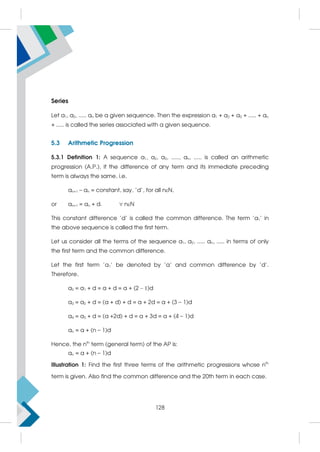
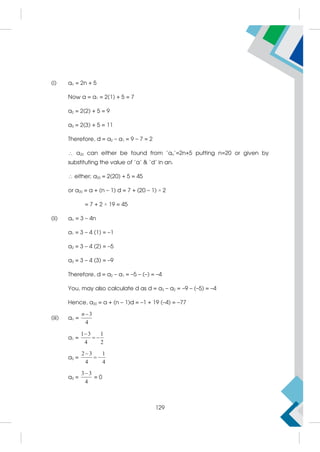
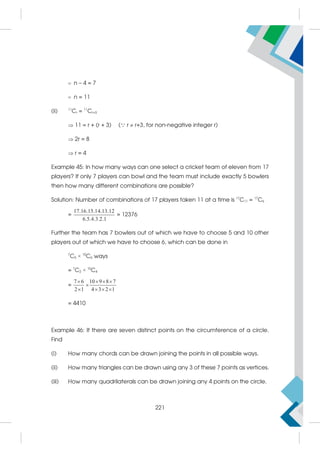
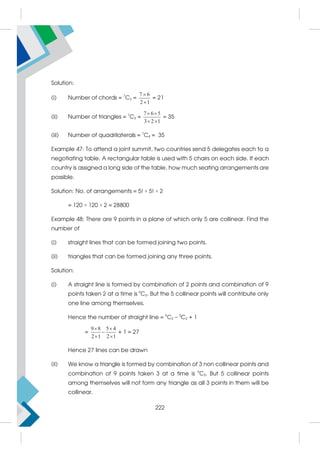
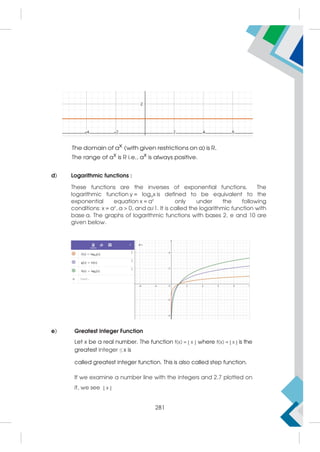
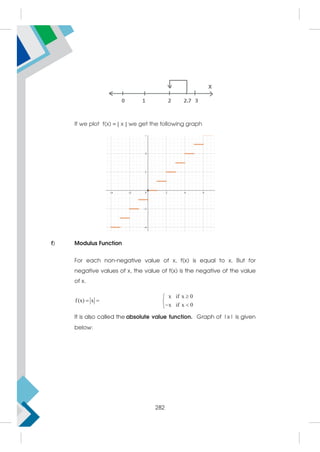
  • 285.
    8.3 Graphical representationof functions: Graphical representation of the function finds many applications. In Finance, Science and Technology graphs are the tools used for many purposes. In the simplest case one variable is plotted as a function of another, typically using rectangular axes. It is therefore important that we understand the nature of graph representing different functions. Let us plot the graph of function f(x) = 3x+2 Graph of f(x) = 3x will be different in its y intercept and if we plot y = 5x+2 will be a straight line with a greater slope. 275
  • 286.
    Check your Progress2 : Above graphs are plotted using GeoGebra Graphing calculator which is available at : https://www.geogebra.org/graphing?lang=en. Explore this useful tool in plotting different functions. Plot the graph of following functions using GeoGebra Graphing calculator: a) f(x) = x2 b) f(x) = x3 c) f(x) = 1/x 8.4 Domain and range of a function: Functions assign outputs to inputs. The domain of a function is the set of all possible inputs for the function. For example, the domain of f(x)=x² is all real numbers, and the domain of g(x)=1/x is all real numbers except for x=0. We can also define special functions whose domains are more limited. Thus, the domain of a function is the set of all values the independent variable can take. The domain can be specified explicitly or implicitly. When it is implicit, the domain is the set of all real numbers for which the function makes sense. Let us take an example: f(x) x 4   276
  • 287.
    If we plota graph it will look like the one given below: The domain of this function is x≥−4, since x cannot be less than −4. If we try to put value less than -4 we cannot calculate the square root. The range of a function is the complete set of all possible resulting values of the dependent variable after we have substituted the domain. We notice that the curve is either on or above the horizontal axis. For x - 4, we will always get a zero or positive value of y. We say the range in this case is y ≥ 0. Similarly for y = sin x, we can see that range to be between −1 and 1. 277
  • 288.
    A function canbe considered as a machine that processes elements of its domain to produce elements of its range. When an element x of domain is fed into input of the machine, the element f(x) of the range comes out in the output as illustrated in the following diagram: Check your Progress 3 : a) Click on the following link of a GeoGebra applet to understand the concept of range and domain of a function : https://www.geogebra.org/m/VGCbyDfr 278
  • 289.
    b) Plot agraph using a spreadsheet and find out the range of the following functions : f(x) = cos x and f(x) = tan x. 8.5 Types of functions: There are different types of functions. We will try to explore some functions a) Polynomial Functions A function f : R R is said to be a polynomial function, if for each x R. f(x) = a0xn + a1xn-1 + a2xn-2 + …. + an-1x + an where a0, a1, a2, a3, , an are real numbers and n is a non- negative integer. The degree of the polynomial is n if a0 0. Example: 3 2 f (x) x – x 2x 3    is a polynomial of degree 3. 3/2 f(x) x 2x 1    is not a polynomial. f(x) 3x 1   is a linear polynomial. 0 f (x) 7x   is polynomial of degree 0. b) Rational Function: A function defined by the quotient of two polynomials is called a rational function. Thus f(x) f(x) ,g(x) 0 g(x)   is a rational function. 3 2 2x x 5 f(x) x 3x     is a rational function. 279
  • 290.
    Note: This functionis not defined at x = 0 and x = 3. ( Why?) c) Exponential Function: Let x be any real number and a 0 but a 1, f(x) = ax is called exponential function with base a. For different values to the base a, the function f(x) = ax have different characteristics. If a 1, f(x) = ax is strictly increasing. If o a 1, f(x) = ax is strictly decreasing. If a = 1, the graph of f(x) = a is a horizontal line. 280
  • 291.
    The domain ofax (with given restrictions on a) is R. The range of ax is R i.e., ax is always positive. d) Logarithmic functions : These functions are the inverses of exponential functions. The logarithmic function y = logax is defined to be equivalent to the exponential equation x = ay only under the following conditions: x = ay , a 0, and a≠1. It is called the logarithmic function with base a. The graphs of logarithmic functions with bases 2, e and 10 are given below. e) Greatest Integer Function Let x be a real number. The function f(x) = ⌊ x ⌋ where f(x) = ⌊ x ⌋ is the greatest integer ≤ x is called greatest integer function. This is also called step function. If we examine a number line with the integers and 2.7 plotted on it, we see ⌊ x ⌋ 281
  • 292.
    If we plotf(x) = ⌊ x ⌋ we get the following graph f) Modulus Function For each non-negative value of x, f(x) is equal to x. But for negative values of x, the value of f(x) is the negative of the value of x. f(x) x   x if x 0 x if x 0       It is also called the absolute value function. Graph of |x| is given below: 282
  • 293.
    g) Signum Function Thesignum of a real number, also called sgn or signum, is -1 for a negative number (i.e., one with a minus sign ), 0 for the number zero, or +1 for a positive number (i.e., one with a plus sign). In other words, for any real x sgn (x)  1 for x 0 0 for x 0 1 for x 0          Plot of signum function is given below: 283
  • 294.
    Check your Progress4: Following are the graphs of h (x) = ex , g(x) = 10x and f(x) = 2x plotted using Geo Gebra graphing calculator. Identify the colour of the graph corres- ponding to each function. 8.6 Limit of a function: For understanding Calculus, we need to understand the concept of limit or limiting process. The concept of limit was used to understand the area of a circle in earlier days. The area enclosed by a circle of radius r is given by πr2 . We can view the circle as a limit of a sequence of regular polygons as shown above: 284
  • 295.
    Area of aregular polygon can be obtained by multiplication of half of its perimeter with the distance from the centre to its sides. Thus area of circle can be calculated as below if the side of the polygon tends to zero (limiting case). A = 1/2 × 2πr × r = πr2 . Let us understand the concept of limit in case of a function in intuitive way before the formal definition. Note the behavior of each graph at x=2 285
  • 296.
    2 x 4 f (x) x2    x 2 g(x) x 2    2 1 h(x) (x 2)   (a) (b) (c) We can easily find that these functions are undefined at x=2. Such a statement does not give us a complete picture of the function at this value. To explain the behaviour of graph near x=2 we need to introduce the concept of limit. Let us consider another function : f(x) = (x2 − 1)/(x − 1). When we put the value of x= 1 we find that the function is undefined. Now let us put some values other than x = 1 and find out the value of the function as given below. X (x2 − 1)/(x − 1) 0.5 1.50000 0.9 1.90000 0.99 1.99000 0.999 1.99900 0.9999 1.99990 0.99999 1.99999 ... ... 1.0001 2.00010 1.001 2.00100 1.01 2.01000 1.1 2.10000 1.5 2.50000 286
  • 297.
    It can beobserved that as we get close to 1 we get the value of function close to 2. It means that though the function at x=1 is not defined as we get the value close to 1 we get the value of the function approaches 2. In Mathematics we use a concept of limit to express this situation. This result can be stated as : The limit of (x2 −1)/ (x−1) as x approaches 1 is 2 Symbolically same can be written as : 2 x 1 x 1 lim 2 x 1     Illustrations: Let us find out the limit of some functions: 1. Find the limit of f(x) 4x,  as x approaches 3. Substitute the value of x and we get f(3) = 4x3 =12 2. Let us now find out limit of another function as x tends to zero 2 x 0 6x 7x lim x   When we substitute x =0 we do not get a definite result. Let us simplify and see what happens. 2 6x 7x x(6x 7) 6x 7 x x      Now when we put the value of x=0 we get 2 x 0 lim (6x 7) 7     287
  • 298.
    Algebra of Limits: Thelimit of a sum is the sum of the limits. x a x a x a lim (f g)(x) lim f (x) lim g(x)       if both limits on the right-hand side exist and are finite. The limit of a product is the product of the limits. x a x a x a lim (f .g)(x) lim f (x) lim g(x)      if both limits on the right-hand side exist and are finite. The limit of a quotient is the quotient of the limits. x a x a x a lim (f/ g)(x) lim f (x) lim g(x)      if both limits on the right-hand side exist and are finite and the limit in the denominator is not zero Check your progress: 5 a) Find : 2 x 2 lim (8 3x 12x )    b) Find: 2 x 8 2z 17z 8 lim 8 z     8.7 Continuity of a function: In the case of f(x) = (x2 − 1)/(x − 1) discussed earlier, irrespective of value of x approaches to 1 from a value less than one or greater than one, the value of the limit of the function is 2. We may not always get a unique value in these two cases. See the above example. 288
  • 299.
    We can saythat the limit of f(x) as x approaches 2 from the left is 2, and the limit of f(x) as x approaches 2 from the right is 1. This can be written as: x 2 lim f (x) 2    x 2 lim f (x) 1    The (-) sign indicates from the left, and (+) sign indicates from the right. The function is said to be discontinuous. In other words we can say that limit of this function does not exist at x=2. On the other hand, for the function f(x) = x2, it can be easily verified that at any point, x=a, lim f(x) = f(a) and the graph of the function is smooth curve having no break anywhere. 289
  • 300.
    The function f(x)is said to be continuous at the point x = a if its finite value at x = a is equal to the limiting value of f(x) at the point x = a. Thus for continuity at x = a Left hand limit = right hand limit = value of the function Check your progress 6: a) Study the graph given below: (i) What y-value is the function approaching as x approaches 3 from the left? (ii) What y-value is the function approaching as x approaches 3 from the right? (iii) What (if any) is the actual y-value at x=3? What can you conclude about the function? b) Following are the examples of Some Continuous Functions. Reflect and discuss with your friends. (i) A constant function f(x) = c is continuous everywhere. (ii) Function f(x) nxn; n ∈ ∈ N is continuous on R. (iii) sin x, cos x are continuous functions on R. 290
  • 301.
    (iv) f(x) =|x| is continuous function on R. (v) Polynomial functions are always continuous. 8.8 Instantaneous rate of change and derivative: One of the important applications of the Calculus is the motion of a particle along a straight line. Consider a particle moving in a straight line from a fixed point O to a given point P, and let t be the time elapsed. Then to each value of t there will correspond a distance s, which will be a function of t: s = s(t). If the particle moves with a constant velocity of 22 m/s, we can write the distance covered s = 22 t If we plot the function s(t) with respect of t we get the following graph: 291
  • 302.
    Velocity, which israte of change of s with respect of t can be calculated by finding out the slope of the graph s 22 t    meters per second We can easily see that the value of the slope is constant as velocity is constant in this case. But in the following case where the velocity of the object is not constant. One can find out average value of velocity over a period of time. But how can we find out the velocity of an object at a particular instant t or when Δt = 0 You may wonder how can we find the value of velocity when Δt = 0. Here the concept of limit will help us in finding out a definite value of this instantaneous velocity. We can define instantaneous velocity using slope as the limiting value of Δs/ Δt when Δt tends to zero. This can be written as : t 0 s v(t) lim t      It can also be said to be the value of slope of the tangent line at t. 292
  • 303.
    Thus instantaneous velocityis said to be derivative of s with respect to t . Differentiation is the action of computing a derivative. The derivative of a function y = f(x) of a variable x is a measure of the rate at which the value y of the function changes with respect to the change of the variable x. It is called the derivative of f with respect to x. If x and y are real numbers, and if the graph of f is plotted against x, the derivative is the slope of the tangent to this graph at each point. For example derivative of the function f at a can be written as : h 0 f (a h) f (a) f '(a) lim h     When the limit exists, f is said to be differentiable at a. Here f′(a) is one of several common notations for the derivative If f(x) is a function of x derivative can also be written as: df dx If we use this definition to obtain the derivative then we are using first principle to find out derivative. Illustration : Let us find out derivative of y = 2x2 + 3x. using first principle: 2 2 2 2 2 2 f(x) 2x 3x so f(x h) 2(x h) 3(x h) 2(x 2xh h ) (3x 3h) 2x 4xh 2h 3x 3h                  We now need to find 293
  • 304.
    h 0 2 22 h 0 h 0 h 0 dy f (x h) f(x) lim dx h 2x 4xh 2h 3x 3h 2x 3x lim h 4xh 2h2 3h lim h lim (4 x 2h 3) 4 x 3                               It will be worthwhile to know derivatives of certain functions. Common Functions Function Derivative Constant c 0 Line x 1 ax a Square x2 2x Square Root √x (½)x-½ Exponential ex ex ax ln(a) ax Logarithms ln(x) 1/x loga(x) 1 / (x ln(a)) Check your Progress 7: a) Show that the derivative of a constant is zero and derivate of ax with respect to x is a. b) Let function y=x2 that measures the area of a metallic square of side x. If at any given time the side of the square is a, and we heat the square uniformly increasing the side, what is the tendency of change of the area in that moment? 294
  • 305.
    Some rules whichwill be of help in finding derivatives are: 8.9 Derivatives of algebraic functions using chain rule : A function is composite if you can write it as f(g(x). In other words, it is a function within a function, or a function of a function. For example (5x-2)3 is Rules Function Derivative Multiplication by constant cf cf’ Power Rule xn nxn−1 Sum Rule f + g f’ + g’ Difference Rule f - g f’ − g’ Product Rule fg f g’ + f’ g Quotient Rule f/g (f’ g − g’ f )/g2 Reciprocal Rule 1/f −f’/f2 Trigonometry (x is radians) sin(x) cos(x) cos(x) −sin x tan(x) sec2 x 295
  • 306.
    composite function. Here5x -2 can also be considered as a function. Chain rule helps us in finding the derivative of a composite function. If f is a composite function then derivative of f with respect x can be written using chain rule as :     d f g(x) f ' g(x) g ' (x) x      Where g is the inner function and f is the outer function. Let us find out the derivative (5x-2)3 using chain rule (5x-2)3 is made up of g3 and 5x-2: f(g) = g3 g(x) = 5x−2 The individual derivatives are: f'(g) = 3g2 (by the Power Rule) g'(x) = 5 Therefore derivative (5x-2)3 = 3 ( 5x-2)2 x5 = 15 ( 5x-2)2 One way to interpret the derivative f’ is to say that f’(k) at k is the rate of change of f at x =k Let us say that a water tank is filled at constant rate and the volume of water in the tank is a function of time given by V (t) =3/5 t . If we plot a graph of V(t) with respect to t we get the following : 296
  • 307.
    Here 3/5 (whichis a constant) is the slope of the graph and can be determined by finding the derivative of V(t) with respect to t. That means the water tank is being filled at the rate of 3/5 liters per second. But the situation may not be that simple. If the volume of water being filled in the tank is non linear and is given by the V(t) = 0.2 t2 . Here we will not have constant rate of change of volume. Let us plot the graph and see. We can find instantaneous rate of change of volume of water in the tank by finding the derivative of V(t), which comes out to be 0.2x2t = 0.4t. This value changes with change in time (t). If we want to find the rate of change of volume with respect to time at any instant we just substitute the value. For example, the rate of change will with 2 L/s at t =5 second 297
  • 308.
    Check your Progress8 : a) Find the rate of change of the area of a circle with respect to its radius r when r = 5 cm. b) On heating, the volume of a metal cube is increasing at a rate of 9 cubic centimeters per second. How fast is the surface area increasing when the length of an edge is 10 centimeters? 8.10 Tangent line and equation of tangent : A tangent line (or simply tangent) to a plane curve at a given point is a straight line that just touches the curve at that point. More precisely a straight line is said to be a tangent of a curve y = f(x) at point x = c if the line passes through the point ( c, f ( c) ) on the curve and has a slope f’(c ) where f’ is the derivative of f. In the following diagram a tangent is drawn at the point P. When we say tangent line for a function can be found by computing the derivative, it only means that “ the derivative measures the slope of the tangent line”. Following step can be used to find the slop of the a tangent line for a function f(x) at a given point x = a. 1. Find the derivative f’(x) 2. Put the value of x =a to get the slope. i.e slope m = f’(a) 3. Find out the y coordinate of the point which is b = f(a) 298
  • 309.
    Use the formulay = m(x-a) +b and put values of m,a and b to get the equation of tangent line at point ( a,b) Let us take a concrete example to understand this procedure. For a function f(x) = x3 + 3x2 + 1. We’ll find the tangent lines at a few different points. Plot of the graph is as under: Let us find out the equation of tangent lines at the points x = -3, Case : 1 x = a = -3 The derivative of x3 + 3x2 + 1. Is 3x2 + 6x Slope m = f’(a) = 9 If the value of x = a= -3 value of y = b = 1 Thus equation of the tangent line is y =m (x-a)+b Thus equation of tangent line at point ( -3,1) to the function f(x) = x3 + 3x2 + 1 is y = 9(x+3)+1 If we draw this tangent line it will look like the one given below: 299
  • 310.
    Check your Progress9: a. For the function f(x) = x3 + 3x2 + 1 given above, tangent line at point -3 is drawn using GeoGebra graphing calculator. Draw the tangent line using this application at x= -2 and x=1. b. Find the equations of a line tangent to y = x3 -2x2 +x-3 at the point x=1. Summary: Function, in mathematics is an expression, rule, or law that defines a relationship between one variable (the independent variable) and another variable (the dependent variable). In a function, the input value must have one and only one value for the output. The domain of a function is the set of all values, the independent variable can take. The range of a function is the complete set of all possible 300
  • 311.
    resulting values ofthe dependent variable after we have substituted the domain. Different types of functions are Polynomial function, rational function, Exponential function, Logarithmic function, Greatest integer function, Signum functions etc. All these functions can be plotted on a graph. Concept of limit can be used to find out the value of function when it is not defined at a particular value. The function f(x) is said to be continuous at the point x = a if its finite value at x = a is equal to the limiting value of f(x) at point x = a. Thus for continuity at x = a, Left hand limit = right hand limit = value of the function The derivative of a function y = f(x) of variable x is a measure of the rate at which the value y of the function changes with respect to the change of the variable x. It is called the derivative of f with respect to x. If x and y are real numbers, and if the graph of f is plotted against x, the derivative is the slope of the tangent to this graph at each point. Derivative of the function f at a can be written as : h 0 f(a h) f(a) f '(a) lim h     If f is a composite function then derivative of f with respect x can be written using chain rule as :     d f g(x) f ' g(x) g'(x) dx      Where g is the inner function and f is the outer function. 301
  • 312.
    The concept ofderivative can be used to find the slope of the tangent line for a function f(x) at a given point x = a. Steps are:  Find the derivative f’(x)  Put the value of x =a to get the slope. i.e slope m = f’(a)  Find out the y coordinate of the point which is b = f(a)  Use the formula y = m(x-a) +b and put values of m,a and b to get the equation of tangent line at point (a, b) Solutions to Check your Progress : 1 a (i) is not a function as input 1 has two outputs: 0 and 5. (ii) is a function. Each input has only one output. Same output (4) for same point does not matter. b) (f+g) (x) = x2 -x+6 and the graphs are as under: 302
  • 313.
    2. Graphs areas under : a) b) c) 3. 4. Answers: a) 2 x 2 lim (8 3x 12x ) 8 3(2) 12(4) 50        b) 2 z 8 z 8 z 8 (2z 17z 8) (2z 1)(z 8) 2z 1 lim lim lim 15 8 z (z 8) 1                 5 a) (i) y = -1 (ii) y=2 (iii) y = 2 , the function is not continuous at x=2 6 b) Rate of change of area with respect to side can be calculated by finding the derivative of x2 with respect to x and if we find its value of at ‘a’ we get the tendency of change of the area in that moment. By using first principle we get this value = 2a 303
  • 314.
    7 a) Puttingvalue of r in 2 π r we get 10π cm2 / cm . b) 3.6 cm2 /s 8. b) y’ = 3x2 – 4x + 1 At x=1 we get the value of slope = 3(1)2 -4(1) +1 = 3-4+1= 0. Value of y at x =1 is b = (1)3 -2(1)2 +1-3 = 1-2+1-3 = -3. Using the formula : y = m(x-a) +b = -3 y=-3 is the equation of tangent at x=1 304
  • 315.
  • 316.
    Concept Map 9.1 Introduction Probabilitiesare part and parcel of life. Some examples from daily life where probability calculations are involved are the determination of premium of insurance, the introduction of new medicines in the market, opinion and exit polls and weather forecasts, In everyday life, many of us use probabilities in our language and say things like “I am one hundred percent sure”. Many important practical problems involving probability can be solved using Total Probability Theorem and Bayes' theorem. These theorems can be used to solve the problems related to insurances, to find out the rate of risk of lending money to potential borrowers, determine the accuracy of medical test results etc. In this unit we are going to discuss more about the practical applications of these two theorems. To understand and apply these two theorems we should know some basic concepts like random experiment, sample space, events, mutually exclusive events, independent and dependent events. 306
  • 317.
    9.2 Random experimentand sample space: An experiment is called random if it has more than one possible outcome and it is not possible to predict the outcome in advance. For example before rolling a die, we do not know the result and hence is random in nature. Rolling a die, therefore is an example of a random experiment. A random experiment is a process by which we observe something uncertain. After the experiment, the outcome of the random experiment is known. An outcome is a result of a random experiment. The set of all possible outcomes is called the sample space. Sample space can be represented as a Set of all possible outcomes. Thus in the context of a random experiment, the sample space is our universal set. Here are some examples of random experiments and their sample spaces represented in the form of sets. Random experiment: Tossing a coin Sample space: S={head, tail} Random experiment: Rolling a die Sample space: D={1,2,3,4,5,6} 307
  • 318.
    Random experiment :Observing the number of android phones sold by a company in 2019. Sample space: L={0,1,2,3,⋯} Random experiment: Observing the number of goals scored in a soccer match. Sample space: K={0,1,2,3,⋯} When a random experiment consists of performance repeated several times, we call each one of them a trial. Thus, a trial is a particular performance of a random experiment. In tossing a coin, each trial will result in either heads or tails. Note that the sample space is defined based on how you define the outcome of your random experiment. For example, if we toss a coin three times and observe the sequence of heads/tails as an outcome, which is usually the understanding, the sample space may be defined as: S={(H,H,H),(H,H,T),(H,T,H),(T,H,H),(H,T,T),(T,H,T),(T,T,H),(T,T,T)}. And if the outcome of the experiment of tossing a coin three times is defined as the number of heads, then S = {0,1,2,3} Example 1 : In each of the following experiments specify appropriate sample space (i) A girl has a one rupee coin, a two rupee coin and a five rupee coin in her pocket. She takes out two coins out of her pocket, one after the other. 308
  • 319.
    (ii) A personis noting down the number of accidents along a busy road during a year. Solution: (i) Let Q denote a 1 rupee coin, H denote a 2 rupee coin and R denote a 5 rupee coin. The first coin she takes out of her pocket may be any one of the three coins Q, H or R. Corresponding to Q, the second draw may be H or R. So the result of two draws may be QH or QR. Similarly, corresponding to H, the second draw may be Q or R. Therefore, the outcomes may be HQ or HR. Lastly, corresponding to R, the second draw may be H or Q. So, the outcomes may be RH or RQ. Thus, the sample space is S={QH, QR, HQ, HR, RH, RQ} (ii) The number of accidents along a busy road during the year of observation can be either 0 (for no accident) or 1 or 2, or some other positive integer. Thus, a sample space associated with this experiment is S= {0,1,2,...} Example-2 : A bag has 3 blue and 4 white balls in it. If a tossed coin shows head, we draw a ball from the bag. If it shows tail we throw a die to show a number. Describe the sample space of this experiment. Solution: Let us denote blue balls by B1, B2, B3 and the white balls by W1, W2, W3, W4. Then a sample space of the experiment is S = { HB1, HB2, HB3, HW1, HW2, HW3, HW4, T1, T2, T3, T4, T5, T6}. Here HB1 means head on the coin and ball B1 HW1 means head on the coin and ball W1. For any number i, HBi means head on the coin and ball Bi. HWi means head on the coin and ball Wi. Similarly, Tj means tail on the coin and the number j on the die. Here, i = 1, 2, 3; j = 1, 2, 3, 4, 5, 6 309
  • 320.
    Check your Progress-1 : 1. Write down an experiment in practical life whose sample space is S = {0,1,2,...} 2. Suppose 3 bulbs are selected at random from a lot of bulbs. Each bulb is tested and classified as defective (D) or non – defective (N). Write the sample space of this Experiment. 9.3 Event and its probability: When we say Event associated with a random experiment we mean a set of one (or more) outcomes. We have seen earlier that sample space of tossing a coin three times is defined as. S={(H,H,H),(H,H,T),(H,T,H),(T,H,H),(H,T,T),(T,H,T),(T,T,H),(T,T,T)}. Suppose, we want to find only the outcomes which have at least two heads; then the set of all such possibilities (outcomes) can be given as: E={(H,H,H),(H,H,T),(H,T,H),(T,H,H)}. E is an event associated with this experiment. Thus, an event is a subset of the sample space, i.e., E is a subset of S. Even the empty set is a subset of S, hence an event, called the Impossible event. The S, itself is a subset of S, hence an event, called ‘Sure’ event. There could be a lot of events associated with a Random Experiment. For any event E to occur, the outcome of the experiment must be an element of the set E. Then how to calculate the probability of an event? The ratio of number of favourable outcomes to the total number of outcomes is defined as the probability of occurrence of an event. Note: This definition applies when the outcomes of the experiment are equally likely to occur. 310
  • 321.
    So, the probabilitythat an event will occur is given as: Number of Favourable Ou P(E) Total Number of Ou tco tc mes omes  Consider the event A = {2, 4, 6, 8} associated with the experiment of drawing a card from a deck of ten cards numbered from 1 to 10. Clearly the sample space is S = {1, 2, 3, ...,10} If all the outcomes 1, 2, ...,10 are considered to be equally likely, then the probability of each outcome is 1 10 Now the probability of event A is P(A) = P(2) + P(4) + P(6) + P(8) (Following an axiom of Probability theory) 1 1 1 1 4 2 10 10 10 10 10 5       We have calculated the probability of an event as sum of probabilities of each outcome in that event. While calculating the probability of each outcome we have taken into account sample space for finding the total number of outcomes. Similarly we can also find an event which is not A. Let us write down the event not A with reference to the example we have discussed earlier. A′ = {1, 3, 5, 7, 9, 10} P(A′) = P(1) + P(3) + P(5) + P(7) + P(9) + P(10) = 1 6 3 6 10 10 5    We can easily see that P(A’) = 1- P(A) This means that , if the event A occurs event ‘not A’ cannot occur. They are called mutually exclusive events. Note : Two mutually exclusive events need not be compliment of each other. 311
  • 322.
    Two events aresaid to be mutually exclusive if the occurrence of one rules out the occurrence of the other. E and F are mutually exclusive if E  F =  Some terms Similar to this term related to events are used in our future discussions. Let us understand these terms. Independent Events and Dependent Events: If the probability of occurrence of an event is completely unaffected by the occurrence (or non-occurrence) of another event, such events are termed as independent events. The events that are not independent are called dependent events. Impossible and Sure Events: If the probability of occurrence of an event is zero such an event is called an impossible event. If the probability of occurrence of an event is 1, it is called a sure event. In other words, the empty set ϕ represents an impossible event and the sample space S represents a sure event. Exhaustive Events: A set of events is called exhaustive if all the events together consume the entire sample space. Their union is the sample space. Mutually Exclusive Events: If the occurrence of one event excludes the simultaneous occurrence of another event, then such events are called mutually exclusive events. For example, if S = {1 , 2 , 3 , 4 , 5 , 6} and E1, E2 are two events such that E1 consists of numbers less than 4 and E2 consists of a number greater than 5. So, E1 = {1,2,3} and E2 = {6} . Then, E1 and E2 are also called mutually exclusive events. 312
  • 323.
    Dependent Events Mr. Vermaand Ms. Banerjee plan to invest some money in the shares of one of the companies in the following sectors: 1. Banking 2. Software development 3. Metal 4. Automobiles They approach the same financial analyst for advice and his recommendation has definite influence on their decision. The two events E = Mr. Verma invests in shares of banking sector F = Ms. Banerjee invests in metal stocks are dependent events as they have the same financial advisor influencing their decision. Independent Events A missile radar detective system consists of two radar screens 'RSO2A' and 'RQ54L'. The probability that these will detect an incoming missile are 0.9 and 0.85 respectively. The two events E = radar screen 'RS02A' detects the missile F = radar screen 'RQ54L' detects the missile are independent events as the probability of detection by any one is not affected by the detection of missile by of the other. Impossible and Sure Events Impossible Event The cut off list for centralized admission to B.Com program in various colleges is as under: 313
  • 324.
    College Minimum Percentage HinduCollege St. Stephens Hansraj SRCC 95% 97% 95% 96% If Sarthak who scored 92% in class 12 has applied for admission in B.Com program then the event E = Sarthak gets admission in one of these colleges is an impossible event as his marks are less than the minimum cut off required Sure Event A manufacturer of earphone claims that not more than 2 pieces of every 1000 earphones manufactured are defective. It also states that a consignment of earphones for export is rejected if it contains atleast 3 defective pieces per 1000. The event: A = The consignment for export by the manufacturer is accepted is a sure event. Exhaustive Events An inhabitant is selected at random from a city. The events S1 = The person selected is covid +ve S1'= The person selected is not covid +ve S2 = The person is diabetic The events S1 and S1'are exhaustive events as they cover the whole sample space. Mutually Exclusive Events A packet containing flower seeds contains 30 seeds of which 12 seeds are of red flower, 8 seeds of yellows flowers and 10 seeds of blue flowers. The two events 314
  • 325.
    E1 = theseed produces red flower E2 = the seed produces yellow flower are mutually exclusive events as the flower can be either red or yellow in colour. Mutually Exclusive and Exhaustive Events A financial institution sanctioned the following type of loans in 2019. Type of loans Number of Approvals 1. Business loan 18 2. Debit consolidation loan 15 3. Economic opportunity loan 17 If an application from approved loans is selected at random for review then the events: E1 = application for business loan E2 = application for debit consolidation loan E3 = application for economic opportunity loan are mutually exclusive and exhaustive events as E1, E2 and E3 have nothing in common and all the applications are of one of these types. Check your progress-2: Give real life examples of the following: 1. Independent Events and Dependent Events 2. Impossible and Sure Events 3. Exhaustive Events 4. Mutually Exclusive Events Mutually exclusive and exhaustive Events 315
  • 326.
    9.4 Conditional Probability Ifwe have two events associated with the same experiment, does the information about the occurrence of one of the events affect the probability of the other event? Let us try to answer this question by taking up a random experiment in which the outcomes are equally likely to occur. Consider the experiment of tossing three fair coins. The sample space of the experiment is S = {HHH, HHT, HTH, THH, HTT, THT, TTH, TTT} Since the coins are fair, we can assign the probability 1 8 to each sample point Let us consider two events E F. Let E be the event where ‘at least two heads appear’ and F be the event where ‘first coin shows tail’. Now, suppose we are given that the first coin shows tail, i.e. F occurs, then what is the probability of occurrence of E? In the above example above we can clearly see that we have placed a condition: When F occurs, then what is the probability of occurrence of E? Do you think the probability of event E with the condition will be same or different? Let E be the event ‘at least two heads appear’ and F be the event ‘first coin shows tail’. Then we can write the sample spaces as: E = {HHH, HHT, HTH, THH} and F = {THH, THT, TTH, TTT}  P(E) = P (HHH) + P (HHT) + P (HTH) + P (THH) = 1 1 1 1 1 8 8 8 8 2     316
  • 327.
    P(F) = P({THH}) + P ({THT}) + P ({TTH}) + P ({TTT}) = 1 1 1 1 1 8 8 8 8 2     Now we have to consider only those outcomes which are favourable to the occurrence of the event F to answer the question “Suppose we are given that the first coin shows tail, what is the probability of occurrence of E?”. That means we have to find out what is common between E and F or the condition given in F matches with that in the Event E. This can be found as given below. E ∩ F = {THH} Now, the sample point of F which is favourable to event E is THH. Thus, Probability of E considering F as the sample space = 1 4 or Probability of E given that the event F has occurred = 1 4 This probability of the event E is called the conditional probability of E given that F has already occurred, and is denoted by P (E|F). Hence, P(E|F) = 1 4 Note that the elements of F which favour the event E are the common elements of E and F, i.e. the sample points of E ∩ F. If E and F are the two events associated with the same sample space of a random experiment, the conditional probability of the event E given that F has occurred is given by: P(E|F) = Number of elementary events favourable to E F Number of elementary events which are favourable to F        P E F P E F provide ( ) | , d P F 0 P F    317
  • 328.
    Example: A familyhas two children. What is the probability that both the children are boys given that at least one of them is a boy? Solution : Let E and F denote the following events : E : both the children are boys F : at least one of the children is a boy Then E = {(b,b)} and F = {(b,b), (g,b), (b,g)} Now E∩ F = {(b,b)} Thus P(E|F) = 1 3 We have used the formula : P(E|F) = Number of elementary events favourable to E F Number of elementary events which are favourable to F  You can also verify the following formula in the above case. P(E|F) = P(E F) P(F)  provided P (F) ≠ 0 Check your progress-3 1. In a group of 100 sports car buyers, 40 bought alarm systems, 30 purchased bucket seats, and 20 purchased an alarm system and bucket seats. If a car buyer chosen at random, bought an alarm system, what is the probability they also bought bucket seats? 2. From the given data, find out the probability that a randomly selected person is male, given that he owns a pet? 318
  • 329.
    9.5 Theorem ofTotal Probability Theorem of total probability “expresses the total probability of an outcome which can be realized via several distinct events”. The collection of events A1, A2, . . . , An is said to be a partition in a sample space S if (a)A1U A2 U… U An = S (b)Ai ∩ Aj =  for all i, j, i  j (c ) Ai ≠  for all i In essence, a partition is a collection of non-empty, non-overlapping subsets of a sample space whose union is the sample space itself. If B is any event within S then we can express B as the union of subsets: B = (B ∩ A1) ∪ (B ∩ A2) ∪ · · · ∪ (B ∩ An) This is illustrated in the diagram that follows in which an event B in S is represented by the shaded region. 319
  • 330.
    The bracketed events(B ∩A1),(B ∩A2). . .(B ∩An) are mutually exclusive (if one occurs then none of the others can occur). Using the addition law of probability for mutually exclusive events, we can write probability of event B as: P(B) = P(B ∩ A1) + P(B ∩ A2) + · · · + P(B ∩ An) Each of the probabilities on the right-hand side may be expressed in terms of conditional probabilities: P(B ∩ Ai) = P(B|Ai)P(Ai) for all I P(B A) as P(B A) P(A)         Using these in the expression for P(B), above, gives: P(B) = 1 1 2 2 n n P(B A )P(A ) P(B A )P(A ) ... P(B A )P(A )    n i i i 1 P(B A )P(A )   Let us understand this theorem with an example. A person has undertaken a construction job. The probabilities are 0.65 that there will be strike, 0.80 that the construction job will be completed on time if there is no strike, and 0.32 that the construction job will be completed on time if there is a strike. Now we have to determine the probability that the construction job will be completed on time. To solve this problem let us see if this comprise of two mutually exclusive events. We can see that there is either strike (B) or there is no strike (B’) . The sum of these probabilities should be 1 . If we have strike then we cannot have ‘no strike’ and vice versa. That means events B and B’ form partition of the sample space. Hence we can write probability of strike as P(B) = 0.65, P(B’) = P(no strike) = 1 −P(B) = 1 −0.65 = 0.35 Now there is another event : Completion of work A . This can happen when there is strike and also when there is no strike for various reasons. This fits the requirement of application of theorem of total probability, we have 320
  • 331.
    It is giventhat the probability of completion of work when there is strike (B) as P(A|B) = 0.32 and probability of completion of work when there is no strike (B’) as P(A|B’) = 0.80 Now we can easily find out the probability of completion of work in any case as: P(A) = P(B) P(A|B) + P(B’) P(A|B’) = 0.65 × 0.32 + 0.35 × 0.8 = 0.208 + 0.28 = 0.488 Thus, the probability that the construction job will be completed in time is 0.488. WATCH THIS VIDEO : https://www.youtube.com/watch?v=U3_783xznQI Check your progress-4 : Its given that 80% of people attend their family and doctor regularly; 35% of these people have no health problems cropping up during the following year. Out of the 20% of people who don’t see their doctor regularly, only 5% have no health issues during the following year. What is the probability a person selected at random will have no health problems in the following year? 9.6 Bayes’ theorem Bayes' theorem, named after 18th-century British mathematician Thomas Bayes, is a mathematical formula for determining conditional probability. It provides a way to revise existing predictions or theories (update probabilities) given new or additional evidence. This theorem is the foundation of the field of Bayesian statistics. Statement of the theorem: If A1, A2, ... An are n non empty events which constitute a partition of sample space S i.e., Ai  Aj =  for all i, j i  j which means 321
  • 332.
    A1, A2, ...An are pairwise disjoint and A1  A2  .....  An = S Also B is any event of non-zero probability, then i P(A B) = i i n j j j 1 P(A )P(B A ) P(A )P(B A )   for any i = 1, 2, 3, ..., n Proof: By formula of conditional probability, we know i P(A B) = ( ∩ ) ( ) = i i P(A )P(B A ) P(B) (By multiplication rule) i i n j j j 1 P(A )P(B A ) P(A )P(B A )    (By theorem of total probability) Remark: In Bayes’ theorem the following terminology is applied. The events A1, A2, ... An are called hypotheses. The probability P (Ai) is called the priori probability of the hypotheses. The conditional probability i P(A B) is called a posteriori probability of the hypothesis Ai. Let us try to understand this theorem with a practical example given below: Illustration: Let us find out patients’ probability of having liver disease if they are alcoholic. “Being an alcoholic” is the test for liver disease.  A could mean the event “Patient has liver disease.” Let us say 10% of patients entering a clinic have liver disease as per data available with the doctor. Probability of event A = P(A) = 0.10  B could mean the confirmatory test that “Patient is an alcoholic.” Let us assume that five percent of the clinic’s patients are alcoholics. Probability of event B = P(B) = 0.05 322
  • 333.
    You might alsoknow that among those patients diagnosed with liver disease, 7% are alcoholics. This is B|A: the probability that a patient is alcoholic, given that they have liver disease, is 7%. Applying Bayes’ theorem, we get P(A|B) = (0.07 x 0.1)/0.05 = 0.14 In other words, if the patient is an alcoholic, his/her chances of having liver disease is 0.14 (14%). This is a large increase from the 10% suggested by past data. But it’s still unlikely that any particular patient has liver disease. WATCH THESE VIDEOS NOW TO INTERNALIZE THE THEOREM. Bayes’ theorem : https://www.youtube.com/watch?v=HZGCoVF3YvM Implications of Bayes’ theorem : https://www.youtube.com/watch?v=R13BD8qKeTg Prior probability, in Bayesian statistical inference, is the probability of an event before new data is collected. This is the best way of assessing the probability of an outcome based on the current knowledge before an experiment is performed. Posterior probability is the revised probability of an event occurring after taking into consideration new information. Posterior probability is calculated by updating the prior probability by using Bayes' theorem. In statistical terms, the posterior probability is the probability of event A occurring given that event B has occurred. Bayes' theorem thus gives the probability of an event based on new information that is, or may be related, to that event. The formula can also be used to see how the probability of an event occurring is affected by hypothetical new information, supposing the new information will turns out to be true. Exercise on Bayes’ theorem 1. The number of loans sanctioned by a particular branch of a bank under different heads and the percentage of defaults in each category is given above: 323
  • 334.
    Types of Loan Numberof Loans Approved Defaults (%) Personal Loan 15 3% Education Loan 5 1% Housing Loan 10 2% Car Loan 10 5% If the loan application form picked at random for review is found to be of a person who has defaulted then find the probability that the application was for car loan. 2. A courier service company sends 30% of its orders by air, 50% by combination of bus and local transport and remaining 20% by train. Past record shows the courier is delivered late 2%, 7% and 5% of the time when orders are sent by air, bus local transport and train respectively. Find (i) the probability that the order will be delivered late (ii) the probability that the parcel delivered to a customer is sent by train if it is delivered late. 3. A young entrepreneur imports high tech machines for a startup venture. The imported machines are to be set up by an expert who is sent by the firm making these machines. From experience it is known that 80% of the times the expert is able to correctly set up the machines. If the setup is correctly done the machine produces 90% acceptable items and in case of an incorrect set up the machine produces only 50% acceptable item. If after a certain set up the machine produces an acceptable item followed by an unacceptable item find the probability that the machine is incorrectly set up. 4. An insurance company insures scooter drivers, car drivers and bus drivers in the ratio 4:5:3. The probability of a scooter driver, car driver and bus driver meeting with an accident is 0.7%, 0.4% and 1.2% respectively. If an insured 324
  • 335.
    person meets withan accident find the probability that the person is a scooter driver. 5. Two cards from a pack of 52 cards are lost. From the remaining cards of the pack a card is drawn at random and is found to be spade. Find the probability that the lost cards are both spades. 6. A laboratory blood test is 99% effective in detecting a certain disease when it is in fact, present. However, the test also yields a false positive result for 0.5% of the healthy person tested. If 0.2% of the population actually has the disease, what is the probability that a person has the disease given that his test result is positive? Check your progress - 5 1. Car Repair Diagnosis The manager of a car repair workshop knows from past experience that when a call is received from a person who is stuck up far away and has problem starting the car, the probabilities of various troubles are as follows: Event Trouble Probability A1 Battery problem 0.4 A2 No petrol 0.3 A3 Flooded 0.1 A4 Some other reason 0.2 Assuming that no two faults occur simultaneously and E be the event that the car starts if instructions given by the manager are followed by the driver with probabilities: P (E|A1) = 0.3, P (E|A2) = 0, P (E|A3) = 0.8, P (E|A4) = 0.5 (a) If a person follows the instructions given by the manager, what is the probability that the car starts? (b) If the car starts on following the instructions of the manager, find the probability that car had a battery problem. 325
  • 336.
    2. In afactory which manufactures bulbs, units A, B and C manufacture respectively 25%, 35% and 40% of the bulbs. Of their outputs, 5, 4 and 2 percent are respectively defective bulbs. A bulbs is drawn at random from the product and is found to be defective. What is the probability that it is manufactured by the unit B? Summary 1. A random experiment is a process by which we observe something uncertain 2. An outcome is a result of a random experiment. 3. The set of all possible outcomes is called the sample space. The sample space is defined based on how you define your random experiment. 4. A trial is a particular performance of a random experiment. 5. An event is a subset of the sample space. 6. The ratio of number of favourable outcomes to the total number of outcomes is defined as the probability of occurrence of an event. 7. We have Independent or dependent Events, Impossible and Sure Events, Exhaustive Events, Mutually Exclusive Events according to the probabilities with reference to the sample space. 8. If E and F are two events associated with the same sample space of a random experiment, the conditional probability of the event E given that F has occurred, P(E|F) = Number of elementary events favourable to E F Number of elementary events which are favourable to F  P(E|F)=   P(E F F ) P  , provided P (F) ≠ 0 326
  • 337.
    9. Theorem oftotal probability “expresses the total probability of an outcome which can be realized via several distinct events”. if (a)A1UA2U…UAn = S (b)Ai ∩Aj =  for all i, j (c ) Ai ≠  for all i Then : P(B) = P(B|A1)P(A1) + P(B|A2)P(A2) + · · · + P(B|An)P(An) n 1 i i 1 P(B A )P(A )    10. Bayes’ Theorem If A1, A2,… An are n non empty events which constitute a partition of sample space S. Also B is any event of non zero probability, then i i i n j j j 1 P(A )P(B A ) P(A B) P(A )P(B A )    for any i = 1,2,3, …,n Practical and project work 1. Find out different examples of practical applications of Total Probability theorem and Bayes’ theorem in finance, research and industry 2. Search for data and frame a problem to be solved by Bayes’ theorem. Use excel sheet to calculate the result. Further exploration 1. https://www.cimt.org.uk/projects/mepres/alevel/stats_ch1.pdf Solutions to Check your Progress - 1 1. Observing the Number of people voted in a constituency. 2. S= {DDD, DDN, DND, NDD, DNN, NDN, NND, NNN} 327
  • 338.
    Solutions to checkyour Progress-2 1. Independent events A : Person having black hair B : Person working in a MNC Dependent events : Traffic and Condition of road Accident 2. Impossible event : Sun rising in the west Sure event : Getting sum of number 12 when a pair of dice are rolled 3. Exhaustive events A: Getting a head in a single throw of a coin B: Getting a tail in a single throw of a coin 4. Mutually exclusive events A: A person running forward B: A person running backward avB=0 5. Mutually exclusive and exhaustive events A: getting an even number in a throw of a die B: getting an odd number in a single throw of a die. Solution to check your Progress - 3 1. Let A denotes the event of car buyer buying alarm system and B denotes the event of car buyer buying bucket seat P(A) = 40%, or 0.4. P(A∩B) = 20 0.2 100  Substitude the values in the formula 328
  • 339.
    P(B|A) = P(A B)0.2 0.5 P(A) 0.4    The probability that a buyer bought bucket seats, given that they purchased an alarm system, is 50%. 2. Let M stands for event of person being male and P stands for a event that person is a pet owner, we have: P(M∩P) = 0.41. P(P) = 0.86 Substituting in the formula: P(M|P) = P(M P) 0.41 0.477,or 47.7% P(M) 0.86    Solution to check your Progress – 4 1. Let D denotes the event of seeing the doctor regularly and H denotes the event of facing no health issues the following year. Probability of those who see doctor regularly, P(D) = 0.80 Probability of those who do not see the doctor regularly, P( D’) =0.20 Probability of those who see the doctor given that have no health issues P(H|D) =0.35 Probability of those who do not see doctor and have no health issues P(H|D’) = 0.05 P(H) = P(D) P(H|D) + P(D’) P(H|D’) = 0.80x0.35 +0.20x0.05 = 0.28+0.01 329
  • 340.
    Answer to exerciseon Baye’s Theorem 1. 5/12 2. 51/1000, 10/51 3. 25/61 4. 1/3 5. .051 6. 198/697 Solution to Check your Progress - 5 1 (a) We need to compute P(E) Using theorem of total probability, we get P(E) = P(A1) P (E|A1) + P(A2) P (E|A2) + P(A3) P (E|A3) + P(A4) P (E|A4) = 0.4 × 0.3 + 0.3 × 0 + 0.1 × 0.8 + 0.2 × 0.5 = 0.12 + 0 + 0.08 + 0.10 = 0.3 … (1) The probability that the car starts is 0.3 (b) We use Bayes' formula to compute the posteriori probability P (A1|E):   i i 1 4 j i i 1 P(A )P(B A ) P A / E P(A )P(B A )    0.4 0.3 0.3   (Using 1) = 0.4 Thus the probability that the car had battery problem if it started on following managers instruction is 0.4. 2. Let B1, B2, B3 be the event that the bulb is manufactured by units A, B and C respectively and E be the event that bulb manufactured is defective P(B1) = 0.25, P (B2) = 0.35 and P(B3) = 0.40 P(E|B1) = Probability that the bolt drawn is defective given that it is manufactured by unit A = 5% = 0.05 330
  • 341.
    Also P(E|B2) =0.04, P(E|B3) = 0.02. 2 2 2 1 1 2 2 3 3 P(B ) P(E B ) P(B E) P(B ) P(E B ) P(B ) P(E B ) P(B ) P(E B )        0.35 0.04 0.25 0.05 0.35 0.04 0.40 0.02        0.014 28 0.0345 69   331
  • 343.
  • 344.
  • 345.
  • 346.
  • 347.
  • 348.
  • 349.
  • 350.
  • 351.
  • 352.
  • 353.
  • 354.
  • 355.
  • 356.
  • 357.
  • 358.
  • 359.
  • 360.
  • 361.
  • 362.
  • 363.
  • 364.
  • 365.
  • 366.
  • 367.
  • 368.
  • 369.
  • 370.
  • 371.
  • 372.
  • 373.
  • 374.
  • 375.
  • 376.
  • 377.
  • 378.
  • 379.
  • 380.
  • 381.
  • 382.
  • 383.
  • 384.
  • 385.
  • 386.
  • 387.
  • 388.
  • 389.
  • 390.
  • 391.
  • 392.
  • 393.
  • 394.
  • 395.
  • 396.
  • 397.
  • 398.
  • 399.
  • 400.
  • 401.
  • 402.
  • 403.
  • 404.
  • 405.
  • 406.
  • 407.
  • 408.
  • 409.
  • 410.
  • 411.
  • 412.
  • 413.
  • 414.
  • 415.
  • 417.
  • 418.
  • 419.
  • 420.
  • 421.
  • 422.
  • 423.
  • 424.
  • 425.
  • 426.
  • 427.
  • 428.
  • 429.
  • 430.
  • 431.
  • 432.
  • 433.
  • 434.
  • 435.
  • 436.
  • 437.
  • 438.
  • 439.
  • 440.
  • 441.
  • 442.
  • 443.
  • 444.
  • 445.
  • 446.
  • 447.
  • 448.
  • 449.
  • 450.
  • 451.
  • 452.
  • 453.
  • 454.
  • 455.
  • 456.
  • 457.
  • 458.
  • 459.
  • 460.
  • 461.
  • 462.
    Concept Map 12.1 StraightLine A straight line is a curve such that every point on the line segment joining any two points on it lies on it. Equation of a Line: The equation of a straight line is a linear relation between two variables x and y, which is satisfied by the coordinates of each and every point on the line and is not satisfied by any other point in the Cartesian plane. 452
  • 463.
    Slope of aLine: Inclination of a Line The inclination of a line is the angle θ which the line makes with the positive direction of the x-axis, measured in anticlockwise direction. Clearly 00  θ 1800 . If we are keeping θ unique thus 00  θ 1800 . Slope or Gradient of a Line: If θ is the inclination of a non-vertical line, then tan θ is called the slope of the line and is denoted by m. Remark 1: The slope of a horizontal line is 0, because tan 00 = 0. Remark 2: The slope of a vertical line is not defined, because tan 900 is not defined. Let L1 and L2 be two non-vertical lines with slopes m1 and m2 respectively. Let their inclinations be θ1 and θ2 respectively. If L1 and L2 are parallel  θ1 = θ2  tan θ1 = tan θ2  m1 = m2 453
  • 464.
    12.2 Slopes ofPerpendicular Lines Let L1 and L2 be two non-vertical lines with slopes m1 and m2 respectively. Let their inclinations be θ1 and θ2 respectively. Then m1 = tan θ1 and m2 = tan θ2 Let L1 and L2 be perpendicular to each other. Then θ2 = 900 + θ1  tan θ2 = tan (900 + θ 1) = – cot θ1  tan θ2 = – 1 tan    m2 = – 1 1 m  m1m2 = –1 Angle between Two Non-vertical and Non-perpendicular Lines 454
  • 465.
    Slope of aLine Passing through Two given Points Let us consider a non-vertical line CAB, passing through the points A (x1, y1) and B (x2, y2). Let θ be its inclination Draw AL and BM perpendicular to x-axis and AN  BM Thus BAN = ACM = θ From right triangle ANB, we have tan θ = 2 1 2 1 BN BM NM BM AL AN LM OM OL y y x x          m = tan θ = 2 1 2 1 y y x x   Hence, the slope of the line joining the points A (x1, y1) and B (x2, y2) is given by, m = 2 1 2 1 y y x x   455
  • 466.
    12.3 Angle betweentwo Lines Let L1 and L2 be the two given non-vertical and non-perpendicular lines with slopes m1 and m2 respectively. Let 1 and 2 be their respective inclinations. Then m1 = tan 1 and m2 = tan 2. Let  and (1800 – θ) be the angles between L1 and L2. We have θ = 2 – 1 where 1, 2  900  tan θ = tan (2 – 1) = tan tan 1 tan tan             tan θ = 2 1 1 2 m m 1 m m   where 1 + m1 m2  0 Also tan (1800 – θ) = – tan θ = – 2 1 1 2 m m 1 m m   Thus, tangent of the angle between given lines is =  2 1 1 2 m m 1 m m   Let  = min. { θ, (180 – θ)}, then  is acute and so tan  0. 2 1 1 2 m m tan 1 m m      456
  • 467.
    12.4 Various Formsof the Equation of a Line 1. Equation of x-axis: We know that the ordinate of each point on the x-axis is 0. If P (x, y) is any point on the x-axis, then y = 0. Hence the equation of x-axis is y = 0. 2. Equation of y-axis: We know that the abscissa of each point on the y-axis is 0. If P (x, y) is any point on the y-axis, then x = 0. Hence the equation of y-axis is x = 0. 3. Equation of a line parallel to y-axis. Let AB be a straight line parallel to the y-axis lying on its right hand side at a distance a from it. Thus, the abscissa of each point on AB is a. If P (x, y) is any point on AB, then x = a. Thus, the equation of a vertical line at a distance a from the y-axis, lying on its right hand side is x = a. Similarly, the equation of a vertical line at a distance a from the y-axis, lying on its left-hand side is x = –a. 4. Equation of a line parallel to x-axis 457
  • 468.
    Let AB bea straight line parallel to the x-axis, lying above it at a distance b from it. Then ordinate of each point on AB is b. If P (x, y) is any point on AB, then y = b. Thus the equation of a horizontal line at a distance b from the x-axis, lying above the x-axis is y = b. Similarly, the equation of a horizontal line at a distance b from the x-axis, lying below the x-axis is y = –b. Equation of a Line in Point-Slope Form Let L be a non-vertical line with slope m and passing through a point A (x1, y1). Let P (x, y) be an arbitrary point on L. Then slope of the line L = 1 1 y y x x    m = 1 1 y y x x    y–y1 = m (x – x1) where m = tan θ Equation of a Line in Two-Point Form 458
  • 469.
    Let L bethe line passing through the points A (x1, y1) and B (x2, y2) and let P (x, y) be an arbitrary point on L. Then slope of AP = slope of AB.  1 1 y y x x   = 2 1 2 1   y y x x  y – y1 = 2 1 2 1 y y x x   (x – x1) which is the required equation. Equation of a Line in Slope-Intercept Form Let L be a given line with slope m, making an intercept c on the y-axis. Then, L cuts the y-axis at the point (O,C). (Remember C could be –ve, O or +ve. The y intercept of the line is C.) Thus, the line L has slope m and it passes through the point C (o, c). So by point-slope form, the equation of L is y – c = m (x – 0)  y = mx + c Equation of a Line in Intercept Form 459
  • 470.
    Let AB bethe line cutting the x-axis and the y-axis at A (a, o) and B (o, b) respectively. Here, x – intercept and y – intercept of the line are a, b respectively. Let us assume that none of a, b is 0. So, the equation of line AB is given by 0 0 0 y b x a a       y b x a a     b (x – a) = – ay  bx + ay = ab  x y a b  = 1 (Division of both sides by ab is possible as none of a and b is 0) Thus, the equation of a line making intercepts a and b on the x and y axis respectively is 1 x y a b   . Equation of a Line in Normal Form Let L be the given line. Draw ON perpendicular to L. Let ON = p and let the angle between positive direction of the x-axis and ON be  in anti- clockwise sense. Draw perpendicular NM on the x-axis. We have 460
  • 471.
    OM ON = cos and NM ON = sin  (In this figure  is acute. But,  could be such that 0  2 ) In all possible cases, the co-ordinates of N are (p cos , sin ) 3 ( , ) 2 2        OM = p cos  and NM = p sin  Thus the coordinates of N are (p cos , p sin ) Moreover, line L is perpendicular to ON.  Slope of the line L = 1 1 cos Slope of ON tan sin         Thus, the line L passes through the point N (p cos , p sin ) and has slope m = cos sin    So, the equation of the line L is given by y – p sin  = cos sin    (x – p cos )  (y – p sin ) sin  = – cos  (x – p cos )  x cos  + y sin  = p (cos2  + sin2 )  x cos  + y sin  = p which is the required equation. Theorem: Prove that the equation Ax + By + C = 0 always represents a line provided A and B are not simultaneously zero. Proof: Let Ax + By + C = 0 where A2 + B2  0 Case I: When A = 0 and B  0 In this case, the given equation becomes 461
  • 472.
    By + C= 0  y = C B  which represents a line parallel to the x-axis Case II: When A  0 and B = 0 In this case, the given equation becomes Ax + C = 0  x = C A  which represents a line parallel to the y-axis You may note that even if 3 or , 2 2     the equation would be of the form y = p or – y = p which is of the form 3 3 x cos y sin p or x cos y sin p 2 2 2 2          Case III: When A  0 and B  0 In this case we have Ax + By + C = 0  By = – Ax + (–C)  y = A B        x + C B        This is clearly an equation of a line in slope intercept form y = mx + c, where m = A B        and C B        Thus Ax + By + C = 0 where A2 + B2  0 always represents a line. Theorem: Prove that the length of perpendicular from a given point P (x1, y1) on a line Ax + By + C = 0 is given by d = 1 1 2 2 A B C A B x y    Proof: Let L be the line represented by the equation Ax + By + C = 0 and let P (x1, y1) be a given point outside it. 462
  • 473.
    Let us assumethat none of A, B, C is 0 Let this line L intersect the x-axis and the y-axis at points Q and R respectively, and let PM  QR. Now, Ax + By + C = 0  Ax + By = –C  A B C –C x y   = 1  C C – A B x y               = 1 Thus, the given line intersects the x-axis and the y-axis at the points Q C – , 0 A       and R C 0, – B       respectively. Area of  PQR =   1 1 1 1 -C -C C 0 0. 0 . 2 B A B                        x y y = 1 1 1 C C 2 B A AB          x y =   1 1 1 C A B C 2 AB x y   =   1 1 C A B C 2AB x y   (1) 463
  • 474.
    Also, area of PQR = 1 2 × QR × PM = 1 2 × PM ×     2 2 OQ OR  = 1 2 × PM × 2 2 C C A B                = 1 2 × PM × 2 2 2 2 C C A B  (2) From equation (1) and (2), we get 1 2 × PM × 2 2 2 2 C C A B  =   1 1 C A B 2AB x y C    2 2 1 C A B PM 2 AB     =   1 1 C A B 2AB   x y C  PM = 1 1 2 2 A B C A B x y    Hence, d = 1 1 2 2 A B C A B x y    It may be easily seen that the formula stands true even if A = 0, B  0, C = 0 or A  0, B = 0, C = 0 or A = 0, B  0, C  0 or A  0, B = 0, C  0. Remarks: The length of perpendicular from the origin (0, 0) on the line Ax + By + C = 0 is 2 2 C A B  464
  • 475.
    Distance between TwoParallel Lines Theorem: Prove that the distance between two parallel lines Ax + By + C1 = 0 and Ax + By + C2 = 0 is given by d = 2 1 2 2 C – C A B  Solution: Let L1 and L2 be two given parallel lines represented by Ax + By + C1 = 0 (1) and Ax + By + C2 = 0 (2) Putting y = 0 in equation (1), we get x = 1 C A  (assuming A  0) Thus L1, intersects the x-axis at Q = 1 C , 0 A        Let QR  L2 and let d = |QR|. Then d = length of perpendicular from Q 1 C , 0 A        on Ax + By + C2 = 0  d = 1 2 2 1 2 2 2 2 C A B 0 C C C A A B A B                465
  • 476.
    Illustrative Examples Microeconomic applications:Demand curve Example 1: Let us assume that the demand curve is described by the line q = mp + b. Find its equations given that a promoter discovers that the demand for theatre tickets is 1200 when the price is Rs. 400, but decreases to 900 when the price is raised to Rs. 450. Solution: The form of the equation q = mp + b indicates that the price p, is the independent variable and the quantity q, is the dependent variable. The problem gives us two points of the demand line as (400, 1200) and (450, 900). We must identify the slope and the y-intercept of the line. Slope m = 2 1 2 1 900 1200 300 450 400 50 q q q p p p           = –6 The equation must, therefore, take on the form, q = –6p + b. Now since (400, 1200) is a point on the demand curve it must satisfy the equation q = –6 p + b. By substitution, we obtain 1200 = – 6 (400) + b or 1200 = – 2400 + b b = 3600 Now, since m = – 6 and b = 3600, the equation of the demand line is q = – 6 p + 3600 Example 2: The equilibrium quantity and the equilibrium price of a product are determined by the point where the supply and demand curves intersect. For a given product, the supply is determined by the line. q supply = 30 p – 45 and for the same product, the demand is determined by the line q demand = – 15 p + 855 466
  • 477.
    Determine the equilibriumprice and the equilibrium quantity and trace the supply and demand lines on the same graph. Solution: We must determine the coordinates of point (q, p) situated at the intersection of the two lines. This point must, therefore, satisfy both the supply and the demand equations. The solution to this problem is to solve: q = 30 p – 45 (1) q = – 15 p + 855 (2) Thus from equation (1) and (2) 30 p – 45 = – 15 p + 855 or 45 p = 900 p = 20 and q = 30 (20) – 45 = 555 The equilibrium price and the equilibrium quantity are, therefore, Rs. 20 and 555 resepctively. Example 3: Find the equations of the lines parallel to the axes and passing through the point (–3, 5). 467
  • 478.
    Solution: We knowthat (i) The equation of a line parallel to the x-axis and passing through (–3, 5) is y = 5 (ii) The equation of a line parallel to the y-axis and passing through (–3, 5) is x = –3 Example 4: Find the equation of the perpendicular bisector of the line segment joining the points A (2, 3) and B (6, –5) Solution: Here A (2, 3) and B (6, –5) are the end points of the given line segment. The midpoint of AB is 2 6 3 5 M , 2 2         i.e., M (4, –1) Slope of AB = 5 3 6 2    = –2 Let LM AB  and let the slope of LM be m. Thus, mx (–2) = –1  m = 1 2 Now, LM is the perpendicular bisector of AB with slope = 1 2 and passing through M (4, –1). 468
  • 479.
    So, the requiredequation is y + 1 = 1 2 (x – 4) or 2y + 2 = x – 4  x – 2y – 6 = 0 Example 5: Find the equation of the line whose y-intercept is –3 and which is perpendicular to the line 3x – 2y + 5 = 0. Solution: 3x – 2y + 5 = 0  2y = 3x + 5  y = 3 2 x + 5 2  Slope of the given line = 3 2  Slope of a line perpendicular to the given line = – 2 3 ( m2 = 1 1 m  ) Now, the equation of a line with slope 2 3  and y-intercept –3 is given by y = 2 3 x  – 3  2x + 3y + 9 = 0 which is the required equation. Example 6: If M (a, b) is the midpoint of a line segment intercepted between the axes, show that the equation of the line is x y a b  = 2. Solution: Let the equation of the line be x y c d  = 1 469
  • 480.
    Thus, it cutsthe x-axis and y-axis at the points A (c, 0) and B (o, d). M (a, b) is the midpoint of AB. So 0 2 c = a and 0 2 d  = b.  c = 2a and d = 2b. So the required equation is 2 2 x y a b  = 1  x y a b  = 2 Example 7: Find the equation of a line whose perpendicular distance from the origin is 2 units and the angle between the perpendicular segment and the positive direction of the x-axis is 2400 . Solution: Let equation of the line be x cos  + y sin  = p Here p = 2 units and  = 2400 470
  • 481.
    cos 2400 = cos(1800 + 600 ) = – cos 600 = – 1 2 sin 2400 = sin (1800 + 600 ) = – sin 600 = 3 2  So, the equation of the line is x cos 2400 + y sin 2400 = 2  x × 1 2        + y × 3 2          = 2  x + 3 y + 4 = 0 which is the required equation. Example 8: Reduce the equation 3 x + y + 2 = 0 to the normal form x cos  + y sin  = p and hence find the value of  and p. Solution: We have 3 x + y + 2 = 0  – 3 x – y = 2 3 2          x + 1 2        y = 1 Normal form of the equation is x cos  + y sin  = p Here, cos  = 3 2  , sin  = 1 2  , p = 1 Since cos  0 and sin  0,  lies in the third quadrant. Now, tan  = sin cos   = 1 2 2 3                = 1 3 = tan (1800 + 300 ) = tan 2100   = 2100 471
  • 482.
    Thus,  =2100 and p = 1 Hence, the given equation in normal form is x cos 2100 + y sin 2100 = 1. Example 9: Find the distance between the parallel lines. 15x + 8y – 34 = 0 and 15x + 8y + 31 = 0 Solution: Converting each of the given equation to the form y = mx + c, we get 15 x + 8y – 34 = 0  y = 15 8  x + 17 4 (1) 15 x + 8y + 31 = 0  y = 15 8  x - 31 8 (2) Clearly, the slopes of the given lines are equal and so they are parallel. The given lines are of the form y = mx + c1 and y = mx + c2 where m = 15 8  , c1 = 17 4 and c2 = 31 8   Distance between the given lines = 2 2 1 c c 1 m   = 2 31 17 8 4 15 1 8           = 65 8 225 1 64   = 65 8 289 64 = 65 8 8 17  = 65 17 units Hence, the distance between the given lines is 65 17 units. 472
  • 483.
    Exercise 1 1. Findthe equation of a line which is equidistant from the lines y = 8 and y = –2. 2. If A (1, 4), B (2, –3) and C (–1, –2) are the vertices of a ABC, then find the equation of (i) the median through A (ii) the altitude through A (iii) the perpendicular bisector of BC 3. Find the equation of the bisector of the angle between the coordinate axes. 4. Find the equation of the line passing through the point (2, 2) and cutting off intercepts on the axes, whose sum is 9. 5. Find the equation of the line which is at a distance of 3 units from the origin such that tan  = 5 12 , where  is the acute angle which this perpendicular makes with the positive direction of the x-axis. 6. Reduce the equation 5x – 12y = 60 to intercept form. Hence find the length of the portion of the line intercepted between the axes. 7. Reduce the equation x + y – 2 = 0 to the normal form. 8. What are the points on the x-axis whose perpendicular distance from the line 3 4 x y  = 1 is 4 units. 9. A company produces shoes. When 30 shoes are produced the total cost of production is Rs. 1500. When 50 shoes are produced the costs increases to Rs. 2000. What is the cost equation (C) if it varies linearly in function to the number of shoes produced (q). 10. Consider a market characterised by the following supply and demand curves: 473
  • 484.
    q demand =– 10p + 1000 q supply = 0.2 p + 2986 Find the equilibrium price and quantity. 12.5 Circle A circle is the set of all points in a plane, each of which is at a constant distance from a fixed point in the plane. The fixed point is called the centre and the constant distance is called the radius. Radius is always positive. It P1, P2, P3, ..... are points on the circle with center C, and radius r, then CP1 = CP2 = CP3 = ..... = r Equation of a Circle in Standard Form Let O (0, 0) be the centre of the circle and r be its radius. Let P (x, y) be a point in the plane, then P lies on the circle iff OP = r i.e.,     2 2 0 0 x y r      x2 + y2 = r2 474
  • 485.
    This is standardform of the equation of a circle. Equation of a Circle in Central Form Let C (h, k) be the centre of the circle and r be its radius. Let P (x, y) be a point in the plane, then P lies on the circle if CP = r      2 2 x h y k    = r  (x – h)2 + (y – k)2 = r2 This is known as the central form of the equation of a circle. Equation of a Circle in Diameter Form Let A (x1, y1) and B (x2, y2) be the extremities of a diameter of the circle. Let P (x, y), be any point on the circle. Thus slope of the line AP = 1 1 y y x x   and slope of the line BP = 2 2 y y x x   Now P lies on the circle, so APB = 900 The lines i.e. AP and BP are perpendicular to each other. 475
  • 486.
    So 1 1 y y xx   . 2 2 y y x x   = –1  (y – y1) (y – y2) = – (x – x1) (x – x2)  (x – x1) (x – x2) + (y – y1) (y – y2) = 0 This is the equation of a circle in diameter form. Equation of a circle in General Form We know that the equation of the circle with centre (h, k) and radius r is (x – h)2 + (y – k)2 = r2  x2 + y2 – 2hx – 2ky + h2 + k2 – r2 = 0 It can be written is x2 + y2 + 2gx + 2fy + c = 0 where g = –h, f = –k and c = h2 + k2 – r2  r2 = h2 + k2 – c = (-g)2 + (-f)2 – c = g2 + f2 – c But r2 0, so g2 + f2 – c 0 Now if we consider any equation x2 + y2 + 2gx + 2fy + c = 0 with g2 + f2 – c 0 then on adding g2 + f2 on both the sides, we get (x2 + 2gx + g2 ) + (y2 + 2fg + f2 ) + c = g2 + f2  (x + g)2 + (y + f)2 = g2 + f2 – c  {x – (–g)}2 + {y – (–f)}2 =   2 2 2 g f c            2 2 g f x y      = 2 2 g f c   476
  • 487.
    The distance ofthe point (x, y) from the point (–g, –f) is a fixed positive real number r   2 2 g f c    This is the set of all points (x, y) which is at a constant distance r   2 2 g f c    from the fixed point (–g, –f) So the equation x2 + y2 + 2gx + 2fy + c = 0 represents a circle with centre (–g, –f) and radius 2 2 g f c   . This is general form of the equation of a circle. x2 + y2 + 2gx + 2fy + c = 0 12.6 Properties of Circles 1. If g2 + f2 – c = 0, the equation of circle is satisfied by one and only one point (–g, –f). Therefore it represents a single point known as point circle. 2. If g2 + f2 – c 0, the equation of the circle is not satisfied by any real value of x, y i.e. it is not satisfied by the co-ordinates of any point in the plane. 3. The general equation of a circle has the following character stics. (i) It is an equation of second degree in x, y containing no product term xy. (ii) Coefficients of x2 = Coefficients of y2 = 1 4. The equation ax2 + ay2 + 2 gx + 2fy + c = 0 represents a circle if a  0 and g2 + f2 – c 0. Its centre is g f , a a         and radius is 2 2 g + f ac a  . The equation ax2 + 2hxy + by2 + 2gx + 2fy + c = 0 represents a circle if (i) a = b  0 (ii) h = 0 and (iii) g2 + f2 – ac 0 477
  • 488.
    Illustrative Examples Example 1:Find the equation of a circle with centre (3, –2) and radius 5. Solution: We know that the equation of a circle with centre C (h, k) and radius r is given by (x – h)2 + (y – k)2 = r2 Here h = 3, k = –2 and r = 5  Required equation of the circle is (x – 3)2 + (y + 2)2 = 52  x2 + y2 – 6x + 4y – 12 = 0 Example 2: Find the equation of the circle with centre (2, 2) and which passes through the point (4, 5). Solution: The centre of the circle is C (2, 2) and it passes through the point P (4, 5)  radius of circle = CP =     2 2 4 2 5 2    = 4 9  = 13  Equation of the circle is (x – 2)2 + (y – 2)2 =   2 13  x2 + y2 – 4x – 4y – 5 = 0 Example 3: Find the equation of the circle of radius 5 whose centre lies on x– axis and passes through the point (2, 3). Solution: Let equation of the circle be (x - h)2 + (y - k)2 = r2 centre lies on x-axis so centre is (h,o) Since the circle passes through A (2, 3) and has radius 5.  (2 – h)2 + (3 – 0)2 = 52 478
  • 489.
     (2 –h)2 = 16  2 – h = 4, –4  h = –2, 6  The centre of the circle is (–2, 0) or (6, 0). Equation of the circle is (x + 2)2 + (y – 0)2 = 52 or (x – 6)2 + (y – 0)2 = 52 i.e. x2 + y2 + 4x – 21 = 0 or x2 + y2 – 12x + 11 = 0 There are two circles satisfying the given conditions. Example 4: Find the equation of the circle passing through (0, 0) and which makes intercepts a and b on the coordinate axes. Solution: Since the circle cuts off intercepts a and b on the coordinate axes, so it passes through the points A (a, 0) and B (o, b). As the axes are perpendicular to each other and hence AB becomes a diameter of this circle.  The equation of the circle is (x – a) (x – 0) + (y – 0) (y – b) = 0 or, x2 + y2 – ax – by = 0 Example 5: Find the centre and radius of the circle x2 + y2 – 8x + 10y – 12 = 0. Solution: The given equation is 479
  • 490.
    x2 + y2 – 8x+ 10y – 12 = 0 Comparing it with x2 + y2 + 2 gx + 2 fy + c = 0, we get g = –4, f = 5 and c = –12  r2 = g2 + f2 – c = (–4)2 + 52 – (–12) = 53 0 Or, r = 53 Hence, the given equation represents a circle with centre (–g, –f) i.e., (4, –5) and radius = 53 Exercise 2 Very short answer type questions 1. Find the equation of the circle with: (i) centre (0, 2) and radius 2. (ii) centre (0, 0) and radius 3. (iii) centre (–a, –b) and radius 2 2 a b  . 2. Find the equation of the circle drawn on a diagonal of the rectangle as its diameter whose sides are the lines x = 4, x = –5, y = 5 and y = –1. 3. Which of the following equations represent a circle? If so, determine its centre and radius. (i) 3x2 + 3y2 + 6x - 4y = 1 (ii) 2x2 + 2y2 + 3y + 10 = 0 (iii) x2 + y2 - 12x + 6y + 45 = 0 4. One end of a diameter of the circle x2 + y2 – 6x + 5y – 7 = 0 is (–1, 3). Find the coordinates of the other end of the diameter 480
  • 491.
    5. Find theequation of the circle passing through the points (2, 3) and (–1, 1) and whose centre lies on the line x – 3y – 11 = 0. 6. Find the value of p so that x2 + y2 + 8x + 10y + p = 0 is the equation of a circle of radius 7 units. 7. Find the value of k for which the circles x2 + y2 – 3x + ky – 5 = 0 and 4x2 + 4y2 – 12x – y – 9 = 0 are concentric. 12.7 Parabola A parabola is the set of all points in a plane which are equidistant from a fixed line and a fixed point (not on the line) in the plane. The fixed line (say ℓ) is called the directrix of the parabola and the fixed point (say F) is called the focus of the parabola. If P1, P2, P3.... are points on the parabola and M1P1, M2P2, M3P3 are perpendiculars to the directrix ℓ, then FP1 = M1P1, FP2 = M2P2, FP3 = M3P3 etc. The line passing through the focus and perpendicular to the directrix is called the axis of the parabola. The point of intersection of parabola with the axis is 481
  • 492.
    called the vertexof the parabola. The equation of a parabola is simplest if its vertex is at the origin and its axis lies along either x-axis or y-axis. Equation of a parabola in the standard form Let F be the focus, ℓ be the directrix and Z be the foot of perpendicular from F to the line ℓ. Take ZF as x-axis Let O be the mid-point of ZF. Take O as the origin. Then the line through 0 and perpendicular to ZF becomes y-axis. Let ZF = 2a (a 0) then ZO = OF = a Since F lies to the right of O and Z to the left of O, coordinates of F and Z are (a, 0) and (–a, 0) respectively. Therefore, the equation of the line ℓ i.e., directrix is x = –a or x + a = 0. Let P (x,y) be any point in the plane of the line ℓ and the point F, and MP be the perpendicular distance from P to the line ℓ then P lies on the parabola iff FP = MP or   2 2 1     x a x a y 482
  • 493.
    or (x –a)2 + y2 = (x + a)2  x2 + a2 - 2ax + y2 = x2 + a2 + 2ax  y2 = 4ax Hence, the equation of a parabola is y2 = 4ax, a 0, with the focus F (a, 0) and directrix x + a = 0 It is called standard form of the equation of a parabola. Some observations about the parabola y2 = 4ax, a 0 If (x, y) is a point on the parabola y2 = 4ax, then (x, –y) is also a point on the parabola So, the given parabola is symmetrical about x-axis. (i) This line is the axis of symmetry of the parabola y2 = 4ax. (ii) The focus is F (a, 0) and directrix is x + a = 0. (iii) The point O (0, 0) where the axis of parabola meets the parabola is the vertex of the parabola. (iv) If x 0, then y2 = 4ax has no real solutions in y and so there is no point on the curve with negative x coordinate i.e., on the left of y-axis. When x = 0 we get y2 = 0  y = 0. Thus (0, 0) is the only point of the y-axis which lies on it. Therefore the entire curve, except the origin, lies to the right of y-axis. (v) A chord passing through the focus F and perpendicular to the axis of the parabola is called the latus rectum of the parabola. 12.8 Length of the Latus Rectum Let chord LL' be the latus rectum of the parabola, then LL' passes through focus F (a, 0) and is perpendicular to x-axis. Let LF = k (k0), then the points L and L' are (a, k) and (a, –k) respectively. 483
  • 494.
    As L (a,k) lies on the parabola y2 = 4ax, we get k2 = 4a × a  k = 2a  The points L and L' are (a, 2a), (a, –2a) and length of the latus rectum = LL'= 2k = 4a. Also equation of the latus rectum is x = a or x – a = 0. To find the other equations of a parabola in standard form (i) Focus F (–a, 0), a 0 and the line x – a = 0 as directrix. (ii) Focus F (0, a), a 0 and the line y + a = 0 as directrix. (iii) Focus (0, –a), a 0 and the line y – a = 0 as directrix. (i) Let P (x, y) be any point in the plane of directrix and focus and MP be the perpendicular distance from P to the directrix. 484
  • 495.
    Then P lieson parabola. Iff FP = MP    2 2 x a y x a      (x + a)2 + y2 = (x – a)2  x2 + a2 + 2ax + y2 = x2 + a2 – 2ax  y2 = –4ax, a 0 The axis is y = 0, equation of directrix x – a = 0, focus (–a, 0). Length of latus rectum = 4a, equation of latus rectum x + a = 0. (ii) The equation of the parabola opening upwards is x2 = 4ay, a 0. Axis x = 0, directrix y + a = 0, Focus (0, a). Length of the latus rectum = 4a Equation of latus rectum is y – a = 0 (iii) The equation of the parabola opening downwards is x2 = –4 ay, a 0 Axis x = 0, directrix y – a = 0, Focus (0,–a). 485
  • 496.
    Length of thelatus rectum = 4a Equation of the latus rectum is y + a = 0 Illustrative Examples Example 1: If a parabolic reflector is 20 cm in diameter and 5 cm deep, find the focus. Solution: Let AOB be the parabolic reflector which is 20 cm in diameter and 5 cm deep, then AB = 20 cm and OM = 5cm, where M is midpoint of AB. The equation of the parabola can be taken as y2 = 4ax 486
  • 497.
    Since the pointA (5, 10) lies on the parabola, so 102 = 4a × 5  a = 5  The coordinates of the focus are (a, 0) i.e., (5, 0). Example 2: A beam is supported at its ends by supports which are 12 metres apart. Since the load is concentrated at the centre of the beam there is a deflection of 3 cm at the centre and the deflected beam is in the shape of a parabola. How far from the centre is the deflection 1 cm? Solution: Let AOB be the beam in the shape of a parabola with vertex at the lowest point O. The beam is supported at the points A and B. Take the vertex O of the parabola as origin and the axis of the parabola as y- axis. The equation of the parabola is x2 = 4 ay. Given AB = 12 m and OM = 3 cm = 3 100 m. As M is the midpoint of AB, MB = 6 m. The coordinates of B are 3 6, 100       Since B lies on the parabola 487
  • 498.
    504 62 = 4a × 3 100 a = 36 100 12  = 300 Let P be any point on the parabola whose deflection is 1 cm, then NP = 2 cm = 2 100 m. Let ON = x metre, then the coordinates of P are 2 , 100 x       . Since P lies on the parabola, we get x2 = 4 × 300 × 2 100  x2 = 24  x =  2 6 . Hence, the points of the beam where the deflection is 1 cm are at a distance of 2 6 m from the centre. Example 3: The girder of a railway bridge is a parabola with its vertex at the highest point 10 metre above the ends. If the span is 100 metres, find height of the girder at 20 metres from its mid-point. Solution: Take the vertex O of the parabola as origin and the axis of the parabola as y- axis. Therefore, the equation of the parabola is x2 = – 4 ay. Given OM = 10 metre and Q'Q = 100 metres As M is the midpoint of Q'Q, MQ = 50 metres. Therefore coordinates of Q are (50, –10). 488
  • 499.
    505 Since Q lieson the parabola, so 502 = – 4a (– 10)  a = 125 2 Let MN = 20 metres, draw NR  MQ to meet the parabola at P. As P lies below the x-axis, coordinates of P are (20, –p) where p = PR 0 Since P lies on the parabola, we get 202 = –4. 125 2 (–p)  p = 400 250 = 8 5 = 1.6  The required height = NP = NR – PR = 10 – 1.6 as NR = OM = 10 m = 8.4 metres Example 4: The cable of a uniformly loaded bridge hangs in the form of a parabola. The roadway which is horizontal and 100 m long is supported by vertical wires attached to the cable, the longest wire being 30 m and the shortest being 6 m. Find the length of the supporting wire attached to the roadway 18 m from the middle. Solution: The bridge is hung by supporting wires in a parabolic arc with vertex at the lowest point and the axis vertical. The equation of the parabola can be taken as x2 = 4 ay. 489
  • 500.
    506 Shortest supporting wire= OM = 6 m. Longest supporting vertical wire = NB = 30 m.  LB = 30 – 6 = 24 m. Also OL = 1 2 × 100 m = 50 m.  The point B is (50, 24) which lies on the parabola, and so we get (50)2 = 4a × 24  a = 2500 96 Let PQ be the vertical supporting wire at a distance of 18 m from M. If PQ = k metres, then the point P (18, k – 6) lies on parabola, we get 182 = 4 × 2500 96 (k – 6)  324 24 2500  = k – 6  k = 324 24 2500  + 6 = 9.11 metres (approx.) Hence the length of the wire required = 9.11 metres (approx.) Exercise 3 1. The focus of the parabolic mirror is at a distance of 5 cm from its vertex. If the mirror is 45 cm deep, find the distance AB. 490
  • 501.
    2. An arcis in the form of a parabola with its axis vertical. The arc is 10 m high and 5 m wide at the base. How wide is it 2 m from the vertex of the parabola? 3. The towers of a suspension bridge, hang in the form of a parabola, have their tops 30 metres above the roadway and are 200 metres apart. If the cable is 5 metres above the roadway at the centre of the bridge, find the length of the vertical supporting cable 30 metres from the centre. 4. The girder of a railway bridge is in the form of a parabola with its vertex at the highest point, 15 metres above the ends. If the span is 150 metres, find its height at 30 metres from the midpoint. 5. A water jet from a fountain reaches its maximum height of 4 metres at a distance of 0.5 metres from the vertical passing through the point O of the water outlet. Find the height of the jet above the horizontal OX at a distance 0.75 metre from the point O. Answer Unit – VIII Exercise – 1 1. Y = 3 2. (i) 13 9 0    x y (ii) 3 11 0   x y (iii) 3 4 0    x y 3.   y x 4. 2 6   x y 5. 12 5 39   x y 6. 6 12 5    x y , a = 12, b = -5 7. 0 0 os45 45 2   x C y Sin 8. (8, 0), (-2, 0) 9. 0 25 75   c 491
  • 502.
    10. 68, 76and 312, 35 Exercise – 2 1. (i) 2 2 4 0    x y y (ii) 2 2 9 0    x y (iii) 2 2 2 2 2 2 0 0       x y ax by b 2. 2 2 4 25 0      x y x y 3. (i) Circle, Centre 2 ( 1, ), 3  radius = 4 3 (ii) Not circle (iii) A point circle with centre (6, -3) and radius zero 4. (7, -8) 5. 2 2 7 5 14 0      x y x y 6. -8 7. 1 4  Exercise – 3 1. 1.56 m approx. 2. 60 m 3. 2.23 m approx. 4. 7.25 m 5. 12.6 m 6. 13 m 492
  • 504.
  • 505.
  • 506.
  • 507.
  • 508.
  • 509.
  • 510.
  • 511.
  • 512.
  • 513.
  • 514.
  • 515.
  • 516.
  • 517.
  • 518.
  • 519.
  • 520.
  • 521.
  • 522.
  • 523.
  • 524.
  • 525.