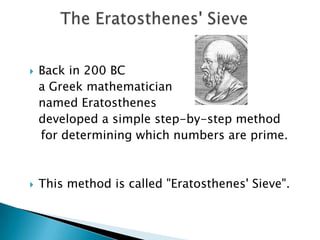
The Eratosthenes' SieveBack in 200 BC 	a Greek mathematician 	named Eratosthenes 	developed a simple step-by-step method    for determining which numbers are prime. This method is called "Eratosthenes' Sieve".
A sieveis a strainer    that allows     small particles                                   	  to pass through                                                             while catching the larger particles.
In the case of Eratosthenes' Sieve,                       the small particles that pass through are all the non-prime numbers and  the large particles that remain are the Prime Numbers.
Eratosthenes
He was born in Cirene (actually Shahhat, Libia, which is in Africa)He studied in AlexandriaArquimedes was his friendHe died at the age of 80.
He was a great mathematician, 	philosopher,    poet and astronomer.People knew him as the second Plato or   because he was always second in                       every subject he studied.
His method to 	find out 	the prime numbers 	can be divided into 5 simple steps.
But wait a minute, folks!
What are Prime Numbers?Numbers Divisible Only by Themselves and 1Any number that has only two factors, itself and 1.
Is the number 1                                                      a prime number?No, it isn´t. The number 1 is NOT considered Prime Why?Because it only has one factor , itself.
What is a sieve?What can we do with Eratosthenes´ sieve?We can find out which of the numbers from 1 to 100 are primeLet´s do it!
The Eratosthenes' Sieve - Step 1Make a table of the numbers 1 to 100 		  organized into 10 rows
The Eratosthenes' Sieve - Step 2	Cross out the number 1    because by definition it is NOT Prime number
The Eratosthenes' Sieve - Step 3Circle the number 2 and 	        cross out all the multiples of 2 		 (or all the even numbers)
The Eratosthenes' Sieve - Step 4	Look for the following number that is not crossed out. Circle the number and cross out all the multiples of that number.
The Eratosthenes' Sieve - Step 5		     Repeat step 4 	until you get to the number 7.
     Finished?All of the circled numbers    are PRIME NUMBERS!
Now you can watch           a simulation of the sieve...Pay attention!
ERATOSTHENES SIEVE

ERATOSTHENES SIEVE

  • 1.
    The Eratosthenes' SieveBackin 200 BC a Greek mathematician named Eratosthenes developed a simple step-by-step method for determining which numbers are prime. This method is called "Eratosthenes' Sieve".
  • 2.
    A sieveis astrainer that allows small particles to pass through while catching the larger particles.
  • 3.
    In the caseof Eratosthenes' Sieve, the small particles that pass through are all the non-prime numbers and the large particles that remain are the Prime Numbers.
  • 4.
  • 5.
    He was bornin Cirene (actually Shahhat, Libia, which is in Africa)He studied in AlexandriaArquimedes was his friendHe died at the age of 80.
  • 6.
    He was agreat mathematician, philosopher, poet and astronomer.People knew him as the second Plato or because he was always second in every subject he studied.
  • 7.
    His method to find out the prime numbers can be divided into 5 simple steps.
  • 8.
    But wait aminute, folks!
  • 9.
    What are PrimeNumbers?Numbers Divisible Only by Themselves and 1Any number that has only two factors, itself and 1.
  • 10.
    Is the number1 a prime number?No, it isn´t. The number 1 is NOT considered Prime Why?Because it only has one factor , itself.
  • 11.
    What is asieve?What can we do with Eratosthenes´ sieve?We can find out which of the numbers from 1 to 100 are primeLet´s do it!
  • 12.
    The Eratosthenes' Sieve- Step 1Make a table of the numbers 1 to 100 organized into 10 rows
  • 13.
    The Eratosthenes' Sieve- Step 2 Cross out the number 1 because by definition it is NOT Prime number
  • 14.
    The Eratosthenes' Sieve- Step 3Circle the number 2 and cross out all the multiples of 2 (or all the even numbers)
  • 15.
    The Eratosthenes' Sieve- Step 4 Look for the following number that is not crossed out. Circle the number and cross out all the multiples of that number.
  • 16.
    The Eratosthenes' Sieve- Step 5 Repeat step 4 until you get to the number 7.
  • 17.
    Finished?All of the circled numbers are PRIME NUMBERS!
  • 18.
    Now you canwatch a simulation of the sieve...Pay attention!