Prepared by
Azhar Mahmood
Structures acquired during
deposition of
sedimentary rock unit are
called as primary
sedimentary structures.
 These are useful for maping purpose.
 These are useful to mark paleocurrent
direction.
 These are also use for marking of top and
bottom of strata.
 Environment of deposition can also have
been marked by primary sedimentary
structures.
 Relative age is also marked by them.
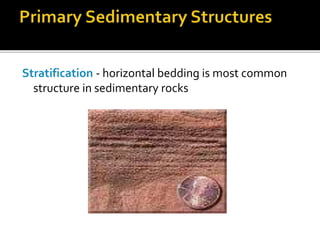
Stratification - horizontal bedding is most common
structure in sedimentary rocks
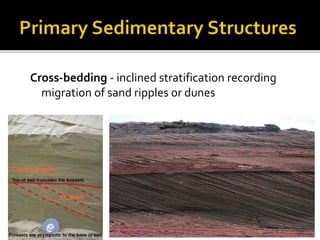
Cross-bedding - inclined stratification recording
migration of sand ripples or dunes
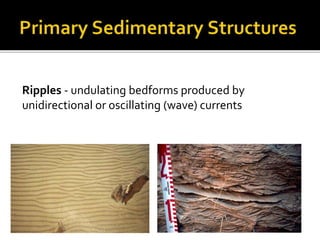
Ripples - undulating bedforms produced by
unidirectional or oscillating (wave) currents
 Asymmetrical ripple marks describe the past
flow direction
 Symmetrical marks top and bottum
Graded bedding - progressive decrease in grain size
upward in bed
• indicator of upwards direction in deposit
• common feature of turbidites
 It,s useful for maping purpose.
 These are also use for marking of top and
bottom of strata.
Sole marks - erosional grooves and marks formed by
scouring of bed by unidirectional flows
• good indicators of current flow direction
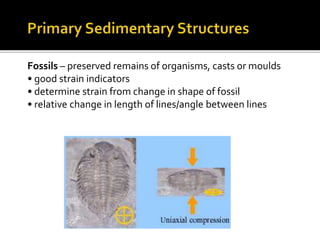
Fossils – preserved remains of organisms, casts or moulds
• good strain indicators
• determine strain from change in shape of fossil
• relative change in length of lines/angle between lines
are pieces
of shale or mudstone created
when an erosive current
containing suspended
sediment flows over a shale
bed, tears up pieces of it, and
carries these "rip ups" some
distance
 Use for top and bottum
 Use for determine relative age
 are a geological feature
characterized by small
craterlike pits with slightly
raised edges that are the
result of the impact of rain
on soft sediment surfaces
are polygonal cracks that form
when
mud shrinks as it dries.They
indicate that the
mud accumulated in shallow
water that periodically dried
up.
 It,s tell us
 Top and bottum
 Environment [Arid,Semi Arid]
 Condition
 Imbrication is the
orderly, overlapping
arrangement of
flattened or sub-
spheroidal grains in
the direction of flow.
Flow in this case is
usually water flow,
but it can be other
types of fluid flow
 To determine paleo-path of rivers and
channel
 Current direction {which is always opposite to
dip direction}
 When a river flow in the center of riverV type
structure formed by loose material are called
flute cast
 In it deformation as well as
sedimentation carried out side
by side
 S.S.D = Deformation +
Sedimentation
 Types
 1: Slump fold
 2: Flame structures
 3: Clastic Dikes
 A slump is a form of mass wasting that occurs
when a coherent mass of loosely
consolidated materials or rock layers moves a
short distance down a slope Movement is
characterized by sliding along a concave-
upward or planar surface. Causes of slumping
include earthquake shocks, thorough
wetting, freezing and thawing, undercutting,
and loading of a slope
 A term introduced byWalton
(1956, p. 267) for a
sedimentary structure
consisting of sharp-crested
wave- or flame-shaped
plumes of mud that have
risen irregularly upward into
an overlying layer, generally
a rapidly deposited sand
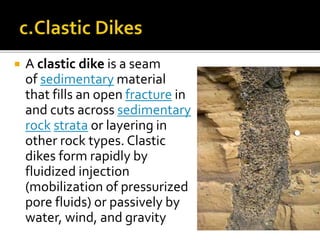
 A clastic dike is a seam
of sedimentary material
that fills an open fracture in
and cuts across sedimentary
rock strata or layering in
other rock types. Clastic
dikes form rapidly by
fluidized injection
(mobilization of pressurized
pore fluids) or passively by
water, wind, and gravity
 They extend parallel
to passive
margins that have
high sediment supply
.Their fault plane
dips mostly toward
the basin and has
long-term
continuous
displacement

Primary sedimentary structures

  • 1.
  • 2.
    Structures acquired during depositionof sedimentary rock unit are called as primary sedimentary structures.
  • 3.
     These areuseful for maping purpose.  These are useful to mark paleocurrent direction.  These are also use for marking of top and bottom of strata.  Environment of deposition can also have been marked by primary sedimentary structures.  Relative age is also marked by them.
  • 4.
    Stratification - horizontalbedding is most common structure in sedimentary rocks
  • 5.
    Cross-bedding - inclinedstratification recording migration of sand ripples or dunes
  • 6.
    Ripples - undulatingbedforms produced by unidirectional or oscillating (wave) currents
  • 8.
     Asymmetrical ripplemarks describe the past flow direction  Symmetrical marks top and bottum
  • 9.
    Graded bedding -progressive decrease in grain size upward in bed • indicator of upwards direction in deposit • common feature of turbidites
  • 10.
     It,s usefulfor maping purpose.  These are also use for marking of top and bottom of strata.
  • 11.
    Sole marks -erosional grooves and marks formed by scouring of bed by unidirectional flows • good indicators of current flow direction
  • 12.
    Fossils – preservedremains of organisms, casts or moulds • good strain indicators • determine strain from change in shape of fossil • relative change in length of lines/angle between lines
  • 13.
    are pieces of shaleor mudstone created when an erosive current containing suspended sediment flows over a shale bed, tears up pieces of it, and carries these "rip ups" some distance
  • 14.
     Use fortop and bottum  Use for determine relative age
  • 15.
     are ageological feature characterized by small craterlike pits with slightly raised edges that are the result of the impact of rain on soft sediment surfaces
  • 16.
    are polygonal cracksthat form when mud shrinks as it dries.They indicate that the mud accumulated in shallow water that periodically dried up.
  • 17.
     It,s tellus  Top and bottum  Environment [Arid,Semi Arid]  Condition
  • 18.
     Imbrication isthe orderly, overlapping arrangement of flattened or sub- spheroidal grains in the direction of flow. Flow in this case is usually water flow, but it can be other types of fluid flow
  • 19.
     To determinepaleo-path of rivers and channel  Current direction {which is always opposite to dip direction}
  • 20.
     When ariver flow in the center of riverV type structure formed by loose material are called flute cast
  • 21.
     In itdeformation as well as sedimentation carried out side by side  S.S.D = Deformation + Sedimentation  Types  1: Slump fold  2: Flame structures  3: Clastic Dikes
  • 22.
     A slumpis a form of mass wasting that occurs when a coherent mass of loosely consolidated materials or rock layers moves a short distance down a slope Movement is characterized by sliding along a concave- upward or planar surface. Causes of slumping include earthquake shocks, thorough wetting, freezing and thawing, undercutting, and loading of a slope
  • 23.
     A termintroduced byWalton (1956, p. 267) for a sedimentary structure consisting of sharp-crested wave- or flame-shaped plumes of mud that have risen irregularly upward into an overlying layer, generally a rapidly deposited sand
  • 24.
     A clasticdike is a seam of sedimentary material that fills an open fracture in and cuts across sedimentary rock strata or layering in other rock types. Clastic dikes form rapidly by fluidized injection (mobilization of pressurized pore fluids) or passively by water, wind, and gravity
  • 26.
     They extendparallel to passive margins that have high sediment supply .Their fault plane dips mostly toward the basin and has long-term continuous displacement