UNIVERSITY OF AZAD JAMMU AND
KASHMIR MUZAFFARABAD
PRESENTED TO:
Respected Sir Fahad Sab
PRESENTED BY:
“Azhar Mahmood”
Roll No: 225
Date : 15/01/2015
PRESNETATION # 01
TOPIC
Applications of the following
 Gravity survey
Magnetic survey
Electrical resistivity survey
Seismic survey
01: GRAVITY SURVEY
METHOD
Definition:
It is a method
of measuring the force of gravity in
drill holes by means of gravimeters in order to
determine the mean density values of rocks at differen
t depths in their natural bed.
Application of Gravity
Method Survey:
Hydrocarbon exploration
Regional geological studies
Isostatic compensation determination
Exploration for mass estimation of mineral deposits
Detection of subsurface cavities
Location of buried rock valley
Determination of glacier thickness
Shape of earth(geodesy)
Monitoring volcanoes
Hydrocarbon exploration
This is also called oil and gas exploration is the search
by geophysicist for hydrocarbon deposits beneath
the Earth's surface such as oil and natural gas . Oil and
gas exploration are grouped under the science
of petroleum geology.
Engineering application
Gravity surveys can be carried out to locate iron rich
accumulations within furnace, cinder piles .
Accumulations Of Hydrocarbons
Gravity Surveys are used either alone or in conjunction
with magnetic surveys, to determine the location and
size of the major source structures which contain
accumulations of hydrocarbons.
Hydrogeology
Determination of the major structures that control
the location of aquifers.
Additionally, Magneto telluric and Magnetics
surveys may also be used for the same purpose
The gravity method is a nondestructive geophysical
technique that measures differences in the earth’s
studies including locating voids and karst features,
buried stream valleys, water table levels and the
determination of soil layer thickness.
karst features
Gravity data in engineering and environmental
applications should be collected in a grid or along a
profile with stations spacing 5 meters or less. In
addition, gravity station elevations must be
determined to within 0.2m
 Using the highly precise locations and elevations plus
all other quantifiable disturbing effects, the data are
processed to remove all these predictable effects.
02: Magnetic survey method
Magnetic survey
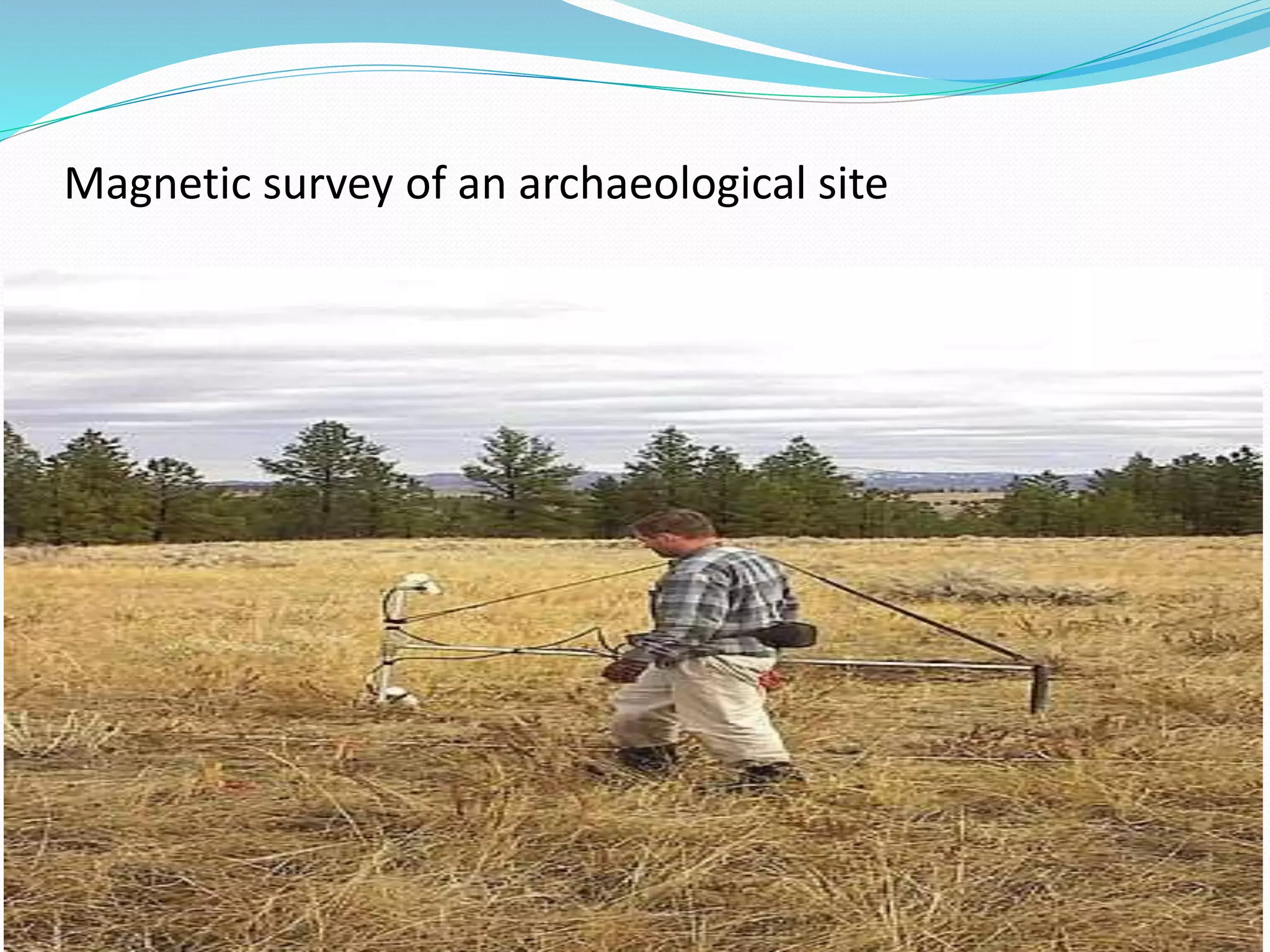
Magnetic survey is one of a number of methods
used in archaeological geophysics Magnetic surveys
record variation in the Earth's magnetic field.
In archaeology , magnetic surveys are used to detect
and map archaeological artifacts and features.
Magnetic surveys are used in both terrestrial
and marine archaeology.
 Basic Concepts
 The Earth possesses a magnetic field caused primarily
by sources in the core. The form of the field is roughly
the same as would be caused by a dipole or bar magnet
located near the Earth's center and aligned sub parallel
to the geographic axis
Magnetic survey of an archaeological site
APPLICATION OF MAGNETIC
METHOD SURVEY
Locating buried Pipes, cables, tank and drums
Fault studies
Ore exploration identification of metalliferous
deposits, for example massive sulphides
Geothermal exploration
Mapping buried utilities
Exploration of fossil fuels (oil and gas)
Exploration of ore deposit
Regional and global tectonics
Large scale of geological structures ,volcanology
Engineering construction site investigation
 Burried foundation ,fine pits for archeology
 Mineral exploration
Locating buried Pipes, cables, tank and drums
Magnetic geophysical surveys measure small,
localized variations in the Earth's magnetic field.
The magnetic properties of naturally occurring
materials such as magnetic ore bodies and basic
igneous rocks.
Magnetometer surveys find underground storage
tanks, drums, piles and reinforced concrete
foundations by detecting the magnetic anomalies
they produce.
Exploration Mineral
Magnetic survey, one of the tools used by exploration
mineral-bearing ore bodies or even oil-bearing
sedimentary structures and locate on map the
remains of buried structures.
Marine Magnetic Methods
Magnetic methods, as employed in marine
applications, differ little in theory from surface
magnetic surveys. The instrument measures the
earth’s total magnetic field at each measurement
location. However, practical applications of field
techniques, field equipment, and geographic control
can vary greatly between surface and marine surveys.
Magnetics surveys measure the magnitude and
orientation of the Earth’s magnetic field.
Magnetic field at Earth’s surface depends on field
generated in Earth’s core, magnetic mineral content of
surface materials, and remnant magnetization of
surface rocks.
03: Electrical Resistance Survey
Method
Definition:
Electrical resistance survey also called earth
resistance or resistivity survey is one of a number of
methods used in archaeological geophysics. In this
type of survey electrical resistance meters are used to
detect and map subsurface archaeological features and
patterning.
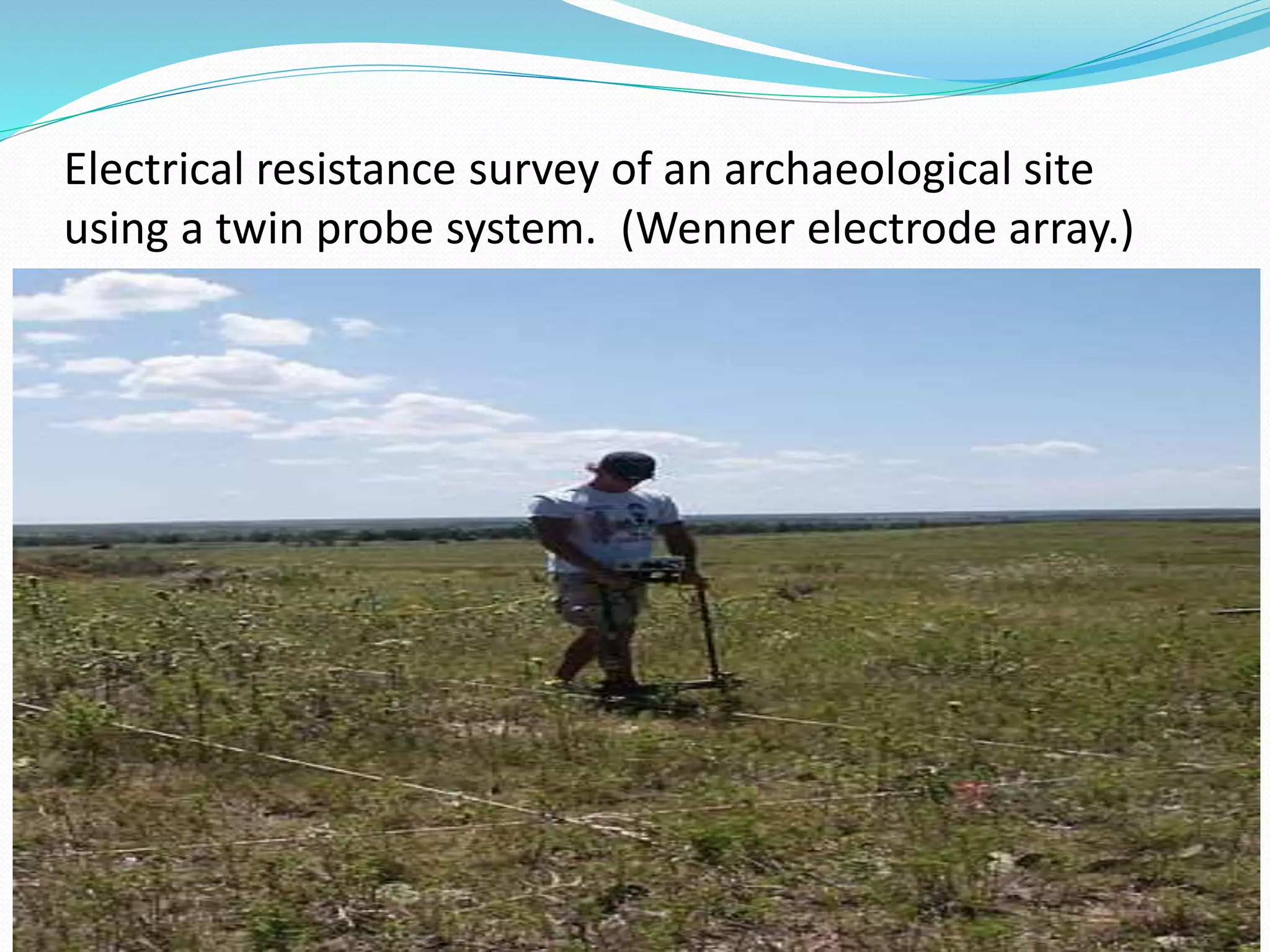
Electrical resistance survey of an archaeological site
using a twin probe system. (Wenner electrode array.)
APPLICATION ELECTRICAL RESISTANCE
SURVEY METHOD
The presence of certain metallic ore
The temperature of sub surface
 Geothermal energy
The presence of archeological feature
 Graves
 Fire pits
 Pot holes .
Amount of ground water present
I. Amount of dissolved salt
II.Presence of contaminants
III.% porosity and permeability
Specific Applications
 Determine electrical characteristics of
surrounding area.
Determine depth of water table
Detect contaminant plumes
Determine extent of saltwater intrusion
Detect fracture zones and faults
Detect areas of potentially unstable ground, e.g.
mine shafts, sinkholes, voids
Assist in dam stability analysis
Determine overburden depth
Locate buried mafic dikes
Provide data for corrosion control
design
Determine lithology/structure.
Electrical resistivity method is also useful
for simultaneously detecting lateral and
vertical changes in subsurface electrical
properties
04 :Seismic Surveys
Methods
Definition
Seismic survey, method of investigating subterranean
structure, particularly as related to exploration for
petroleum, natural gas, and mineral deposits.
A seismic survey is a technique similar to an ultrasound
that is used to develop images of the rock layers below
ground.
Seismic Surveys Methods
Applications Seismic Surveys
Methods
 Seismic surveys are used to locate and estimate the size of
offshore oil and gas reserves.
 To carry out such surveys, ships tow multiple air gun arrays
that emit thousands of high-decibel explosive impulses to
map the seafloor.
 The auditory assault from seismic surveys has been found
to damage or kill fish eggs and larvae and to impair the
hearing and health of fish and marine mammals.
Hydrocarbon exploration
It is used by the hydrocarbon industry to provide a high
resolution map of acoustic impedance contrasts at depths
of up to 10 km within the subsurface. This can be combined
with seismic attribute analysis and other exploration
geophysics tools and used to help geologists build
a geological model of the area of interest.
Land survey
Land seismic surveys tend to be large entities,
requiring hundreds of tons of equipment and
employing anywhere from a few hundred to a few
thousand people, deployed over vast areas for many
months.
Marine survey
Traditional marine seismic surveys are
conducted using specially-equipped vessels that tow
one or more cables containing a series of
hydrophones at constant intervals
Seismic surveying is also play vital part of exploring for
oil and gas. That makes it critical to producing the
energy we need to power our homes and businesses.
THANKS!

Applications Gravity survey Magnetic survey Electrical resistivity survey Seismic survey

  • 2.
    UNIVERSITY OF AZADJAMMU AND KASHMIR MUZAFFARABAD PRESENTED TO: Respected Sir Fahad Sab PRESENTED BY: “Azhar Mahmood” Roll No: 225 Date : 15/01/2015
  • 3.
    PRESNETATION # 01 TOPIC Applicationsof the following  Gravity survey Magnetic survey Electrical resistivity survey Seismic survey
  • 4.
  • 5.
    Definition: It is amethod of measuring the force of gravity in drill holes by means of gravimeters in order to determine the mean density values of rocks at differen t depths in their natural bed.
  • 6.
  • 7.
    Hydrocarbon exploration Regional geologicalstudies Isostatic compensation determination Exploration for mass estimation of mineral deposits Detection of subsurface cavities Location of buried rock valley Determination of glacier thickness Shape of earth(geodesy) Monitoring volcanoes
  • 8.
    Hydrocarbon exploration This isalso called oil and gas exploration is the search by geophysicist for hydrocarbon deposits beneath the Earth's surface such as oil and natural gas . Oil and gas exploration are grouped under the science of petroleum geology.
  • 9.
    Engineering application Gravity surveyscan be carried out to locate iron rich accumulations within furnace, cinder piles .
  • 10.
    Accumulations Of Hydrocarbons GravitySurveys are used either alone or in conjunction with magnetic surveys, to determine the location and size of the major source structures which contain accumulations of hydrocarbons.
  • 11.
    Hydrogeology Determination of themajor structures that control the location of aquifers. Additionally, Magneto telluric and Magnetics surveys may also be used for the same purpose
  • 12.
    The gravity methodis a nondestructive geophysical technique that measures differences in the earth’s studies including locating voids and karst features, buried stream valleys, water table levels and the determination of soil layer thickness.
  • 13.
  • 14.
    Gravity data inengineering and environmental applications should be collected in a grid or along a profile with stations spacing 5 meters or less. In addition, gravity station elevations must be determined to within 0.2m  Using the highly precise locations and elevations plus all other quantifiable disturbing effects, the data are processed to remove all these predictable effects.
  • 15.
  • 16.
    Magnetic survey Magnetic surveyis one of a number of methods used in archaeological geophysics Magnetic surveys record variation in the Earth's magnetic field. In archaeology , magnetic surveys are used to detect and map archaeological artifacts and features. Magnetic surveys are used in both terrestrial and marine archaeology.
  • 17.
     Basic Concepts The Earth possesses a magnetic field caused primarily by sources in the core. The form of the field is roughly the same as would be caused by a dipole or bar magnet located near the Earth's center and aligned sub parallel to the geographic axis
  • 18.
    Magnetic survey ofan archaeological site
  • 19.
  • 20.
    Locating buried Pipes,cables, tank and drums Fault studies Ore exploration identification of metalliferous deposits, for example massive sulphides Geothermal exploration Mapping buried utilities
  • 21.
    Exploration of fossilfuels (oil and gas) Exploration of ore deposit Regional and global tectonics Large scale of geological structures ,volcanology Engineering construction site investigation  Burried foundation ,fine pits for archeology  Mineral exploration
  • 22.
    Locating buried Pipes,cables, tank and drums Magnetic geophysical surveys measure small, localized variations in the Earth's magnetic field. The magnetic properties of naturally occurring materials such as magnetic ore bodies and basic igneous rocks. Magnetometer surveys find underground storage tanks, drums, piles and reinforced concrete foundations by detecting the magnetic anomalies they produce.
  • 23.
    Exploration Mineral Magnetic survey,one of the tools used by exploration mineral-bearing ore bodies or even oil-bearing sedimentary structures and locate on map the remains of buried structures.
  • 24.
    Marine Magnetic Methods Magneticmethods, as employed in marine applications, differ little in theory from surface magnetic surveys. The instrument measures the earth’s total magnetic field at each measurement location. However, practical applications of field techniques, field equipment, and geographic control can vary greatly between surface and marine surveys.
  • 25.
    Magnetics surveys measurethe magnitude and orientation of the Earth’s magnetic field. Magnetic field at Earth’s surface depends on field generated in Earth’s core, magnetic mineral content of surface materials, and remnant magnetization of surface rocks.
  • 26.
  • 27.
    Definition: Electrical resistance surveyalso called earth resistance or resistivity survey is one of a number of methods used in archaeological geophysics. In this type of survey electrical resistance meters are used to detect and map subsurface archaeological features and patterning.
  • 28.
    Electrical resistance surveyof an archaeological site using a twin probe system. (Wenner electrode array.)
  • 29.
  • 30.
    The presence ofcertain metallic ore The temperature of sub surface  Geothermal energy The presence of archeological feature  Graves  Fire pits  Pot holes .
  • 31.
    Amount of groundwater present I. Amount of dissolved salt II.Presence of contaminants III.% porosity and permeability
  • 32.
    Specific Applications  Determineelectrical characteristics of surrounding area. Determine depth of water table Detect contaminant plumes Determine extent of saltwater intrusion Detect fracture zones and faults Detect areas of potentially unstable ground, e.g. mine shafts, sinkholes, voids
  • 33.
    Assist in damstability analysis Determine overburden depth Locate buried mafic dikes Provide data for corrosion control design Determine lithology/structure.
  • 34.
    Electrical resistivity methodis also useful for simultaneously detecting lateral and vertical changes in subsurface electrical properties
  • 35.
  • 36.
    Definition Seismic survey, methodof investigating subterranean structure, particularly as related to exploration for petroleum, natural gas, and mineral deposits. A seismic survey is a technique similar to an ultrasound that is used to develop images of the rock layers below ground.
  • 37.
  • 38.
  • 39.
     Seismic surveysare used to locate and estimate the size of offshore oil and gas reserves.  To carry out such surveys, ships tow multiple air gun arrays that emit thousands of high-decibel explosive impulses to map the seafloor.  The auditory assault from seismic surveys has been found to damage or kill fish eggs and larvae and to impair the hearing and health of fish and marine mammals.
  • 40.
    Hydrocarbon exploration It isused by the hydrocarbon industry to provide a high resolution map of acoustic impedance contrasts at depths of up to 10 km within the subsurface. This can be combined with seismic attribute analysis and other exploration geophysics tools and used to help geologists build a geological model of the area of interest.
  • 41.
    Land survey Land seismicsurveys tend to be large entities, requiring hundreds of tons of equipment and employing anywhere from a few hundred to a few thousand people, deployed over vast areas for many months.
  • 42.
    Marine survey Traditional marineseismic surveys are conducted using specially-equipped vessels that tow one or more cables containing a series of hydrophones at constant intervals
  • 43.
    Seismic surveying isalso play vital part of exploring for oil and gas. That makes it critical to producing the energy we need to power our homes and businesses.
  • 44.