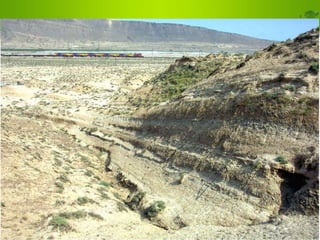
Facies And Facies Analysis
Page  2
Content
1. Introduction- Definition and History of facies
2. Types of facies- Lithofacies, ichnofacies, biofacies, seismic facies.
3. Facies sequence and facies association
4. Facies tools
5. Sedimentary log
6. Facie model
7. Facies analysis and environment
8. Applications and limitations of facies
Page  3
Definition and History of Facies
Facies is the aspect, appearance, and characteristics of a rock unit, usually
reflecting the conditions of its origin; especially as differentiating it from
adjacent or associated units.
The word facies was first introduced by a Swiss geologist, Amanz Gressly in
1838, as part of his contribution to the foundation to mordern stratigraphy.
Facies analysis refers to the interpretation of rocks and sediments for the
purpose of reconstructing the processes that were responsible for the original
deposition
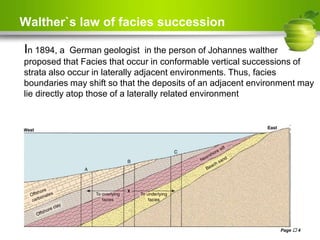
Walther`s law of facies succession
In 1894, a German geologist in the person of Johannes walther
proposed that Facies that occur in conformable vertical successions of
strata also occur in laterally adjacent environments. Thus, facies
boundaries may shift so that the deposits of an adjacent environment may
lie directly atop those of a laterally related environment
Page  4
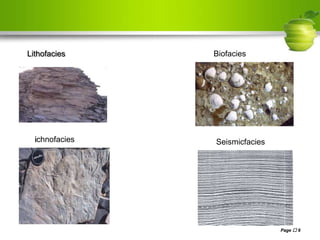
Types of facies
 Lithofacies: These facies are characterized by sedimentary
attributes, such as grain-size, sedimentary structures, bedding,
color
 Biofacies: These facies are Characterized by fossil content
(body fossils ) such as shell and tooth.
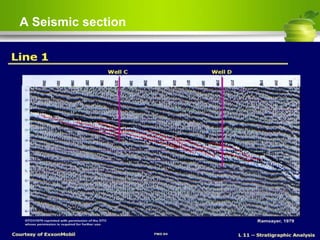
 Seismic facies: These facies are Characterized by seismic
reflection amplitude and continuity. (Interpreted in terms of
large-scale lithologic characteristics).
 Ichnofacies: The assemblage of trace fossils like foot prints
and burrow traces.
Page  6Page  6
Lithofacies Biofacies
ichnofacies Seismicfacies
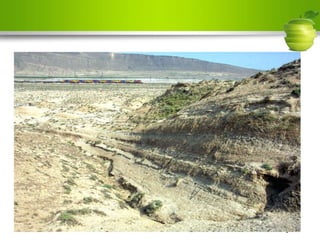
Facies Sequence and Facies Association
 Facies association that reflect a particular depositional
environment is said to be formed when a group of different
individual facies caused by different processes all occur in the
same environment. These facies all share the same
environment.
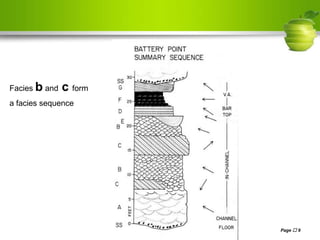
 Facies sequence or facies succession is a facies association in
which facies occur in a particular order. They occur when there
is a repetition of a series of processes as a response to regular
changes in conditions.
Page  7
Page  8
Page  9
Facies b and c form
a facies sequence
Page  10
Facies Tools
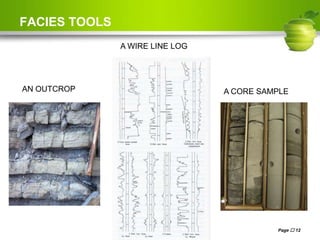
 Facies tools are devices from which data associated with
facies analysis are acquired. They include :
 Outcrops
 Core samples
 Wire line log
 Seismic section
Page  11
FACIES TOOLS
Page  12
AN OUTCROP
A WIRE LINE LOG
A CORE SAMPLE
A Seismic section
Page  13
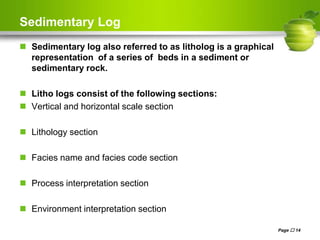
Sedimentary Log
 Sedimentary log also referred to as litholog is a graphical
representation of a series of beds in a sediment or
sedimentary rock.
 Litho logs consist of the following sections:
 Vertical and horizontal scale section
 Lithology section
 Facies name and facies code section
 Process interpretation section
 Environment interpretation section
Page  14
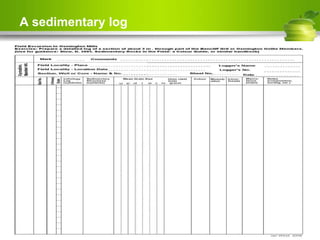
A sedimentary log
Page  15
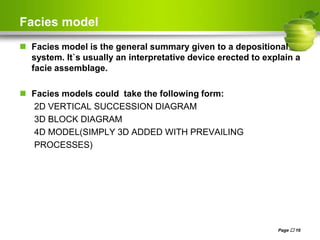
Facies model
 Facies model is the general summary given to a depositional
system. It`s usually an interpretative device erected to explain a
facie assemblage.
 Facies models could take the following form:
2D VERTICAL SUCCESSION DIAGRAM
3D BLOCK DIAGRAM
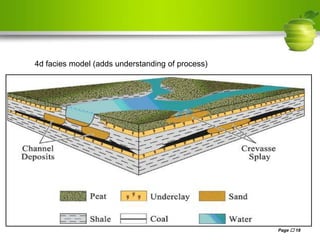
4D MODEL(SIMPLY 3D ADDED WITH PREVAILING
PROCESSES)
Page  16
Page  17
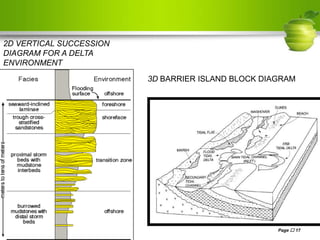
3D BARRIER ISLAND BLOCK DIAGRAM
2D VERTICAL SUCCESSION
DIAGRAM FOR A DELTA
ENVIRONMENT
Page  18
4d facies model (adds understanding of process)
Facies analysis and environment
 Deltaic facies and environment:
Delta can be classified based on energy into:
river dorminated delta
wave dorminated delta
tide dorminated delta
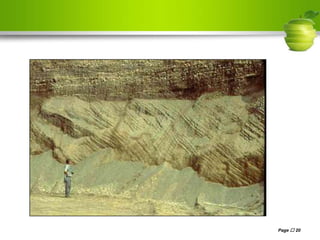
Deltas are generally characterized by top set bed, fore set bed,
and bottom set bed
Page  19
Page  20
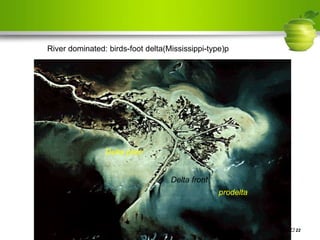
River dorminated delta
 These are deltas in which river activities are prevalent at the delta ,
with the effects of wind and tides being minor at the delta front.
Examples include : Mississippi delta
 River dominated deltas are usually characterized by :
 distributary channel
 interdistributary bay
Page  21
)
Page  22
River dominated: birds-foot delta(Mississippi-type)p
prodelta
Delta front
Delta plain
Mississippi delta
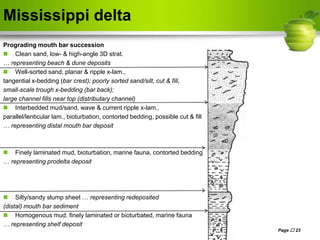
Prograding mouth bar succession
 Clean sand, low- & high-angle 3D strat.
… representing beach & dune deposits
 Well-sorted sand, planar & ripple x-lam.,
tangential x-bedding (bar crest); poorly sorted sand/silt, cut & fill,
small-scale trough x-bedding (bar back);
large channel fills near top (distributary channel)
 Interbedded mud/sand, wave & current ripple x-lam.,
parallel/lenticular lam., bioturbation, contorted bedding, possible cut & fill
… representing distal mouth bar deposit
 Finely laminated mud, bioturbation, marine fauna, contorted bedding
… representing prodelta deposit
 Silty/sandy slump sheet … representing redeposited
(distal) mouth bar sediment
 Homogenous mud, finely laminated or bioturbated, marine fauna
… representing shelf deposit
Page  23
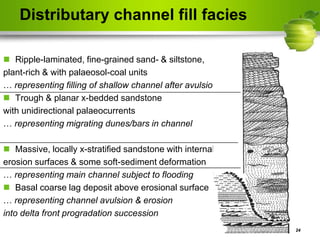
Distributary channel fill facies
Page  24
 Ripple-laminated, fine-grained sand- & siltstone,
plant-rich & with palaeosol-coal units
… representing filling of shallow channel after avulsion
 Trough & planar x-bedded sandstone
with unidirectional palaeocurrents
… representing migrating dunes/bars in channel
 Massive, locally x-stratified sandstone with internal
erosion surfaces & some soft-sediment deformation
… representing main channel subject to flooding
 Basal coarse lag deposit above erosional surface
… representing channel avulsion & erosion
into delta front progradation succession
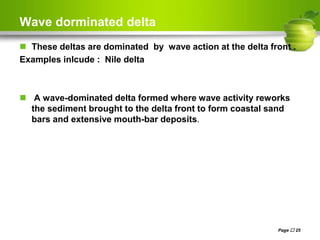
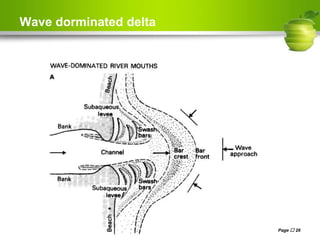
Wave dorminated delta
Page  25
 These deltas are dominated by wave action at the delta front .
Examples inlcude : Nile delta
 A wave-dominated delta formed where wave activity reworks
the sediment brought to the delta front to form coastal sand
bars and extensive mouth-bar deposits.
Wave dorminated delta
Page  26
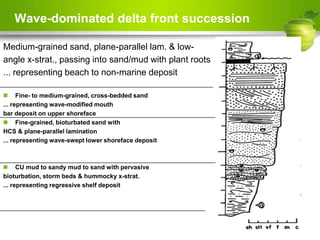
Wave-dominated delta front succession
Medium-grained sand, plane-parallel lam. & low-
angle x-strat., passing into sand/mud with plant roots
... representing beach to non-marine deposit
 Fine- to medium-grained, cross-bedded sand
... representing wave-modified mouth
bar deposit on upper shoreface
 Fine-grained, bioturbated sand with
HCS & plane-parallel lamination
... representing wave-swept lower shoreface deposit
 CU mud to sandy mud to sand with pervasive
bioturbation, storm beds & hummocky x-strat.
... representing regressive shelf deposit
Page  27
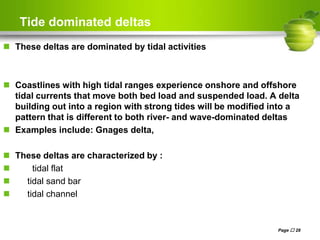
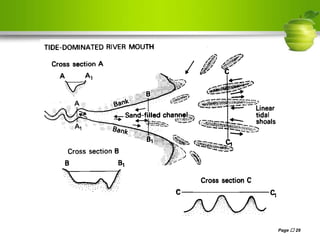
Tide dominated deltas
 These deltas are dominated by tidal activities
 Coastlines with high tidal ranges experience onshore and offshore
tidal currents that move both bed load and suspended load. A delta
building out into a region with strong tides will be modified into a
pattern that is different to both river- and wave-dominated deltas
 Examples include: Gnages delta,
 These deltas are characterized by :
 tidal flat
 tidal sand bar
 tidal channel
Page  28
Page  29
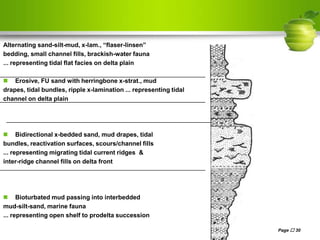
Alternating sand-silt-mud, x-lam., “flaser-linsen”
bedding, small channel fills, brackish-water fauna
... representing tidal flat facies on delta plain
 Erosive, FU sand with herringbone x-strat., mud
drapes, tidal bundles, ripple x-lamination ... representing tidal
channel on delta plain
 Bidirectional x-bedded sand, mud drapes, tidal
bundles, reactivation surfaces, scours/channel fills
... representing migrating tidal current ridges &
inter-ridge channel fills on delta front
 Bioturbated mud passing into interbedded
mud-silt-sand, marine fauna
... representing open shelf to prodelta succession
Page  30
Page  31
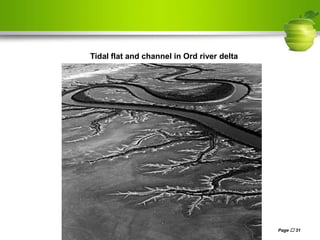
Tidal flat and channel in Ord river delta
Why is Facies analysis essential to a
sedimentologist?
 Advantages and Application:-
 1. simplifies and standardizes
observations-permits rapid logging of field
sections and drill core.
 2.Facies analysis is useful in hydrocarbon exploration.
 3. it is also useful in paleogeography.
 4. it also finds its importance in paleoecological reconstruction.
 5.Facies analysis is also useful in groundwater exploration
Page  32
 Disadvantages include:
1) Discourages observations of the rare or unusual-may lead to
inappropriate simplifications
Page  33
Thank You
For listening

Facies term

  • 1.
  • 2.
    Page  2 Content 1.Introduction- Definition and History of facies 2. Types of facies- Lithofacies, ichnofacies, biofacies, seismic facies. 3. Facies sequence and facies association 4. Facies tools 5. Sedimentary log 6. Facie model 7. Facies analysis and environment 8. Applications and limitations of facies
  • 3.
    Page  3 Definitionand History of Facies Facies is the aspect, appearance, and characteristics of a rock unit, usually reflecting the conditions of its origin; especially as differentiating it from adjacent or associated units. The word facies was first introduced by a Swiss geologist, Amanz Gressly in 1838, as part of his contribution to the foundation to mordern stratigraphy. Facies analysis refers to the interpretation of rocks and sediments for the purpose of reconstructing the processes that were responsible for the original deposition
  • 4.
    Walther`s law offacies succession In 1894, a German geologist in the person of Johannes walther proposed that Facies that occur in conformable vertical successions of strata also occur in laterally adjacent environments. Thus, facies boundaries may shift so that the deposits of an adjacent environment may lie directly atop those of a laterally related environment Page  4
  • 5.
    Types of facies Lithofacies: These facies are characterized by sedimentary attributes, such as grain-size, sedimentary structures, bedding, color  Biofacies: These facies are Characterized by fossil content (body fossils ) such as shell and tooth.  Seismic facies: These facies are Characterized by seismic reflection amplitude and continuity. (Interpreted in terms of large-scale lithologic characteristics).  Ichnofacies: The assemblage of trace fossils like foot prints and burrow traces.
  • 6.
    Page  6Page 6 Lithofacies Biofacies ichnofacies Seismicfacies
  • 7.
    Facies Sequence andFacies Association  Facies association that reflect a particular depositional environment is said to be formed when a group of different individual facies caused by different processes all occur in the same environment. These facies all share the same environment.  Facies sequence or facies succession is a facies association in which facies occur in a particular order. They occur when there is a repetition of a series of processes as a response to regular changes in conditions. Page  7
  • 8.
  • 9.
    Page  9 Faciesb and c form a facies sequence
  • 10.
  • 11.
    Facies Tools  Faciestools are devices from which data associated with facies analysis are acquired. They include :  Outcrops  Core samples  Wire line log  Seismic section Page  11
  • 12.
    FACIES TOOLS Page 12 AN OUTCROP A WIRE LINE LOG A CORE SAMPLE
  • 13.
  • 14.
    Sedimentary Log  Sedimentarylog also referred to as litholog is a graphical representation of a series of beds in a sediment or sedimentary rock.  Litho logs consist of the following sections:  Vertical and horizontal scale section  Lithology section  Facies name and facies code section  Process interpretation section  Environment interpretation section Page  14
  • 15.
  • 16.
    Facies model  Faciesmodel is the general summary given to a depositional system. It`s usually an interpretative device erected to explain a facie assemblage.  Facies models could take the following form: 2D VERTICAL SUCCESSION DIAGRAM 3D BLOCK DIAGRAM 4D MODEL(SIMPLY 3D ADDED WITH PREVAILING PROCESSES) Page  16
  • 17.
    Page  17 3DBARRIER ISLAND BLOCK DIAGRAM 2D VERTICAL SUCCESSION DIAGRAM FOR A DELTA ENVIRONMENT
  • 18.
    Page  18 4dfacies model (adds understanding of process)
  • 19.
    Facies analysis andenvironment  Deltaic facies and environment: Delta can be classified based on energy into: river dorminated delta wave dorminated delta tide dorminated delta Deltas are generally characterized by top set bed, fore set bed, and bottom set bed Page  19
  • 20.
  • 21.
    River dorminated delta These are deltas in which river activities are prevalent at the delta , with the effects of wind and tides being minor at the delta front. Examples include : Mississippi delta  River dominated deltas are usually characterized by :  distributary channel  interdistributary bay Page  21 )
  • 22.
    Page  22 Riverdominated: birds-foot delta(Mississippi-type)p prodelta Delta front Delta plain
  • 23.
    Mississippi delta Prograding mouthbar succession  Clean sand, low- & high-angle 3D strat. … representing beach & dune deposits  Well-sorted sand, planar & ripple x-lam., tangential x-bedding (bar crest); poorly sorted sand/silt, cut & fill, small-scale trough x-bedding (bar back); large channel fills near top (distributary channel)  Interbedded mud/sand, wave & current ripple x-lam., parallel/lenticular lam., bioturbation, contorted bedding, possible cut & fill … representing distal mouth bar deposit  Finely laminated mud, bioturbation, marine fauna, contorted bedding … representing prodelta deposit  Silty/sandy slump sheet … representing redeposited (distal) mouth bar sediment  Homogenous mud, finely laminated or bioturbated, marine fauna … representing shelf deposit Page  23
  • 24.
    Distributary channel fillfacies Page  24  Ripple-laminated, fine-grained sand- & siltstone, plant-rich & with palaeosol-coal units … representing filling of shallow channel after avulsion  Trough & planar x-bedded sandstone with unidirectional palaeocurrents … representing migrating dunes/bars in channel  Massive, locally x-stratified sandstone with internal erosion surfaces & some soft-sediment deformation … representing main channel subject to flooding  Basal coarse lag deposit above erosional surface … representing channel avulsion & erosion into delta front progradation succession
  • 25.
    Wave dorminated delta Page 25  These deltas are dominated by wave action at the delta front . Examples inlcude : Nile delta  A wave-dominated delta formed where wave activity reworks the sediment brought to the delta front to form coastal sand bars and extensive mouth-bar deposits.
  • 26.
  • 27.
    Wave-dominated delta frontsuccession Medium-grained sand, plane-parallel lam. & low- angle x-strat., passing into sand/mud with plant roots ... representing beach to non-marine deposit  Fine- to medium-grained, cross-bedded sand ... representing wave-modified mouth bar deposit on upper shoreface  Fine-grained, bioturbated sand with HCS & plane-parallel lamination ... representing wave-swept lower shoreface deposit  CU mud to sandy mud to sand with pervasive bioturbation, storm beds & hummocky x-strat. ... representing regressive shelf deposit Page  27
  • 28.
    Tide dominated deltas These deltas are dominated by tidal activities  Coastlines with high tidal ranges experience onshore and offshore tidal currents that move both bed load and suspended load. A delta building out into a region with strong tides will be modified into a pattern that is different to both river- and wave-dominated deltas  Examples include: Gnages delta,  These deltas are characterized by :  tidal flat  tidal sand bar  tidal channel Page  28
  • 29.
  • 30.
    Alternating sand-silt-mud, x-lam.,“flaser-linsen” bedding, small channel fills, brackish-water fauna ... representing tidal flat facies on delta plain  Erosive, FU sand with herringbone x-strat., mud drapes, tidal bundles, ripple x-lamination ... representing tidal channel on delta plain  Bidirectional x-bedded sand, mud drapes, tidal bundles, reactivation surfaces, scours/channel fills ... representing migrating tidal current ridges & inter-ridge channel fills on delta front  Bioturbated mud passing into interbedded mud-silt-sand, marine fauna ... representing open shelf to prodelta succession Page  30
  • 31.
    Page  31 Tidalflat and channel in Ord river delta
  • 32.
    Why is Faciesanalysis essential to a sedimentologist?  Advantages and Application:-  1. simplifies and standardizes observations-permits rapid logging of field sections and drill core.  2.Facies analysis is useful in hydrocarbon exploration.  3. it is also useful in paleogeography.  4. it also finds its importance in paleoecological reconstruction.  5.Facies analysis is also useful in groundwater exploration Page  32
  • 33.
     Disadvantages include: 1)Discourages observations of the rare or unusual-may lead to inappropriate simplifications Page  33
  • 34.