Primary Sclerosing Cholangitis
HAMED RASHAD
HAMED RASHAD
Professor of surgery Banha faculty of medicine - Egypt
Primary Sclerosing
Primary Sclerosing
Cholangitis PSC
Cholangitis PSC
Definition
Definition
A chronic inflammatory
cholestatic disease
cholestatic disease
Progressive destruction of bile
ducts
ducts
May progress to cirrhosis
Aetiology unknown
Aetiology unknown
 Rare disorder
Rare disorder
 Characterized by diffuse
Characterized by diffuse
inflammation of the biliary tract
leading to fibrosis and strictures of
the biliary system
the biliary system
 Most common - men aged 20-40
Most common - men aged 20-40
Primary Sclerosing
Primary Sclerosing
Cholangitis
Cholangitis
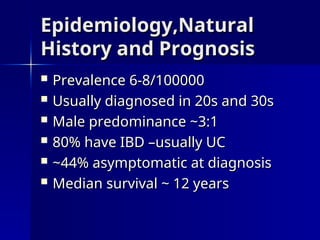
Epidemiology,Natural
History and Prognosis
 Prevalence 6-8/100000
Prevalence 6-8/100000
 Usually diagnosed in 20s and 30s
Usually diagnosed in 20s and 30s
 Male predominance ~3:1
Male predominance ~3:1
 80% have IBD –usually UC
80% have IBD –usually UC
 ~44% asymptomatic at diagnosis
~44% asymptomatic at diagnosis
 Median survival ~ 12 years
Median survival ~ 12 years
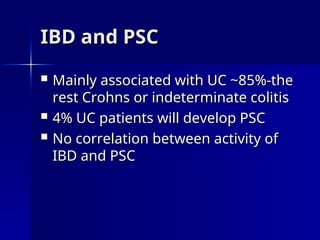
IBD and PSC
IBD and PSC
 Mainly associated with UC ~85%-the
Mainly associated with UC ~85%-the
rest Crohns or indeterminate colitis
 4% UC patients will develop PSC
4% UC patients will develop PSC
 No correlation between activity of
No correlation between activity of
IBD and PSC
IBD and PSC
Aetiology and
Aetiology and
Pathogenesis
Pathogenesis
 Familial incidence
Familial incidence
 HLA associations-
HLA associations-
B8,DR3,DRw52a,DR2,DR4
 Polymorphism of TNF gene
Polymorphism of TNF gene
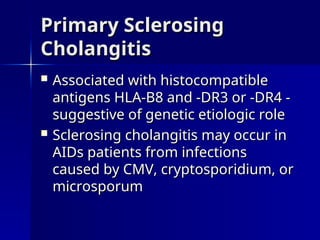
 Associated with histocompatible
Associated with histocompatible
antigens HLA-B8 and -DR3 or -DR4 -
suggestive of genetic etiologic role
 Sclerosing cholangitis may occur in
Sclerosing cholangitis may occur in
AIDs patients from infections
caused by CMV, cryptosporidium, or
microsporum
microsporum
Primary Sclerosing
Primary Sclerosing
Cholangitis
Cholangitis
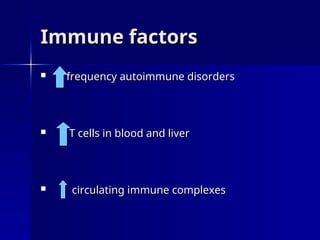
Immune factors
Immune factors
 frequency autoimmune disorders
frequency autoimmune disorders
 T cells in blood and liver
T cells in blood and liver
 circulating immune complexes
circulating immune complexes
Autoantibodies
Autoantibodies
 95% patients with PSC have at least
95% patients with PSC have at least
one autoantibody
one autoantibody
 85% +ve ANCA
85% +ve ANCA
 50% +ve ANA
50% +ve ANA
 25% +ve SMA
25% +ve SMA
Pathogenesis
Pathogenesis
 Association between PSC and UC
Association between PSC and UC
suggests a pathogenic interaction
 ?bacteria or toxic substances
?bacteria or toxic substances
absorbed via inflammed mucosa
 Bile duct injury suggest ischaemic
Bile duct injury suggest ischaemic
injury ?immune complex mediated
Clinical Manifestations
 44% asymptomatic but most
44% asymptomatic but most
develop symptoms over time
 Pruritis,jaundice,pain and fatigue
Pruritis,jaundice,pain and fatigue
are common symptoms
are common symptoms
 Later on develop symptoms of
Later on develop symptoms of
cirrhosis and portal hypertension
 Symptoms -
Symptoms -
– progressive obstructive jaundice
progressive obstructive jaundice
frequently associated with:
 malaise, pruritus,anorexia and
malaise, pruritus,anorexia and
indigestion
indigestion
 Early detection in presymptomatic
Early detection in presymptomatic
phase may occur due to elevated
alkaline phosphatase level
Primary Sclerosing
Primary Sclerosing
Cholangitis
Cholangitis
Cholangiocarcinoma
Cholangiocarcinoma
 Lifetime prevalence of 10-30%
Lifetime prevalence of 10-30%
 Annual risk 1.5% per year
Annual risk 1.5% per year
 Difficult to diagnose
Difficult to diagnose
 Patients also have late risk of HCC
Patients also have late risk of HCC
PSC and Bowel cancer
 25% PSC develop cancer or dysplasia
25% PSC develop cancer or dysplasia
cf 5.6% with UC alone
 Cancers associated with PSC tend to
Cancers associated with PSC tend to
be more proximal,are more
advanced at diagnosis and mre likely
to be fatal
to be fatal
 Need aggressive colonoscopic
Need aggressive colonoscopic
surveillance
surveillance
Diagnosis
Diagnosis
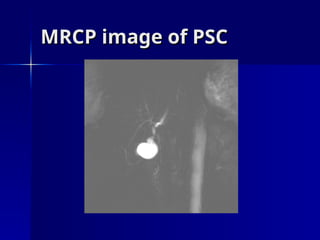
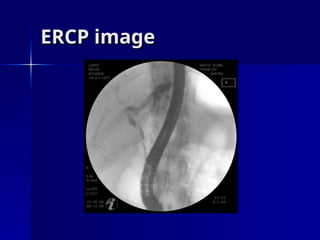
 Cholangiography-either MRCP or
Cholangiography-either MRCP or
ERCP
ERCP
 Clinical,biochemical and histological
Clinical,biochemical and histological
features
features
ERCP and MRCP
ERCP and MRCP
 Typical features:-
Typical features:-
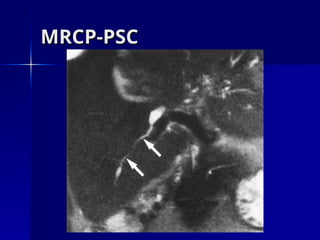
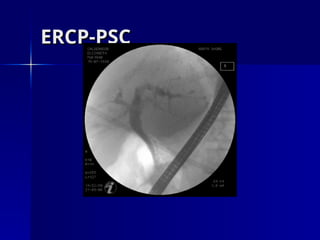
multifocal strictures and dilatation
usually affects both intra and
extrahepatic ducts
extrahepatic ducts
MRCP image of PSC
MRCP image of PSC
ERCP image
ERCP image
MRCP-PSC
MRCP-PSC
ERCP-PSC
ERCP-PSC
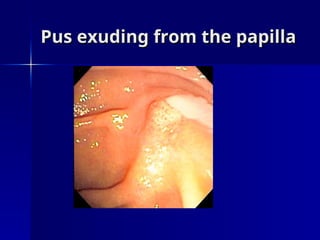
Pus exuding from the papilla
Liver biopsy
Liver biopsy
 Useful for staging disease
Useful for staging disease
 “
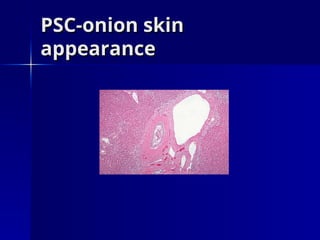
“Onion skin fibrosis” only in ~10%
Onion skin fibrosis” only in ~10%
biopsies
biopsies
 ~5% patients have typical biopsy
~5% patients have typical biopsy
features with a normal
cholangiogram
cholangiogram
PSC-onion skin
PSC-onion skin
appearance
appearance
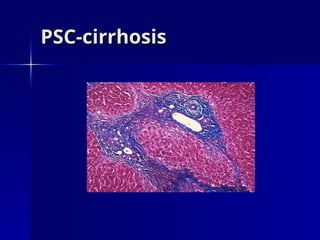
PSC-cirrhosis
PSC-cirrhosis
Lab tests
Lab tests
 LFTs-cholestatic pattern:ALP 3-5x
LFTs-cholestatic pattern:ALP 3-5x
ULN
ULN
-AST/ALT slightly elevated only
-raised bilirubin may occur with
advanced disease,dominant
stricture,cholangioca,stones,cholan
gitis
gitis
Management
Management
 Many strategies tried but only
Many strategies tried but only
transplantation shown to improve
survival
survival
 Tx w/corticosteroids and broad spectrum
Tx w/corticosteroids and broad spectrum
antimicrobial agents yields inconsistent
and unpredictable results
 Episodes of acute bacterial cholangitis
Episodes of acute bacterial cholangitis
may be treated with ciprofloxacin
 high dose ursodeoxycholic acid
high dose ursodeoxycholic acid
(20mg/kg/d) may reduce
cholangiographic progression and liver
fibrosis
fibrosis
Primary Sclerosing
Primary Sclerosing
Cholangitis
Cholangitis
 In patients with ulcerative colitis,
In patients with ulcerative colitis,
primary sclerosing cholangitis is an
independent risk factor for
development of colorectal dysplasia
and cancer- routine colonoscopic
surveillance is advised
Primary Sclerosing
Primary Sclerosing
Cholangitis
Cholangitis
Ursodeoxycholic acid
 Causes significant biochemical
Causes significant biochemical
improvement
improvement
 Little symptomatic or clinical benefit
Little symptomatic or clinical benefit
 May need high doses
May need high doses
 Major role may be to reduce bowel
Major role may be to reduce bowel
cancer risk in patients with PSC/UC
 Not funded in NZ !
Not funded in NZ !
Steroids
Steroids
 No long term data
No long term data
 Serious risk of bone disease
Serious risk of bone disease
 Colchicine, D-Penicillamine, Nicotine of no
Colchicine, D-Penicillamine, Nicotine of no
benefit
benefit
 Combination Rx with UDCA Aza and
Combination Rx with UDCA Aza and
steroids showed clinical and biochemical
improvement in a small trial
Endoscopic treatment
 Direct injection of steroids into
Direct injection of steroids into
biliary tree ineffective
 Balloon dilation or stenting can
Balloon dilation or stenting can
improve clinical,biochemical and
cholangiographic appearances
 Some reports of survival advantages
Some reports of survival advantages
and delay to liver transplantation
 For patients with cirrhosis and
For patients with cirrhosis and
clinical decompensation, liver
transplantation is the procedure of
choice
choice
Primary Sclerosing
Primary Sclerosing
Cholangitis
Cholangitis
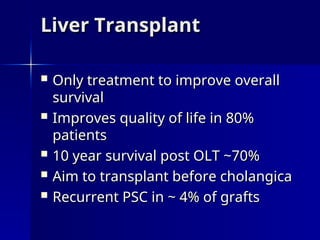
Liver Transplant
Liver Transplant
 Only treatment to improve overall
Only treatment to improve overall
survival
survival
 Improves quality of life in 80%
Improves quality of life in 80%
patients
patients
 10 year survival post OLT ~70%
10 year survival post OLT ~70%
 Aim to transplant before cholangica
Aim to transplant before cholangica
 Recurrent PSC in ~ 4% of grafts
Recurrent PSC in ~ 4% of grafts
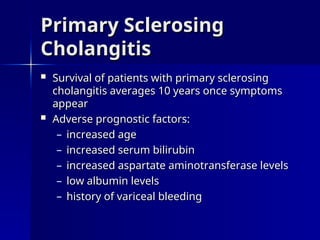
 Survival of patients with primary sclerosing
Survival of patients with primary sclerosing
cholangitis averages 10 years once symptoms
appear
appear
 Adverse prognostic factors:
Adverse prognostic factors:
– increased age
increased age
– increased serum bilirubin
increased serum bilirubin
– increased aspartate aminotransferase levels
increased aspartate aminotransferase levels
– low albumin levels
low albumin levels
– history of variceal bleeding
history of variceal bleeding
Primary Sclerosing
Primary Sclerosing
Cholangitis
Cholangitis
THANK YOU
THANK YOU

Primary Sclerosing Cholangitis management the lect .ppt

  • 1.
    Primary Sclerosing Cholangitis PrimarySclerosing Cholangitis HAMED RASHAD HAMED RASHAD Professor of surgery Banha faculty of medicine - Egypt Professor of surgery Banha faculty of medicine - Egypt
  • 2.
  • 3.
    Definition Definition A chronic inflammatory Achronic inflammatory cholestatic disease cholestatic disease Progressive destruction of bile Progressive destruction of bile ducts ducts May progress to cirrhosis May progress to cirrhosis Aetiology unknown Aetiology unknown
  • 4.
     Rare disorder Raredisorder  Characterized by diffuse Characterized by diffuse inflammation of the biliary tract inflammation of the biliary tract leading to fibrosis and strictures of leading to fibrosis and strictures of the biliary system the biliary system  Most common - men aged 20-40 Most common - men aged 20-40 Primary Sclerosing Primary Sclerosing Cholangitis Cholangitis
  • 5.
    Epidemiology,Natural Epidemiology,Natural History and Prognosis Historyand Prognosis  Prevalence 6-8/100000 Prevalence 6-8/100000  Usually diagnosed in 20s and 30s Usually diagnosed in 20s and 30s  Male predominance ~3:1 Male predominance ~3:1  80% have IBD –usually UC 80% have IBD –usually UC  ~44% asymptomatic at diagnosis ~44% asymptomatic at diagnosis  Median survival ~ 12 years Median survival ~ 12 years
  • 6.
    IBD and PSC IBDand PSC  Mainly associated with UC ~85%-the Mainly associated with UC ~85%-the rest Crohns or indeterminate colitis rest Crohns or indeterminate colitis  4% UC patients will develop PSC 4% UC patients will develop PSC  No correlation between activity of No correlation between activity of IBD and PSC IBD and PSC
  • 7.
    Aetiology and Aetiology and Pathogenesis Pathogenesis Familial incidence Familial incidence  HLA associations- HLA associations- B8,DR3,DRw52a,DR2,DR4 B8,DR3,DRw52a,DR2,DR4  Polymorphism of TNF gene Polymorphism of TNF gene
  • 8.
     Associated withhistocompatible Associated with histocompatible antigens HLA-B8 and -DR3 or -DR4 - antigens HLA-B8 and -DR3 or -DR4 - suggestive of genetic etiologic role suggestive of genetic etiologic role  Sclerosing cholangitis may occur in Sclerosing cholangitis may occur in AIDs patients from infections AIDs patients from infections caused by CMV, cryptosporidium, or caused by CMV, cryptosporidium, or microsporum microsporum Primary Sclerosing Primary Sclerosing Cholangitis Cholangitis
  • 9.
    Immune factors Immune factors frequency autoimmune disorders frequency autoimmune disorders  T cells in blood and liver T cells in blood and liver  circulating immune complexes circulating immune complexes
  • 10.
    Autoantibodies Autoantibodies  95% patientswith PSC have at least 95% patients with PSC have at least one autoantibody one autoantibody  85% +ve ANCA 85% +ve ANCA  50% +ve ANA 50% +ve ANA  25% +ve SMA 25% +ve SMA
  • 11.
    Pathogenesis Pathogenesis  Association betweenPSC and UC Association between PSC and UC suggests a pathogenic interaction suggests a pathogenic interaction  ?bacteria or toxic substances ?bacteria or toxic substances absorbed via inflammed mucosa absorbed via inflammed mucosa  Bile duct injury suggest ischaemic Bile duct injury suggest ischaemic injury ?immune complex mediated injury ?immune complex mediated
  • 12.
    Clinical Manifestations Clinical Manifestations 44% asymptomatic but most 44% asymptomatic but most develop symptoms over time develop symptoms over time  Pruritis,jaundice,pain and fatigue Pruritis,jaundice,pain and fatigue are common symptoms are common symptoms  Later on develop symptoms of Later on develop symptoms of cirrhosis and portal hypertension cirrhosis and portal hypertension
  • 13.
     Symptoms - Symptoms- – progressive obstructive jaundice progressive obstructive jaundice frequently associated with: frequently associated with:  malaise, pruritus,anorexia and malaise, pruritus,anorexia and indigestion indigestion  Early detection in presymptomatic Early detection in presymptomatic phase may occur due to elevated phase may occur due to elevated alkaline phosphatase level alkaline phosphatase level Primary Sclerosing Primary Sclerosing Cholangitis Cholangitis
  • 14.
    Cholangiocarcinoma Cholangiocarcinoma  Lifetime prevalenceof 10-30% Lifetime prevalence of 10-30%  Annual risk 1.5% per year Annual risk 1.5% per year  Difficult to diagnose Difficult to diagnose  Patients also have late risk of HCC Patients also have late risk of HCC
  • 15.
    PSC and Bowelcancer PSC and Bowel cancer  25% PSC develop cancer or dysplasia 25% PSC develop cancer or dysplasia cf 5.6% with UC alone cf 5.6% with UC alone  Cancers associated with PSC tend to Cancers associated with PSC tend to be more proximal,are more be more proximal,are more advanced at diagnosis and mre likely advanced at diagnosis and mre likely to be fatal to be fatal  Need aggressive colonoscopic Need aggressive colonoscopic surveillance surveillance
  • 16.
    Diagnosis Diagnosis  Cholangiography-either MRCPor Cholangiography-either MRCP or ERCP ERCP  Clinical,biochemical and histological Clinical,biochemical and histological features features
  • 17.
    ERCP and MRCP ERCPand MRCP  Typical features:- Typical features:- multifocal strictures and dilatation multifocal strictures and dilatation usually affects both intra and usually affects both intra and extrahepatic ducts extrahepatic ducts
  • 18.
    MRCP image ofPSC MRCP image of PSC
  • 19.
  • 20.
  • 21.
  • 22.
    Pus exuding fromthe papilla Pus exuding from the papilla
  • 23.
    Liver biopsy Liver biopsy Useful for staging disease Useful for staging disease  “ “Onion skin fibrosis” only in ~10% Onion skin fibrosis” only in ~10% biopsies biopsies  ~5% patients have typical biopsy ~5% patients have typical biopsy features with a normal features with a normal cholangiogram cholangiogram
  • 24.
  • 25.
  • 26.
    Lab tests Lab tests LFTs-cholestatic pattern:ALP 3-5x LFTs-cholestatic pattern:ALP 3-5x ULN ULN -AST/ALT slightly elevated only -AST/ALT slightly elevated only -raised bilirubin may occur with -raised bilirubin may occur with advanced disease,dominant advanced disease,dominant stricture,cholangioca,stones,cholan stricture,cholangioca,stones,cholan gitis gitis
  • 27.
    Management Management  Many strategiestried but only Many strategies tried but only transplantation shown to improve transplantation shown to improve survival survival
  • 28.
     Tx w/corticosteroidsand broad spectrum Tx w/corticosteroids and broad spectrum antimicrobial agents yields inconsistent antimicrobial agents yields inconsistent and unpredictable results and unpredictable results  Episodes of acute bacterial cholangitis Episodes of acute bacterial cholangitis may be treated with ciprofloxacin may be treated with ciprofloxacin  high dose ursodeoxycholic acid high dose ursodeoxycholic acid (20mg/kg/d) may reduce (20mg/kg/d) may reduce cholangiographic progression and liver cholangiographic progression and liver fibrosis fibrosis Primary Sclerosing Primary Sclerosing Cholangitis Cholangitis
  • 29.
     In patientswith ulcerative colitis, In patients with ulcerative colitis, primary sclerosing cholangitis is an primary sclerosing cholangitis is an independent risk factor for independent risk factor for development of colorectal dysplasia development of colorectal dysplasia and cancer- routine colonoscopic and cancer- routine colonoscopic surveillance is advised surveillance is advised Primary Sclerosing Primary Sclerosing Cholangitis Cholangitis
  • 30.
    Ursodeoxycholic acid Ursodeoxycholic acid Causes significant biochemical Causes significant biochemical improvement improvement  Little symptomatic or clinical benefit Little symptomatic or clinical benefit  May need high doses May need high doses  Major role may be to reduce bowel Major role may be to reduce bowel cancer risk in patients with PSC/UC cancer risk in patients with PSC/UC  Not funded in NZ ! Not funded in NZ !
  • 31.
    Steroids Steroids  No longterm data No long term data  Serious risk of bone disease Serious risk of bone disease  Colchicine, D-Penicillamine, Nicotine of no Colchicine, D-Penicillamine, Nicotine of no benefit benefit  Combination Rx with UDCA Aza and Combination Rx with UDCA Aza and steroids showed clinical and biochemical steroids showed clinical and biochemical improvement in a small trial improvement in a small trial
  • 32.
    Endoscopic treatment Endoscopic treatment Direct injection of steroids into Direct injection of steroids into biliary tree ineffective biliary tree ineffective  Balloon dilation or stenting can Balloon dilation or stenting can improve clinical,biochemical and improve clinical,biochemical and cholangiographic appearances cholangiographic appearances  Some reports of survival advantages Some reports of survival advantages and delay to liver transplantation and delay to liver transplantation
  • 33.
     For patientswith cirrhosis and For patients with cirrhosis and clinical decompensation, liver clinical decompensation, liver transplantation is the procedure of transplantation is the procedure of choice choice Primary Sclerosing Primary Sclerosing Cholangitis Cholangitis
  • 34.
    Liver Transplant Liver Transplant Only treatment to improve overall Only treatment to improve overall survival survival  Improves quality of life in 80% Improves quality of life in 80% patients patients  10 year survival post OLT ~70% 10 year survival post OLT ~70%  Aim to transplant before cholangica Aim to transplant before cholangica  Recurrent PSC in ~ 4% of grafts Recurrent PSC in ~ 4% of grafts
  • 35.
     Survival ofpatients with primary sclerosing Survival of patients with primary sclerosing cholangitis averages 10 years once symptoms cholangitis averages 10 years once symptoms appear appear  Adverse prognostic factors: Adverse prognostic factors: – increased age increased age – increased serum bilirubin increased serum bilirubin – increased aspartate aminotransferase levels increased aspartate aminotransferase levels – low albumin levels low albumin levels – history of variceal bleeding history of variceal bleeding Primary Sclerosing Primary Sclerosing Cholangitis Cholangitis
  • 36.