“Design and Build under the
FIDIC Contracts”
Presentation By-
Ranjit V Patil
M.Tech (Civil- Construction Management)
Rajarambapu Institute of Technology,
Islampur, Maharashtra.
Mob.No. 9503361010
 FIDIC?????
 It is a French short form of…
“Federation Internationale Des Ingenieurs – Counseils”
 In English it is referred as
“ International Federation of Consulting Engineers”
 FIDIC : “ International” Form of contract.
 Used by funders such as World Bank etc.
Introduction
 Origin:-
Founded in 1913 by three national associations of consulting
engineers within Europe.
 FIDIC currently has 99 Members Associations & Associates.
 CONSULTING ENGINEERS ASSOCIATION OF INDIA is the
member from India.
 FIDIC Vision:-
Enabling the development of a sustainable world as the recognised
global voice for the consulting engineering industry.
 FIDIC Mission :-
To work closely with our stakeholders to improve the
business climate in which we operate and enable our
members to contribute to making the world a better
place to live in, now and in the future.
 FIDIC Values :
1. Quality
2. Integrity
3. Sustainability
FIDIC LOGO
 What is Design and Built???
 It is procurement method which has been in use for long time.
 Before the emergence of architecture as profession clients
used to procure building by process of design and built.
 In Nineteenth Century-
It was the separation of responsibility for fabrication
from responsibility for design that led to the emergence
of so called ‘traditional general contracting’.
Design and Built
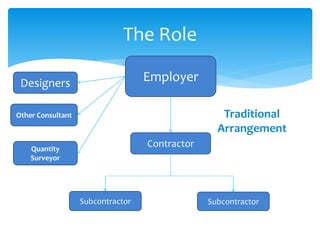
The Role
Employer
Contractor
Designers
Other Consultant
Quantity
Surveyor
Subcontractor Subcontractor
Traditional
Arrangement
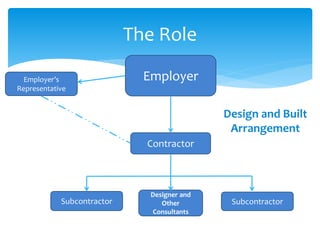
The Role
Employer
Contractor
Employer’s
Representative
Designer and
Other
Consultants
Subcontractor Subcontractor
Design and Built
Arrangement
 Price Certainty
 Single Point Responsibility
 Good For “Non- Expert” clients
 Contractor’s Expertise
 Quicker Build Time
Advantages of Design and Built
 Contractor designs and builds to price.
 Employer’s reduced control of design and quality.
 Employer’s reduced control of change cost
 Not Good for complex projects
 Longer tender period
 Expensive to contractor to prepare tender.
Disadvantages of using Design and
Built
 The better the Employer’s requirements, the better the completed
project.
 Consider first of all what are the Employer’s needs??
 What???
What does he need???
 When?????
When does he need it????
 How?????
How much will/can he pay?????
 Which????
Which is the best contractual method to meet these needs???
 Is the Design and Built the Best method?? Weigh Up the advantages
and disadvantages.
The Employer’s Requirements
 Procurement refers to: the process of obtaining goods and services from another
for some consideration.
 The choice of procurement strategy identifies how the project is structured
 Design and coordination consideration have led to the development of following
procurement methods:
1. Traditional Procurement
2. Design and Build
3. Management Procurement
Procurement methods
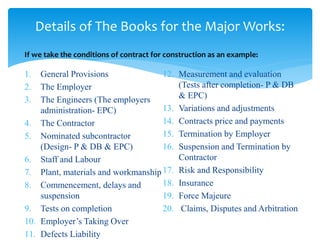
1. General Provisions
2. The Employer
3. The Engineers (The employers
administration- EPC)
4. The Contractor
5. Nominated subcontractor
(Design- P & DB & EPC)
6. Staff and Labour
7. Plant, materials and workmanship
8. Commencement, delays and
suspension
9. Tests on completion
10. Employer’s Taking Over
11. Defects Liability
12. Measurement and evaluation
(Tests after completion- P & DB
& EPC)
13. Variations and adjustments
14. Contracts price and payments
15. Termination by Employer
16. Suspension and Termination by
Contractor
17. Risk and Responsibility
18. Insurance
19. Force Majeure
20. Claims, Disputes and Arbitration
Details of The Books for the Major Works:
If we take the conditions of contract for construction as an example:
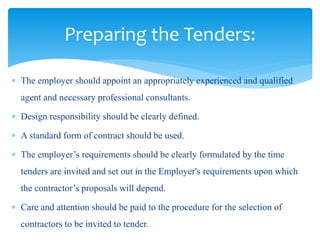
 The employer should appoint an appropriately experienced and qualified
agent and necessary professional consultants.
 Design responsibility should be clearly defined.
 A standard form of contract should be used.
 The employer’s requirements should be clearly formulated by the time
tenders are invited and set out in the Employer's requirements upon which
the contractor’s proposals will depend.
 Care and attention should be paid to the procedure for the selection of
contractors to be invited to tender.
Preparing the Tenders:
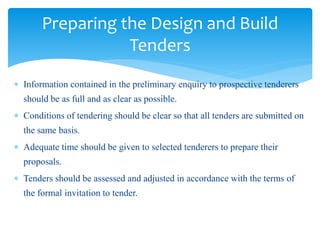
 Information contained in the preliminary enquiry to prospective tenderers
should be as full and as clear as possible.
 Conditions of tendering should be clear so that all tenders are submitted on
the same basis.
 Adequate time should be given to selected tenderers to prepare their
proposals.
 Tenders should be assessed and adjusted in accordance with the terms of
the formal invitation to tender.
Preparing the Design and Build
Tenders
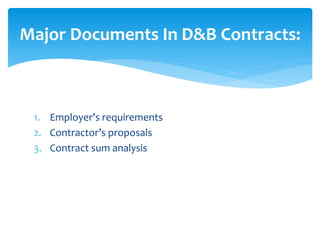
1. Employer’s requirements
2. Contractor’s proposals
3. Contract sum analysis
Major Documents In D&B Contracts:
 The purpose
 The scope
 The design
 Other technical criteria
Employer’s Requirements
1. Relatively small Value, short construction time or involving simple or
repetitive work
2. Large or more complex project
3. Contractor going to Most of design
4. For Process and Power Plant
5. The Infrastructure Project
6. The Privately Financed Project
Factors in deciding which form of
FIDIC form of Contract
1. Part I: Orange Book ( D&B and Turnkey Contracts)-
1995
2. Part II: The Yellow Book (Plant and D&B Contract)-
1999
Overview of FIDIC Conditions of
Contract:
 Both the book consists of 20 clauses in each.
 Every clause consist of number of sub clauses.
 Each clause is important to resolve the problems in contract.
 Clauses are grouped as per the their type of work and
requirement
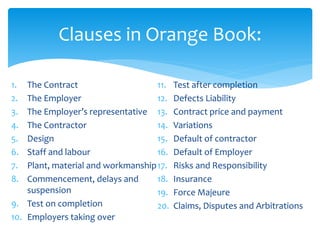
1. The Contract
2. The Employer
3. The Employer’s representative
4. The Contractor
5. Design
6. Staff and labour
7. Plant, material and workmanship
8. Commencement, delays and
suspension
9. Test on completion
10. Employers taking over
11. Test after completion
12. Defects Liability
13. Contract price and payment
14. Variations
15. Default of contractor
16. Default of Employer
17. Risks and Responsibility
18. Insurance
19. Force Majeure
20. Claims, Disputes and Arbitrations
Clauses in Orange Book:
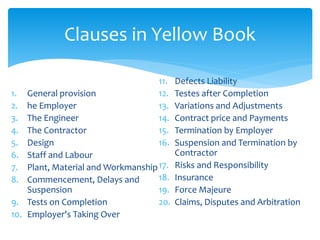
1. General provision
2. he Employer
3. The Engineer
4. The Contractor
5. Design
6. Staff and Labour
7. Plant, Material and Workmanship
8. Commencement, Delays and
Suspension
9. Tests on Completion
10. Employer's Taking Over
11. Defects Liability
12. Testes after Completion
13. Variations and Adjustments
14. Contract price and Payments
15. Termination by Employer
16. Suspension and Termination by
Contractor
17. Risks and Responsibility
18. Insurance
19. Force Majeure
20. Claims, Disputes and Arbitration
Clauses in Yellow Book
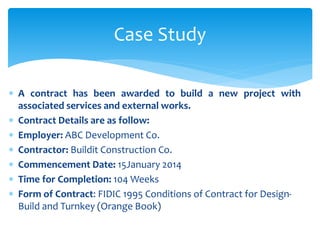
 A contract has been awarded to build a new project with
associated services and external works.
 Contract Details are as follow:
 Employer: ABC Development Co.
 Contractor: Buildit Construction Co.
 Commencement Date: 15January 2014
 Time for Completion: 104 Weeks
 Form of Contract: FIDIC 1995 Conditions of Contract for Design-
Build and Turnkey (Orange Book)
Case Study
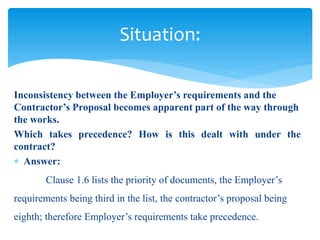
Inconsistency between the Employer’s requirements and the
Contractor’s Proposal becomes apparent part of the way through
the works.
Which takes precedence? How is this dealt with under the
contract?
 Answer:
Clause 1.6 lists the priority of documents, the Employer’s
requirements being third in the list, the contractor’s proposal being
eighth; therefore Employer’s requirements take precedence.
Situation:
 Which of the contractor’s claim clauses allow the contractor to
claim cost and which allow cost plus reasonable profit?
Answer:
Clauses giving the contractor the right to recover Cost:
 Clause 4.11- Unforeseeable physical conditions
 Clause 4.24- Fossils
 Clause 8.8- Suspension
 Clause 13.16- Changes in legislation
 Clause 17.4- Employer’s Risks
 Clause 19.5- Force Majeure
Situation:
Clauses giving the Contractor the right to recover the cost plus
reasonable profit:
 Clause 2.2- Employers failure give access
 Clause 11.4- Employer not permitting access for testing
 Clause 12.8- Contractor instructed to search
 Clause 16.1- Default by Employer
 Reasonable profit is whatever profit the parties agree between
themselves as “reasonable”.
Cont’d
 The Employer’s representative has issued a verbal instruction to carry out
additional work
I. Does the contractor have to comply with the instruction?
II. How does the contract deal with verbal instruction?
Answer:
I. No, under clause 1.8, wherever provision is made for the giving of notice,
instruction, etc. unless otherwise specified such communication shall be in writing.
II. The Contract does not provide for the giving of verbal instructions (Note
that most other contracts provide for the contractor issue a written confirmation of
verbal instruction, which if not rejected, becomes an instruction)
Situation
 ABC Development Co. is late in paying a certified amount due to
Buildit construction.
What are Buildit Construction’s rights regarding this situation?
Answer:
Under clause 13.8, if payment is delayed, the contractor is entitled to
receive financing changes compounded monthly on the amount unpaid during
the delay. Unless part II states otherwise, this is 3% above the discount rate of
the central bank in the country of the currency of the payment. The contractor
is not required to give notice in order to receive this payment.
Situation
Buildit Construction wishes to be paid for the precast concrete
flooring units held at their subcontractor’s works 20km from the
site awaiting delivery to six weeks later.
Answer:
FIDIC 1995 conditions of contract for Design-Build and
Turnkey (Orange Book) does not provide for payment for materials
held off site.
Situation
Thank You

Fidic

  • 1.
    “Design and Buildunder the FIDIC Contracts” Presentation By- Ranjit V Patil M.Tech (Civil- Construction Management) Rajarambapu Institute of Technology, Islampur, Maharashtra. Mob.No. 9503361010
  • 2.
     FIDIC?????  Itis a French short form of… “Federation Internationale Des Ingenieurs – Counseils”  In English it is referred as “ International Federation of Consulting Engineers”  FIDIC : “ International” Form of contract.  Used by funders such as World Bank etc. Introduction
  • 3.
     Origin:- Founded in1913 by three national associations of consulting engineers within Europe.  FIDIC currently has 99 Members Associations & Associates.  CONSULTING ENGINEERS ASSOCIATION OF INDIA is the member from India.
  • 4.
     FIDIC Vision:- Enablingthe development of a sustainable world as the recognised global voice for the consulting engineering industry.  FIDIC Mission :- To work closely with our stakeholders to improve the business climate in which we operate and enable our members to contribute to making the world a better place to live in, now and in the future.  FIDIC Values : 1. Quality 2. Integrity 3. Sustainability
  • 5.
  • 6.
     What isDesign and Built???  It is procurement method which has been in use for long time.  Before the emergence of architecture as profession clients used to procure building by process of design and built.  In Nineteenth Century- It was the separation of responsibility for fabrication from responsibility for design that led to the emergence of so called ‘traditional general contracting’. Design and Built
  • 7.
  • 8.
  • 9.
     Price Certainty Single Point Responsibility  Good For “Non- Expert” clients  Contractor’s Expertise  Quicker Build Time Advantages of Design and Built
  • 10.
     Contractor designsand builds to price.  Employer’s reduced control of design and quality.  Employer’s reduced control of change cost  Not Good for complex projects  Longer tender period  Expensive to contractor to prepare tender. Disadvantages of using Design and Built
  • 11.
     The betterthe Employer’s requirements, the better the completed project.  Consider first of all what are the Employer’s needs??  What??? What does he need???  When????? When does he need it????  How????? How much will/can he pay?????  Which???? Which is the best contractual method to meet these needs???  Is the Design and Built the Best method?? Weigh Up the advantages and disadvantages. The Employer’s Requirements
  • 12.
     Procurement refersto: the process of obtaining goods and services from another for some consideration.  The choice of procurement strategy identifies how the project is structured  Design and coordination consideration have led to the development of following procurement methods: 1. Traditional Procurement 2. Design and Build 3. Management Procurement Procurement methods
  • 13.
    1. General Provisions 2.The Employer 3. The Engineers (The employers administration- EPC) 4. The Contractor 5. Nominated subcontractor (Design- P & DB & EPC) 6. Staff and Labour 7. Plant, materials and workmanship 8. Commencement, delays and suspension 9. Tests on completion 10. Employer’s Taking Over 11. Defects Liability 12. Measurement and evaluation (Tests after completion- P & DB & EPC) 13. Variations and adjustments 14. Contracts price and payments 15. Termination by Employer 16. Suspension and Termination by Contractor 17. Risk and Responsibility 18. Insurance 19. Force Majeure 20. Claims, Disputes and Arbitration Details of The Books for the Major Works: If we take the conditions of contract for construction as an example:
  • 14.
     The employershould appoint an appropriately experienced and qualified agent and necessary professional consultants.  Design responsibility should be clearly defined.  A standard form of contract should be used.  The employer’s requirements should be clearly formulated by the time tenders are invited and set out in the Employer's requirements upon which the contractor’s proposals will depend.  Care and attention should be paid to the procedure for the selection of contractors to be invited to tender. Preparing the Tenders:
  • 15.
     Information containedin the preliminary enquiry to prospective tenderers should be as full and as clear as possible.  Conditions of tendering should be clear so that all tenders are submitted on the same basis.  Adequate time should be given to selected tenderers to prepare their proposals.  Tenders should be assessed and adjusted in accordance with the terms of the formal invitation to tender. Preparing the Design and Build Tenders
  • 16.
    1. Employer’s requirements 2.Contractor’s proposals 3. Contract sum analysis Major Documents In D&B Contracts:
  • 17.
     The purpose The scope  The design  Other technical criteria Employer’s Requirements
  • 18.
    1. Relatively smallValue, short construction time or involving simple or repetitive work 2. Large or more complex project 3. Contractor going to Most of design 4. For Process and Power Plant 5. The Infrastructure Project 6. The Privately Financed Project Factors in deciding which form of FIDIC form of Contract
  • 19.
    1. Part I:Orange Book ( D&B and Turnkey Contracts)- 1995 2. Part II: The Yellow Book (Plant and D&B Contract)- 1999 Overview of FIDIC Conditions of Contract:
  • 20.
     Both thebook consists of 20 clauses in each.  Every clause consist of number of sub clauses.  Each clause is important to resolve the problems in contract.  Clauses are grouped as per the their type of work and requirement
  • 21.
    1. The Contract 2.The Employer 3. The Employer’s representative 4. The Contractor 5. Design 6. Staff and labour 7. Plant, material and workmanship 8. Commencement, delays and suspension 9. Test on completion 10. Employers taking over 11. Test after completion 12. Defects Liability 13. Contract price and payment 14. Variations 15. Default of contractor 16. Default of Employer 17. Risks and Responsibility 18. Insurance 19. Force Majeure 20. Claims, Disputes and Arbitrations Clauses in Orange Book:
  • 22.
    1. General provision 2.he Employer 3. The Engineer 4. The Contractor 5. Design 6. Staff and Labour 7. Plant, Material and Workmanship 8. Commencement, Delays and Suspension 9. Tests on Completion 10. Employer's Taking Over 11. Defects Liability 12. Testes after Completion 13. Variations and Adjustments 14. Contract price and Payments 15. Termination by Employer 16. Suspension and Termination by Contractor 17. Risks and Responsibility 18. Insurance 19. Force Majeure 20. Claims, Disputes and Arbitration Clauses in Yellow Book
  • 23.
     A contracthas been awarded to build a new project with associated services and external works.  Contract Details are as follow:  Employer: ABC Development Co.  Contractor: Buildit Construction Co.  Commencement Date: 15January 2014  Time for Completion: 104 Weeks  Form of Contract: FIDIC 1995 Conditions of Contract for Design- Build and Turnkey (Orange Book) Case Study
  • 24.
    Inconsistency between theEmployer’s requirements and the Contractor’s Proposal becomes apparent part of the way through the works. Which takes precedence? How is this dealt with under the contract?  Answer: Clause 1.6 lists the priority of documents, the Employer’s requirements being third in the list, the contractor’s proposal being eighth; therefore Employer’s requirements take precedence. Situation:
  • 25.
     Which ofthe contractor’s claim clauses allow the contractor to claim cost and which allow cost plus reasonable profit? Answer: Clauses giving the contractor the right to recover Cost:  Clause 4.11- Unforeseeable physical conditions  Clause 4.24- Fossils  Clause 8.8- Suspension  Clause 13.16- Changes in legislation  Clause 17.4- Employer’s Risks  Clause 19.5- Force Majeure Situation:
  • 26.
    Clauses giving theContractor the right to recover the cost plus reasonable profit:  Clause 2.2- Employers failure give access  Clause 11.4- Employer not permitting access for testing  Clause 12.8- Contractor instructed to search  Clause 16.1- Default by Employer  Reasonable profit is whatever profit the parties agree between themselves as “reasonable”. Cont’d
  • 27.
     The Employer’srepresentative has issued a verbal instruction to carry out additional work I. Does the contractor have to comply with the instruction? II. How does the contract deal with verbal instruction? Answer: I. No, under clause 1.8, wherever provision is made for the giving of notice, instruction, etc. unless otherwise specified such communication shall be in writing. II. The Contract does not provide for the giving of verbal instructions (Note that most other contracts provide for the contractor issue a written confirmation of verbal instruction, which if not rejected, becomes an instruction) Situation
  • 28.
     ABC DevelopmentCo. is late in paying a certified amount due to Buildit construction. What are Buildit Construction’s rights regarding this situation? Answer: Under clause 13.8, if payment is delayed, the contractor is entitled to receive financing changes compounded monthly on the amount unpaid during the delay. Unless part II states otherwise, this is 3% above the discount rate of the central bank in the country of the currency of the payment. The contractor is not required to give notice in order to receive this payment. Situation
  • 29.
    Buildit Construction wishesto be paid for the precast concrete flooring units held at their subcontractor’s works 20km from the site awaiting delivery to six weeks later. Answer: FIDIC 1995 conditions of contract for Design-Build and Turnkey (Orange Book) does not provide for payment for materials held off site. Situation
  • 30.