CONSTRUCTION
INDUSTRY
AIM
TO GIVE A BRIEF IDEA ON
VARIOUS FACTORS WHICH
AFFECT THE CONSTRUCTION
INDUSTRY
OBJECTIVES
• CONSTRUCTION INDUSTRY IN LOCAL AND
GLOBAL ENVIRONMENT
• CONSTRUCTION INDUSTRY IN RELATES TO
ECONOMY
• CONSTRUCTION INDUSTRY IN RELATES TO
EMPLOYMENT OF LABOUR
• IDENTIFY THE BUILDING TEAM AND THEIR
ROLE IN A PROJECT
CONSTRUCTION INDUSTRY IN LOCAL
AND GLOBAL ENVIRONMENT
5
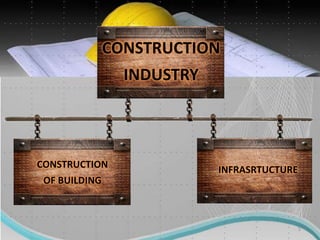
INFRASRTUCTURE
CONSTRUCTION
OF BUILDING
Disparity
in
Payment
CONSTRUCTION
INDUSTRY
CONSTRUCTION INDUSTRY IN LOCAL
• Related codes
• Zoning ordinances
• Subdivision
Regulations
• Planning laws
• Licensing
requirements
• Environmental
regulations
• Safety legislation
• Monetary and
Fiscal policies,
• Tax laws,
• Financial
institution
operating rules,
• Wage regulations.
AN ACT TO PROVIDE FOR THE DEVELOPMENT OF THE CONSTRUCTION INDUSTRY IN SRI LANKA
• REGULATE
• REGISTER
• FORMALIZE
• STANDARDIZE THE ACTIVITIES OF THE CONSTRUCTION
INDUSTRY
• TO PROVIDE FOR THE ESTABLISHMENT OF THE NATIONAL
ADVISORY COUNCIL ON CONSTRUCTION
• THE ESTABLISHMENT OF THE CONSTRUCTION INDUSTRY
DEVELOPMENT
• INDUSTRY DEVELOPMENT FUND AND THE FUND OF THE
CONSTRUCTION INDUSTRY DEVELOPMENT AUTHORITY
• TO PROVIDE MEASURES FOR THE IMPROVEMENT AND
WELLBEING OF THE INDUSTRY RELATED PROFESSIONALS,
MANUFACTURERS, SUPPLIERS, CONTRACTORS AND
CRAFTSMEN; AND FOR THE SETTLEMENT OF DISPUTES
RELATED TO CONSTRUCTION ACTIVITIES
• TO ENSURE PUBLICSAFETY IN THE CONSTRUCTIONINDUSTRY
OF SRI LANKA AND FOR MATTERS CONNECTED THEREWITH
OR INCIDENTALTHERETO
PLANNING & BUILDING REGULATIONS
• LAND SUB DIVISION & AMALGAMATION
• ACCESSIBILITY
• PARKING & TRAFFIC CONTROL
• PLOT USAGE
• BUILDING CATEGORY & HEIGHTS
• OPEN SPACES AROUND THE BUILDING
• REGULATION INSIDE THE BUILDING
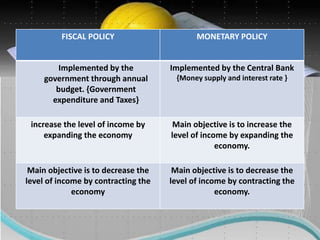
FISCAL POLICY MONETARY POLICY
Implemented by the
government through annual
budget. {Government
expenditure and Taxes}
Implemented by the Central Bank
{Money supply and interest rate }
increase the level of income by
expanding the economy
Main objective is to increase the
level of income by expanding the
economy.
Main objective is to decrease the
level of income by contracting the
economy
Main objective is to decrease the
level of income by contracting the
economy.
CONSTRUCTION INDUSTRY IN
GLOBAL
• Developed countries are actively working
towards achieving a high-income status .
• Involves intensive transformation of the
economic structure.
• The governments have outlined an
economic road map to transform the
country in order to be recognised as a
developed nation.
• This requires average growth in GDP per
annum during the Plan Period.
• The construction sector is active and
features prominently in terms of policy
formulation and implementations.
• A comparison of the size of the construction
industry with developing countries suggests
that its contribution has been consistent and
stable
CONSTRUCTION INDUSTRY RELATED
IN ECONOMY
ECONOMY WHAT IS IT?????????
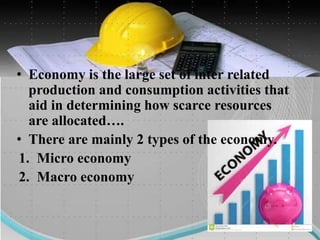
• Economy is the large set of inter related
production and consumption activities that
aid in determining how scarce resources
are allocated….
• There are mainly 2 types of the economy.
1. Micro economy
2. Macro economy
• EXAMPLE-it is about how money worked in
country, how they used money, utility
(satisfaction ) after consumer goal or services.
CONSTRUCTIONS INDUSTRY
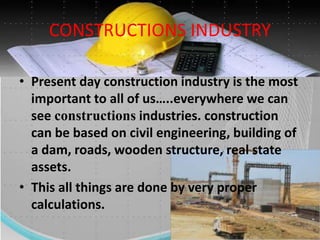
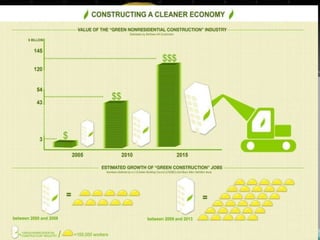
• Present day construction industry is the most
important to all of us…..everywhere we can
see constructions industries. construction
can be based on civil engineering, building of
a dam, roads, wooden structure, real state
assets.
• This all things are done by very proper
calculations.
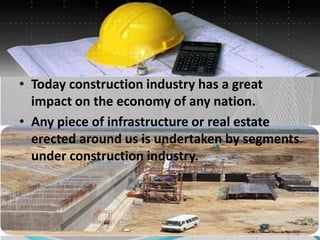
• Today construction industry has a great
impact on the economy of any nation.
• Any piece of infrastructure or real estate
erected around us is undertaken by segments
under construction industry.
The ways economy deals with the
constructions
• The construction industry is diversfirld.it
involves which clients like property builders,
property developers ,materials suppliers and
contractors.
• The construction industry brings cost effective
building solutions where in all these clients
play an active role to make the contract a
success.
• .
Construction field with economy…..
• Construction industry works with calculations
and within the frame work of credits .All of
construction works deals with money .when
the construction is over we have to pay for
labors, for travels, for excavations, for
materials.so all of things are involved with
the money
• Construction industry has main relationship
with economy because of GDP and GNP….
LABOUR PRODUCTIVITY TRENDS IN
SRI LANKA
WHAT IS THE GDP AND
GNP????????????
• GDP is standard for GROSS DOMESTIC PRODUCT.
This is the largest quantitative measure of a
nations total economic activity.
• More specifically GDP represents the monetary
value of all goods and services produced within
a nation’s geographic borders over a identified
period of time.
• GNP means GROSS NATIONAL PRODUCT is a
broad measure of a nations total economic
activity. GNP is the value of all finished goods
and services produced in a country in one year.
RELATIONSHIP BETWEEN LABOUR
COST AND PRODUCTIVITY
• LABOUR COST
• CONSUPTION
• PRODUCTION
There are special bond with consumer and
productor in the market.one moment we think
productor is a like economy and consumer is a act
like construction field, we can see this relationship
very clearly.
CONSTRUCTION INDUSTRY IN RELATES
TO ECONOMY IN SRI LANKA
• In the economy .There are mainly 2 types of
policies.
1.Fiscal Policy
2.Monetry Policy
Fiscal Policy
• Implement by the government through
annual bud jet.
• Government expenditure and taxes are the
main tools.
• Main object is to achieve economic
stabilization.
Monetary Policy
• Implemented by the central bank
• Money supply and interest rate are the main
tools.
• Government constructions can build after
money supply by the central bank.
CONSTRUCTION INDUSTRY
IN RELATES TO
EMPLOYMENT OF LABOUR.
Construction worker
A construction worker is a tradesman ,labourer
or professional employed in the Physical
construction of the built environment.
Construction workers often work under a
foreman.
TRADES
He division of labour of construction
encompasses a diverse range of skilled and
manual labour.
SAFETY
Construction safety is very important to ensure
a safe environment for the workers. All
construction workers need to be educated on
safety at each construction site to minimize
injury.
CONTROVERSY
• report described unsafe and unfair working
conditions and failure on the part of the
government to enforce labor standards in the
construction industry.
• The International Labor Organization (ILO)
estimated that, at the end of 2006, 90% of the
40 million construction workers in China were
migrant workers.Many of the migrant workers
turned to construction work after their farming
communities collapsed into poverty.
Labour relations in construction
The market demand in construction fluctuates greatly, often
within short periods and with uneven distributions among
geographical regions. Even when the volume of construction is
relatively steady, some types of work may decline in importance
while other types gain. Under an unstable economic
environment, employers in the construction industry place great
value on flexibility in hiring and laying off workers as their
volumes of work wax and wane.
There are many crafts in the construction labor forces, but most
contractors hire from only a few of these crafts to satisfy their
specialized needs. Because of the peculiar characteristics of
employment conditions, employers and workers are placed in a
more intimate relationship than in many other industries.
Non-unionized construction
The comprehensive plans of the
contractors' association apply to all
employees and crafts of a contractor

regardless of their trades. Under such
operations, workers have full rights to
move through the nation among member
contractors of the association.
Job-site productivity is influenced by many
factors which can be characterized either as
labor characteristics, project work conditions or
as non-productive activities. The labor
characteristics include:
• age, skill and experience of workforce
• leadership and motivation of workforce
The non-productive activities associated with a project may or may not be
paid by the owner, but they nevertheless take up potential labor resources
which can otherwise be directed to the project. The non-productive
activities include among other factors:
• Indirect labor required to maintain the progress of the project
• Rework for correcting unsatisfactory work
• Temporary work stoppage due to inclement weather or material shortage
• Time off for union activities
• Absentee time, including late start and early quits
• Non-working holidays
• Strikes
Each category of factors affects the productive labor available to a project as
well as the on-site labor efficiency.
Labour characteristics
• Quality of work
• Quantity of work
• Job knowledge
• Related work knowledge
• Judgment
• Initiative
• Communicative ability
• Interpersonal skills
• Ability to work under pressure
• Security sensitivity
• Planning effectiveness
• Leadership
• delegating
Project work conditions
• Job-site labor productivity can be estimated either for
each craft or each type of construction under a
specific set of work conditions. A base labor
productivity may be defined for a set of work
conditions specified by the owner or contractor who
wishes to observe and measure the labor performance
over a period of time under such conditions. A labor
productivity index may then be defined as the ratio of
the job-site labor productivity under a different set of
work conditions to the base labor productivity, and is
a measure of the relative labor efficiency of a project
under this new set of work conditions.
Labour law
Labour law mediates the relationship between
workers (employees), employers, trade unions
and the government. Collective labour law relates
to the tripartite relationship between employee,
employer and union. Individual labour law
concerns employees' rights at work and through
the contract for work. Employment standards are
social norms for the minimum socially acceptable
conditions under which employees or contractors
are allowed to work. Government agencies
enforce labour law.
Individual labour law
• Minimum wage
• Employment terms
• Living wage
• Hours
• Health and safety
• Discrimination
• dismissal
Building team and their
role in a project
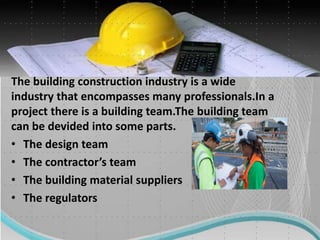
The building construction industry is a wide
industry that encompasses many professionals.In a
project there is a building team.The building team
can be devided into some parts.
• The design team
• The contractor’s team
• The building material suppliers
• The regulators
The design team
The design team is responsible for the overall
layout and appearance of a building. An
architect may lead a design team. The design
team consists with,
• Architect
• Structural engineer
• Quantity surveyor
• The clerk of work
Architect
• Architects are licensed professionals trained in
the art and science of building design, develop
the concepts for structures and turn those
concepts into images and plans. Before
constructing a building, an architect needs to
draw a plan of the building. Architects create
the overall aesthetic and look of buildings and
other structures, but the design of a building
involves far more than its appearance.
Quantity Surveyor
The quntity surveyor prepares the bill of
quantities for building projects so that
contractor can accurately price the work. The
quntity surveyor works out the size of areas
and the volume of required materials from the
design team’s drawigs and specification.
The clerk of works
The clerk of works who is usually employed by
the client is an expert in how buildings should
be constructed. They use this knowledge to
make sure that the contractor builds the
building correctly and safety.
Structural Engineers
• They makes sure that buildings are
structurally stable.The engineer calculates
the weight of the construction materials,the
weight of the people and equipment who will
occupy the building and the maximum wind
pressure on the building.
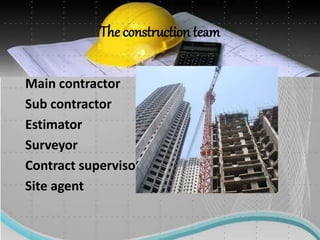
The construction team
Main contractor
Sub contractor
Estimator
Surveyor
Contract supervisor
Site agent
The main contractor
• The main contractor enters into a contract
with the client to build the building according
to the design team’s drawigs, specifications
and bill of quantities.
The surveyor
• A land surveyor is the government authorized
specialist who is licensed to determine
boundaries, they determine the relative
positions of places on or beneath the surface
of the earth by measuring distances,
directions and elevations. They are the first
professionals to carry out physical work on the
construction site.
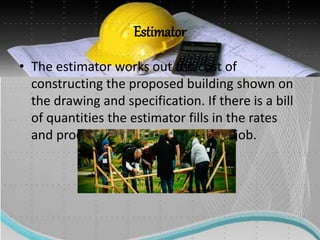
Estimator
• The estimator works out the cost of
constructing the proposed building shown on
the drawing and specification. If there is a bill
of quantities the estimator fills in the rates
and produces the total cost for the job.
Trades foremen
They are experienced at specific trades such as
brickwork, carpentry or plumbing. They organise
and control the workers in their own trade.
Thank you !

Construction industry

  • 1.
  • 2.
    AIM TO GIVE ABRIEF IDEA ON VARIOUS FACTORS WHICH AFFECT THE CONSTRUCTION INDUSTRY
  • 3.
    OBJECTIVES • CONSTRUCTION INDUSTRYIN LOCAL AND GLOBAL ENVIRONMENT • CONSTRUCTION INDUSTRY IN RELATES TO ECONOMY • CONSTRUCTION INDUSTRY IN RELATES TO EMPLOYMENT OF LABOUR • IDENTIFY THE BUILDING TEAM AND THEIR ROLE IN A PROJECT
  • 4.
    CONSTRUCTION INDUSTRY INLOCAL AND GLOBAL ENVIRONMENT
  • 5.
  • 6.
  • 7.
    • Related codes •Zoning ordinances • Subdivision Regulations • Planning laws • Licensing requirements • Environmental regulations • Safety legislation • Monetary and Fiscal policies, • Tax laws, • Financial institution operating rules, • Wage regulations.
  • 8.
    AN ACT TOPROVIDE FOR THE DEVELOPMENT OF THE CONSTRUCTION INDUSTRY IN SRI LANKA
  • 9.
    • REGULATE • REGISTER •FORMALIZE • STANDARDIZE THE ACTIVITIES OF THE CONSTRUCTION INDUSTRY • TO PROVIDE FOR THE ESTABLISHMENT OF THE NATIONAL ADVISORY COUNCIL ON CONSTRUCTION • THE ESTABLISHMENT OF THE CONSTRUCTION INDUSTRY DEVELOPMENT • INDUSTRY DEVELOPMENT FUND AND THE FUND OF THE CONSTRUCTION INDUSTRY DEVELOPMENT AUTHORITY
  • 10.
    • TO PROVIDEMEASURES FOR THE IMPROVEMENT AND WELLBEING OF THE INDUSTRY RELATED PROFESSIONALS, MANUFACTURERS, SUPPLIERS, CONTRACTORS AND CRAFTSMEN; AND FOR THE SETTLEMENT OF DISPUTES RELATED TO CONSTRUCTION ACTIVITIES • TO ENSURE PUBLICSAFETY IN THE CONSTRUCTIONINDUSTRY OF SRI LANKA AND FOR MATTERS CONNECTED THEREWITH OR INCIDENTALTHERETO
  • 12.
    PLANNING & BUILDINGREGULATIONS • LAND SUB DIVISION & AMALGAMATION • ACCESSIBILITY • PARKING & TRAFFIC CONTROL • PLOT USAGE • BUILDING CATEGORY & HEIGHTS • OPEN SPACES AROUND THE BUILDING • REGULATION INSIDE THE BUILDING
  • 13.
    FISCAL POLICY MONETARYPOLICY Implemented by the government through annual budget. {Government expenditure and Taxes} Implemented by the Central Bank {Money supply and interest rate } increase the level of income by expanding the economy Main objective is to increase the level of income by expanding the economy. Main objective is to decrease the level of income by contracting the economy Main objective is to decrease the level of income by contracting the economy.
  • 14.
  • 15.
    • Developed countriesare actively working towards achieving a high-income status . • Involves intensive transformation of the economic structure. • The governments have outlined an economic road map to transform the country in order to be recognised as a developed nation.
  • 16.
    • This requiresaverage growth in GDP per annum during the Plan Period. • The construction sector is active and features prominently in terms of policy formulation and implementations. • A comparison of the size of the construction industry with developing countries suggests that its contribution has been consistent and stable
  • 17.
  • 18.
    ECONOMY WHAT ISIT?????????
  • 19.
    • Economy isthe large set of inter related production and consumption activities that aid in determining how scarce resources are allocated…. • There are mainly 2 types of the economy. 1. Micro economy 2. Macro economy
  • 20.
    • EXAMPLE-it isabout how money worked in country, how they used money, utility (satisfaction ) after consumer goal or services.
  • 21.
    CONSTRUCTIONS INDUSTRY • Presentday construction industry is the most important to all of us…..everywhere we can see constructions industries. construction can be based on civil engineering, building of a dam, roads, wooden structure, real state assets. • This all things are done by very proper calculations.
  • 22.
    • Today constructionindustry has a great impact on the economy of any nation. • Any piece of infrastructure or real estate erected around us is undertaken by segments under construction industry.
  • 23.
    The ways economydeals with the constructions • The construction industry is diversfirld.it involves which clients like property builders, property developers ,materials suppliers and contractors. • The construction industry brings cost effective building solutions where in all these clients play an active role to make the contract a success.
  • 24.
  • 25.
    Construction field witheconomy….. • Construction industry works with calculations and within the frame work of credits .All of construction works deals with money .when the construction is over we have to pay for labors, for travels, for excavations, for materials.so all of things are involved with the money • Construction industry has main relationship with economy because of GDP and GNP….
  • 26.
  • 27.
    WHAT IS THEGDP AND GNP???????????? • GDP is standard for GROSS DOMESTIC PRODUCT. This is the largest quantitative measure of a nations total economic activity. • More specifically GDP represents the monetary value of all goods and services produced within a nation’s geographic borders over a identified period of time. • GNP means GROSS NATIONAL PRODUCT is a broad measure of a nations total economic activity. GNP is the value of all finished goods and services produced in a country in one year.
  • 28.
    RELATIONSHIP BETWEEN LABOUR COSTAND PRODUCTIVITY • LABOUR COST • CONSUPTION • PRODUCTION There are special bond with consumer and productor in the market.one moment we think productor is a like economy and consumer is a act like construction field, we can see this relationship very clearly.
  • 29.
    CONSTRUCTION INDUSTRY INRELATES TO ECONOMY IN SRI LANKA • In the economy .There are mainly 2 types of policies. 1.Fiscal Policy 2.Monetry Policy
  • 30.
    Fiscal Policy • Implementby the government through annual bud jet. • Government expenditure and taxes are the main tools. • Main object is to achieve economic stabilization.
  • 31.
    Monetary Policy • Implementedby the central bank • Money supply and interest rate are the main tools. • Government constructions can build after money supply by the central bank.
  • 33.
    CONSTRUCTION INDUSTRY IN RELATESTO EMPLOYMENT OF LABOUR.
  • 34.
    Construction worker A constructionworker is a tradesman ,labourer or professional employed in the Physical construction of the built environment. Construction workers often work under a foreman.
  • 35.
    TRADES He division oflabour of construction encompasses a diverse range of skilled and manual labour.
  • 36.
    SAFETY Construction safety isvery important to ensure a safe environment for the workers. All construction workers need to be educated on safety at each construction site to minimize injury.
  • 37.
    CONTROVERSY • report describedunsafe and unfair working conditions and failure on the part of the government to enforce labor standards in the construction industry. • The International Labor Organization (ILO) estimated that, at the end of 2006, 90% of the 40 million construction workers in China were migrant workers.Many of the migrant workers turned to construction work after their farming communities collapsed into poverty.
  • 38.
    Labour relations inconstruction The market demand in construction fluctuates greatly, often within short periods and with uneven distributions among geographical regions. Even when the volume of construction is relatively steady, some types of work may decline in importance while other types gain. Under an unstable economic environment, employers in the construction industry place great value on flexibility in hiring and laying off workers as their volumes of work wax and wane. There are many crafts in the construction labor forces, but most contractors hire from only a few of these crafts to satisfy their specialized needs. Because of the peculiar characteristics of employment conditions, employers and workers are placed in a more intimate relationship than in many other industries.
  • 39.
    Non-unionized construction The comprehensiveplans of the contractors' association apply to all employees and crafts of a contractor regardless of their trades. Under such operations, workers have full rights to move through the nation among member contractors of the association.
  • 40.
    Job-site productivity isinfluenced by many factors which can be characterized either as labor characteristics, project work conditions or as non-productive activities. The labor characteristics include: • age, skill and experience of workforce • leadership and motivation of workforce
  • 41.
    The non-productive activitiesassociated with a project may or may not be paid by the owner, but they nevertheless take up potential labor resources which can otherwise be directed to the project. The non-productive activities include among other factors: • Indirect labor required to maintain the progress of the project • Rework for correcting unsatisfactory work • Temporary work stoppage due to inclement weather or material shortage • Time off for union activities • Absentee time, including late start and early quits • Non-working holidays • Strikes Each category of factors affects the productive labor available to a project as well as the on-site labor efficiency.
  • 42.
    Labour characteristics • Qualityof work • Quantity of work • Job knowledge • Related work knowledge • Judgment • Initiative • Communicative ability • Interpersonal skills • Ability to work under pressure • Security sensitivity • Planning effectiveness • Leadership • delegating
  • 43.
    Project work conditions •Job-site labor productivity can be estimated either for each craft or each type of construction under a specific set of work conditions. A base labor productivity may be defined for a set of work conditions specified by the owner or contractor who wishes to observe and measure the labor performance over a period of time under such conditions. A labor productivity index may then be defined as the ratio of the job-site labor productivity under a different set of work conditions to the base labor productivity, and is a measure of the relative labor efficiency of a project under this new set of work conditions.
  • 44.
    Labour law Labour lawmediates the relationship between workers (employees), employers, trade unions and the government. Collective labour law relates to the tripartite relationship between employee, employer and union. Individual labour law concerns employees' rights at work and through the contract for work. Employment standards are social norms for the minimum socially acceptable conditions under which employees or contractors are allowed to work. Government agencies enforce labour law.
  • 45.
    Individual labour law •Minimum wage • Employment terms • Living wage • Hours • Health and safety • Discrimination • dismissal
  • 46.
    Building team andtheir role in a project
  • 47.
    The building constructionindustry is a wide industry that encompasses many professionals.In a project there is a building team.The building team can be devided into some parts. • The design team • The contractor’s team • The building material suppliers • The regulators
  • 48.
    The design team Thedesign team is responsible for the overall layout and appearance of a building. An architect may lead a design team. The design team consists with, • Architect • Structural engineer • Quantity surveyor • The clerk of work
  • 49.
    Architect • Architects arelicensed professionals trained in the art and science of building design, develop the concepts for structures and turn those concepts into images and plans. Before constructing a building, an architect needs to draw a plan of the building. Architects create the overall aesthetic and look of buildings and other structures, but the design of a building involves far more than its appearance.
  • 50.
    Quantity Surveyor The quntitysurveyor prepares the bill of quantities for building projects so that contractor can accurately price the work. The quntity surveyor works out the size of areas and the volume of required materials from the design team’s drawigs and specification.
  • 51.
    The clerk ofworks The clerk of works who is usually employed by the client is an expert in how buildings should be constructed. They use this knowledge to make sure that the contractor builds the building correctly and safety.
  • 52.
    Structural Engineers • Theymakes sure that buildings are structurally stable.The engineer calculates the weight of the construction materials,the weight of the people and equipment who will occupy the building and the maximum wind pressure on the building.
  • 53.
    The construction team Maincontractor Sub contractor Estimator Surveyor Contract supervisor Site agent
  • 54.
    The main contractor •The main contractor enters into a contract with the client to build the building according to the design team’s drawigs, specifications and bill of quantities.
  • 55.
    The surveyor • Aland surveyor is the government authorized specialist who is licensed to determine boundaries, they determine the relative positions of places on or beneath the surface of the earth by measuring distances, directions and elevations. They are the first professionals to carry out physical work on the construction site.
  • 56.
    Estimator • The estimatorworks out the cost of constructing the proposed building shown on the drawing and specification. If there is a bill of quantities the estimator fills in the rates and produces the total cost for the job.
  • 57.
    Trades foremen They areexperienced at specific trades such as brickwork, carpentry or plumbing. They organise and control the workers in their own trade.
  • 59.