Rate Analysis
⚫ Inorder to determine the rate of a particular item, the
factors affecting the rate of the item are studied carefully
and then finally, a rate is decided for that item. This process
of determining the rate of an item is termed as the Analysis
of rate or Rate analysis
3.
Purpose of RateAnalysis
⚫ Following are the two main purposes of Rate analysis
⚫ To determine the actual cost per unit of item
⚫ To examine the item for economic process and economic uses
of materials involved in making the item
4.
Importance of RateAnalysis
⚫ Gives clear picture of various forces acting behind performance of particular
item
⚫ It should be remembered that the Rate analysis of any item is never complete
⚫ For instance, in rate analysis of brickwork, a definite rate for brick is
assumed. But this rate for bricks is derived by the manufacturer of bricks by
his own rate analysis for preparing bricks
⚫ Thus, theoretically, the rate analysis is incomplete, but in practice, it serves
as a useful guide to arrive at a reasonable rate for particular item.
5.
Essentials of RateAnalysis
⚫ For arriving at the correct rate analysis, the following
essentials are necessary for the person carrying out the
analysis:
⚫ Good knowledge of construction work and familiarity with the
trade
⚫ Information regarding costs of materials, labour and
equipment
6.
Schedule of Rates
⚫A schedule or list of rates of various items is prepared after the
analysis of rates of these items. Such a document is known as the
Schedule of Rates.
⚫ It is prepared by large concerns or public bodies
⚫ It becomes very useful, especially in deciding the rate of an extra
item, carried out by contractor
⚫ Normally a clause is given in contract as “Any extra work shall be
paid as per rate in schedule of rates.”
7.
Schedule of Rates
⚫The schedule of Rates consists of groups of items such as demolishing
items, excavation items, concrete items, brickwork items etc and also
information regarding the present wages of labour and prices of
different items.
⚫ The SOR are periodically revised as the rate of items may vary
⚫ The Central Public Works Department (CPWD) is the premier
construction organisation of Govt. Of India
8.
Schedule of Rates
⚫The CPWD SOR contains the basic rates of materials, labour,
carriage etc of about 2500 items and finished rates of about 3000
items of work covered under different sub heads such as
building work, road work, water supply and drainage items etc.
⚫ Sundries such as water charges and contractor’s profit are also
added in the final rate.
⚫ Computer programs are used for revising the SOR periodically
9.
Standard Costing
⚫ Onthe basis of case studies of efficient organisations, the
process by which an optimum cost of an item with respect to
material, labour, supervision, equipment etc is worked out, is
known as standard costing.
⚫ Thus the cost arrived at by standard costing indicates the cost
which would be incurred, if all the activities connected with that
item are efficiently organized.
10.
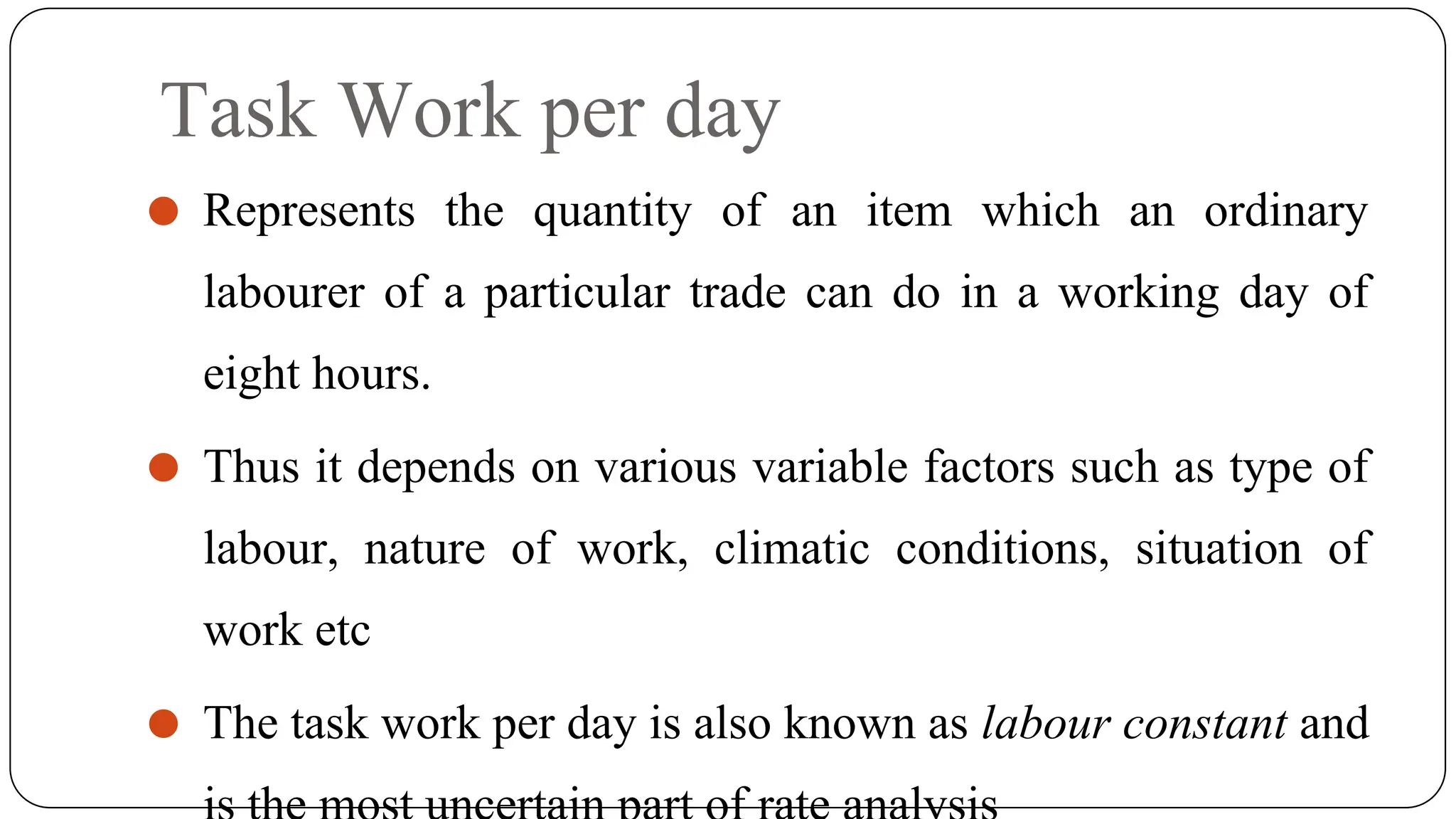
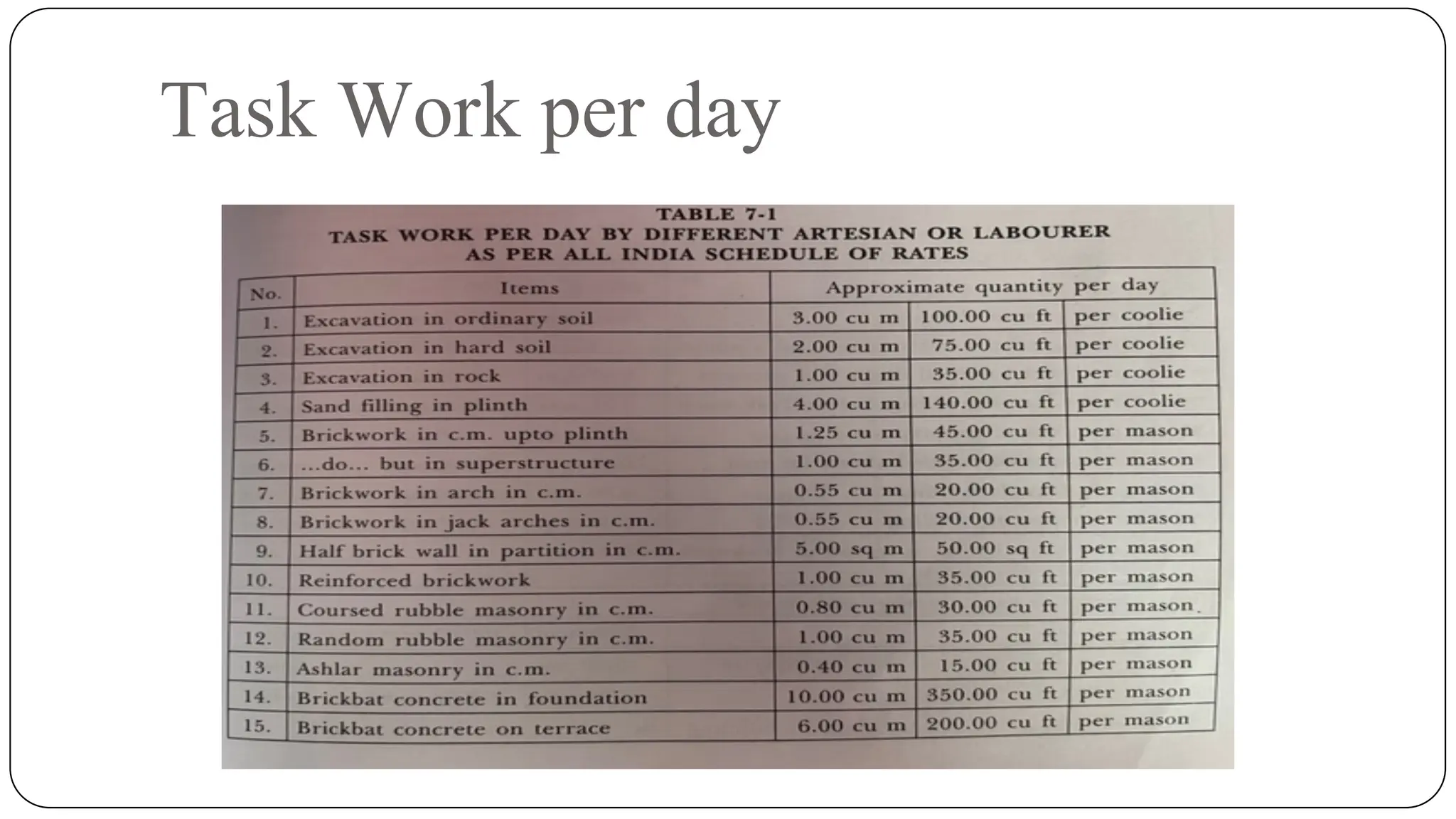
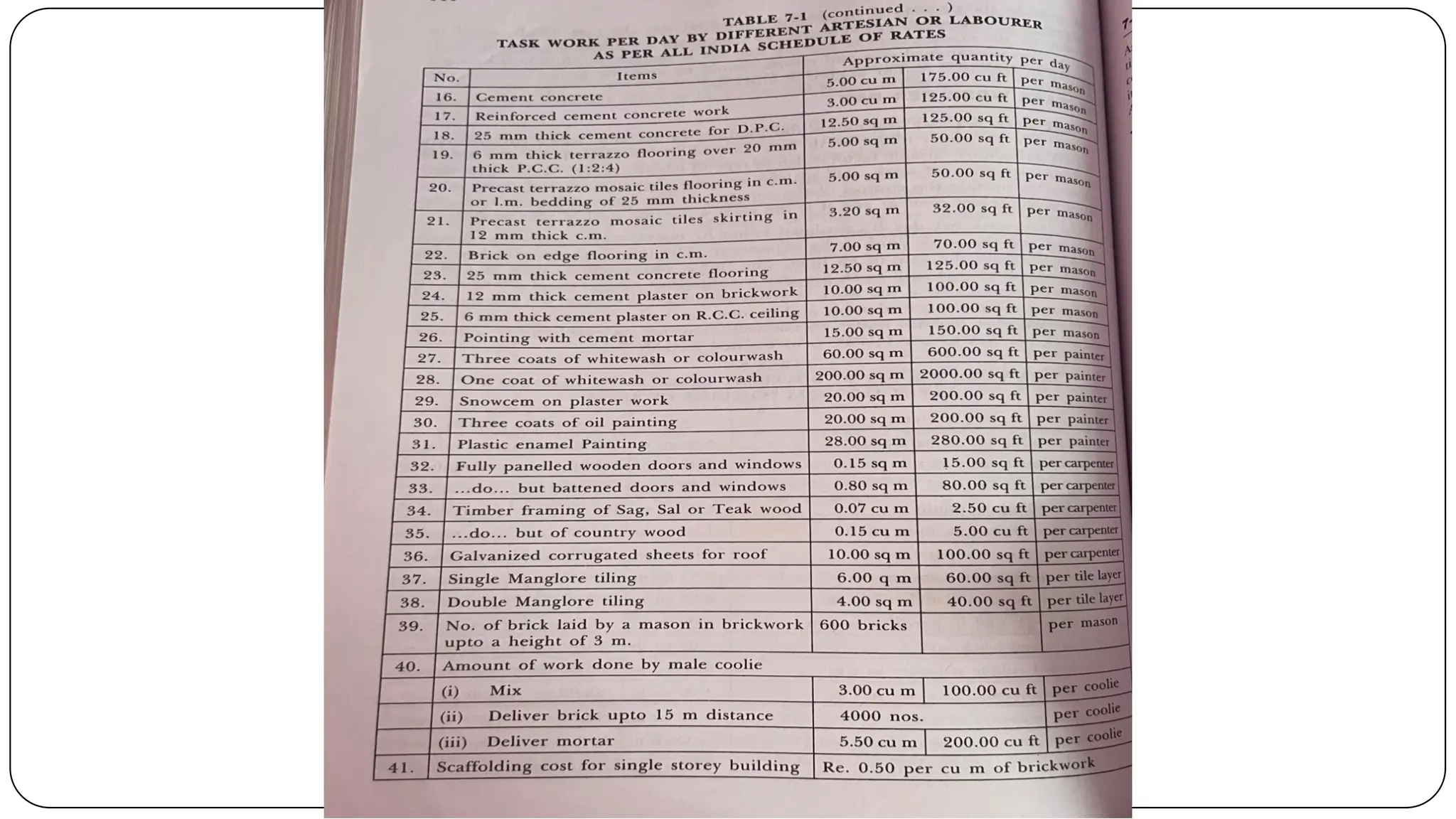
Task Work perday
⚫ Represents the quantity of an item which an ordinary
labourer of a particular trade can do in a working day of
eight hours.
⚫ Thus it depends on various variable factors such as type of
labour, nature of work, climatic conditions, situation of
work etc
⚫ The task work per day is also known as labour constant and
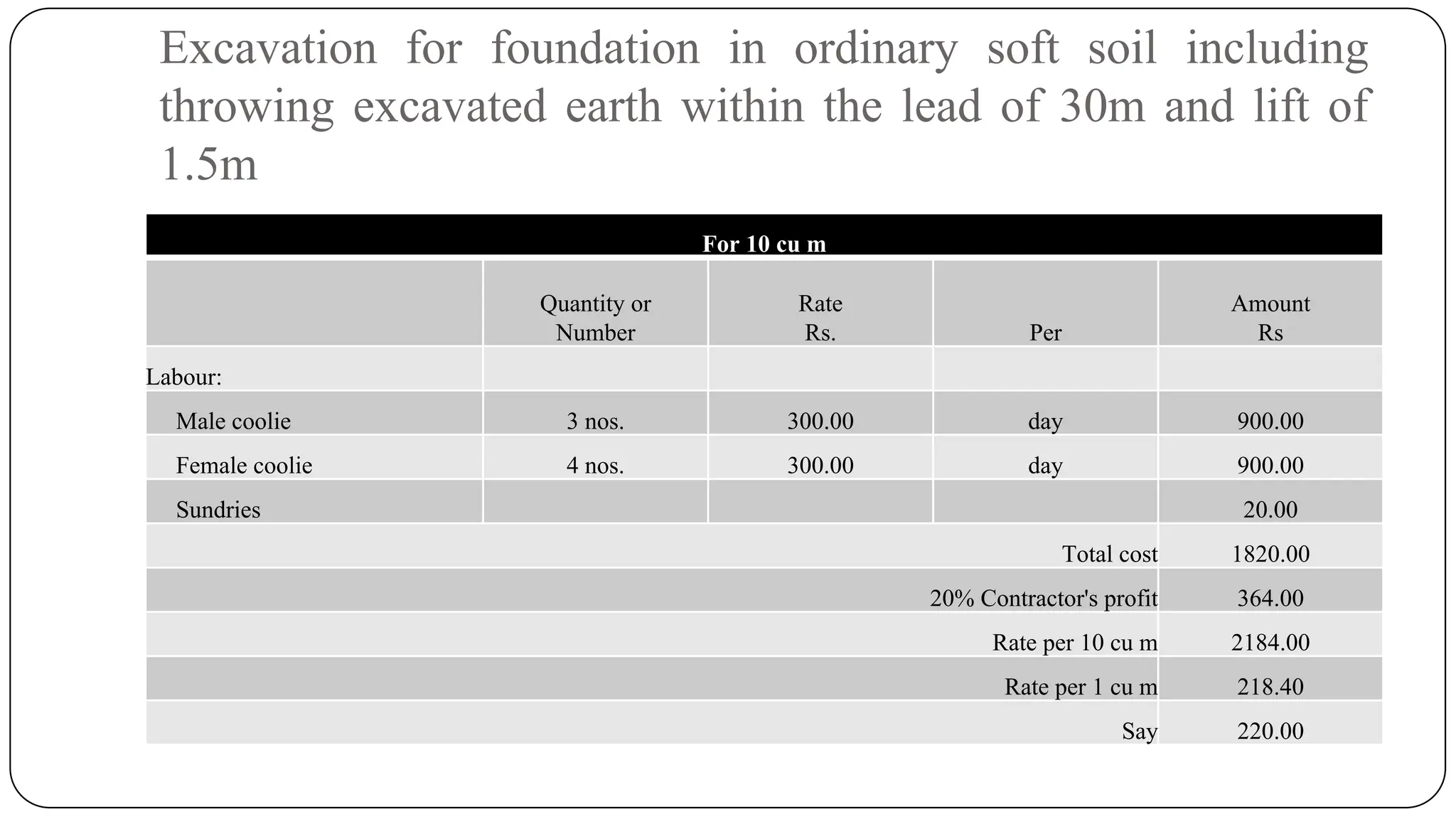
Excavation for foundationin ordinary soft soil including
throwing excavated earth within the lead of 30m and lift of
1.5m
For 10 cu m
Quantity or
Number
Rate
Rs. Per
Amount
Rs
Labour:
Male coolie 3 nos. 300.00 day 900.00
Female coolie 4 nos. 300.00 day 900.00
Sundries 20.00
Total cost 1820.00
20% Contractor's profit 364.00
Rate per 10 cu m 2184.00
Rate per 1 cu m 218.40
Say 220.00



![Chapt_4[1].ppt very interseting and important](https://cdn.slidesharecdn.com/ss_thumbnails/chapt41-251208222956-7cf5e0fa-thumbnail.jpg?width=640&height=640&fit=bounds)


