STANDARD COSTING &
VARIANCE ANALYSIS
BY – POORVI HATTARKI
MAHESH VELPUL
MEGHA KUNCHI
MEANING
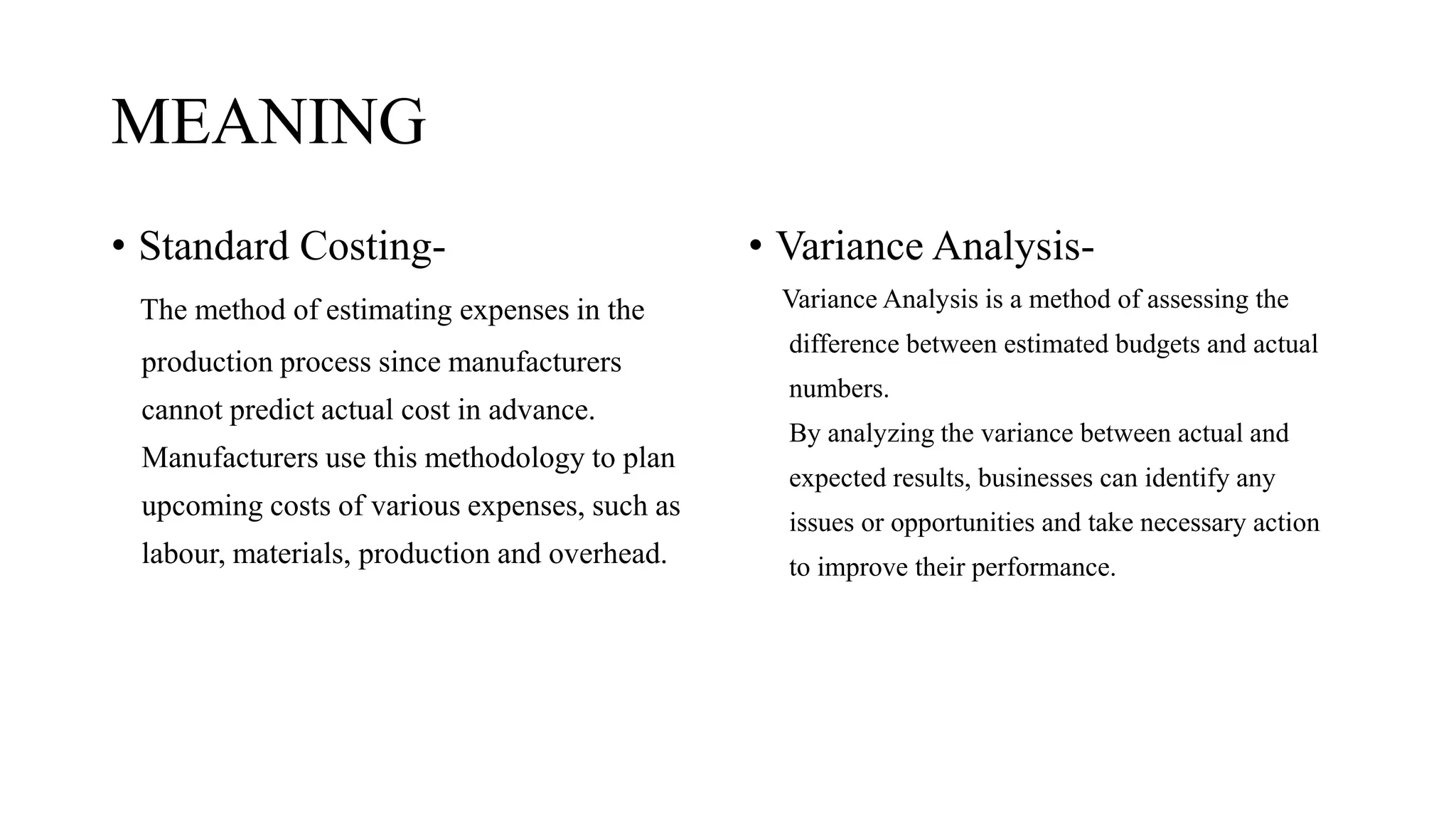
• Standard Costing-
The method of estimating expenses in the
production process since manufacturers
cannot predict actual cost in advance.
Manufacturers use this methodology to plan
upcoming costs of various expenses, such as
labour, materials, production and overhead.
• Variance Analysis-
Variance Analysis is a method of assessing the
difference between estimated budgets and actual
numbers.
By analyzing the variance between actual and
expected results, businesses can identify any
issues or opportunities and take necessary action
to improve their performance.
MEANING
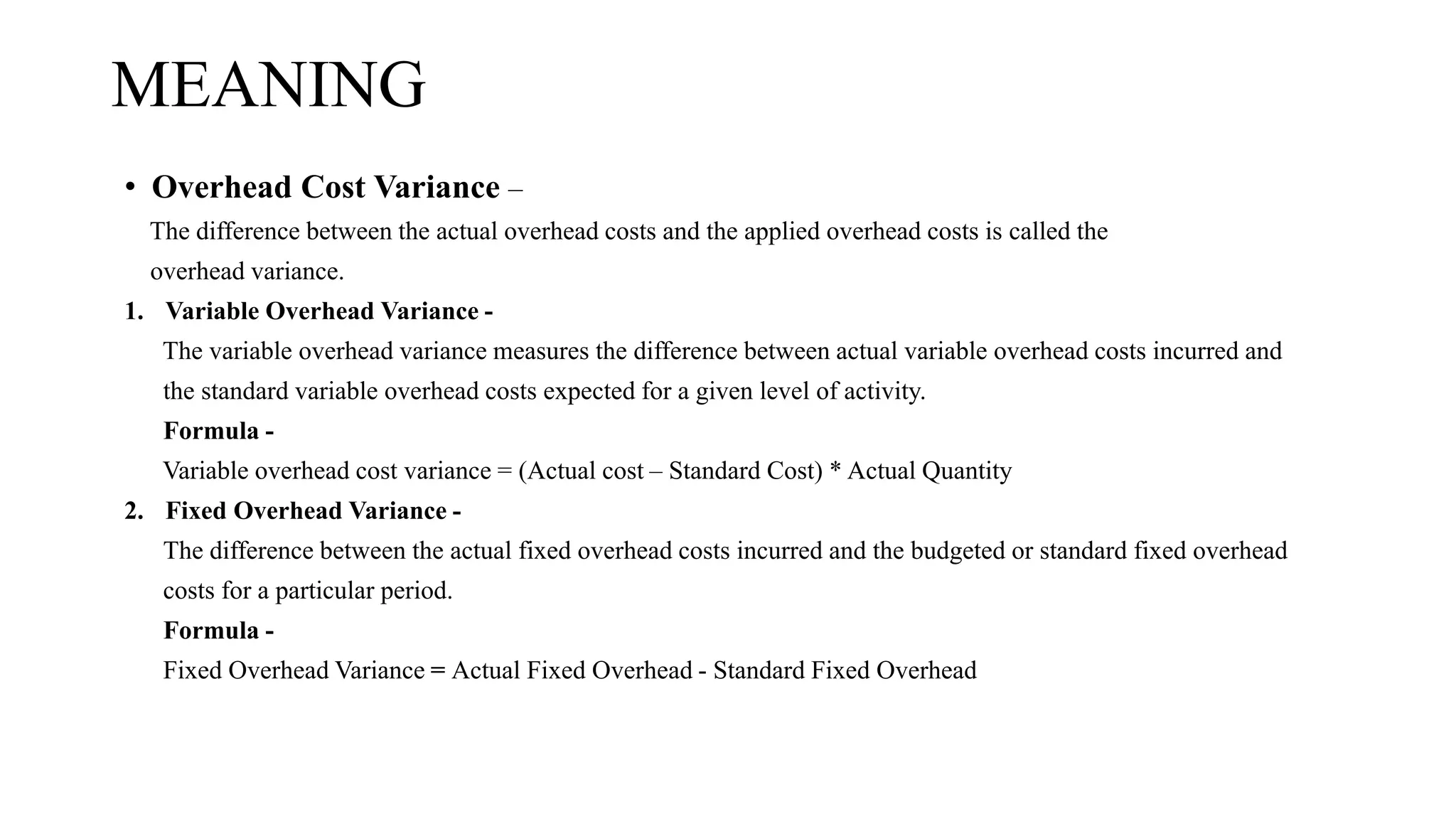
• Overhead Cost Variance –
The difference between the actual overhead costs and the applied overhead costs is called the
overhead variance.
1. Variable Overhead Variance -
The variable overhead variance measures the difference between actual variable overhead costs incurred and
the standard variable overhead costs expected for a given level of activity.
Formula -
Variable overhead cost variance = (Actual cost – Standard Cost) * Actual Quantity
2. Fixed Overhead Variance -
The difference between the actual fixed overhead costs incurred and the budgeted or standard fixed overhead
costs for a particular period.
Formula -
Fixed Overhead Variance = Actual Fixed Overhead - Standard Fixed Overhead
MEANING
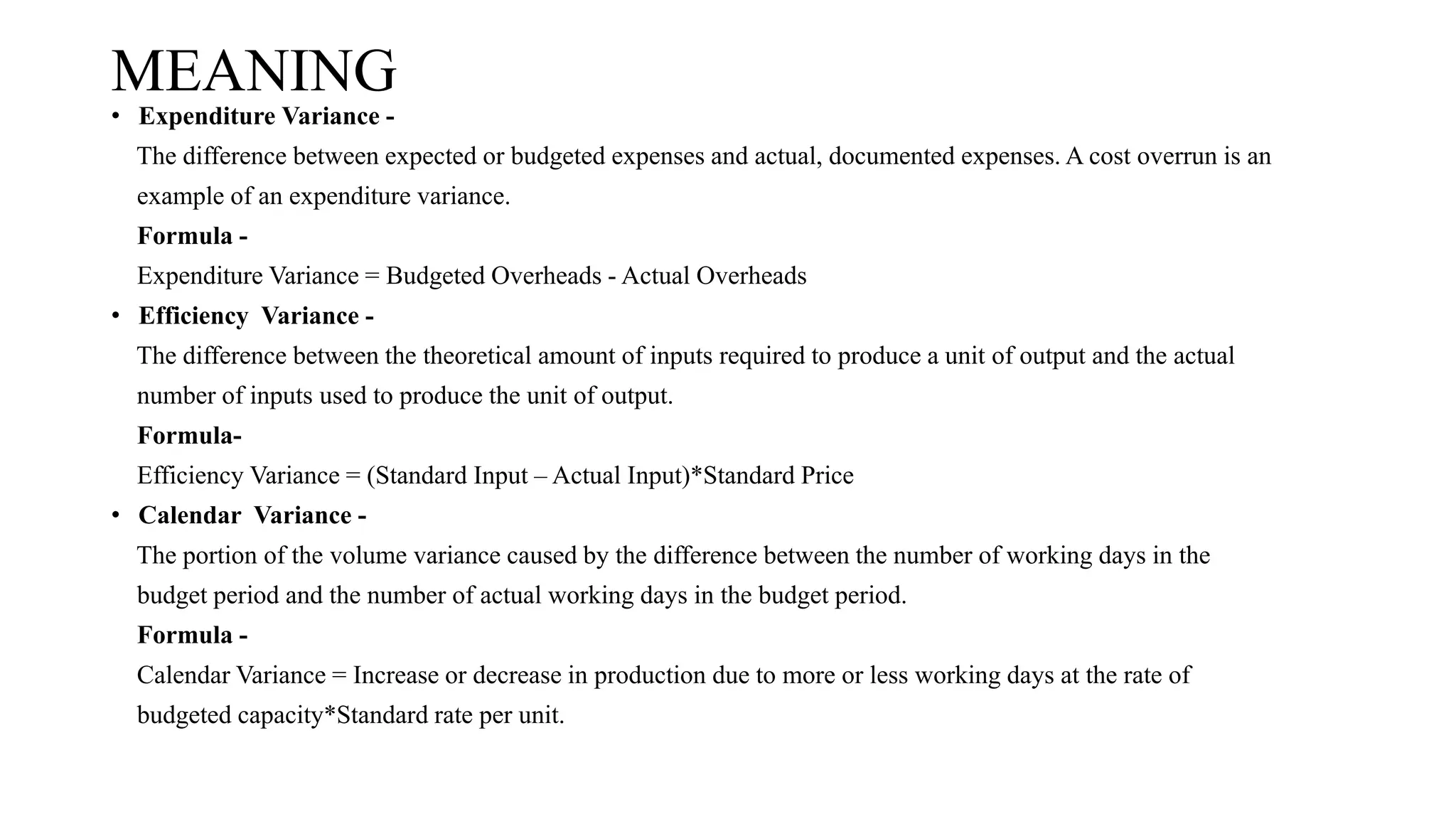
• Expenditure Variance -
The difference between expected or budgeted expenses and actual, documented expenses. A cost overrun is an
example of an expenditure variance.
Formula -
Expenditure Variance = Budgeted Overheads - Actual Overheads
• Efficiency Variance -
The difference between the theoretical amount of inputs required to produce a unit of output and the actual
number of inputs used to produce the unit of output.
Formula-
Efficiency Variance = (Standard Input – Actual Input)*Standard Price
• Calendar Variance -
The portion of the volume variance caused by the difference between the number of working days in the
budget period and the number of actual working days in the budget period.
Formula -
Calendar Variance = Increase or decrease in production due to more or less working days at the rate of
budgeted capacity*Standard rate per unit.
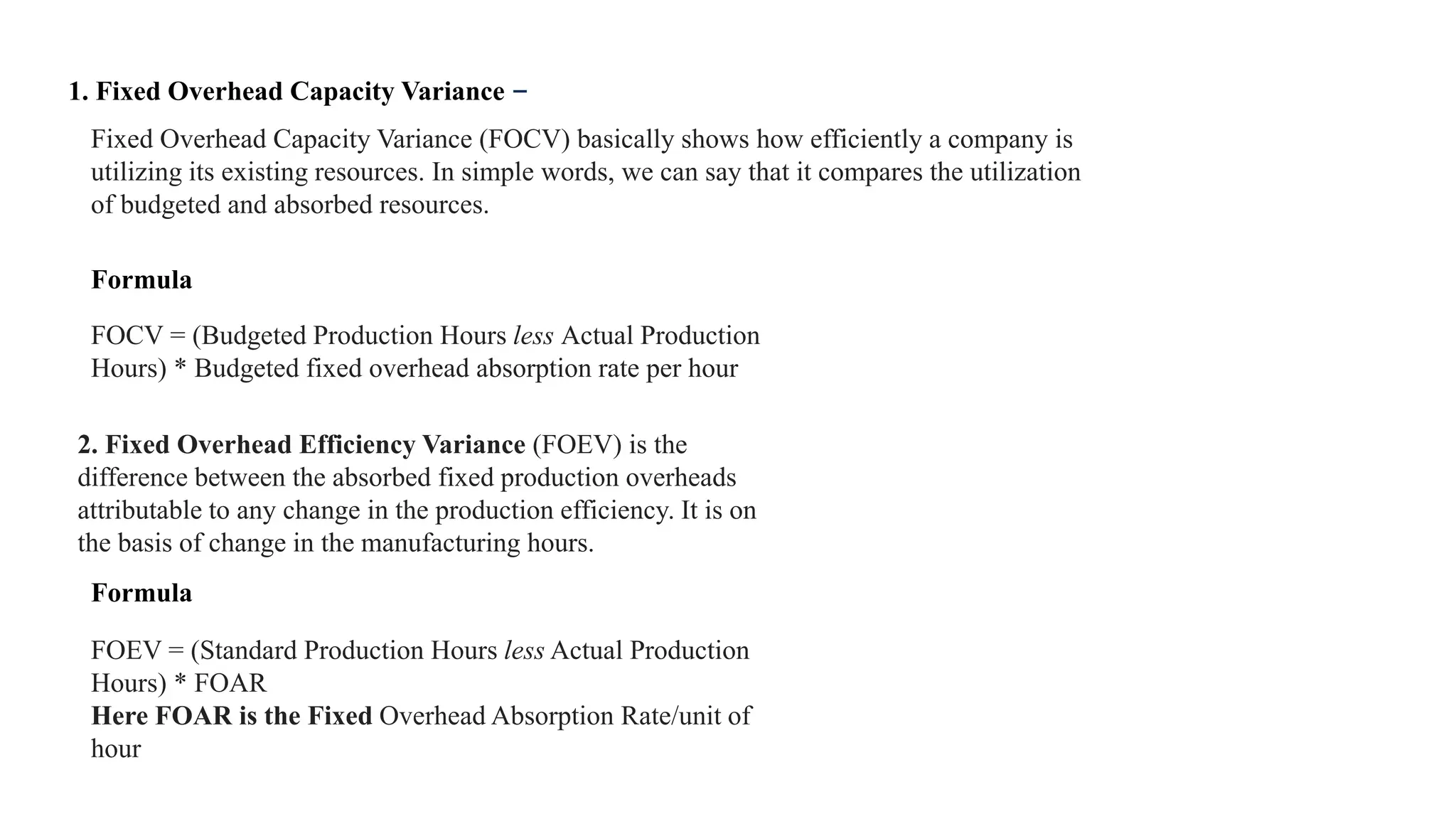
Fixed Overhead Capacity Variance (FOCV) basically shows how efficiently a company is
utilizing its existing resources. In simple words, we can say that it compares the utilization
of budgeted and absorbed resources.
1. Fixed Overhead Capacity Variance –
FOCV = (Budgeted Production Hours less Actual Production
Hours) * Budgeted fixed overhead absorption rate per hour
2. Fixed Overhead Efficiency Variance (FOEV) is the
difference between the absorbed fixed production overheads
attributable to any change in the production efficiency. It is on
the basis of change in the manufacturing hours.
FOEV = (Standard Production Hours less Actual Production
Hours) * FOAR
Here FOAR is the Fixed Overhead Absorption Rate/unit of
hour
Formula
Formula
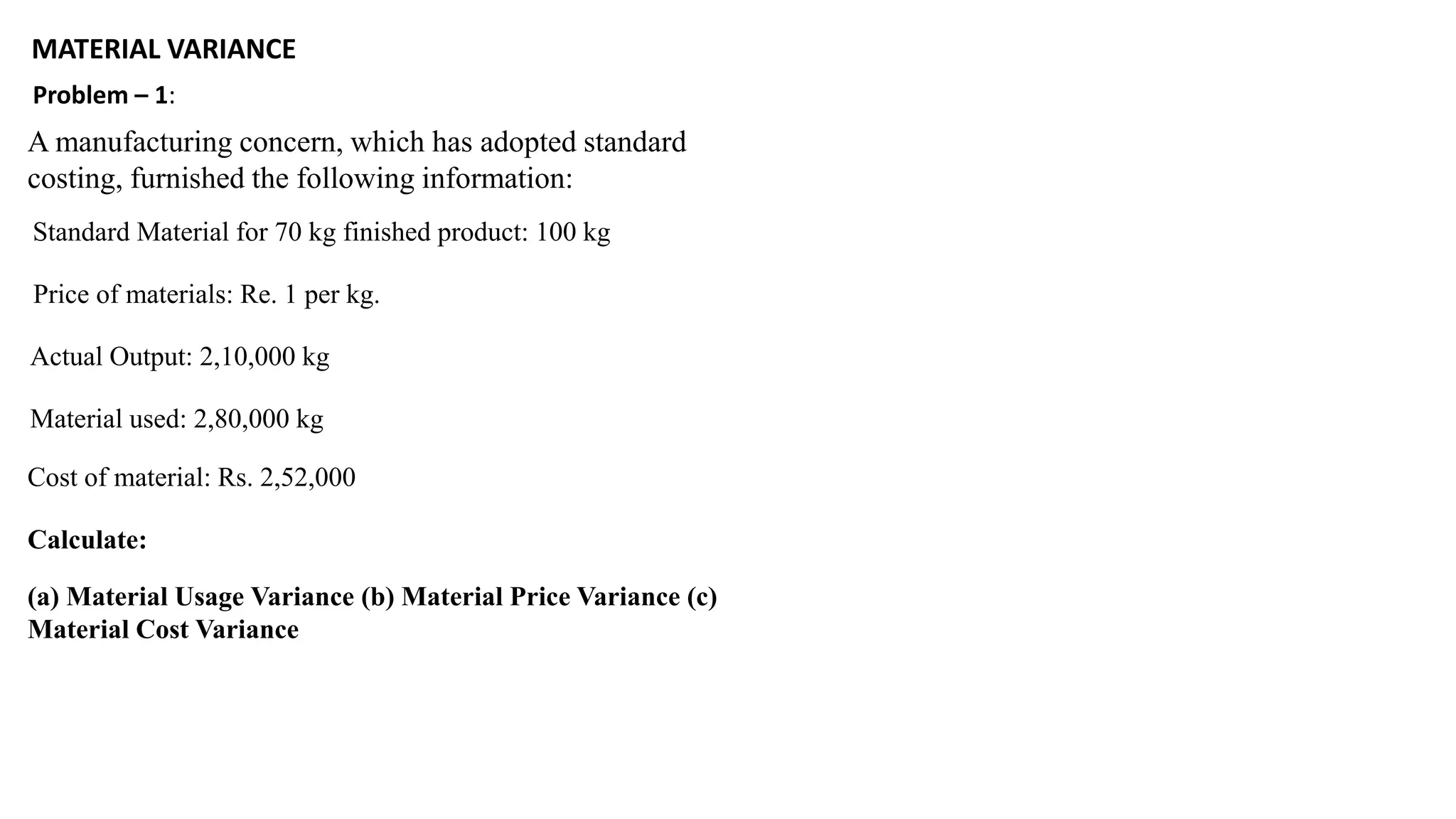
A manufacturing concern, which has adopted standard
costing, furnished the following information:
MATERIAL VARIANCE
Problem – 1:
Standard Material for 70 kg finished product: 100 kg
Price of materials: Re. 1 per kg.
Actual Output: 2,10,000 kg
Material used: 2,80,000 kg
Cost of material: Rs. 2,52,000
Calculate:
(a) Material Usage Variance (b) Material Price Variance (c)
Material Cost Variance
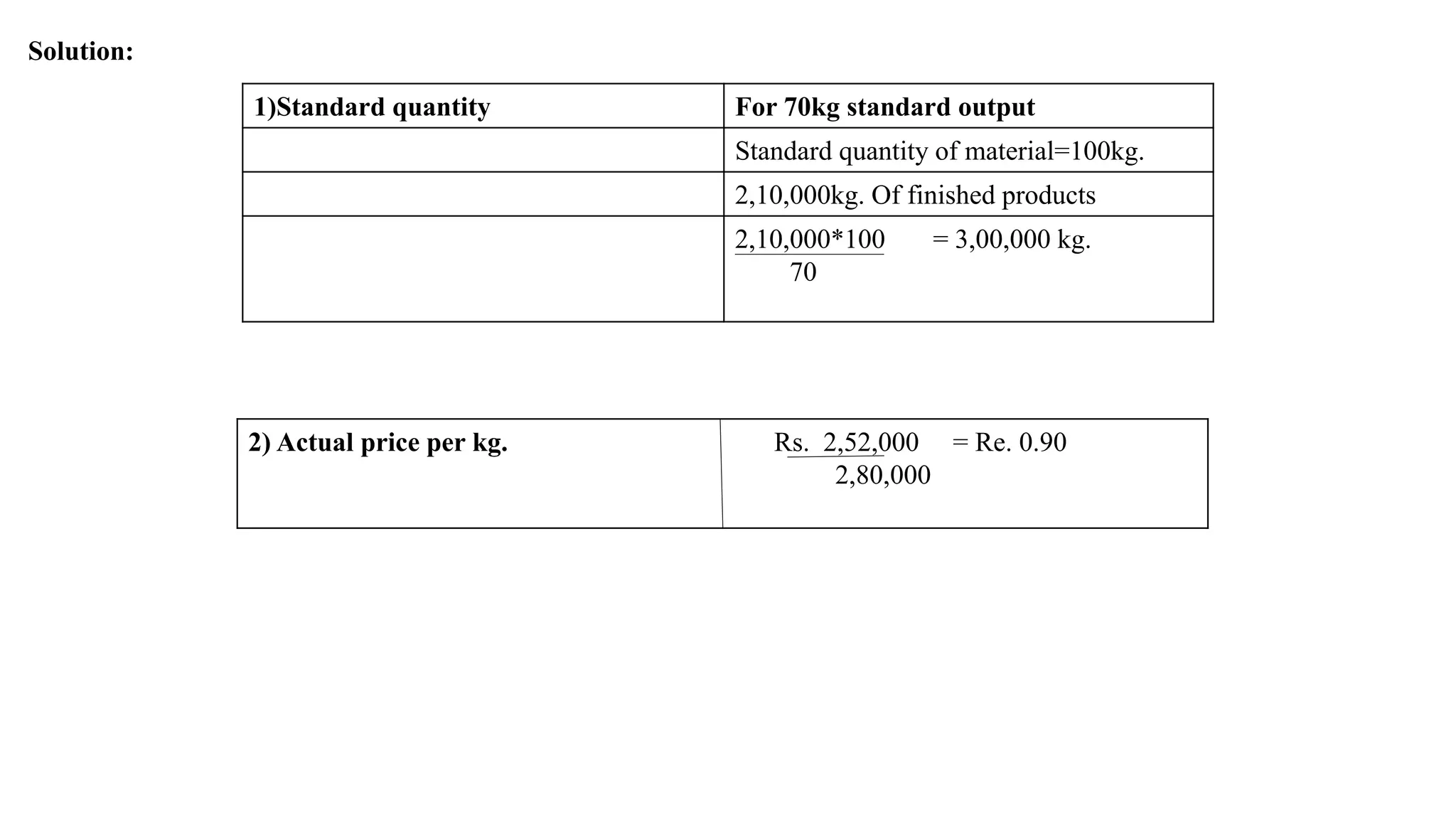
Solution:
1)Standard quantity For 70kg standard output
Standard quantity of material=100kg.
2,10,000kg. Of finished products
2,10,000*100 = 3,00,000 kg.
70
2) Actual price per kg. Rs. 2,52,000 = Re. 0.90
2,80,000
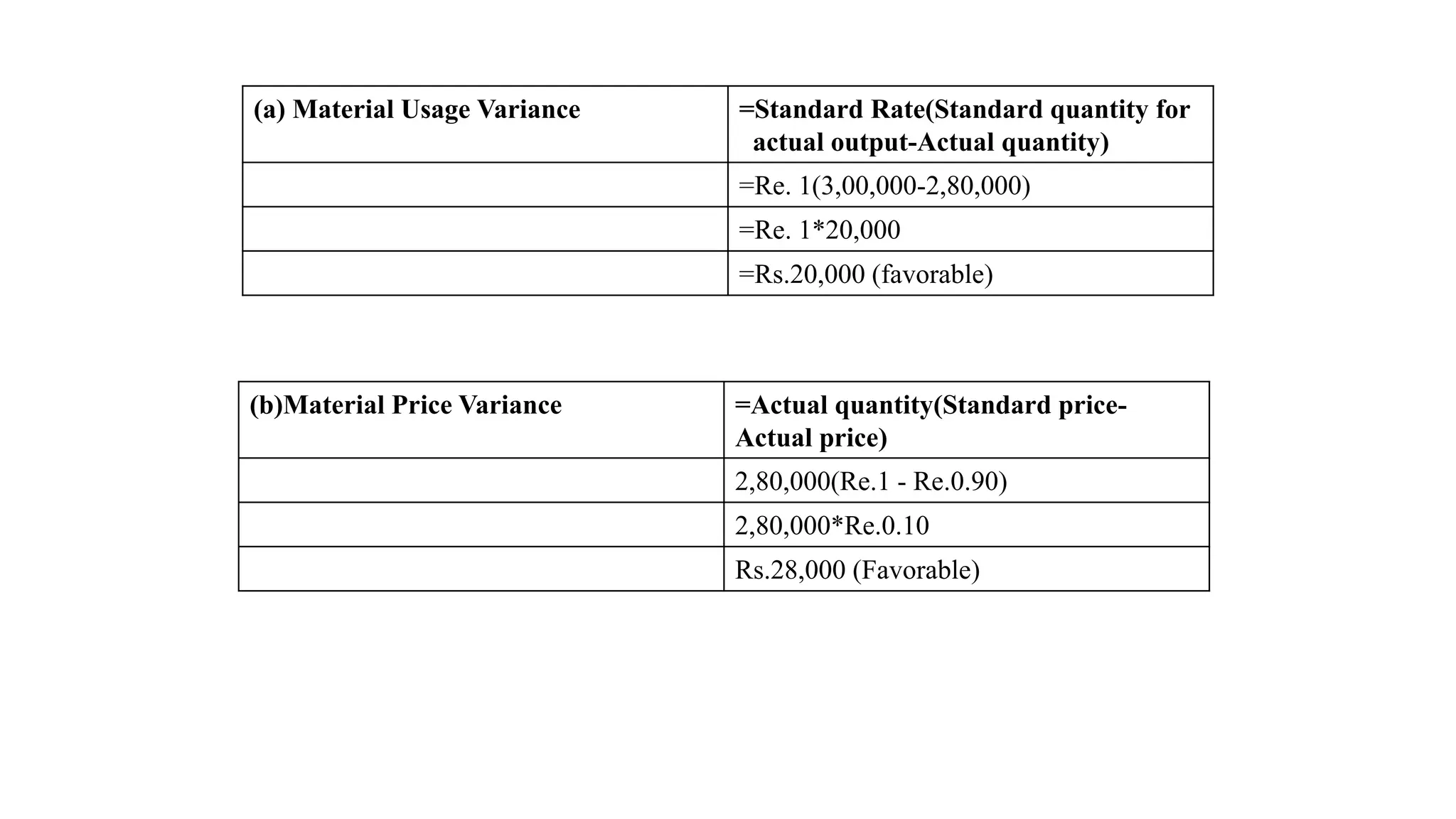
(a) Material Usage Variance =Standard Rate(Standard quantity for
actual output-Actual quantity)
=Re. 1(3,00,000-2,80,000)
=Re. 1*20,000
=Rs.20,000 (favorable)
(b)Material Price Variance =Actual quantity(Standard price-
Actual price)
2,80,000(Re.1 - Re.0.90)
2,80,000*Re.0.10
Rs.28,000 (Favorable)
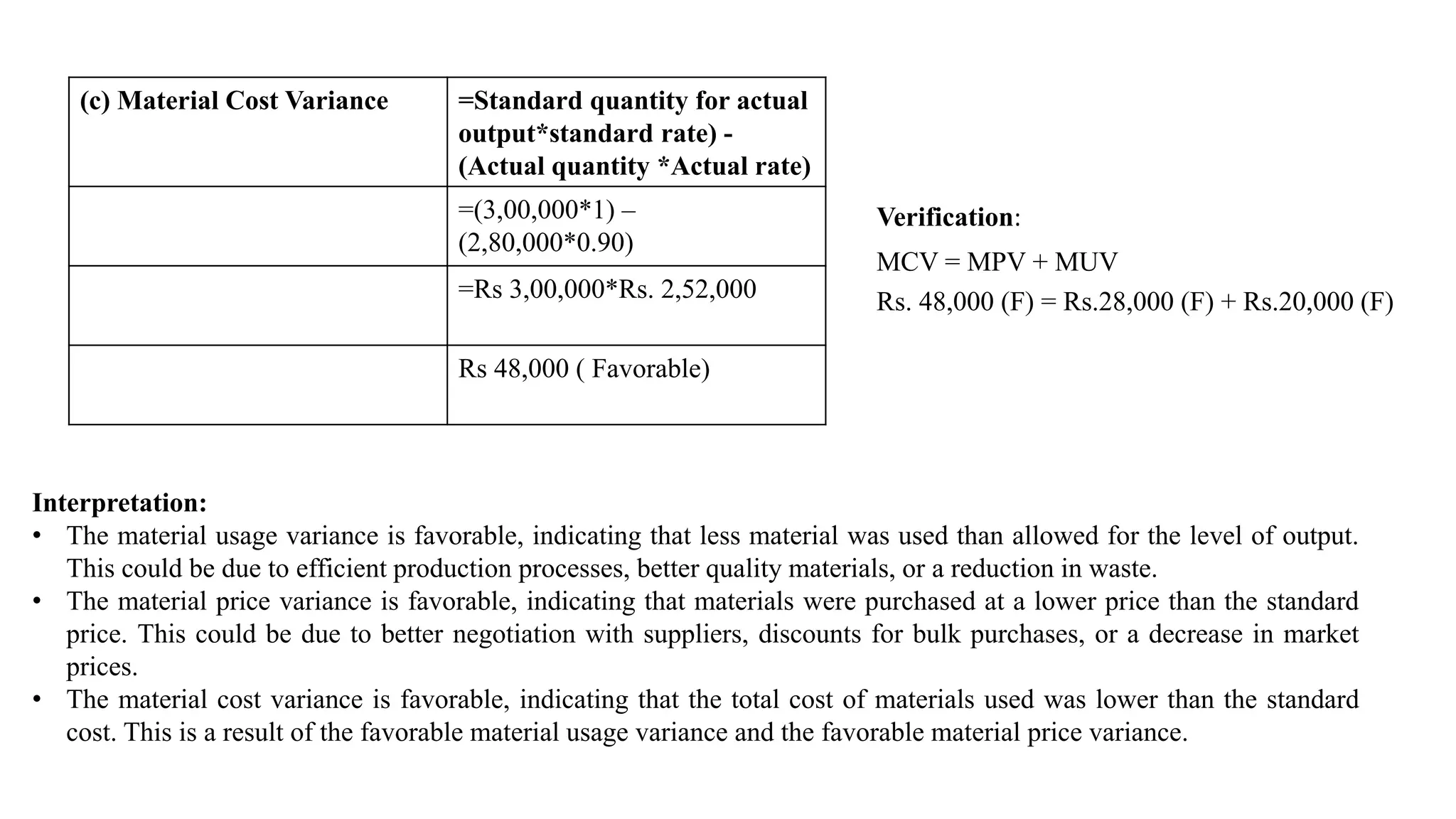
(c) Material Cost Variance =Standard quantity for actual
output*standard rate) -
(Actual quantity *Actual rate)
=(3,00,000*1) –
(2,80,000*0.90)
=Rs 3,00,000*Rs. 2,52,000
Rs 48,000 ( Favorable)
Verification:
MCV = MPV + MUV
Rs. 48,000 (F) = Rs.28,000 (F) + Rs.20,000 (F)
Interpretation:
• The material usage variance is favorable, indicating that less material was used than allowed for the level of output.
This could be due to efficient production processes, better quality materials, or a reduction in waste.
• The material price variance is favorable, indicating that materials were purchased at a lower price than the standard
price. This could be due to better negotiation with suppliers, discounts for bulk purchases, or a decrease in market
prices.
• The material cost variance is favorable, indicating that the total cost of materials used was lower than the standard
cost. This is a result of the favorable material usage variance and the favorable material price variance.
Labour Variance:
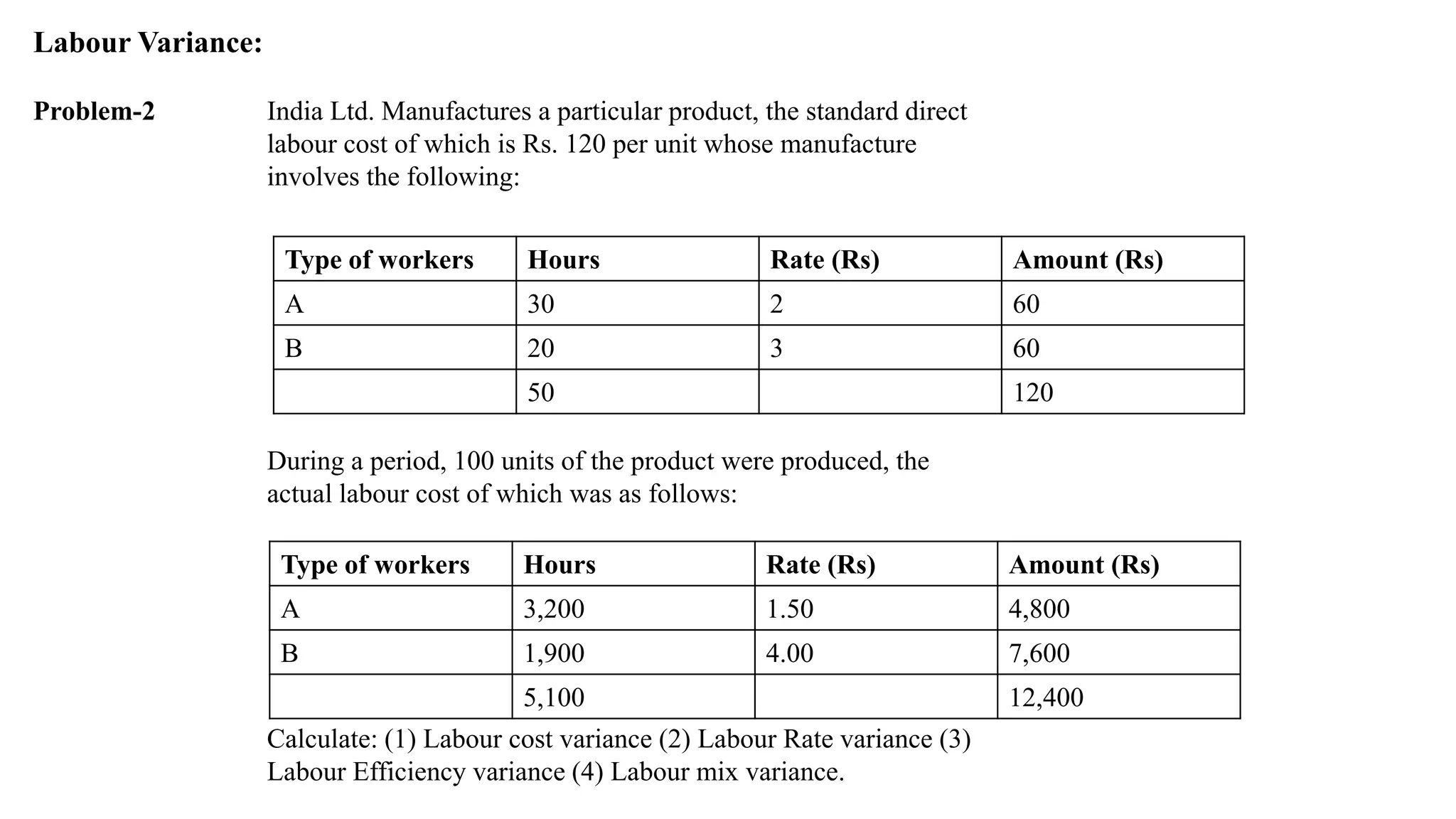
Problem‐2 India Ltd. Manufactures a particular product, the standard direct
labour cost of which is Rs. 120 per unit whose manufacture
involves the following:
Type of workers Hours Rate (Rs) Amount (Rs)
A 30 2 60
B 20 3 60
50 120
During a period, 100 units of the product were produced, the
actual labour cost of which was as follows:
Type of workers Hours Rate (Rs) Amount (Rs)
A 3,200 1.50 4,800
B 1,900 4.00 7,600
5,100 12,400
Calculate: (1) Labour cost variance (2) Labour Rate variance (3)
Labour Efficiency variance (4) Labour mix variance.
Solution:
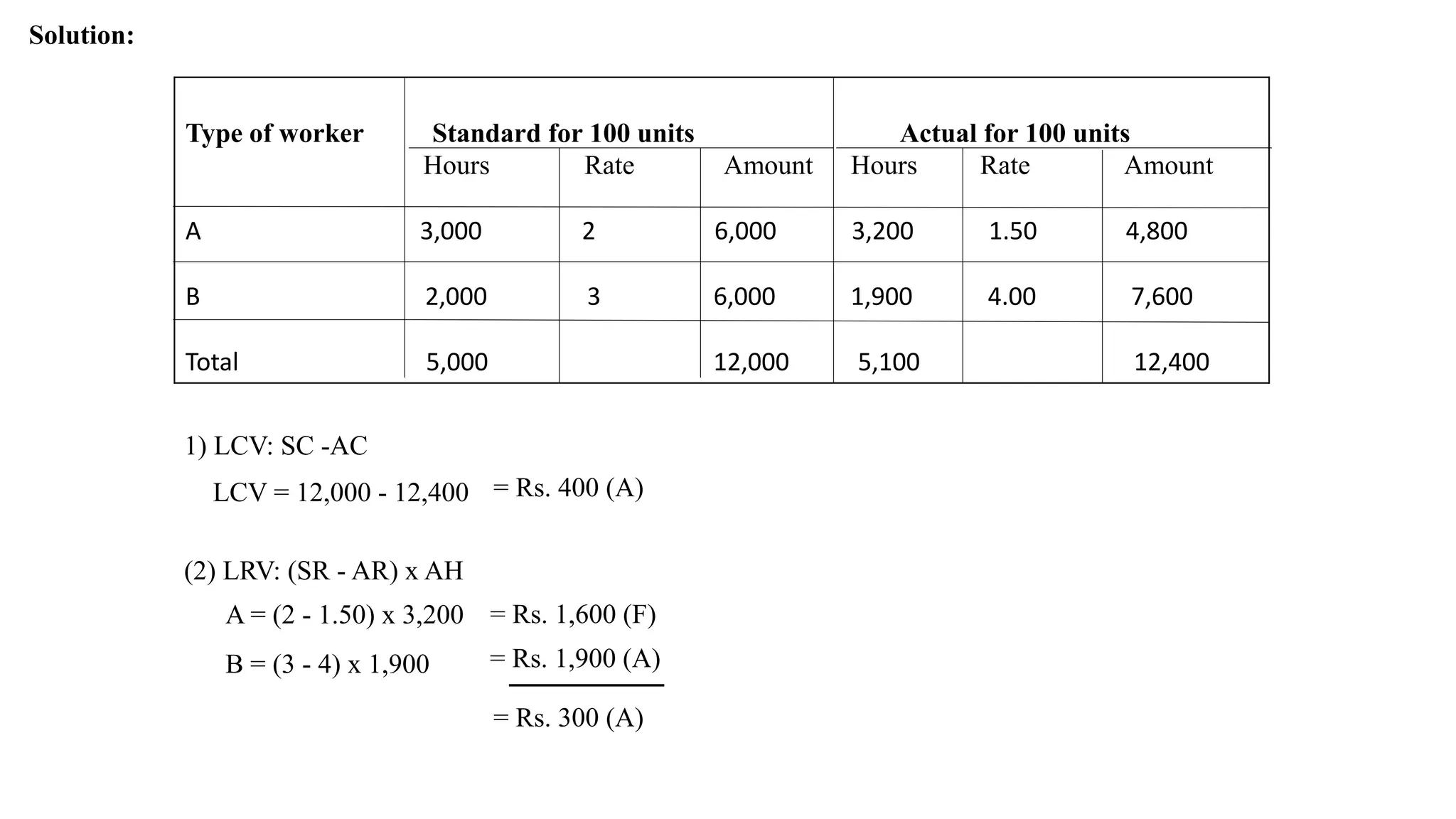
Type of worker Standard for 100 units Actual for 100 units
Hours Rate Amount Hours Rate Amount
A 3,000 2 6,000 3,200 1.50 4,800
B 2,000 3 6,000 1,900 4.00 7,600
Total 5,000 12,000 5,100 12,400
1) LCV: SC ‐AC
LCV = 12,000 ‐ 12,400 = Rs. 400 (A)
(2) LRV: (SR ‐ AR) x AH
A = (2 ‐ 1.50) x 3,200 = Rs. 1,600 (F)
B = (3 ‐ 4) x 1,900 = Rs. 1,900 (A)
= Rs. 300 (A)
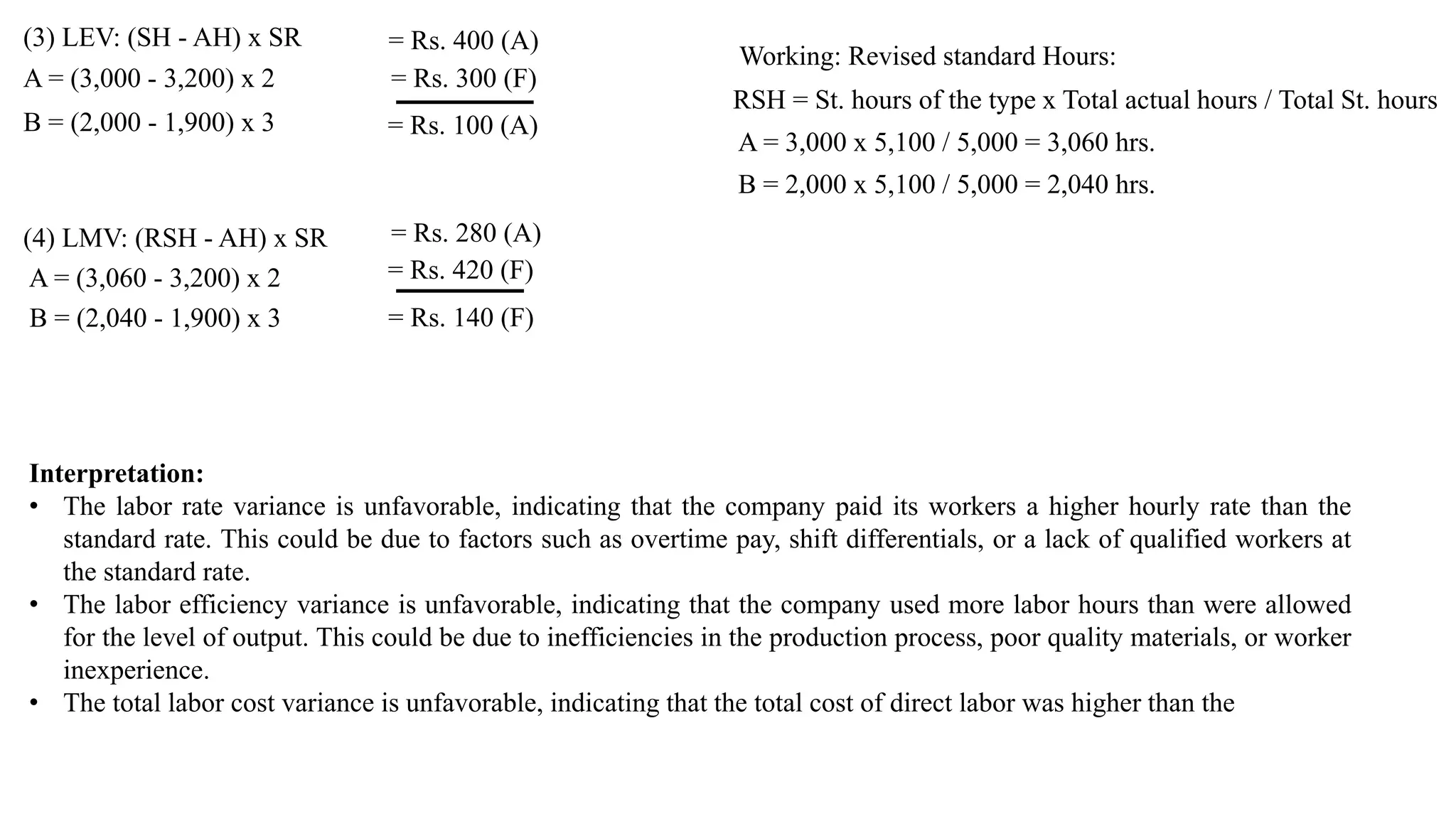
(3) LEV: (SH ‐ AH) x SR
A = (3,000 ‐ 3,200) x 2
= Rs. 400 (A)
B = (2,000 ‐ 1,900) x 3
= Rs. 300 (F)
= Rs. 100 (A)
(4) LMV: (RSH ‐ AH) x SR
A = (3,060 ‐ 3,200) x 2
= Rs. 280 (A)
B = (2,040 ‐ 1,900) x 3
= Rs. 420 (F)
= Rs. 140 (F)
Working: Revised standard Hours:
RSH = St. hours of the type x Total actual hours / Total St. hours
A = 3,000 x 5,100 / 5,000 = 3,060 hrs.
B = 2,000 x 5,100 / 5,000 = 2,040 hrs.
Interpretation:
• The labor rate variance is unfavorable, indicating that the company paid its workers a higher hourly rate than the
standard rate. This could be due to factors such as overtime pay, shift differentials, or a lack of qualified workers at
the standard rate.
• The labor efficiency variance is unfavorable, indicating that the company used more labor hours than were allowed
for the level of output. This could be due to inefficiencies in the production process, poor quality materials, or worker
inexperience.
• The total labor cost variance is unfavorable, indicating that the total cost of direct labor was higher than the
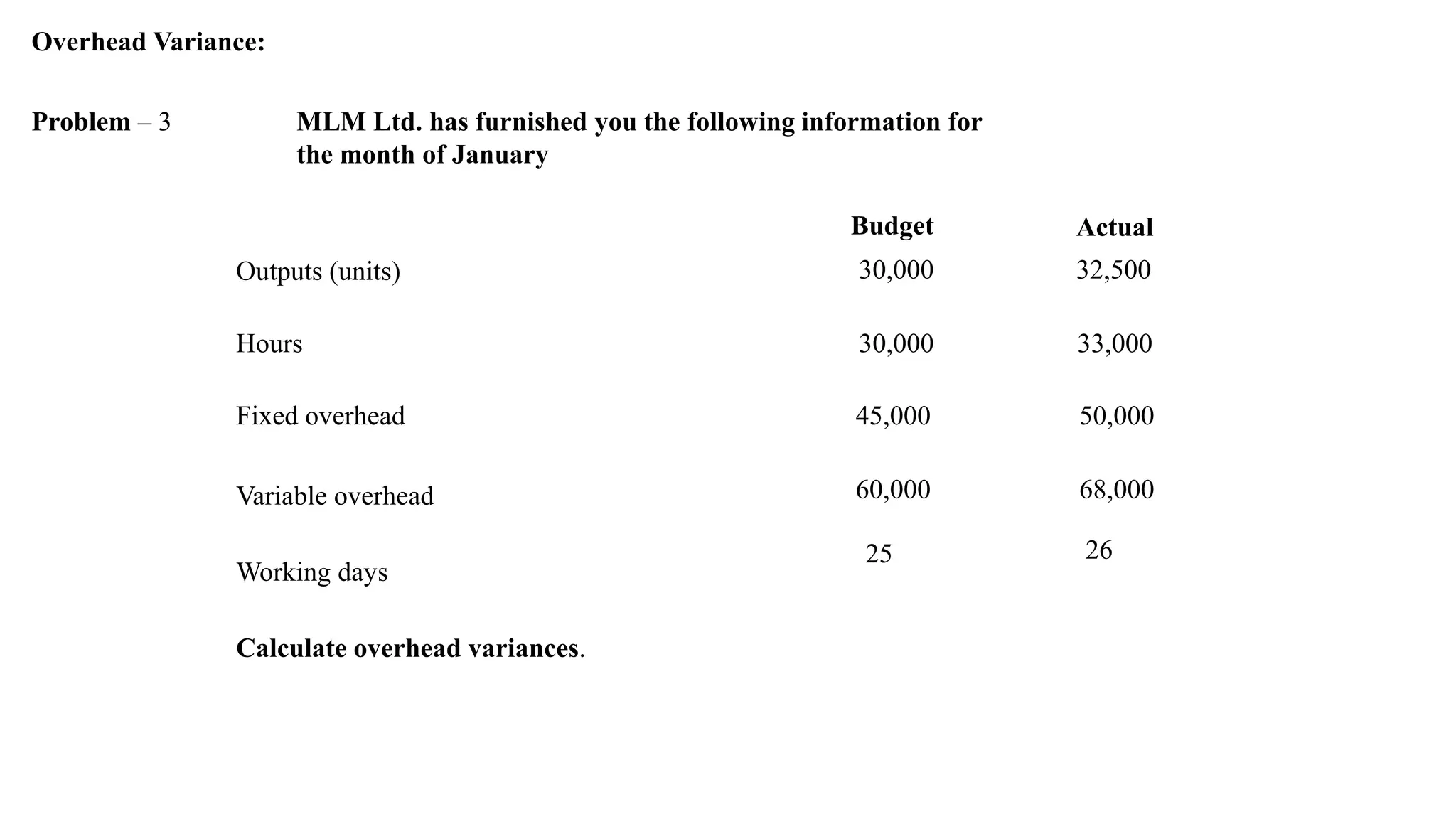
Overhead Variance:
Problem – 3 MLM Ltd. has furnished you the following information for
the month of January
Budget Actual
Outputs (units) 30,000 32,500
Hours 30,000 33,000
Fixed overhead 45,000 50,000
Variable overhead 60,000 68,000
Working days
25 26
Calculate overhead variances.
Solution:
Necessary calculations
Standard hour per unit = Budgeted hours = 30,000
Budgeted units 30,000
Standard hour for actual output = 32,500 units x 1 hour = 32,500
Standard overhead rate per hour = Budgeted overheads
Budgeted hours
For fixed overhead = 45,000
30,000
= Rs. 1.50 per unit
For variable overhead = 60,000
30,000
= Rs. 2 per unit
Standard fixed overhead rate per day = Rs. 45,000 ÷ 25 days = Rs. 1,800
Recovered overhead = Standard hours for actual output x Standard Rate
For fixed overhead = 32,500 hours x Rs. 1.50 = Rs. 48,750
For variable overhead = 32,500 hours x Rs. 2 = Rs. 65,000
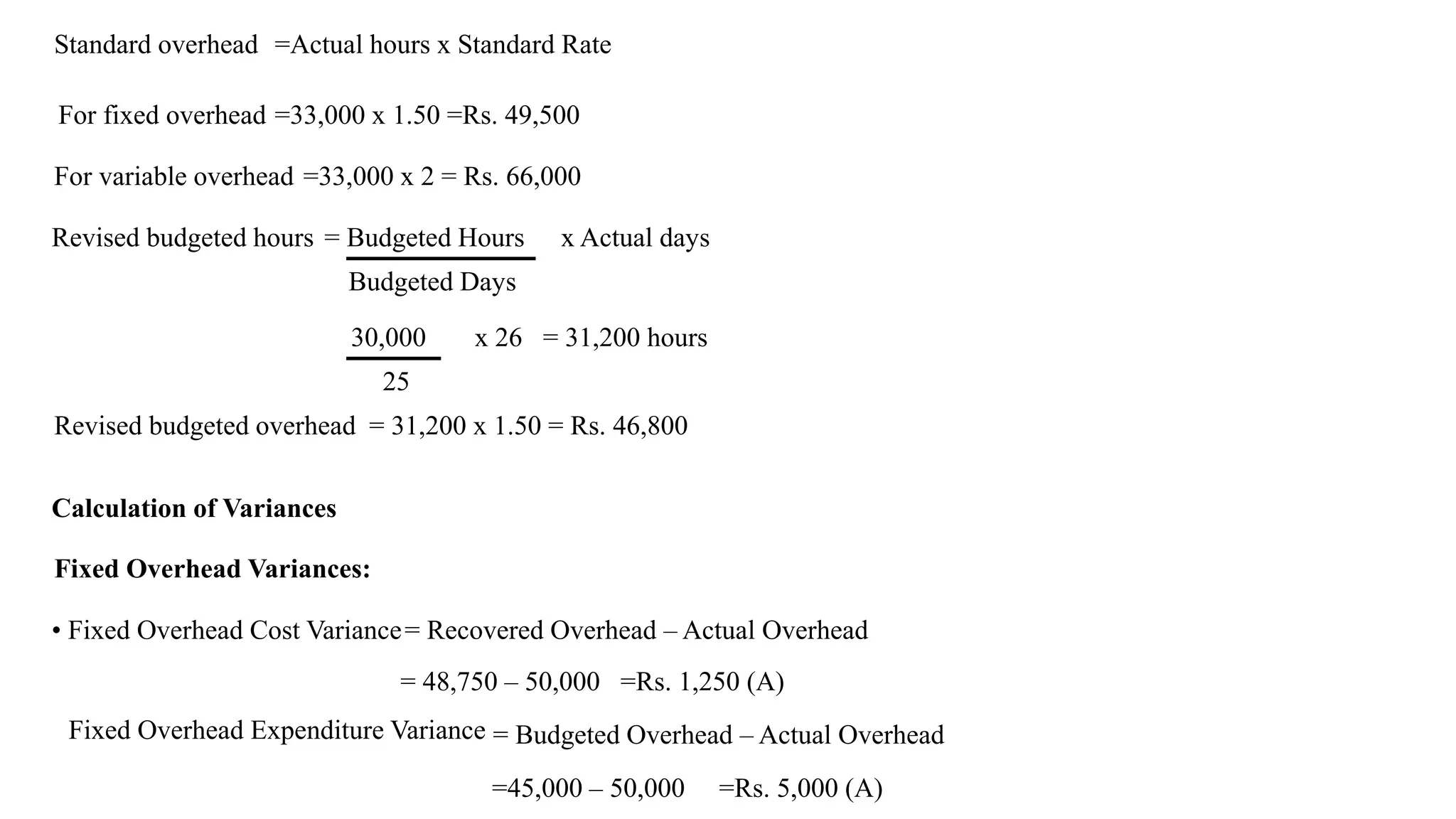
Standard overhead =Actual hours x Standard Rate
For fixed overhead =33,000 x 1.50 =Rs. 49,500
For variable overhead =33,000 x 2 = Rs. 66,000
Revised budgeted hours = Budgeted Hours
Budgeted Days
x Actual days
30,000
25
x 26 = 31,200 hours
Revised budgeted overhead = 31,200 x 1.50 = Rs. 46,800
Calculation of Variances
Fixed Overhead Variances:
• Fixed Overhead Cost Variance= Recovered Overhead – Actual Overhead
= 48,750 – 50,000 =Rs. 1,250 (A)
Fixed Overhead Expenditure Variance = Budgeted Overhead – Actual Overhead
=45,000 – 50,000 =Rs. 5,000 (A)
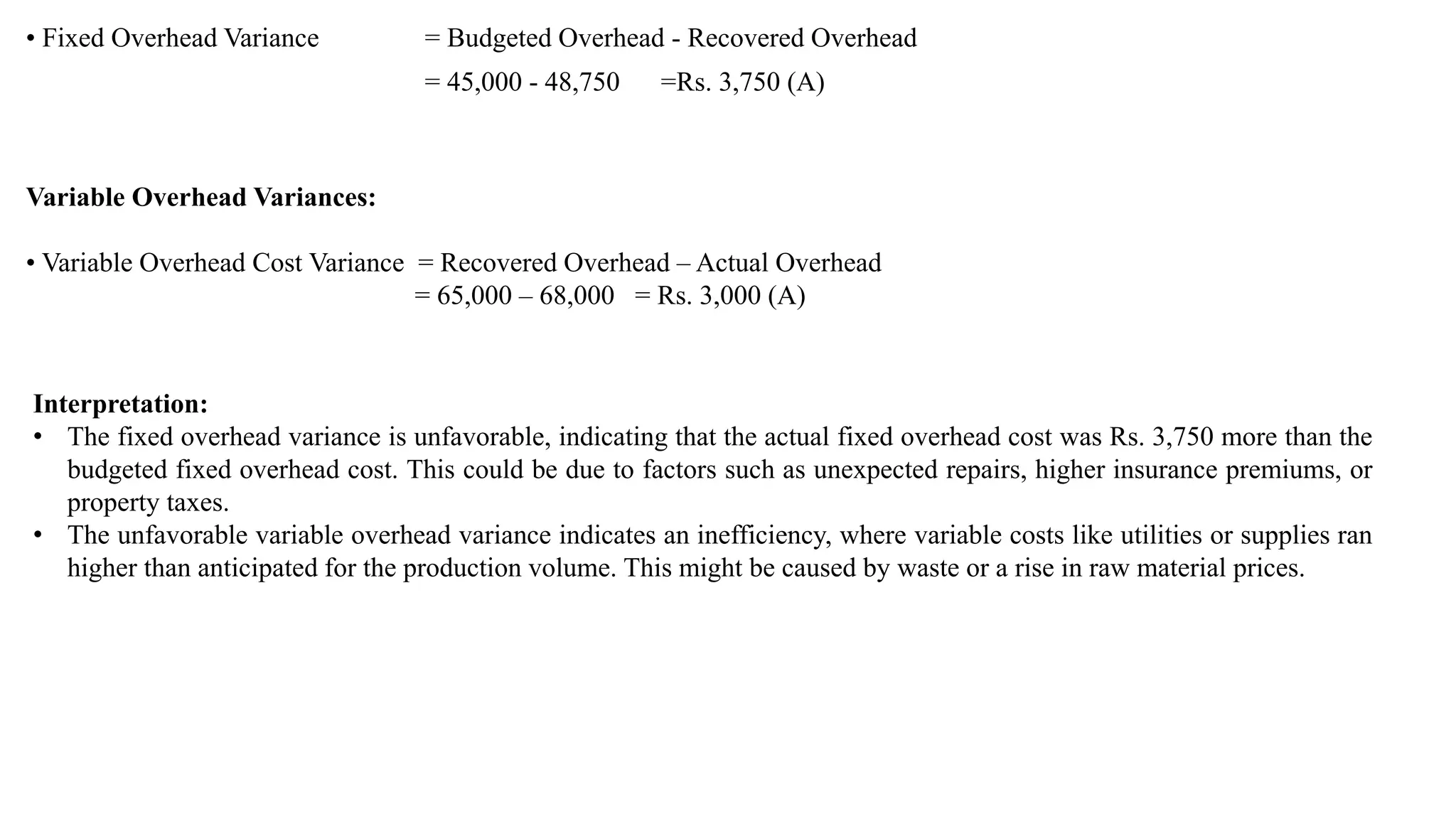
• Fixed Overhead Variance = Budgeted Overhead - Recovered Overhead
= 45,000 - 48,750 =Rs. 3,750 (A)
Variable Overhead Variances:
• Variable Overhead Cost Variance = Recovered Overhead – Actual Overhead
= 65,000 – 68,000 = Rs. 3,000 (A)
Interpretation:
• The fixed overhead variance is unfavorable, indicating that the actual fixed overhead cost was Rs. 3,750 more than the
budgeted fixed overhead cost. This could be due to factors such as unexpected repairs, higher insurance premiums, or
property taxes.
• The unfavorable variable overhead variance indicates an inefficiency, where variable costs like utilities or supplies ran
higher than anticipated for the production volume. This might be caused by waste or a rise in raw material prices.

STANDARD COSTING & VARIANCE ANALYSIS (4).pptx

  • 1.
    STANDARD COSTING & VARIANCEANALYSIS BY – POORVI HATTARKI MAHESH VELPUL MEGHA KUNCHI
  • 2.
    MEANING • Standard Costing- Themethod of estimating expenses in the production process since manufacturers cannot predict actual cost in advance. Manufacturers use this methodology to plan upcoming costs of various expenses, such as labour, materials, production and overhead. • Variance Analysis- Variance Analysis is a method of assessing the difference between estimated budgets and actual numbers. By analyzing the variance between actual and expected results, businesses can identify any issues or opportunities and take necessary action to improve their performance.
  • 3.
    MEANING • Overhead CostVariance – The difference between the actual overhead costs and the applied overhead costs is called the overhead variance. 1. Variable Overhead Variance - The variable overhead variance measures the difference between actual variable overhead costs incurred and the standard variable overhead costs expected for a given level of activity. Formula - Variable overhead cost variance = (Actual cost – Standard Cost) * Actual Quantity 2. Fixed Overhead Variance - The difference between the actual fixed overhead costs incurred and the budgeted or standard fixed overhead costs for a particular period. Formula - Fixed Overhead Variance = Actual Fixed Overhead - Standard Fixed Overhead
  • 4.
    MEANING • Expenditure Variance- The difference between expected or budgeted expenses and actual, documented expenses. A cost overrun is an example of an expenditure variance. Formula - Expenditure Variance = Budgeted Overheads - Actual Overheads • Efficiency Variance - The difference between the theoretical amount of inputs required to produce a unit of output and the actual number of inputs used to produce the unit of output. Formula- Efficiency Variance = (Standard Input – Actual Input)*Standard Price • Calendar Variance - The portion of the volume variance caused by the difference between the number of working days in the budget period and the number of actual working days in the budget period. Formula - Calendar Variance = Increase or decrease in production due to more or less working days at the rate of budgeted capacity*Standard rate per unit.
  • 5.
    Fixed Overhead CapacityVariance (FOCV) basically shows how efficiently a company is utilizing its existing resources. In simple words, we can say that it compares the utilization of budgeted and absorbed resources. 1. Fixed Overhead Capacity Variance – FOCV = (Budgeted Production Hours less Actual Production Hours) * Budgeted fixed overhead absorption rate per hour 2. Fixed Overhead Efficiency Variance (FOEV) is the difference between the absorbed fixed production overheads attributable to any change in the production efficiency. It is on the basis of change in the manufacturing hours. FOEV = (Standard Production Hours less Actual Production Hours) * FOAR Here FOAR is the Fixed Overhead Absorption Rate/unit of hour Formula Formula
  • 6.
    A manufacturing concern,which has adopted standard costing, furnished the following information: MATERIAL VARIANCE Problem – 1: Standard Material for 70 kg finished product: 100 kg Price of materials: Re. 1 per kg. Actual Output: 2,10,000 kg Material used: 2,80,000 kg Cost of material: Rs. 2,52,000 Calculate: (a) Material Usage Variance (b) Material Price Variance (c) Material Cost Variance
  • 7.
    Solution: 1)Standard quantity For70kg standard output Standard quantity of material=100kg. 2,10,000kg. Of finished products 2,10,000*100 = 3,00,000 kg. 70 2) Actual price per kg. Rs. 2,52,000 = Re. 0.90 2,80,000
  • 8.
    (a) Material UsageVariance =Standard Rate(Standard quantity for actual output-Actual quantity) =Re. 1(3,00,000-2,80,000) =Re. 1*20,000 =Rs.20,000 (favorable) (b)Material Price Variance =Actual quantity(Standard price- Actual price) 2,80,000(Re.1 - Re.0.90) 2,80,000*Re.0.10 Rs.28,000 (Favorable)
  • 9.
    (c) Material CostVariance =Standard quantity for actual output*standard rate) - (Actual quantity *Actual rate) =(3,00,000*1) – (2,80,000*0.90) =Rs 3,00,000*Rs. 2,52,000 Rs 48,000 ( Favorable) Verification: MCV = MPV + MUV Rs. 48,000 (F) = Rs.28,000 (F) + Rs.20,000 (F) Interpretation: • The material usage variance is favorable, indicating that less material was used than allowed for the level of output. This could be due to efficient production processes, better quality materials, or a reduction in waste. • The material price variance is favorable, indicating that materials were purchased at a lower price than the standard price. This could be due to better negotiation with suppliers, discounts for bulk purchases, or a decrease in market prices. • The material cost variance is favorable, indicating that the total cost of materials used was lower than the standard cost. This is a result of the favorable material usage variance and the favorable material price variance.
  • 10.
    Labour Variance: Problem‐2 IndiaLtd. Manufactures a particular product, the standard direct labour cost of which is Rs. 120 per unit whose manufacture involves the following: Type of workers Hours Rate (Rs) Amount (Rs) A 30 2 60 B 20 3 60 50 120 During a period, 100 units of the product were produced, the actual labour cost of which was as follows: Type of workers Hours Rate (Rs) Amount (Rs) A 3,200 1.50 4,800 B 1,900 4.00 7,600 5,100 12,400 Calculate: (1) Labour cost variance (2) Labour Rate variance (3) Labour Efficiency variance (4) Labour mix variance.
  • 11.
    Solution: Type of workerStandard for 100 units Actual for 100 units Hours Rate Amount Hours Rate Amount A 3,000 2 6,000 3,200 1.50 4,800 B 2,000 3 6,000 1,900 4.00 7,600 Total 5,000 12,000 5,100 12,400 1) LCV: SC ‐AC LCV = 12,000 ‐ 12,400 = Rs. 400 (A) (2) LRV: (SR ‐ AR) x AH A = (2 ‐ 1.50) x 3,200 = Rs. 1,600 (F) B = (3 ‐ 4) x 1,900 = Rs. 1,900 (A) = Rs. 300 (A)
  • 12.
    (3) LEV: (SH‐ AH) x SR A = (3,000 ‐ 3,200) x 2 = Rs. 400 (A) B = (2,000 ‐ 1,900) x 3 = Rs. 300 (F) = Rs. 100 (A) (4) LMV: (RSH ‐ AH) x SR A = (3,060 ‐ 3,200) x 2 = Rs. 280 (A) B = (2,040 ‐ 1,900) x 3 = Rs. 420 (F) = Rs. 140 (F) Working: Revised standard Hours: RSH = St. hours of the type x Total actual hours / Total St. hours A = 3,000 x 5,100 / 5,000 = 3,060 hrs. B = 2,000 x 5,100 / 5,000 = 2,040 hrs. Interpretation: • The labor rate variance is unfavorable, indicating that the company paid its workers a higher hourly rate than the standard rate. This could be due to factors such as overtime pay, shift differentials, or a lack of qualified workers at the standard rate. • The labor efficiency variance is unfavorable, indicating that the company used more labor hours than were allowed for the level of output. This could be due to inefficiencies in the production process, poor quality materials, or worker inexperience. • The total labor cost variance is unfavorable, indicating that the total cost of direct labor was higher than the
  • 13.
    Overhead Variance: Problem –3 MLM Ltd. has furnished you the following information for the month of January Budget Actual Outputs (units) 30,000 32,500 Hours 30,000 33,000 Fixed overhead 45,000 50,000 Variable overhead 60,000 68,000 Working days 25 26 Calculate overhead variances.
  • 14.
    Solution: Necessary calculations Standard hourper unit = Budgeted hours = 30,000 Budgeted units 30,000 Standard hour for actual output = 32,500 units x 1 hour = 32,500 Standard overhead rate per hour = Budgeted overheads Budgeted hours For fixed overhead = 45,000 30,000 = Rs. 1.50 per unit For variable overhead = 60,000 30,000 = Rs. 2 per unit Standard fixed overhead rate per day = Rs. 45,000 ÷ 25 days = Rs. 1,800 Recovered overhead = Standard hours for actual output x Standard Rate For fixed overhead = 32,500 hours x Rs. 1.50 = Rs. 48,750 For variable overhead = 32,500 hours x Rs. 2 = Rs. 65,000
  • 15.
    Standard overhead =Actualhours x Standard Rate For fixed overhead =33,000 x 1.50 =Rs. 49,500 For variable overhead =33,000 x 2 = Rs. 66,000 Revised budgeted hours = Budgeted Hours Budgeted Days x Actual days 30,000 25 x 26 = 31,200 hours Revised budgeted overhead = 31,200 x 1.50 = Rs. 46,800 Calculation of Variances Fixed Overhead Variances: • Fixed Overhead Cost Variance= Recovered Overhead – Actual Overhead = 48,750 – 50,000 =Rs. 1,250 (A) Fixed Overhead Expenditure Variance = Budgeted Overhead – Actual Overhead =45,000 – 50,000 =Rs. 5,000 (A)
  • 16.
    • Fixed OverheadVariance = Budgeted Overhead - Recovered Overhead = 45,000 - 48,750 =Rs. 3,750 (A) Variable Overhead Variances: • Variable Overhead Cost Variance = Recovered Overhead – Actual Overhead = 65,000 – 68,000 = Rs. 3,000 (A) Interpretation: • The fixed overhead variance is unfavorable, indicating that the actual fixed overhead cost was Rs. 3,750 more than the budgeted fixed overhead cost. This could be due to factors such as unexpected repairs, higher insurance premiums, or property taxes. • The unfavorable variable overhead variance indicates an inefficiency, where variable costs like utilities or supplies ran higher than anticipated for the production volume. This might be caused by waste or a rise in raw material prices.