By: Rozana Aboalkhair
NEW ADVANCE IN BIO-PRINTING AND
TISSUE ENGINEERING
A. Atala, "Tissue engineering for bladder substitution," World J Urol, vol. 18, pp. 364-70, 2000.
CONTENTS
• Introduction
• Tissue engineering and bioprinting
• Organ printer
• Bioink
• Benefits of bioprinting technology
• Challenges that can face bioprinting technology
• Current development of bioprinting technology
• Conclusion
INTRODUCTION
U.S. Government Information on Organ and Tissue Donation and Transplantation, January 2013
• 117,521 people in United
States in need of organ
• Each day 79 receive organ
each day while 18 will die
from a lack of one.
The need for organs 2013
TISSUE ENGINEERING
• To produce functional cell, tissue and organ to repair, replace or
enhance biological function that has been lost by diseases or injury.
• It is also, one of the most promising approaches to solve the problems
of shortage of suitable organs for transplantation.
• one of its goals is to create artificial organs.
Mironov, V., Boland, T., Trusk, T., Forgacs, G., & Markwald, R. R. (2003). Organ printing: computer-aided jet-based 3D tissue engineering.
TRENDS in Biotechnology, 21(4), 157-161.
BIO-PRINTING
• Integrating biology science and 3-D printing
technology.
• The ability to print various biological materials
and cells along with various tissue scaffold
materials.
• Currently NO real organ has been
successful created, but scientists are
currently working on this idea and are making
progress.
First commercial bioprinter company is Organovo
Adv. Mater. 2013
DOI:10.1002/adma.201305506
Lee, V., Singh, G., Trasatti, J. P., Bjornsson, C., Xu, X., Tran, T. N., ... & Karande, P. (2013). Design and Fabrication of Human Skin
by Three-Dimensional Bioprinting. Tissue Engineering Part C: Methods.
ORGAN PRINTER
• An organ printer incorporates two
technologies, tissue engineering
and a 3D printer.
• Instead of paper, Petri dishes are
used.
• Instead of ink, cells and chemical
called a “crosslinker” are used.
• The cells are individually made for
the patient.
Adv. Mater. 2013
DOI:10.1002/adma.201305506
Jakab, K., Norotte, C., Marga, F., Murphy, K., Vunjak-Novakovic, G., & Forgacs, G. (2010). Tissue engineering by self-assembly and bio-
printing of living cells. Biofabrication, 2(2), 022001.
BIOINK
• A small skin biopsy is taken from the patient.
• The fibroblasts from the skin are isolated and cultivated in vitro.
• These fibroblasts are reprogrammed into the organ cell that is needed.
• These reprogrammed cells are then used as the “ink” for the organ
printer.
Seliktar, D., Dikovsky, D., & Napadensky, E. (2013). Bioprinting and Tissue Engineering: Recent Advances and Future Perspectives.
Israel Journal of Chemistry, 53(9‐10), 795-804.
CONT.
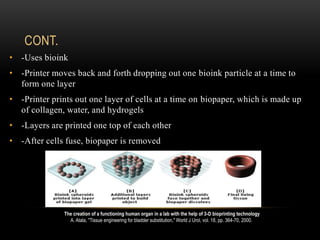
• -Uses bioink
• -Printer moves back and forth dropping out one bioink particle at a time to
form one layer
• -Printer prints out one layer of cells at a time on biopaper, which is made up
of collagen, water, and hydrogels
• -Layers are printed one top of each other
• -After cells fuse, biopaper is removed
The creation of a functioning human organ in a lab with the help of 3-D bioprinting technology
A. Atala, "Tissue engineering for bladder substitution," World J Urol, vol. 18, pp. 364-70, 2000.
BENEFITS OF BIOPRINTING
• Most organs can be made using this method, as long as the fibroblast
can be reprogrammed to be that organ cell.
• No organ rejection will occur because it will be the patient’s own
DNA.
• Eliminate the need for immunosuppressant drugs needed after a
regular organ transplant
• Can by pass the organ donor list.
• Can be used to treat anyone since the organ is made for the
individual.
Seliktar, D., Dikovsky, D., & Napadensky, E. (2013). Bioprinting and Tissue Engineering: Recent Advances and Future Perspectives.
Israel Journal of Chemistry, 53(9‐10), 795-804.
CHALLENGES
• Still very expensive.
• The organ that is being made can die if no blood vessels are created
within the organ.
• Creating these blood vessels requires certain stem cells which are
expensive.
• Use of stem cells is still controversial
• Still takes a long time to actually make the organ.
Seliktar, D., Dikovsky, D., & Napadensky, E. (2013). Bioprinting and Tissue Engineering: Recent Advances and Future Perspectives.
Israel Journal of Chemistry, 53(9‐10), 795-804.
CURRENT DEVELOPMENT
 Wake Forest Institute of Regenerative Medicine and a surgeon
• In 2011, successfully printed a kidney from human cells in seven hours
• Not functional in humans yet but their research is still in progress
 University of Pennsylvania
• In 2012, successfully, created a sugar template that can helps shape
development of a vascular network for artificial organs.
• After network is printed, cells are inserted and network then grows.
• Sugar template is dissolved after completion of development.
CONCLUSION
• Organ printers are just modified 3D printers that have been outfitted
to make human organs out of living cells.
• Advancements in tissue engineering and 3-D printing technology will
help in development of artificial organs from organ printing.
• If achieved, more lives could saved and prolonged
• Hopefully , in the future this procedure will be less expensive and
more widely available.
Seliktar, D., Dikovsky, D., & Napadensky, E. (2013). Bioprinting and Tissue Engineering: Recent Advances and Future Perspectives.
Israel Journal of Chemistry, 53(9‐10), 795-804.
REFERENCES
• Lee, V., Singh, G., Trasatti, J. P., Bjornsson, C., Xu, X., Tran, T. N., ... & Karande, P. (2013). Design and
Fabrication of Human Skin by Three-Dimensional Bioprinting. Tissue Engineering Part C: Methods.
• Jakab, K., Norotte, C., Marga, F., Murphy, K., Vunjak-Novakovic, G., & Forgacs, G. (2010). Tissue
engineering by self-assembly and bio-printing of living cells. Biofabrication, 2(2), 022001.
• U.S. Government Information on Organ and Tissue Donation and Transplantation, January 2013
<http://www.organdonor.gov/index.html>.
• Mironov, V., Boland, T., Trusk, T., Forgacs, G., & Markwald, R. R. (2009). Organ printing: computer-
aided jet-based 3D tissue engineering. TRENDS in Biotechnology, 21(4), 157-161.
• Seliktar, D., Dikovsky, D., & Napadensky, E. (2013). Bioprinting and Tissue Engineering: Recent
Advances and Future Perspectives. Israel Journal of Chemistry, 53(9‐10), 795-804.
• S. Khalil, F. Nam, and W. Sun, "Multi-nozzle deposition for construction of 3-D biopolymer tissue
scaffolds," Rapid Prototyping Journal, vol. 11, pp. 9-17, 2005
• A. Atala, "Tissue engineering for bladder substitution," World J Urol, vol. 18, pp. 364-70, 2000.
• THANK YOU…

New advance in bio-printing and tissue engineering

  • 1.
    By: Rozana Aboalkhair NEWADVANCE IN BIO-PRINTING AND TISSUE ENGINEERING A. Atala, "Tissue engineering for bladder substitution," World J Urol, vol. 18, pp. 364-70, 2000.
  • 2.
    CONTENTS • Introduction • Tissueengineering and bioprinting • Organ printer • Bioink • Benefits of bioprinting technology • Challenges that can face bioprinting technology • Current development of bioprinting technology • Conclusion
  • 3.
    INTRODUCTION U.S. Government Informationon Organ and Tissue Donation and Transplantation, January 2013 • 117,521 people in United States in need of organ • Each day 79 receive organ each day while 18 will die from a lack of one. The need for organs 2013
  • 4.
    TISSUE ENGINEERING • Toproduce functional cell, tissue and organ to repair, replace or enhance biological function that has been lost by diseases or injury. • It is also, one of the most promising approaches to solve the problems of shortage of suitable organs for transplantation. • one of its goals is to create artificial organs. Mironov, V., Boland, T., Trusk, T., Forgacs, G., & Markwald, R. R. (2003). Organ printing: computer-aided jet-based 3D tissue engineering. TRENDS in Biotechnology, 21(4), 157-161.
  • 5.
    BIO-PRINTING • Integrating biologyscience and 3-D printing technology. • The ability to print various biological materials and cells along with various tissue scaffold materials. • Currently NO real organ has been successful created, but scientists are currently working on this idea and are making progress. First commercial bioprinter company is Organovo Adv. Mater. 2013 DOI:10.1002/adma.201305506 Lee, V., Singh, G., Trasatti, J. P., Bjornsson, C., Xu, X., Tran, T. N., ... & Karande, P. (2013). Design and Fabrication of Human Skin by Three-Dimensional Bioprinting. Tissue Engineering Part C: Methods.
  • 6.
    ORGAN PRINTER • Anorgan printer incorporates two technologies, tissue engineering and a 3D printer. • Instead of paper, Petri dishes are used. • Instead of ink, cells and chemical called a “crosslinker” are used. • The cells are individually made for the patient. Adv. Mater. 2013 DOI:10.1002/adma.201305506 Jakab, K., Norotte, C., Marga, F., Murphy, K., Vunjak-Novakovic, G., & Forgacs, G. (2010). Tissue engineering by self-assembly and bio- printing of living cells. Biofabrication, 2(2), 022001.
  • 7.
    BIOINK • A smallskin biopsy is taken from the patient. • The fibroblasts from the skin are isolated and cultivated in vitro. • These fibroblasts are reprogrammed into the organ cell that is needed. • These reprogrammed cells are then used as the “ink” for the organ printer. Seliktar, D., Dikovsky, D., & Napadensky, E. (2013). Bioprinting and Tissue Engineering: Recent Advances and Future Perspectives. Israel Journal of Chemistry, 53(9‐10), 795-804.
  • 8.
    CONT. • -Uses bioink •-Printer moves back and forth dropping out one bioink particle at a time to form one layer • -Printer prints out one layer of cells at a time on biopaper, which is made up of collagen, water, and hydrogels • -Layers are printed one top of each other • -After cells fuse, biopaper is removed The creation of a functioning human organ in a lab with the help of 3-D bioprinting technology A. Atala, "Tissue engineering for bladder substitution," World J Urol, vol. 18, pp. 364-70, 2000.
  • 9.
    BENEFITS OF BIOPRINTING •Most organs can be made using this method, as long as the fibroblast can be reprogrammed to be that organ cell. • No organ rejection will occur because it will be the patient’s own DNA. • Eliminate the need for immunosuppressant drugs needed after a regular organ transplant • Can by pass the organ donor list. • Can be used to treat anyone since the organ is made for the individual. Seliktar, D., Dikovsky, D., & Napadensky, E. (2013). Bioprinting and Tissue Engineering: Recent Advances and Future Perspectives. Israel Journal of Chemistry, 53(9‐10), 795-804.
  • 10.
    CHALLENGES • Still veryexpensive. • The organ that is being made can die if no blood vessels are created within the organ. • Creating these blood vessels requires certain stem cells which are expensive. • Use of stem cells is still controversial • Still takes a long time to actually make the organ. Seliktar, D., Dikovsky, D., & Napadensky, E. (2013). Bioprinting and Tissue Engineering: Recent Advances and Future Perspectives. Israel Journal of Chemistry, 53(9‐10), 795-804.
  • 11.
    CURRENT DEVELOPMENT  WakeForest Institute of Regenerative Medicine and a surgeon • In 2011, successfully printed a kidney from human cells in seven hours • Not functional in humans yet but their research is still in progress  University of Pennsylvania • In 2012, successfully, created a sugar template that can helps shape development of a vascular network for artificial organs. • After network is printed, cells are inserted and network then grows. • Sugar template is dissolved after completion of development.
  • 12.
    CONCLUSION • Organ printersare just modified 3D printers that have been outfitted to make human organs out of living cells. • Advancements in tissue engineering and 3-D printing technology will help in development of artificial organs from organ printing. • If achieved, more lives could saved and prolonged • Hopefully , in the future this procedure will be less expensive and more widely available. Seliktar, D., Dikovsky, D., & Napadensky, E. (2013). Bioprinting and Tissue Engineering: Recent Advances and Future Perspectives. Israel Journal of Chemistry, 53(9‐10), 795-804.
  • 13.
    REFERENCES • Lee, V.,Singh, G., Trasatti, J. P., Bjornsson, C., Xu, X., Tran, T. N., ... & Karande, P. (2013). Design and Fabrication of Human Skin by Three-Dimensional Bioprinting. Tissue Engineering Part C: Methods. • Jakab, K., Norotte, C., Marga, F., Murphy, K., Vunjak-Novakovic, G., & Forgacs, G. (2010). Tissue engineering by self-assembly and bio-printing of living cells. Biofabrication, 2(2), 022001. • U.S. Government Information on Organ and Tissue Donation and Transplantation, January 2013 <http://www.organdonor.gov/index.html>. • Mironov, V., Boland, T., Trusk, T., Forgacs, G., & Markwald, R. R. (2009). Organ printing: computer- aided jet-based 3D tissue engineering. TRENDS in Biotechnology, 21(4), 157-161. • Seliktar, D., Dikovsky, D., & Napadensky, E. (2013). Bioprinting and Tissue Engineering: Recent Advances and Future Perspectives. Israel Journal of Chemistry, 53(9‐10), 795-804. • S. Khalil, F. Nam, and W. Sun, "Multi-nozzle deposition for construction of 3-D biopolymer tissue scaffolds," Rapid Prototyping Journal, vol. 11, pp. 9-17, 2005 • A. Atala, "Tissue engineering for bladder substitution," World J Urol, vol. 18, pp. 364-70, 2000.
  • 14.