3D BIO-PRINTING
TECHNOLOGY
Guided by,
Mrs. DEEPA SUSAN GEORGE
ASSISTANT PROFESSOR
ECE DEPARTMENT
Presented by,
HASHIM SALIM
S7 ECE A
12010516
Department Of Electronics and communication
1
STRUCTURE OF PRESENTATION
 Introduction
 Organ transplantation
 Tissue engineering
 Applications of 3D printing
 Bio printing
 Qualities of this technique
 Method of bio-printing
 Bio printer
 Steps of bio printing
 Result
 Advantage and disadvantage
 Conclusion
Department Of Electronics and communication
2
INTRODUCTION
3D BIO-PRINTING is the three-dimensional printing of
biological tissue and organs through the layering of living
cells. It is mainly divided into two :
1. ORGAN TRANSPLANTATION
It refers to transplantation of organs due to organ failure or
injury.
2. TISSUE ENGINEERING
It is the study of the growth of new connective tissue, or
organs, from cells.
Department Of Electronics and communication
3
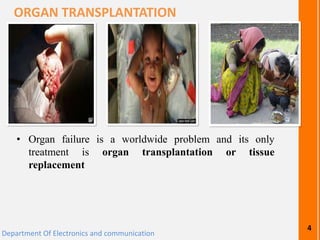
• Organ failure is a worldwide problem and its only
treatment is organ transplantation or tissue
replacement
ORGAN TRANSPLANTATION
Department Of Electronics and communication
4
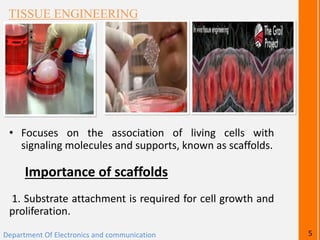
• Focuses on the association of living cells with
signaling molecules and supports, known as scaffolds.
Importance of scaffolds
1. Substrate attachment is required for cell growth and
proliferation.
TISSUE ENGINEERING
Department Of Electronics and communication 5
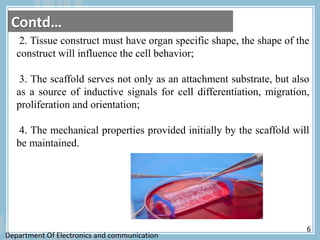
2. Tissue construct must have organ specific shape, the shape of the
construct will influence the cell behavior;
3. The scaffold serves not only as an attachment substrate, but also
as a source of inductive signals for cell differentiation, migration,
proliferation and orientation;
4. The mechanical properties provided initially by the scaffold will
be maintained.
Contd…
Department Of Electronics and communication
6
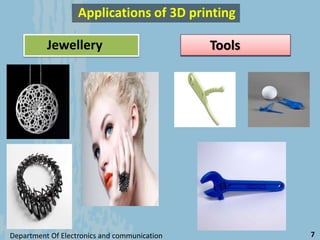
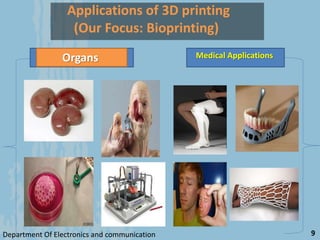
Applications of 3D printing
Jewellery Tools
Department Of Electronics and communication 7
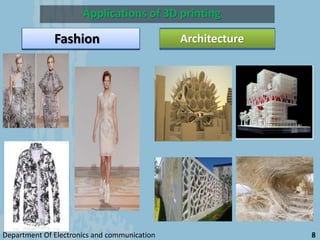
Applications of 3D printing
Fashion Architecture
Department Of Electronics and communication 8
Applications of 3D printing
(Our Focus: Bioprinting)
Organs Medical Applications
Department Of Electronics and communication 9
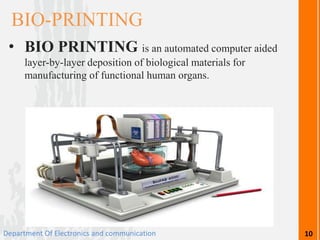
• BIO PRINTING is an automated computer aided
layer-by-layer deposition of biological materials for
manufacturing of functional human organs.
BIO-PRINTING
Department Of Electronics and communication 10
BEST QUALITIES OF THIS TECHNIQUES:
RAPID
PROTOTYPING
HIGH
RESOLUTION
HIGH PRECISION
COMPUTER
CONTROL
Department Of Electronics and communication 11
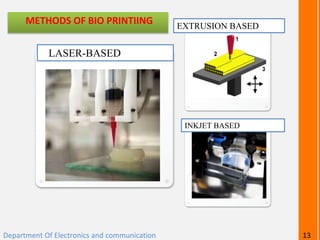
METHODS OF BIO PRINTIING
LASER-BASED
EXTRUSION BASED
INKJET BASED
Department Of Electronics and communication 13
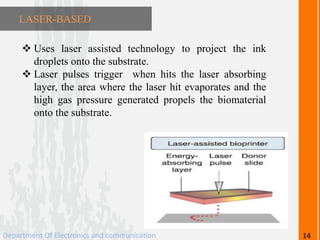
LASER-BASED
 Uses laser assisted technology to project the ink
droplets onto the substrate.
 Laser pulses trigger when hits the laser absorbing
layer, the area where the laser hit evaporates and the
high gas pressure generated propels the biomaterial
onto the substrate.
Department Of Electronics and communication 14
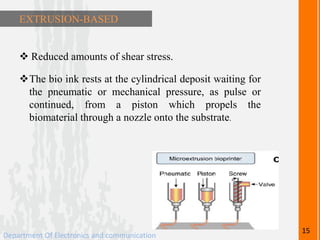
EXTRUSION-BASED
 Reduced amounts of shear stress.
The bio ink rests at the cylindrical deposit waiting for
the pneumatic or mechanical pressure, as pulse or
continued, from a piston which propels the
biomaterial through a nozzle onto the substrate.
Department Of Electronics and communication
15
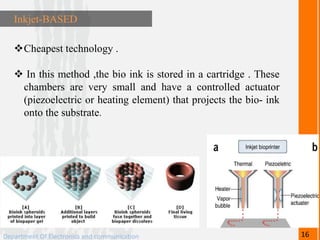
Inkjet-BASED
Cheapest technology .
 In this method ,the bio ink is stored in a cartridge . These
chambers are very small and have a controlled actuator
(piezoelectric or heating element) that projects the bio- ink
onto the substrate.
Department Of Electronics and communication 16
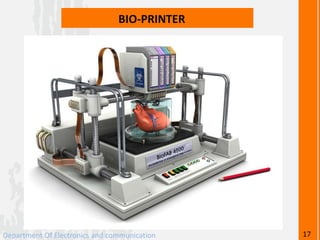
BIO-PRINTER
Department Of Electronics and communication 17
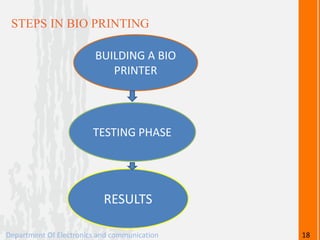
STEPS IN BIO PRINTING
BUILDING A BIO
PRINTER
TESTING PHASE
RESULTS
Department Of Electronics and communication 18
BUILDING A BIO-PRINTER
Bio printing aims to build an organ, layer by layer, using
scanners and printers .
The most important axes, X and Y, were built with 1 sheet
of Poly(methyl methacrylate) (PMMA), also known as
acrylic glass, with one stepper motor and rails to guide the
printing head.
For the Z axis, a different motor is needed since it had to
support the weight of the print head.
Department Of Electronics and communication 19
TESTING PHASE
 After the building process ,testing phase is processed. It is mainly to test
the three axes and all the functioning of bio printer.
 Before the biological print process to get started the bio printer was set to
print with the cartridge intact, with the factory ink it came with.
 This allowed to observe step loss or nozzle firing malfunction events in
order to redefine the timing parameters and other algorithm parameters to
ensure the system correct functioning.
Department Of Electronics and communication 20
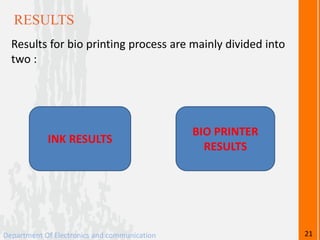
RESULTS
Results for bio printing process are mainly divided into
two :
INK RESULTS
BIO PRINTER
RESULTS
Department Of Electronics and communication 21
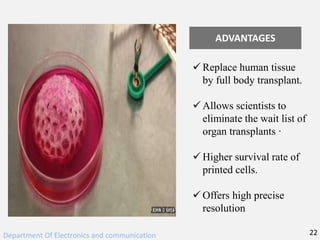
ADVANTAGES
 Replace human tissue
by full body transplant.
 Allows scientists to
eliminate the wait list of
organ transplants ·
 Higher survival rate of
printed cells.
 Offers high precise
resolution
Department Of Electronics and communication 22
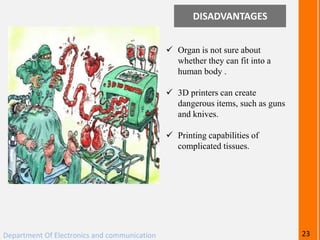
DISADVANTAGES
 Organ is not sure about
whether they can fit into a
human body .
 3D printers can create
dangerous items, such as guns
and knives.
 Printing capabilities of
complicated tissues.
Department Of Electronics and communication 23
CONCLUSION
With the continuous growth of the world’s population , and
increase of human life expectancy, more cases of organ failure
and tissue damage appear .
Most common bio printing methods were described and
discussed with their characteristics and limitations.
In terms of future perspectives for this work, more bio print
testing would be needed to be done to optimize the bio ink,
substrate and the process parameters.
Department Of Electronics and communication 24
REFERENCES
1. M. Weber, et al., “Organ transplantation in the twenty-first century”, The
Urologic clinics of North America, 1998. 25(1): p. 51-61.
2. S. Steering Committee of the Istanbul, “Organ trafficking and transplant
tourism and commercialism: the Declaration of Istanbul”, The Lancet.
372(9632): p. 5-6.
3. Sixty-Third, W.H.A. and W.H. Organization, “WHO Guiding Principles on
Human Cell, Tissue and Organ Transplantation. Cell and tissue banking”,
2010. 11(4): p. 413.
4. J.R. Wolter, and R.F. Meyer, “Sessile macrophages forming clear
endothelium-like membrane on inside of successful keratoprosthesis”, Trans
Am Ophthalmol Soc, 1984. 82: p. 187-202.
5. M. Nakamura, Y. Nishiyama, and C. Henmi. “3D Micro-fabrication by Inkjet
3D biofabrication for 3D tissue engineering”, in MicroNanoMechatronics and
Human Science, 2008. MHS 2008. International Symposium on. 2008. IEEE.
Department Of Electronics and communication
25
3D bioprinting

3D bioprinting

  • 1.
    3D BIO-PRINTING TECHNOLOGY Guided by, Mrs.DEEPA SUSAN GEORGE ASSISTANT PROFESSOR ECE DEPARTMENT Presented by, HASHIM SALIM S7 ECE A 12010516 Department Of Electronics and communication 1
  • 2.
    STRUCTURE OF PRESENTATION Introduction  Organ transplantation  Tissue engineering  Applications of 3D printing  Bio printing  Qualities of this technique  Method of bio-printing  Bio printer  Steps of bio printing  Result  Advantage and disadvantage  Conclusion Department Of Electronics and communication 2
  • 3.
    INTRODUCTION 3D BIO-PRINTING isthe three-dimensional printing of biological tissue and organs through the layering of living cells. It is mainly divided into two : 1. ORGAN TRANSPLANTATION It refers to transplantation of organs due to organ failure or injury. 2. TISSUE ENGINEERING It is the study of the growth of new connective tissue, or organs, from cells. Department Of Electronics and communication 3
  • 4.
    • Organ failureis a worldwide problem and its only treatment is organ transplantation or tissue replacement ORGAN TRANSPLANTATION Department Of Electronics and communication 4
  • 5.
    • Focuses onthe association of living cells with signaling molecules and supports, known as scaffolds. Importance of scaffolds 1. Substrate attachment is required for cell growth and proliferation. TISSUE ENGINEERING Department Of Electronics and communication 5
  • 6.
    2. Tissue constructmust have organ specific shape, the shape of the construct will influence the cell behavior; 3. The scaffold serves not only as an attachment substrate, but also as a source of inductive signals for cell differentiation, migration, proliferation and orientation; 4. The mechanical properties provided initially by the scaffold will be maintained. Contd… Department Of Electronics and communication 6
  • 7.
    Applications of 3Dprinting Jewellery Tools Department Of Electronics and communication 7
  • 8.
    Applications of 3Dprinting Fashion Architecture Department Of Electronics and communication 8
  • 9.
    Applications of 3Dprinting (Our Focus: Bioprinting) Organs Medical Applications Department Of Electronics and communication 9
  • 10.
    • BIO PRINTINGis an automated computer aided layer-by-layer deposition of biological materials for manufacturing of functional human organs. BIO-PRINTING Department Of Electronics and communication 10
  • 11.
    BEST QUALITIES OFTHIS TECHNIQUES: RAPID PROTOTYPING HIGH RESOLUTION HIGH PRECISION COMPUTER CONTROL Department Of Electronics and communication 11
  • 12.
    METHODS OF BIOPRINTIING LASER-BASED EXTRUSION BASED INKJET BASED Department Of Electronics and communication 13
  • 13.
    LASER-BASED  Uses laserassisted technology to project the ink droplets onto the substrate.  Laser pulses trigger when hits the laser absorbing layer, the area where the laser hit evaporates and the high gas pressure generated propels the biomaterial onto the substrate. Department Of Electronics and communication 14
  • 14.
    EXTRUSION-BASED  Reduced amountsof shear stress. The bio ink rests at the cylindrical deposit waiting for the pneumatic or mechanical pressure, as pulse or continued, from a piston which propels the biomaterial through a nozzle onto the substrate. Department Of Electronics and communication 15
  • 15.
    Inkjet-BASED Cheapest technology . In this method ,the bio ink is stored in a cartridge . These chambers are very small and have a controlled actuator (piezoelectric or heating element) that projects the bio- ink onto the substrate. Department Of Electronics and communication 16
  • 16.
  • 17.
    STEPS IN BIOPRINTING BUILDING A BIO PRINTER TESTING PHASE RESULTS Department Of Electronics and communication 18
  • 18.
    BUILDING A BIO-PRINTER Bioprinting aims to build an organ, layer by layer, using scanners and printers . The most important axes, X and Y, were built with 1 sheet of Poly(methyl methacrylate) (PMMA), also known as acrylic glass, with one stepper motor and rails to guide the printing head. For the Z axis, a different motor is needed since it had to support the weight of the print head. Department Of Electronics and communication 19
  • 19.
    TESTING PHASE  Afterthe building process ,testing phase is processed. It is mainly to test the three axes and all the functioning of bio printer.  Before the biological print process to get started the bio printer was set to print with the cartridge intact, with the factory ink it came with.  This allowed to observe step loss or nozzle firing malfunction events in order to redefine the timing parameters and other algorithm parameters to ensure the system correct functioning. Department Of Electronics and communication 20
  • 20.
    RESULTS Results for bioprinting process are mainly divided into two : INK RESULTS BIO PRINTER RESULTS Department Of Electronics and communication 21
  • 21.
    ADVANTAGES  Replace humantissue by full body transplant.  Allows scientists to eliminate the wait list of organ transplants ·  Higher survival rate of printed cells.  Offers high precise resolution Department Of Electronics and communication 22
  • 22.
    DISADVANTAGES  Organ isnot sure about whether they can fit into a human body .  3D printers can create dangerous items, such as guns and knives.  Printing capabilities of complicated tissues. Department Of Electronics and communication 23
  • 23.
    CONCLUSION With the continuousgrowth of the world’s population , and increase of human life expectancy, more cases of organ failure and tissue damage appear . Most common bio printing methods were described and discussed with their characteristics and limitations. In terms of future perspectives for this work, more bio print testing would be needed to be done to optimize the bio ink, substrate and the process parameters. Department Of Electronics and communication 24
  • 24.
    REFERENCES 1. M. Weber,et al., “Organ transplantation in the twenty-first century”, The Urologic clinics of North America, 1998. 25(1): p. 51-61. 2. S. Steering Committee of the Istanbul, “Organ trafficking and transplant tourism and commercialism: the Declaration of Istanbul”, The Lancet. 372(9632): p. 5-6. 3. Sixty-Third, W.H.A. and W.H. Organization, “WHO Guiding Principles on Human Cell, Tissue and Organ Transplantation. Cell and tissue banking”, 2010. 11(4): p. 413. 4. J.R. Wolter, and R.F. Meyer, “Sessile macrophages forming clear endothelium-like membrane on inside of successful keratoprosthesis”, Trans Am Ophthalmol Soc, 1984. 82: p. 187-202. 5. M. Nakamura, Y. Nishiyama, and C. Henmi. “3D Micro-fabrication by Inkjet 3D biofabrication for 3D tissue engineering”, in MicroNanoMechatronics and Human Science, 2008. MHS 2008. International Symposium on. 2008. IEEE. Department Of Electronics and communication 25

Editor's Notes

  • #2 This template can be used as a starter file for a photo album.
  • #5 INTRO OGN PL,TISS ENGG. BI PRNT ….. BIO -
  • #24 Most common bioprinting methods were described and discussed with their characteristics and limitations.