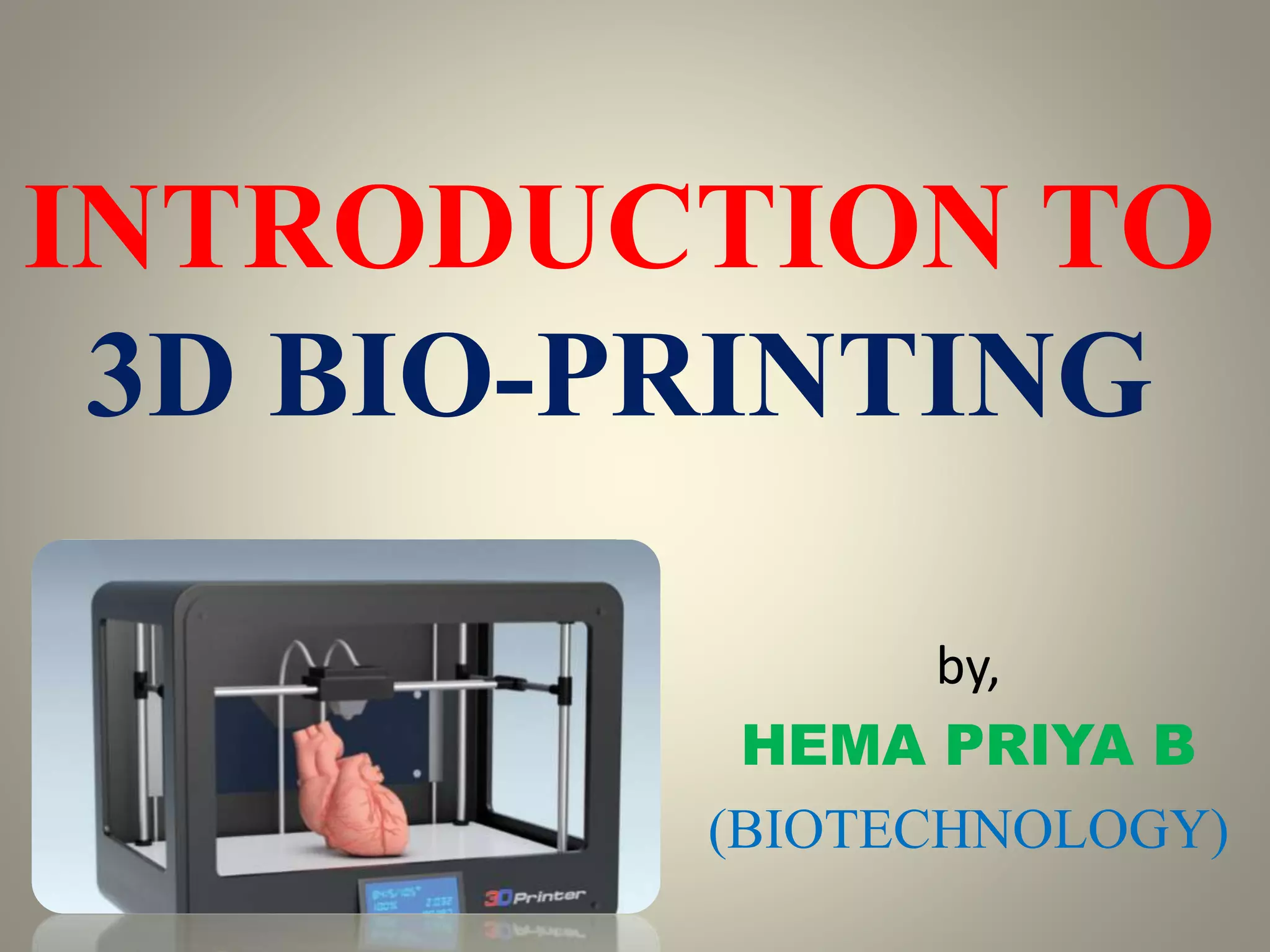
INTRODUCTION TO
3D BIO-PRINTING
by,
HEMA PRIYA B
(BIOTECHNOLOGY)
Need of 3D Bio-printing
• Clinical Case:
- Tissue/Organ implants fabricated from
own body cells
• Pharmacy Case:
- Behavioral studies of tissue/cells
- Drug discovery
- Alternative to animal testing or reduce the
need for animal trials.
3D Bio-printing
• Bio-printing refers to 3D printers which deposit
layers of biomaterial to build complex bodily
structures like skin, bones and even corneas.
• The requisite cells are taken from a patient or, if
this isn’t possible, adult stem cells can be used
and cultivated into a bio-ink to print an organic
object.
• These are typically held together through some
sort of dissolvable gel or collagen scaffold which
can support the cells and mould them into the
correct shape.
Types of 3D Bio-printing
1) Inkjet Bio-printing
2) Extrusion Bio-printing
3) Laser Bio-printing
1. Inkjet Bio-printing
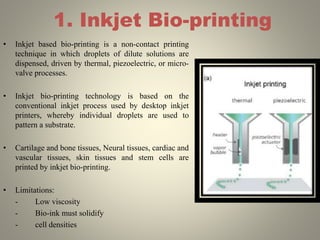
• Inkjet based bio-printing is a non-contact printing
technique in which droplets of dilute solutions are
dispensed, driven by thermal, piezoelectric, or micro-
valve processes.
• Inkjet bio-printing technology is based on the
conventional inkjet process used by desktop inkjet
printers, whereby individual droplets are used to
pattern a substrate.
• Cartilage and bone tissues, Neural tissues, cardiac and
vascular tissues, skin tissues and stem cells are
printed by inkjet bio-printing.
• Limitations:
- Low viscosity
- Bio-ink must solidify
- cell densities
2. Extrusion Bio-printing
• Most commonly used bio-printed method.
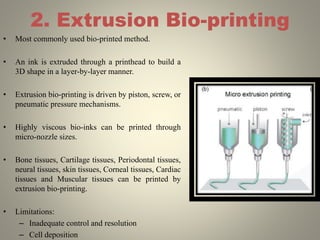
• An ink is extruded through a printhead to build a
3D shape in a layer-by-layer manner.
• Extrusion bio-printing is driven by piston, screw, or
pneumatic pressure mechanisms.
• Highly viscous bio-inks can be printed through
micro-nozzle sizes.
• Bone tissues, Cartilage tissues, Periodontal tissues,
neural tissues, skin tissues, Corneal tissues, Cardiac
tissues and Muscular tissues can be printed by
extrusion bio-printing.
• Limitations:
– Inadequate control and resolution
– Cell deposition
3. Laser Bio-printing
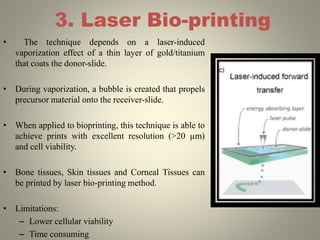
• The technique depends on a laser-induced
vaporization effect of a thin layer of gold/titanium
that coats the donor-slide.
• During vaporization, a bubble is created that propels
precursor material onto the receiver-slide.
• When applied to bioprinting, this technique is able to
achieve prints with excellent resolution (>20 µm)
and cell viability.
• Bone tissues, Skin tissues and Corneal Tissues can
be printed by laser bio-printing method.
• Limitations:
– Lower cellular viability
– Time consuming
Cell survival During printing
• Oxygen
• Growth factors
• Nutrients
• Temperature
are the factors helps to survival of cells during
3D printing.
Applications
• Now a days 3D Bio-printing is used
for,
–Tissue mimics for drug testing
Limitations
• Vascularization
• Immune rejection
• Biocompatibility
Introduction to 3D Bio-printing

Introduction to 3D Bio-printing

  • 1.
  • 2.
    Need of 3DBio-printing • Clinical Case: - Tissue/Organ implants fabricated from own body cells • Pharmacy Case: - Behavioral studies of tissue/cells - Drug discovery - Alternative to animal testing or reduce the need for animal trials.
  • 3.
    3D Bio-printing • Bio-printingrefers to 3D printers which deposit layers of biomaterial to build complex bodily structures like skin, bones and even corneas. • The requisite cells are taken from a patient or, if this isn’t possible, adult stem cells can be used and cultivated into a bio-ink to print an organic object. • These are typically held together through some sort of dissolvable gel or collagen scaffold which can support the cells and mould them into the correct shape.
  • 4.
    Types of 3DBio-printing 1) Inkjet Bio-printing 2) Extrusion Bio-printing 3) Laser Bio-printing
  • 5.
    1. Inkjet Bio-printing •Inkjet based bio-printing is a non-contact printing technique in which droplets of dilute solutions are dispensed, driven by thermal, piezoelectric, or micro- valve processes. • Inkjet bio-printing technology is based on the conventional inkjet process used by desktop inkjet printers, whereby individual droplets are used to pattern a substrate. • Cartilage and bone tissues, Neural tissues, cardiac and vascular tissues, skin tissues and stem cells are printed by inkjet bio-printing. • Limitations: - Low viscosity - Bio-ink must solidify - cell densities
  • 6.
    2. Extrusion Bio-printing •Most commonly used bio-printed method. • An ink is extruded through a printhead to build a 3D shape in a layer-by-layer manner. • Extrusion bio-printing is driven by piston, screw, or pneumatic pressure mechanisms. • Highly viscous bio-inks can be printed through micro-nozzle sizes. • Bone tissues, Cartilage tissues, Periodontal tissues, neural tissues, skin tissues, Corneal tissues, Cardiac tissues and Muscular tissues can be printed by extrusion bio-printing. • Limitations: – Inadequate control and resolution – Cell deposition
  • 7.
    3. Laser Bio-printing •The technique depends on a laser-induced vaporization effect of a thin layer of gold/titanium that coats the donor-slide. • During vaporization, a bubble is created that propels precursor material onto the receiver-slide. • When applied to bioprinting, this technique is able to achieve prints with excellent resolution (>20 µm) and cell viability. • Bone tissues, Skin tissues and Corneal Tissues can be printed by laser bio-printing method. • Limitations: – Lower cellular viability – Time consuming
  • 8.
    Cell survival Duringprinting • Oxygen • Growth factors • Nutrients • Temperature are the factors helps to survival of cells during 3D printing.
  • 9.
    Applications • Now adays 3D Bio-printing is used for, –Tissue mimics for drug testing
  • 10.
    Limitations • Vascularization • Immunerejection • Biocompatibility