3D PRINTING
Jenna
Aaron
Adrienne
What is 3D Printing?
• Additive process to create any shape from
a digital model
• Industrial Robot
• Successive layers of material to make up
different shapes
What We Can Print
• Bio-Printing: Tissue engineering to create organs for
implants
• Skin
• Clothing and jewelry
• Casts for humans and animals
• Phone Cases
• Guns
• Guitars, clocks
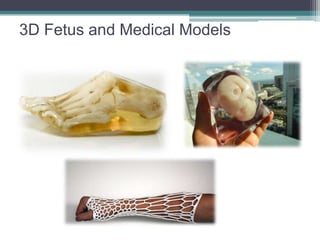
3D Fetus and Medical Models
3D PRINTED ORGANS
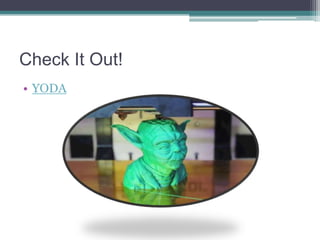
Check It Out!
• YODA
Limitations
• Slow speed limits use for mass production
• Size needed to create large items
• Limited materials due to additive process
Future of 3D Printing
• Houses
• Trees
• Meat and Leather
• Global Economic Change
• Mass Personalization with material items
Effects of 3D Printing
• Environmental Impacts
• New Age of Art
• Education
• Medical
• Global Economy
Bio Printing Testing
• Printing organs could be used for drug or vaccine testing, and
not having to do test’s on animals or synthetic models
anymore which would make organ testing far more accurate.
• A printed liver for example, made from human cells could be
used as an intermediate step in drug testing in order to make
sure that a drug was safe before testing it on actual people.
• About 18 people die daily in the U.S. alone each day just
waiting for a transplant that may never come due to such
organ shortage from a real human. Bio printing could cut this
number in half if not more if got approved.
Three different Bio printers….
• Bio printers: NovoGen MMX, is the world's first 3D bio
printer. The printer has two robotic print heads. One places
human cells and the other places a hydrogel, scaffold, or
other type of support.
• Inkjet inspired printers: It is adapted so that skin cells
can be placed in an ink cartridge and printed directly on a
wound.
• Six-axis printer: Six-axis printer that can print layers but
come back and start printing a new layer on the outside of
the heart.
Rejecting the Transplant
In any transplant or surgery, there is always the risk of the body
rejecting the organ or cells. This can occur when tissue from one
area of the body is put into another area of the body. The organ
or tissue has to have time to integrate into the body after the
implant. Since the technology for 3D bio printing is so
new, doctors and engineers have not even gotten to this point
yet, but it's important to recognize these risks.
How it Works…
• “Bio Printing works like this: Scientists harvest human cells from
biopsies or stem cells, then allow them to multiply in a petri
dish. The mixture, like biological ink, is fed into the 3D
pritner, which is programmed to arrange different cell
types, along with other materials, into a precise three-
dimensional shape.” -- CNN Brandon Griggs.
• Doctors then hope that when the 3D print is placed into the
body, that the cell will work with the existing tissue in the body.
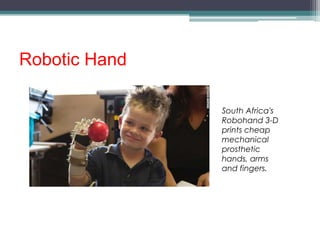
Robotic Hand
South Africa's
Robohand 3-D
prints cheap
mechanical
prosthetic
hands, arms
and fingers.
Printing Skin
Wake Forest
School of
medicine in
the United
States is
developing a
printer that will
print skin
straight onto
the wounds of
burn victims.
Pictured, a
researcher
works on a
prosthetic
"burned" hand.
Hip Stems and Bones
Washington State
University has 3-D
printed structures
from layers of bio-
compatible
calcium
phosphate, includi
ng a hip stem (left)
and bone
scaffolds.
• The U.S. government has funded a university called “Body on
a Chip” project that prints tissue samples that mimic the
functions of the heart, liver, lungs, and other organs.
• The government is being highly cooperative with this new
technology in terms of funding to science labs and Universities
because it does deal with health and lowering death toll.
• But… Bio printing does raise the question on who will be able
to afford it. Bio printing organs are likely to be very
expensive, which would mean only the wealthiest patients
would get the privilege of having them.
There is lots of controversy…
“Will only the rich be able to afford it? Are
we playing God? In the end, saving lives
tends to trump all objections”
-CNN

3 d printing

  • 1.
  • 2.
    What is 3DPrinting? • Additive process to create any shape from a digital model • Industrial Robot • Successive layers of material to make up different shapes
  • 4.
    What We CanPrint • Bio-Printing: Tissue engineering to create organs for implants • Skin • Clothing and jewelry • Casts for humans and animals • Phone Cases • Guns • Guitars, clocks
  • 6.
    3D Fetus andMedical Models
  • 7.
  • 8.
  • 9.
    Limitations • Slow speedlimits use for mass production • Size needed to create large items • Limited materials due to additive process
  • 10.
    Future of 3DPrinting • Houses • Trees • Meat and Leather • Global Economic Change • Mass Personalization with material items
  • 11.
    Effects of 3DPrinting • Environmental Impacts • New Age of Art • Education • Medical • Global Economy
  • 12.
    Bio Printing Testing •Printing organs could be used for drug or vaccine testing, and not having to do test’s on animals or synthetic models anymore which would make organ testing far more accurate. • A printed liver for example, made from human cells could be used as an intermediate step in drug testing in order to make sure that a drug was safe before testing it on actual people. • About 18 people die daily in the U.S. alone each day just waiting for a transplant that may never come due to such organ shortage from a real human. Bio printing could cut this number in half if not more if got approved.
  • 13.
    Three different Bioprinters…. • Bio printers: NovoGen MMX, is the world's first 3D bio printer. The printer has two robotic print heads. One places human cells and the other places a hydrogel, scaffold, or other type of support. • Inkjet inspired printers: It is adapted so that skin cells can be placed in an ink cartridge and printed directly on a wound. • Six-axis printer: Six-axis printer that can print layers but come back and start printing a new layer on the outside of the heart.
  • 14.
    Rejecting the Transplant Inany transplant or surgery, there is always the risk of the body rejecting the organ or cells. This can occur when tissue from one area of the body is put into another area of the body. The organ or tissue has to have time to integrate into the body after the implant. Since the technology for 3D bio printing is so new, doctors and engineers have not even gotten to this point yet, but it's important to recognize these risks.
  • 15.
    How it Works… •“Bio Printing works like this: Scientists harvest human cells from biopsies or stem cells, then allow them to multiply in a petri dish. The mixture, like biological ink, is fed into the 3D pritner, which is programmed to arrange different cell types, along with other materials, into a precise three- dimensional shape.” -- CNN Brandon Griggs. • Doctors then hope that when the 3D print is placed into the body, that the cell will work with the existing tissue in the body.
  • 16.
    Robotic Hand South Africa's Robohand3-D prints cheap mechanical prosthetic hands, arms and fingers.
  • 17.
    Printing Skin Wake Forest Schoolof medicine in the United States is developing a printer that will print skin straight onto the wounds of burn victims. Pictured, a researcher works on a prosthetic "burned" hand.
  • 18.
    Hip Stems andBones Washington State University has 3-D printed structures from layers of bio- compatible calcium phosphate, includi ng a hip stem (left) and bone scaffolds.
  • 19.
    • The U.S.government has funded a university called “Body on a Chip” project that prints tissue samples that mimic the functions of the heart, liver, lungs, and other organs. • The government is being highly cooperative with this new technology in terms of funding to science labs and Universities because it does deal with health and lowering death toll. • But… Bio printing does raise the question on who will be able to afford it. Bio printing organs are likely to be very expensive, which would mean only the wealthiest patients would get the privilege of having them. There is lots of controversy…
  • 20.
    “Will only therich be able to afford it? Are we playing God? In the end, saving lives tends to trump all objections” -CNN