Bioprinting
Brian Igoe
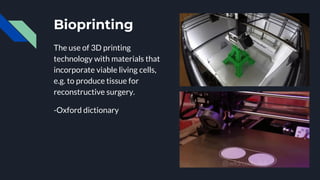
Bioprinting
The use of 3D printing
technology with materials that
incorporate viable living cells,
e.g. to produce tissue for
reconstructive surgery.
-Oxford dictionary
Background
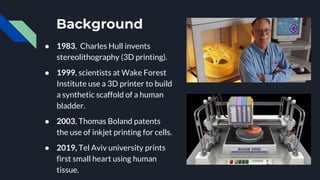
● 1983, Charles Hull invents
stereolithography (3D printing).
● 1999, scientists at Wake Forest
Institute use a 3D printer to build
a synthetic scaffold of a human
bladder.
● 2003, Thomas Boland patents
the use of inkjet printing for cells.
● 2019, Tel Aviv university prints
first small heart using human
tissue.
3D printing the heart
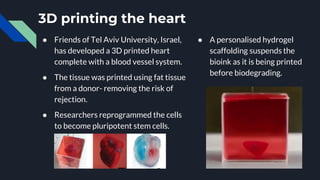
● Friends of Tel Aviv University, Israel,
has developed a 3D printed heart
complete with a blood vessel system.
● The tissue was printed using fat tissue
from a donor- removing the risk of
rejection.
● Researchers reprogrammed the cells
to become pluripotent stem cells.
● A personalised hydrogel
scaffolding suspends the
bioink as it is being printed
before biodegrading.
Why is this Biotechnology?
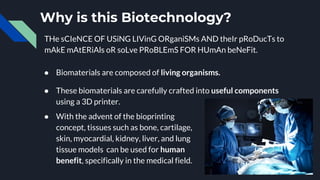
● Biomaterials are composed of living organisms.
● These biomaterials are carefully crafted into useful components
using a 3D printer.
● With the advent of the bioprinting
concept, tissues such as bone, cartilage,
skin, myocardial, kidney, liver, and lung
tissue models can be used for human
benefit, specifically in the medical field.
THe sCIeNCE OF USiNG LIVinG ORganiSMs AND theIr pRoDucTs to
mAkE mAtERiAls oR soLve PRoBLEmS FOR HUmAn beNeFit.
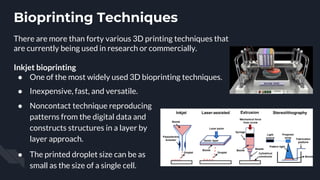
Bioprinting Techniques
There are more than forty various 3D printing techniques that
are currently being used in research or commercially.
Inkjet bioprinting
● One of the most widely used 3D bioprinting techniques.
● Inexpensive, fast, and versatile.
● Noncontact technique reproducing
patterns from the digital data and
constructs structures in a layer by
layer approach.
● The printed droplet size can be as
small as the size of a single cell.
The process of 3D bioprinting
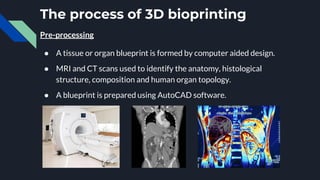
Pre-processing
● A tissue or organ blueprint is formed by computer aided design.
● MRI and CT scans used to identify the anatomy, histological
structure, composition and human organ topology.
● A blueprint is prepared using AutoCAD software.
The process of 3D bioprinting
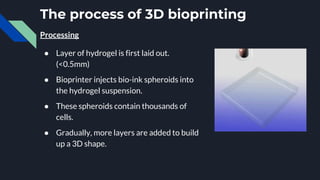
Processing
● Layer of hydrogel is first laid out.
(<0.5mm)
● Bioprinter injects bio-ink spheroids into
the hydrogel suspension.
● These spheroids contain thousands of
cells.
● Gradually, more layers are added to build
up a 3D shape.
The process of 3D bioprinting
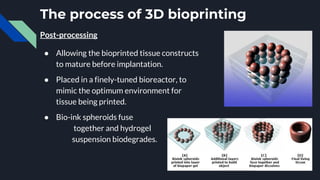
Post-processing
● Allowing the bioprinted tissue constructs
to mature before implantation.
● Placed in a finely-tuned bioreactor, to
mimic the optimum environment for
tissue being printed.
● Bio-ink spheroids fuse
together and hydrogel
suspension biodegrades.
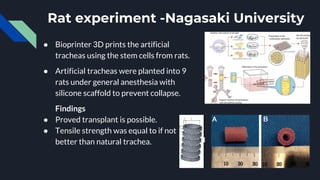
Rat experiment -Nagasaki University
● Bioprinter 3D prints the artificial
tracheas using the stem cells from rats.
● Artificial tracheas were planted into 9
rats under general anesthesia with
silicone scaffold to prevent collapse.
Findings
● Proved transplant is possible.
● Tensile strength was equal to if not
better than natural trachea.
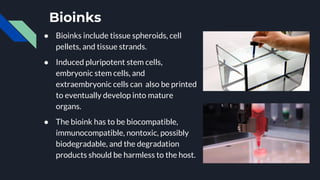
Bioinks
● Bioinks include tissue spheroids, cell
pellets, and tissue strands.
● Induced pluripotent stem cells,
embryonic stem cells, and
extraembryonic cells can also be printed
to eventually develop into mature
organs.
● The bioink has to be biocompatible,
immunocompatible, nontoxic, possibly
biodegradable, and the degradation
products should be harmless to the host.
The future of Bioprinting
The development of mature bioinks is currently the
biggest obstacle that needs to be faced going
forward.
In future we can expect 3D Bioprinted [BLANK]..
Corneas
Synthetic corneas in surgery for cataracts and
other sight complications.
Bones
Bioprinted bone material is capable of fusing with a
patient’s natural bones over time, eventually being
replaced by them.
Summary
● Bioprinting: The use of 3D printing technology with
materials that incorporate viable living cells, e.g. to
produce tissue for reconstructive surgery.
● Inkjet bioprinting is one of the most widely used
techniques.
● 3 stages: pre-processing, processing and post-
processing.
● The development of mature bioinks is currently the
bottleneck of bioprinting technology.
● Still a long way to go before mainstream use of
bioprinting is commonplace.
Definitions
Bioink: substances made of living cells that can be used for 3D
bioprinting.
Bioprinting: The use of 3D printing technology with materials that
incorporate viable living cells, e.g. to produce tissue for reconstructive
surgery.
Pluripotent stem cells: Pluripotent stem cells are cells that have the
capacity to self-renew by dividing and to develop into the three
primary germ cell layers of the early embryo and therefore into all cells
of the adult body
References
Organ Bioprinting: Are We There Yet? Guifang Gao, Ying Huang, Arndt F. Schilling,*
Karen Hubbell, and Xiaofeng Cui*
3D bioprinting and the current applications in tissue engineering Ying Huang1,*,
Xiao-Fei Zhang1,*, Guifang Gao1, Tomo Yonezawa2 and Xiaofeng Cui1,3
Scaffold-free trachea regeneration by tissue engineering with bio-3D printing†
Daisuke Taniguchi, Keitaro Matsumoto, Tomoshi Tsuchiya, Ryusuke Machino,
Yosuke Takeoka, Abdelmotagaly Elgalad, Kiyofumi Gunge, Katsunori Takagi, Yasuaki
Taura, Go Hatachi, Naoto Matsuo, Naoya Yamasaki, Koichi Nakayama, Takeshi
Nagayasu
3D Printing of Personalized Thick and Perfusable Cardiac Patches and Hearts
Nadav Noor Assaf Shapira Reuven Edri Idan Gal Lior Wertheim Tal Dvir
https://www.sciencedirect.com/topics/agricultural-and-biological-sciences/3d-
bioprinting

3d bioprinting

  • 1.
  • 2.
    Bioprinting The use of3D printing technology with materials that incorporate viable living cells, e.g. to produce tissue for reconstructive surgery. -Oxford dictionary
  • 3.
    Background ● 1983, CharlesHull invents stereolithography (3D printing). ● 1999, scientists at Wake Forest Institute use a 3D printer to build a synthetic scaffold of a human bladder. ● 2003, Thomas Boland patents the use of inkjet printing for cells. ● 2019, Tel Aviv university prints first small heart using human tissue.
  • 4.
    3D printing theheart ● Friends of Tel Aviv University, Israel, has developed a 3D printed heart complete with a blood vessel system. ● The tissue was printed using fat tissue from a donor- removing the risk of rejection. ● Researchers reprogrammed the cells to become pluripotent stem cells. ● A personalised hydrogel scaffolding suspends the bioink as it is being printed before biodegrading.
  • 5.
    Why is thisBiotechnology? ● Biomaterials are composed of living organisms. ● These biomaterials are carefully crafted into useful components using a 3D printer. ● With the advent of the bioprinting concept, tissues such as bone, cartilage, skin, myocardial, kidney, liver, and lung tissue models can be used for human benefit, specifically in the medical field. THe sCIeNCE OF USiNG LIVinG ORganiSMs AND theIr pRoDucTs to mAkE mAtERiAls oR soLve PRoBLEmS FOR HUmAn beNeFit.
  • 6.
    Bioprinting Techniques There aremore than forty various 3D printing techniques that are currently being used in research or commercially. Inkjet bioprinting ● One of the most widely used 3D bioprinting techniques. ● Inexpensive, fast, and versatile. ● Noncontact technique reproducing patterns from the digital data and constructs structures in a layer by layer approach. ● The printed droplet size can be as small as the size of a single cell.
  • 7.
    The process of3D bioprinting Pre-processing ● A tissue or organ blueprint is formed by computer aided design. ● MRI and CT scans used to identify the anatomy, histological structure, composition and human organ topology. ● A blueprint is prepared using AutoCAD software.
  • 8.
    The process of3D bioprinting Processing ● Layer of hydrogel is first laid out. (<0.5mm) ● Bioprinter injects bio-ink spheroids into the hydrogel suspension. ● These spheroids contain thousands of cells. ● Gradually, more layers are added to build up a 3D shape.
  • 9.
    The process of3D bioprinting Post-processing ● Allowing the bioprinted tissue constructs to mature before implantation. ● Placed in a finely-tuned bioreactor, to mimic the optimum environment for tissue being printed. ● Bio-ink spheroids fuse together and hydrogel suspension biodegrades.
  • 10.
    Rat experiment -NagasakiUniversity ● Bioprinter 3D prints the artificial tracheas using the stem cells from rats. ● Artificial tracheas were planted into 9 rats under general anesthesia with silicone scaffold to prevent collapse. Findings ● Proved transplant is possible. ● Tensile strength was equal to if not better than natural trachea.
  • 11.
    Bioinks ● Bioinks includetissue spheroids, cell pellets, and tissue strands. ● Induced pluripotent stem cells, embryonic stem cells, and extraembryonic cells can also be printed to eventually develop into mature organs. ● The bioink has to be biocompatible, immunocompatible, nontoxic, possibly biodegradable, and the degradation products should be harmless to the host.
  • 12.
    The future ofBioprinting The development of mature bioinks is currently the biggest obstacle that needs to be faced going forward. In future we can expect 3D Bioprinted [BLANK].. Corneas Synthetic corneas in surgery for cataracts and other sight complications. Bones Bioprinted bone material is capable of fusing with a patient’s natural bones over time, eventually being replaced by them.
  • 13.
    Summary ● Bioprinting: Theuse of 3D printing technology with materials that incorporate viable living cells, e.g. to produce tissue for reconstructive surgery. ● Inkjet bioprinting is one of the most widely used techniques. ● 3 stages: pre-processing, processing and post- processing. ● The development of mature bioinks is currently the bottleneck of bioprinting technology. ● Still a long way to go before mainstream use of bioprinting is commonplace.
  • 14.
    Definitions Bioink: substances madeof living cells that can be used for 3D bioprinting. Bioprinting: The use of 3D printing technology with materials that incorporate viable living cells, e.g. to produce tissue for reconstructive surgery. Pluripotent stem cells: Pluripotent stem cells are cells that have the capacity to self-renew by dividing and to develop into the three primary germ cell layers of the early embryo and therefore into all cells of the adult body
  • 15.
    References Organ Bioprinting: AreWe There Yet? Guifang Gao, Ying Huang, Arndt F. Schilling,* Karen Hubbell, and Xiaofeng Cui* 3D bioprinting and the current applications in tissue engineering Ying Huang1,*, Xiao-Fei Zhang1,*, Guifang Gao1, Tomo Yonezawa2 and Xiaofeng Cui1,3 Scaffold-free trachea regeneration by tissue engineering with bio-3D printing† Daisuke Taniguchi, Keitaro Matsumoto, Tomoshi Tsuchiya, Ryusuke Machino, Yosuke Takeoka, Abdelmotagaly Elgalad, Kiyofumi Gunge, Katsunori Takagi, Yasuaki Taura, Go Hatachi, Naoto Matsuo, Naoya Yamasaki, Koichi Nakayama, Takeshi Nagayasu 3D Printing of Personalized Thick and Perfusable Cardiac Patches and Hearts Nadav Noor Assaf Shapira Reuven Edri Idan Gal Lior Wertheim Tal Dvir https://www.sciencedirect.com/topics/agricultural-and-biological-sciences/3d- bioprinting