
OVERVIEW:
 INTRODUCTION
 COMPONENTS
 PROCESS
 ADVANTAGES
 DISADVANTAGES
 APPLICATIONS
 CONCLUSION

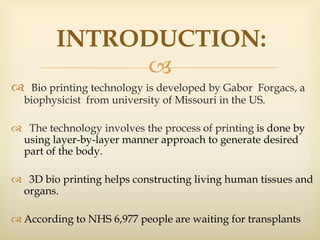
 Bio printing technology is developed by Gabor Forgacs, a
biophysicist from university of Missouri in the US.
 The technology involves the process of printing is done by
using layer-by-layer manner approach to generate desired
part of the body.
 3D bio printing helps constructing living human tissues and
organs.
 According to NHS 6,977 people are waiting for transplants
INTRODUCTION:

3D & 4D BIO PRINTERS:
3D BIO PRINTER:
 3D printing refers to
various processes used to
synthesize a three
dimensional object .
 It is also known
as additive
manufacturing (AM.
 The technology is already
successful with many
applications in full
operation and employing
many diverse materials
4D BIO PRINTER:
 4D printing is the printing
of smart, environmentally
responsive biological
structures, tissues and
organs.
 4D bio printing begins
with the printing of
multiple cells or
biological matrices
resulting in structures
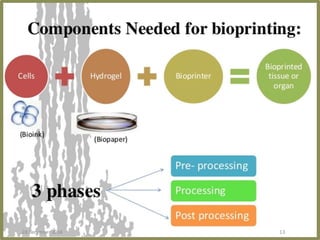
 BIO INK:
Bio-ink is a material made from living cells that
behaves much like a liquid, allowing to "print" it in order to
create a desired shape.
 BIO PAPER:
Bio paper can be defined as a biocompatible,
degradable, in situ cross linkable and biomimetic hydrogel
that is permissible to tissue fusion in order to serve as a
substrate for cell deposition in bio printing.
 BIO PRINTER:
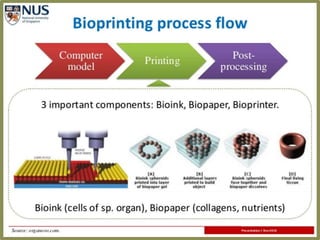
Bio printers can print complex 3D structures with
the combinations of “bio ink” and “bio paper”.
COMPONENTS:

PRE-PROCESSING:
 Pre-processing is the process of creating a model that
the printer will later create and choosing the materials
that will be used.
PROCESS:
PROCESSING:
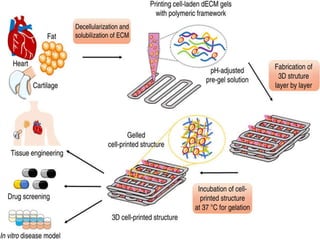
 Directed by software: Bio ink and cartridge of hydrogel
are loaded in the bio printer and printed on bio paper.
 Printers prints first layer of the water based gel,
collagen and second bio ink cells.

CONT.
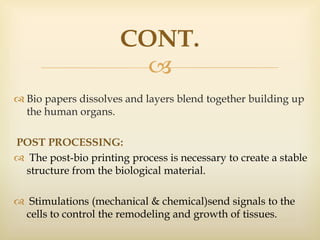
 Bio papers dissolves and layers blend together building up
the human organs.
POST PROCESSING:
 The post-bio printing process is necessary to create a stable
structure from the biological material.
 Stimulations (mechanical & chemical)send signals to the
cells to control the remodeling and growth of tissues.

ADVANTAGES:
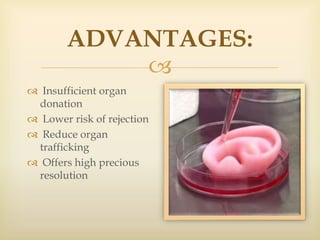
 Insufficient organ
donation
 Lower risk of rejection
 Reduce organ
trafficking
 Offers high precious
resolution

DIS ADVANTAGES:
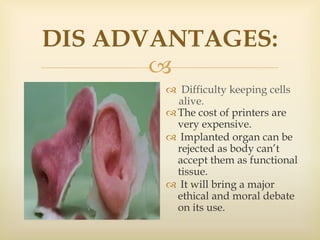
 Difficulty keeping cells
alive.
The cost of printers are
very expensive.
 Implanted organ can be
rejected as body can’t
accept them as functional
tissue.
 It will bring a major
ethical and moral debate
on its use.

 Tissue Engineering
vascularization is a key tissue in tissue
engineering that needs to be addressed because there is
a real and urgent need to engineer functional tissues.
 Drug delivery
4D bio printing enables the precise control of
the spatial distribution of different components that
can self-fold or self-unfold to encapsulate and release
drugs or cells in a programmable manner.
APPLICATIONS:
CONCLUSION:
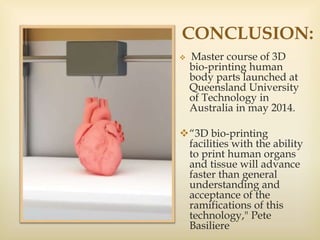
 Master course of 3D
bio-printing human
body parts launched at
Queensland University
of Technology in
Australia in may 2014.
“3D bio-printing
facilities with the ability
to print human organs
and tissue will advance
faster than general
understanding and
acceptance of the
ramifications of this
technology," Pete
Basiliere

THANK YOU

Bio printing

  • 2.
     OVERVIEW:  INTRODUCTION  COMPONENTS PROCESS  ADVANTAGES  DISADVANTAGES  APPLICATIONS  CONCLUSION
  • 3.
      Bio printingtechnology is developed by Gabor Forgacs, a biophysicist from university of Missouri in the US.  The technology involves the process of printing is done by using layer-by-layer manner approach to generate desired part of the body.  3D bio printing helps constructing living human tissues and organs.  According to NHS 6,977 people are waiting for transplants INTRODUCTION:
  • 5.
     3D & 4DBIO PRINTERS: 3D BIO PRINTER:  3D printing refers to various processes used to synthesize a three dimensional object .  It is also known as additive manufacturing (AM.  The technology is already successful with many applications in full operation and employing many diverse materials 4D BIO PRINTER:  4D printing is the printing of smart, environmentally responsive biological structures, tissues and organs.  4D bio printing begins with the printing of multiple cells or biological matrices resulting in structures
  • 6.
     BIO INK: Bio-inkis a material made from living cells that behaves much like a liquid, allowing to "print" it in order to create a desired shape.  BIO PAPER: Bio paper can be defined as a biocompatible, degradable, in situ cross linkable and biomimetic hydrogel that is permissible to tissue fusion in order to serve as a substrate for cell deposition in bio printing.  BIO PRINTER: Bio printers can print complex 3D structures with the combinations of “bio ink” and “bio paper”. COMPONENTS:
  • 8.
     PRE-PROCESSING:  Pre-processing isthe process of creating a model that the printer will later create and choosing the materials that will be used. PROCESS: PROCESSING:  Directed by software: Bio ink and cartridge of hydrogel are loaded in the bio printer and printed on bio paper.  Printers prints first layer of the water based gel, collagen and second bio ink cells.
  • 9.
     CONT.  Bio papersdissolves and layers blend together building up the human organs. POST PROCESSING:  The post-bio printing process is necessary to create a stable structure from the biological material.  Stimulations (mechanical & chemical)send signals to the cells to control the remodeling and growth of tissues.
  • 11.
     ADVANTAGES:  Insufficient organ donation Lower risk of rejection  Reduce organ trafficking  Offers high precious resolution
  • 12.
     DIS ADVANTAGES:  Difficultykeeping cells alive. The cost of printers are very expensive.  Implanted organ can be rejected as body can’t accept them as functional tissue.  It will bring a major ethical and moral debate on its use.
  • 13.
      Tissue Engineering vascularizationis a key tissue in tissue engineering that needs to be addressed because there is a real and urgent need to engineer functional tissues.  Drug delivery 4D bio printing enables the precise control of the spatial distribution of different components that can self-fold or self-unfold to encapsulate and release drugs or cells in a programmable manner. APPLICATIONS:
  • 14.
    CONCLUSION:  Master courseof 3D bio-printing human body parts launched at Queensland University of Technology in Australia in may 2014. “3D bio-printing facilities with the ability to print human organs and tissue will advance faster than general understanding and acceptance of the ramifications of this technology," Pete Basiliere
  • 15.