Rishabh Kataria
TECH TALK
3D BIO-
PRINTING
What’s it..?
3D bio-printing is a regenerative science and
process for generating spatially-controlled cell
patterns in 3D, where cell function and viability
are preserved within the printed construct.
Using 3D bio-printing for fabricating biological
constructs typically involves dispensing cells
onto a biocompatible scaffold using a
successive layer-by-layer approach to generate
tissue-like three-dimensional structures.
Why..?
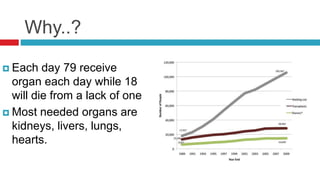
 Each day 79 receive
organ each day while 18
will die from a lack of one
 Most needed organs are
kidneys, livers, lungs,
hearts.
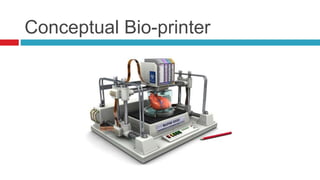
Conceptual Bio-printer
Bioprinter
The idea of 3d printers are from inkjet printers, driven by a
motor, moves in horizontal strips across a sheet of paper. As it
moves, ink stored in a cartridge sprays through tiny nozzles
and falls on the page in a series of fine drops. The limitation of
inkjet printers is that they only print in two dimensions -- along
the x- and y-axes. A 3-D printer overcomes this by adding a
mechanism to print along an additional axis, usually labeled
the z-axis in mathematical applications. This mechanism is
an elevator that moves a platform up and down. Fill the
cartridge with plastic, and the printer will output a three-
dimensional plastic widget. Fill it with cells, and it will output a
mass of cells.
Continues…
Conceptually, bio-printing is really that simple. In
reality, it's a bit more challenging because an
organ contains more than one type of material.
And because the material is living tissue, it needs
to receive nutrients and oxygen. To
accommodate this, bioprinting companies have
modified their 3-D printers to better serve the
medical community.
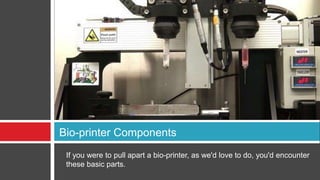
If you were to pull apart a bio-printer, as we'd love to do, you'd encounter
these basic parts.
Bio-printer Components
Print head mount
On a bio-printer, the print heads are
attached to a metal plate running along a
horizontal track. The x-axis motor propels the
metal plate (and the print heads) from side to
side, allowing material to be deposited in
either horizontal direction.
Elevator
A metal track running vertically at the
back of the machine, the elevator, driven by
the z-axis motor, moves the print heads up
and down. This makes it possible to stack
successive layers of material, one on top of
the next
Platform
A shelf at the bottom of the machine
provides a platform for the organ to rest on
during the production process. The platform
may support a scaffold, a petri dish or a well
plate, which could contain up to 24 small
depressions to hold organ tissue samples for
pharmaceutical testing. A third motor moves
the platform front to back along the y-axis
Reservoirs
The reservoirs attach to the print heads
and hold the biomaterial to be deposited
during the printing process. These are
equivalent to the cartridges in your inkjet
printer.
Print heads/syringes
A pump forces material from the
reservoirs down through a small nozzle or
syringe, which is positioned just above the
platform. As the material is extruded, it forms a
layer on the platform.
Triangulation sensor
A small sensor tracks the tip of each
print head as it moves along the x ,y and z-
axes. Software communicates with the
machine so the precise location of the print
heads is known throughout the process..
Micro-gel
Unlike the ink you load into your printer at home,
bio-ink is alive, so it needs food, water and
oxygen to survive. This nurturing environment is
provided by a micro-gel think gelatin enriched
with vitamins, proteins and other life-sustaining
compounds. Researchers either mix cells with the
gel before printing or extrude the cells from one
print head, micro-gel from the other. Either way,
the gel helps the cells stay suspended and
prevents them from settling and clumping.
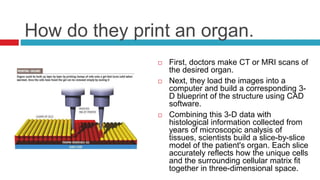
How do they print an organ.
 First, doctors make CT or MRI scans of
the desired organ.
 Next, they load the images into a
computer and build a corresponding 3-
D blueprint of the structure using CAD
software.
 Combining this 3-D data with
histological information collected from
years of microscopic analysis of
tissues, scientists build a slice-by-slice
model of the patient's organ. Each slice
accurately reflects how the unique cells
and the surrounding cellular matrix fit
together in three-dimensional space.
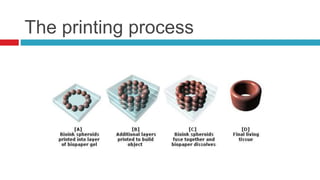
The printing process
Benefits
 Artificial organ personalized using
patients own cells
 No DNA rejection
 Eliminate organ donation
 Can give you another life
 No waiting period
Disadvantages
 Printers cost hundreds of thousands of
dollars
 Possibly more expensive than regular
organ transplant
 Use of stem cells is still controversial
 Cost of using stem cells
Just look through some bioprinting projects which gonna going to
change the world
3d bio-printing projects
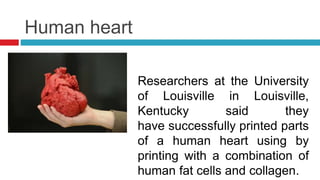
Human heart
Researchers at the University
of Louisville in Louisville,
Kentucky said they
have successfully printed parts
of a human heart using by
printing with a combination of
human fat cells and collagen.
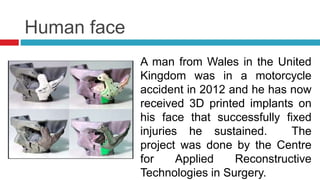
Human face
A man from Wales in the United
Kingdom was in a motorcycle
accident in 2012 and he has now
received 3D printed implants on
his face that successfully fixed
injuries he sustained. The
project was done by the Centre
for Applied Reconstructive
Technologies in Surgery.
Liver tissue
In January, Organovo successfully
printed samples of human liver tissue that
were distributed to an outside laboratory for
testing. The company is aiming for
commercial sales later this year. The sets
of 24 samples take about 30 minutes to
produce. According to the company, the
printed tissue responds to drugs similarly to
a regular human liver.
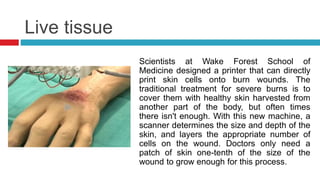
Live tissue
Scientists at Wake Forest School of
Medicine designed a printer that can directly
print skin cells onto burn wounds. The
traditional treatment for severe burns is to
cover them with healthy skin harvested from
another part of the body, but often times
there isn't enough. With this new machine, a
scanner determines the size and depth of the
skin, and layers the appropriate number of
cells on the wound. Doctors only need a
patch of skin one-tenth of the size of the
wound to grow enough for this process.
Rishabh Kataria
THANK YOU

3dbio printing

  • 1.
  • 2.
  • 3.
    What’s it..? 3D bio-printingis a regenerative science and process for generating spatially-controlled cell patterns in 3D, where cell function and viability are preserved within the printed construct. Using 3D bio-printing for fabricating biological constructs typically involves dispensing cells onto a biocompatible scaffold using a successive layer-by-layer approach to generate tissue-like three-dimensional structures.
  • 4.
    Why..?  Each day79 receive organ each day while 18 will die from a lack of one  Most needed organs are kidneys, livers, lungs, hearts.
  • 5.
  • 6.
    Bioprinter The idea of3d printers are from inkjet printers, driven by a motor, moves in horizontal strips across a sheet of paper. As it moves, ink stored in a cartridge sprays through tiny nozzles and falls on the page in a series of fine drops. The limitation of inkjet printers is that they only print in two dimensions -- along the x- and y-axes. A 3-D printer overcomes this by adding a mechanism to print along an additional axis, usually labeled the z-axis in mathematical applications. This mechanism is an elevator that moves a platform up and down. Fill the cartridge with plastic, and the printer will output a three- dimensional plastic widget. Fill it with cells, and it will output a mass of cells.
  • 7.
    Continues… Conceptually, bio-printing isreally that simple. In reality, it's a bit more challenging because an organ contains more than one type of material. And because the material is living tissue, it needs to receive nutrients and oxygen. To accommodate this, bioprinting companies have modified their 3-D printers to better serve the medical community.
  • 8.
    If you wereto pull apart a bio-printer, as we'd love to do, you'd encounter these basic parts. Bio-printer Components
  • 9.
    Print head mount Ona bio-printer, the print heads are attached to a metal plate running along a horizontal track. The x-axis motor propels the metal plate (and the print heads) from side to side, allowing material to be deposited in either horizontal direction.
  • 10.
    Elevator A metal trackrunning vertically at the back of the machine, the elevator, driven by the z-axis motor, moves the print heads up and down. This makes it possible to stack successive layers of material, one on top of the next
  • 11.
    Platform A shelf atthe bottom of the machine provides a platform for the organ to rest on during the production process. The platform may support a scaffold, a petri dish or a well plate, which could contain up to 24 small depressions to hold organ tissue samples for pharmaceutical testing. A third motor moves the platform front to back along the y-axis
  • 12.
    Reservoirs The reservoirs attachto the print heads and hold the biomaterial to be deposited during the printing process. These are equivalent to the cartridges in your inkjet printer.
  • 13.
    Print heads/syringes A pumpforces material from the reservoirs down through a small nozzle or syringe, which is positioned just above the platform. As the material is extruded, it forms a layer on the platform.
  • 14.
    Triangulation sensor A smallsensor tracks the tip of each print head as it moves along the x ,y and z- axes. Software communicates with the machine so the precise location of the print heads is known throughout the process..
  • 15.
    Micro-gel Unlike the inkyou load into your printer at home, bio-ink is alive, so it needs food, water and oxygen to survive. This nurturing environment is provided by a micro-gel think gelatin enriched with vitamins, proteins and other life-sustaining compounds. Researchers either mix cells with the gel before printing or extrude the cells from one print head, micro-gel from the other. Either way, the gel helps the cells stay suspended and prevents them from settling and clumping.
  • 16.
    How do theyprint an organ.  First, doctors make CT or MRI scans of the desired organ.  Next, they load the images into a computer and build a corresponding 3- D blueprint of the structure using CAD software.  Combining this 3-D data with histological information collected from years of microscopic analysis of tissues, scientists build a slice-by-slice model of the patient's organ. Each slice accurately reflects how the unique cells and the surrounding cellular matrix fit together in three-dimensional space.
  • 17.
  • 18.
    Benefits  Artificial organpersonalized using patients own cells  No DNA rejection  Eliminate organ donation  Can give you another life  No waiting period
  • 19.
    Disadvantages  Printers costhundreds of thousands of dollars  Possibly more expensive than regular organ transplant  Use of stem cells is still controversial  Cost of using stem cells
  • 20.
    Just look throughsome bioprinting projects which gonna going to change the world 3d bio-printing projects
  • 21.
    Human heart Researchers atthe University of Louisville in Louisville, Kentucky said they have successfully printed parts of a human heart using by printing with a combination of human fat cells and collagen.
  • 22.
    Human face A manfrom Wales in the United Kingdom was in a motorcycle accident in 2012 and he has now received 3D printed implants on his face that successfully fixed injuries he sustained. The project was done by the Centre for Applied Reconstructive Technologies in Surgery.
  • 23.
    Liver tissue In January,Organovo successfully printed samples of human liver tissue that were distributed to an outside laboratory for testing. The company is aiming for commercial sales later this year. The sets of 24 samples take about 30 minutes to produce. According to the company, the printed tissue responds to drugs similarly to a regular human liver.
  • 24.
    Live tissue Scientists atWake Forest School of Medicine designed a printer that can directly print skin cells onto burn wounds. The traditional treatment for severe burns is to cover them with healthy skin harvested from another part of the body, but often times there isn't enough. With this new machine, a scanner determines the size and depth of the skin, and layers the appropriate number of cells on the wound. Doctors only need a patch of skin one-tenth of the size of the wound to grow enough for this process.
  • 25.