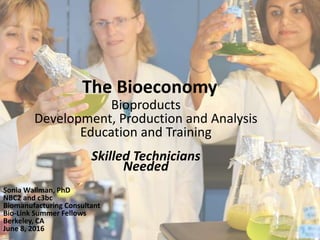
The Bioeconomy
Bioproducts
Development, Production and Analysis
Education and Training
Skilled Technicians
Needed
Sonia Wallman, PhD
NBC2 and c3bc
Biomanufacturing Consultant
Bio-Link Summer Fellows
Berkeley, CA
June 8, 2016
History of Northeast Biomanufacturing
Collaborative and Center
Since 2003, working with biomanufacturing employers to define
the skills, knowledge and abilities (SKAs) needed by technicians to
develop, produce and analyze bioproducts. Starting with
biopharmaceutical production and analysis in 2003, 2007 and
2013; with biofuels in 2013 and finishing up with industrial
biotechnology in 2015 (and 2016), we will synthesized these inputs
from local (and global) employers into a single set of SKAs to
educate and train technicians to support the development and
growth of the bioeconomy. The synthesis of these inputs on what
biotechnicians need to know and do is driving the production of
hands-on and online curriculum and instructional materials,
including laboratory manuals, textbooks and virtual industrial
modules to facilitate deep understanding of what is required by
technicians to biomanufacture bioproducts, creating an
awareness of the many career pathways in biomanufacturing.
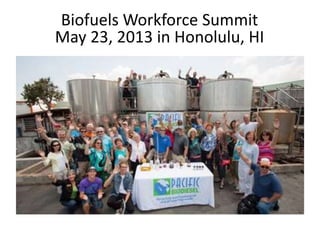
Biofuels Workforce Summit
May 23, 2013 in Honolulu, HI
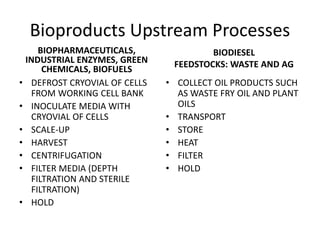
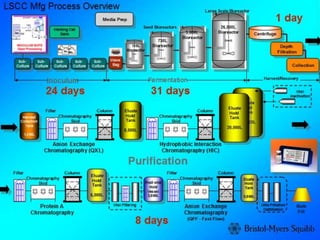
Bioproducts Upstream Processes
BIOPHARMACEUTICALS,
INDUSTRIAL ENZYMES, GREEN
CHEMICALS, BIOFUELS
• DEFROST CRYOVIAL OF CELLS
FROM WORKING CELL BANK
• INOCULATE MEDIA WITH
CRYOVIAL OF CELLS
• SCALE-UP
• HARVEST
• CENTRIFUGATION
• FILTER MEDIA (DEPTH
FILTRATION AND STERILE
FILTRATION)
• HOLD
BIODIESEL
FEEDSTOCKS: WASTE AND AG
• COLLECT OIL PRODUCTS SUCH
AS WASTE FRY OIL AND PLANT
OILS
• TRANSPORT
• STORE
• HEAT
• FILTER
• HOLD
Bioproducts Downstream Processes
BIOPHARMACEUTICALS,
INDUSTRIAL ENZYMES, GREEN
CHEMICALS, BIOENERGY
• DEPTH FILTRATION
• LIQUID COLUMN
CHROMATOGRAPHY (ION
EXCHANGE, AFFINITY,
HYDROPHOBIC
INTERACTION=HIC, SIZE
EXCLUSION=GEL FILTRATION)
• TANGENTIAL FLOW
FILTRATION
• STERILE FILTRATION
• COLLECT BATCH
• FORMULATE, FILL AND FINISH
(for biopharmaceuticals)
• DISTRIBUTE
BIODIESEL
FEEDSTOCKS: WASTE AND AG
• TRANSESTERIFY OIL WITH
ALKALINE CATALYST AND
METHANOL INTO FAME (FATTY
ACID METHYL ESTERS=BIODIESEL)
• SEPARATE INTO FAME-MeOH AND
GLYCEROL-MeOH LAYERS
• DISTILL MeOH FROM BOTH
LAYERS – RECYCLE MeOH
• WATER WASH FAME LAYER AND
FILTER OR DISTILL AT HIGH
VACUUM
• DISTRIBUTE BIODIESEL
• SELL GLYCEROL CRUDE OR
PURIFIED BY HIGH VACUUM
DISTILLATION
Pacific Biodiesel (Big Island Biodiesel)
5M gallon/year Fry Oil to Biodiesel Facility
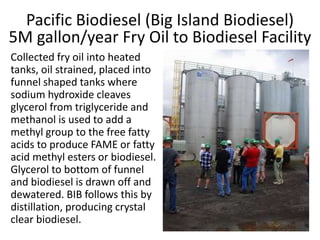
Collected fry oil into heated
tanks, oil strained, placed into
funnel shaped tanks where
sodium hydroxide cleaves
glycerol from triglyceride and
methanol is used to add a
methyl group to the free fatty
acids to produce FAME or fatty
acid methyl esters or biodiesel.
Glycerol to bottom of funnel
and biodiesel is drawn off and
dewatered. BIB follows this by
distillation, producing crystal
clear biodiesel.
Vessels and Pumps
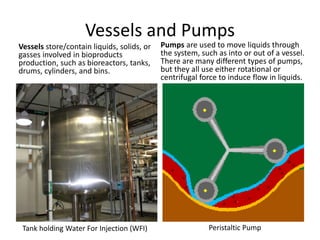
Vessels store/contain liquids, solids, or
gasses involved in bioproducts
production, such as bioreactors, tanks,
drums, cylinders, and bins.
Pumps are used to move liquids through
the system, such as into or out of a vessel.
There are many different types of pumps,
but they all use either rotational or
centrifugal force to induce flow in liquids.
Tank holding Water For Injection (WFI) Peristaltic Pump
Compressors, Fans and Motors
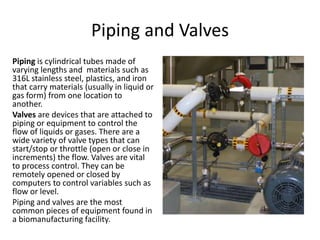
Piping and Valves
Piping is cylindrical tubes made of
varying lengths and materials such as
316L stainless steel, plastics, and iron
that carry materials (usually in liquid or
gas form) from one location to
another.
Valves are devices that are attached to
piping or equipment to control the
flow of liquids or gases. There are a
wide variety of valve types that can
start/stop or throttle (open or close in
increments) the flow. Valves are vital
to process control. They can be
remotely opened or closed by
computers to control variables such as
flow or level.
Piping and valves are the most
common pieces of equipment found in
a biomanufacturing facility.
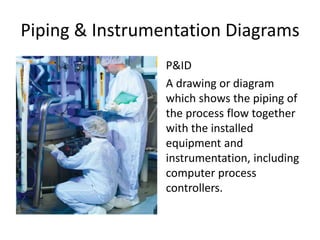
Piping & Instrumentation Diagrams
P&ID
A drawing or diagram
which shows the piping of
the process flow together
with the installed
equipment and
instrumentation, including
computer process
controllers.
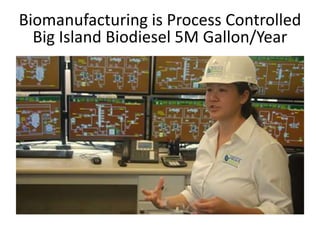
Biomanufacturing is Process Controlled
Big Island Biodiesel 5M Gallon/Year
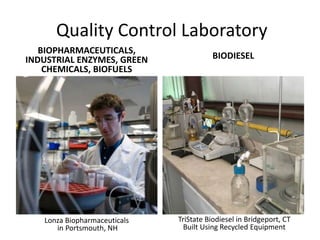
Quality Control Laboratory
BIOPHARMACEUTICALS,
INDUSTRIAL ENZYMES, GREEN
CHEMICALS, BIOFUELS
BIODIESEL
TriState Biodiesel in Bridgeport, CT
Built Using Recycled Equipment
Lonza Biopharmaceuticals
in Portsmouth, NH
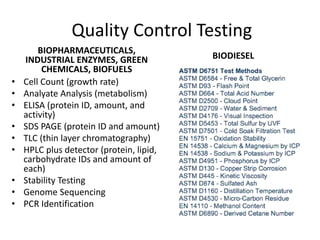
Quality Control Testing
BIOPHARMACEUTICALS,
INDUSTRIAL ENZYMES, GREEN
CHEMICALS, BIOFUELS
BIODIESEL
• Cell Count (growth rate)
• Analyate Analysis (metabolism)
• ELISA (protein ID, amount, and
activity)
• SDS PAGE (protein ID and amount)
• TLC (thin layer chromatography)
• HPLC plus detector (protein, lipid,
carbohydrate IDs and amount of
each)
• Stability Testing
• Genome Sequencing
• PCR Identification
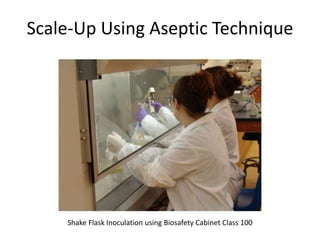
Scale-Up Using Aseptic Technique
Shake Flask Inoculation using Biosafety Cabinet Class 100
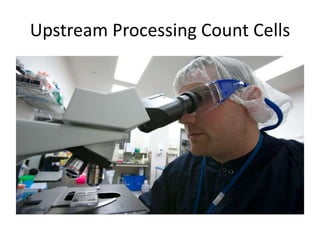
Upstream Processing Count Cells
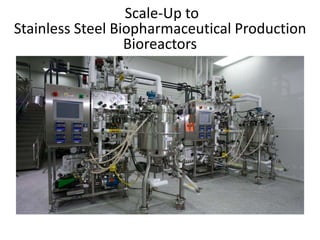
Scale-Up to
Stainless Steel Biopharmaceutical Production
Bioreactors
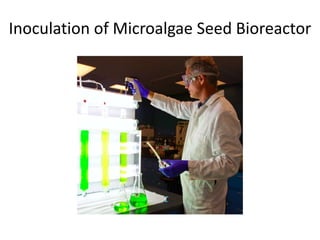
Inoculation of Microalgae Seed Bioreactor
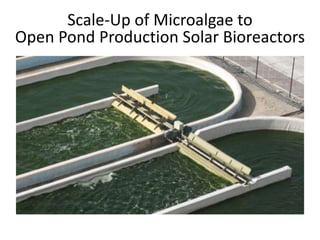
Scale-Up of Microalgae to
Open Pond Production Solar Bioreactors
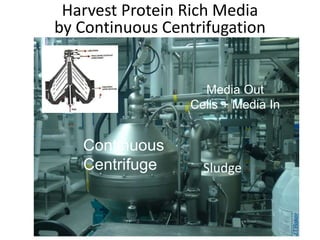
Sludge
Continuous
Centrifuge
Media Out
Cells + Media In
Harvest Protein Rich Media
by Continuous Centrifugation
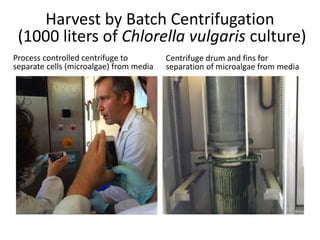
Harvest by Batch Centrifugation
(1000 liters of Chlorella vulgaris culture)
Process controlled centrifuge to
separate cells (microalgae) from media
Centrifuge drum and fins for
separation of microalgae from media
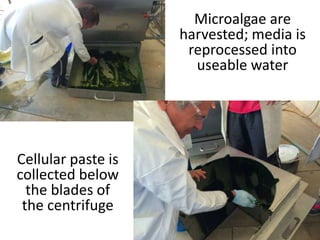
Cellular paste is
collected below
the blades of
the centrifuge
Microalgae are
harvested; media is
reprocessed into
useable water
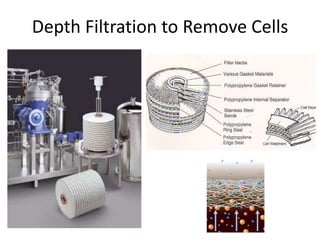
Depth Filtration to Remove Cells
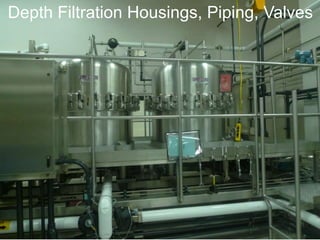
Depth Filtration Housings, Piping, Valves
Tangential Flow Filtration (TFF) for
Separation and Concentration
Using TFF with the right cut off filters, the biologic of interest
can be separated from other thing
For instance HSA has a molecular weight of 69KD. To make
sure that the protein of interest is retained, a 10KD cut-off
filter is used.
After ultrafiltration, we can diafilter, adding the phosphate
buffer at pH 7.1 that we will also use to equilibrate our
affinity column to prepare it for affinity chromatography of
HSA.
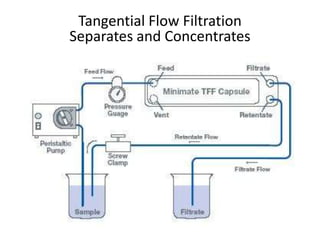
Tangential Flow Filtration
Separates and Concentrates
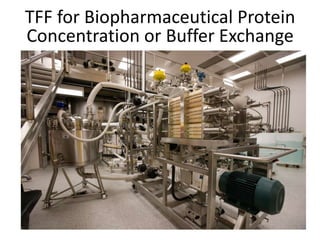
TFF for Biopharmaceutical Protein
Concentration or Buffer Exchange
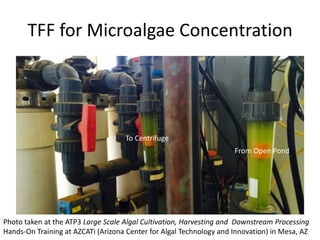
TFF for Microalgae Concentration
Photo taken at the ATP3 Large Scale Algal Cultivation, Harvesting and Downstream Processing
Hands-On Training at AZCATi (Arizona Center for Algal Technology and Innovation) in Mesa, AZ
From Open Pond
To Centrifuge
Chromatography for Purification and
Quality Control Chemistry of the Protein,
Lipid or Carbohydrate of Interest
Separation Science Used for Downstream Processes
and for Quality Control Chemistry Monitoring of both
Upstream and Downstream Processes
Stationary Media and Moving Buffer System
Result in Competition and Separation
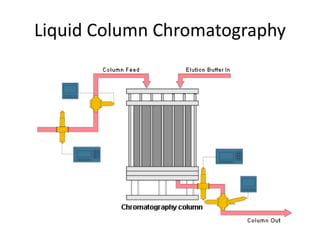
Liquid Column Chromatography
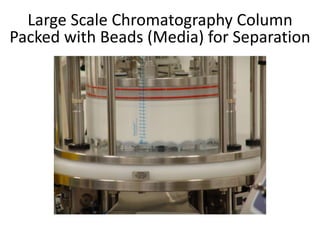
Large Scale Chromatography Column
Packed with Beads (Media) for Separation
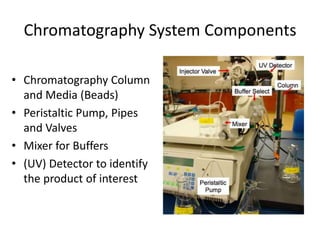
Chromatography System Components
• Chromatography Column
and Media (Beads)
• Peristaltic Pump, Pipes
and Valves
• Mixer for Buffers
• (UV) Detector to identify
the product of interest
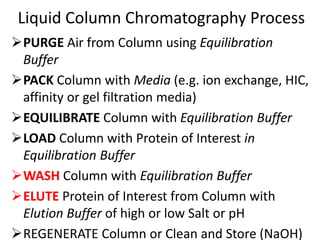
Liquid Column Chromatography Process
PURGE Air from Column using Equilibration
Buffer
PACK Column with Media (e.g. ion exchange, HIC,
affinity or gel filtration media)
EQUILIBRATE Column with Equilibration Buffer
LOAD Column with Protein of Interest in
Equilibration Buffer
WASH Column with Equilibration Buffer
ELUTE Protein of Interest from Column with
Elution Buffer of high or low Salt or pH
REGENERATE Column or Clean and Store (NaOH)
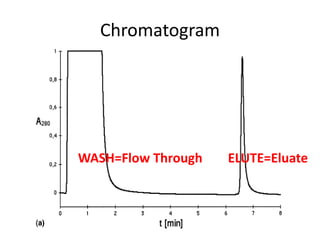
Chromatogram
WASH=Flow Through ELUTE=Eluate
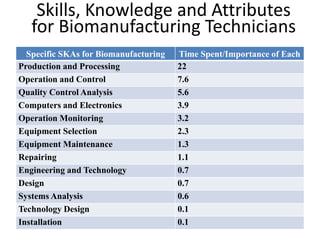
Skills, Knowledge and Attributes
for Biomanufacturing Technicians
Specific SKAs for Biomanufacturing Time Spent/Importance of Each
Production and Processing 22
Operation and Control 7.6
Quality Control Analysis 5.6
Computers and Electronics 3.9
Operation Monitoring 3.2
Equipment Selection 2.3
Equipment Maintenance 1.3
Repairing 1.1
Engineering and Technology 0.7
Design 0.7
Systems Analysis 0.6
Technology Design 0.1
Installation 0.1
Lab Science, Medical Devices and
Biomanufacturing
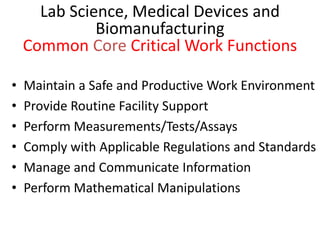
Common Core Critical Work Functions
• Maintain a Safe and Productive Work Environment
• Provide Routine Facility Support
• Perform Measurements/Tests/Assays
• Comply with Applicable Regulations and Standards
• Manage and Communicate Information
• Perform Mathematical Manipulations
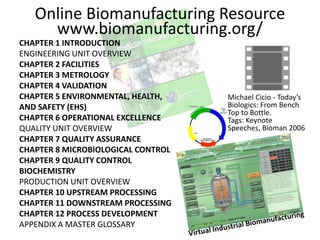
Online Biomanufacturing Resource
www.biomanufacturing.org/
CHAPTER 1 INTRODUCTION
ENGINEERING UNIT OVERVIEW
CHAPTER 2 FACILITIES
CHAPTER 3 METROLOGY
CHAPTER 4 VALIDATION
CHAPTER 5 ENVIRONMENTAL, HEALTH,
AND SAFETY (EHS)
CHAPTER 6 OPERATIONAL EXCELLENCE
QUALITY UNIT OVERVIEW
CHAPTER 7 QUALITY ASSURANCE
CHAPTER 8 MICROBIOLOGICAL CONTROL
CHAPTER 9 QUALITY CONTROL
BIOCHEMISTRY
PRODUCTION UNIT OVERVIEW
CHAPTER 10 UPSTREAM PROCESSING
CHAPTER 11 DOWNSTREAM PROCESSING
CHAPTER 12 PROCESS DEVELOPMENT
APPENDIX A MASTER GLOSSARY
Michael Cicio - Today’s
Biologics: From Bench
Top to Bottle.
Tags: Keynote
Speeches, Bioman 2006
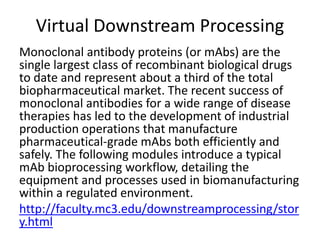
Virtual Downstream Processing
Monoclonal antibody proteins (or mAbs) are the
single largest class of recombinant biological drugs
to date and represent about a third of the total
biopharmaceutical market. The recent success of
monoclonal antibodies for a wide range of disease
therapies has led to the development of industrial
production operations that manufacture
pharmaceutical-grade mAbs both efficiently and
safely. The following modules introduce a typical
mAb bioprocessing workflow, detailing the
equipment and processes used in biomanufacturing
within a regulated environment.
http://faculty.mc3.edu/downstreamprocessing/stor
y.html
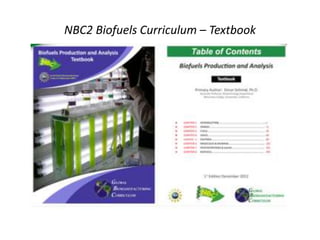
NBC2 Biofuels Curriculum – Textbook
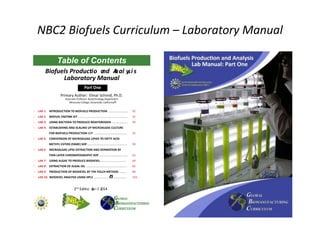
NBC2 Biofuels Curriculum – Laboratory Manual
Table of Contents
► LAB 1: INTRODUCTION TO BIOFUELS PRODUCTION ........................ 05
► LAB 2: BIOFUEL ENZYME KIT ............................................................. 25
► LAB 3: USING BACTERIA TO PRODUCE BIOHYDROGEN ................... 39
► LAB 4: ESTABLISHING AND SCALING UP MICROALGAE CULTURE
FOR BIOFUELS PRODUCTION SOP ........................................ 55
► LAB 5: CONVERSION OF MICROALGAE LIPIDS TO FATTY ACID
METHYL ESTERS (FAME) SOP.................................................. 59
► LAB 6: MICROALGAE LIPID EXTRACTION AND SEPARATION BY
THIN LAYER CHROMATOGRAPHY SOP.................................... 63
► LAB 7: USING ALGAE TO PRODUCE BIODIESEL................................ 69
► LAB 8: EXTRACTION OF ALGAL OIL .................................................. 83
► LAB 9: PRODUCTION OF BIODIESEL BY THE FOLCH METHOD ......... 89
► LAB 10: BIODIESEL ANALYSIS USING HPLC ........................................ 103
Biofuels Productio
n
and Anal ysis
Laboratory Manual
Primary Author: Elmar Schmid, Ph.D.
Associate Professor, Biotechnology Department
Miracosta College, Oceanside, California
2nd
Editio
n
Apr il 2014
Part One
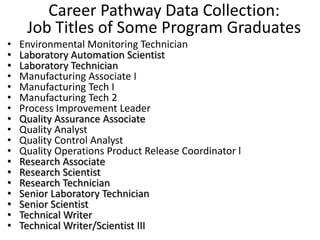
Career Pathway Data Collection:
Job Titles of Some Program Graduates
• Environmental Monitoring Technician
• Laboratory Automation Scientist
• Laboratory Technician
• Manufacturing Associate I
• Manufacturing Tech I
• Manufacturing Tech 2
• Process Improvement Leader
• Quality Assurance Associate
• Quality Analyst
• Quality Control Analyst
• Quality Operations Product Release Coordinator l
• Research Associate
• Research Scientist
• Research Technician
• Senior Laboratory Technician
• Senior Scientist
• Technical Writer
• Technical Writer/Scientist III

Biomanufacturing 2016

  • 1.
    The Bioeconomy Bioproducts Development, Productionand Analysis Education and Training Skilled Technicians Needed Sonia Wallman, PhD NBC2 and c3bc Biomanufacturing Consultant Bio-Link Summer Fellows Berkeley, CA June 8, 2016
  • 2.
    History of NortheastBiomanufacturing Collaborative and Center Since 2003, working with biomanufacturing employers to define the skills, knowledge and abilities (SKAs) needed by technicians to develop, produce and analyze bioproducts. Starting with biopharmaceutical production and analysis in 2003, 2007 and 2013; with biofuels in 2013 and finishing up with industrial biotechnology in 2015 (and 2016), we will synthesized these inputs from local (and global) employers into a single set of SKAs to educate and train technicians to support the development and growth of the bioeconomy. The synthesis of these inputs on what biotechnicians need to know and do is driving the production of hands-on and online curriculum and instructional materials, including laboratory manuals, textbooks and virtual industrial modules to facilitate deep understanding of what is required by technicians to biomanufacture bioproducts, creating an awareness of the many career pathways in biomanufacturing.
  • 3.
    Biofuels Workforce Summit May23, 2013 in Honolulu, HI
  • 4.
    Bioproducts Upstream Processes BIOPHARMACEUTICALS, INDUSTRIALENZYMES, GREEN CHEMICALS, BIOFUELS • DEFROST CRYOVIAL OF CELLS FROM WORKING CELL BANK • INOCULATE MEDIA WITH CRYOVIAL OF CELLS • SCALE-UP • HARVEST • CENTRIFUGATION • FILTER MEDIA (DEPTH FILTRATION AND STERILE FILTRATION) • HOLD BIODIESEL FEEDSTOCKS: WASTE AND AG • COLLECT OIL PRODUCTS SUCH AS WASTE FRY OIL AND PLANT OILS • TRANSPORT • STORE • HEAT • FILTER • HOLD
  • 5.
    Bioproducts Downstream Processes BIOPHARMACEUTICALS, INDUSTRIALENZYMES, GREEN CHEMICALS, BIOENERGY • DEPTH FILTRATION • LIQUID COLUMN CHROMATOGRAPHY (ION EXCHANGE, AFFINITY, HYDROPHOBIC INTERACTION=HIC, SIZE EXCLUSION=GEL FILTRATION) • TANGENTIAL FLOW FILTRATION • STERILE FILTRATION • COLLECT BATCH • FORMULATE, FILL AND FINISH (for biopharmaceuticals) • DISTRIBUTE BIODIESEL FEEDSTOCKS: WASTE AND AG • TRANSESTERIFY OIL WITH ALKALINE CATALYST AND METHANOL INTO FAME (FATTY ACID METHYL ESTERS=BIODIESEL) • SEPARATE INTO FAME-MeOH AND GLYCEROL-MeOH LAYERS • DISTILL MeOH FROM BOTH LAYERS – RECYCLE MeOH • WATER WASH FAME LAYER AND FILTER OR DISTILL AT HIGH VACUUM • DISTRIBUTE BIODIESEL • SELL GLYCEROL CRUDE OR PURIFIED BY HIGH VACUUM DISTILLATION
  • 6.
    Pacific Biodiesel (BigIsland Biodiesel) 5M gallon/year Fry Oil to Biodiesel Facility Collected fry oil into heated tanks, oil strained, placed into funnel shaped tanks where sodium hydroxide cleaves glycerol from triglyceride and methanol is used to add a methyl group to the free fatty acids to produce FAME or fatty acid methyl esters or biodiesel. Glycerol to bottom of funnel and biodiesel is drawn off and dewatered. BIB follows this by distillation, producing crystal clear biodiesel.
  • 7.
    Vessels and Pumps Vesselsstore/contain liquids, solids, or gasses involved in bioproducts production, such as bioreactors, tanks, drums, cylinders, and bins. Pumps are used to move liquids through the system, such as into or out of a vessel. There are many different types of pumps, but they all use either rotational or centrifugal force to induce flow in liquids. Tank holding Water For Injection (WFI) Peristaltic Pump
  • 8.
  • 9.
    Piping and Valves Pipingis cylindrical tubes made of varying lengths and materials such as 316L stainless steel, plastics, and iron that carry materials (usually in liquid or gas form) from one location to another. Valves are devices that are attached to piping or equipment to control the flow of liquids or gases. There are a wide variety of valve types that can start/stop or throttle (open or close in increments) the flow. Valves are vital to process control. They can be remotely opened or closed by computers to control variables such as flow or level. Piping and valves are the most common pieces of equipment found in a biomanufacturing facility.
  • 10.
    Piping & InstrumentationDiagrams P&ID A drawing or diagram which shows the piping of the process flow together with the installed equipment and instrumentation, including computer process controllers.
  • 11.
    Biomanufacturing is ProcessControlled Big Island Biodiesel 5M Gallon/Year
  • 12.
    Quality Control Laboratory BIOPHARMACEUTICALS, INDUSTRIALENZYMES, GREEN CHEMICALS, BIOFUELS BIODIESEL TriState Biodiesel in Bridgeport, CT Built Using Recycled Equipment Lonza Biopharmaceuticals in Portsmouth, NH
  • 13.
    Quality Control Testing BIOPHARMACEUTICALS, INDUSTRIALENZYMES, GREEN CHEMICALS, BIOFUELS BIODIESEL • Cell Count (growth rate) • Analyate Analysis (metabolism) • ELISA (protein ID, amount, and activity) • SDS PAGE (protein ID and amount) • TLC (thin layer chromatography) • HPLC plus detector (protein, lipid, carbohydrate IDs and amount of each) • Stability Testing • Genome Sequencing • PCR Identification
  • 15.
    Scale-Up Using AsepticTechnique Shake Flask Inoculation using Biosafety Cabinet Class 100
  • 16.
  • 17.
    Scale-Up to Stainless SteelBiopharmaceutical Production Bioreactors
  • 18.
  • 19.
    Scale-Up of Microalgaeto Open Pond Production Solar Bioreactors
  • 20.
    Sludge Continuous Centrifuge Media Out Cells +Media In Harvest Protein Rich Media by Continuous Centrifugation
  • 21.
    Harvest by BatchCentrifugation (1000 liters of Chlorella vulgaris culture) Process controlled centrifuge to separate cells (microalgae) from media Centrifuge drum and fins for separation of microalgae from media
  • 22.
    Cellular paste is collectedbelow the blades of the centrifuge Microalgae are harvested; media is reprocessed into useable water
  • 24.
    Depth Filtration toRemove Cells
  • 25.
  • 26.
    Tangential Flow Filtration(TFF) for Separation and Concentration Using TFF with the right cut off filters, the biologic of interest can be separated from other thing For instance HSA has a molecular weight of 69KD. To make sure that the protein of interest is retained, a 10KD cut-off filter is used. After ultrafiltration, we can diafilter, adding the phosphate buffer at pH 7.1 that we will also use to equilibrate our affinity column to prepare it for affinity chromatography of HSA.
  • 27.
  • 28.
    TFF for BiopharmaceuticalProtein Concentration or Buffer Exchange
  • 29.
    TFF for MicroalgaeConcentration Photo taken at the ATP3 Large Scale Algal Cultivation, Harvesting and Downstream Processing Hands-On Training at AZCATi (Arizona Center for Algal Technology and Innovation) in Mesa, AZ From Open Pond To Centrifuge
  • 30.
    Chromatography for Purificationand Quality Control Chemistry of the Protein, Lipid or Carbohydrate of Interest Separation Science Used for Downstream Processes and for Quality Control Chemistry Monitoring of both Upstream and Downstream Processes Stationary Media and Moving Buffer System Result in Competition and Separation
  • 31.
  • 32.
    Large Scale ChromatographyColumn Packed with Beads (Media) for Separation
  • 33.
    Chromatography System Components •Chromatography Column and Media (Beads) • Peristaltic Pump, Pipes and Valves • Mixer for Buffers • (UV) Detector to identify the product of interest
  • 34.
    Liquid Column ChromatographyProcess PURGE Air from Column using Equilibration Buffer PACK Column with Media (e.g. ion exchange, HIC, affinity or gel filtration media) EQUILIBRATE Column with Equilibration Buffer LOAD Column with Protein of Interest in Equilibration Buffer WASH Column with Equilibration Buffer ELUTE Protein of Interest from Column with Elution Buffer of high or low Salt or pH REGENERATE Column or Clean and Store (NaOH)
  • 35.
  • 36.
    Skills, Knowledge andAttributes for Biomanufacturing Technicians Specific SKAs for Biomanufacturing Time Spent/Importance of Each Production and Processing 22 Operation and Control 7.6 Quality Control Analysis 5.6 Computers and Electronics 3.9 Operation Monitoring 3.2 Equipment Selection 2.3 Equipment Maintenance 1.3 Repairing 1.1 Engineering and Technology 0.7 Design 0.7 Systems Analysis 0.6 Technology Design 0.1 Installation 0.1
  • 37.
    Lab Science, MedicalDevices and Biomanufacturing Common Core Critical Work Functions • Maintain a Safe and Productive Work Environment • Provide Routine Facility Support • Perform Measurements/Tests/Assays • Comply with Applicable Regulations and Standards • Manage and Communicate Information • Perform Mathematical Manipulations
  • 38.
    Online Biomanufacturing Resource www.biomanufacturing.org/ CHAPTER1 INTRODUCTION ENGINEERING UNIT OVERVIEW CHAPTER 2 FACILITIES CHAPTER 3 METROLOGY CHAPTER 4 VALIDATION CHAPTER 5 ENVIRONMENTAL, HEALTH, AND SAFETY (EHS) CHAPTER 6 OPERATIONAL EXCELLENCE QUALITY UNIT OVERVIEW CHAPTER 7 QUALITY ASSURANCE CHAPTER 8 MICROBIOLOGICAL CONTROL CHAPTER 9 QUALITY CONTROL BIOCHEMISTRY PRODUCTION UNIT OVERVIEW CHAPTER 10 UPSTREAM PROCESSING CHAPTER 11 DOWNSTREAM PROCESSING CHAPTER 12 PROCESS DEVELOPMENT APPENDIX A MASTER GLOSSARY Michael Cicio - Today’s Biologics: From Bench Top to Bottle. Tags: Keynote Speeches, Bioman 2006
  • 39.
    Virtual Downstream Processing Monoclonalantibody proteins (or mAbs) are the single largest class of recombinant biological drugs to date and represent about a third of the total biopharmaceutical market. The recent success of monoclonal antibodies for a wide range of disease therapies has led to the development of industrial production operations that manufacture pharmaceutical-grade mAbs both efficiently and safely. The following modules introduce a typical mAb bioprocessing workflow, detailing the equipment and processes used in biomanufacturing within a regulated environment. http://faculty.mc3.edu/downstreamprocessing/stor y.html
  • 40.
  • 41.
    NBC2 Biofuels Curriculum– Laboratory Manual Table of Contents ► LAB 1: INTRODUCTION TO BIOFUELS PRODUCTION ........................ 05 ► LAB 2: BIOFUEL ENZYME KIT ............................................................. 25 ► LAB 3: USING BACTERIA TO PRODUCE BIOHYDROGEN ................... 39 ► LAB 4: ESTABLISHING AND SCALING UP MICROALGAE CULTURE FOR BIOFUELS PRODUCTION SOP ........................................ 55 ► LAB 5: CONVERSION OF MICROALGAE LIPIDS TO FATTY ACID METHYL ESTERS (FAME) SOP.................................................. 59 ► LAB 6: MICROALGAE LIPID EXTRACTION AND SEPARATION BY THIN LAYER CHROMATOGRAPHY SOP.................................... 63 ► LAB 7: USING ALGAE TO PRODUCE BIODIESEL................................ 69 ► LAB 8: EXTRACTION OF ALGAL OIL .................................................. 83 ► LAB 9: PRODUCTION OF BIODIESEL BY THE FOLCH METHOD ......... 89 ► LAB 10: BIODIESEL ANALYSIS USING HPLC ........................................ 103 Biofuels Productio n and Anal ysis Laboratory Manual Primary Author: Elmar Schmid, Ph.D. Associate Professor, Biotechnology Department Miracosta College, Oceanside, California 2nd Editio n Apr il 2014 Part One
  • 42.
    Career Pathway DataCollection: Job Titles of Some Program Graduates • Environmental Monitoring Technician • Laboratory Automation Scientist • Laboratory Technician • Manufacturing Associate I • Manufacturing Tech I • Manufacturing Tech 2 • Process Improvement Leader • Quality Assurance Associate • Quality Analyst • Quality Control Analyst • Quality Operations Product Release Coordinator l • Research Associate • Research Scientist • Research Technician • Senior Laboratory Technician • Senior Scientist • Technical Writer • Technical Writer/Scientist III