
3D BIOPRINTING
by Nikesh Patel 1

by Nikesh Patel 2
Overview
 Introduction.
 Process.
 Technology.
 Advantages.
 Disavantages.
 Second Life.
 Video .
 Conclusions.

Introduction.
3D bio-printing helps constructing living human tissues
and organs
Printing process is made by using printing layer-by-
layer approach to generate desired part of the body .
According to NHS 6,977 people are waiting for
transplants and 616 received transplant.
3D organs liver, kidney, aortic valve or even heart.
by Nikesh Patel 3
by Nikesh Patel 4
Process.
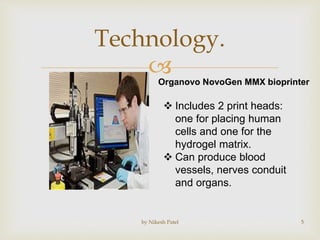
Directed by sofware ;BioInk and cartridge of Hydrogel
are loaded into the 3D bio printer and printed on
biopaper .
Printer prints first layer of the water-based gel,colagen
and second BioInk cells .
Second layer of BioInk cells.
Layers blend together building up the human organs.

Technology.
by Nikesh Patel 5
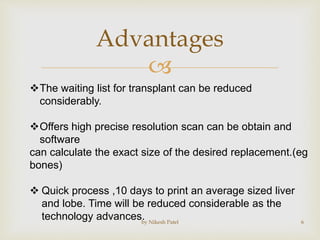
Organovo NovoGen MMX bioprinter
 Includes 2 print heads:
one for placing human
cells and one for the
hydrogel matrix.
 Can produce blood
vessels, nerves conduit
and organs.

Advantages
by Nikesh Patel 6
The waiting list for transplant can be reduced
considerably.
Offers high precise resolution scan can be obtain and
software
can calculate the exact size of the desired replacement.(eg
bones)
 Quick process ,10 days to print an average sized liver
and lobe. Time will be reduced considerable as the
technology advances.

Disadvantages
by Nikesh Patel 7
It will bring a major ethical and moral debate on
its use .
Implanted organ can be rejected as body cant
accept them as functional tissue.
 The cost of printers are very expensive.

Video.
by Nikesh Patel 8

Second Life
by Nikesh Patel 9
by Nikesh Patel 10
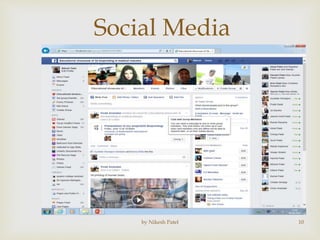
Social Media

Conclusions
by Nikesh Patel 11
 Master course of 3D bio-printing human body parts
launched at Queensland University of Technology in
Australia in may 2014.
 “3D bioprinting facilities with the ability to print human
organs and tissue will advance far faster than general
understanding and acceptance of the ramifications of
this technology," Pete Basiliere
THANK YOU !

References
by Nikesh Patel 12
 http://www.gartner.com/newsroom/id/2658315
 https://www.organdonation.nhs.uk/
 http://www.3ders.org/articles/20140509-master-course-of-3d-bio-printing-
human-body-parts-launched.html
 http://www.invetech.com.au/portfolio/life-sciences/3d-bioprinter-world-
first-print-human-tissue/
 http://www.telegraph.co.uk/technology/news/10629531/The-next-step-
3D-printing-the-human-body.html
 http://www.organovo.com

3 d bioprinting

  • 1.
  • 2.
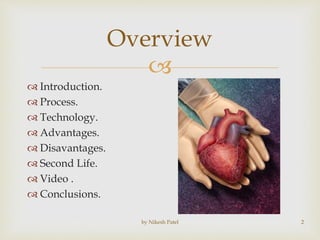
     by Nikesh Patel2 Overview  Introduction.  Process.  Technology.  Advantages.  Disavantages.  Second Life.  Video .  Conclusions.
  • 3.
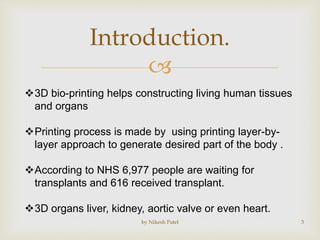
     Introduction. 3D bio-printing helpsconstructing living human tissues and organs Printing process is made by using printing layer-by- layer approach to generate desired part of the body . According to NHS 6,977 people are waiting for transplants and 616 received transplant. 3D organs liver, kidney, aortic valve or even heart. by Nikesh Patel 3
  • 4.
    by Nikesh Patel4 Process. Directed by sofware ;BioInk and cartridge of Hydrogel are loaded into the 3D bio printer and printed on biopaper . Printer prints first layer of the water-based gel,colagen and second BioInk cells . Second layer of BioInk cells. Layers blend together building up the human organs.
  • 5.
     Technology. by Nikesh Patel5 Organovo NovoGen MMX bioprinter  Includes 2 print heads: one for placing human cells and one for the hydrogel matrix.  Can produce blood vessels, nerves conduit and organs.
  • 6.
     Advantages by Nikesh Patel6 The waiting list for transplant can be reduced considerably. Offers high precise resolution scan can be obtain and software can calculate the exact size of the desired replacement.(eg bones)  Quick process ,10 days to print an average sized liver and lobe. Time will be reduced considerable as the technology advances.
  • 7.
     Disadvantages by Nikesh Patel7 It will bring a major ethical and moral debate on its use . Implanted organ can be rejected as body cant accept them as functional tissue.  The cost of printers are very expensive.
  • 8.
  • 9.
  • 10.
    by Nikesh Patel10 Social Media
  • 11.
     Conclusions by Nikesh Patel11  Master course of 3D bio-printing human body parts launched at Queensland University of Technology in Australia in may 2014.  “3D bioprinting facilities with the ability to print human organs and tissue will advance far faster than general understanding and acceptance of the ramifications of this technology," Pete Basiliere THANK YOU !
  • 12.
     References by Nikesh Patel12  http://www.gartner.com/newsroom/id/2658315  https://www.organdonation.nhs.uk/  http://www.3ders.org/articles/20140509-master-course-of-3d-bio-printing- human-body-parts-launched.html  http://www.invetech.com.au/portfolio/life-sciences/3d-bioprinter-world- first-print-human-tissue/  http://www.telegraph.co.uk/technology/news/10629531/The-next-step- 3D-printing-the-human-body.html  http://www.organovo.com