- Pratyusha
- ECE-A
CONTENTS
 Introduction
 3d printing & applications
 Bio printing
 Advantages & disadvantages
 Applications
INTRODUCTION
 Definition :
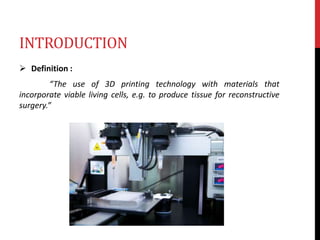
“The use of 3D printing technology with materials that
incorporate viable living cells, e.g. to produce tissue for reconstructive
surgery.”
3D PRINTING
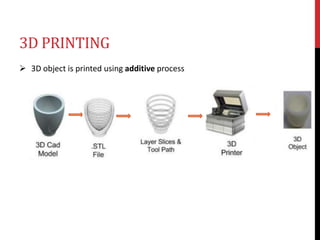
 3D object is printed using additive process
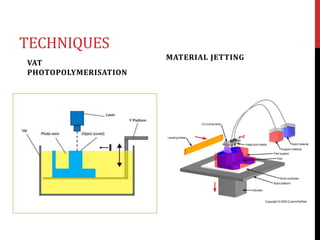
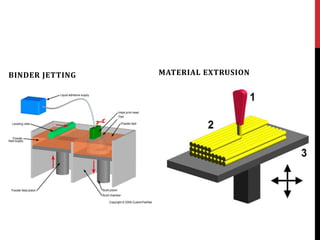
TECHNIQUES
VAT
PHOTOPOLYMERISATION
MATERIAL JETTING
BINDER JETTING MATERIAL EXTRUSION
APPLICATIONS
 Medical industry
 Bioprinting
 Aerospace & aviation
 Automotive
 Industrial 3D printing
 Personal use
BIOPRINTING
 Bio-printing technology is developed by Gabor Forgacs, a
biophysicist from University of Missouri in the US
 Prints 3D structure using “bioink” & “biopaper”
COMPONENTS OF
BIOPRINTING
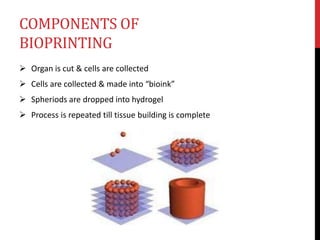
 Organ is cut & cells are collected
 Cells are collected & made into “bioink”
 Spheriods are dropped into hydrogel
 Process is repeated till tissue building is complete
ADVANTAGES &
DISADVANTAGES
ADVANTAGES
 Replace human tissue
by full body
transplant
 Allows scientists to
eliminate the wait list
of organ transplants ·
 Higher survival rate of
printed cells
 Offers high precise
resolution
DISADVANTAGES
 The replaced cell not sure
to fit in human body
 Large-scale construction
increases the complexity
 Printing capabilities of
complicated tissues
 The necessary
specifications required for
given printing construction
(for therapy design, need
to be precise and specific)
APPLICATIONS
 It could be utilized to create entire living organs such as heart, liver
and kidneys
 Creation of functional human beings, which can be printed on
demand and reach maturity in few weeks.
 Newly developed drugs can be tested out on manufactured cells
than on animals and humans. It will lead to a huge reduction in cost
and time.
 Situ bio printing works by imprinting cells directly onto human
body.
Bioprinting

Bioprinting

  • 1.
  • 2.
    CONTENTS  Introduction  3dprinting & applications  Bio printing  Advantages & disadvantages  Applications
  • 3.
    INTRODUCTION  Definition : “Theuse of 3D printing technology with materials that incorporate viable living cells, e.g. to produce tissue for reconstructive surgery.”
  • 4.
    3D PRINTING  3Dobject is printed using additive process
  • 5.
  • 6.
  • 7.
    APPLICATIONS  Medical industry Bioprinting  Aerospace & aviation  Automotive  Industrial 3D printing  Personal use
  • 8.
    BIOPRINTING  Bio-printing technologyis developed by Gabor Forgacs, a biophysicist from University of Missouri in the US  Prints 3D structure using “bioink” & “biopaper”
  • 9.
    COMPONENTS OF BIOPRINTING  Organis cut & cells are collected  Cells are collected & made into “bioink”  Spheriods are dropped into hydrogel  Process is repeated till tissue building is complete
  • 10.
    ADVANTAGES & DISADVANTAGES ADVANTAGES  Replacehuman tissue by full body transplant  Allows scientists to eliminate the wait list of organ transplants ·  Higher survival rate of printed cells  Offers high precise resolution DISADVANTAGES  The replaced cell not sure to fit in human body  Large-scale construction increases the complexity  Printing capabilities of complicated tissues  The necessary specifications required for given printing construction (for therapy design, need to be precise and specific)
  • 11.
    APPLICATIONS  It couldbe utilized to create entire living organs such as heart, liver and kidneys  Creation of functional human beings, which can be printed on demand and reach maturity in few weeks.  Newly developed drugs can be tested out on manufactured cells than on animals and humans. It will lead to a huge reduction in cost and time.  Situ bio printing works by imprinting cells directly onto human body.

Editor's Notes

  • #4 Printing of tissues & organs using 3d printers.