MT-5009 – Analyzing Hi-Tech Opportunities

3D Printing - Biological Applications

By
Anand (A0068259)
Archit (A0098517)
Arun (A0081990)
Hemant (A0068251)
Yuwei (A0118280)

Presentation | Nov 2013
Introducing 3D printing
• What is it
– Generation of a 3D solid model virtually of any orientation from a
digital medium.
– Additive printing technique - Improvised form of rapid proto-typing.
• Why was is it
– Fascination with the idea of replication.
– Deserted scenario :The need for replication technology.

• When was it
– Based on the first Patent published in 1984 under Stereolithography.
– Stereolithography: Using UV beam to solidify photopolymers.
• Where was it commercialised
– 3D systems: First commercial rapid prototyping technology.

Presentation | Nov 2013
Evolution of 3D printing
• Additive – Generating 3D object through sequential layering of material.
Extrusion

Wire

Granular

Powder-bed and
inkjet-head 3D
printing

Laminated

Light polymerised

Fused-deposition
modeling (FDM)

Electron-Beam Freeform
Fabrication(EBF3)

Direct metal laser
sintering (DMLS)

Plaster-based 3D printing
(PP)

Laminated-object
manufacturing (LOM)

Stereolithography (SLA)

Electron-beam
melting (EBM)

Further development in
Inkjet printing

Digital-Light
Processing (DLP)

Selective laser
melting (SLM)

Selective heat sintering
(SHS)

Selective laser
sintering (SLS)

Presentation | Nov 2013
Inkjet Printing
Conventional printing
Printing
Materials

paper

Non conventional printing
Functional material

Other than paper

E.g. Conductive Ink
Thermal

Inkjet
printing
(1956)

Drop – on – demand

Squeeze tube

Bending

Piezoelectric

Pushing

Electrostatic

Shear mode

Acoustic

Printing
Technology

Binary Deflection
Multiple deflection

Continuous printing
Hertz
Ink jet material deposition

Microdot
Organic light emitting
diodes

Printed Circuit boards
– Conductive Ink

Presentation | Nov 2013
Performance Metrics
Stereolithography (SLA)
Fused Deposition Modeling (FDM)
Selective Laser Sintering (SLS)
Multi-Jet Modeling (MJM – 3DP)
Attributes to performance
• Affordability,
• Material Availability
• Precision
• Geometric scaling
• Strength
• Time
Generation of metric for biomedical
application
"bioprinting fidelity index" (BFI)

The Future of 3D Printing; http://replicatorworld.com/issue-printer/overview-2012

Presentation | Nov 2013
Impact of 3D printing
3-D printing to be next $1-trillion
industry

Over hyped technology

In reality , the time for
Investment in disruptive
technology should be right
after the spike in patent filing
signaling a new wave of
product /service/application
and not after a hype-spike

10 Reasons to Be Wary of 3-D Printing Stocks (Part 1)
http://www.techandinnovationdaily.com/2013/02/01/3-d-printing-warning-part-1/

Presentation | Nov 2013
Applications of 3D printing
3D Printing

Processes

Applications

Industries

Demographics

Category

Modeling

Manufacturing

Engineer

Class

Prototyping

Art

Consumer

Material

Tooling

Entertainment

Practitioner

Manufacturing

Healthcare

Artist

Presentation | Nov 2013
Applications of 3D printing
Jewellery

Tooling

Presentation | Nov 2013
Applications of 3D printing
Fashion

Architecture

Presentation | Nov 2013
Applications of 3D printing

(Our Focus: Bioprinting)
Organs

Medical Applications

Presentation | Nov 2013
3D-Bioprinting
Technology

Presentation | Nov 2013
“

The Singapore predicament
Number of organs donated for transplants in Singapore
remains dismally low, despite a law requiring donations by
all after death. Source: healthxchange.com.sg

”

Presentation | Nov 2013
The coveted “Organs”
• 117,521 people in
US in need of organ.
• Hostilities
in
Singapore despite
HOTA.
• Kidneys,
hearts,
livers, lungs are
most coveted.
• Organs not usable
despite donation.

Source: The Boston Globe

Presentation | Nov 2013
Fiction meets reality
Bio-printing is an automated computer
aided layer-by-layer deposition of
biological materials for manufacturing
of functional human organs.

 Artificial bioprinters
already been built.
 NovoGen MMX® built
Organovo and Invenech.
Source: Organovo.

have

by

Presentation | Nov 2013
Bioprinting deconstructed
• Intrinsic nature of cells to coalesce1, tissues to selfassemble2 and fluidity of embryonic tissues3.
• Organ printing mimics the natural biological process of
embryonic cellular fusion.

Source: 1Mironov et al., Anat. Rec., 2Wilson, H.V., J. Exp. Zool., 3G. et al. Biophys. J.

Presentation | Nov 2013
Bioprinting process flow
Computer
model

Computer
tomography1

Printing

Vasculature2
Most challenging

Source: 1nlpnow.com., 2tissueinformatics.com, 3med.umich.edu.

Postprocessing

Layer-by-layer
Config.3
Presentation | Nov 2013
Bioprinting process flow
Computer
model

Printing

Postprocessing

3 important components: Bioink, Biopaper, Bioprinter.

Bioink (cells of sp. organ), Biopaper (collagens, nutrients)
Source: organovo.com.

Presentation | Nov 2013
Bioprinting process flow
Computer
model

Printing

Postprocessing

Bioreactor
 Supply nutrients for further cell growth
 Physiological environment
for tissue maturation.
 Mechanical and bio. testing.

Presentation | Nov 2013
Bioprinting Roadmap

Source: organovo.com.

Presentation | Nov 2013
Current Progress
Ear1: 250 mn cells and collagen from rat tail
make human ear in 15 min. Post-processing 3
months. To serve children with hearing loss due
to malformed outer ear.
Kidneys2: Layer-by-layer building of scaffold and
deposition of kidney cells. Assembly to be
transplanted into patient. Degradation of
scaffold to follow in-vivo.
Blood Vessels3: Rigid but non-toxic sugar
filaments form core. Cells deposited around
filaments. Subsequent blood flow dissolves
sugar.
Source: 1Cornell University., 2Wake Forest Inst., 3Univ. Of Pennsylvania.

Presentation | Nov 2013
Current Progress
Skin grafts1: laser scan wound to determine
depth and area. One inkjet ejects enzymes and
second, cells. Layer is finally sealed by human
skin cells. Useful in war and disaster zones.
Bones2: Print scaffold with ceramic or
Titanium powder. After 1 day in culture of
human stem cells, its ready. Repair of
complex fractures in accident survivors.
Drug testing3: $1.2bn to make a new drug in 12
years.
1 in 5000 has a chance to make it to market.
20-50% drug fail from pre-clinical animal trails to
human trials.
Source: 1Wake Forest Inst., 2 Washington State University, 3Organovo

Presentation | Nov 2013
Market Research &
Entrepreneurial
Opportunities

Presentation | Nov 2013
Biomaterial (Bio-ink, Bio-paper) Market

Million USD

Source: US market for Biomaterials

Presentation | Nov 2013
Biomaterial Cost projections
(b)

(a)

Figure: Graphs showing the price reduction of Biomaterials; (a) Collagen; (b) Polycaprolactone;

Table: Cost of cells from 2011 to 2013
Year
2011

225

2012

217

2013
Source: Sigma-Aldrich

Cost of cells (500 ml)
SGD

216
Presentation | Nov 2013
Biomaterials:
Reason for cost reduction
• Increase in the number of manufacturers.

• Mass production.
• Increase in demand.
• Invention of new materials with lesser cost.
• Local manufacturing and reduced inventory.

• Novel material compositions and properties.
• Multifunctional materials.

Presentation | Nov 2013
Bioprinters: Cost
Minimum Price:
$15,000

2008

2013

Source: http://disruptiveinnovation.se/?p=286

Minimum Price:
$ 500

Presentation | Nov 2013
Bioprinters: Cost
Reason for cost reduction
• Well established technology.
• Lesser IP’s
• Increase in the number of market players.

• Economies of scale.
• Increase in demand.
• Local manufacturing and reduced inventory.
• Cheaper and more accessible after market parts and repair.
• Multifunctional structures.
We believe that the cost of Bioprinters will reduce further in future.
Presentation | Nov 2013
Bioprinters: Performance
1. Accuracy

Source: Biomaterials as biopaper by Rana Imani

Presentation | Nov 2013
Bioprinters: Performance
2. Time

• Increasing the number of liquid
dispensing nozzle is one way to speed up
the process to reduce the time.

Source: http://inhabitat.com/3d-printed-bones-are-saving-a-uk-hospital-thousands-in-fees/3d-bone-imaging-printing-4/

Presentation | Nov 2013
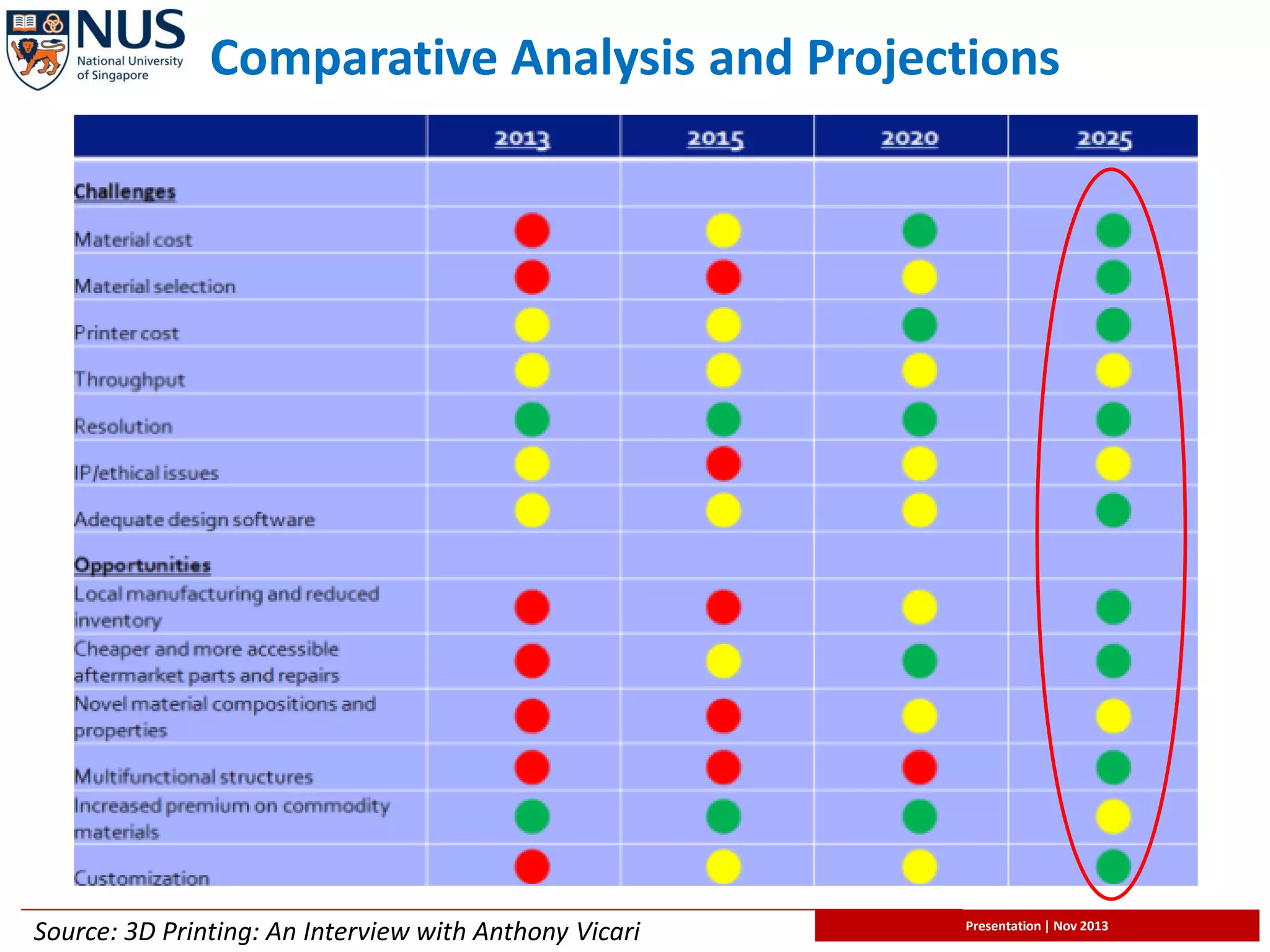
Comparative Analysis and Projections

Source: 3D Printing: An Interview with Anthony Vicari

Presentation | Nov 2013
Competitors Influence

Source: Organovo.com; *Cytograft public materials

Presentation | Nov 2013
Demand for Organs

Today’s Scenario

Year

• 115,000 people currently need organ transplants in the US.

• 10 people die every day while waiting for their transplant.

Source: www.ivhn.org

Presentation | Nov 2013
Cost Analysis
Rough estimates on the total cost of Organ Transplants
Estimated U.S. Average 2011 Billed Charges Per Transplant

Source: U.S Organ and tissue transplant cost estimates and discussion

Presentation | Nov 2013
Cost Analysis
Case Study on Bioprinting of Kidney

• Cost of Kidney Transplant

: $ 80,000 USD

• Cost for Bioprinting of Kidney

: $ 280,000 USD*

* Projected cost for bioprinted kidney 2013

• Dialysis treatment costs $55,000-$75,000 per patient per year.

• Treatments for diabetes costs around $6,000 per year per patient.
• Total cost of $245 billion per year has been spent in the United
States for diabetes treatment.

Takes around 10 hours to bioprint a Kidney*

Source: Fung Technical Report No. 2013.04.17; * www.ted.com

Presentation | Nov 2013
Cost Analysis - Pricing Projections
Table: Pricing Projections on Bioprinting of Kidney in United States*
S. No
1
2
3
4
5
6
7
8
9

Year
2014
2016
2018
2020
2022
2024
2026
2028
2030

Demand for Kidney
113,000
126,500
140,700
156,000
172,600
190,300
209,200
229,200
250,000

Price (USD)
247,500
221,000
199,000
180,000
162,000
147,000
134,000
122,000
112,000

Assumption: To estimate the pricing projections, the revenue of the company is maintained constant.

Reasons for Cost Reduction:
Cost of Bioprinted Kidney < 120 K
• Continuous increase in demand.
USD by 2030
• Increase in the number of Competitors.
• Continuous decrease in the cost of biomaterials.
• Continuous decrease in the price of bioprinters.
• Economies of scale.
• Local manufacturing and reduced inventory.
• Cheaper and more accessible after market parts and repair.
* Projections are purely based on the demand for kidney in United States.

Presentation | Nov 2013
Entrepreneurial Opportunities

• Making of design model, the printer and the bio-material.
• Dentists can utilize patients’ unique teeth layout and bone scans to create friendlier implants and
prosthetics.
• Manufacturing of multipurpose 3D printing heads and nozzles.
• Synthetic materials for manufacturing tissues, bones, cartilage and organs.
• “Organ lockers,” a system that provides secure storage and transportation for customer’s organs.
• Scanning Kiosks.
• Manufacturing and distribution of Bio-inks and other biocompatible materials for 3D bio printing.

• Packaging of the 3D bioprinted organs.
Presentation | Nov 2013
Entrepreneurial Opportunities
Commercial Areas
Blood Vessels
Cartilage Grafts
Cardiac Muscle
Grafts

Nerve Re-growth

Presentation | Nov 2013
Industrial Impacts
Patients who are cured by 3D bioprinting technology are the big winners.
Positively Impacted Industries
• Bio-ink,

scaffolds

and

Biocompatible

Negatively Impacted Industries
• Kidney dialysis industries.

materials manufacturers.

• Companies that supply blood sugar testing

• 3D Bioprinters manufacturers.

supplies.

• Hospitals & insurance companies (no

• Companies that produces and supplies

longer need to spend money on transplant

insulin, pills and insulin pumps.

logistics).

• Companies that sell pacemakers, new

• Stem-cell harvesting and storage business.

heart valves.

• Surgical supplies companies.

• Organ replacement logistics.

• Computer

aided design (CAD) software

companies.

Presentation | Nov 2013
SWOT Analysis
S

O

Strengths
• All vital organs can be printed by one
3D bioprinter.
• Easy to build own custom machine.
• Easy to make body parts with desired
size and shape.
• Huge market potential.
• Provides several entrepreneurial
opportunities.

Opportunities
Improving machine possibilities
• larger models.
• faster printing.
• multi colour prints.
• active development of biocompatible
materials.
• customization of designs based on
customer needs.

W

Weaknesses
• Quality of the organs printed.
• Production time.
• Technolgy is still in prematured state.
• Expensive.

T

Threats
• Technology background of the user.
• Time taken for printing an organ.
• Cost of organ printing.
• In wrong hands, may contribute to fake
identity, increase in crime and illegal
activities.

Presentation | Nov 2013
Bioprinting - Forecast
Research (today)

• Printing medication
• Printing new Skin
• Printing cartilage & bones
• Printing replacement

Technology Adoption
(3 - 5 Years)

• Specific organ tissue
replacement
for
important organs such
as heart and kidney.

tissues
• Printing replacement
organs
• Printing stem cells

• Personalized
replacement 3D printed
joints (hip, knee) with
custom fit.
• Life saving 3D printed
organ replacement (high
cost.

Commercialization
(5 - 7 Years)

• Replacement 3D printed
organs commonly available
at affordable cost.
• Liver Kidney replacement
companies achieve maturity.
• 3D printed tissue
replacement for all body
organs available.
• Printing medication at
home widely available.

Presentation | Nov 2013
Pro’s and Con’s Analysis
• Takes less time than lab-grown artificial organs, therefore,

future demand looks bright.
• However, organ printing has certain disadvantages and
limitations compared to lab-grown organs.
• Lab-grown organs get to take the time for the different cell

types to start integrating and function with each other while
organ printing does not give quite the same opportunity.
• In 10 years, the number of patients that require organs will
have doubled.
• Is a bio-fabrication line possible?
• Many challenges ahead and aspects left to improve before
commercialization of organ printing.

Presentation | Nov 2013
Pro’s and Con’s Analysis
• Vascularization, scaling, the interaction between the
different cell types, well-functioning organs that can be
integrated into the patient’s body.
• From a systems engineering point of view, it will require
more than bio-printers to produce complex tissues and
organs.
• Bioprinters alone will not be enough for producing the
artificial organs. Steps such as fusion, assembling,
remodeling, maturing are required.
• Quality control a crucial matter!!!

Presentation | Nov 2013
Thank You

Presentation | Nov 2013
Supporting Info: Bio-inks
• Prepared by mixing cells with biocompatible materials (Hydrogels).
• Suitable hydrogels are chosen based on the Organ to be printed.
(Ex. Collagen is widely used for bone printing)

Bio-ink materials

• Collagen
• Alginate
• Fibrin
• Polycaprolactone
• Thorbin

Widely used

Collagen
Fibrin
Alginate

reason

• Excellent Biocompatibility.
• Homogenously incorporate cells, growth factors.
• Processed under mild conditions.
• Easy chemical modification.
• Sol-gel transition.
Source: C. J. Ferris et al. Biomaterials Science 2013, 1, 224-230.

Presentation | Nov 2013
Supporting Info: Bio-papers
Supports the Bio-ink during processing steps and post processing steps.

Source: Nakamura et al. Biofabrication 2 (2010) 014110

Presentation | Nov 2013
Supporting Information

Presentation | Nov 2013

3D Bio-Printing; Becoming Economically Feasible

  • 1.
    MT-5009 – AnalyzingHi-Tech Opportunities 3D Printing - Biological Applications By Anand (A0068259) Archit (A0098517) Arun (A0081990) Hemant (A0068251) Yuwei (A0118280) Presentation | Nov 2013
  • 2.
    Introducing 3D printing •What is it – Generation of a 3D solid model virtually of any orientation from a digital medium. – Additive printing technique - Improvised form of rapid proto-typing. • Why was is it – Fascination with the idea of replication. – Deserted scenario :The need for replication technology. • When was it – Based on the first Patent published in 1984 under Stereolithography. – Stereolithography: Using UV beam to solidify photopolymers. • Where was it commercialised – 3D systems: First commercial rapid prototyping technology. Presentation | Nov 2013
  • 3.
    Evolution of 3Dprinting • Additive – Generating 3D object through sequential layering of material. Extrusion Wire Granular Powder-bed and inkjet-head 3D printing Laminated Light polymerised Fused-deposition modeling (FDM) Electron-Beam Freeform Fabrication(EBF3) Direct metal laser sintering (DMLS) Plaster-based 3D printing (PP) Laminated-object manufacturing (LOM) Stereolithography (SLA) Electron-beam melting (EBM) Further development in Inkjet printing Digital-Light Processing (DLP) Selective laser melting (SLM) Selective heat sintering (SHS) Selective laser sintering (SLS) Presentation | Nov 2013
  • 4.
    Inkjet Printing Conventional printing Printing Materials paper Nonconventional printing Functional material Other than paper E.g. Conductive Ink Thermal Inkjet printing (1956) Drop – on – demand Squeeze tube Bending Piezoelectric Pushing Electrostatic Shear mode Acoustic Printing Technology Binary Deflection Multiple deflection Continuous printing Hertz Ink jet material deposition Microdot Organic light emitting diodes Printed Circuit boards – Conductive Ink Presentation | Nov 2013
  • 5.
    Performance Metrics Stereolithography (SLA) FusedDeposition Modeling (FDM) Selective Laser Sintering (SLS) Multi-Jet Modeling (MJM – 3DP) Attributes to performance • Affordability, • Material Availability • Precision • Geometric scaling • Strength • Time Generation of metric for biomedical application "bioprinting fidelity index" (BFI) The Future of 3D Printing; http://replicatorworld.com/issue-printer/overview-2012 Presentation | Nov 2013
  • 6.
    Impact of 3Dprinting 3-D printing to be next $1-trillion industry Over hyped technology In reality , the time for Investment in disruptive technology should be right after the spike in patent filing signaling a new wave of product /service/application and not after a hype-spike 10 Reasons to Be Wary of 3-D Printing Stocks (Part 1) http://www.techandinnovationdaily.com/2013/02/01/3-d-printing-warning-part-1/ Presentation | Nov 2013
  • 7.
    Applications of 3Dprinting 3D Printing Processes Applications Industries Demographics Category Modeling Manufacturing Engineer Class Prototyping Art Consumer Material Tooling Entertainment Practitioner Manufacturing Healthcare Artist Presentation | Nov 2013
  • 8.
    Applications of 3Dprinting Jewellery Tooling Presentation | Nov 2013
  • 9.
    Applications of 3Dprinting Fashion Architecture Presentation | Nov 2013
  • 10.
    Applications of 3Dprinting (Our Focus: Bioprinting) Organs Medical Applications Presentation | Nov 2013
  • 11.
  • 12.
    “ The Singapore predicament Numberof organs donated for transplants in Singapore remains dismally low, despite a law requiring donations by all after death. Source: healthxchange.com.sg ” Presentation | Nov 2013
  • 13.
    The coveted “Organs” •117,521 people in US in need of organ. • Hostilities in Singapore despite HOTA. • Kidneys, hearts, livers, lungs are most coveted. • Organs not usable despite donation. Source: The Boston Globe Presentation | Nov 2013
  • 14.
    Fiction meets reality Bio-printingis an automated computer aided layer-by-layer deposition of biological materials for manufacturing of functional human organs.  Artificial bioprinters already been built.  NovoGen MMX® built Organovo and Invenech. Source: Organovo. have by Presentation | Nov 2013
  • 15.
    Bioprinting deconstructed • Intrinsicnature of cells to coalesce1, tissues to selfassemble2 and fluidity of embryonic tissues3. • Organ printing mimics the natural biological process of embryonic cellular fusion. Source: 1Mironov et al., Anat. Rec., 2Wilson, H.V., J. Exp. Zool., 3G. et al. Biophys. J. Presentation | Nov 2013
  • 16.
    Bioprinting process flow Computer model Computer tomography1 Printing Vasculature2 Mostchallenging Source: 1nlpnow.com., 2tissueinformatics.com, 3med.umich.edu. Postprocessing Layer-by-layer Config.3 Presentation | Nov 2013
  • 17.
    Bioprinting process flow Computer model Printing Postprocessing 3important components: Bioink, Biopaper, Bioprinter. Bioink (cells of sp. organ), Biopaper (collagens, nutrients) Source: organovo.com. Presentation | Nov 2013
  • 18.
    Bioprinting process flow Computer model Printing Postprocessing Bioreactor Supply nutrients for further cell growth  Physiological environment for tissue maturation.  Mechanical and bio. testing. Presentation | Nov 2013
  • 19.
  • 20.
    Current Progress Ear1: 250mn cells and collagen from rat tail make human ear in 15 min. Post-processing 3 months. To serve children with hearing loss due to malformed outer ear. Kidneys2: Layer-by-layer building of scaffold and deposition of kidney cells. Assembly to be transplanted into patient. Degradation of scaffold to follow in-vivo. Blood Vessels3: Rigid but non-toxic sugar filaments form core. Cells deposited around filaments. Subsequent blood flow dissolves sugar. Source: 1Cornell University., 2Wake Forest Inst., 3Univ. Of Pennsylvania. Presentation | Nov 2013
  • 21.
    Current Progress Skin grafts1:laser scan wound to determine depth and area. One inkjet ejects enzymes and second, cells. Layer is finally sealed by human skin cells. Useful in war and disaster zones. Bones2: Print scaffold with ceramic or Titanium powder. After 1 day in culture of human stem cells, its ready. Repair of complex fractures in accident survivors. Drug testing3: $1.2bn to make a new drug in 12 years. 1 in 5000 has a chance to make it to market. 20-50% drug fail from pre-clinical animal trails to human trials. Source: 1Wake Forest Inst., 2 Washington State University, 3Organovo Presentation | Nov 2013
  • 22.
  • 23.
    Biomaterial (Bio-ink, Bio-paper)Market Million USD Source: US market for Biomaterials Presentation | Nov 2013
  • 24.
    Biomaterial Cost projections (b) (a) Figure:Graphs showing the price reduction of Biomaterials; (a) Collagen; (b) Polycaprolactone; Table: Cost of cells from 2011 to 2013 Year 2011 225 2012 217 2013 Source: Sigma-Aldrich Cost of cells (500 ml) SGD 216 Presentation | Nov 2013
  • 25.
    Biomaterials: Reason for costreduction • Increase in the number of manufacturers. • Mass production. • Increase in demand. • Invention of new materials with lesser cost. • Local manufacturing and reduced inventory. • Novel material compositions and properties. • Multifunctional materials. Presentation | Nov 2013
  • 26.
    Bioprinters: Cost Minimum Price: $15,000 2008 2013 Source:http://disruptiveinnovation.se/?p=286 Minimum Price: $ 500 Presentation | Nov 2013
  • 27.
    Bioprinters: Cost Reason forcost reduction • Well established technology. • Lesser IP’s • Increase in the number of market players. • Economies of scale. • Increase in demand. • Local manufacturing and reduced inventory. • Cheaper and more accessible after market parts and repair. • Multifunctional structures. We believe that the cost of Bioprinters will reduce further in future. Presentation | Nov 2013
  • 28.
    Bioprinters: Performance 1. Accuracy Source:Biomaterials as biopaper by Rana Imani Presentation | Nov 2013
  • 29.
    Bioprinters: Performance 2. Time •Increasing the number of liquid dispensing nozzle is one way to speed up the process to reduce the time. Source: http://inhabitat.com/3d-printed-bones-are-saving-a-uk-hospital-thousands-in-fees/3d-bone-imaging-printing-4/ Presentation | Nov 2013
  • 30.
    Comparative Analysis andProjections Source: 3D Printing: An Interview with Anthony Vicari Presentation | Nov 2013
  • 31.
    Competitors Influence Source: Organovo.com;*Cytograft public materials Presentation | Nov 2013
  • 32.
    Demand for Organs Today’sScenario Year • 115,000 people currently need organ transplants in the US. • 10 people die every day while waiting for their transplant. Source: www.ivhn.org Presentation | Nov 2013
  • 33.
    Cost Analysis Rough estimateson the total cost of Organ Transplants Estimated U.S. Average 2011 Billed Charges Per Transplant Source: U.S Organ and tissue transplant cost estimates and discussion Presentation | Nov 2013
  • 34.
    Cost Analysis Case Studyon Bioprinting of Kidney • Cost of Kidney Transplant : $ 80,000 USD • Cost for Bioprinting of Kidney : $ 280,000 USD* * Projected cost for bioprinted kidney 2013 • Dialysis treatment costs $55,000-$75,000 per patient per year. • Treatments for diabetes costs around $6,000 per year per patient. • Total cost of $245 billion per year has been spent in the United States for diabetes treatment. Takes around 10 hours to bioprint a Kidney* Source: Fung Technical Report No. 2013.04.17; * www.ted.com Presentation | Nov 2013
  • 35.
    Cost Analysis -Pricing Projections Table: Pricing Projections on Bioprinting of Kidney in United States* S. No 1 2 3 4 5 6 7 8 9 Year 2014 2016 2018 2020 2022 2024 2026 2028 2030 Demand for Kidney 113,000 126,500 140,700 156,000 172,600 190,300 209,200 229,200 250,000 Price (USD) 247,500 221,000 199,000 180,000 162,000 147,000 134,000 122,000 112,000 Assumption: To estimate the pricing projections, the revenue of the company is maintained constant. Reasons for Cost Reduction: Cost of Bioprinted Kidney < 120 K • Continuous increase in demand. USD by 2030 • Increase in the number of Competitors. • Continuous decrease in the cost of biomaterials. • Continuous decrease in the price of bioprinters. • Economies of scale. • Local manufacturing and reduced inventory. • Cheaper and more accessible after market parts and repair. * Projections are purely based on the demand for kidney in United States. Presentation | Nov 2013
  • 36.
    Entrepreneurial Opportunities • Makingof design model, the printer and the bio-material. • Dentists can utilize patients’ unique teeth layout and bone scans to create friendlier implants and prosthetics. • Manufacturing of multipurpose 3D printing heads and nozzles. • Synthetic materials for manufacturing tissues, bones, cartilage and organs. • “Organ lockers,” a system that provides secure storage and transportation for customer’s organs. • Scanning Kiosks. • Manufacturing and distribution of Bio-inks and other biocompatible materials for 3D bio printing. • Packaging of the 3D bioprinted organs. Presentation | Nov 2013
  • 37.
    Entrepreneurial Opportunities Commercial Areas BloodVessels Cartilage Grafts Cardiac Muscle Grafts Nerve Re-growth Presentation | Nov 2013
  • 38.
    Industrial Impacts Patients whoare cured by 3D bioprinting technology are the big winners. Positively Impacted Industries • Bio-ink, scaffolds and Biocompatible Negatively Impacted Industries • Kidney dialysis industries. materials manufacturers. • Companies that supply blood sugar testing • 3D Bioprinters manufacturers. supplies. • Hospitals & insurance companies (no • Companies that produces and supplies longer need to spend money on transplant insulin, pills and insulin pumps. logistics). • Companies that sell pacemakers, new • Stem-cell harvesting and storage business. heart valves. • Surgical supplies companies. • Organ replacement logistics. • Computer aided design (CAD) software companies. Presentation | Nov 2013
  • 39.
    SWOT Analysis S O Strengths • Allvital organs can be printed by one 3D bioprinter. • Easy to build own custom machine. • Easy to make body parts with desired size and shape. • Huge market potential. • Provides several entrepreneurial opportunities. Opportunities Improving machine possibilities • larger models. • faster printing. • multi colour prints. • active development of biocompatible materials. • customization of designs based on customer needs. W Weaknesses • Quality of the organs printed. • Production time. • Technolgy is still in prematured state. • Expensive. T Threats • Technology background of the user. • Time taken for printing an organ. • Cost of organ printing. • In wrong hands, may contribute to fake identity, increase in crime and illegal activities. Presentation | Nov 2013
  • 40.
    Bioprinting - Forecast Research(today) • Printing medication • Printing new Skin • Printing cartilage & bones • Printing replacement Technology Adoption (3 - 5 Years) • Specific organ tissue replacement for important organs such as heart and kidney. tissues • Printing replacement organs • Printing stem cells • Personalized replacement 3D printed joints (hip, knee) with custom fit. • Life saving 3D printed organ replacement (high cost. Commercialization (5 - 7 Years) • Replacement 3D printed organs commonly available at affordable cost. • Liver Kidney replacement companies achieve maturity. • 3D printed tissue replacement for all body organs available. • Printing medication at home widely available. Presentation | Nov 2013
  • 41.
    Pro’s and Con’sAnalysis • Takes less time than lab-grown artificial organs, therefore, future demand looks bright. • However, organ printing has certain disadvantages and limitations compared to lab-grown organs. • Lab-grown organs get to take the time for the different cell types to start integrating and function with each other while organ printing does not give quite the same opportunity. • In 10 years, the number of patients that require organs will have doubled. • Is a bio-fabrication line possible? • Many challenges ahead and aspects left to improve before commercialization of organ printing. Presentation | Nov 2013
  • 42.
    Pro’s and Con’sAnalysis • Vascularization, scaling, the interaction between the different cell types, well-functioning organs that can be integrated into the patient’s body. • From a systems engineering point of view, it will require more than bio-printers to produce complex tissues and organs. • Bioprinters alone will not be enough for producing the artificial organs. Steps such as fusion, assembling, remodeling, maturing are required. • Quality control a crucial matter!!! Presentation | Nov 2013
  • 43.
  • 44.
    Supporting Info: Bio-inks •Prepared by mixing cells with biocompatible materials (Hydrogels). • Suitable hydrogels are chosen based on the Organ to be printed. (Ex. Collagen is widely used for bone printing) Bio-ink materials • Collagen • Alginate • Fibrin • Polycaprolactone • Thorbin Widely used Collagen Fibrin Alginate reason • Excellent Biocompatibility. • Homogenously incorporate cells, growth factors. • Processed under mild conditions. • Easy chemical modification. • Sol-gel transition. Source: C. J. Ferris et al. Biomaterials Science 2013, 1, 224-230. Presentation | Nov 2013
  • 45.
    Supporting Info: Bio-papers Supportsthe Bio-ink during processing steps and post processing steps. Source: Nakamura et al. Biofabrication 2 (2010) 014110 Presentation | Nov 2013
  • 46.