www.postersession.com
We hope you find this template useful! This one is set
The global shortage of donor organs is a cause for
countless fatalities across the world. Although,
diseases can be treated through organ transplantation it
can come along with many complications.
Not only is there a high demand for donor organs,
there is also the risk of the body’s rejection of the
newly implanted organ. The number of available
organs for transplantation is not enough causing a
shortage of organs. The patient may not wait very
long.
Organ printing is a new technology. It is an
interdisciplinary field involving many sciences and
technologies among life sciences, biology, computer
sciences, physics and engineering. Through the
method of 3D printing organs, many lives could be
saved as well as reducing the need for donor organs.
Technologies
Applications
3D Structured Human Organs by Bioprinting
Bibliography
I. Atala, A., Bauer, S. B., Soker, S., Yoo, J. J., & Retik,
A. B. (2006). Tissue-engineered autologous bladders
for patients needing cystoplasty. The Lancet,
367(9518), 1241-1246. doi:10.1016/s0140-
6736(06)68438-9
II. Carrel, A., & Lindbergh, C. A. (1938). The culture of
organs. New York: P.B. Hoeber.
III. Atala, A. (2011). Printing a Human Kidney. TED2011.
Filmed March, 2011.
http://www.ted.com/talks/anthony_atala_printing_a_h
uman_kidney
The Bladder
There are varieties of injuries that can lead to
damage or loss of the bladder, requiring eventual
replacement or repair of the organ. Researchers
soon adopted 3-D printers to make scaffolds more
precisely because manually placing the cells onto
scaffold remained a time-consuming and arduous
process. Engineered bladders were made
possible because they can be made with just two
cell types however; an organ such as a kidney
consists of thirty cell types.
The Heart
The human heart is a complex biological
machine. It pumps blood to all parts of the body,
begins to beat three weeks after conception and
does not stop until the day of death. A heart
transplant is a lifesaving procedure which
removes a damaged or diseased heart and
replaces it with a new one. Once the cells are
formed, they themselves manufacture the
microstructures necessary and the 3D bioprinting
scaffolds, the suitable base, are used to build
larger structures up to the size of a whole organ.
The Kidney
In addition to the great need of heart transplants
there is even a greater number of patients waiting
for a kidney transplant. Currently, there are over a
hundred thousand people anxiously waiting for a
lifesaving kidney A kidney transplant can pose
risks to both the donor and the recipient. There
can be possible surgical complications such as
pain, infection, blood loss, blood clots, allergic
reactions to anesthesia, pneumonia, injury to
surrounding tissue and organs, or even death.
3D printed kidney parts
Thanks to the evolution of the bioprinting
technology, some scientists of the Jennifer Lewis
lab developed intricate tubes working on real
kidneys. For the first time, scientists created
artificial kidney tissue, working like real ones
thanks to living cells. It is quite a revolution!
In Situ , Bioprinting surgeries:-
In this surgeries printing cells directly onto or into
the body during surgery for better healing time.
Within few years we could use automated surgical
arm with Bioprint nozzles to enter the body and
print cell directly into a damaged site.
Introduction
Discussion
IS-44
History
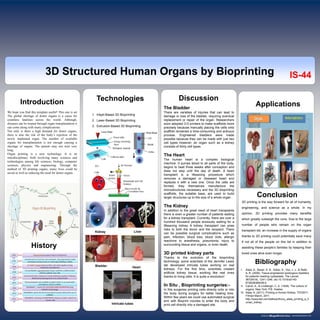
1. Inkjet-Based 3D Bioprinting
2. Laser-Based 3D Bioprinting
3. Extrusion-Based 3D Bioprinting
3D printing is the way forward for all of humanity,
engineering, and science as a whole. In my
opinion, 3D printing provides many benefits
which greatly outweigh the cons. Due to the large
number of people who remain on the organ
transplant list, an increase in the supply of organs
thanks to 3D printing could potentially save many
if not all of the people on this list in addition to
assisting these people’s families by keeping their
loved ones alive even longer.
Conclusion
Laser Pulse Print Head
Kidney Liver
Bladder Heart
Intricate tubes

Poster

  • 1.
    www.postersession.com We hope youfind this template useful! This one is set The global shortage of donor organs is a cause for countless fatalities across the world. Although, diseases can be treated through organ transplantation it can come along with many complications. Not only is there a high demand for donor organs, there is also the risk of the body’s rejection of the newly implanted organ. The number of available organs for transplantation is not enough causing a shortage of organs. The patient may not wait very long. Organ printing is a new technology. It is an interdisciplinary field involving many sciences and technologies among life sciences, biology, computer sciences, physics and engineering. Through the method of 3D printing organs, many lives could be saved as well as reducing the need for donor organs. Technologies Applications 3D Structured Human Organs by Bioprinting Bibliography I. Atala, A., Bauer, S. B., Soker, S., Yoo, J. J., & Retik, A. B. (2006). Tissue-engineered autologous bladders for patients needing cystoplasty. The Lancet, 367(9518), 1241-1246. doi:10.1016/s0140- 6736(06)68438-9 II. Carrel, A., & Lindbergh, C. A. (1938). The culture of organs. New York: P.B. Hoeber. III. Atala, A. (2011). Printing a Human Kidney. TED2011. Filmed March, 2011. http://www.ted.com/talks/anthony_atala_printing_a_h uman_kidney The Bladder There are varieties of injuries that can lead to damage or loss of the bladder, requiring eventual replacement or repair of the organ. Researchers soon adopted 3-D printers to make scaffolds more precisely because manually placing the cells onto scaffold remained a time-consuming and arduous process. Engineered bladders were made possible because they can be made with just two cell types however; an organ such as a kidney consists of thirty cell types. The Heart The human heart is a complex biological machine. It pumps blood to all parts of the body, begins to beat three weeks after conception and does not stop until the day of death. A heart transplant is a lifesaving procedure which removes a damaged or diseased heart and replaces it with a new one. Once the cells are formed, they themselves manufacture the microstructures necessary and the 3D bioprinting scaffolds, the suitable base, are used to build larger structures up to the size of a whole organ. The Kidney In addition to the great need of heart transplants there is even a greater number of patients waiting for a kidney transplant. Currently, there are over a hundred thousand people anxiously waiting for a lifesaving kidney A kidney transplant can pose risks to both the donor and the recipient. There can be possible surgical complications such as pain, infection, blood loss, blood clots, allergic reactions to anesthesia, pneumonia, injury to surrounding tissue and organs, or even death. 3D printed kidney parts Thanks to the evolution of the bioprinting technology, some scientists of the Jennifer Lewis lab developed intricate tubes working on real kidneys. For the first time, scientists created artificial kidney tissue, working like real ones thanks to living cells. It is quite a revolution! In Situ , Bioprinting surgeries:- In this surgeries printing cells directly onto or into the body during surgery for better healing time. Within few years we could use automated surgical arm with Bioprint nozzles to enter the body and print cell directly into a damaged site. Introduction Discussion IS-44 History 1. Inkjet-Based 3D Bioprinting 2. Laser-Based 3D Bioprinting 3. Extrusion-Based 3D Bioprinting 3D printing is the way forward for all of humanity, engineering, and science as a whole. In my opinion, 3D printing provides many benefits which greatly outweigh the cons. Due to the large number of people who remain on the organ transplant list, an increase in the supply of organs thanks to 3D printing could potentially save many if not all of the people on this list in addition to assisting these people’s families by keeping their loved ones alive even longer. Conclusion Laser Pulse Print Head Kidney Liver Bladder Heart Intricate tubes