03/10/2023
1
Deep Foundations-Piles and
Drilled shafts
Piles are structural members made of steel,
concrete and timber.
Pile foundations are deep and more costly than
shallow foundations but necessary to ensure
structural safety.
03/10/2023
2
Pile Foundations
Need for Pile Foundations
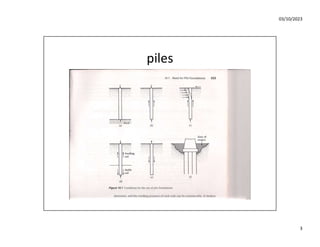
• When the upper soil layer is highly compressible and too
weak to support the load transmitted by the
superstructure
• When the bedrock is not encountered at a reasonable
depth below the ground surface, piles are used to
transmit the structural load to the soil gradually.
• When the tall buildings, and earth-retaining structures
are subjected to horizontal forces such as strong wind
and/or earthquake forces.
• When the soils at the proposed site are expansive and
collapsible. Expansive soils swell and shrink as the
moisture content increases and decreases.
• The swelling pressure of such soils can be considerable.
03/10/2023
3
piles
03/10/2023
4
piles
03/10/2023
5
The need for piles
• Soils such as loess are collapsible. When the moisture
content of these soils increases, their structures may
break down. A sudden decrease in the void ratio of the
soil induces larger settlements of structures supported
by shallow foundations.
• The foundations of some structures, such as
transmission towers, offshore platforms, and basement
mates below the water table, are subjected uplifting
forces.
• Bridge abutments and piers are usually constructed
over pile foundations because of soil erosion at the
ground surface.
03/10/2023
6
•Piles are structural members made of steel,
concrete, and or timber.
•Piles are used to build pile foundations,
which are deep and more costly than
shallow foundations.
•The use of piles ensure structural safety.
•Drilled shafts are cast-in-place piles that
generally have diameter greater than 750
mm
03/10/2023
7
•When the upper soil layers are highly compressible and too weak
or expansive and collapsible, to support the load transmitted by
the superstructure, piles are used to transmit the load to the
underlying bedrock or a stronger soil layer.
•Pile foundations resist lateral forces in earth retaining structures
and tall buildings where there are subjected to strong wind
andor earthquake forces.
• Oil platforms Foundations and basements mats below the water
table which are subjected to uplifting forces need pile
foundations.
•Bridge abutments and piers are constructed over pile
foundations to avoid the possible loss of bearing capacity that a
shallow foundation might suffer due to soil erosion and scouring.
03/10/2023
8
Types of piles and their structural
characteristics
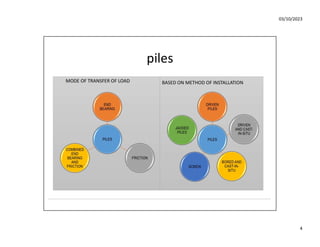
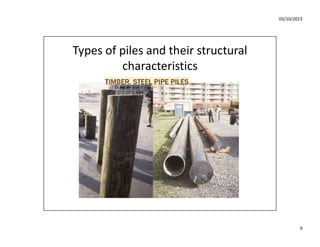
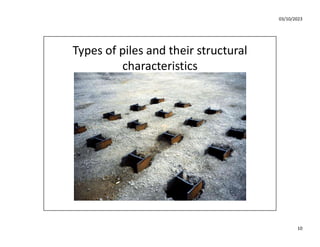
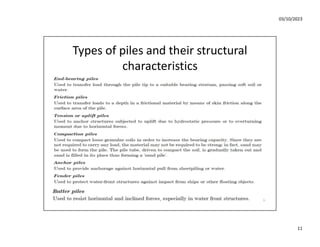
• Different types of piles are used in the
construction work, depending on the type of
load to be carried, the subsoil conditions, and
the water table.
• Piles can be divided into the following:
• Steel piles
• Concrete piles
• Wooden (timber) piles
03/10/2023
9
Types of piles and their structural
characteristics
03/10/2023
10
Types of piles and their structural
characteristics
03/10/2023
11
Types of piles and their structural
characteristics
03/10/2023
12
Steel piles
• Steel piles generally are either pipe piles or rolled steel H-section piles.
• Pipe piles can be driven into the ground with their ends open or closed.
• H section piles are usually preferred because their web and flange
thicknesses are equal.
• When necessary, steel piles are spliced by welding or by riveting or bolts.
• When hard driving conditions are expected, such as driving through dense
gravel, shale and soft rock, steel piles can be fitted with driving points or
shoes.
• usual length: 15-60 m; usual load 300 kn -1200kN
• advantages a) easy to handle with respect to cutoff and extension to the
desired length.
• Can stand high driving stresses
• High load-carrying capacity
03/10/2023
13
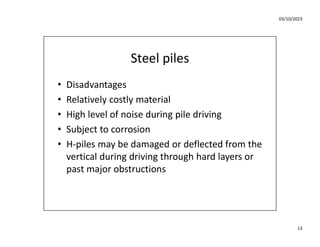
Steel piles
• Disadvantages
• Relatively costly material
• High level of noise during pile driving
• Subject to corrosion
• H-piles may be damaged or deflected from the
vertical during driving through hard layers or
past major obstructions
03/10/2023
14
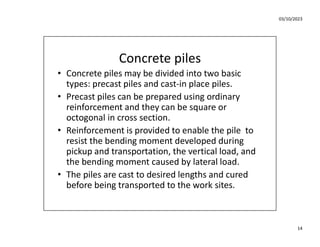
Concrete piles
• Concrete piles may be divided into two basic
types: precast piles and cast-in place piles.
• Precast piles can be prepared using ordinary
reinforcement and they can be square or
octogonal in cross section.
• Reinforcement is provided to enable the pile to
resist the bending moment developed during
pickup and transportation, the vertical load, and
the bending moment caused by lateral load.
• The piles are cast to desired lengths and cured
before being transported to the work sites.
03/10/2023
15
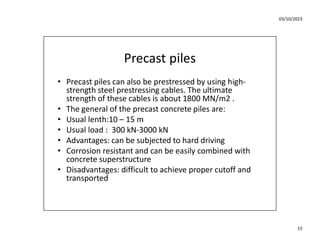
Precast piles
• Precast piles can also be prestressed by using high-
strength steel prestressing cables. The ultimate
strength of these cables is about 1800 MN/m2 .
• The general of the precast concrete piles are:
• Usual lenth:10 – 15 m
• Usual load : 300 kN-3000 kN
• Advantages: can be subjected to hard driving
• Corrosion resistant and can be easily combined with
concrete superstructure
• Disadvantages: difficult to achieve proper cutoff and
transported
03/10/2023
16
03/10/2023
17
Installation of piles
• Most piles are driven into the ground by hammers or vibratory
drivers.
• The types of hammer used for pile driving include the a) drop
hammer b)single acting air or steam hammer or double –acting and
differential air or steam hammer c) diesel hammer.
• In the driving operation, a cap is attached to the top of the pile. A
cushion is sometimes used between the cap and the pile to reduce
the impact force.
• Based on the nature of their placement, driven piles such as
concrete piles and closed ended pipe piles are displacement piles
because they move some soils laterally; hence, there is a tendency
for the densification of soil surrounding them
• Steel H-piles displace less soils and also bored piles(piers) are non
displacement piles.
• Driven piles are costly and noisy as compared to cast-in-place piles
03/10/2023
18
Cast-in-situ piles
• Piles are built by making a hole in the ground and then
filling it with concrete.
• In firm soils, contractors use the dry method (the open-
hole method) to build the shaft. These holes usually
advance quickly using conventional flight augers and
remain open without any special support.
• After checking the open hole for cleanliness and alignment,
it is simple matter to insert the steel reinforcement cage
and dump concrete in from the top using tremie or a
concrete pump to deliver the concrete.
• For excavation below the water table, the contractor simply
pumps the water out as the hole advances and places the
concrete in the dewatered shaft.
03/10/2023
19
Drilling technigues in caving or
squeezing soils
• A hole is said to be caving when the sides collapse
before or during concrete placement. This is especially
likely in clean sands below the water table.
• Squeezing refers to the sides of the hole bulging
inward, either during or after drilling, and is most likely
in soft clays and silts or highly organic soils.
• Either of these conditions could produce necking in the
shaft (a local reduction in its diameter) or soil
inclusions in the concrete, both of which could have
disastrous consequences.
• To prevent caving or soils, casing or drilling fluid are
used.
03/10/2023
20
Casing method
• Drill the hole using conventional methods until
encountering the caving strata.
• Insert a steel pipe (the casing) into the hole and
advance it past the caving strata. The diameter of
the casing is usually 50 -150 mm less than the
diameter of the upper part of the shaft.
• Drill through the casing and into the non-caving
soils below using a smaller auger,
• Place the reinforcing steel cage and the concrete
through the casing.
03/10/2023
21
DRILLING FLUID METHOD OR SLURRY
METHOD
• Drill a starter hole, perhaps 3 meter deep
• Fill the starter hole with a mixture of water and betonite clay to
form a drilling mud or slurry
• This material will keep the hole open because of the hydrostatic
pressure it applies to bthe soil.
• Advance the hole by passing the drilling tools through the slurry.
Continue to add water and bentonite as necessaey.
• Insert the reinforcing steel cage directly into the slurry
• Fill the hole with concrete using a pipe that extends to the bottom.
The concrete pushes the slurry to the ground surface, where it is
captured.
• This method is quite effective but slow and messy.
•
03/10/2023
22
Underreamed shafts
• An underreamed shaft also known as belled shafts is
one with enlarged base
• The larger base area of underreamed shafts increases
their end bearing capacity.
• Concrete
• Concrete for drilled shafts must have sufficient slump
(100 -200) mm to flow properly and completely fill the
hole
• Using concrete that is too stiff creats voids that
weakens the shafts
03/10/2023
23
03/10/2023
24
03/10/2023
25
03/10/2023
26
03/10/2023
27
03/10/2023
28
03/10/2023
29
03/10/2023
30
03/10/2023
31

Piles and drilled shaft - Deep Foundations

  • 1.
    03/10/2023 1 Deep Foundations-Piles and Drilledshafts Piles are structural members made of steel, concrete and timber. Pile foundations are deep and more costly than shallow foundations but necessary to ensure structural safety.
  • 2.
    03/10/2023 2 Pile Foundations Need forPile Foundations • When the upper soil layer is highly compressible and too weak to support the load transmitted by the superstructure • When the bedrock is not encountered at a reasonable depth below the ground surface, piles are used to transmit the structural load to the soil gradually. • When the tall buildings, and earth-retaining structures are subjected to horizontal forces such as strong wind and/or earthquake forces. • When the soils at the proposed site are expansive and collapsible. Expansive soils swell and shrink as the moisture content increases and decreases. • The swelling pressure of such soils can be considerable.
  • 3.
  • 4.
  • 5.
    03/10/2023 5 The need forpiles • Soils such as loess are collapsible. When the moisture content of these soils increases, their structures may break down. A sudden decrease in the void ratio of the soil induces larger settlements of structures supported by shallow foundations. • The foundations of some structures, such as transmission towers, offshore platforms, and basement mates below the water table, are subjected uplifting forces. • Bridge abutments and piers are usually constructed over pile foundations because of soil erosion at the ground surface.
  • 6.
    03/10/2023 6 •Piles are structuralmembers made of steel, concrete, and or timber. •Piles are used to build pile foundations, which are deep and more costly than shallow foundations. •The use of piles ensure structural safety. •Drilled shafts are cast-in-place piles that generally have diameter greater than 750 mm
  • 7.
    03/10/2023 7 •When the uppersoil layers are highly compressible and too weak or expansive and collapsible, to support the load transmitted by the superstructure, piles are used to transmit the load to the underlying bedrock or a stronger soil layer. •Pile foundations resist lateral forces in earth retaining structures and tall buildings where there are subjected to strong wind andor earthquake forces. • Oil platforms Foundations and basements mats below the water table which are subjected to uplifting forces need pile foundations. •Bridge abutments and piers are constructed over pile foundations to avoid the possible loss of bearing capacity that a shallow foundation might suffer due to soil erosion and scouring.
  • 8.
    03/10/2023 8 Types of pilesand their structural characteristics • Different types of piles are used in the construction work, depending on the type of load to be carried, the subsoil conditions, and the water table. • Piles can be divided into the following: • Steel piles • Concrete piles • Wooden (timber) piles
  • 9.
    03/10/2023 9 Types of pilesand their structural characteristics
  • 10.
    03/10/2023 10 Types of pilesand their structural characteristics
  • 11.
    03/10/2023 11 Types of pilesand their structural characteristics
  • 12.
    03/10/2023 12 Steel piles • Steelpiles generally are either pipe piles or rolled steel H-section piles. • Pipe piles can be driven into the ground with their ends open or closed. • H section piles are usually preferred because their web and flange thicknesses are equal. • When necessary, steel piles are spliced by welding or by riveting or bolts. • When hard driving conditions are expected, such as driving through dense gravel, shale and soft rock, steel piles can be fitted with driving points or shoes. • usual length: 15-60 m; usual load 300 kn -1200kN • advantages a) easy to handle with respect to cutoff and extension to the desired length. • Can stand high driving stresses • High load-carrying capacity
  • 13.
    03/10/2023 13 Steel piles • Disadvantages •Relatively costly material • High level of noise during pile driving • Subject to corrosion • H-piles may be damaged or deflected from the vertical during driving through hard layers or past major obstructions
  • 14.
    03/10/2023 14 Concrete piles • Concretepiles may be divided into two basic types: precast piles and cast-in place piles. • Precast piles can be prepared using ordinary reinforcement and they can be square or octogonal in cross section. • Reinforcement is provided to enable the pile to resist the bending moment developed during pickup and transportation, the vertical load, and the bending moment caused by lateral load. • The piles are cast to desired lengths and cured before being transported to the work sites.
  • 15.
    03/10/2023 15 Precast piles • Precastpiles can also be prestressed by using high- strength steel prestressing cables. The ultimate strength of these cables is about 1800 MN/m2 . • The general of the precast concrete piles are: • Usual lenth:10 – 15 m • Usual load : 300 kN-3000 kN • Advantages: can be subjected to hard driving • Corrosion resistant and can be easily combined with concrete superstructure • Disadvantages: difficult to achieve proper cutoff and transported
  • 16.
  • 17.
    03/10/2023 17 Installation of piles •Most piles are driven into the ground by hammers or vibratory drivers. • The types of hammer used for pile driving include the a) drop hammer b)single acting air or steam hammer or double –acting and differential air or steam hammer c) diesel hammer. • In the driving operation, a cap is attached to the top of the pile. A cushion is sometimes used between the cap and the pile to reduce the impact force. • Based on the nature of their placement, driven piles such as concrete piles and closed ended pipe piles are displacement piles because they move some soils laterally; hence, there is a tendency for the densification of soil surrounding them • Steel H-piles displace less soils and also bored piles(piers) are non displacement piles. • Driven piles are costly and noisy as compared to cast-in-place piles
  • 18.
    03/10/2023 18 Cast-in-situ piles • Pilesare built by making a hole in the ground and then filling it with concrete. • In firm soils, contractors use the dry method (the open- hole method) to build the shaft. These holes usually advance quickly using conventional flight augers and remain open without any special support. • After checking the open hole for cleanliness and alignment, it is simple matter to insert the steel reinforcement cage and dump concrete in from the top using tremie or a concrete pump to deliver the concrete. • For excavation below the water table, the contractor simply pumps the water out as the hole advances and places the concrete in the dewatered shaft.
  • 19.
    03/10/2023 19 Drilling technigues incaving or squeezing soils • A hole is said to be caving when the sides collapse before or during concrete placement. This is especially likely in clean sands below the water table. • Squeezing refers to the sides of the hole bulging inward, either during or after drilling, and is most likely in soft clays and silts or highly organic soils. • Either of these conditions could produce necking in the shaft (a local reduction in its diameter) or soil inclusions in the concrete, both of which could have disastrous consequences. • To prevent caving or soils, casing or drilling fluid are used.
  • 20.
    03/10/2023 20 Casing method • Drillthe hole using conventional methods until encountering the caving strata. • Insert a steel pipe (the casing) into the hole and advance it past the caving strata. The diameter of the casing is usually 50 -150 mm less than the diameter of the upper part of the shaft. • Drill through the casing and into the non-caving soils below using a smaller auger, • Place the reinforcing steel cage and the concrete through the casing.
  • 21.
    03/10/2023 21 DRILLING FLUID METHODOR SLURRY METHOD • Drill a starter hole, perhaps 3 meter deep • Fill the starter hole with a mixture of water and betonite clay to form a drilling mud or slurry • This material will keep the hole open because of the hydrostatic pressure it applies to bthe soil. • Advance the hole by passing the drilling tools through the slurry. Continue to add water and bentonite as necessaey. • Insert the reinforcing steel cage directly into the slurry • Fill the hole with concrete using a pipe that extends to the bottom. The concrete pushes the slurry to the ground surface, where it is captured. • This method is quite effective but slow and messy. •
  • 22.
    03/10/2023 22 Underreamed shafts • Anunderreamed shaft also known as belled shafts is one with enlarged base • The larger base area of underreamed shafts increases their end bearing capacity. • Concrete • Concrete for drilled shafts must have sufficient slump (100 -200) mm to flow properly and completely fill the hole • Using concrete that is too stiff creats voids that weakens the shafts
  • 23.
  • 24.
  • 25.
  • 26.
  • 27.
  • 28.
  • 29.
  • 30.
  • 31.