SARVAJANIK COLLEGE OF ENGINEERING AND TECHNOLOGY
SUBJECT : ADVANCED CONSTRUCTION AND EQUIPMENTS (2160601)
TOPIC : SINKING , TILTING AND DISEASE OF CAISSON
PREPARED BY:
KISHAN KAPADIA :140420106031
NIKITA KOTHARI :140420106032
JAY LAD :140420106033
UMANG LAPSIWALA :140420106034
NEVIL MANDANI :140420106035
GUIDED BY:-MANISHA VASHI
1
CONTENT
 INTRODUCTION
 SINKING OF CAISSONS
 TILTING OF CAISSONS
 CAISSON DISEASES
2
CAISSONS
 The term “caisson” is derived from French word caisse meaning a box.
 Caisson is defined as a watertight structure round or rectangular , which is sunk
through ground or water to exclude water and semi fluid material during the
process of excavations of foundation and which subsequently becomes an integral
part of sub structure.
3
SINKING OF CAISSONS
 A caisson is sunk by self-weight, concrete or water ballast placed on top, or by
hydraulic jacks… this is defined as sinking of caisson.
 The methods adopted for sinking are as follows :
1. Air and water jets
2. Blasting
3. Loading
4. Sand island
4
1. Air and water jets :
 In this method , the jets are provided near the cutting edge level to reduce the skin
friction.
 The air or water is forced through the jets which ultimately facilitates the sinking of
caisson.
2. Blasting :
 In this method , the explosives are used to remove any obstruction such as rock,
boulder etc. and thereby to facilitate the sinking of caisson.
 The blasting also reduce skin friction.
 The usual explosive used in blasting is “Gelignite” which is provided at a depth about
one to two meters below the curb level.
 The quantity required per blast is 1N to 5N.
5
3. Loading :
 This is the usual method adopted to sink wells when a hard surface is met with.
4. Sand island :
 This method is also known as an artificial island method.
 It is to be adopted when subsoil conditions are such that it is not possible to keep caisson
stable.
 This method consists in sinking a steel cylinder around the site of work and then filling this
cylinder with stand or other dredged material.
 The caisson is sunk through this filling in the usual manner.
6
PROBLEMS IN WELL SINKING
The major problems are as follows :
 Sand blowing
 Tilting of Wells
 Shifting of Wells
7
TILTING OF WELLS
 When a well sinks more on one side than the other, then it is known to have tilted.
The tilting is mainly due to unequal dredging and non-uniform bearing power of
soil.
Causes of Tilts :
 Non Uniform bearing capacity
 Obstruction on one side well
 Sand blowing in wells during sinking
 Sudden sinking of well due to blasting
8
Methods for bring a tilted caisson in position
1. Control of dredging :
 In this method , dredging is done only near the portion which has tilted.
 The portion which is higher than the other is termed as tilted portion or tilted
edge.
 By extreme care dredging should be done and the caisson is then placed at its
actual place.
 If there is not proper care taken there is chance of turn up of the well.
9
2. Eccentric Loading
• In this method, heavy loads
are placed on the tilted edge.
The moment caused by
heavy loads brings the well
in true position.
10
3. Water jetting :
 In this method, the water jet is forced on the outer faces of the well towards the
higher side so that skin friction is reduced towards the higher side.
 This method effective in case the well being sunk in sandy strata.
4. Pushing by Jacks :
 In this method, the well may be pushed by jacks on the tilted side of well.
11
5. Use of explosives :
 In this method, the explosives are used to remove obstacles from the tilted edge.
 This blow able to remove any obstacles.
 This is risky method so it is adopted only under special circumstances.
6. Deposition of Earth on one side and Excavation on other :
 In this method, an open excavations is carried out on one side of the well while
depositing more earth on the other side.
 By this the pressure on the higher side is released and that on the lower side
increased thus correcting tilt.
12
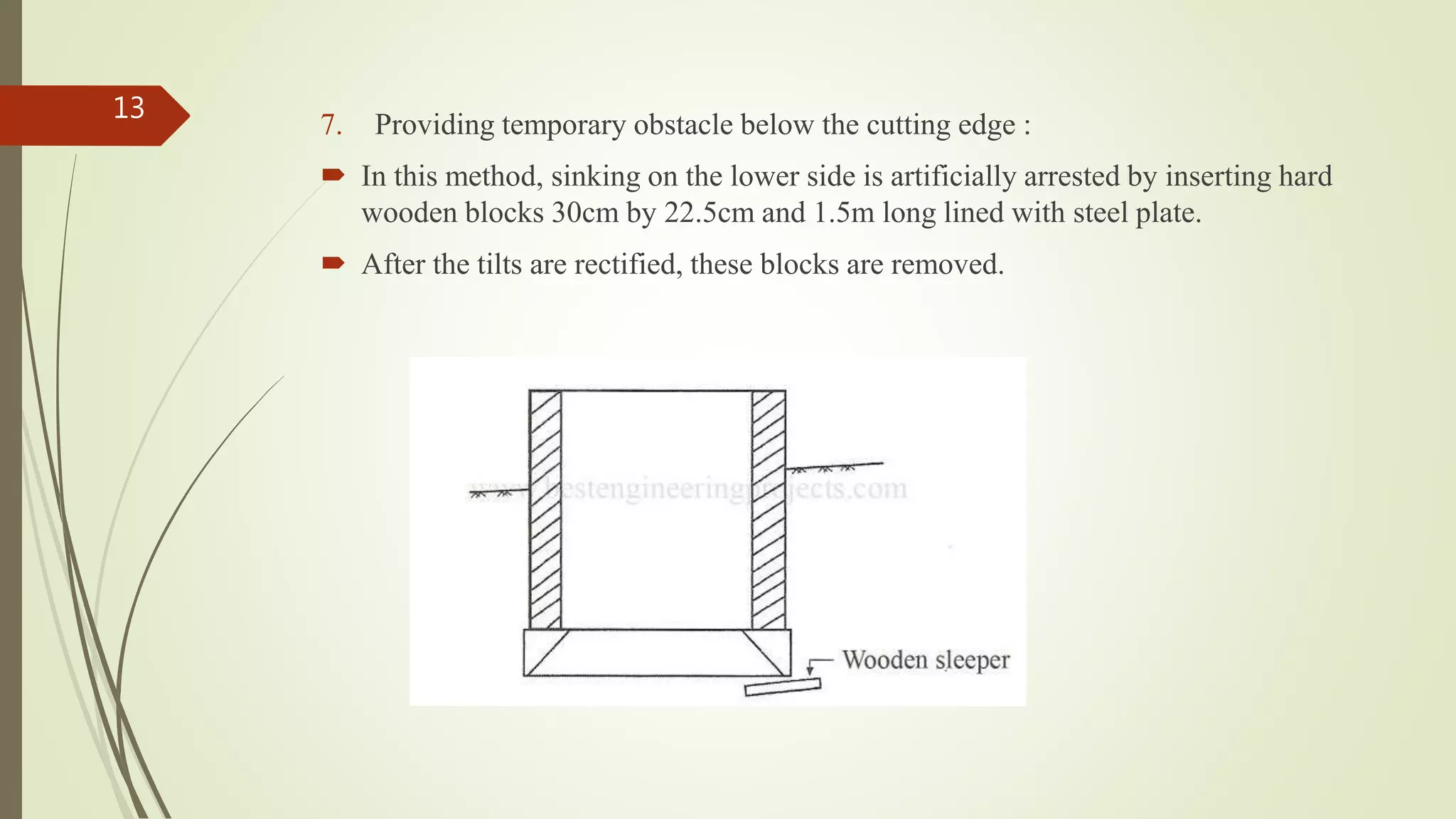
7. Providing temporary obstacle below the cutting edge :
 In this method, sinking on the lower side is artificially arrested by inserting hard
wooden blocks 30cm by 22.5cm and 1.5m long lined with steel plate.
 After the tilts are rectified, these blocks are removed.
13
8. Pulling the well :
 In this method the well is pulled towards the higher side by placing one or more
steel ropes round the well with vertical sleepers packed.
 The vertical sleepers distribute the pressure over large area of well steining.
 This method is effective only in early stages of sinking.
14
CAISSON DISEASE
 The workers working under compressed air inside the working chamber, suffer a
certain type of disease when they return to atmospheric pressure. This disease is
known as “caisson sickness” or “caisson disease”.
 The main symptoms of disease are:
1. Dizziness
2. Double vision
3. Headche
4. Trouble to speaking
5. Pain in legs
15
 When a person is subjected to compressed air, nitrogen is also absorbed along
with oxygen by the tissue-fluids of the person.
 The oxygen is dissolved by blood, while nitrogen is kept in suspension as it is not
soluable in blood.
 When the air pressure is reduced, tissue fluids release nitrogen content at a certain
rate.
 If the reduction of pressure is not gradual, the nitrogen will not be able to come
out in the form of gas, And it forms bubble.
 If the bubble are blocked in joints, they will cause violent pains in joints.
 If they are developed in spinal cord or heart, it will result in paralysis or death
respectively.
16
PRECAUTIONS
 Work not exceeds more than 1shift
 1shift should not more than 12 hours
 Temperature of working chamber maintained at 25C
 Rate of compression and decompression should properly maintained
 Person with strong hearts, relatively low pressure are appointed
 Medical chamber provided near the side of work
 Use of alcoholic drinks prohibited
 All local police station and hospitals are informed regarding the location of work
17
• The worker used man locks for entry,
interval and exit. This locks are
properly ventilated.
• The safety lamps provided for safety
against fire hazard.
• The workers should be made fully
conversant with use of bells, signals
etc.
• Worker should take proper meal before
the shift started and suitable
refreshment should provided at proper
interval.
18
Refrence
 https://en.wikipedia.org/wiki/Caisson_(engineering)
 http://www.theconstructioncivil.org/caissons-types-of-caissons/
19
Thank you…
20

SINKING , TILTING AND DISEASE OF CAISSON

  • 1.
    SARVAJANIK COLLEGE OFENGINEERING AND TECHNOLOGY SUBJECT : ADVANCED CONSTRUCTION AND EQUIPMENTS (2160601) TOPIC : SINKING , TILTING AND DISEASE OF CAISSON PREPARED BY: KISHAN KAPADIA :140420106031 NIKITA KOTHARI :140420106032 JAY LAD :140420106033 UMANG LAPSIWALA :140420106034 NEVIL MANDANI :140420106035 GUIDED BY:-MANISHA VASHI 1
  • 2.
    CONTENT  INTRODUCTION  SINKINGOF CAISSONS  TILTING OF CAISSONS  CAISSON DISEASES 2
  • 3.
    CAISSONS  The term“caisson” is derived from French word caisse meaning a box.  Caisson is defined as a watertight structure round or rectangular , which is sunk through ground or water to exclude water and semi fluid material during the process of excavations of foundation and which subsequently becomes an integral part of sub structure. 3
  • 4.
    SINKING OF CAISSONS A caisson is sunk by self-weight, concrete or water ballast placed on top, or by hydraulic jacks… this is defined as sinking of caisson.  The methods adopted for sinking are as follows : 1. Air and water jets 2. Blasting 3. Loading 4. Sand island 4
  • 5.
    1. Air andwater jets :  In this method , the jets are provided near the cutting edge level to reduce the skin friction.  The air or water is forced through the jets which ultimately facilitates the sinking of caisson. 2. Blasting :  In this method , the explosives are used to remove any obstruction such as rock, boulder etc. and thereby to facilitate the sinking of caisson.  The blasting also reduce skin friction.  The usual explosive used in blasting is “Gelignite” which is provided at a depth about one to two meters below the curb level.  The quantity required per blast is 1N to 5N. 5
  • 6.
    3. Loading : This is the usual method adopted to sink wells when a hard surface is met with. 4. Sand island :  This method is also known as an artificial island method.  It is to be adopted when subsoil conditions are such that it is not possible to keep caisson stable.  This method consists in sinking a steel cylinder around the site of work and then filling this cylinder with stand or other dredged material.  The caisson is sunk through this filling in the usual manner. 6
  • 7.
    PROBLEMS IN WELLSINKING The major problems are as follows :  Sand blowing  Tilting of Wells  Shifting of Wells 7
  • 8.
    TILTING OF WELLS When a well sinks more on one side than the other, then it is known to have tilted. The tilting is mainly due to unequal dredging and non-uniform bearing power of soil. Causes of Tilts :  Non Uniform bearing capacity  Obstruction on one side well  Sand blowing in wells during sinking  Sudden sinking of well due to blasting 8
  • 9.
    Methods for bringa tilted caisson in position 1. Control of dredging :  In this method , dredging is done only near the portion which has tilted.  The portion which is higher than the other is termed as tilted portion or tilted edge.  By extreme care dredging should be done and the caisson is then placed at its actual place.  If there is not proper care taken there is chance of turn up of the well. 9
  • 10.
    2. Eccentric Loading •In this method, heavy loads are placed on the tilted edge. The moment caused by heavy loads brings the well in true position. 10
  • 11.
    3. Water jetting:  In this method, the water jet is forced on the outer faces of the well towards the higher side so that skin friction is reduced towards the higher side.  This method effective in case the well being sunk in sandy strata. 4. Pushing by Jacks :  In this method, the well may be pushed by jacks on the tilted side of well. 11
  • 12.
    5. Use ofexplosives :  In this method, the explosives are used to remove obstacles from the tilted edge.  This blow able to remove any obstacles.  This is risky method so it is adopted only under special circumstances. 6. Deposition of Earth on one side and Excavation on other :  In this method, an open excavations is carried out on one side of the well while depositing more earth on the other side.  By this the pressure on the higher side is released and that on the lower side increased thus correcting tilt. 12
  • 13.
    7. Providing temporaryobstacle below the cutting edge :  In this method, sinking on the lower side is artificially arrested by inserting hard wooden blocks 30cm by 22.5cm and 1.5m long lined with steel plate.  After the tilts are rectified, these blocks are removed. 13
  • 14.
    8. Pulling thewell :  In this method the well is pulled towards the higher side by placing one or more steel ropes round the well with vertical sleepers packed.  The vertical sleepers distribute the pressure over large area of well steining.  This method is effective only in early stages of sinking. 14
  • 15.
    CAISSON DISEASE  Theworkers working under compressed air inside the working chamber, suffer a certain type of disease when they return to atmospheric pressure. This disease is known as “caisson sickness” or “caisson disease”.  The main symptoms of disease are: 1. Dizziness 2. Double vision 3. Headche 4. Trouble to speaking 5. Pain in legs 15
  • 16.
     When aperson is subjected to compressed air, nitrogen is also absorbed along with oxygen by the tissue-fluids of the person.  The oxygen is dissolved by blood, while nitrogen is kept in suspension as it is not soluable in blood.  When the air pressure is reduced, tissue fluids release nitrogen content at a certain rate.  If the reduction of pressure is not gradual, the nitrogen will not be able to come out in the form of gas, And it forms bubble.  If the bubble are blocked in joints, they will cause violent pains in joints.  If they are developed in spinal cord or heart, it will result in paralysis or death respectively. 16
  • 17.
    PRECAUTIONS  Work notexceeds more than 1shift  1shift should not more than 12 hours  Temperature of working chamber maintained at 25C  Rate of compression and decompression should properly maintained  Person with strong hearts, relatively low pressure are appointed  Medical chamber provided near the side of work  Use of alcoholic drinks prohibited  All local police station and hospitals are informed regarding the location of work 17
  • 18.
    • The workerused man locks for entry, interval and exit. This locks are properly ventilated. • The safety lamps provided for safety against fire hazard. • The workers should be made fully conversant with use of bells, signals etc. • Worker should take proper meal before the shift started and suitable refreshment should provided at proper interval. 18
  • 19.
  • 20.