Writing: It’s Just What
        We Do
   Being a “Writing Teacher” in Any Discipline
        Teaching Assistants’ Workshop
                September 2007
            Dalhousie Writing Centre
Before we begin


What is your image of a writer?


      Are you a writer?
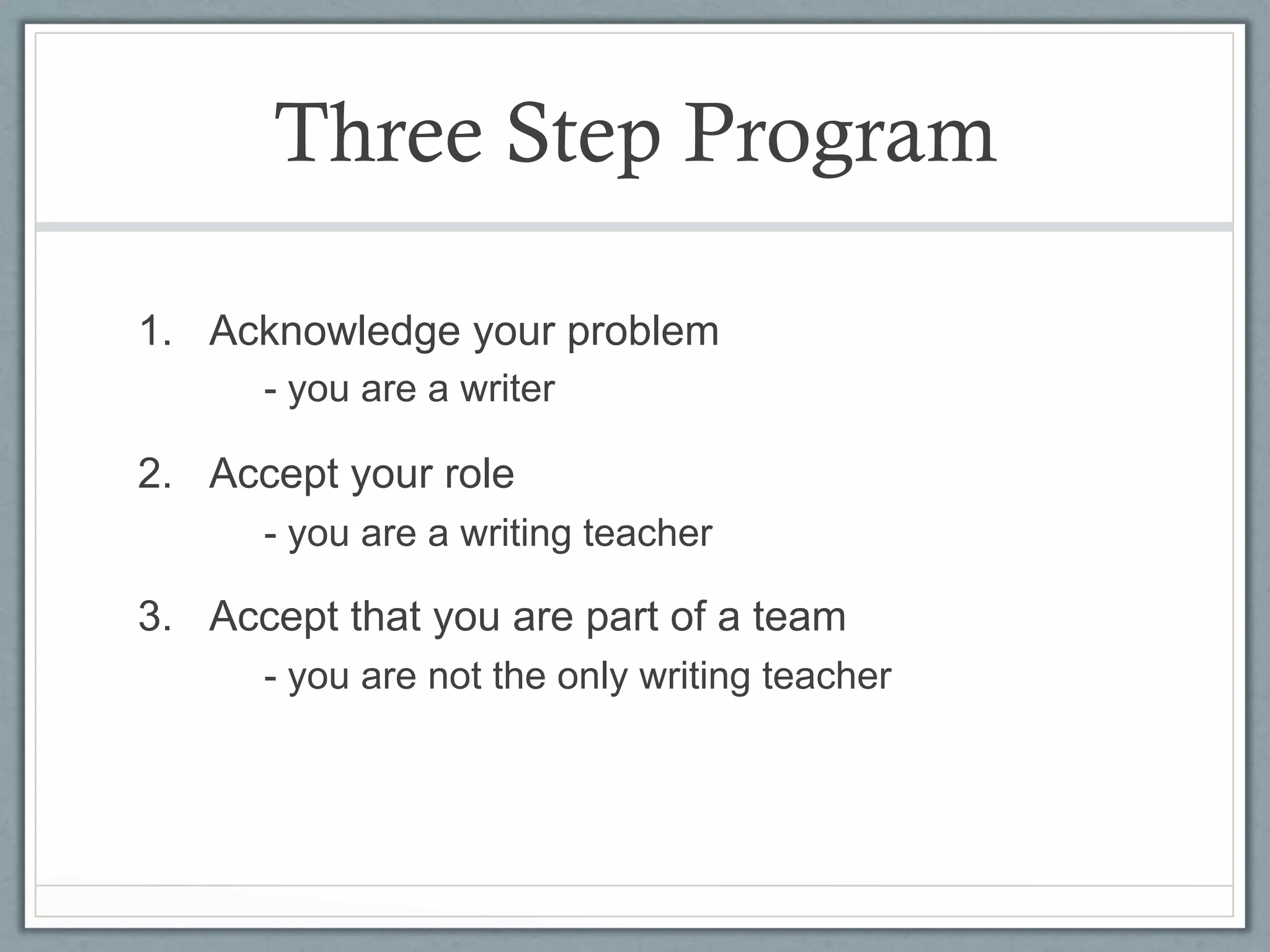
Three Step Program

1.  Acknowledge your problem
      - you are a writer

2.  Accept your role
      - you are a writing teacher

3.  Accept that you are part of a team
      - you are not the only writing teacher
1. Acknowledge your problem: You are
               a writer

•  What are your feelings generally about writing?


§  Are you a fairly competent writer? Where are your
    major challenges?


§  Do you see writing as a process or as a product?


§  What is writing like in your field or discipline?
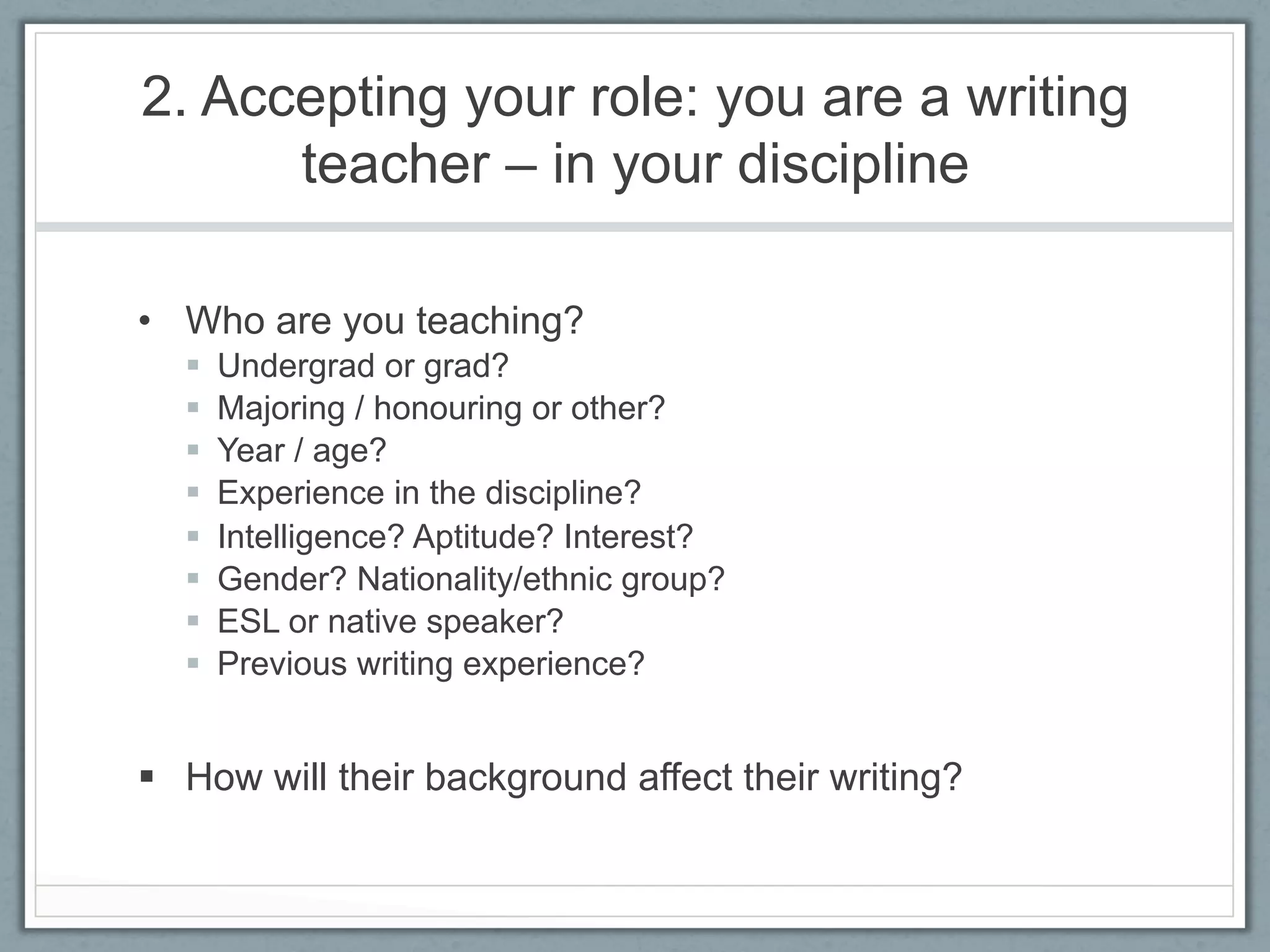
2. Accepting your role: you are a writing
      teacher – in your discipline

•  Who are you teaching?
  §    Undergrad or grad?
  §    Majoring / honouring or other?
  §    Year / age?
  §    Experience in the discipline?
  §    Intelligence? Aptitude? Interest?
  §    Gender? Nationality/ethnic group?
  §    ESL or native speaker?
  §    Previous writing experience?


§  How will their background affect their writing?
Being Practical


What can you do to help your students become good
              writers in your discipline?
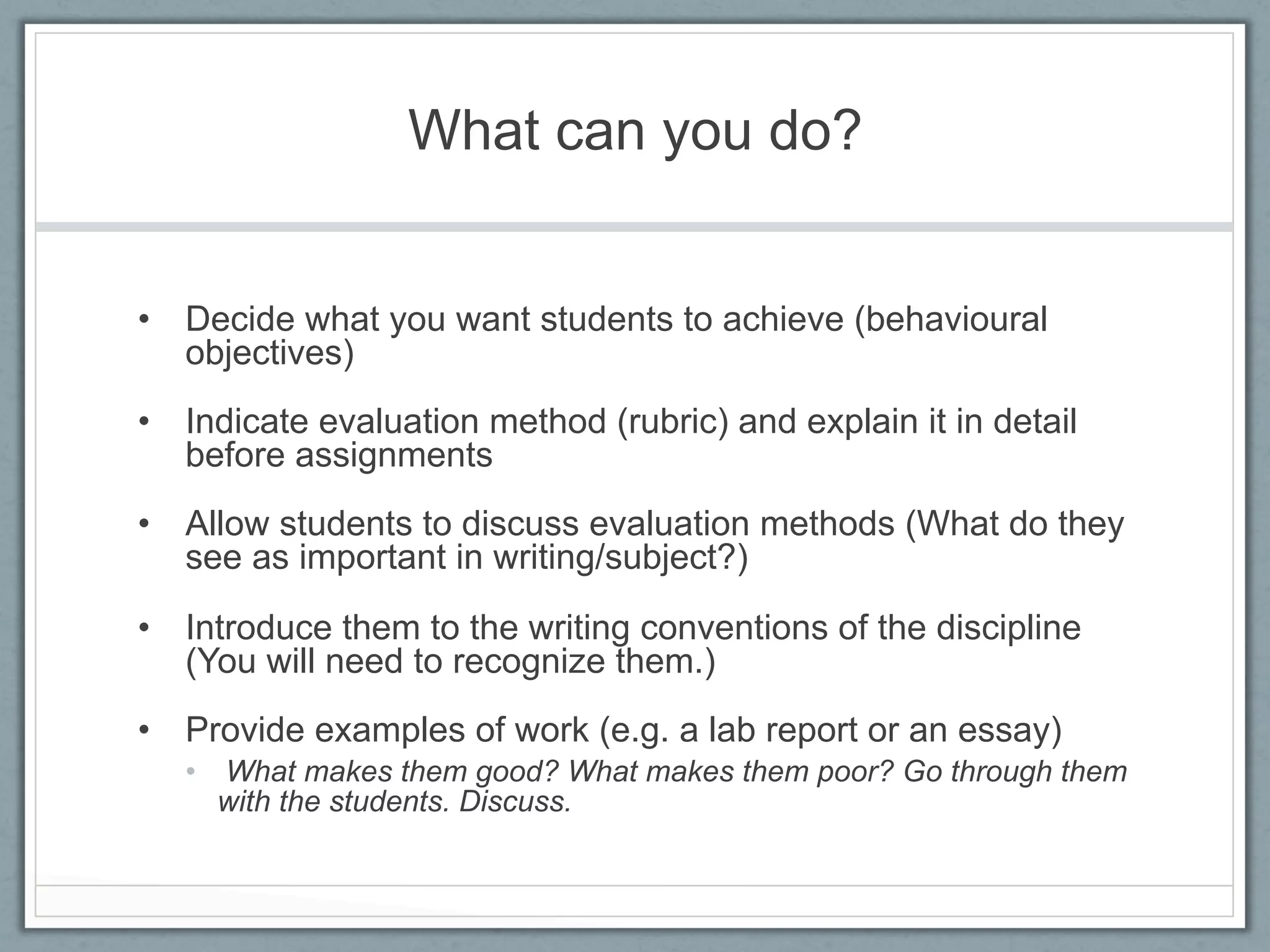
What can you do?


•  Decide what you want students to achieve (behavioural
   objectives)
•  Indicate evaluation method (rubric) and explain it in detail
   before assignments
•  Allow students to discuss evaluation methods (What do they
   see as important in writing/subject?)

•  Introduce them to the writing conventions of the discipline
   (You will need to recognize them.)
•  Provide examples of work (e.g. a lab report or an essay)
   •  What makes them good? What makes them poor? Go through them
      with the students. Discuss.
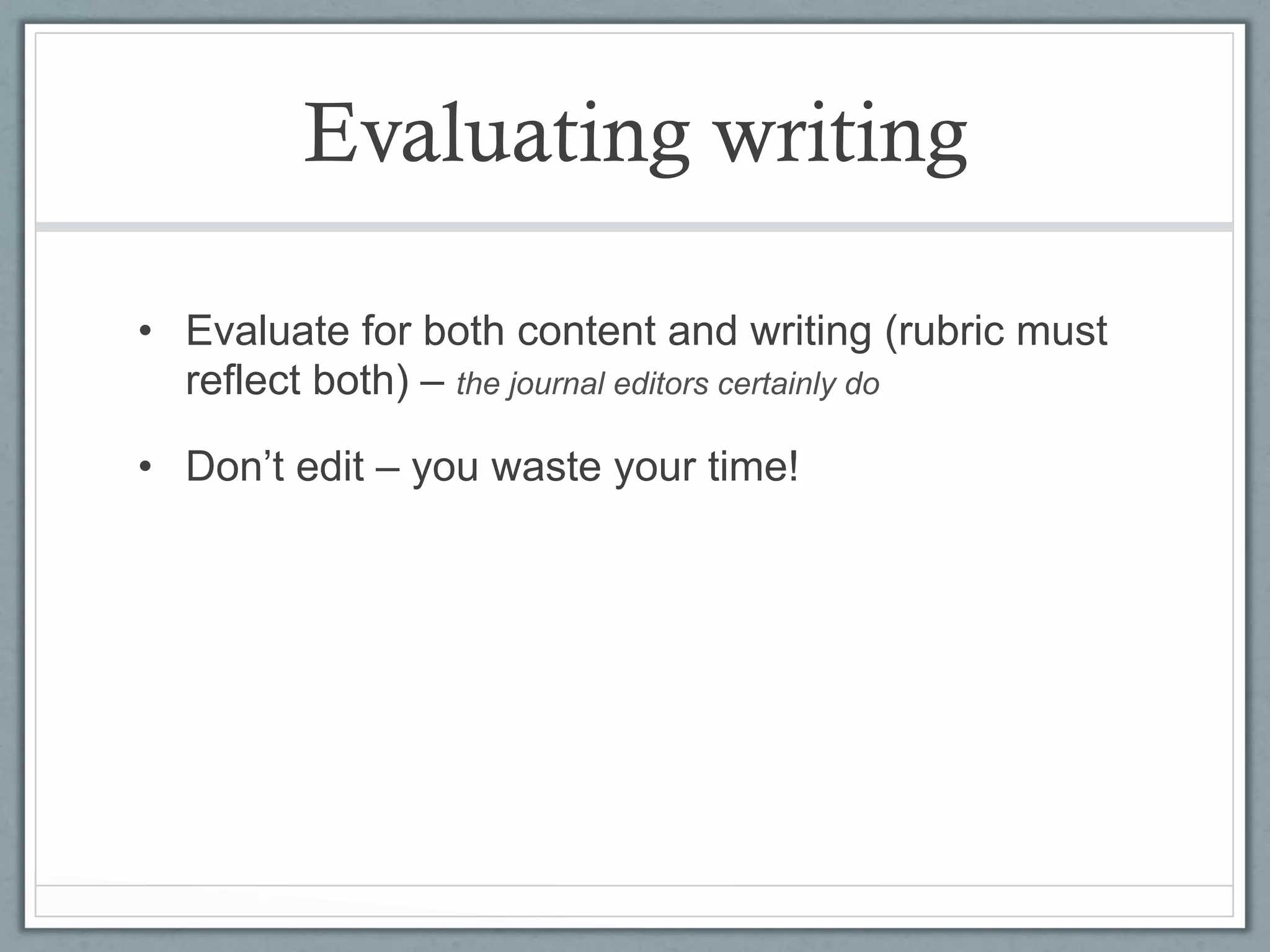
Evaluating writing

•  Evaluate for both content and writing (rubric must
   reflect both) – the journal editors certainly do

•  Don’t edit – you waste your time!
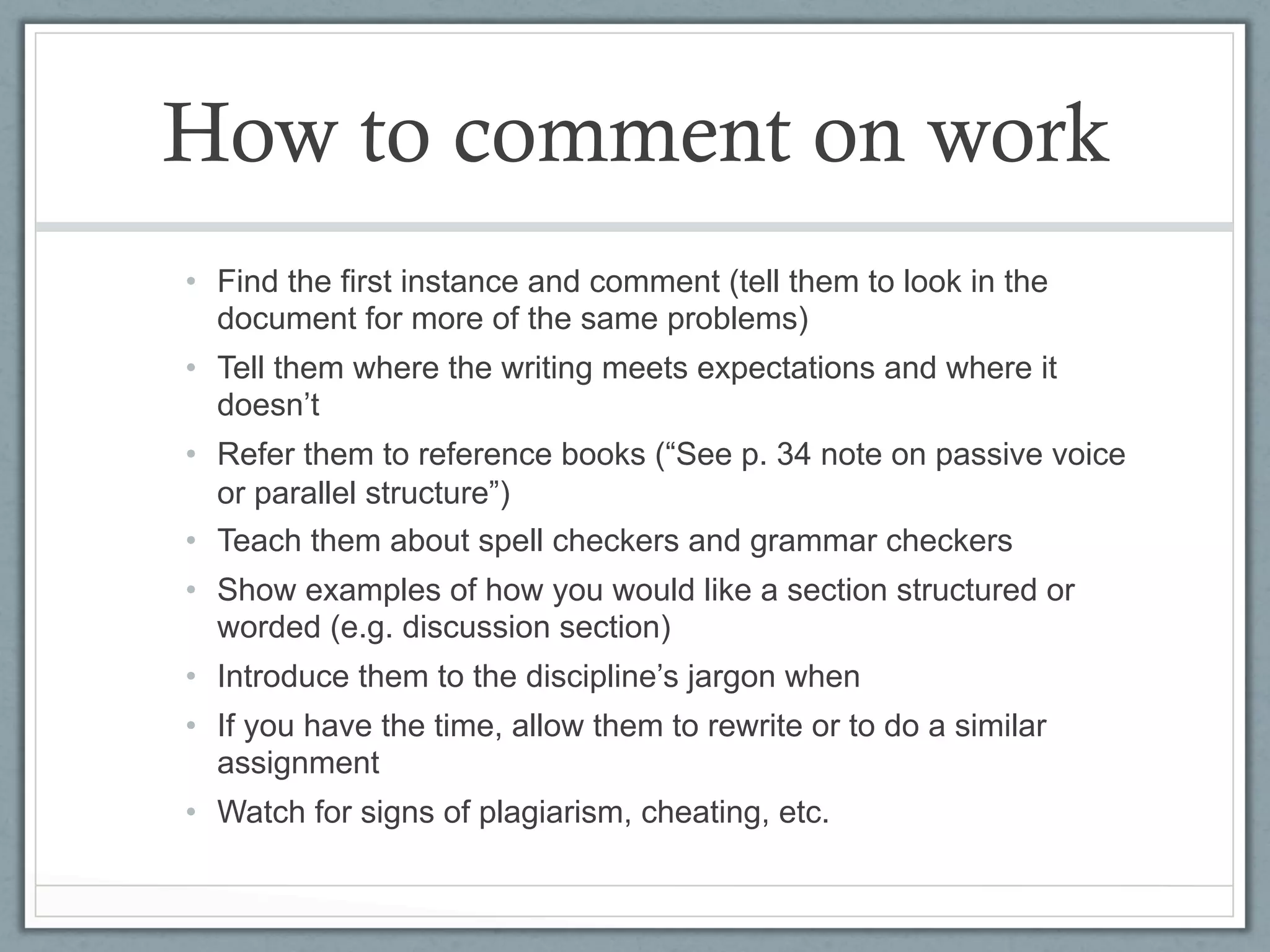
How to comment on work
•  Find the first instance and comment (tell them to look in the
   document for more of the same problems)
•  Tell them where the writing meets expectations and where it
   doesn’t
•  Refer them to reference books (“See p. 34 note on passive voice
   or parallel structure”)
•  Teach them about spell checkers and grammar checkers
•  Show examples of how you would like a section structured or
   worded (e.g. discussion section)
•  Introduce them to the discipline’s jargon when
•  If you have the time, allow them to rewrite or to do a similar
   assignment
•  Watch for signs of plagiarism, cheating, etc.
3. Accept that you’re part of a
    team of “writing” teachers

•  You are not alone

•  You have a faculty member

•  You have a librarian subject specialist

•  You have peers (faculty and grad students)

•  You have the CLT

          •  You have the Writing Centre
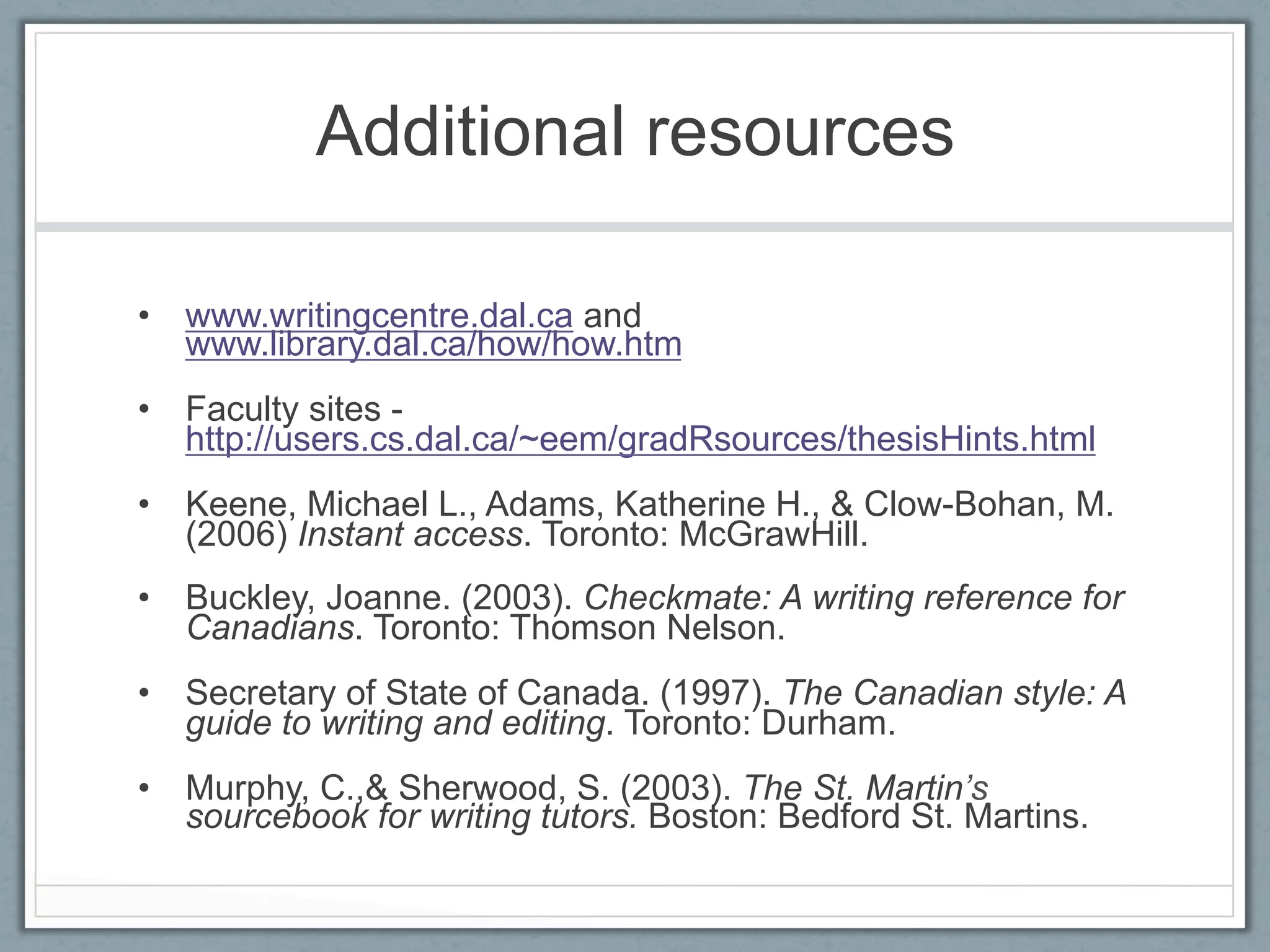
Additional resources

•  www.writingcentre.dal.ca and
   www.library.dal.ca/how/how.htm
•  Faculty sites -
   http://users.cs.dal.ca/~eem/gradRsources/thesisHints.html
•  Keene, Michael L., Adams, Katherine H., & Clow-Bohan, M.
   (2006) Instant access. Toronto: McGrawHill.
•  Buckley, Joanne. (2003). Checkmate: A writing reference for
   Canadians. Toronto: Thomson Nelson.
•  Secretary of State of Canada. (1997). The Canadian style: A
   guide to writing and editing. Toronto: Durham.
•  Murphy, C.,& Sherwood, S. (2003). The St. Martin’s
   sourcebook for writing tutors. Boston: Bedford St. Martins.
More resources
•  Day, R.A. (1998). How to write & publish a scientific paper.
   Westport: Oryx
•  Northey, M.,& Jewinski, J. (2005). Making sense: A
   student s guide to research and writing. Toronto: Oxford.
•  Pechenik, J.A. (2004). A short guide to writing about
   biology.Toronto: Pearson.
•  Adams, K.H.,& Keene, M.L. (2000). Research and writing
   across the disciplines. Toronto: Mayfield.
•  Crème, P.,& Lea, M.R. (1997). Writing at university: A guide
   for students. Maidenhead: Open U.
•  Writing Centre website for more links to discipline-specific
   writing guidelines www.writingcentre.dal.ca
Dalhousie Writing Centre:
           Services

§  One-on-one appointments
§  Seminars
§  ESL non-credit course
Contact the Writing Centre

§  www.writingcentre.dal.ca

§  writingcentre@dal.ca

§  494-1963 (appointments & information)
      §  G40M in Learning Commons
P.S.

•  Have patience

•  Enjoy the experience

•  Send your students to see us

•  Come yourselves!


              Thank you for your time.

TA presentation

  • 1.
    Writing: It’s JustWhat We Do Being a “Writing Teacher” in Any Discipline Teaching Assistants’ Workshop September 2007 Dalhousie Writing Centre
  • 2.
    Before we begin Whatis your image of a writer? Are you a writer?
  • 3.
    Three Step Program 1. Acknowledge your problem - you are a writer 2.  Accept your role - you are a writing teacher 3.  Accept that you are part of a team - you are not the only writing teacher
  • 4.
    1. Acknowledge yourproblem: You are a writer •  What are your feelings generally about writing? §  Are you a fairly competent writer? Where are your major challenges? §  Do you see writing as a process or as a product? §  What is writing like in your field or discipline?
  • 5.
    2. Accepting yourrole: you are a writing teacher – in your discipline •  Who are you teaching? §  Undergrad or grad? §  Majoring / honouring or other? §  Year / age? §  Experience in the discipline? §  Intelligence? Aptitude? Interest? §  Gender? Nationality/ethnic group? §  ESL or native speaker? §  Previous writing experience? §  How will their background affect their writing?
  • 6.
    Being Practical What canyou do to help your students become good writers in your discipline?
  • 7.
    What can youdo? •  Decide what you want students to achieve (behavioural objectives) •  Indicate evaluation method (rubric) and explain it in detail before assignments •  Allow students to discuss evaluation methods (What do they see as important in writing/subject?) •  Introduce them to the writing conventions of the discipline (You will need to recognize them.) •  Provide examples of work (e.g. a lab report or an essay) •  What makes them good? What makes them poor? Go through them with the students. Discuss.
  • 8.
    Evaluating writing •  Evaluatefor both content and writing (rubric must reflect both) – the journal editors certainly do •  Don’t edit – you waste your time!
  • 9.
    How to commenton work •  Find the first instance and comment (tell them to look in the document for more of the same problems) •  Tell them where the writing meets expectations and where it doesn’t •  Refer them to reference books (“See p. 34 note on passive voice or parallel structure”) •  Teach them about spell checkers and grammar checkers •  Show examples of how you would like a section structured or worded (e.g. discussion section) •  Introduce them to the discipline’s jargon when •  If you have the time, allow them to rewrite or to do a similar assignment •  Watch for signs of plagiarism, cheating, etc.
  • 10.
    3. Accept thatyou’re part of a team of “writing” teachers •  You are not alone •  You have a faculty member •  You have a librarian subject specialist •  You have peers (faculty and grad students) •  You have the CLT •  You have the Writing Centre
  • 11.
    Additional resources •  www.writingcentre.dal.caand www.library.dal.ca/how/how.htm •  Faculty sites - http://users.cs.dal.ca/~eem/gradRsources/thesisHints.html •  Keene, Michael L., Adams, Katherine H., & Clow-Bohan, M. (2006) Instant access. Toronto: McGrawHill. •  Buckley, Joanne. (2003). Checkmate: A writing reference for Canadians. Toronto: Thomson Nelson. •  Secretary of State of Canada. (1997). The Canadian style: A guide to writing and editing. Toronto: Durham. •  Murphy, C.,& Sherwood, S. (2003). The St. Martin’s sourcebook for writing tutors. Boston: Bedford St. Martins.
  • 12.
    More resources •  Day,R.A. (1998). How to write & publish a scientific paper. Westport: Oryx •  Northey, M.,& Jewinski, J. (2005). Making sense: A student s guide to research and writing. Toronto: Oxford. •  Pechenik, J.A. (2004). A short guide to writing about biology.Toronto: Pearson. •  Adams, K.H.,& Keene, M.L. (2000). Research and writing across the disciplines. Toronto: Mayfield. •  Crème, P.,& Lea, M.R. (1997). Writing at university: A guide for students. Maidenhead: Open U. •  Writing Centre website for more links to discipline-specific writing guidelines www.writingcentre.dal.ca
  • 13.
    Dalhousie Writing Centre: Services §  One-on-one appointments §  Seminars §  ESL non-credit course
  • 14.
    Contact the WritingCentre §  www.writingcentre.dal.ca §  writingcentre@dal.ca §  494-1963 (appointments & information) §  G40M in Learning Commons
  • 15.
    P.S. •  Have patience • Enjoy the experience •  Send your students to see us •  Come yourselves! Thank you for your time.

Editor's Notes

  • #7 Teaching assistants need paper. They should work in groups to think about what they can do to help their students become good writers in the discipline.