Selection & Recruitment “ Hiring the right people for the right position at the right time” For more information:  Lynn Tulip Assessment 4 Potential lynn@assessment4potential.com | 07801 689801 | www.assessment4potential.com
Definitions: Recruitment  is the process which aims to attract suitably qualified candidates for a job from which it is possible to select a competent person Selection  is the application of techniques with the aim of selecting and appointing a competent person.
Selection & Recruitment Define Source Capture Assess Hire
Selection & Recruitment Define Job profile Job Analysis Job description Person specification  Type of worker Permanent, temp or contract Salary Selection Process Who is involved? What will happen?
Job Analysis Define accurately and clearly the nature and purpose of the role and the skills and attributes needed to carry it out.  Job analysis  is the first stage in this process.  It involves asking questions and gathering information to identify the key elements of the job and the ideal characteristics of the post-holder. This analysis forms the basis of the job description and the person specification.
Job Description The job description outlines the role in terms of the day to day tasks and responsibilities and benefits which the post-holder is entitled to.  The job description helps potential applicants to decide whether to apply for the job, and can be used to devise the advertisement and the employment contract.
Define the job role of  Marketing Assistant
Person Specification A person specification is a profile of the ideal candidate for the job. It lists the essential and desirable criteria necessary to carry out the role.
Define the job role of  Marketing Assistant
Recruitment Process
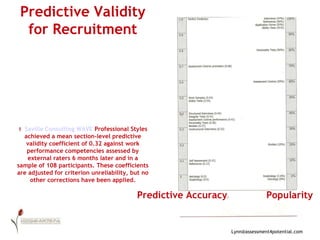
Predictive Validity for Recruitment 1  Saville Consulting WAVE  Professional Styles achieved a mean section-level predictive validity coefficient of 0.32 against work performance competencies assessed by external raters 6 months later and in a sample of 108 participants. These coefficients are adjusted for criterion unreliability, but no other corrections have been applied. Predictive Accuracy 1   Popularity
Selection Tools  Validity & Popularity
Assessment Methods
Selection & Recruitment Source Attract candidates Internal External Advertise  Job Centres Recruitment Agency Networking Newspaper/journals
Attract Candidates Internal Notice-boards etc External Job Centres Employment Agencies Local Newspapers Trade Journals Job fairs  CV or Application Form? External  [cont] Engage networks of friends and colleagues Business/society meetings Internet [inc craigslist, job boards, etc] Local colleges and trade schools
Advertisement Check-list Salary or salary guide Whether the role is full-time or permanent or a short-term contract (if not implicitly clear from elsewhere in the advert) Oher package details or guide (pension, car etc) Explanation of recruitment process Response and application instructions [include dates] Contact details as necessary, for example, address, phone, fax, email, etc. Job and or advert reference (advert references help you analyse results from different adverts for the same job) Website address  | corporate branding Quality accreditations, for example in the UK, Investor in People Equal opportunities statement Job title, Job base location Employer or recruitment agency/consultancy Succinct description of business/organization/division activity and market position and aims To whom the position reports - or other indication of where the role is in the structure Outline of job role and purpose - expressed in the 'second-person' (you, your, etc) Indication of scale, size, responsibility, time-scale, and territory of role Outline of ideal candidate profile - expressed in 'second-person' Indicate qualifications and experience required (which could be incorporated within candidate profile)
Handling Ad Responses State a “reply by” date in the ad. Require applicants to answer three to five basic questions in the body of their e-mail reply. This can be a first line of screening applications. Reply to all applicants via e-mail and ask them to answer a set of questions. Give a reasonable but quick turn-around time. Set up a separate and distinct e-mail address to receive applications. Notify your existing staff of the ad and provide them with instructions for handling incoming phone inquiries. A one-page information and interest form will standardize the conversations your staff has with callers .
Selection & Recruitment  Capture Sifting matrix Experience Job competencies Knowledge Qualifications Short list Invite
Sifting Matrix
Invite Short-listed Applicants Letters of invitation Include:  The process, the panel names  Date, time & venue Additional assessments Information pack about the company  Ask for confirmation of any special needs
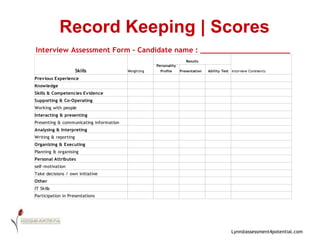
Selection & Recruitment Assess Interview Competency based Consistent Record keeping Tests Ability Personality Ratings Score
Interview Prepare by: Agenda  Read the application form, JD & PS Identify areas for clarification and exploration Plan the questions Identify key competency questions Prepare all paperwork for record keeping Consider what questions you might be asked by candidates
Competencies   Competencies are tools that employers use to assess candidates suitability and performance. Competencies refer to an individual's traits or characteristics; this includes their knowledge, skills, thought patterns, aspects of self-esteem, and social roles Competency based recruitment favours diversity and inclusion as it widens the pool of candidates.
Examples of Competency Questions Can you give us an example that shows your leadership skills?  How would you deal with a difficult customer or employee?  Can you give an example of a problem which you solved?  What have been your major achievements and accomplishments?  Can you give an example of working well as a team member?  Can you give an example of your organisational skills?
Structure of the Interview Introduce yourself  Give some background information about the organisation and the job  Structure the questions to cover all the relevant areas Ask open-ended questions  Avoid leading questions  Listen, and make brief notes as necessary on salient points  Have a set time to include candidate questions Make sure the candidate is familiar with the terms and conditions of the job, and they are acceptable.  Tell the candidate what will happen next and when to expect to hear you.
Psychometric, Psychological or Occupational Testing Definition: “ tools which are essentially sophisticated instruments designed to measure individual differences in a number of areas such as intelligence and ability” should be viewed more as a  useful indicator  rather than a definitive verdict on a person's skills or potential used in recruitment to ascertain whether or not a candidate is likely to be a good fit for a job their administration and interpretation must be carried out by qualified people
Psychometric Test Explained Employers use psychometric tests during recruitment Psychometric tests give some quantifiable measurement indicating whether or not candidates possess certain aptitudes and abilities that are  essential  for the job. Tests reveal information about  skills, abilities and personality that can't be gathered from applications and interviews alone.
A psychometric test must be: Objective: The score must not affected by the testers’ beliefs or values Standardized: It must be administered under controlled conditions Reliable: It must minimize and quantify any intrinsic errors Predictive: It must make an accurate prediction of performance Non Discriminatory: It must not disadvantage any group on the basis of gender, culture, ethnicity, etc.
When to use Psychometric Tests 1 st  step to narrow the field.  Invite to interview if suitable level attained In conjunction with an interview Make an informed and  unbiased  decision about  the next stage of selection Part of an assessment centre or with final interview
Employers Use
What do psychometric tests measure? Psychometric tests may measure aptitude, personality or interests  Aptitude tests measure your maximum performance capacity, the other tests examine typical or preferred behaviour
Ability & Aptitude
Aptitude Tests Measure how people differ in their ability to perform or carry out different tasks.  (these are the type you are most likely to find at the first stage of a selection process ).
Personality Questionnaires
Personality Questionnaires These measure how people differ in their style or manner of doing things, and in the way they interact with their environment and other people (personality)
Psychometric Tools can Tie the Recruitment Process Together
Record Keeping | Scores
Selection & Recruitment Hire Offer Reference checking Induction
Offer Offer Letter Terms & Conditions of employment Check References
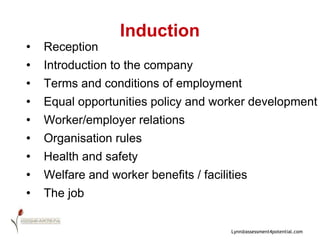
Induction Reception Introduction to the company Terms and conditions of employment Equal opportunities policy and worker development Worker/employer relations Organisation rules Health and safety  Welfare and worker benefits / facilities The job
Simplified Selection
Different Publishers
Hiring the right people for the right position at the right time For more information:  Lynn Tulip Assessment 4 Potential lynn@assessment4potential.com | 07801 689801 | www.assessment4potential.com

Presentation on selection for uploading

  • 1.
    Selection & Recruitment“ Hiring the right people for the right position at the right time” For more information: Lynn Tulip Assessment 4 Potential lynn@assessment4potential.com | 07801 689801 | www.assessment4potential.com
  • 2.
    Definitions: Recruitment is the process which aims to attract suitably qualified candidates for a job from which it is possible to select a competent person Selection is the application of techniques with the aim of selecting and appointing a competent person.
  • 3.
    Selection & RecruitmentDefine Source Capture Assess Hire
  • 4.
    Selection & RecruitmentDefine Job profile Job Analysis Job description Person specification Type of worker Permanent, temp or contract Salary Selection Process Who is involved? What will happen?
  • 5.
    Job Analysis Defineaccurately and clearly the nature and purpose of the role and the skills and attributes needed to carry it out. Job analysis is the first stage in this process. It involves asking questions and gathering information to identify the key elements of the job and the ideal characteristics of the post-holder. This analysis forms the basis of the job description and the person specification.
  • 6.
    Job Description Thejob description outlines the role in terms of the day to day tasks and responsibilities and benefits which the post-holder is entitled to. The job description helps potential applicants to decide whether to apply for the job, and can be used to devise the advertisement and the employment contract.
  • 7.
    Define the jobrole of Marketing Assistant
  • 8.
    Person Specification Aperson specification is a profile of the ideal candidate for the job. It lists the essential and desirable criteria necessary to carry out the role.
  • 9.
    Define the jobrole of Marketing Assistant
  • 10.
  • 11.
    Predictive Validity forRecruitment 1 Saville Consulting WAVE Professional Styles achieved a mean section-level predictive validity coefficient of 0.32 against work performance competencies assessed by external raters 6 months later and in a sample of 108 participants. These coefficients are adjusted for criterion unreliability, but no other corrections have been applied. Predictive Accuracy 1 Popularity
  • 12.
    Selection Tools Validity & Popularity
  • 13.
  • 14.
    Selection & RecruitmentSource Attract candidates Internal External Advertise Job Centres Recruitment Agency Networking Newspaper/journals
  • 15.
    Attract Candidates InternalNotice-boards etc External Job Centres Employment Agencies Local Newspapers Trade Journals Job fairs CV or Application Form? External [cont] Engage networks of friends and colleagues Business/society meetings Internet [inc craigslist, job boards, etc] Local colleges and trade schools
  • 16.
    Advertisement Check-list Salaryor salary guide Whether the role is full-time or permanent or a short-term contract (if not implicitly clear from elsewhere in the advert) Oher package details or guide (pension, car etc) Explanation of recruitment process Response and application instructions [include dates] Contact details as necessary, for example, address, phone, fax, email, etc. Job and or advert reference (advert references help you analyse results from different adverts for the same job) Website address | corporate branding Quality accreditations, for example in the UK, Investor in People Equal opportunities statement Job title, Job base location Employer or recruitment agency/consultancy Succinct description of business/organization/division activity and market position and aims To whom the position reports - or other indication of where the role is in the structure Outline of job role and purpose - expressed in the 'second-person' (you, your, etc) Indication of scale, size, responsibility, time-scale, and territory of role Outline of ideal candidate profile - expressed in 'second-person' Indicate qualifications and experience required (which could be incorporated within candidate profile)
  • 17.
    Handling Ad ResponsesState a “reply by” date in the ad. Require applicants to answer three to five basic questions in the body of their e-mail reply. This can be a first line of screening applications. Reply to all applicants via e-mail and ask them to answer a set of questions. Give a reasonable but quick turn-around time. Set up a separate and distinct e-mail address to receive applications. Notify your existing staff of the ad and provide them with instructions for handling incoming phone inquiries. A one-page information and interest form will standardize the conversations your staff has with callers .
  • 18.
    Selection & Recruitment Capture Sifting matrix Experience Job competencies Knowledge Qualifications Short list Invite
  • 19.
  • 20.
    Invite Short-listed ApplicantsLetters of invitation Include: The process, the panel names Date, time & venue Additional assessments Information pack about the company Ask for confirmation of any special needs
  • 21.
    Selection & RecruitmentAssess Interview Competency based Consistent Record keeping Tests Ability Personality Ratings Score
  • 22.
    Interview Prepare by:Agenda Read the application form, JD & PS Identify areas for clarification and exploration Plan the questions Identify key competency questions Prepare all paperwork for record keeping Consider what questions you might be asked by candidates
  • 23.
    Competencies Competencies are tools that employers use to assess candidates suitability and performance. Competencies refer to an individual's traits or characteristics; this includes their knowledge, skills, thought patterns, aspects of self-esteem, and social roles Competency based recruitment favours diversity and inclusion as it widens the pool of candidates.
  • 24.
    Examples of CompetencyQuestions Can you give us an example that shows your leadership skills? How would you deal with a difficult customer or employee? Can you give an example of a problem which you solved? What have been your major achievements and accomplishments? Can you give an example of working well as a team member? Can you give an example of your organisational skills?
  • 25.
    Structure of theInterview Introduce yourself Give some background information about the organisation and the job Structure the questions to cover all the relevant areas Ask open-ended questions Avoid leading questions Listen, and make brief notes as necessary on salient points Have a set time to include candidate questions Make sure the candidate is familiar with the terms and conditions of the job, and they are acceptable. Tell the candidate what will happen next and when to expect to hear you.
  • 26.
    Psychometric, Psychological orOccupational Testing Definition: “ tools which are essentially sophisticated instruments designed to measure individual differences in a number of areas such as intelligence and ability” should be viewed more as a useful indicator rather than a definitive verdict on a person's skills or potential used in recruitment to ascertain whether or not a candidate is likely to be a good fit for a job their administration and interpretation must be carried out by qualified people
  • 27.
    Psychometric Test ExplainedEmployers use psychometric tests during recruitment Psychometric tests give some quantifiable measurement indicating whether or not candidates possess certain aptitudes and abilities that are essential for the job. Tests reveal information about skills, abilities and personality that can't be gathered from applications and interviews alone.
  • 28.
    A psychometric testmust be: Objective: The score must not affected by the testers’ beliefs or values Standardized: It must be administered under controlled conditions Reliable: It must minimize and quantify any intrinsic errors Predictive: It must make an accurate prediction of performance Non Discriminatory: It must not disadvantage any group on the basis of gender, culture, ethnicity, etc.
  • 29.
    When to usePsychometric Tests 1 st step to narrow the field. Invite to interview if suitable level attained In conjunction with an interview Make an informed and unbiased decision about the next stage of selection Part of an assessment centre or with final interview
  • 30.
  • 31.
    What do psychometrictests measure? Psychometric tests may measure aptitude, personality or interests Aptitude tests measure your maximum performance capacity, the other tests examine typical or preferred behaviour
  • 32.
  • 33.
    Aptitude Tests Measurehow people differ in their ability to perform or carry out different tasks. (these are the type you are most likely to find at the first stage of a selection process ).
  • 34.
  • 35.
    Personality Questionnaires Thesemeasure how people differ in their style or manner of doing things, and in the way they interact with their environment and other people (personality)
  • 36.
    Psychometric Tools canTie the Recruitment Process Together
  • 37.
  • 38.
    Selection & RecruitmentHire Offer Reference checking Induction
  • 39.
    Offer Offer LetterTerms & Conditions of employment Check References
  • 40.
    Induction Reception Introductionto the company Terms and conditions of employment Equal opportunities policy and worker development Worker/employer relations Organisation rules Health and safety Welfare and worker benefits / facilities The job
  • 41.
  • 42.
  • 43.
    Hiring the rightpeople for the right position at the right time For more information: Lynn Tulip Assessment 4 Potential lynn@assessment4potential.com | 07801 689801 | www.assessment4potential.com

Editor's Notes

  • #4 So how do you do it?
  • #5 So define – you need to know you have a vacancy and what that profile for the job is – what tasks need to be performed, what responsibilities there will be, what sort of person and what knowledge they need. Will it be a permanent position, are there any special requirements and what will you pay them? In addition, you need to sort our how you will go about recruiting. So, who will be involved and what and how will you do it.
  • #15 When it comes to sourcing candidates you might think that it is fairly easy. Just remember there are lots of different places to find good candidates in addition to the traditional methods of adverts. It's also key to remember that you might have candidates already in the workforce – so someone looking to develop into another role. Don't discard internal people. It can be a great money saving opportunity.
  • #18 Certain job ads can generate dozens of responses. Knowing how to handle them in a timely and professional manner sets the tone of your practice with your newest employee. The following methods can be used to manage this process:
  • #19 Again the process of what to do with applications when they come in. Establishing a good process is key – and a sifting matrix is important. Also make sure other employees in the company are aware that there is a recruitment drive so that if they are asked for information or need to reply to questions that they can respond appropriately. I'm a great one for scoring – weighting points and checking that short-listed candidates are the ones that match the job specification the closest. If any of you would like sample documents of scoring and sifting matrix, please drop me an e-mail and I will happily send you examples.
  • #22 Now we come onto the interesting part. The assessment side. How do you distinguish objectively between 2 or more potential candidates.? Again I would suggest a well planned process, sound competency or situational interview questions alongside some psychometric testing. And a good 'scorecard' – I can let you have sample scorecards! Don't forget to take appropriate notes to give feedback if required. Again, I'm happy to give you sample questions as well.
  • #30 A psychometric test must be Objective: The score must not affected by the testers’ beliefs or values Standardized: It must be administered under controlled conditions Reliable: It must minimize and quantify any intrinsic errors Predictive: It must make an accurate prediction of performance Non Discriminatory: It must not disadvantage any group on the basis of gender, culture, ethnicity, etc.
  • #31 Employers use psychometric tests during recruitment Psychometric tests give some quantifiable measurement indicating whether or not candidates possess certain aptitudes and abilities that are essential for the job. Tests reveal information about skills, abilities and personality that can't be gathered from applications and interviews alone. should be viewed more as a useful indicator rather than a definitive verdict on a person's skills or potential used in recruitment to ascertain whether or not a candidate is likely to be a good fit for a job their administration and interpretation must be carried out by qualified people
  • #33 Ability & Aptitude Measure how people differ in their ability to perform or carry out different tasks. (these are the type you are most likely to find at the first stage of a selection process )
  • #35 Personality Measure how people differ in their style or manner of doing things, and in the way they interact with their environment and other people (personality)
  • #37 predict job potential and performance, job and cultural fit, possible career derailing behaviours, motivation drivers and pre-employment checks
  • #39 Then – of course once you have made the decision – there's the formalities to go through. Thank you for listening – I hope this has been useful – and that if you want any extra help with your recruitment, especially on the testing side – you'll let me know.