Stakeholder management
in a matrix environment
A Programme Management SIG webinar
www.apm.org.uk/progm
Welcome & housekeeping
 This webinar is being recorded
 Slides available for viewing on resources pages on APM
website and ProgM microsite
 Please use the questions box to ask questions
Programme Management SIG (ProgM)
 Vision: To be recognised internationally as the leading group for
programme management, supporting a world in which all projects
succeed.
 Workstreams:
 Physical Events
 Virtual Events
 Communications
 Higher Education
 Publications
 Corporate
ProgM
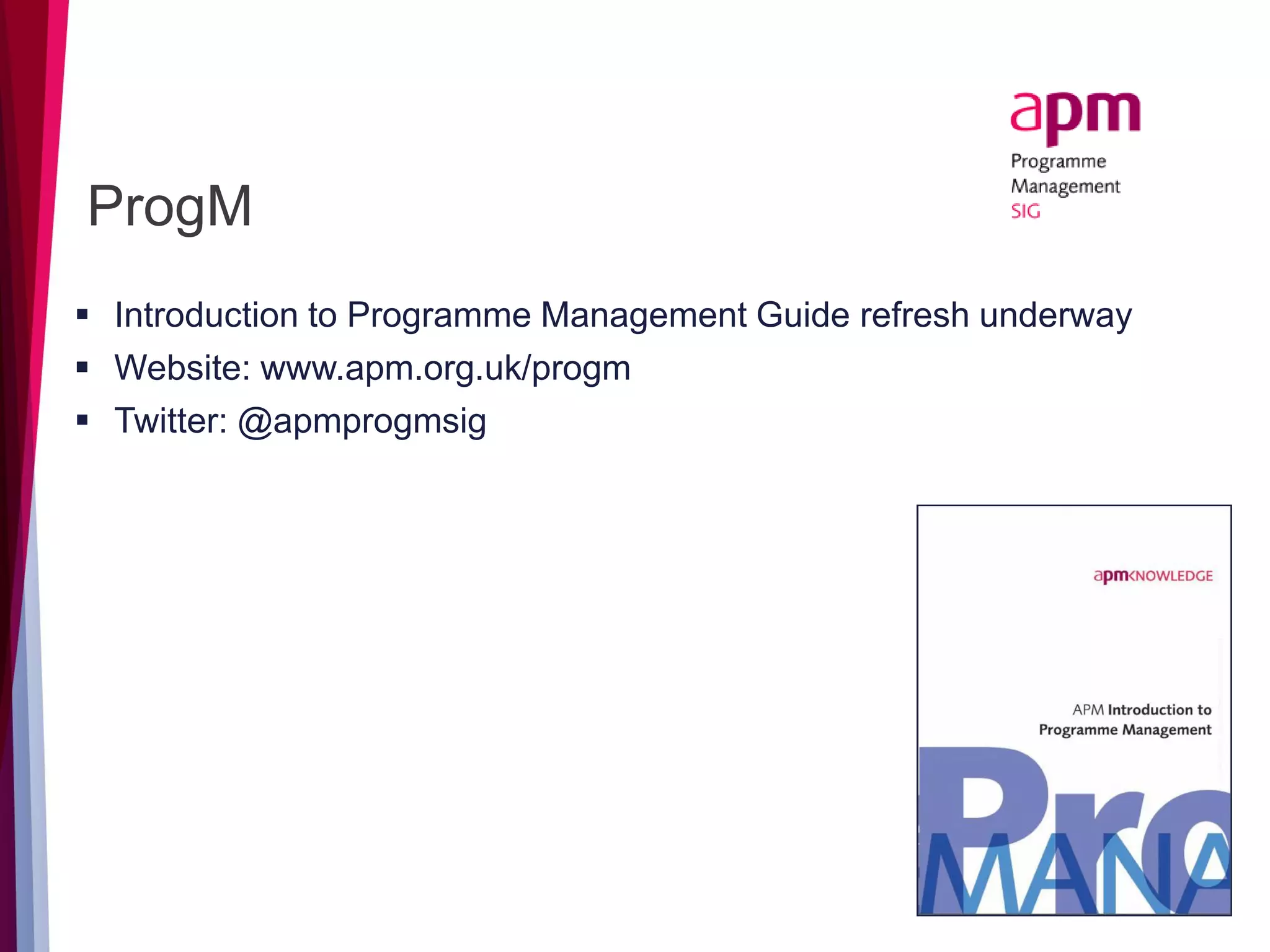
 Introduction to Programme Management Guide refresh underway
 Website: www.apm.org.uk/progm
 Twitter: @apmprogmsig
Upcoming events
 Validating Strategies for Programme Success
 ProgM Webinars
 ProgM Conference
 Events: www.apm.org.uk/events
Stakeholder management
in a matrix environment
Jake Holloway
A Programme Management SIG webinar
www.apm.org.uk/progm
Webinar: Stakeholder
Management in a Matrix
Organisation
Jake Holloway
Clarity for complex changewww.xceedgroup.com/shm
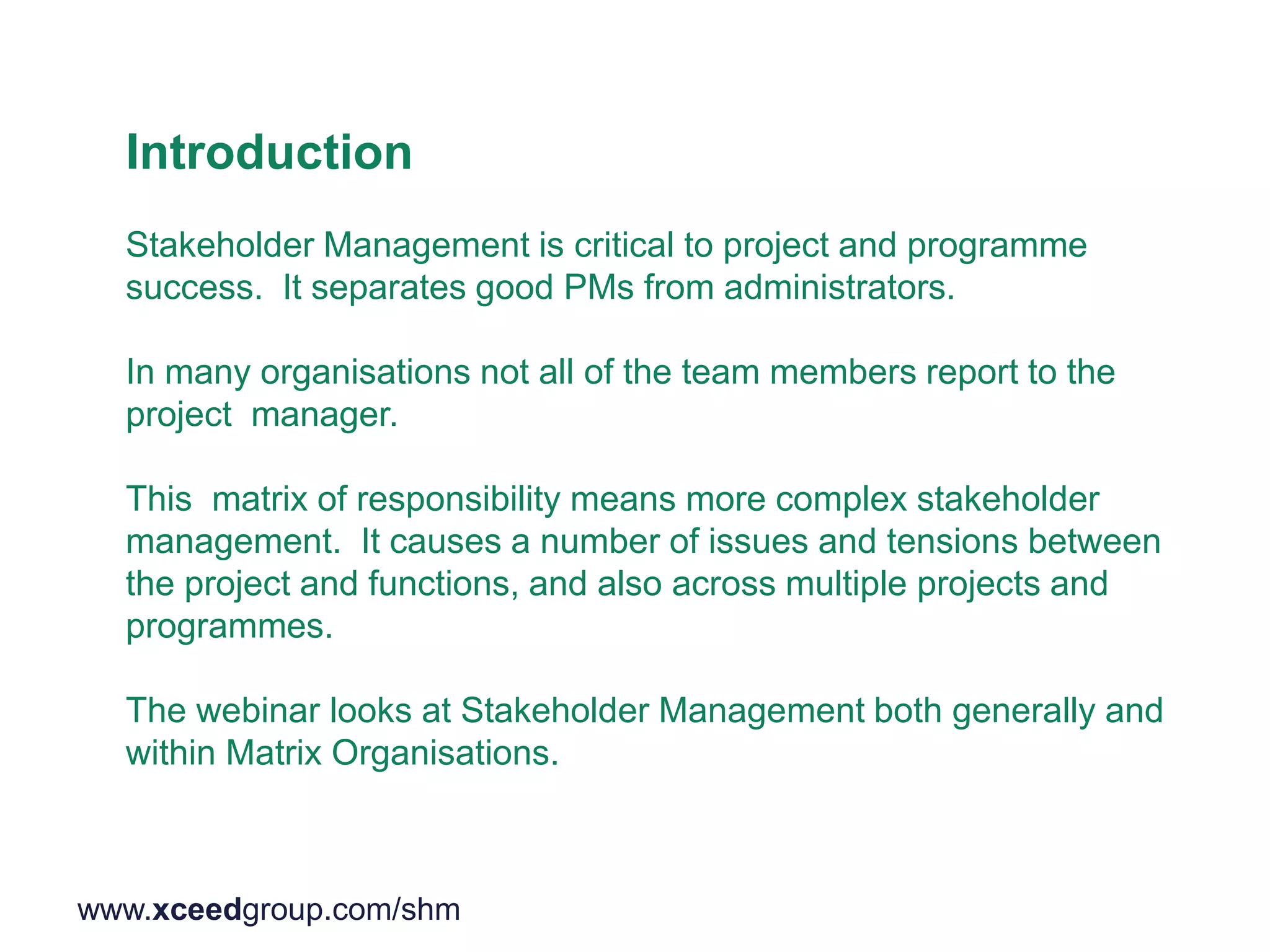
Introduction
Stakeholder Management is critical to project and programme
success. It separates good PMs from administrators.
In many organisations not all of the team members report to the
project manager.
This matrix of responsibility means more complex stakeholder
management. It causes a number of issues and tensions between
the project and functions, and also across multiple projects and
programmes.
The webinar looks at Stakeholder Management both generally and
within Matrix Organisations.
www.xceedgroup.com/shm
25/08/2
015
9
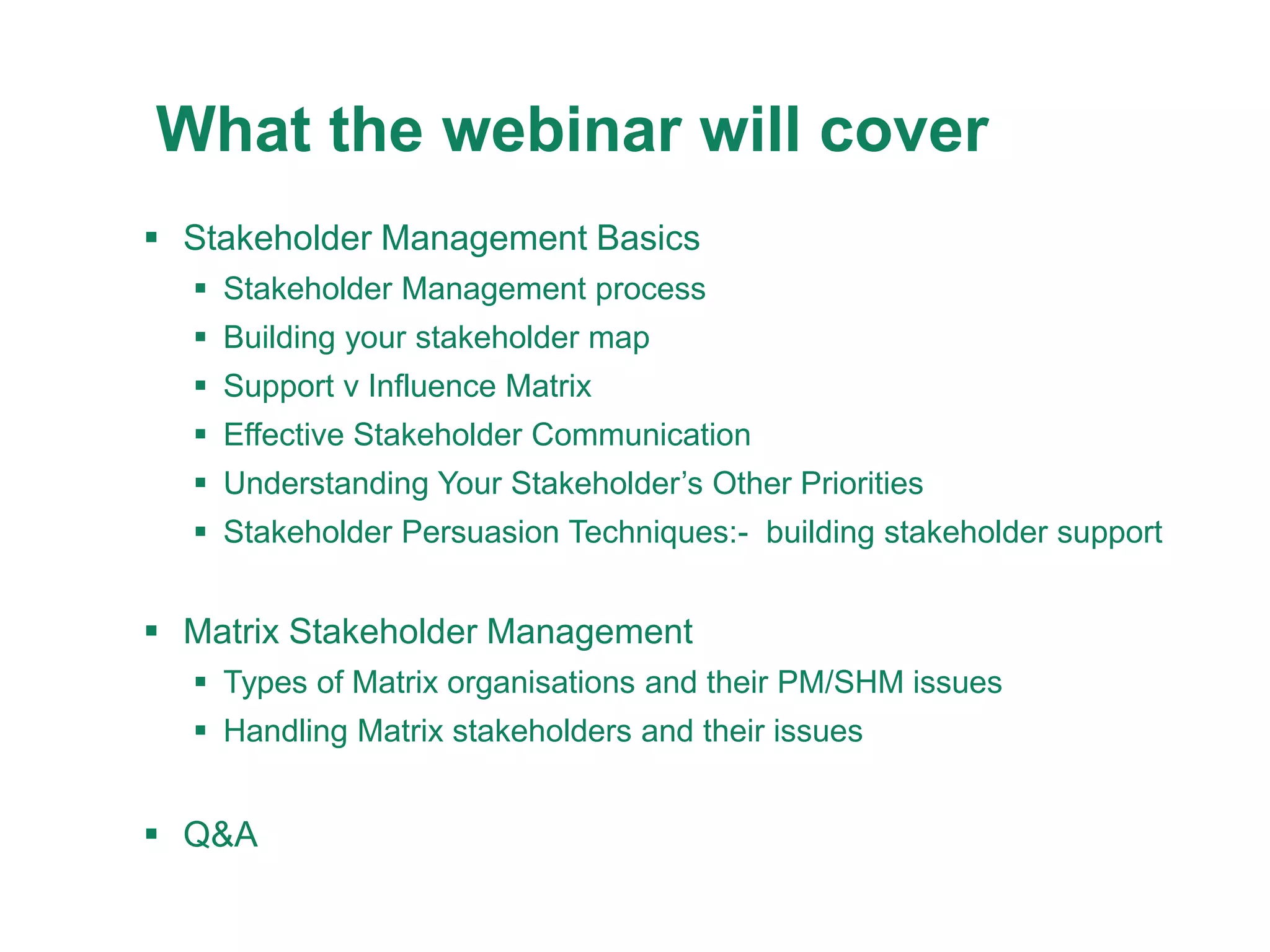
What the webinar will cover
 Stakeholder Management Basics
 Stakeholder Management process
 Building your stakeholder map
 Support v Influence Matrix
 Effective Stakeholder Communication
 Understanding Your Stakeholder’s Other Priorities
 Stakeholder Persuasion Techniques:- building stakeholder support
 Matrix Stakeholder Management
 Types of Matrix organisations and their PM/SHM issues
 Handling Matrix stakeholders and their issues
 Q&A
Stakeholder
Management basics
www.xceedgroup.com/shm
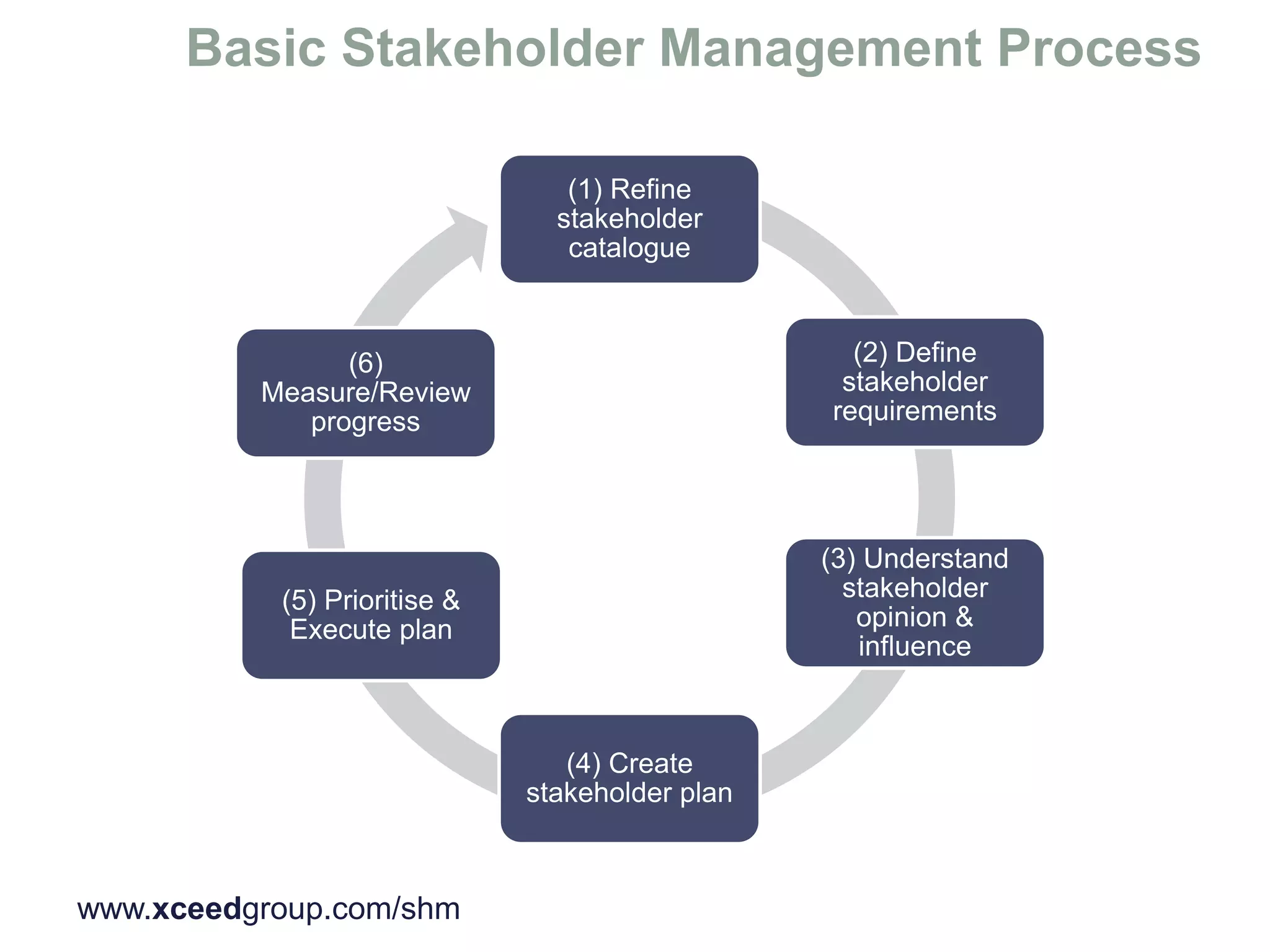
(1) Refine
stakeholder
catalogue
(2) Define
stakeholder
requirements
(3) Understand
stakeholder
opinion &
influence
(4) Create
stakeholder plan
(5) Prioritise &
Execute plan
(6)
Measure/Review
progress
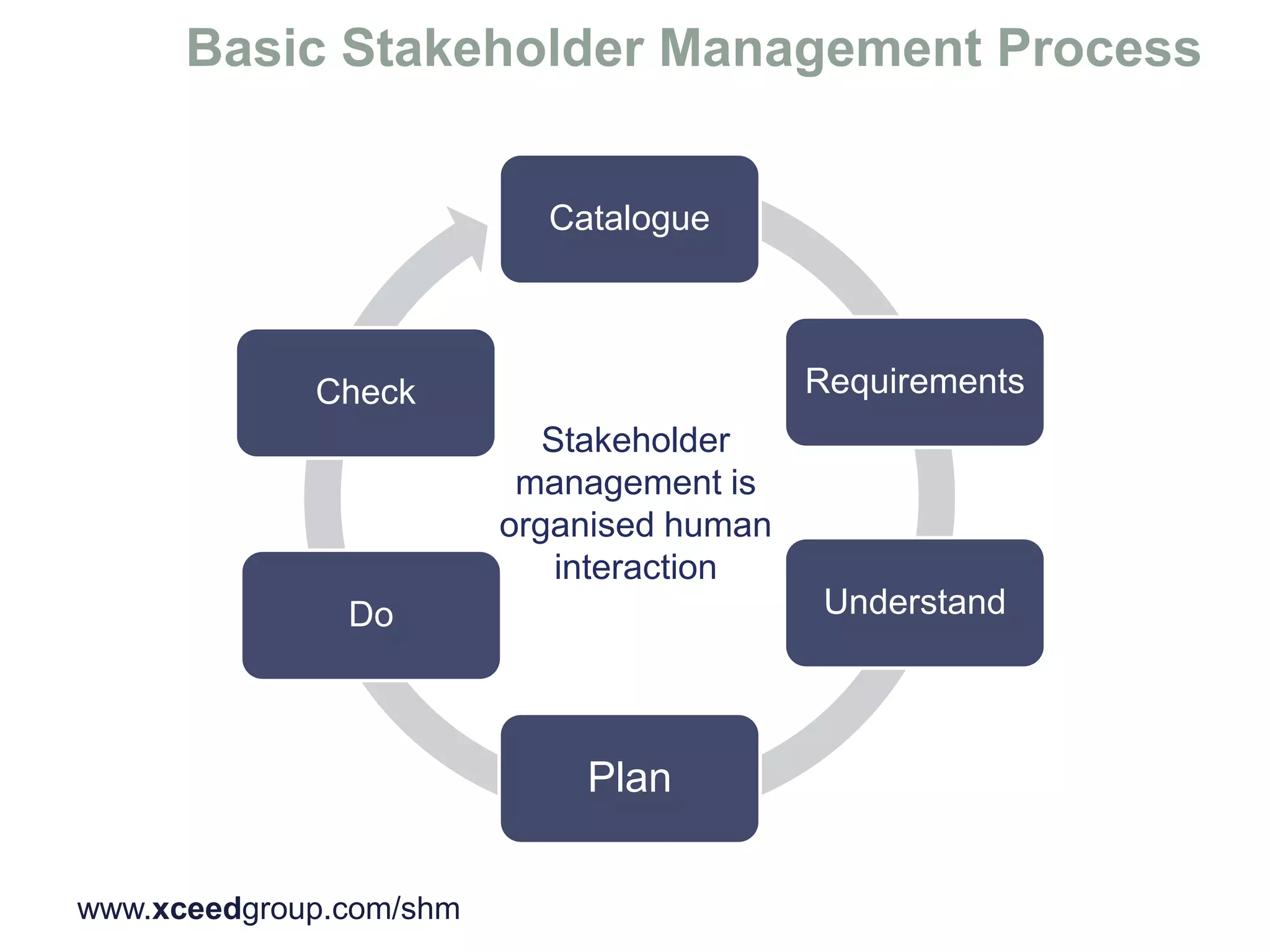
Catalogue
Requirements
Understand
Plan
Do
Check
Stakeholder
management is
organised human
interaction
www.xceedgroup.com/shm
A tested back out
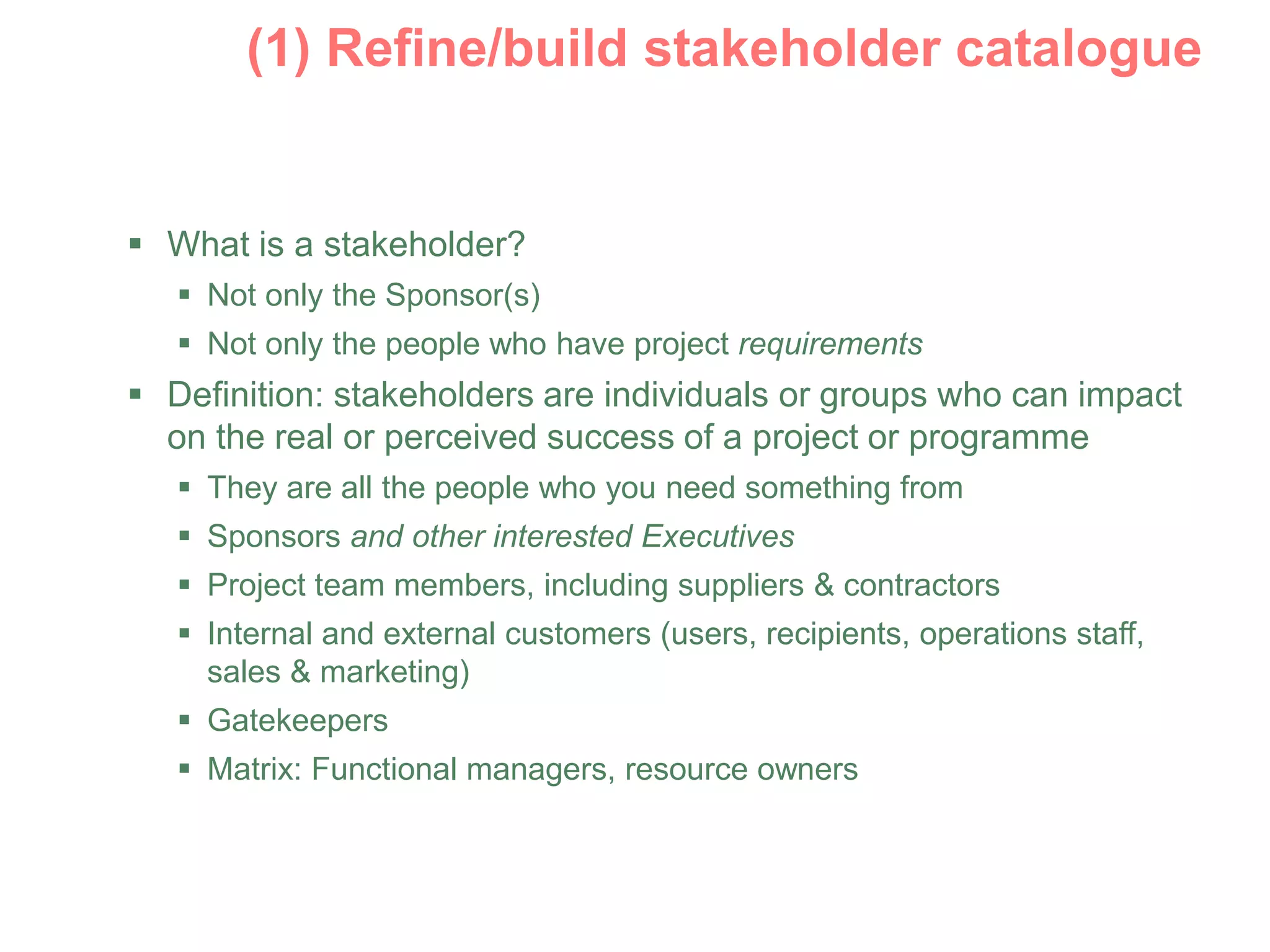
 What is a stakeholder?
 Not only the Sponsor(s)
 Not only the people who have project requirements
 Definition: stakeholders are individuals or groups who can impact
on the real or perceived success of a project or programme
 They are all the people who you need something from
 Sponsors and other interested Executives
 Project team members, including suppliers & contractors
 Internal and external customers (users, recipients, operations staff,
sales & marketing)
 Gatekeepers
 Matrix: Functional managers, resource owners
Rehearsals
Brand Protection
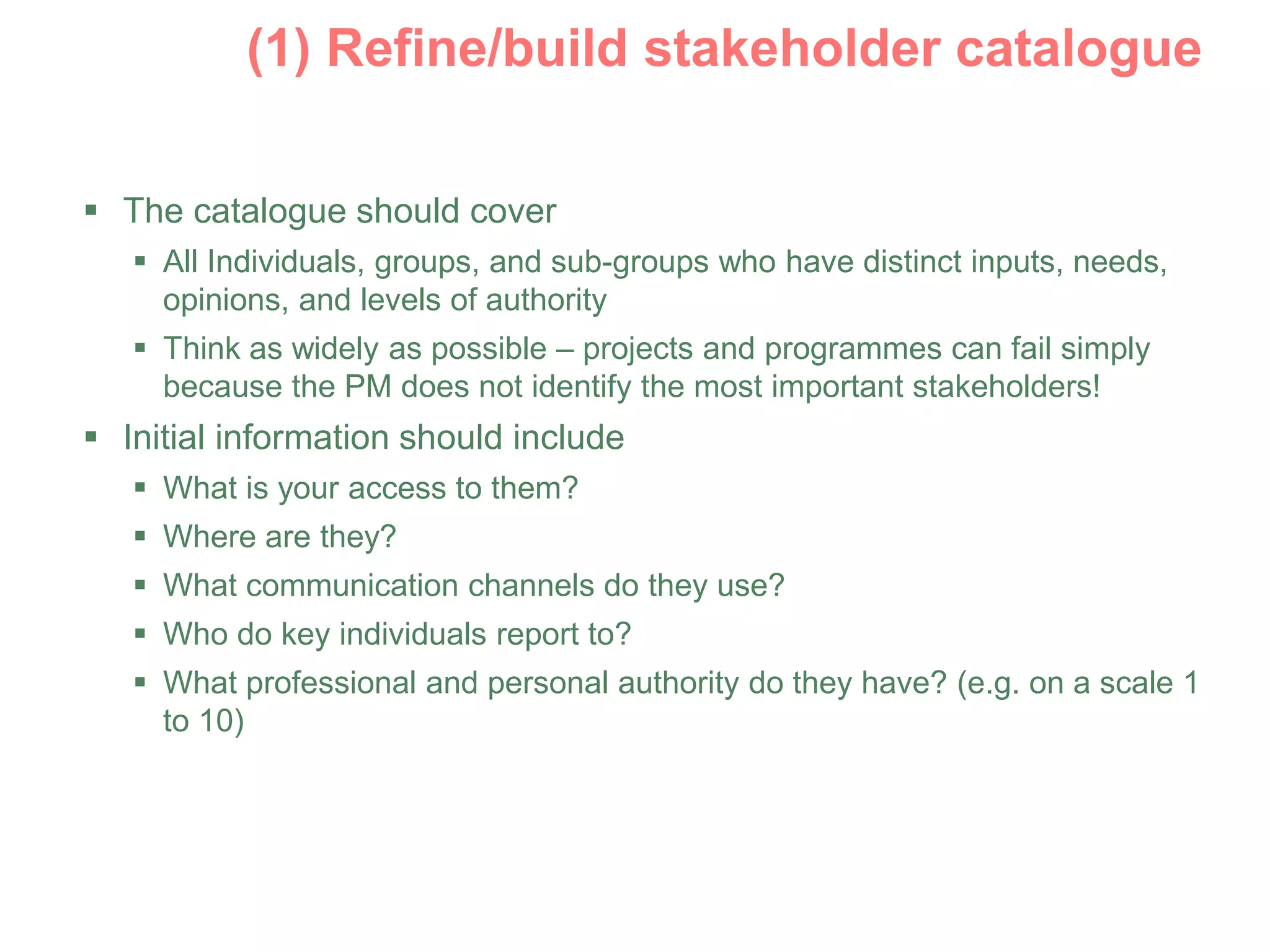
 The catalogue should cover
 All Individuals, groups, and sub-groups who have distinct inputs, needs,
opinions, and levels of authority
 Think as widely as possible – projects and programmes can fail simply
because the PM does not identify the most important stakeholders!
 Initial information should include
 What is your access to them?
 Where are they?
 What communication channels do they use?
 Who do key individuals report to?
 What professional and personal authority do they have? (e.g. on a scale 1
to 10)
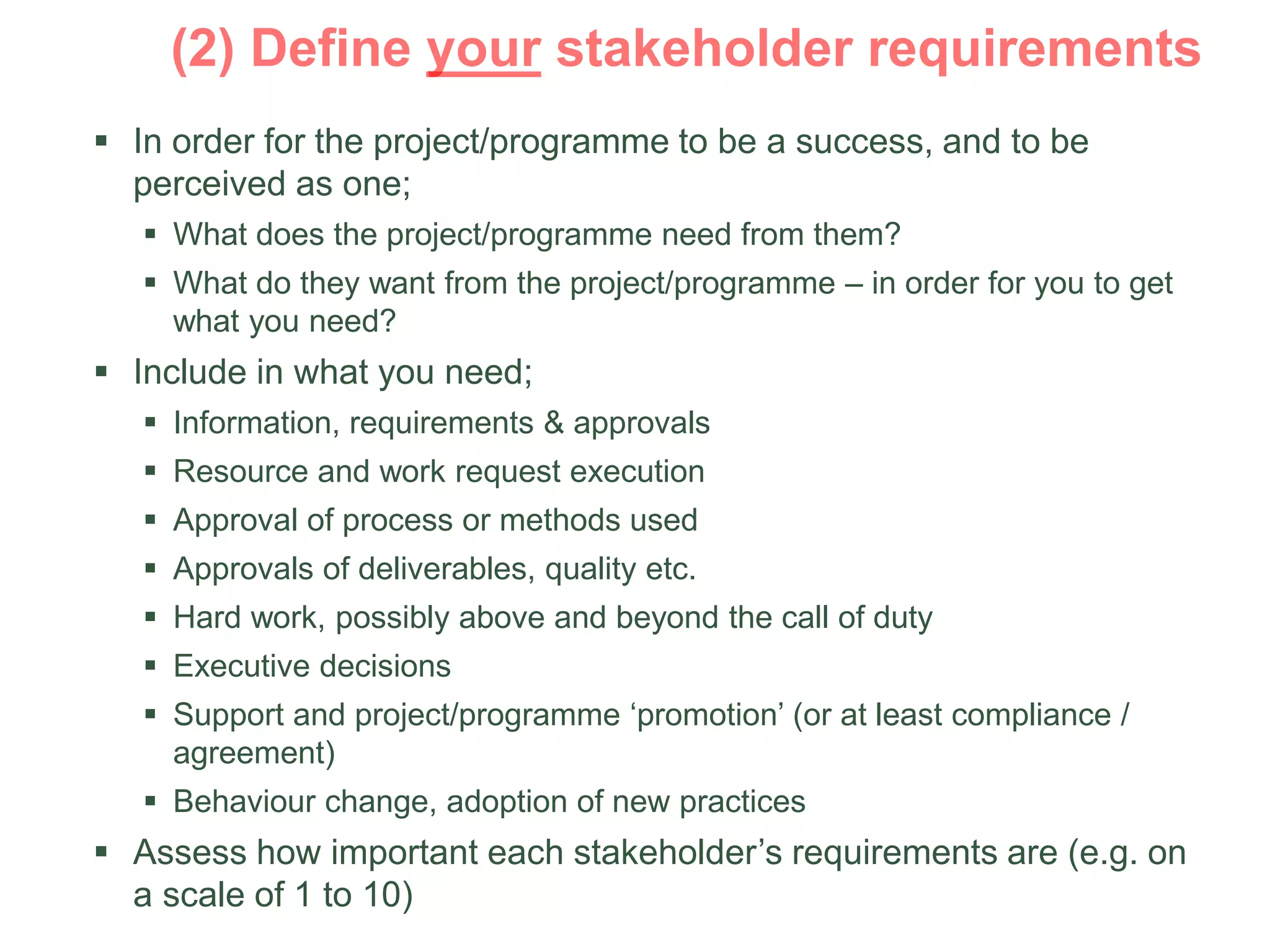
 In order for the project/programme to be a success, and to be
perceived as one;
 What does the project/programme need from them?
 What do they want from the project/programme – in order for you to get
what you need?
 Include in what you need;
 Information, requirements & approvals
 Resource and work request execution
 Approval of process or methods used
 Approvals of deliverables, quality etc.
 Hard work, possibly above and beyond the call of duty
 Executive decisions
 Support and project/programme ‘promotion’ (or at least compliance /
agreement)
 Behaviour change, adoption of new practices
 Assess how important each stakeholder’s requirements are (e.g. on
a scale of 1 to 10)
www.xceedgroup.com/shm
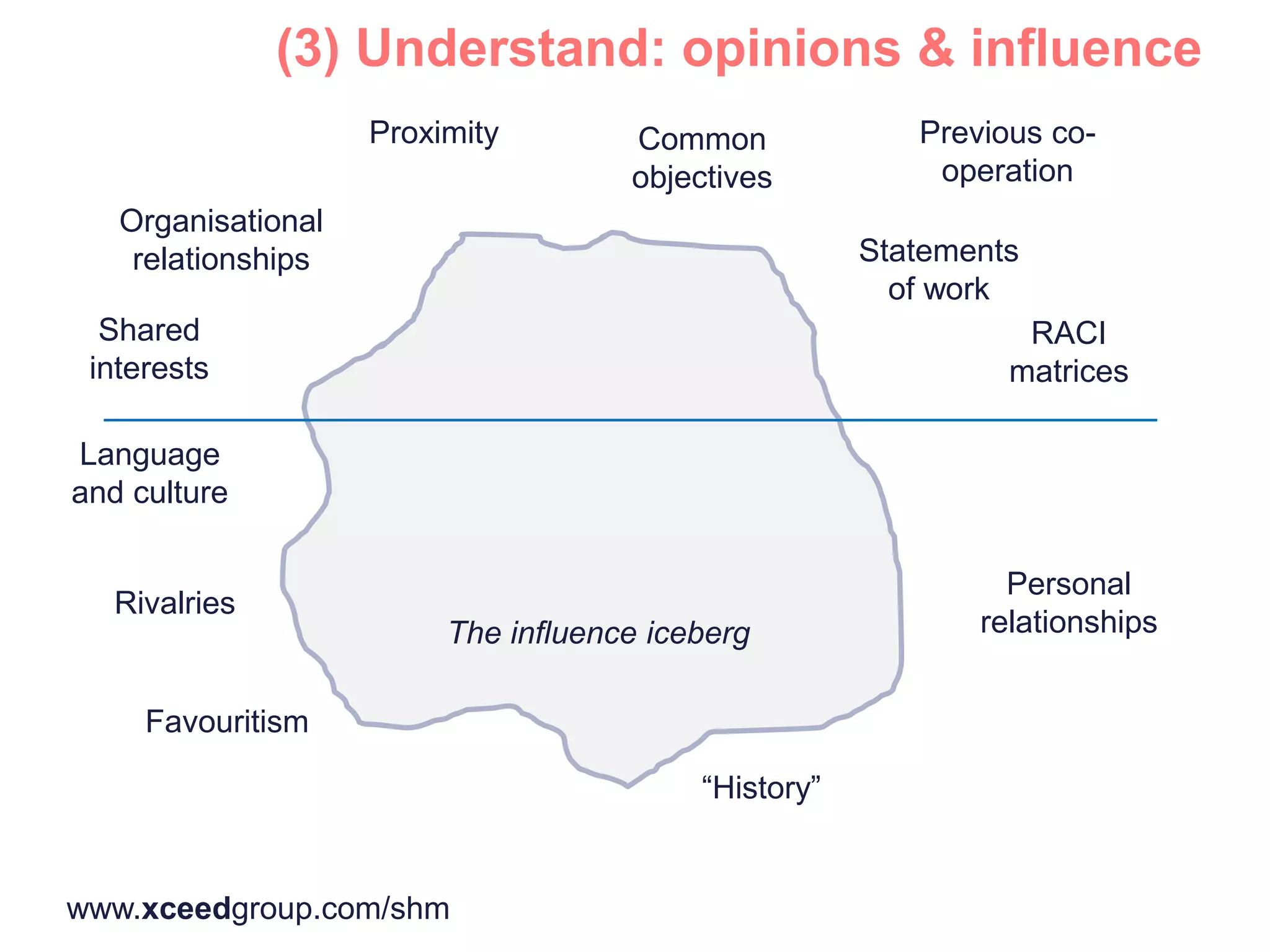
Organisational
relationships Statements
of work
RACI
matrices
Personal
relationships
Favouritism
Rivalries
Shared
interests
“History”
Proximity Common
objectives
Language
and culture
Previous co-
operation
The influence iceberg
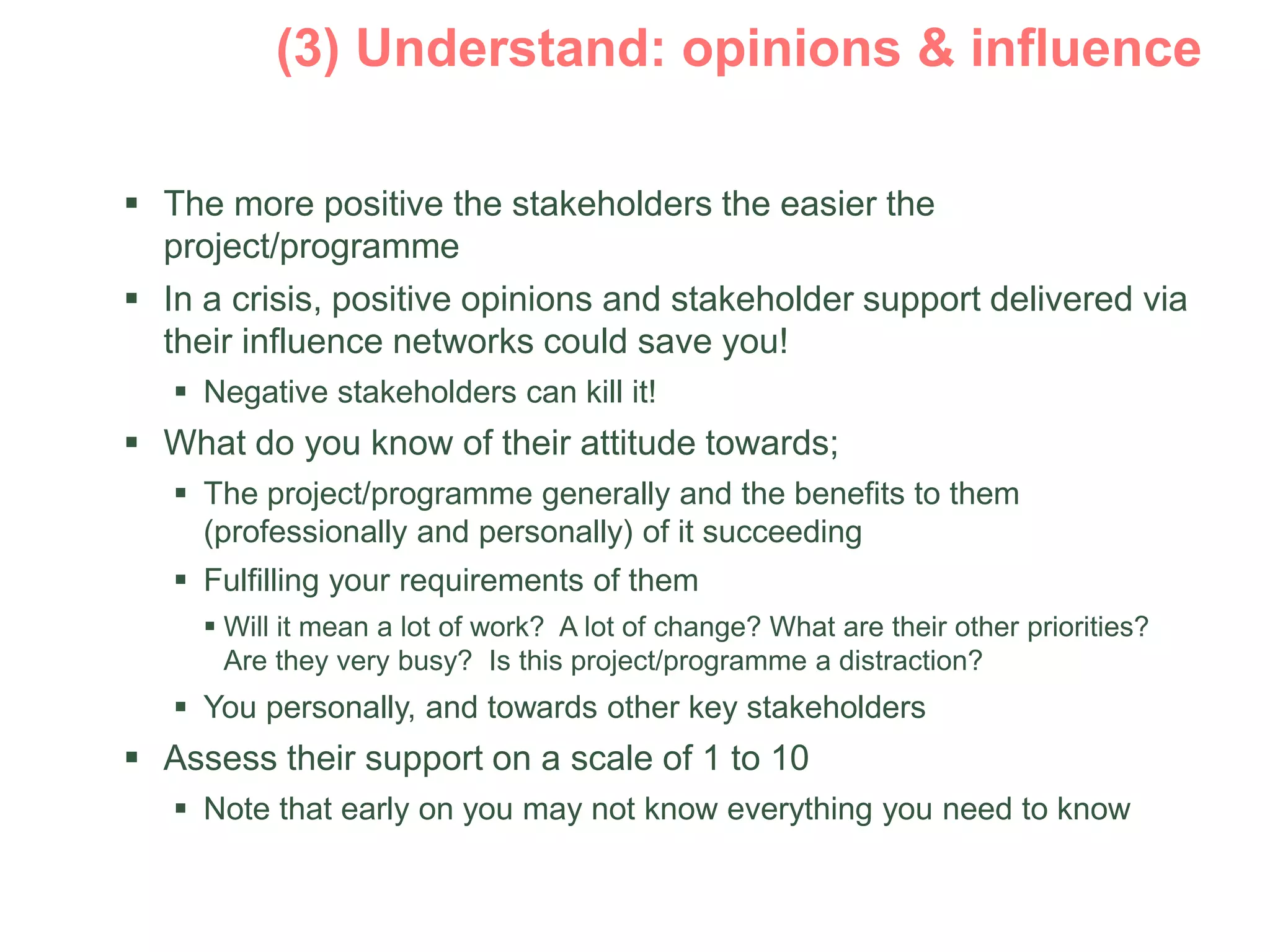
 The more positive the stakeholders the easier the
project/programme
 In a crisis, positive opinions and stakeholder support delivered via
their influence networks could save you!
 Negative stakeholders can kill it!
 What do you know of their attitude towards;
 The project/programme generally and the benefits to them
(professionally and personally) of it succeeding
 Fulfilling your requirements of them
 Will it mean a lot of work? A lot of change? What are their other priorities?
Are they very busy? Is this project/programme a distraction?
 You personally, and towards other key stakeholders
 Assess their support on a scale of 1 to 10
 Note that early on you may not know everything you need to know
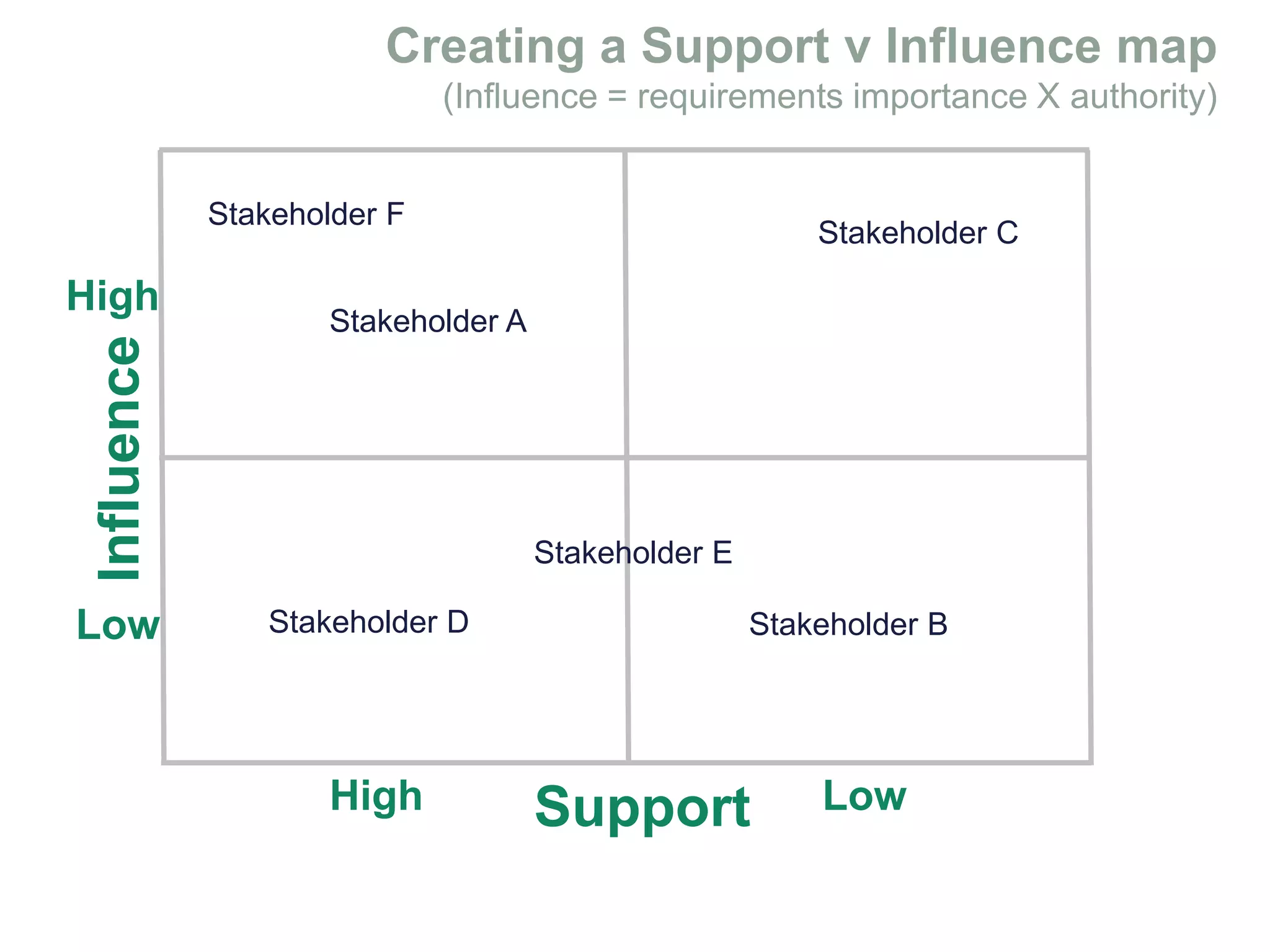
Support
Influence
Stakeholder A
Stakeholder B
Stakeholder C
Stakeholder F
Stakeholder E
Stakeholder D
Low
High
High
Low
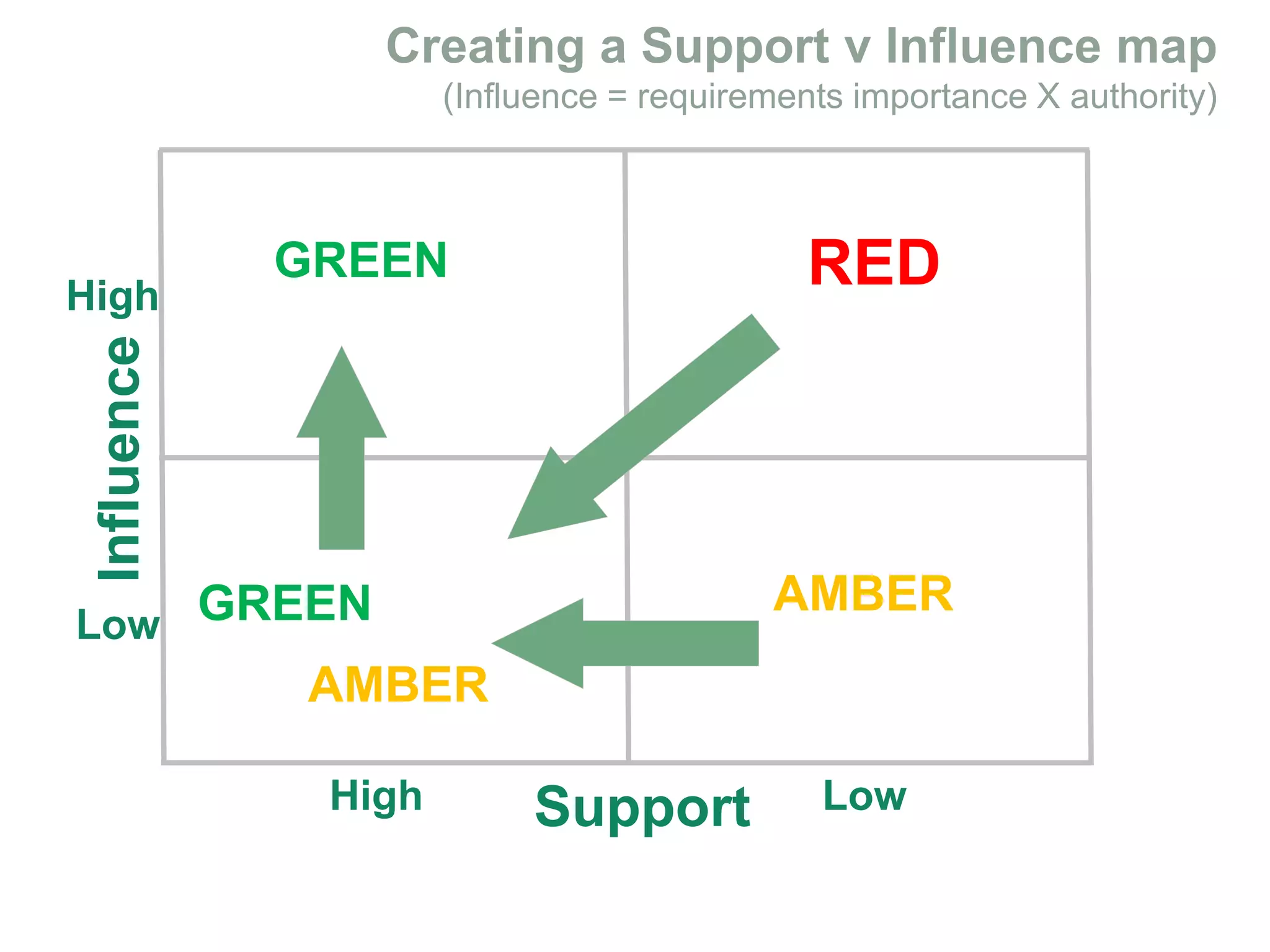
AMBER
Support
Influence
Low
High
High
Low
REDGREEN
GREEN
AMBER
 The stakeholder plan is a plan to obtain the
Stakeholder requirements, and to achieve
other stakeholder-related objectives
 It describes all organised interaction with them
 It is not just a plan to “communicate and engage”
with them, or “get their requirements”
 You must also understand them, persuade them
and change their behaviour
 Why?
 For example
 If an important Executive will have significant impact on the
programme being a success, but you know that they are inclined
against the programme
 Then your plan needs to either persuade them to change their mind – or to
work round the problem of their negativity
 Or if you require the QA Manager to carry out testing and quality audit
quickly and according to your schedule, and you know that that team is
overloaded by other projects/programmes
 Then you need a plan to somehow get ahead of the queue! Which means
persuading them to support your project
 The job of project/programme manager is all about influencing,
persuading, negotiating and changing attitudes and behaviour
 It’s about reality
 It’s not just Gantt charts, it’s social psychology too!
 With stakeholder groups - think like an
Advertiser
 Design messages to address feelings
 Use their channels to connect
(no more project newsletters)
 Measure reach, opinion, recall, level of
engagement, satisfaction, behaviours
 Ask yourself, what would a marketing
person do?
 If you don’t know, get one on your
programme!
www.xceedgroup.com/shm
 With individual stakeholders – think like a
Salesperson
 Focus on persuasion and changing behaviours, not
just ‘engagement’
 Use sales techniques to manage their decision-
making process
What do they want? What are their real objectives and
objections?
What are the benefits? What is their decision making
process? Can you influence it?
Close them on important decisions
 Use persuasion techniques to motivate and
negotiate with them
Social proof, scarcity, investment rationalisation,
comparisons, etc.
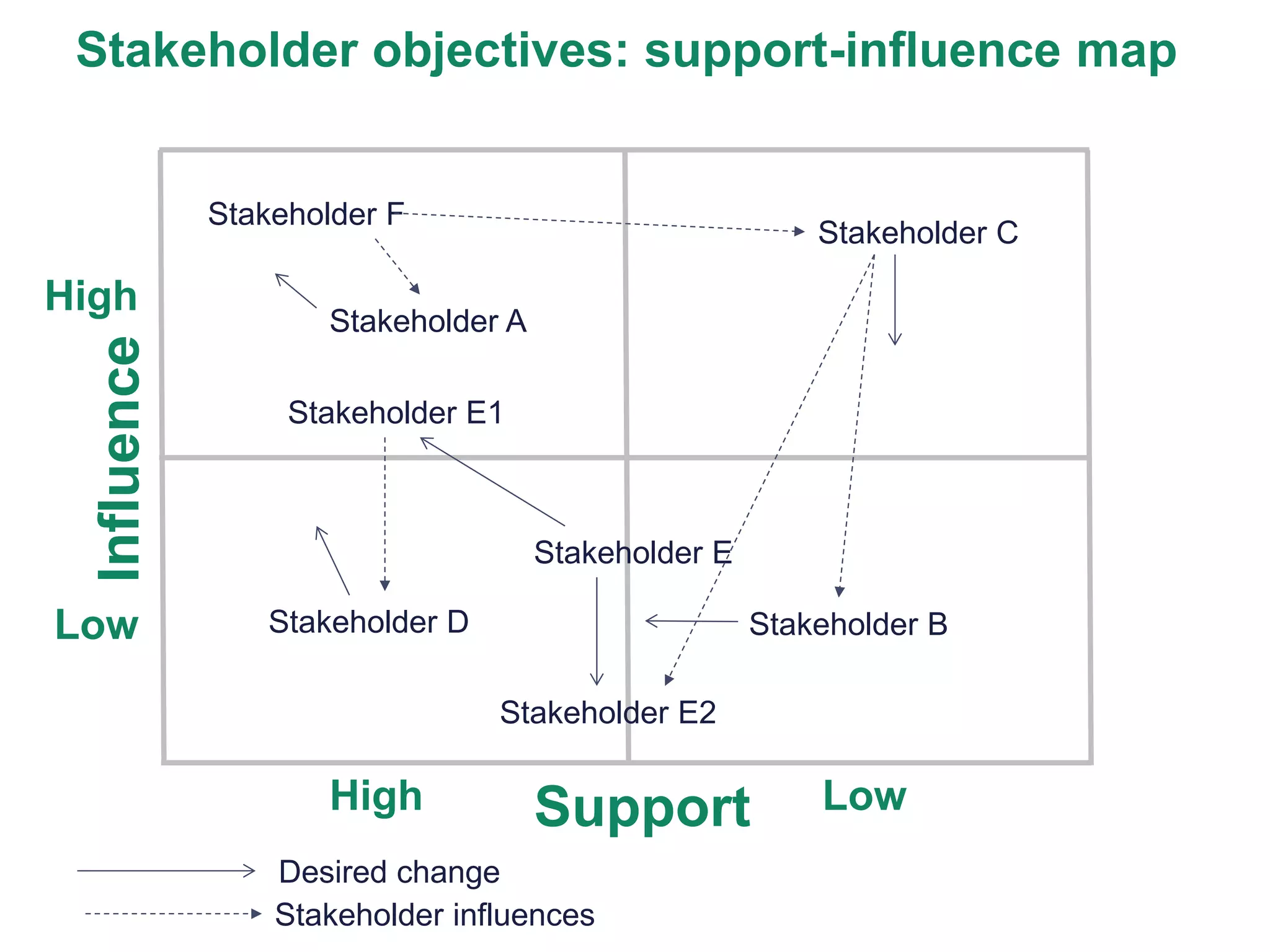
Support
Influence
Stakeholder A
Stakeholder B
Stakeholder C
Stakeholder F
Stakeholder E
Stakeholder D
Low
High
High
Low
Stakeholder E1
Stakeholder E2
Desired change
Stakeholder influences
Stakeholder objectives: support-influence map
www.xceedgroup.com/shm
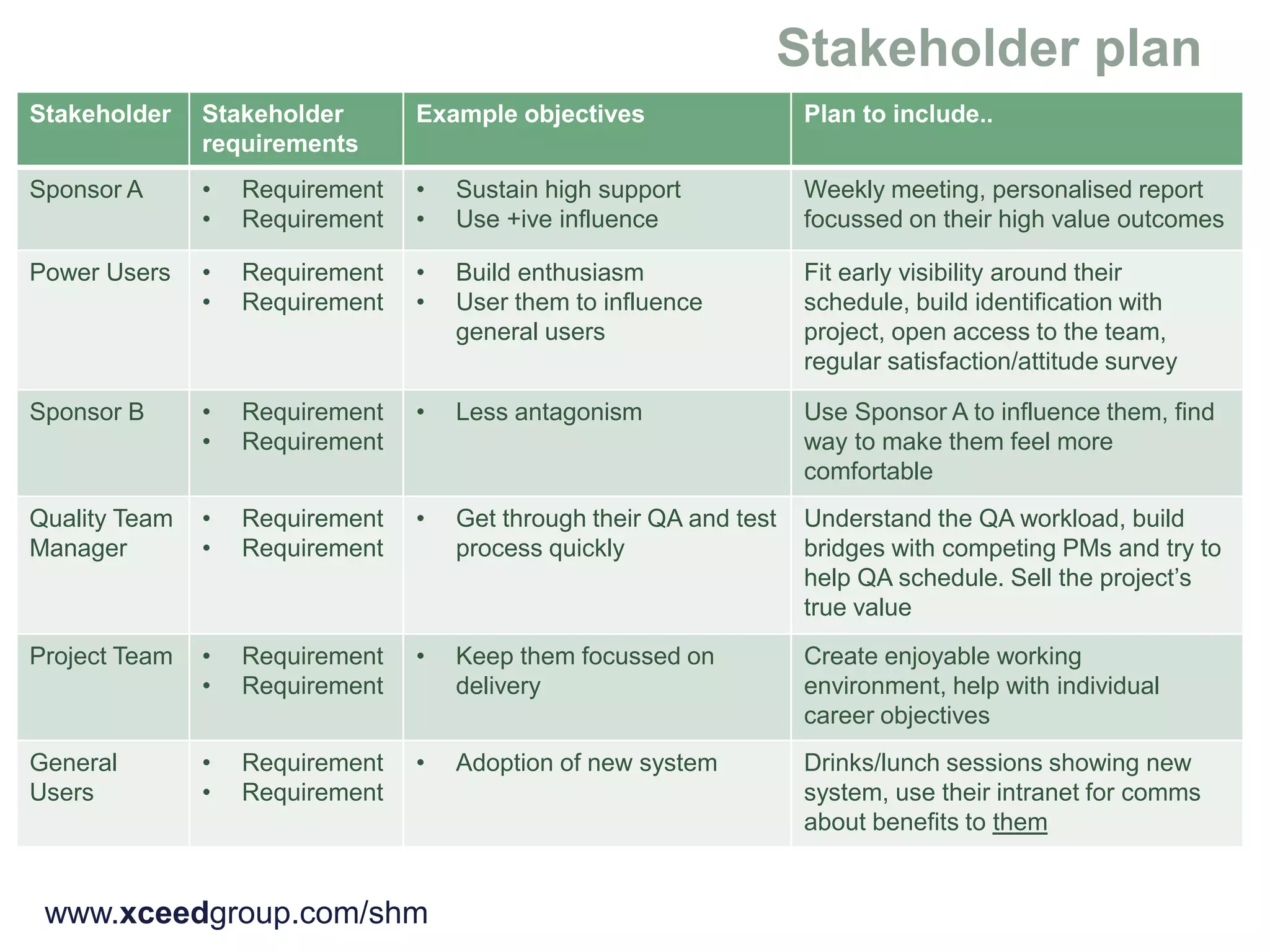
Stakeholder Stakeholder
requirements
Example objectives Plan to include..
Sponsor A • Requirement
• Requirement
• Sustain high support
• Use +ive influence
Weekly meeting, personalised report
focussed on their high value outcomes
Power Users • Requirement
• Requirement
• Build enthusiasm
• User them to influence
general users
Fit early visibility around their
schedule, build identification with
project, open access to the team,
regular satisfaction/attitude survey
Sponsor B • Requirement
• Requirement
• Less antagonism Use Sponsor A to influence them, find
way to make them feel more
comfortable
Quality Team
Manager
• Requirement
• Requirement
• Get through their QA and test
process quickly
Understand the QA workload, build
bridges with competing PMs and try to
help QA schedule. Sell the project’s
true value
Project Team • Requirement
• Requirement
• Keep them focussed on
delivery
Create enjoyable working
environment, help with individual
career objectives
General
Users
• Requirement
• Requirement
• Adoption of new system Drinks/lunch sessions showing new
system, use their intranet for comms
about benefits to them
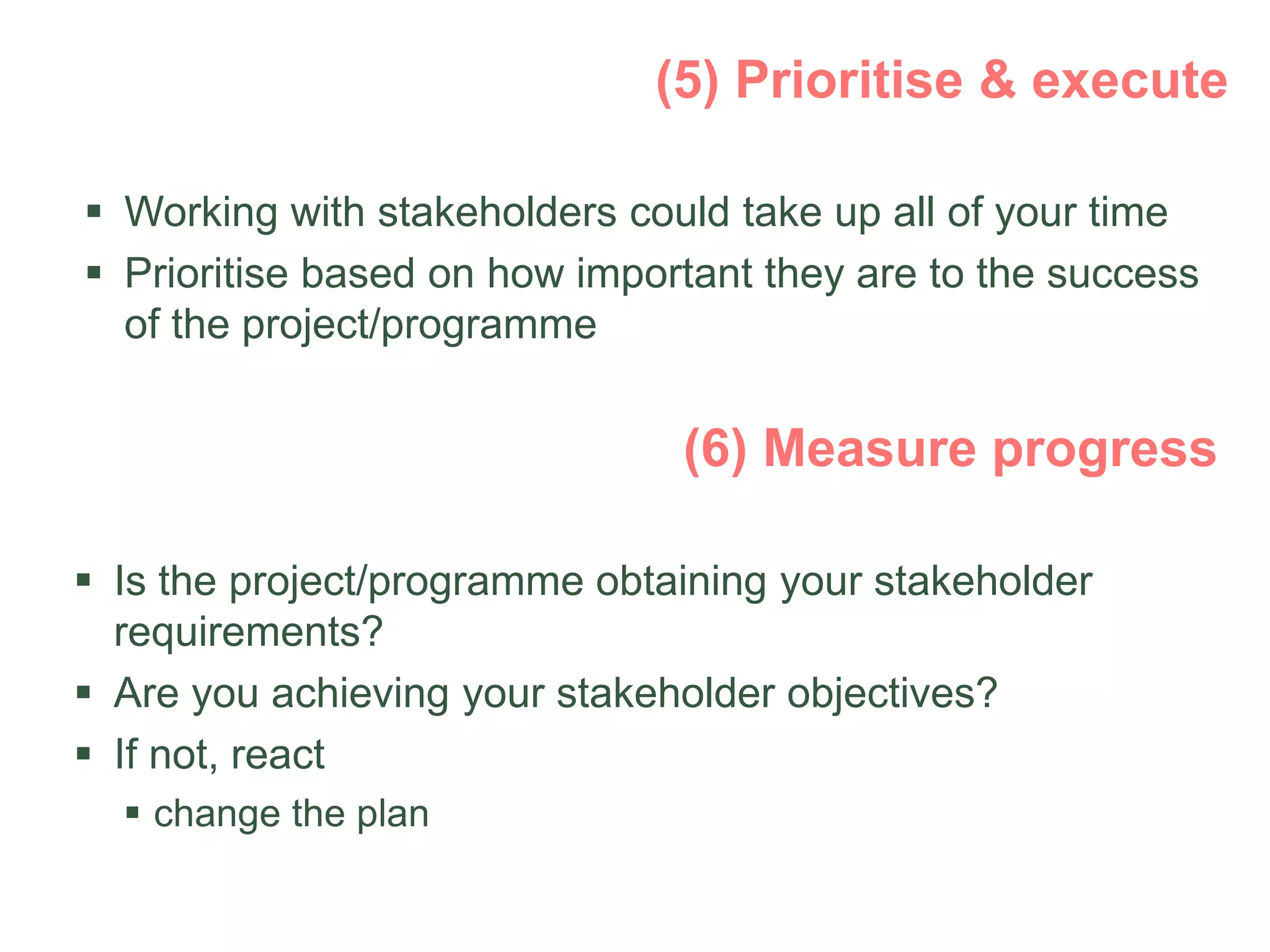
 Working with stakeholders could take up all of your time
 Prioritise based on how important they are to the success
of the project/programme
 Is the project/programme obtaining your stakeholder
requirements?
 Are you achieving your stakeholder objectives?
 If not, react
 change the plan
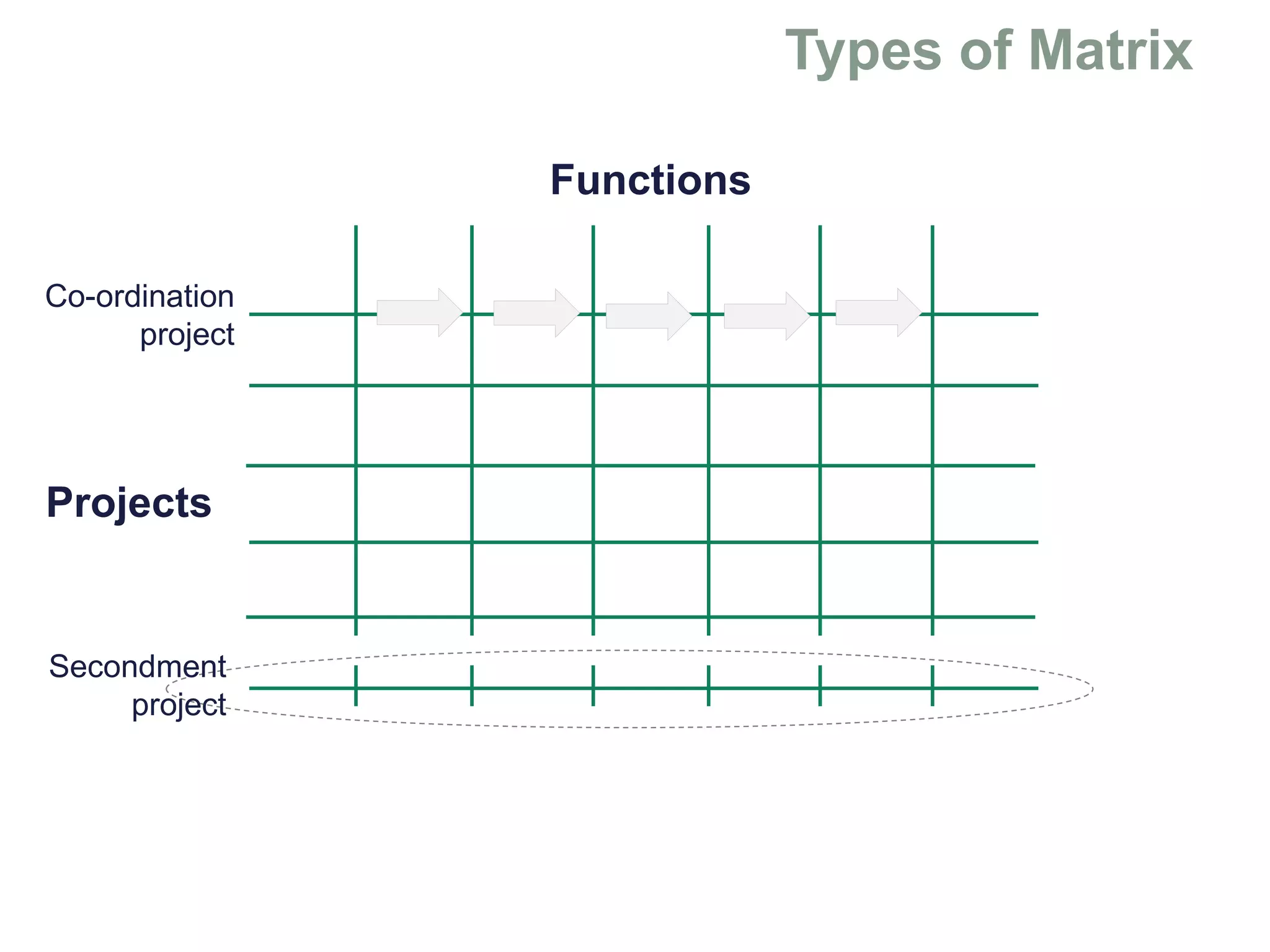
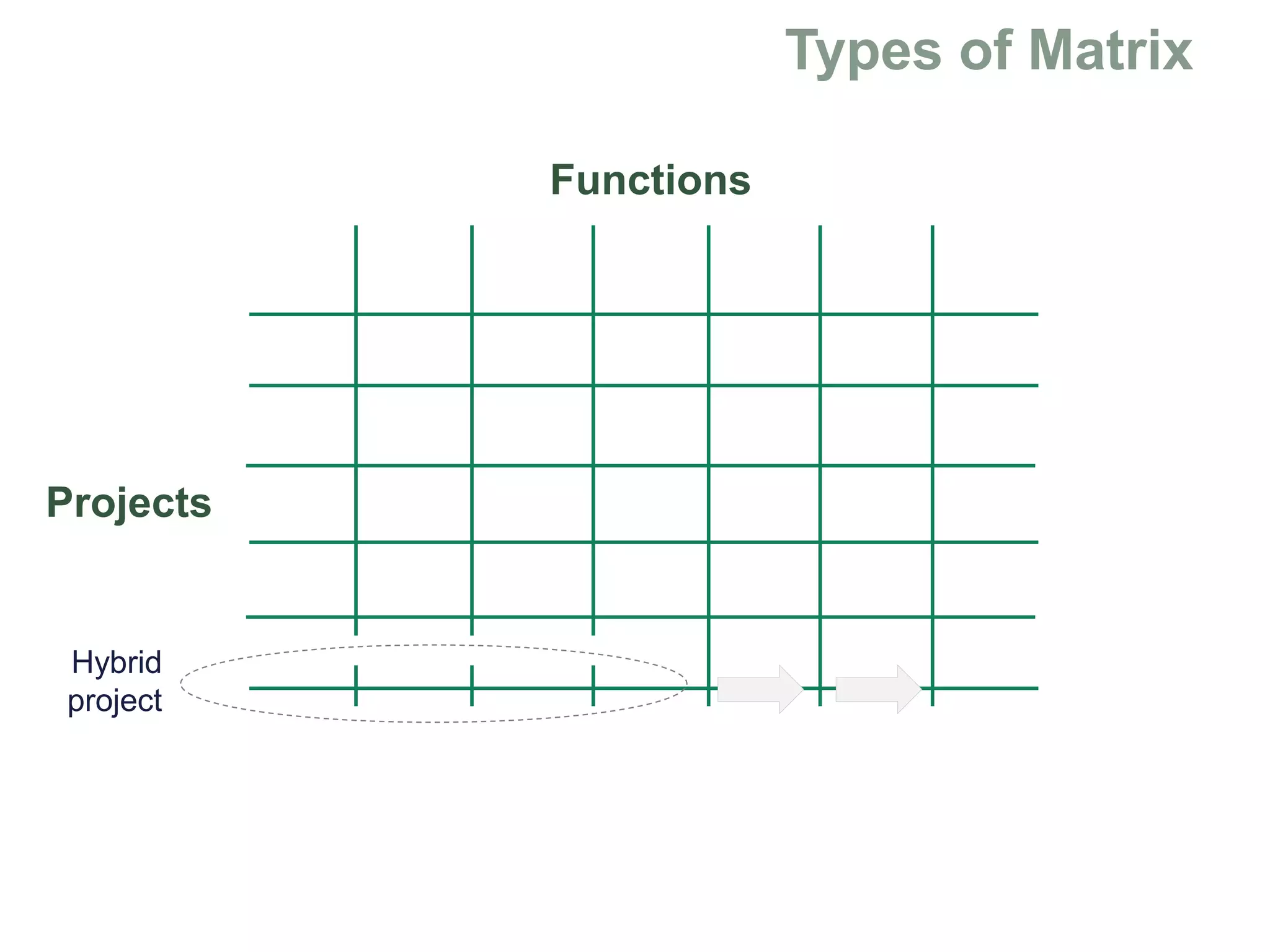
Matrix organisations
Functions
Projects
Co-ordination
project
Secondment
project
Functions
Projects
Hybrid
project
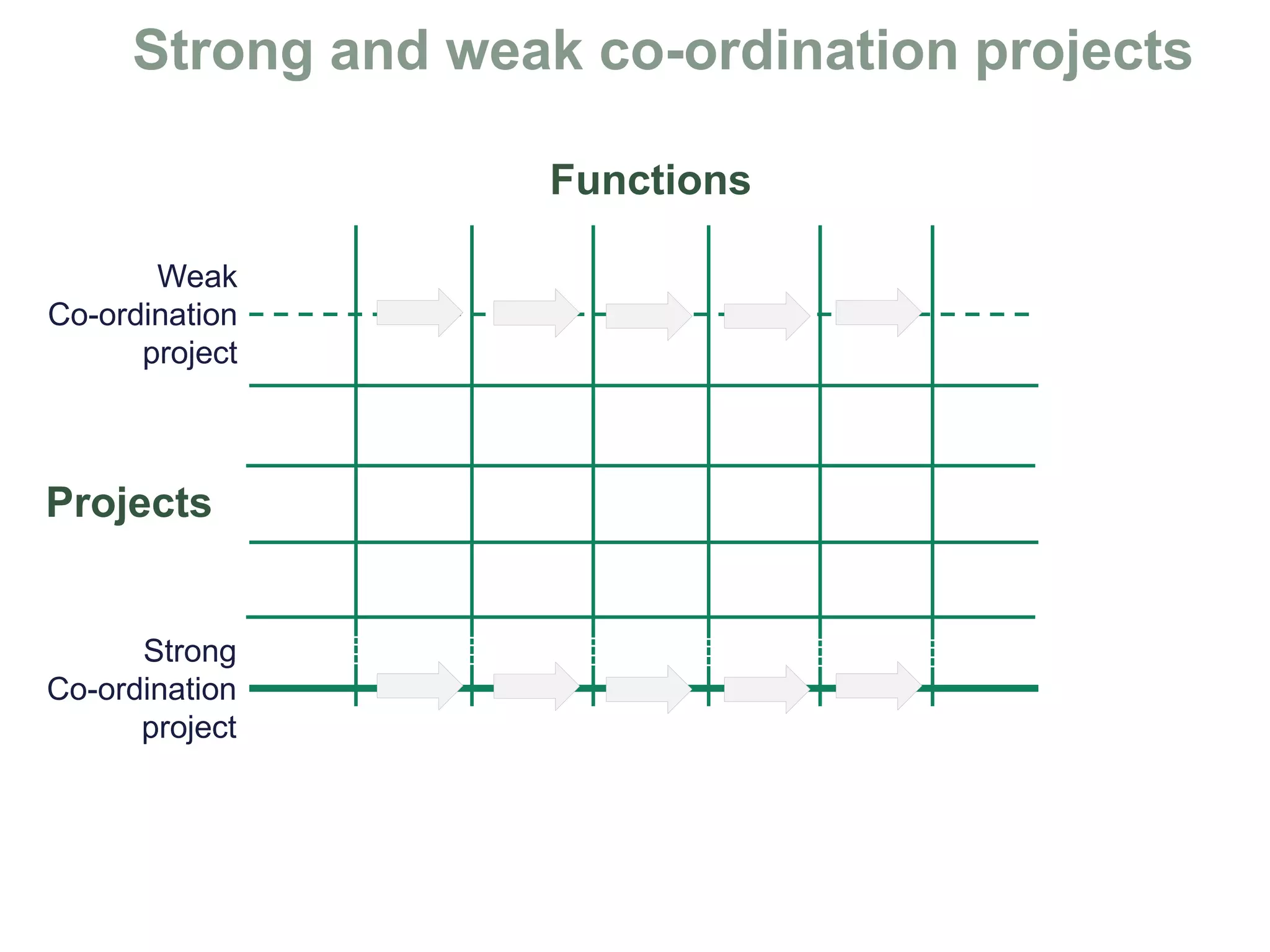
Functions
Projects
Weak
Co-ordination
project
Strong
Co-ordination
project
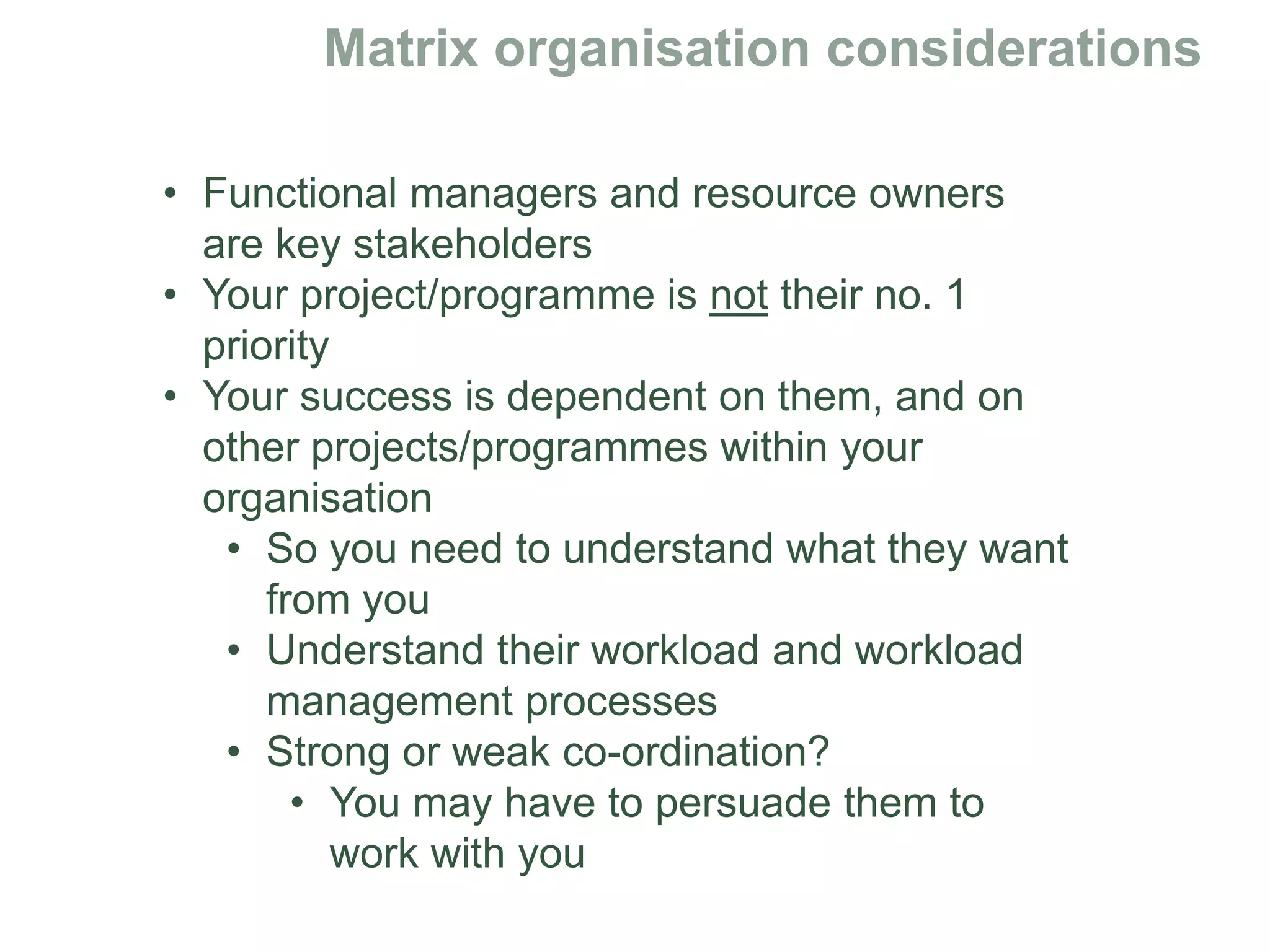
• Functional managers and resource owners
are key stakeholders
• Your project/programme is not their no. 1
priority
• Your success is dependent on them, and on
other projects/programmes within your
organisation
• So you need to understand what they want
from you
• Understand their workload and workload
management processes
• Strong or weak co-ordination?
• You may have to persuade them to
work with you
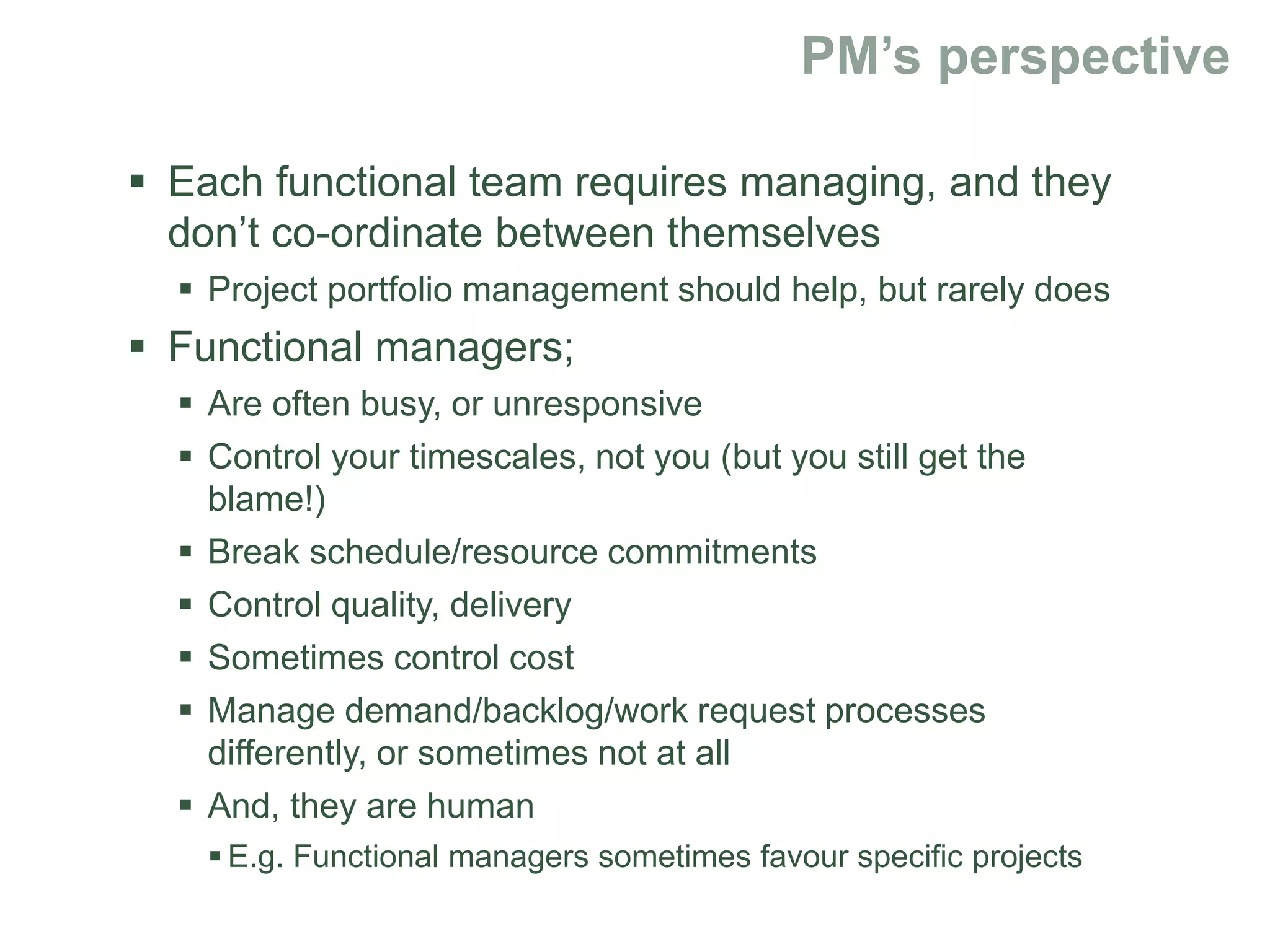
 Each functional team requires managing, and they
don’t co-ordinate between themselves
 Project portfolio management should help, but rarely does
 Functional managers;
 Are often busy, or unresponsive
 Control your timescales, not you (but you still get the
blame!)
 Break schedule/resource commitments
 Control quality, delivery
 Sometimes control cost
 Manage demand/backlog/work request processes
differently, or sometimes not at all
 And, they are human
 E.g. Functional managers sometimes favour specific projects
 Functional managers perspective
 You have to schedule work from multiple Projects, who
don’t co-ordinate
 Project managers keep changing their schedules &
requirements, with too little advanced notice
 Project managers don’t appreciate your problems &
priorities, they just demand work to be done without
seeing the bigger picture
 Some projects are just more interesting/strategic/easy
than others
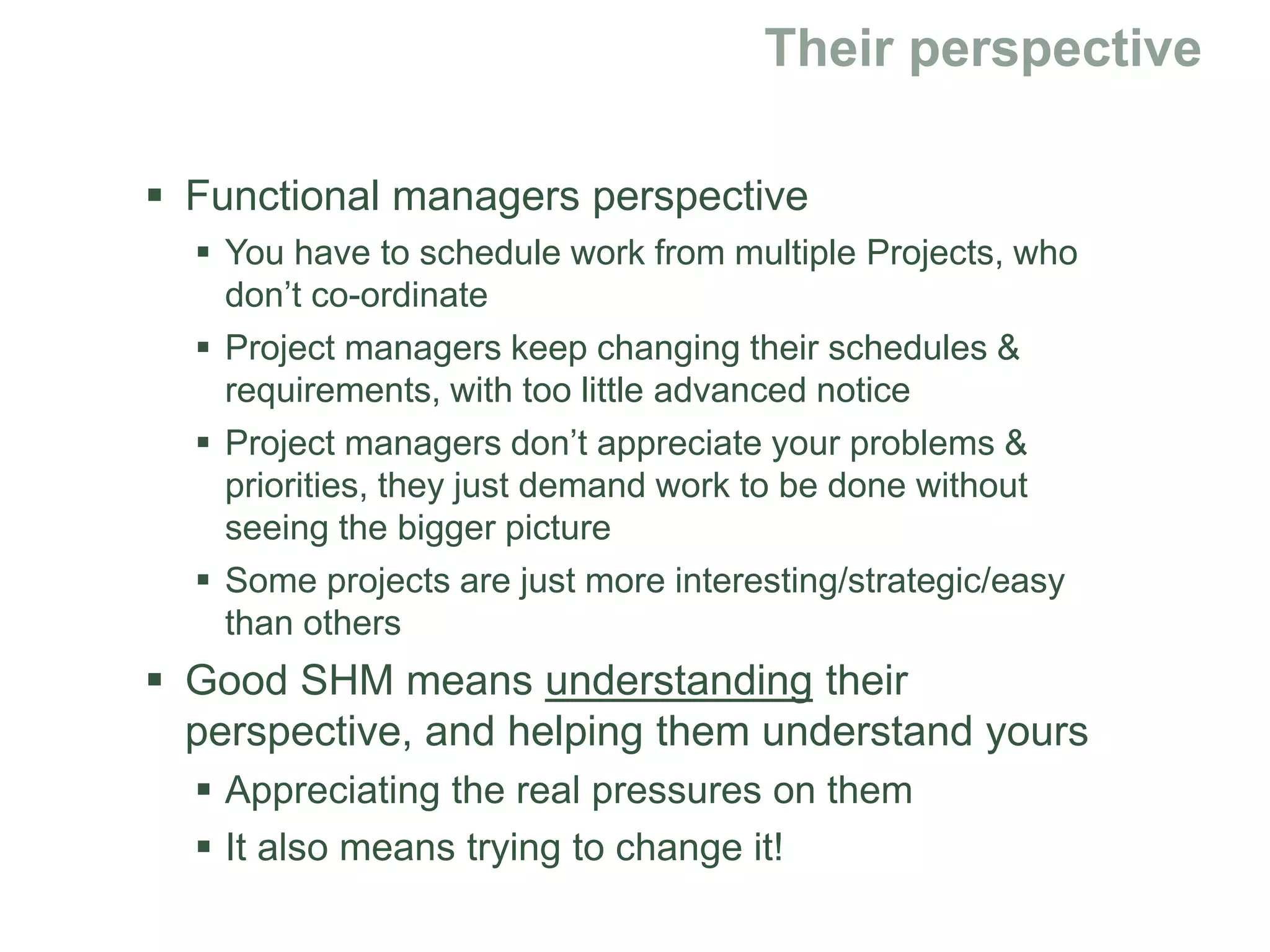
 Good SHM means understanding their
perspective, and helping them understand yours
 Appreciating the real pressures on them
 It also means trying to change it!
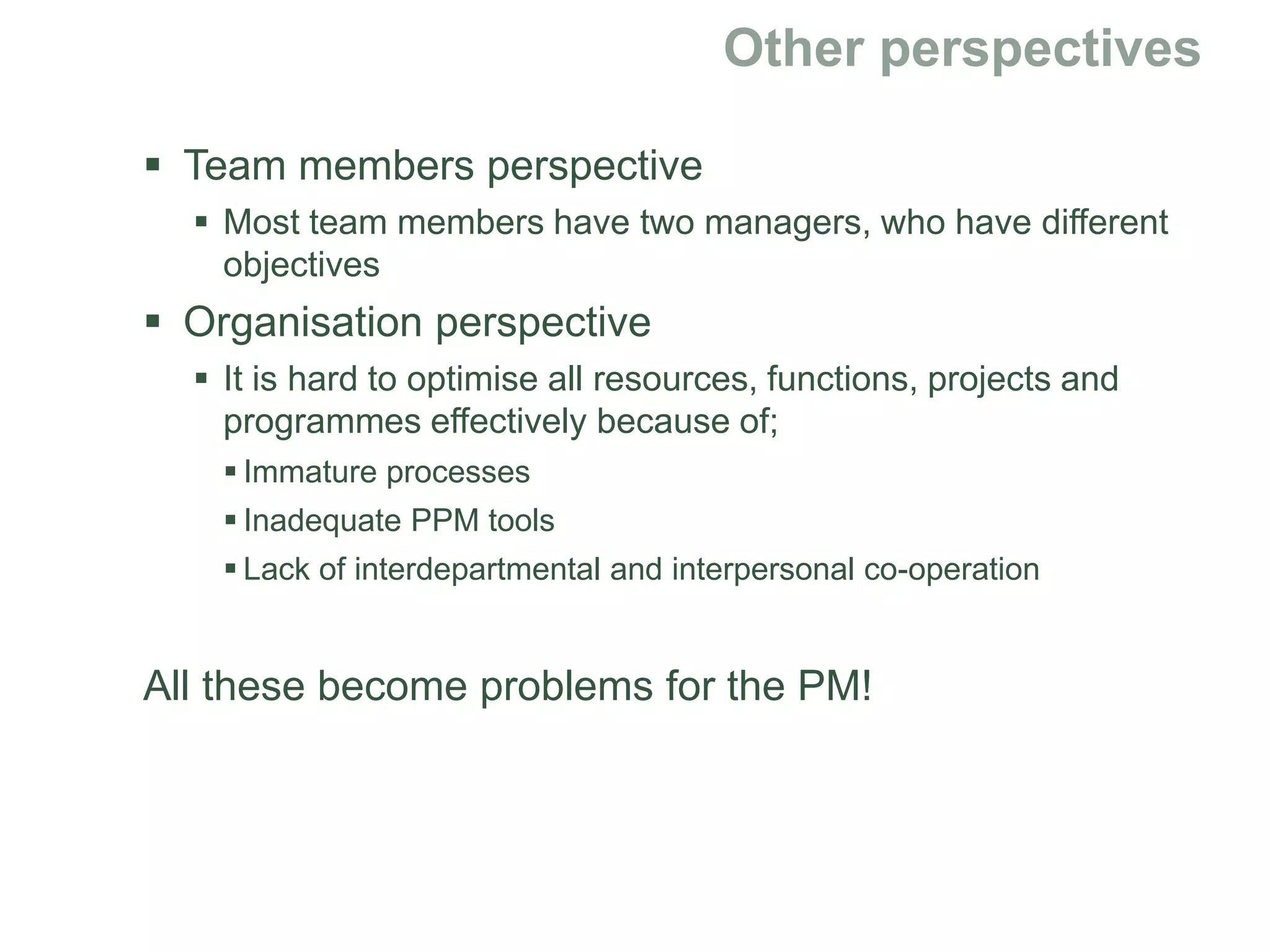
 Team members perspective
 Most team members have two managers, who have different
objectives
 Organisation perspective
 It is hard to optimise all resources, functions, projects and
programmes effectively because of;
 Immature processes
 Inadequate PPM tools
 Lack of interdepartmental and interpersonal co-operation
All these become problems for the PM!
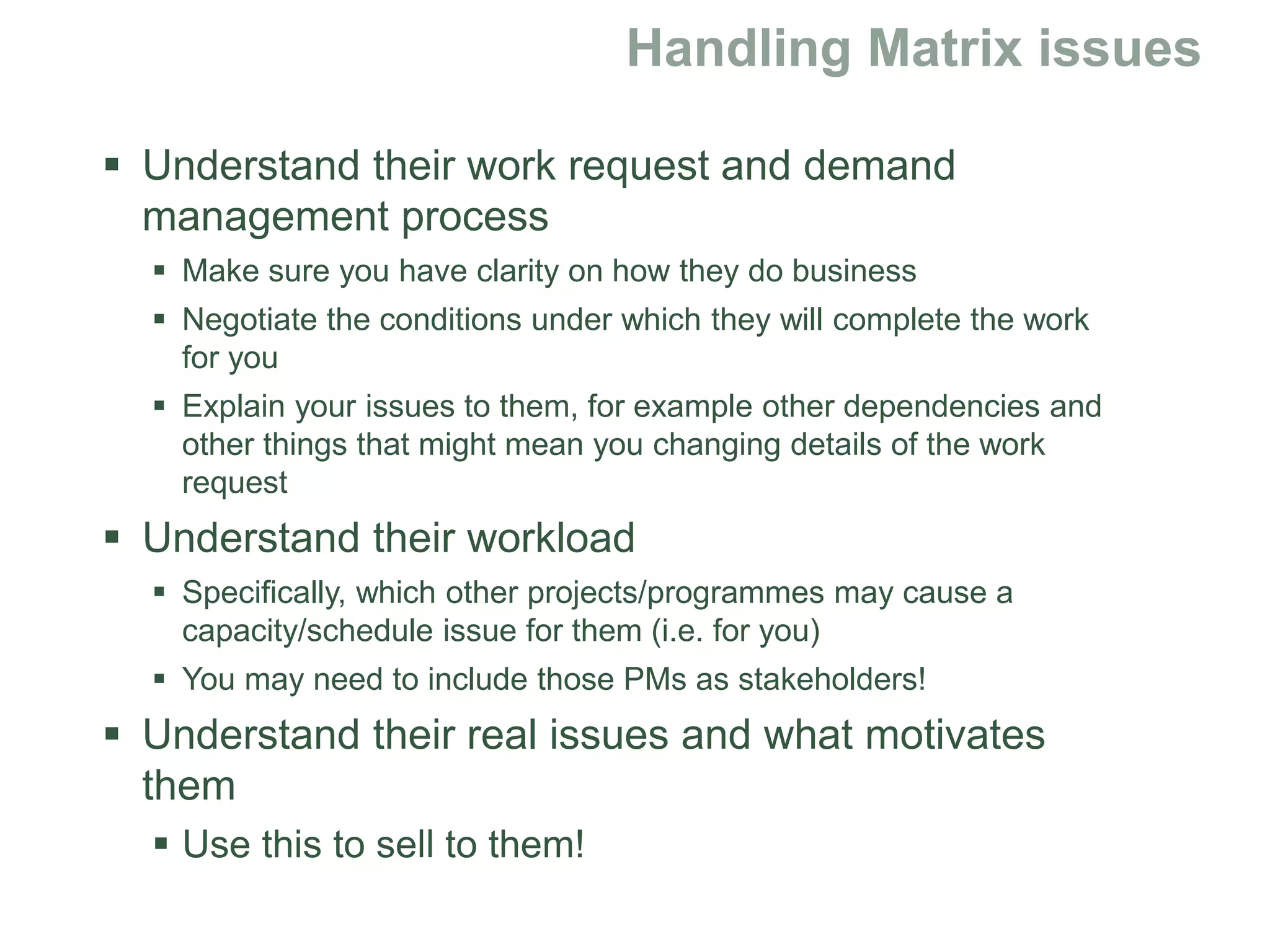
 Understand their work request and demand
management process
 Make sure you have clarity on how they do business
 Negotiate the conditions under which they will complete the work
for you
 Explain your issues to them, for example other dependencies and
other things that might mean you changing details of the work
request
 Understand their workload
 Specifically, which other projects/programmes may cause a
capacity/schedule issue for them (i.e. for you)
 You may need to include those PMs as stakeholders!
 Understand their real issues and what motivates
them
 Use this to sell to them!
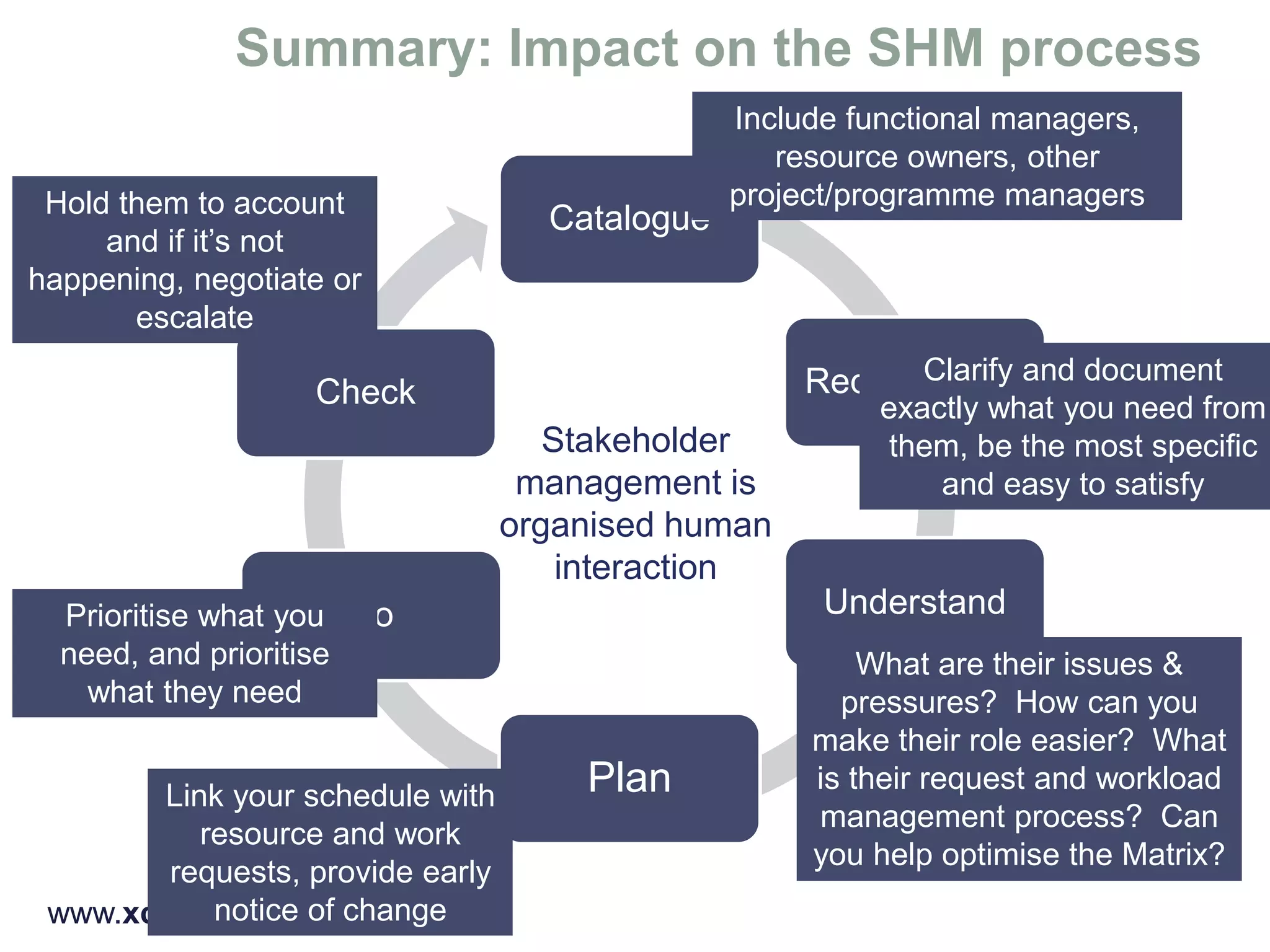
Catalogue
Requirements
Understand
Plan
Do
Check
www.xceedgroup.com/shm
Include functional managers,
resource owners, other
project/programme managers
What are their issues &
pressures? How can you
make their role easier? What
is their request and workload
management process? Can
you help optimise the Matrix?
Clarify and document
exactly what you need from
them, be the most specific
and easy to satisfy
Link your schedule with
resource and work
requests, provide early
notice of change
Prioritise what you
need, and prioritise
what they need
Hold them to account
and if it’s not
happening, negotiate or
escalate
Stakeholder
management is
organised human
interaction
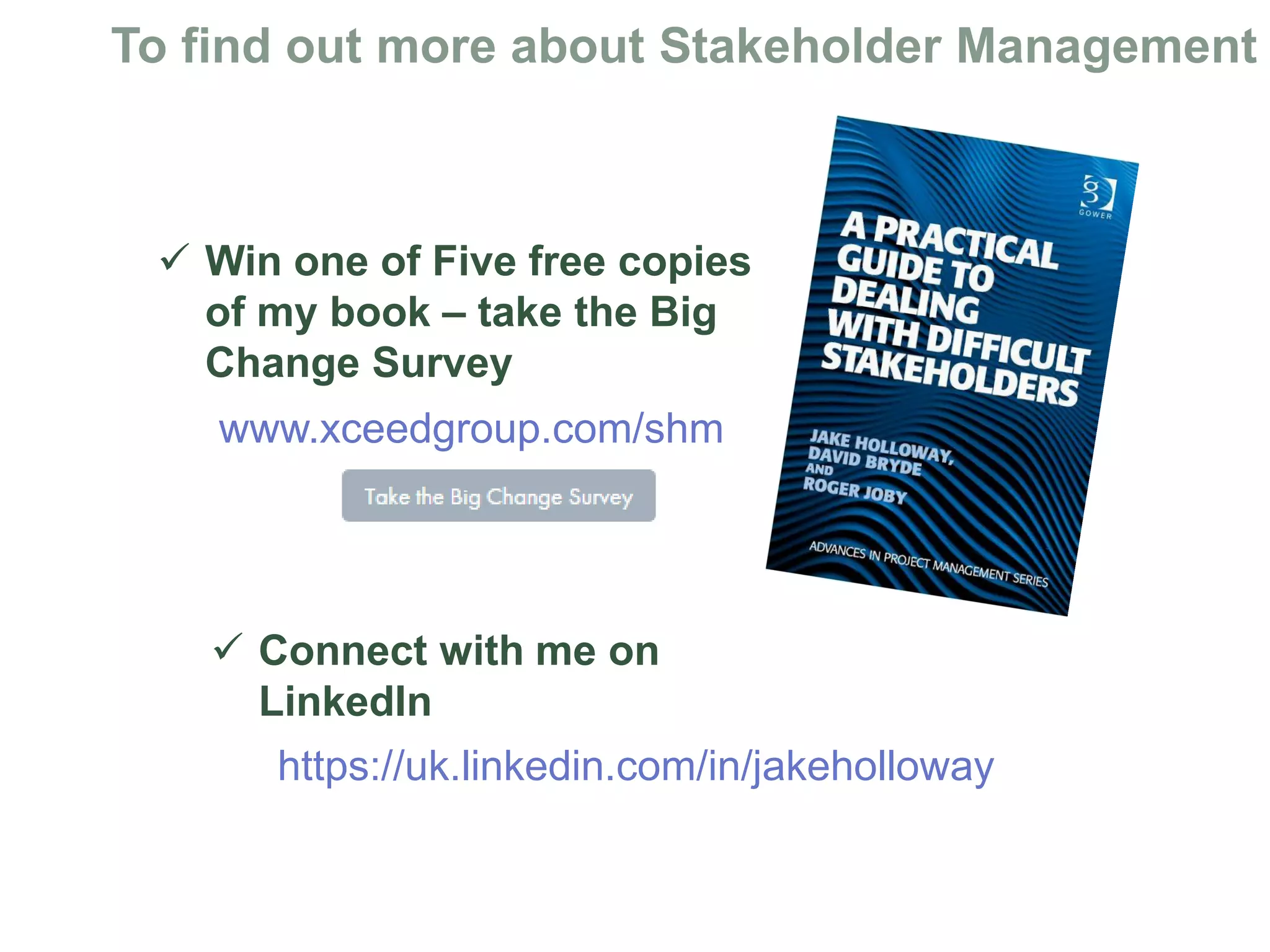
 Win one of Five free copies
of my book – take the Big
Change Survey
www.xceedgroup.com/shm
 Connect with me on
LinkedIn
https://uk.linkedin.com/in/jakeholloway
Questions?
www.apm.org.uk/progm
www.xceedgroup.com/shm

Stakeholder management in a matrix organisation - 25th August 2015

  • 1.
    Stakeholder management in amatrix environment A Programme Management SIG webinar www.apm.org.uk/progm
  • 2.
    Welcome & housekeeping This webinar is being recorded  Slides available for viewing on resources pages on APM website and ProgM microsite  Please use the questions box to ask questions
  • 3.
    Programme Management SIG(ProgM)  Vision: To be recognised internationally as the leading group for programme management, supporting a world in which all projects succeed.  Workstreams:  Physical Events  Virtual Events  Communications  Higher Education  Publications  Corporate
  • 4.
    ProgM  Introduction toProgramme Management Guide refresh underway  Website: www.apm.org.uk/progm  Twitter: @apmprogmsig
  • 5.
    Upcoming events  ValidatingStrategies for Programme Success  ProgM Webinars  ProgM Conference  Events: www.apm.org.uk/events
  • 6.
    Stakeholder management in amatrix environment Jake Holloway A Programme Management SIG webinar www.apm.org.uk/progm
  • 7.
    Webinar: Stakeholder Management ina Matrix Organisation Jake Holloway Clarity for complex changewww.xceedgroup.com/shm
  • 8.
    Introduction Stakeholder Management iscritical to project and programme success. It separates good PMs from administrators. In many organisations not all of the team members report to the project manager. This matrix of responsibility means more complex stakeholder management. It causes a number of issues and tensions between the project and functions, and also across multiple projects and programmes. The webinar looks at Stakeholder Management both generally and within Matrix Organisations. www.xceedgroup.com/shm
  • 9.
    25/08/2 015 9 What the webinarwill cover  Stakeholder Management Basics  Stakeholder Management process  Building your stakeholder map  Support v Influence Matrix  Effective Stakeholder Communication  Understanding Your Stakeholder’s Other Priorities  Stakeholder Persuasion Techniques:- building stakeholder support  Matrix Stakeholder Management  Types of Matrix organisations and their PM/SHM issues  Handling Matrix stakeholders and their issues  Q&A
  • 10.
  • 11.
    www.xceedgroup.com/shm (1) Refine stakeholder catalogue (2) Define stakeholder requirements (3)Understand stakeholder opinion & influence (4) Create stakeholder plan (5) Prioritise & Execute plan (6) Measure/Review progress
  • 12.
  • 13.
    A tested backout  What is a stakeholder?  Not only the Sponsor(s)  Not only the people who have project requirements  Definition: stakeholders are individuals or groups who can impact on the real or perceived success of a project or programme  They are all the people who you need something from  Sponsors and other interested Executives  Project team members, including suppliers & contractors  Internal and external customers (users, recipients, operations staff, sales & marketing)  Gatekeepers  Matrix: Functional managers, resource owners Rehearsals Brand Protection
  • 14.
     The catalogueshould cover  All Individuals, groups, and sub-groups who have distinct inputs, needs, opinions, and levels of authority  Think as widely as possible – projects and programmes can fail simply because the PM does not identify the most important stakeholders!  Initial information should include  What is your access to them?  Where are they?  What communication channels do they use?  Who do key individuals report to?  What professional and personal authority do they have? (e.g. on a scale 1 to 10)
  • 15.
     In orderfor the project/programme to be a success, and to be perceived as one;  What does the project/programme need from them?  What do they want from the project/programme – in order for you to get what you need?  Include in what you need;  Information, requirements & approvals  Resource and work request execution  Approval of process or methods used  Approvals of deliverables, quality etc.  Hard work, possibly above and beyond the call of duty  Executive decisions  Support and project/programme ‘promotion’ (or at least compliance / agreement)  Behaviour change, adoption of new practices  Assess how important each stakeholder’s requirements are (e.g. on a scale of 1 to 10)
  • 16.
  • 17.
     The morepositive the stakeholders the easier the project/programme  In a crisis, positive opinions and stakeholder support delivered via their influence networks could save you!  Negative stakeholders can kill it!  What do you know of their attitude towards;  The project/programme generally and the benefits to them (professionally and personally) of it succeeding  Fulfilling your requirements of them  Will it mean a lot of work? A lot of change? What are their other priorities? Are they very busy? Is this project/programme a distraction?  You personally, and towards other key stakeholders  Assess their support on a scale of 1 to 10  Note that early on you may not know everything you need to know
  • 18.
    Support Influence Stakeholder A Stakeholder B StakeholderC Stakeholder F Stakeholder E Stakeholder D Low High High Low
  • 19.
  • 20.
     The stakeholderplan is a plan to obtain the Stakeholder requirements, and to achieve other stakeholder-related objectives  It describes all organised interaction with them  It is not just a plan to “communicate and engage” with them, or “get their requirements”  You must also understand them, persuade them and change their behaviour  Why?
  • 21.
     For example If an important Executive will have significant impact on the programme being a success, but you know that they are inclined against the programme  Then your plan needs to either persuade them to change their mind – or to work round the problem of their negativity  Or if you require the QA Manager to carry out testing and quality audit quickly and according to your schedule, and you know that that team is overloaded by other projects/programmes  Then you need a plan to somehow get ahead of the queue! Which means persuading them to support your project  The job of project/programme manager is all about influencing, persuading, negotiating and changing attitudes and behaviour  It’s about reality  It’s not just Gantt charts, it’s social psychology too!
  • 22.
     With stakeholdergroups - think like an Advertiser  Design messages to address feelings  Use their channels to connect (no more project newsletters)  Measure reach, opinion, recall, level of engagement, satisfaction, behaviours  Ask yourself, what would a marketing person do?  If you don’t know, get one on your programme! www.xceedgroup.com/shm
  • 23.
     With individualstakeholders – think like a Salesperson  Focus on persuasion and changing behaviours, not just ‘engagement’  Use sales techniques to manage their decision- making process What do they want? What are their real objectives and objections? What are the benefits? What is their decision making process? Can you influence it? Close them on important decisions  Use persuasion techniques to motivate and negotiate with them Social proof, scarcity, investment rationalisation, comparisons, etc.
  • 24.
    Support Influence Stakeholder A Stakeholder B StakeholderC Stakeholder F Stakeholder E Stakeholder D Low High High Low Stakeholder E1 Stakeholder E2 Desired change Stakeholder influences Stakeholder objectives: support-influence map
  • 25.
    www.xceedgroup.com/shm Stakeholder Stakeholder requirements Example objectivesPlan to include.. Sponsor A • Requirement • Requirement • Sustain high support • Use +ive influence Weekly meeting, personalised report focussed on their high value outcomes Power Users • Requirement • Requirement • Build enthusiasm • User them to influence general users Fit early visibility around their schedule, build identification with project, open access to the team, regular satisfaction/attitude survey Sponsor B • Requirement • Requirement • Less antagonism Use Sponsor A to influence them, find way to make them feel more comfortable Quality Team Manager • Requirement • Requirement • Get through their QA and test process quickly Understand the QA workload, build bridges with competing PMs and try to help QA schedule. Sell the project’s true value Project Team • Requirement • Requirement • Keep them focussed on delivery Create enjoyable working environment, help with individual career objectives General Users • Requirement • Requirement • Adoption of new system Drinks/lunch sessions showing new system, use their intranet for comms about benefits to them
  • 26.
     Working withstakeholders could take up all of your time  Prioritise based on how important they are to the success of the project/programme  Is the project/programme obtaining your stakeholder requirements?  Are you achieving your stakeholder objectives?  If not, react  change the plan
  • 27.
  • 28.
  • 29.
  • 30.
  • 31.
    • Functional managersand resource owners are key stakeholders • Your project/programme is not their no. 1 priority • Your success is dependent on them, and on other projects/programmes within your organisation • So you need to understand what they want from you • Understand their workload and workload management processes • Strong or weak co-ordination? • You may have to persuade them to work with you
  • 32.
     Each functionalteam requires managing, and they don’t co-ordinate between themselves  Project portfolio management should help, but rarely does  Functional managers;  Are often busy, or unresponsive  Control your timescales, not you (but you still get the blame!)  Break schedule/resource commitments  Control quality, delivery  Sometimes control cost  Manage demand/backlog/work request processes differently, or sometimes not at all  And, they are human  E.g. Functional managers sometimes favour specific projects
  • 33.
     Functional managersperspective  You have to schedule work from multiple Projects, who don’t co-ordinate  Project managers keep changing their schedules & requirements, with too little advanced notice  Project managers don’t appreciate your problems & priorities, they just demand work to be done without seeing the bigger picture  Some projects are just more interesting/strategic/easy than others  Good SHM means understanding their perspective, and helping them understand yours  Appreciating the real pressures on them  It also means trying to change it!
  • 34.
     Team membersperspective  Most team members have two managers, who have different objectives  Organisation perspective  It is hard to optimise all resources, functions, projects and programmes effectively because of;  Immature processes  Inadequate PPM tools  Lack of interdepartmental and interpersonal co-operation All these become problems for the PM!
  • 35.
     Understand theirwork request and demand management process  Make sure you have clarity on how they do business  Negotiate the conditions under which they will complete the work for you  Explain your issues to them, for example other dependencies and other things that might mean you changing details of the work request  Understand their workload  Specifically, which other projects/programmes may cause a capacity/schedule issue for them (i.e. for you)  You may need to include those PMs as stakeholders!  Understand their real issues and what motivates them  Use this to sell to them!
  • 36.
    Catalogue Requirements Understand Plan Do Check www.xceedgroup.com/shm Include functional managers, resourceowners, other project/programme managers What are their issues & pressures? How can you make their role easier? What is their request and workload management process? Can you help optimise the Matrix? Clarify and document exactly what you need from them, be the most specific and easy to satisfy Link your schedule with resource and work requests, provide early notice of change Prioritise what you need, and prioritise what they need Hold them to account and if it’s not happening, negotiate or escalate Stakeholder management is organised human interaction
  • 37.
     Win oneof Five free copies of my book – take the Big Change Survey www.xceedgroup.com/shm  Connect with me on LinkedIn https://uk.linkedin.com/in/jakeholloway
  • 38.