
Human Resource Management

Najibullah Safi, MD, MSc. HPM
NPO/PHC, WHO - Afghanistan
Objectives
• By the end of the session participants will be able to:
– Describe Human resource planning and functions
Introduction
• Meaning of human resources
– HR of an organization is composed of all the efforts, skills
or capabilities of all the people who work for the
organization

• Organization culture
– Internal factors
– External factors
Introduction cont.
Purpose
and Goals

External
Environment

Organizatio
n Policies

e.g. Customers,
Competitors …

Rules and
Procedures

Organization
Culture

Communic
ation
channels

Organization
Structure

Employees
skills and
attitude
Decision
Making
mechanism

Use of
technology
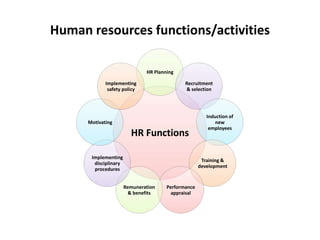
Human resources functions/activities
HR Planning
Implementing
safety policy

Recruitment
& selection

Motivating

HR Functions
Implementing
disciplinary
procedures

Induction of
new
employees

Training &
development

Remuneration
& benefits

Performance
appraisal
Strategic aspects of HRM
• Innovation
– More effective and efficient HR system

• Long term planning
– Meet objectives and goals of the organization

• Advisory function
– Assist managers of departments in the implementation of
HR policies
Man power planning
• Forecasting and estimating the future demand
– Recruitment and training of adequate and suitable
employees
– Retention of employees
– Effective utilization of entire workforce
– Improvement of employee performance
– Release of employees, if necessary
Man power planning cont.

Employees
categories

Existing
employees

New
employees

Potential
employees

Leavers
Man power planning cont.

Existing
employees

• Performance appraisal
• Productivity
• Deployment
• Equal opportunities
• Education and training
• Remuneration
• Promotion and career development
Man power planning cont.

New
employees

• Recruitment – source and methods
• Selection procedure
• Terms of employments
• Induction
• On the job training and additional
training
Man power planning cont.

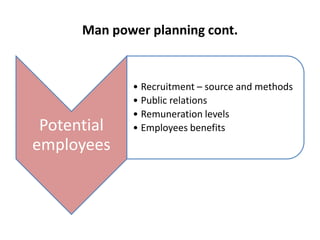
Potential
employees

• Recruitment – source and methods
• Public relations
• Remuneration levels
• Employees benefits
Man power planning cont.

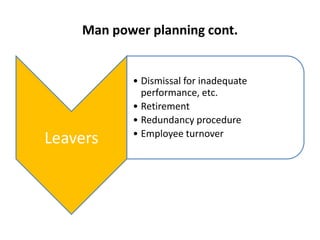
Leavers

• Dismissal for inadequate
performance, etc.
• Retirement
• Redundancy procedure
• Employee turnover
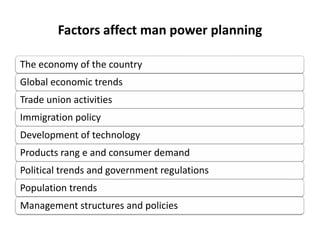
Factors affect man power planning
The economy of the country
Global economic trends
Trade union activities
Immigration policy
Development of technology

Products rang e and consumer demand
Political trends and government regulations
Population trends
Management structures and policies
Recruitment
• The first step in the process of filling of a vacancy
• The process by which a job vacancy
is identified and potential employees are notified
• The nature of the recruitment process
is regulated and subject to employment law
• Main forms of recruitment is through advertising in
newspapers, magazines, trade papers and internal
vacancy lists
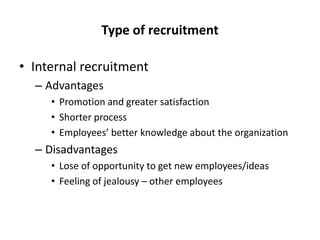
Type of recruitment
• Internal recruitment
– Advantages
• Promotion and greater satisfaction
• Shorter process
• Employees’ better knowledge about the organization

– Disadvantages
• Lose of opportunity to get new employees/ideas
• Feeling of jealousy – other employees
Type of recruitment cont.
• External recruitment
– Sources
•
•
•
•
•

Universities
Employment agencies
Advertisement
Consultants
Website

– Advantages
– Disadvantages
Recruitment process
•
•
•
•
•
•

Job analysis
Job descriptions
Employee specification
Attracting suitable applicants
Employment application forms
Required documents e.g. degree, recommendation
letter, references …
Selection
• The process of assessing candidates and appointing a
post holder
• Short listing
• Employment interviews
• Selection test
– Work, aptitude, intelligent and personality tests

• Appointment
• Dealing with unsuccessful candidates
• Probationary period
Induction
• Components of an induction program
–
–
–
–
–
–

Introduction to the business
Layout of buildings
Terms and condition of employment
Relevant personnel policies
Business rules and procedures
Arrangement for employee involvement and
communication
– Welfare and benefits and facilities
Training and development
• Training need assessment
• Benefits of the training
– To the employees
– To the organization

• Types of training programs
– Job training
– Refresher training
– Promotional training
Training and development methods
• On the job methods
–
–
–
–
–

Specific job training
Apprenticeship training
Coaching and under study program
Job rotation
Special projects and taskforces

• Off the job methods
– Special courses and lectures, conferences, case
studies, simulation and role playing
Characteristics of a good training program
•
•
•
•
•
•

Determination of training needs
Relevance to job requirements
Allowance for individual differences
Result oriented
Suitable incentives
Management support
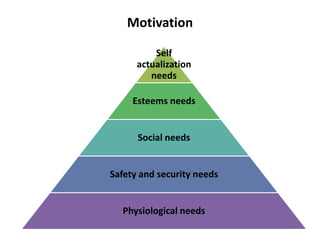
Motivation
Self
actualization
needs
Esteems needs

Social needs

Safety and security needs

Physiological needs
Motivation strategies

Empowering employees

Providing an effective reward system

Redesigning jobs (job enlargement,
rotation, enrichment)

Creating flexibility
Health, safety, security and welfare
• HR department responsibilities
– Assist management to deal adequately with:
•
•
•
•
•
•
•

Prevention of accidents
Creating safety consciousness
Making people safe
Making the work environment safe
Machinery and equipment handling
Safety committees
Fire prevention and fire fighting
Health, safety, security and welfare cont.
• Medical facilities
– Pre engagement exams
– Medical checks
– Medical centers

• Employee welfare
– Canteen facilities
– Vehicle parking
– Sport facilities
– Workers’ committee
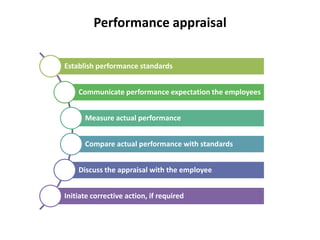
Performance appraisal
Establish performance standards
Communicate performance expectation the employees
Measure actual performance
Compare actual performance with standards
Discuss the appraisal with the employee
Initiate corrective action, if required
Performance appraisal methods

Traditional
methods
- Ranking
- Grading
- Check list
- Comparison
- Group appraisal
- Field review

Modern
methods
- Assessment
center
- Appraisal by
results or by
objectives
- Human asset
accounting
methods
Discipline
• Firms cannot just ‘sack’ workers
• Wide range of procedures and steps
in dealing with workplace conflict
–
–
–
–
–
–

Informal meetings
Formal meetings
Verbal warnings
Written warnings
Grievance procedures
Working with external agencies
Employment legislation
• Increasingly important aspect of the HRM role
• Wide range of areas for attention
• Adds to the cost of the business
Crucial aspects of employment legislation:
– Race
– Gender
– Disability
• Disability is no longer an issue for employers
to ignore, they must take reasonable steps
to accommodate and recruit disabled workers
Remuneration
• Remuneration policy might be affected by:
-

Strength of the trade union or staff association
Economic climate of the country
Availability of labor in a particular area
Government policies
System of remuneration
•
•
•
•
•
•

Time rates
Piece work rates
Bonus
Incentives
Commission
Allowances
System of remuneration cont.
• Standard employment benefits
– Annual paid holidays
– Sickness pay
– Fringe benefits
•
•
•
•
•
•
•

Vehicle
Accommodation
Salary advance
Loans
Flexible working hours
Insurance
Working from home or other location
Human resource management

Human resource management

  • 1.
    Human Resource Management NajibullahSafi, MD, MSc. HPM NPO/PHC, WHO - Afghanistan
  • 2.
    Objectives • By theend of the session participants will be able to: – Describe Human resource planning and functions
  • 3.
    Introduction • Meaning ofhuman resources – HR of an organization is composed of all the efforts, skills or capabilities of all the people who work for the organization • Organization culture – Internal factors – External factors
  • 4.
    Introduction cont. Purpose and Goals External Environment Organizatio nPolicies e.g. Customers, Competitors … Rules and Procedures Organization Culture Communic ation channels Organization Structure Employees skills and attitude Decision Making mechanism Use of technology
  • 5.
    Human resources functions/activities HRPlanning Implementing safety policy Recruitment & selection Motivating HR Functions Implementing disciplinary procedures Induction of new employees Training & development Remuneration & benefits Performance appraisal
  • 6.
    Strategic aspects ofHRM • Innovation – More effective and efficient HR system • Long term planning – Meet objectives and goals of the organization • Advisory function – Assist managers of departments in the implementation of HR policies
  • 7.
    Man power planning •Forecasting and estimating the future demand – Recruitment and training of adequate and suitable employees – Retention of employees – Effective utilization of entire workforce – Improvement of employee performance – Release of employees, if necessary
  • 8.
    Man power planningcont. Employees categories Existing employees New employees Potential employees Leavers
  • 9.
    Man power planningcont. Existing employees • Performance appraisal • Productivity • Deployment • Equal opportunities • Education and training • Remuneration • Promotion and career development
  • 10.
    Man power planningcont. New employees • Recruitment – source and methods • Selection procedure • Terms of employments • Induction • On the job training and additional training
  • 11.
    Man power planningcont. Potential employees • Recruitment – source and methods • Public relations • Remuneration levels • Employees benefits
  • 12.
    Man power planningcont. Leavers • Dismissal for inadequate performance, etc. • Retirement • Redundancy procedure • Employee turnover
  • 13.
    Factors affect manpower planning The economy of the country Global economic trends Trade union activities Immigration policy Development of technology Products rang e and consumer demand Political trends and government regulations Population trends Management structures and policies
  • 14.
    Recruitment • The firststep in the process of filling of a vacancy • The process by which a job vacancy is identified and potential employees are notified • The nature of the recruitment process is regulated and subject to employment law • Main forms of recruitment is through advertising in newspapers, magazines, trade papers and internal vacancy lists
  • 15.
    Type of recruitment •Internal recruitment – Advantages • Promotion and greater satisfaction • Shorter process • Employees’ better knowledge about the organization – Disadvantages • Lose of opportunity to get new employees/ideas • Feeling of jealousy – other employees
  • 16.
    Type of recruitmentcont. • External recruitment – Sources • • • • • Universities Employment agencies Advertisement Consultants Website – Advantages – Disadvantages
  • 17.
    Recruitment process • • • • • • Job analysis Jobdescriptions Employee specification Attracting suitable applicants Employment application forms Required documents e.g. degree, recommendation letter, references …
  • 18.
    Selection • The processof assessing candidates and appointing a post holder • Short listing • Employment interviews • Selection test – Work, aptitude, intelligent and personality tests • Appointment • Dealing with unsuccessful candidates • Probationary period
  • 19.
    Induction • Components ofan induction program – – – – – – Introduction to the business Layout of buildings Terms and condition of employment Relevant personnel policies Business rules and procedures Arrangement for employee involvement and communication – Welfare and benefits and facilities
  • 20.
    Training and development •Training need assessment • Benefits of the training – To the employees – To the organization • Types of training programs – Job training – Refresher training – Promotional training
  • 21.
    Training and developmentmethods • On the job methods – – – – – Specific job training Apprenticeship training Coaching and under study program Job rotation Special projects and taskforces • Off the job methods – Special courses and lectures, conferences, case studies, simulation and role playing
  • 22.
    Characteristics of agood training program • • • • • • Determination of training needs Relevance to job requirements Allowance for individual differences Result oriented Suitable incentives Management support
  • 23.
  • 24.
    Motivation strategies Empowering employees Providingan effective reward system Redesigning jobs (job enlargement, rotation, enrichment) Creating flexibility
  • 25.
    Health, safety, securityand welfare • HR department responsibilities – Assist management to deal adequately with: • • • • • • • Prevention of accidents Creating safety consciousness Making people safe Making the work environment safe Machinery and equipment handling Safety committees Fire prevention and fire fighting
  • 26.
    Health, safety, securityand welfare cont. • Medical facilities – Pre engagement exams – Medical checks – Medical centers • Employee welfare – Canteen facilities – Vehicle parking – Sport facilities – Workers’ committee
  • 27.
    Performance appraisal Establish performancestandards Communicate performance expectation the employees Measure actual performance Compare actual performance with standards Discuss the appraisal with the employee Initiate corrective action, if required
  • 28.
    Performance appraisal methods Traditional methods -Ranking - Grading - Check list - Comparison - Group appraisal - Field review Modern methods - Assessment center - Appraisal by results or by objectives - Human asset accounting methods
  • 29.
    Discipline • Firms cannotjust ‘sack’ workers • Wide range of procedures and steps in dealing with workplace conflict – – – – – – Informal meetings Formal meetings Verbal warnings Written warnings Grievance procedures Working with external agencies
  • 30.
    Employment legislation • Increasinglyimportant aspect of the HRM role • Wide range of areas for attention • Adds to the cost of the business Crucial aspects of employment legislation: – Race – Gender – Disability • Disability is no longer an issue for employers to ignore, they must take reasonable steps to accommodate and recruit disabled workers
  • 31.
    Remuneration • Remuneration policymight be affected by: - Strength of the trade union or staff association Economic climate of the country Availability of labor in a particular area Government policies
  • 32.
    System of remuneration • • • • • • Timerates Piece work rates Bonus Incentives Commission Allowances
  • 33.
    System of remunerationcont. • Standard employment benefits – Annual paid holidays – Sickness pay – Fringe benefits • • • • • • • Vehicle Accommodation Salary advance Loans Flexible working hours Insurance Working from home or other location