Gain The Competitive Edge
                                    Write the Best CV

Today’s job market is as competitive as ever, you need to stand out from the crowd if you are
to secure an interview. This means that since your CV is YOUR personal sales tool, and on
average the reader may only spend 5 seconds scanning it before making a decision to read on
or discard, YOUR CV needs to powerfully promote you in the best, most relevant and succinct
way. How do you do that?

Tip No 1

Presentation and Content
You need to make sure your CV is not only grammatically correct, with no spelling mistakes
but that it also looks good and reflects you and how you work. For a professional look, use a
readable font; highlight key titles, use bullet points, capitals and underlying where appropriate.
Forget brightly coloured papers, photographs and borders; simple neutral paper with black ink
printed on a good quality printer is best received. Then there is the content: this needs to
show a continuous employment history [so you need to explain the career breaks] and give an
accurate synopsis of your skills, knowledge, experience, abilities and achievements.

Tip No 2

Achievements
Ensure that for every role or position title detailed on your CV, you include “Achievements”
and that you list 2-4 real achievements from that role before you list your responsibilities.
With all your achievements – and they can be in all shapes and sizes – remember to qualify
and quantify them; adding value and results will make them really effective. So for example, if
you developed the business and increased revenue, detail the percentages and figures and
include the time frame.

Tip No 3

Interviews
That’s what you want. An interview – and you need to think about what questions you will be
asked. So, whilst writing your CV think about the specific role where you will be using your
skills, abilities, knowledge and experience. Make it easy for the decision maker; address all the
criteria for that role by including achievements and examples that match their job
specification. Include examples where you have demonstrated your skills and competence in a
particular area – that way when it comes to the interview, you will only need to expand and
give more detail on the statements on your CV.


Remember: It is vital that your CV not only stands out from others but that it is also easy
to read

          Sell yourself on your CV to beat the competition when applying for jobs;
          Identify skills and achievements you may not have realised you possessed;
          Write the CV in the preferred style for HR and recruitment professionals; AND
          Prepare a matching custom covering letter for each CV you send out.

                   ASSESSMENT4POTENTIAL©         info@assessment4potential.com
                                       07801 689801
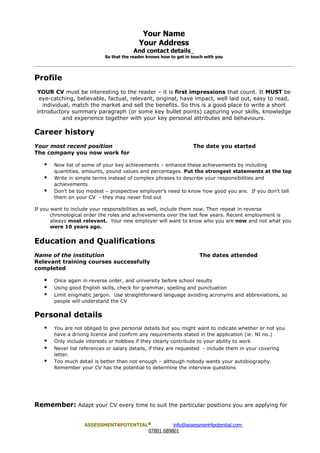
Your Name
                                          Your Address
                                       And contact details
                           So that the reader knows how to get in touch with you


Profile
YOUR CV must be interesting to the reader – it is first impressions that count. It MUST be
 eye-catching, believable, factual, relevant, original, have impact, well laid out, easy to read,
  individual, match the market and sell the benefits. So this is a good place to write a short
introductory summary paragraph (or some key bullet points) capturing your skills, knowledge
          and experience together with your key personal attributes and behaviours.

Career history
Your most recent position                                         The date you started
The company you now work for

       Now list of some of your key achievements – enhance these achievements by including
       quantities, amounts, pound values and percentages. Put the strongest statements at the top
       Write in simple terms instead of complex phrases to describe your responsibilities and
       achievements
       Don’t be too modest – prospective employer’s need to know how good you are. If you don’t tell
       them on your CV - they may never find out

If you want to include your responsibilities as well, include them now. Then repeat in reverse
       chronological order the roles and achievements over the last few years. Recent employment is
       always most relevant. Your new employer will want to know who you are now and not what you
       were 10 years ago.


Education and Qualifications
Name of the institution                                              The dates attended
Relevant training courses successfully
completed

       Once again in reverse order, and university before school results
       Using good English skills, check for grammar, spelling and punctuation
       Limit enigmatic jargon. Use straightforward language avoiding acronyms and abbreviations, so
       people will understand the CV

Personal details
       You are not obliged to give personal details but you might want to indicate whether or not you
       have a driving licence and confirm any requirements stated in the application (ie: NI no.)
       Only include interests or hobbies if they clearly contribute to your ability to work
       Never list references or salary details, if they are requested - include them in your covering
       letter.
       Too much detail is better than not enough – although nobody wants your autobiography.
       Remember your CV has the potential to determine the interview questions


Remember: Adapt your CV every time to suit the particular positions you are applying for


                   ASSESSMENT4POTENTIAL©         info@assessment4potential.com
                                       07801 689801
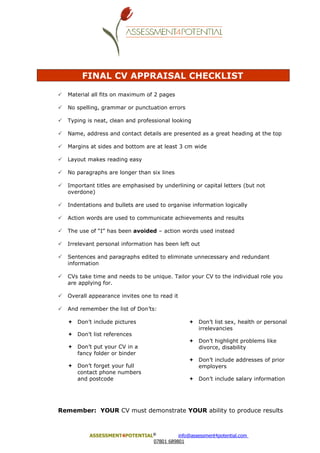
FINAL CV APPRAISAL CHECKLIST

  Material all fits on maximum of 2 pages

  No spelling, grammar or punctuation errors

  Typing is neat, clean and professional looking

  Name, address and contact details are presented as a great heading at the top

  Margins at sides and bottom are at least 3 cm wide

  Layout makes reading easy

  No paragraphs are longer than six lines

  Important titles are emphasised by underlining or capital letters (but not
  overdone)

  Indentations and bullets are used to organise information logically

  Action words are used to communicate achievements and results

  The use of “I” has been avoided – action words used instead

  Irrelevant personal information has been left out

  Sentences and paragraphs edited to eliminate unnecessary and redundant
  information

  CVs take time and needs to be unique. Tailor your CV to the individual role you
  are applying for.

  Overall appearance invites one to read it

  And remember the list of Don’ts:

     Don’t include pictures                        Don’t list sex, health or personal
                                                   irrelevancies
     Don’t list references
                                                   Don’t highlight problems like
     Don’t put your CV in a                        divorce, disability
     fancy folder or binder
                                                   Don’t include addresses of prior
     Don’t forget your full                        employers
     contact phone numbers
     and postcode                                  Don’t include salary information


Remember: YOUR CV must demonstrate YOUR ability to produce results


          ASSESSMENT4POTENTIAL©         info@assessment4potential.com
                              07801 689801

Cv Guidelines

  • 1.
    Gain The CompetitiveEdge Write the Best CV Today’s job market is as competitive as ever, you need to stand out from the crowd if you are to secure an interview. This means that since your CV is YOUR personal sales tool, and on average the reader may only spend 5 seconds scanning it before making a decision to read on or discard, YOUR CV needs to powerfully promote you in the best, most relevant and succinct way. How do you do that? Tip No 1 Presentation and Content You need to make sure your CV is not only grammatically correct, with no spelling mistakes but that it also looks good and reflects you and how you work. For a professional look, use a readable font; highlight key titles, use bullet points, capitals and underlying where appropriate. Forget brightly coloured papers, photographs and borders; simple neutral paper with black ink printed on a good quality printer is best received. Then there is the content: this needs to show a continuous employment history [so you need to explain the career breaks] and give an accurate synopsis of your skills, knowledge, experience, abilities and achievements. Tip No 2 Achievements Ensure that for every role or position title detailed on your CV, you include “Achievements” and that you list 2-4 real achievements from that role before you list your responsibilities. With all your achievements – and they can be in all shapes and sizes – remember to qualify and quantify them; adding value and results will make them really effective. So for example, if you developed the business and increased revenue, detail the percentages and figures and include the time frame. Tip No 3 Interviews That’s what you want. An interview – and you need to think about what questions you will be asked. So, whilst writing your CV think about the specific role where you will be using your skills, abilities, knowledge and experience. Make it easy for the decision maker; address all the criteria for that role by including achievements and examples that match their job specification. Include examples where you have demonstrated your skills and competence in a particular area – that way when it comes to the interview, you will only need to expand and give more detail on the statements on your CV. Remember: It is vital that your CV not only stands out from others but that it is also easy to read Sell yourself on your CV to beat the competition when applying for jobs; Identify skills and achievements you may not have realised you possessed; Write the CV in the preferred style for HR and recruitment professionals; AND Prepare a matching custom covering letter for each CV you send out. ASSESSMENT4POTENTIAL© info@assessment4potential.com 07801 689801
  • 2.
    Your Name Your Address And contact details So that the reader knows how to get in touch with you Profile YOUR CV must be interesting to the reader – it is first impressions that count. It MUST be eye-catching, believable, factual, relevant, original, have impact, well laid out, easy to read, individual, match the market and sell the benefits. So this is a good place to write a short introductory summary paragraph (or some key bullet points) capturing your skills, knowledge and experience together with your key personal attributes and behaviours. Career history Your most recent position The date you started The company you now work for Now list of some of your key achievements – enhance these achievements by including quantities, amounts, pound values and percentages. Put the strongest statements at the top Write in simple terms instead of complex phrases to describe your responsibilities and achievements Don’t be too modest – prospective employer’s need to know how good you are. If you don’t tell them on your CV - they may never find out If you want to include your responsibilities as well, include them now. Then repeat in reverse chronological order the roles and achievements over the last few years. Recent employment is always most relevant. Your new employer will want to know who you are now and not what you were 10 years ago. Education and Qualifications Name of the institution The dates attended Relevant training courses successfully completed Once again in reverse order, and university before school results Using good English skills, check for grammar, spelling and punctuation Limit enigmatic jargon. Use straightforward language avoiding acronyms and abbreviations, so people will understand the CV Personal details You are not obliged to give personal details but you might want to indicate whether or not you have a driving licence and confirm any requirements stated in the application (ie: NI no.) Only include interests or hobbies if they clearly contribute to your ability to work Never list references or salary details, if they are requested - include them in your covering letter. Too much detail is better than not enough – although nobody wants your autobiography. Remember your CV has the potential to determine the interview questions Remember: Adapt your CV every time to suit the particular positions you are applying for ASSESSMENT4POTENTIAL© info@assessment4potential.com 07801 689801
  • 3.
    FINAL CV APPRAISALCHECKLIST Material all fits on maximum of 2 pages No spelling, grammar or punctuation errors Typing is neat, clean and professional looking Name, address and contact details are presented as a great heading at the top Margins at sides and bottom are at least 3 cm wide Layout makes reading easy No paragraphs are longer than six lines Important titles are emphasised by underlining or capital letters (but not overdone) Indentations and bullets are used to organise information logically Action words are used to communicate achievements and results The use of “I” has been avoided – action words used instead Irrelevant personal information has been left out Sentences and paragraphs edited to eliminate unnecessary and redundant information CVs take time and needs to be unique. Tailor your CV to the individual role you are applying for. Overall appearance invites one to read it And remember the list of Don’ts: Don’t include pictures Don’t list sex, health or personal irrelevancies Don’t list references Don’t highlight problems like Don’t put your CV in a divorce, disability fancy folder or binder Don’t include addresses of prior Don’t forget your full employers contact phone numbers and postcode Don’t include salary information Remember: YOUR CV must demonstrate YOUR ability to produce results ASSESSMENT4POTENTIAL© info@assessment4potential.com 07801 689801