PRESENTED BY-VIRAJ V PATIL
1622012
Presentation On Reliability
Engineering
Design of Reliability
 Design Principle-
The basic objective of design is that the equipment/system meets
the target failure rate under the given conditions.
1. Selection of components/parts
2. Functional Rating of all parts/Factor of Safety
3. Environmental conditions with their impact on equipment or
product
4. Complexity of equipment/system
5. Redundancy/diversity
6. Reliability estimation
Design Process
 The Design Process-
1)Requirement-
2)Specifications-
3)Basic Design-
4)Detail Design-
5)Development-
ESTIMATION OF RELIABILITY
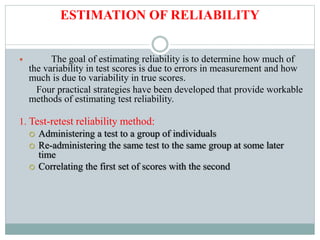
 The goal of estimating reliability is to determine how much of
the variability in test scores is due to errors in measurement and how
much is due to variability in true scores.
Four practical strategies have been developed that provide workable
methods of estimating test reliability.
1. Test-retest reliability method:
 Administering a test to a group of individuals
 Re-administering the same test to the same group at some later
time
 Correlating the first set of scores with the second
ESTIMATION OF RELIABILITY
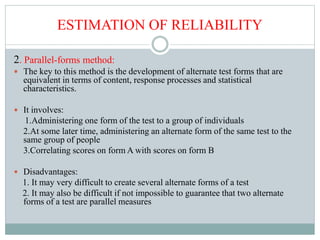
2. Parallel-forms method:
 The key to this method is the development of alternate test forms that are
equivalent in terms of content, response processes and statistical
characteristics.
 It involves:
1.Administering one form of the test to a group of individuals
2.At some later time, administering an alternate form of the same test to the
same group of people
3.Correlating scores on form A with scores on form B
 Disadvantages:
1. It may very difficult to create several alternate forms of a test
2. It may also be difficult if not impossible to guarantee that two alternate
forms of a test are parallel measures
ESTIMATION OF RELIABILITY
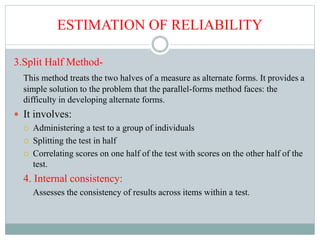
3.Split Half Method-
This method treats the two halves of a measure as alternate forms. It provides a
simple solution to the problem that the parallel-forms method faces: the
difficulty in developing alternate forms.
 It involves:
 Administering a test to a group of individuals
 Splitting the test in half
 Correlating scores on one half of the test with scores on the other half of the
test.
4. Internal consistency:
Assesses the consistency of results across items within a test.
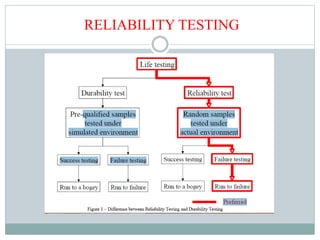
RELIABILITY TESTING
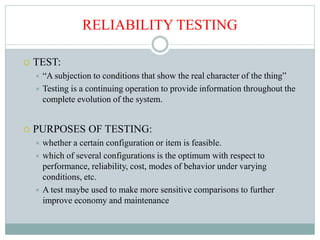
 TEST:
 “A subjection to conditions that show the real character of the thing”
 Testing is a continuing operation to provide information throughout the
complete evolution of the system.
 PURPOSES OF TESTING:
 whether a certain configuration or item is feasible.
 which of several configurations is the optimum with respect to
performance, reliability, cost, modes of behavior under varying
conditions, etc.
 A test maybe used to make more sensitive comparisons to further
improve economy and maintenance
RELIABILITY TESTING
Conclusion
 1.A parallel configuration can greatly increase system
reliability.
 2. Better reliability can be obtained by element or
component redundancy than by unit redundancy.
 3. Using reliability importance measures is one method of
identifying the relative importance of each component in a
system with respect to the overall reliability of the system
THANK
YOU

Presentation on reliability engineering

  • 1.
    PRESENTED BY-VIRAJ VPATIL 1622012 Presentation On Reliability Engineering
  • 2.
    Design of Reliability Design Principle- The basic objective of design is that the equipment/system meets the target failure rate under the given conditions. 1. Selection of components/parts 2. Functional Rating of all parts/Factor of Safety 3. Environmental conditions with their impact on equipment or product 4. Complexity of equipment/system 5. Redundancy/diversity 6. Reliability estimation
  • 3.
    Design Process  TheDesign Process- 1)Requirement- 2)Specifications- 3)Basic Design- 4)Detail Design- 5)Development-
  • 4.
    ESTIMATION OF RELIABILITY The goal of estimating reliability is to determine how much of the variability in test scores is due to errors in measurement and how much is due to variability in true scores. Four practical strategies have been developed that provide workable methods of estimating test reliability. 1. Test-retest reliability method:  Administering a test to a group of individuals  Re-administering the same test to the same group at some later time  Correlating the first set of scores with the second
  • 5.
    ESTIMATION OF RELIABILITY 2.Parallel-forms method:  The key to this method is the development of alternate test forms that are equivalent in terms of content, response processes and statistical characteristics.  It involves: 1.Administering one form of the test to a group of individuals 2.At some later time, administering an alternate form of the same test to the same group of people 3.Correlating scores on form A with scores on form B  Disadvantages: 1. It may very difficult to create several alternate forms of a test 2. It may also be difficult if not impossible to guarantee that two alternate forms of a test are parallel measures
  • 6.
    ESTIMATION OF RELIABILITY 3.SplitHalf Method- This method treats the two halves of a measure as alternate forms. It provides a simple solution to the problem that the parallel-forms method faces: the difficulty in developing alternate forms.  It involves:  Administering a test to a group of individuals  Splitting the test in half  Correlating scores on one half of the test with scores on the other half of the test. 4. Internal consistency: Assesses the consistency of results across items within a test.
  • 7.
    RELIABILITY TESTING  TEST: “A subjection to conditions that show the real character of the thing”  Testing is a continuing operation to provide information throughout the complete evolution of the system.  PURPOSES OF TESTING:  whether a certain configuration or item is feasible.  which of several configurations is the optimum with respect to performance, reliability, cost, modes of behavior under varying conditions, etc.  A test maybe used to make more sensitive comparisons to further improve economy and maintenance
  • 8.
  • 9.
    Conclusion  1.A parallelconfiguration can greatly increase system reliability.  2. Better reliability can be obtained by element or component redundancy than by unit redundancy.  3. Using reliability importance measures is one method of identifying the relative importance of each component in a system with respect to the overall reliability of the system
  • 10.