Quality Control and
Reliability Engineering
Mr.S.Gokul, Assistant Professor
Sri Eshwar College of Engineering
Department of Mechanical Engineering
Basic Concepts
Sri Eshwar College of Engineering
Department of Mechanical Engineering Page 2
Reliability: Reliability is associated with unexpected failures of products or services and
understanding why these failures occur is key to improving reliability.
Various source of Failure:
The product is not fit for purpose or more specifically the design is inherently incapable.
The item may be overstressed in some way.
Failures can be caused by wear-out
Failures might be caused by variation.
Wrong specifications may cause failures.
Misuse of the item may cause failure.
Items are designed for a specific operating environment and if they are then used outside
this environment then failure can occur
Reliability importance:
Safety
Competitiveness
Profit margins
Cost of repair and maintenance
Delays further up supply chain
Reputation
Good will
Measuring reliability:
Many customers will produce a statement of the reliability requirements that is included
in the specification of the product. This statement should include the following:
Sri Eshwar College of Engineering
Department of Mechanical Engineering Page 3
• The definition of failure related to the product’s function and should cover all failure
modes relevant to the function;
• A full description of the environments in which the product will be stored, transported,
operated and maintained;
• A statement of the reliability requirement
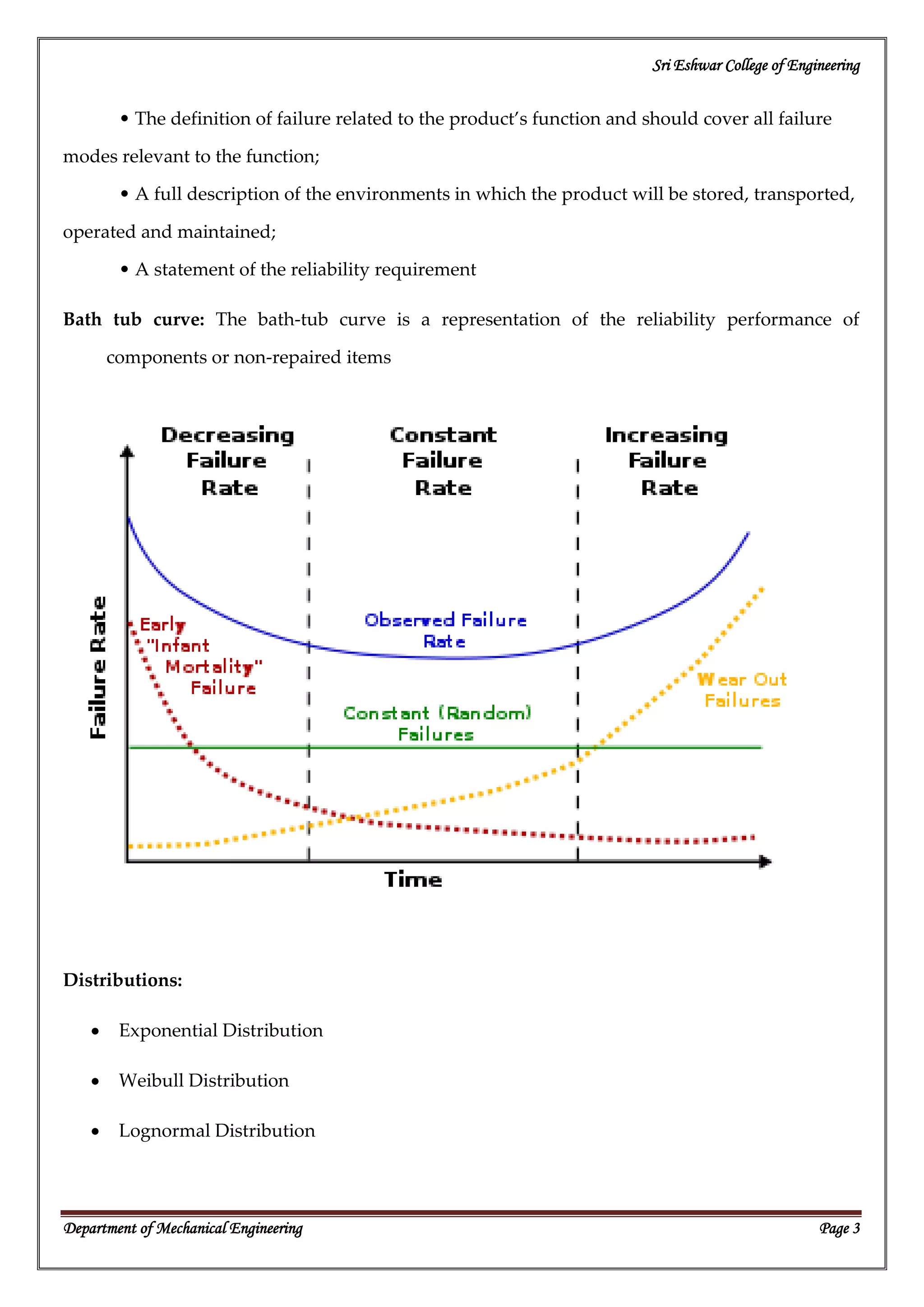
Bath tub curve: The bath-tub curve is a representation of the reliability performance of
components or non-repaired items
Distributions:
Exponential Distribution
Weibull Distribution
Lognormal Distribution

Quality Control Reliability Engineering - Concepts

  • 1.
    Quality Control and ReliabilityEngineering Mr.S.Gokul, Assistant Professor Sri Eshwar College of Engineering Department of Mechanical Engineering Basic Concepts
  • 2.
    Sri Eshwar Collegeof Engineering Department of Mechanical Engineering Page 2 Reliability: Reliability is associated with unexpected failures of products or services and understanding why these failures occur is key to improving reliability. Various source of Failure: The product is not fit for purpose or more specifically the design is inherently incapable. The item may be overstressed in some way. Failures can be caused by wear-out Failures might be caused by variation. Wrong specifications may cause failures. Misuse of the item may cause failure. Items are designed for a specific operating environment and if they are then used outside this environment then failure can occur Reliability importance: Safety Competitiveness Profit margins Cost of repair and maintenance Delays further up supply chain Reputation Good will Measuring reliability: Many customers will produce a statement of the reliability requirements that is included in the specification of the product. This statement should include the following:
  • 3.
    Sri Eshwar Collegeof Engineering Department of Mechanical Engineering Page 3 • The definition of failure related to the product’s function and should cover all failure modes relevant to the function; • A full description of the environments in which the product will be stored, transported, operated and maintained; • A statement of the reliability requirement Bath tub curve: The bath-tub curve is a representation of the reliability performance of components or non-repaired items Distributions: Exponential Distribution Weibull Distribution Lognormal Distribution