Factorial Experiments
Dr. Jitesh J. Thakkar
INDIAN INSTITUTE OF TECHNOLOGY (IIT)
KHARAGPUR
KHARAGPUR – 721 302
Contents
• General principles of factorial experiments
• The two-factor factorial with fixed effects
• The ANOVA for factorials
• Extensions to more than two factors
• Quantitative and qualitative factors – response
curves and surfaces
Source
D. C. Montgomery, Design and analysis of
experiments, 7th edition
Basic Definition
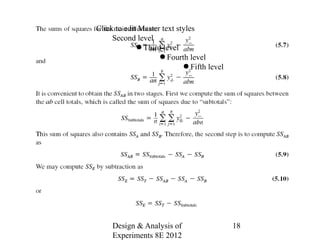
• Many experiments involve the study of the effects
of two or more factors.
• Factorial designs most efficient for this type of
experiment.
• By a factorial design, we mean that in each
complete trial or replicate of the experiment all
possible combinations of the levels of the factors are
investigated
• If there are a levels of factor A and b levels of factor
B, each replicate contains all ab treatment
combinations.
Design & Analysis of
Experiments 8E 2012
5
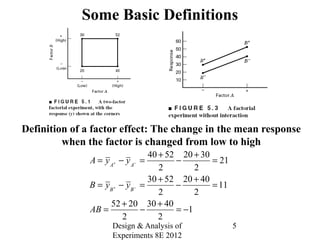
Some Basic Definitions
Definition of a factor effect: The change in the mean response
when the factor is changed from low to high
40 52 20 30
21
2 2
30 52 20 40
11
2 2
52 20 30 40
1
2 2
A A
B B
A y y
B y y
AB
+ −
+ −
+ +
= − = − =
+ +
= − = − =
+ +
= − = −
Design & Analysis of
Experiments 8E 2012
6
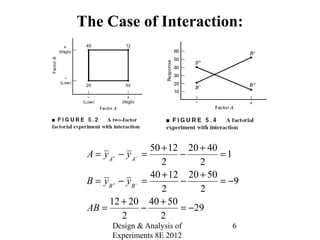
The Case of Interaction:
50 12 20 40
1
2 2
40 12 20 50
9
2 2
12 20 40 50
29
2 2
A A
B B
A y y
B y y
AB
+ −
+ −
+ +
= − = − =
+ +
= − = − = −
+ +
= − = −
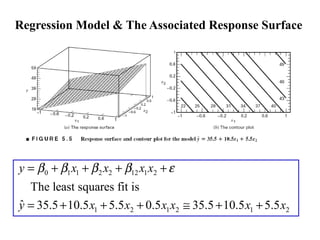
Regression Model & The Associated Response Surface
0 1 1 2 2 12 1 2
1 2 1 2 1 2
The least squares fit is
ˆ 35.5 10.5 5.5 0.5 35.5 10.5 5.5
y x x x x
y x x x x x x
β β β β ε= + + + +
= + + + ≅ + +
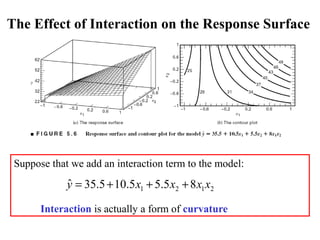
The Effect of Interaction on the Response Surface
Suppose that we add an interaction term to the model:
1 2 1 2
ˆ 35.5 10.5 5.5 8y x x x x= + + +
Interaction is actually a form of curvature
Select Insights
• When an interaction is large, the corresponding main effects have little
practical meaning.
• For the experiment in Figure 5.2, we would estimate the main effect of
A to be
• A=(50+12)/2 – (20+40)/2 = 1
• This is very small and we are tempted to conclude that there is no
effect due to A.
• When we examine the effects of A at different levels of factor B, we
see that this is not the case
• Factor A has an effect, but it depends on the level of factor B.
• Knowledge of AB interaction is more useful than knowledge of the
main effect.
• A significant interaction will often mask the significance of main
effects.
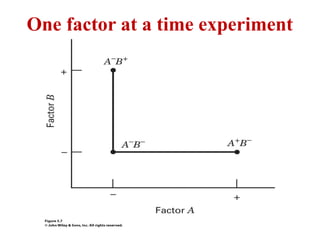
One factor at a time experiment
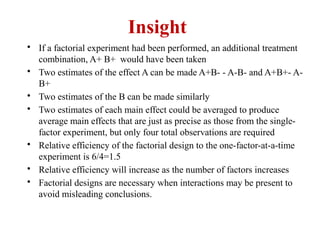
Insight
• If a factorial experiment had been performed, an additional treatment
combination, A+ B+ would have been taken
• Two estimates of the effect A can be made A+B- - A-B- and A+B+- A-
B+
• Two estimates of the B can be made similarly
• Two estimates of each main effect could be averaged to produce
average main effects that are just as precise as those from the single-
factor experiment, but only four total observations are required
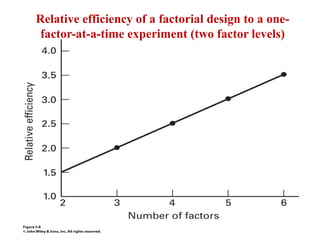
• Relative efficiency of the factorial design to the one-factor-at-a-time
experiment is 6/4=1.5
• Relative efficiency will increase as the number of factors increases
• Factorial designs are necessary when interactions may be present to
avoid misleading conclusions.
Relative efficiency of a factorial design to a one-
factor-at-a-time experiment (two factor levels)
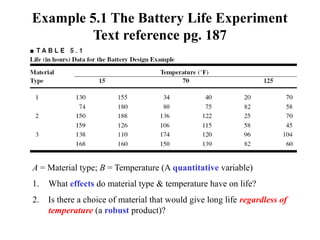
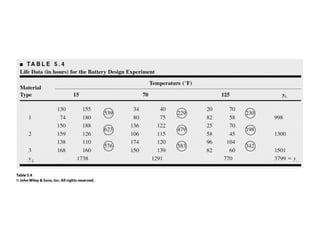
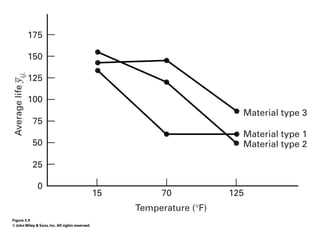
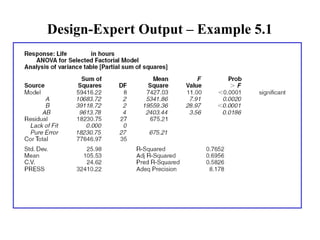
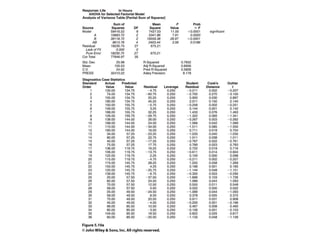
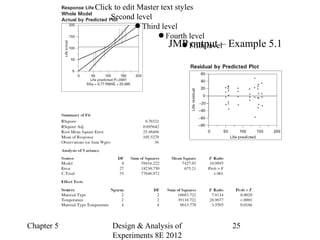
Example 5.1 The Battery Life Experiment
Text reference pg. 187
A = Material type; B = Temperature (A quantitative variable)
1. What effects do material type & temperature have on life?
2. Is there a choice of material that would give long life regardless of
temperature (a robust product)?
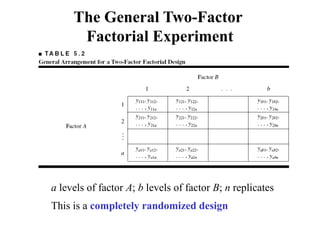
The General Two-Factor
Factorial Experiment
a levels of factor A; b levels of factor B; n replicates
This is a completely randomized design
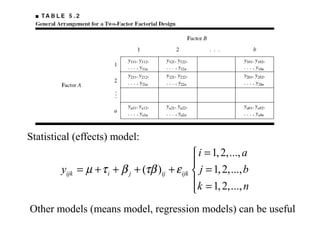
Statistical (effects) model:
1,2,...,
( ) 1,2,...,
1,2,...,
ijk i j ij ijk
i a
y j b
k n
µ τ β τβ ε
=

= + + + + =
 =
Other models (means model, regression models) can be useful
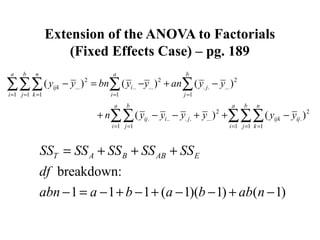
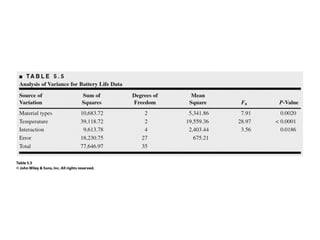
Extension of the ANOVA to Factorials
(Fixed Effects Case) – pg. 189
2 2 2
... .. ... . . ...
1 1 1 1 1
2 2
. .. . . ... .
1 1 1 1 1
( ) ( ) ( )
( ) ( )
a b n a b
ijk i j
i j k i j
a b a b n
ij i j ijk ij
i j i j k
y y bn y y an y y
n y y y y y y
= = = = =
= = = = =
− = − + −
+ − − + + −
∑∑∑ ∑ ∑
∑∑ ∑∑∑
breakdown:
1 1 1 ( 1)( 1) ( 1)
T A B AB ESS SS SS SS SS
df
abn a b a b ab n
= + + +
− = − + − + − − + −
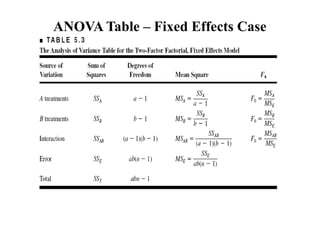
ANOVA Table – Fixed Effects Case
Design & Analysis of
Experiments 8E 2012
18
Click to edit Master text styles
Second level
● Third level
● Fourth level
● Fifth level
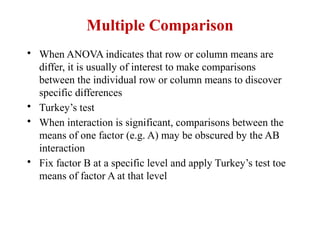
Multiple Comparison
• When ANOVA indicates that row or column means are
differ, it is usually of interest to make comparisons
between the individual row or column means to discover
specific differences
• Turkey’s test
• When interaction is significant, comparisons between the
means of one factor (e.g. A) may be obscured by the AB
interaction
• Fix factor B at a specific level and apply Turkey’s test toe
means of factor A at that level
Design-Expert Output – Example 5.1
Chapter 5 Design & Analysis of
Experiments 8E 2012
25
Click to edit Master text styles
Second level
● Third level
● Fourth level
● Fifth levelJMP output – Example 5.1
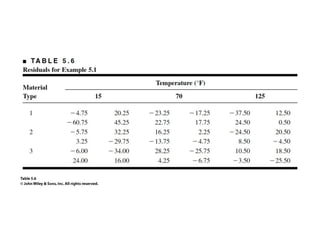
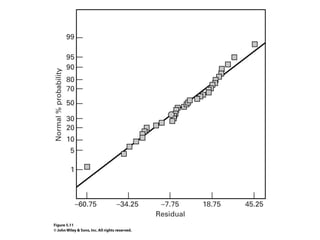
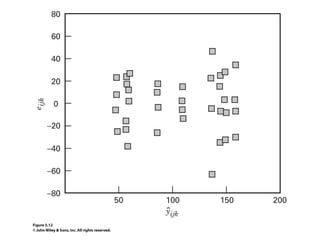
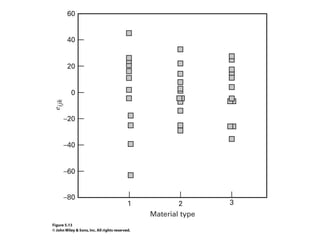
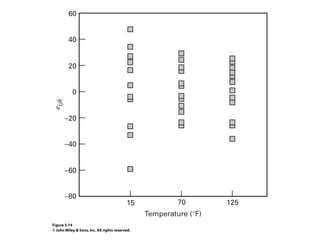
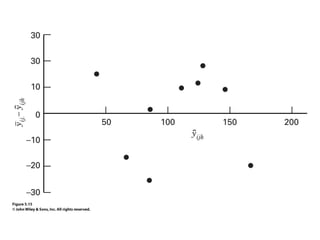
RESIDUALANALYSIS
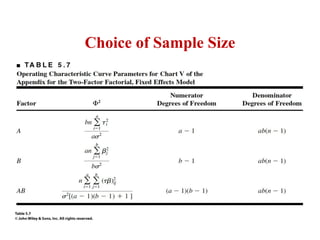
Choice of Sample Size
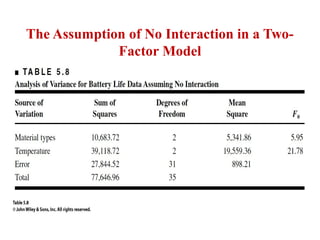
The Assumption of No Interaction in a Two-
Factor Model
One Observation Per Cell
The General Factorial Design
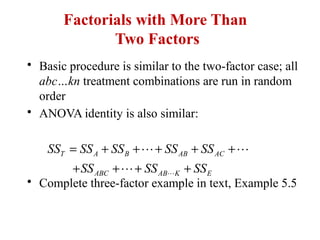
Factorials with More Than
Two Factors
• Basic procedure is similar to the two-factor case; all
abc…kn treatment combinations are run in random
order
• ANOVA identity is also similar:
• Complete three-factor example in text, Example 5.5
T A B AB AC
ABC AB K E
SS SS SS SS SS
SS SS SS
= + + + + +
+ + + +L
L L
L
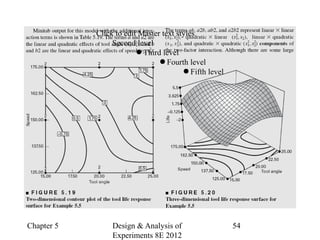
Fitting Response Curves and Surfaces
• The basic ANOVA procedure treats every factor as if it
were qualitative
• Sometimes an experiment will involve both quantitative
and qualitative factors, such as in Example 5.1
• This can be accounted for in the analysis to produce
regression models for the quantitative factors at each level
(or combination of levels) of the qualitative factors
• These response curves and/or response surfaces are often
a considerable aid in practical interpretation of the results
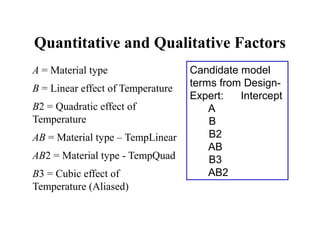
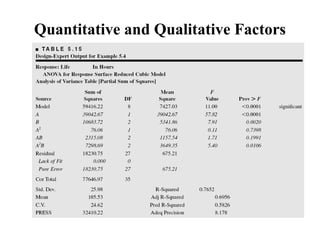
Quantitative and Qualitative Factors
Candidate model
terms from Design-
Expert: Intercept
A
B
B2
AB
B3
AB2
A = Material type
B = Linear effect of Temperature
B2 = Quadratic effect of
Temperature
AB = Material type – TempLinear
AB2 = Material type - TempQuad
B3 = Cubic effect of
Temperature (Aliased)
Quantitative and Qualitative Factors
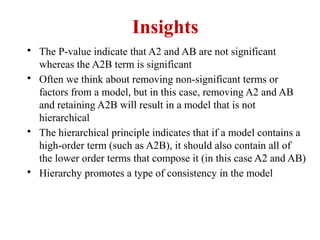
Insights
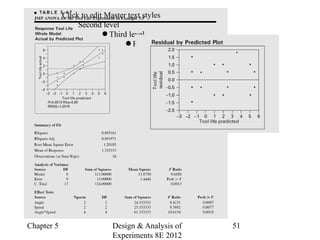
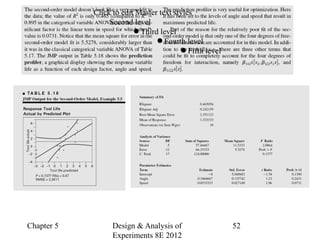
• The P-value indicate that A2 and AB are not significant
whereas the A2B term is significant
• Often we think about removing non-significant terms or
factors from a model, but in this case, removing A2 and AB
and retaining A2B will result in a model that is not
hierarchical
• The hierarchical principle indicates that if a model contains a
high-order term (such as A2B), it should also contain all of
the lower order terms that compose it (in this case A2 and AB)
• Hierarchy promotes a type of consistency in the model
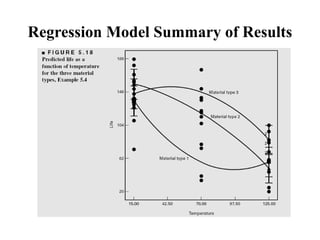
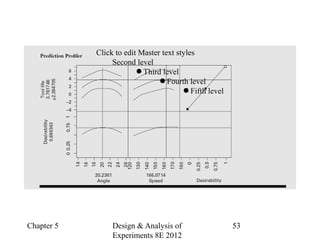
Regression Model Summary of Results
Chapter 5 Design & Analysis of
Experiments 8E 2012
50
Click to edit Master text styles
Second level
● Third level
● Fourth level
● Fifth level
Chapter 5 Design & Analysis of
Experiments 8E 2012
51
Click to edit Master text styles
Second level
● Third level
● Fourth level
● Fifth level
Chapter 5 Design & Analysis of
Experiments 8E 2012
52
Click to edit Master text styles
Second level
● Third level
● Fourth level
● Fifth level
Chapter 5 Design & Analysis of
Experiments 8E 2012
53
Click to edit Master text styles
Second level
● Third level
● Fourth level
● Fifth level
Chapter 5 Design & Analysis of
Experiments 8E 2012
54
Click to edit Master text styles
Second level
● Third level
● Fourth level
● Fifth level
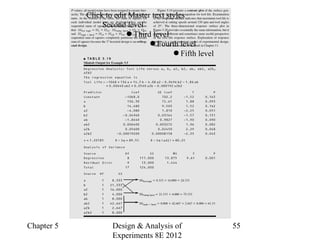
Chapter 5 Design & Analysis of
Experiments 8E 2012
55
Click to edit Master text styles
Second level
● Third level
● Fourth level
● Fifth level
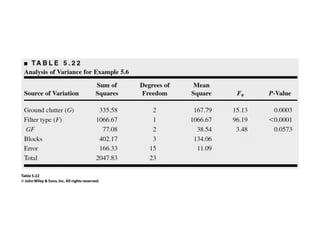
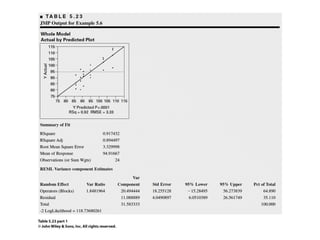
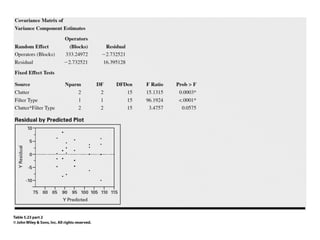
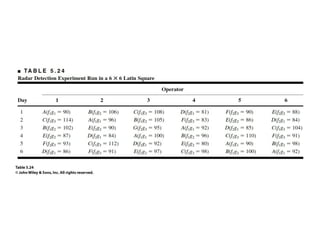
Blocking in a Factorial Design
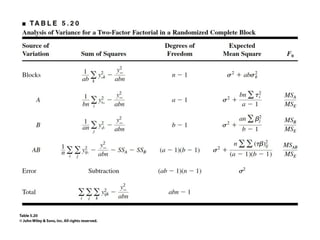
5 factorial design
5 factorial design
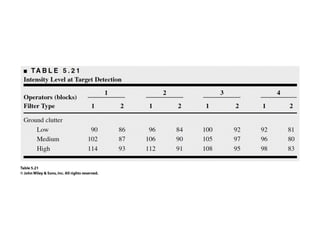
5 factorial design
5 factorial design
5 factorial design
5 factorial design
5 factorial design

5 factorial design

  • 1.
    Factorial Experiments Dr. JiteshJ. Thakkar INDIAN INSTITUTE OF TECHNOLOGY (IIT) KHARAGPUR KHARAGPUR – 721 302
  • 2.
    Contents • General principlesof factorial experiments • The two-factor factorial with fixed effects • The ANOVA for factorials • Extensions to more than two factors • Quantitative and qualitative factors – response curves and surfaces
  • 3.
    Source D. C. Montgomery,Design and analysis of experiments, 7th edition
  • 4.
    Basic Definition • Manyexperiments involve the study of the effects of two or more factors. • Factorial designs most efficient for this type of experiment. • By a factorial design, we mean that in each complete trial or replicate of the experiment all possible combinations of the levels of the factors are investigated • If there are a levels of factor A and b levels of factor B, each replicate contains all ab treatment combinations.
  • 5.
    Design & Analysisof Experiments 8E 2012 5 Some Basic Definitions Definition of a factor effect: The change in the mean response when the factor is changed from low to high 40 52 20 30 21 2 2 30 52 20 40 11 2 2 52 20 30 40 1 2 2 A A B B A y y B y y AB + − + − + + = − = − = + + = − = − = + + = − = −
  • 6.
    Design & Analysisof Experiments 8E 2012 6 The Case of Interaction: 50 12 20 40 1 2 2 40 12 20 50 9 2 2 12 20 40 50 29 2 2 A A B B A y y B y y AB + − + − + + = − = − = + + = − = − = − + + = − = −
  • 7.
    Regression Model &The Associated Response Surface 0 1 1 2 2 12 1 2 1 2 1 2 1 2 The least squares fit is ˆ 35.5 10.5 5.5 0.5 35.5 10.5 5.5 y x x x x y x x x x x x β β β β ε= + + + + = + + + ≅ + +
  • 8.
    The Effect ofInteraction on the Response Surface Suppose that we add an interaction term to the model: 1 2 1 2 ˆ 35.5 10.5 5.5 8y x x x x= + + + Interaction is actually a form of curvature
  • 9.
    Select Insights • Whenan interaction is large, the corresponding main effects have little practical meaning. • For the experiment in Figure 5.2, we would estimate the main effect of A to be • A=(50+12)/2 – (20+40)/2 = 1 • This is very small and we are tempted to conclude that there is no effect due to A. • When we examine the effects of A at different levels of factor B, we see that this is not the case • Factor A has an effect, but it depends on the level of factor B. • Knowledge of AB interaction is more useful than knowledge of the main effect. • A significant interaction will often mask the significance of main effects.
  • 10.
    One factor ata time experiment
  • 11.
    Insight • If afactorial experiment had been performed, an additional treatment combination, A+ B+ would have been taken • Two estimates of the effect A can be made A+B- - A-B- and A+B+- A- B+ • Two estimates of the B can be made similarly • Two estimates of each main effect could be averaged to produce average main effects that are just as precise as those from the single- factor experiment, but only four total observations are required • Relative efficiency of the factorial design to the one-factor-at-a-time experiment is 6/4=1.5 • Relative efficiency will increase as the number of factors increases • Factorial designs are necessary when interactions may be present to avoid misleading conclusions.
  • 12.
    Relative efficiency ofa factorial design to a one- factor-at-a-time experiment (two factor levels)
  • 13.
    Example 5.1 TheBattery Life Experiment Text reference pg. 187 A = Material type; B = Temperature (A quantitative variable) 1. What effects do material type & temperature have on life? 2. Is there a choice of material that would give long life regardless of temperature (a robust product)?
  • 14.
    The General Two-Factor FactorialExperiment a levels of factor A; b levels of factor B; n replicates This is a completely randomized design
  • 15.
    Statistical (effects) model: 1,2,..., () 1,2,..., 1,2,..., ijk i j ij ijk i a y j b k n µ τ β τβ ε =  = + + + + =  = Other models (means model, regression models) can be useful
  • 16.
    Extension of theANOVA to Factorials (Fixed Effects Case) – pg. 189 2 2 2 ... .. ... . . ... 1 1 1 1 1 2 2 . .. . . ... . 1 1 1 1 1 ( ) ( ) ( ) ( ) ( ) a b n a b ijk i j i j k i j a b a b n ij i j ijk ij i j i j k y y bn y y an y y n y y y y y y = = = = = = = = = = − = − + − + − − + + − ∑∑∑ ∑ ∑ ∑∑ ∑∑∑ breakdown: 1 1 1 ( 1)( 1) ( 1) T A B AB ESS SS SS SS SS df abn a b a b ab n = + + + − = − + − + − − + −
  • 17.
    ANOVA Table –Fixed Effects Case
  • 18.
    Design & Analysisof Experiments 8E 2012 18 Click to edit Master text styles Second level ● Third level ● Fourth level ● Fifth level
  • 22.
    Multiple Comparison • WhenANOVA indicates that row or column means are differ, it is usually of interest to make comparisons between the individual row or column means to discover specific differences • Turkey’s test • When interaction is significant, comparisons between the means of one factor (e.g. A) may be obscured by the AB interaction • Fix factor B at a specific level and apply Turkey’s test toe means of factor A at that level
  • 23.
  • 25.
    Chapter 5 Design& Analysis of Experiments 8E 2012 25 Click to edit Master text styles Second level ● Third level ● Fourth level ● Fifth levelJMP output – Example 5.1
  • 27.
  • 32.
  • 33.
    The Assumption ofNo Interaction in a Two- Factor Model
  • 35.
  • 39.
  • 40.
    Factorials with MoreThan Two Factors • Basic procedure is similar to the two-factor case; all abc…kn treatment combinations are run in random order • ANOVA identity is also similar: • Complete three-factor example in text, Example 5.5 T A B AB AC ABC AB K E SS SS SS SS SS SS SS SS = + + + + + + + + +L L L L
  • 45.
    Fitting Response Curvesand Surfaces • The basic ANOVA procedure treats every factor as if it were qualitative • Sometimes an experiment will involve both quantitative and qualitative factors, such as in Example 5.1 • This can be accounted for in the analysis to produce regression models for the quantitative factors at each level (or combination of levels) of the qualitative factors • These response curves and/or response surfaces are often a considerable aid in practical interpretation of the results

  • 46.
    Quantitative and QualitativeFactors Candidate model terms from Design- Expert: Intercept A B B2 AB B3 AB2 A = Material type B = Linear effect of Temperature B2 = Quadratic effect of Temperature AB = Material type – TempLinear AB2 = Material type - TempQuad B3 = Cubic effect of Temperature (Aliased)
  • 47.
  • 48.
    Insights • The P-valueindicate that A2 and AB are not significant whereas the A2B term is significant • Often we think about removing non-significant terms or factors from a model, but in this case, removing A2 and AB and retaining A2B will result in a model that is not hierarchical • The hierarchical principle indicates that if a model contains a high-order term (such as A2B), it should also contain all of the lower order terms that compose it (in this case A2 and AB) • Hierarchy promotes a type of consistency in the model
  • 49.
  • 50.
    Chapter 5 Design& Analysis of Experiments 8E 2012 50 Click to edit Master text styles Second level ● Third level ● Fourth level ● Fifth level
  • 51.
    Chapter 5 Design& Analysis of Experiments 8E 2012 51 Click to edit Master text styles Second level ● Third level ● Fourth level ● Fifth level
  • 52.
    Chapter 5 Design& Analysis of Experiments 8E 2012 52 Click to edit Master text styles Second level ● Third level ● Fourth level ● Fifth level
  • 53.
    Chapter 5 Design& Analysis of Experiments 8E 2012 53 Click to edit Master text styles Second level ● Third level ● Fourth level ● Fifth level
  • 54.
    Chapter 5 Design& Analysis of Experiments 8E 2012 54 Click to edit Master text styles Second level ● Third level ● Fourth level ● Fifth level
  • 55.
    Chapter 5 Design& Analysis of Experiments 8E 2012 55 Click to edit Master text styles Second level ● Third level ● Fourth level ● Fifth level
  • 56.
    Blocking in aFactorial Design

Editor's Notes

  • #11 <number>
  • #13 <number>
  • #20 <number>
  • #21 <number>
  • #22 <number>
  • #25 <number>
  • #27 <number>
  • #29 <number>
  • #30 <number>
  • #31 <number>
  • #32 <number>
  • #34 <number>
  • #35 <number>
  • #37 <number>
  • #38 <number>
  • #39 <number>
  • #42 <number>
  • #43 <number>
  • #44 <number>
  • #45 <number>
  • #58 <number>
  • #59 <number>
  • #60 <number>
  • #61 <number>
  • #62 <number>
  • #63 <number>
  • #64 <number>