Reliability Centred Maintenance – Applications and Opportunities Andy Watson Director
Outline What is it How is it applied What is the process for producing them Opportunities What other benefits Next steps
What is it? Reliability Centred Maintenance (RCM) – a structured approach to planning and executing maintenance Developed during the air transport revolution Aimed at maximising reliability, availability and minimisation of cost and resource
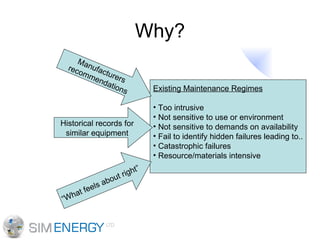
Why? Existing Maintenance Regimes Too intrusive Not sensitive to use or environment Not sensitive to demands on availability Fail to identify hidden failures leading to.. Catastrophic failures Resource/materials intensive Manufacturers recommendations “What feels about right” Historical records for similar equipment
How is it applied? Identification of equipment/asset: Function How it fails to meet that function What causes that failure What the longer term effects of that failure are Is the failure: Hidden Health and safety critical Environmentally critical Operationally critical Non-operationally critical
How is it applied? Prioritises maintenance tasks into: On condition (Condition Based Monitoring) Scheduled restoration Scheduled discard Scheduled failure finding (run to fail) Uses statistical data to optimise maintenance tasks
What is the process for producing them Facilitated session between: An RCM Facilitator Maintenance personnel Operators Other knowledge holders Facilitator can produce the results and reports Reports can be turned into maintenance regimes and recommendations
Opportunities Airbridge RCM study (Heathrow 1997-1999) Study on two types of airbridge: Thyssen and Jetway (T1 and T4) Reduction of 25% in maintenance tasks Reduction of 15% in faults Identification of several hidden failures which would have lead to catastrophe Improved level of tasks for technicians
Other Benefits Fully auditable Nothing is done without a solid reason Technicians spend more time doing higher-tech tasks Reduces intrusiveness and thereby increases flexibility of maintenance teams Quantifiable results and benefits
Next Steps to Starting a Study Site/asset survey to estimate time and costs Devise project plan Set up study team Carry out study Produce reports and schedules Monitor maintenance and faults
Thank you for listening

Reliability Centred Maintenance Presentation

  • 1.
    Reliability Centred Maintenance– Applications and Opportunities Andy Watson Director
  • 2.
    Outline What isit How is it applied What is the process for producing them Opportunities What other benefits Next steps
  • 3.
    What is it?Reliability Centred Maintenance (RCM) – a structured approach to planning and executing maintenance Developed during the air transport revolution Aimed at maximising reliability, availability and minimisation of cost and resource
  • 4.
    Why? Existing MaintenanceRegimes Too intrusive Not sensitive to use or environment Not sensitive to demands on availability Fail to identify hidden failures leading to.. Catastrophic failures Resource/materials intensive Manufacturers recommendations “What feels about right” Historical records for similar equipment
  • 5.
    How is itapplied? Identification of equipment/asset: Function How it fails to meet that function What causes that failure What the longer term effects of that failure are Is the failure: Hidden Health and safety critical Environmentally critical Operationally critical Non-operationally critical
  • 6.
    How is itapplied? Prioritises maintenance tasks into: On condition (Condition Based Monitoring) Scheduled restoration Scheduled discard Scheduled failure finding (run to fail) Uses statistical data to optimise maintenance tasks
  • 7.
    What is theprocess for producing them Facilitated session between: An RCM Facilitator Maintenance personnel Operators Other knowledge holders Facilitator can produce the results and reports Reports can be turned into maintenance regimes and recommendations
  • 8.
    Opportunities Airbridge RCMstudy (Heathrow 1997-1999) Study on two types of airbridge: Thyssen and Jetway (T1 and T4) Reduction of 25% in maintenance tasks Reduction of 15% in faults Identification of several hidden failures which would have lead to catastrophe Improved level of tasks for technicians
  • 9.
    Other Benefits Fullyauditable Nothing is done without a solid reason Technicians spend more time doing higher-tech tasks Reduces intrusiveness and thereby increases flexibility of maintenance teams Quantifiable results and benefits
  • 10.
    Next Steps toStarting a Study Site/asset survey to estimate time and costs Devise project plan Set up study team Carry out study Produce reports and schedules Monitor maintenance and faults
  • 11.
    Thank you forlistening