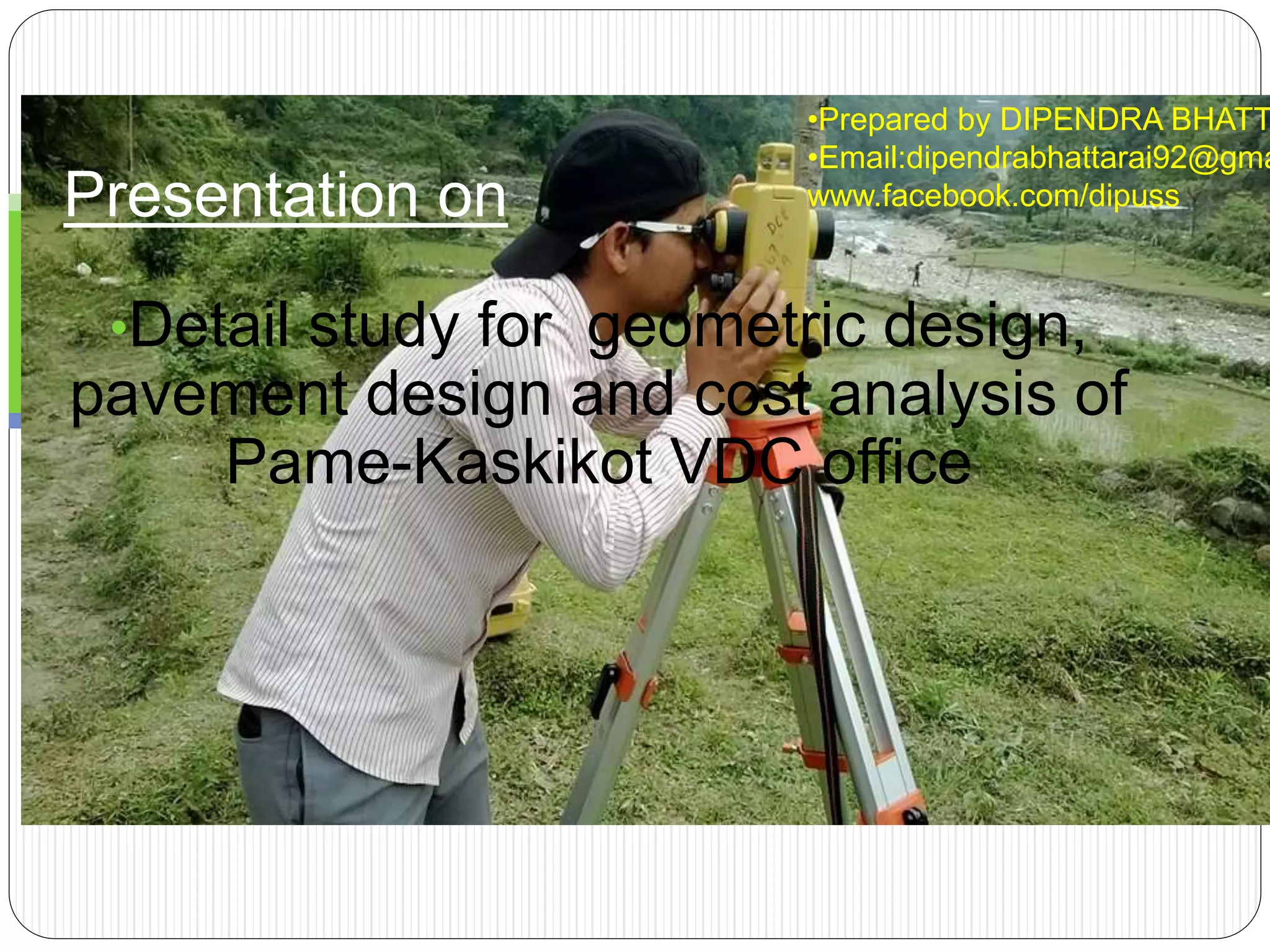
Presentation on
•Detail study for geometric design,
pavement design and cost analysis of
Pame-Kaskikot VDC office
•Prepared by DIPENDRA BHATT
•Email:dipendrabhattarai92@gma
www.facebook.com/dipuss
 Project conducted on Kaskikot VDC,Kaski district
 Joining Pame-Gairabari-Ratamata-Dhokakomukh to
VDC office
 Includes detail survey, geometric design, pavement
design and cost analysis
 About 7 km of which only 2 km is surveyed
Executive Summary
•Walkover surveyof the site
•Detail surveyof site
•Abstract date from total station
INTRODUCTION
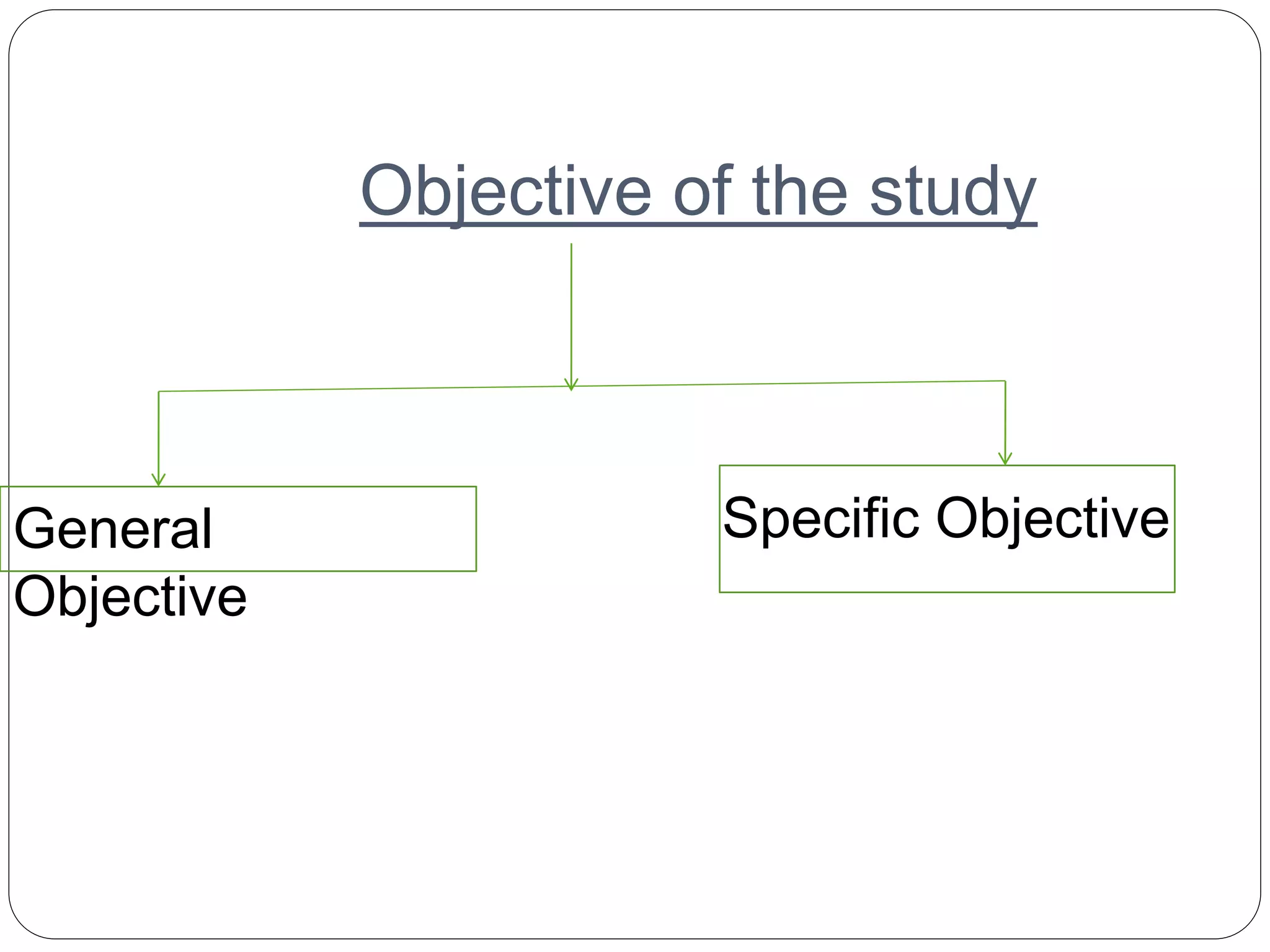
Objective of the study
General
Objective
Specific Objective
 To make detail study for geometric
design, pavement design and cost
analysis of the Pame-VDC office rural
road in Kaskikot.
General Objective
 To design geometric elements of the
road (elements of the horizontal
alignment, elements of vertical
alignment, drainage system, cross-
drainage system, retaining structures)
 To design flexible pavement of the road
 To perform cost analysis for checking
economic feasibility of the road
Specific Objective
 To be familiar with Nepal Road Standards-
2055(revised on 2069)
 To be familiar with the terms and technologies
related with road engineering
 To be able to use the theoretical knowledge of
civil engineering into field practice
•Study area: 2.5 km stretch of road starting
from Pame to Kaskikot VDC office
Use of instrument like Total
station,measuring tape,
Prisms etc
METHODOLOGY
•The stretch of about 2000 meter has been
surveyed by using total station and related
coordinates has been taken.
•Tantitive rough idea of about soil has been done
and soil was found to be humus and muddy.
SURVEYING
•Approach is made about centre line and
pegs are driven.
•By referencing that centre line right and
left side data has been taken.
FIXING THE CENTRE LINE OF
ROAD
•General study and site sketch are made for requirement of
such structure.
•Small gravity walls are found to be require in many places
along the road
•Also few number of large retaining walls are required in
exceptional case while attempt had been made to replace
them by smaller once.
STUDY ABOUT GRAVITY AND
OTHER RETAING STRUCURES
NEED
•Generally in few places spring water has
been found
•Need of cross drainage structure like
culvert ,bridge,drain is nill and no problem
for it.
STUDY ABOUT SOURCE OF
SURFACE AND SUBSURFACE
WATER AND PREVENTION
•Based on the data abstract from total station plan has been
prepared
•Longitude,latitude and altitude of centre line has been
copied as plan of road
•Data are taken in every 20 m interval and even closer in
curve portion
PLAN PRAPARATION
•BY TAKING DATA FROM TOTAL STATION A
ALTITUDE OF CENTRE LINE ARE NOTED AND
PROFILE HAS BEEN PLOTTED.
•Data has been taken in every 20 m interval as far as
practicable however in curves more close the points
were taken
PROFILE PREPARATION
•On the both sides of centre line data has been taken by total
station in addition with centre line.
•Data are generalyl acquired in 2m distance in right and left
as far as possible
•These data with coordinates has been plotted in excell
format obtaining the cross section of road
CROSS SECTION
•Based upon walk over survey tantitive
alignment was made and along which
data are collected
•After data obtained almost rough idea
has been prepared as route
ROUGH ALIGNMENT
 Since the designing of drainage structure and retaining
structures is a vague topic in itself so, due to the limitation
of study time we will be using the standard drawings for
those structures.
 Due to the limited time constraint, only 2.5 km of the total
stretch of the road linking Pame to Kaskikot VDC office
will be used.
 We being the students and not the professionals, it will
impose some manpower constraints too.
Limitation of the study
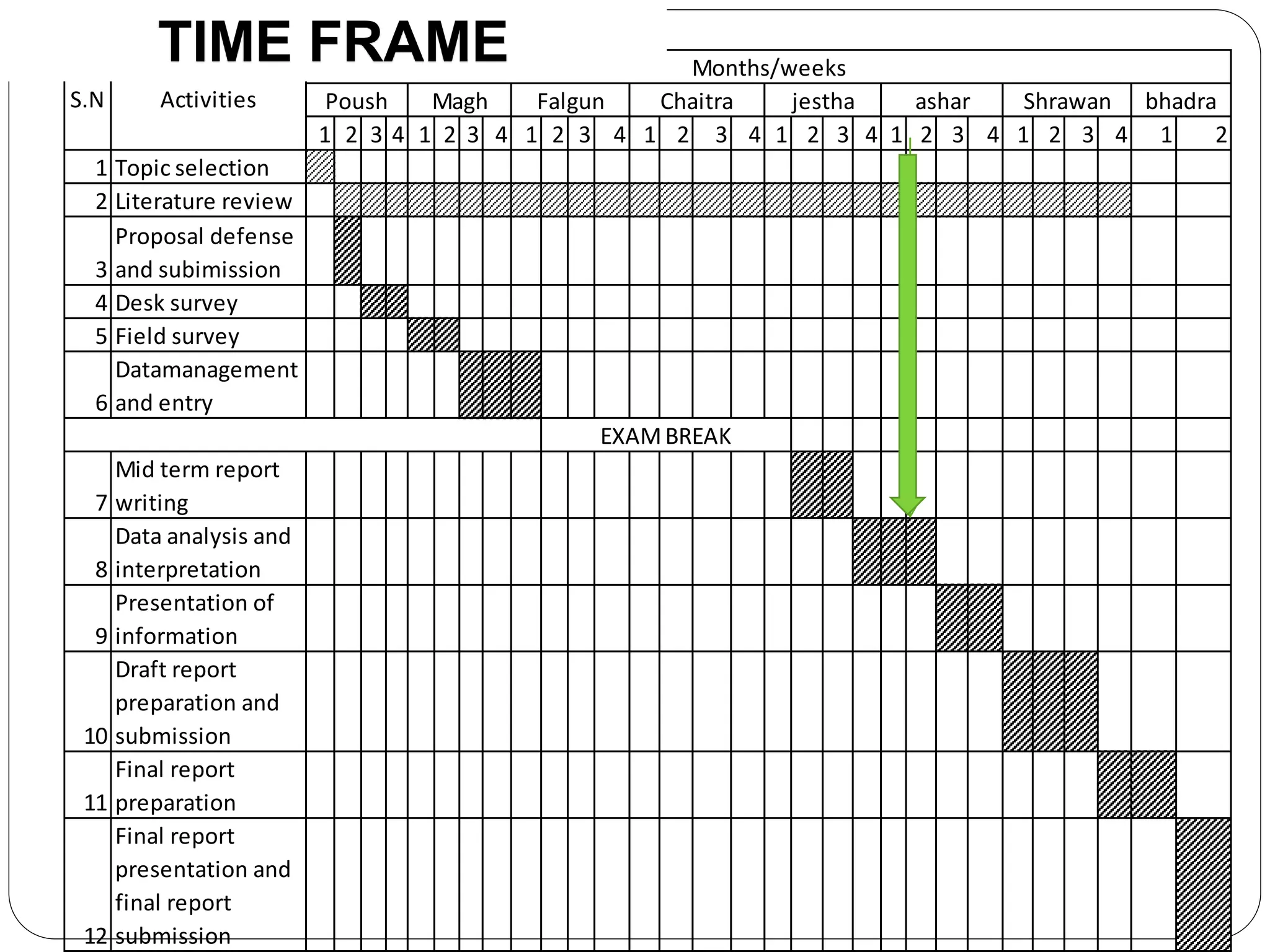
1 2 3 4 1 2 3 4 1 2 3 4 1 2 3 4 1 2 3 4 1 2 3 4 1 2 3 4 1 2
1 Topic selection
2 Literature review
3
Proposal defense
and subimission
4 Desk survey
5 Field survey
6
Datamanagement
and entry
7
Mid term report
writing
8
Data analysis and
interpretation
9
Presentation of
information
10
Draft report
preparation and
submission
11
Final report
preparation
12
Final report
presentation and
final report
submission
EXAMBREAK
ActivitiesS.N Magh Falgun Chaitra
Months/weeks
ashar Shrawan bhadraPoush jestha
TIME FRAME
.
.

presentation on Proposal for road survey & construction

  • 1.
    Presentation on •Detail studyfor geometric design, pavement design and cost analysis of Pame-Kaskikot VDC office •Prepared by DIPENDRA BHATT •Email:dipendrabhattarai92@gma www.facebook.com/dipuss
  • 2.
     Project conductedon Kaskikot VDC,Kaski district  Joining Pame-Gairabari-Ratamata-Dhokakomukh to VDC office  Includes detail survey, geometric design, pavement design and cost analysis  About 7 km of which only 2 km is surveyed Executive Summary
  • 3.
    •Walkover surveyof thesite •Detail surveyof site •Abstract date from total station INTRODUCTION
  • 4.
    Objective of thestudy General Objective Specific Objective
  • 5.
     To makedetail study for geometric design, pavement design and cost analysis of the Pame-VDC office rural road in Kaskikot. General Objective
  • 6.
     To designgeometric elements of the road (elements of the horizontal alignment, elements of vertical alignment, drainage system, cross- drainage system, retaining structures)  To design flexible pavement of the road  To perform cost analysis for checking economic feasibility of the road Specific Objective
  • 7.
     To befamiliar with Nepal Road Standards- 2055(revised on 2069)  To be familiar with the terms and technologies related with road engineering  To be able to use the theoretical knowledge of civil engineering into field practice
  • 8.
    •Study area: 2.5km stretch of road starting from Pame to Kaskikot VDC office Use of instrument like Total station,measuring tape, Prisms etc METHODOLOGY
  • 9.
    •The stretch ofabout 2000 meter has been surveyed by using total station and related coordinates has been taken. •Tantitive rough idea of about soil has been done and soil was found to be humus and muddy. SURVEYING
  • 10.
    •Approach is madeabout centre line and pegs are driven. •By referencing that centre line right and left side data has been taken. FIXING THE CENTRE LINE OF ROAD
  • 11.
    •General study andsite sketch are made for requirement of such structure. •Small gravity walls are found to be require in many places along the road •Also few number of large retaining walls are required in exceptional case while attempt had been made to replace them by smaller once. STUDY ABOUT GRAVITY AND OTHER RETAING STRUCURES NEED
  • 12.
    •Generally in fewplaces spring water has been found •Need of cross drainage structure like culvert ,bridge,drain is nill and no problem for it. STUDY ABOUT SOURCE OF SURFACE AND SUBSURFACE WATER AND PREVENTION
  • 13.
    •Based on thedata abstract from total station plan has been prepared •Longitude,latitude and altitude of centre line has been copied as plan of road •Data are taken in every 20 m interval and even closer in curve portion PLAN PRAPARATION
  • 14.
    •BY TAKING DATAFROM TOTAL STATION A ALTITUDE OF CENTRE LINE ARE NOTED AND PROFILE HAS BEEN PLOTTED. •Data has been taken in every 20 m interval as far as practicable however in curves more close the points were taken PROFILE PREPARATION
  • 15.
    •On the bothsides of centre line data has been taken by total station in addition with centre line. •Data are generalyl acquired in 2m distance in right and left as far as possible •These data with coordinates has been plotted in excell format obtaining the cross section of road CROSS SECTION
  • 16.
    •Based upon walkover survey tantitive alignment was made and along which data are collected •After data obtained almost rough idea has been prepared as route ROUGH ALIGNMENT
  • 17.
     Since thedesigning of drainage structure and retaining structures is a vague topic in itself so, due to the limitation of study time we will be using the standard drawings for those structures.  Due to the limited time constraint, only 2.5 km of the total stretch of the road linking Pame to Kaskikot VDC office will be used.  We being the students and not the professionals, it will impose some manpower constraints too. Limitation of the study
  • 18.
    1 2 34 1 2 3 4 1 2 3 4 1 2 3 4 1 2 3 4 1 2 3 4 1 2 3 4 1 2 1 Topic selection 2 Literature review 3 Proposal defense and subimission 4 Desk survey 5 Field survey 6 Datamanagement and entry 7 Mid term report writing 8 Data analysis and interpretation 9 Presentation of information 10 Draft report preparation and submission 11 Final report preparation 12 Final report presentation and final report submission EXAMBREAK ActivitiesS.N Magh Falgun Chaitra Months/weeks ashar Shrawan bhadraPoush jestha TIME FRAME
  • 19.