CONING OF WHEELS
By :
Swapnil Mangaonkar
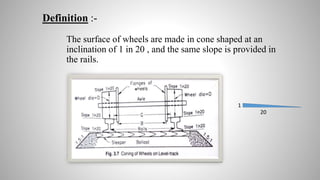
Definition :-
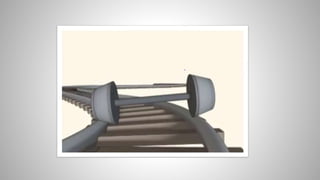
The surface of wheels are made in cone shaped at an
inclination of 1 in 20 , and the same slope is provided in
the rails.
20
1
Concept :-
If the tread of the wheels are flat then there will be movement
between wheel & rails due to which vehicle not be maintained
in central position due to which there will be unequal
distribution of load. To avoid that coning of wheels should be
done.
How it works :-
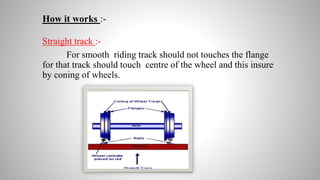
Straight track :-
For smooth riding track should not touches the flange
for that track should touch centre of the wheel and this insure
by coning of wheels.
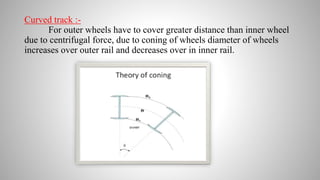
Curved track :-
For outer wheels have to cover greater distance than inner wheel
due to centrifugal force, due to coning of wheels diameter of wheels
increases over outer rail and decreases over in inner rail.
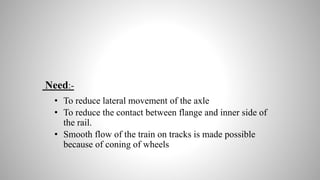
Need:-
• To reduce lateral movement of the axle
• To reduce the contact between flange and inner side of
the rail.
• Smooth flow of the train on tracks is made possible
because of coning of wheels
Disadvantages :-
 Due to centrifugal force , the horizontal components tends
to turn out and rail has widening tendency
 If no base plate is used under void sleeper under the age of
the rails are damaged.
 Pressure on outer rail is more than inner rail this result in
wear of outer rail
 This disadvantages can be prevent by tilting of the rails.

Coning of wheels

  • 1.
    CONING OF WHEELS By: Swapnil Mangaonkar
  • 2.
    Definition :- The surfaceof wheels are made in cone shaped at an inclination of 1 in 20 , and the same slope is provided in the rails. 20 1
  • 3.
    Concept :- If thetread of the wheels are flat then there will be movement between wheel & rails due to which vehicle not be maintained in central position due to which there will be unequal distribution of load. To avoid that coning of wheels should be done.
  • 4.
    How it works:- Straight track :- For smooth riding track should not touches the flange for that track should touch centre of the wheel and this insure by coning of wheels.
  • 5.
    Curved track :- Forouter wheels have to cover greater distance than inner wheel due to centrifugal force, due to coning of wheels diameter of wheels increases over outer rail and decreases over in inner rail.
  • 7.
    Need:- • To reducelateral movement of the axle • To reduce the contact between flange and inner side of the rail. • Smooth flow of the train on tracks is made possible because of coning of wheels
  • 8.
    Disadvantages :-  Dueto centrifugal force , the horizontal components tends to turn out and rail has widening tendency  If no base plate is used under void sleeper under the age of the rails are damaged.  Pressure on outer rail is more than inner rail this result in wear of outer rail  This disadvantages can be prevent by tilting of the rails.