
PRESENTATION
ON
BIOINFORMATICS
DNA SEQUENCING PROCESS
GROUP MEMBER
SAJIBUL HASSAN
NAHIAN AHMED
TARIQUL ISLAM
MONSUR AHMED SHAFIQ
OMAR FARUQ
NAHIAN AHMED
ID- 151-15-5137
DEOXYRIBONUCLEIC ACID
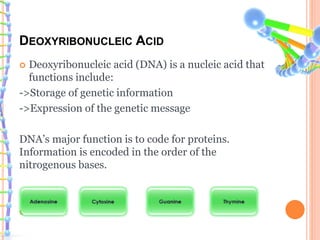
 Deoxyribonucleic acid (DNA) is a nucleic acid that
functions include:
->Storage of genetic information
->Expression of the genetic message
DNA’s major function is to code for proteins.
Information is encoded in the order of the
nitrogenous bases.

DNA SEQUENCING
 Determining the order of bases in a
section of DNA.
 To analyze gene structure and its
relation to gene expression as well as
protein conformation
HISTORY
• Deoxyribonucleic acid (DNA) was first
discovered and isolated by Friedrich
Miescher in 1869
• 1953 structure of DNA established as a
double helix
• 1970 first method of DNA sequencing
involved a location specific primed
extension strategy.
• 1977 Frederick sanger published a method for DNA
sequencing with chain terminating in hibitors.
• 1990 several new methods are developed in the mid to
late90,s
• 2003 complete human genome project
History
SAJIBUL HASSAN
ID-151-15-4986
 DNA Sequencing is used for:
• Mapping genomes
• Determining gene structure
• Detecting polymorphism
• Analyzing genetic variation
• Predicting the possible product(s) of DNA
fragments
• Many purposes depending on the
questions one is asking
DNA SEQUENCING METHOD
Methods of DNA sequencing :
1.Maxam-Gilbert sequencing
2.Chain termination method (Sanger method)
Next generation methods:
1.Massively parallel signature sequencing
2.Polony sequencing
3.Pyrosequencing
4.Illumina sequencing
5.Solid sequencing
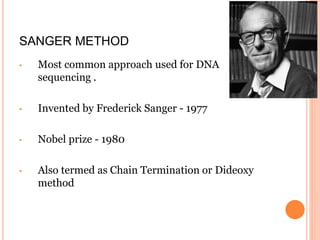
SANGER METHOD
• Most common approach used for DNA
sequencing .
• Invented by Frederick Sanger - 1977
• Nobel prize - 1980
• Also termed as Chain Termination or Dideoxy
method
TARIQUL ISLAM
ID -151-15-5144
STEP - 1
The reaction mixture
• It sorts the newly
synthesized DNA strands
by length.
• The reaction mixture is heated
to keep the newly synthesized
strands separated
• Separated strands are loaded
onto a tiny capillary tube
• The tube is not much thicker
than a human hair and is 1 to 3
feet long
STEP - 2
1.The emerged strands
are passed through a
laser beam
2.The beam causes the
dye to glow at a specific
wavelength, or color. This
color is then detected by a
photocell
STEP - 3
• Computers read the sequence from the gel
and interpret the colors and print a sequence
of nucleotides across the top.
STEP - 4
MONSUR AHMED SHAFIQ
COMPARISON
Sanger Method Maxam Gilbert Method
Enzymatic Chemical
Requires DNA synthesis Requires DNA
Termination of chain
elongation
Breaks DNA at different
nucleotides
Automation Automation is not available
Single-stranded DNA Double-stranded or single-
stranded DNA
MORDEN
APPLICATIONS OF DNA SEQUENCING
• Forensics: to help identify
individuals because each individual
has a different genetic sequence
• Medicine: can be used to help
detect the genes which are linked to
various genetic disorders such as
muscular dystrophy.
• Agriculture: The mapping and
sequencing of a genome of
microorganisms has helped to make
them useful for crops and food
plants.
OMAR FARUQ
ID-151-15-5444
HUMAN GENOME PROJECT
• The biggest challenge for the life sciences
• 15 years project (NIH, DOE of USA)
• Primary goal  Sequence base pairs of human
beings that form DNA
• Identifying & mapping approx. 20K-25K genes
• Significance  Physical & functional
•standpoint
ADVANTAGES
• Improved diagnosis of disease
• Identify the genes causing genetic diseases
• Identifying crime suspects
DISADVANTAGES
• Whole genome cannot be sequenced at once
• Very slow and time consuming
Thank You!!!

DNA Sequencing process

  • 1.
  • 2.
    GROUP MEMBER SAJIBUL HASSAN NAHIANAHMED TARIQUL ISLAM MONSUR AHMED SHAFIQ OMAR FARUQ
  • 3.
  • 4.
    DEOXYRIBONUCLEIC ACID  Deoxyribonucleicacid (DNA) is a nucleic acid that functions include: ->Storage of genetic information ->Expression of the genetic message DNA’s major function is to code for proteins. Information is encoded in the order of the nitrogenous bases. 
  • 5.
    DNA SEQUENCING  Determiningthe order of bases in a section of DNA.  To analyze gene structure and its relation to gene expression as well as protein conformation
  • 6.
    HISTORY • Deoxyribonucleic acid(DNA) was first discovered and isolated by Friedrich Miescher in 1869 • 1953 structure of DNA established as a double helix • 1970 first method of DNA sequencing involved a location specific primed extension strategy.
  • 7.
    • 1977 Fredericksanger published a method for DNA sequencing with chain terminating in hibitors. • 1990 several new methods are developed in the mid to late90,s • 2003 complete human genome project History
  • 8.
  • 9.
     DNA Sequencingis used for: • Mapping genomes • Determining gene structure • Detecting polymorphism • Analyzing genetic variation • Predicting the possible product(s) of DNA fragments • Many purposes depending on the questions one is asking
  • 10.
    DNA SEQUENCING METHOD Methodsof DNA sequencing : 1.Maxam-Gilbert sequencing 2.Chain termination method (Sanger method) Next generation methods: 1.Massively parallel signature sequencing 2.Polony sequencing 3.Pyrosequencing 4.Illumina sequencing 5.Solid sequencing
  • 11.
    SANGER METHOD • Mostcommon approach used for DNA sequencing . • Invented by Frederick Sanger - 1977 • Nobel prize - 1980 • Also termed as Chain Termination or Dideoxy method
  • 12.
  • 13.
    STEP - 1 Thereaction mixture
  • 14.
    • It sortsthe newly synthesized DNA strands by length. • The reaction mixture is heated to keep the newly synthesized strands separated • Separated strands are loaded onto a tiny capillary tube • The tube is not much thicker than a human hair and is 1 to 3 feet long STEP - 2
  • 15.
    1.The emerged strands arepassed through a laser beam 2.The beam causes the dye to glow at a specific wavelength, or color. This color is then detected by a photocell STEP - 3
  • 16.
    • Computers readthe sequence from the gel and interpret the colors and print a sequence of nucleotides across the top. STEP - 4
  • 17.
  • 18.
    COMPARISON Sanger Method MaxamGilbert Method Enzymatic Chemical Requires DNA synthesis Requires DNA Termination of chain elongation Breaks DNA at different nucleotides Automation Automation is not available Single-stranded DNA Double-stranded or single- stranded DNA
  • 19.
    MORDEN APPLICATIONS OF DNASEQUENCING • Forensics: to help identify individuals because each individual has a different genetic sequence • Medicine: can be used to help detect the genes which are linked to various genetic disorders such as muscular dystrophy. • Agriculture: The mapping and sequencing of a genome of microorganisms has helped to make them useful for crops and food plants.
  • 20.
  • 21.
    HUMAN GENOME PROJECT •The biggest challenge for the life sciences • 15 years project (NIH, DOE of USA) • Primary goal  Sequence base pairs of human beings that form DNA • Identifying & mapping approx. 20K-25K genes • Significance  Physical & functional •standpoint
  • 22.
    ADVANTAGES • Improved diagnosisof disease • Identify the genes causing genetic diseases • Identifying crime suspects DISADVANTAGES • Whole genome cannot be sequenced at once • Very slow and time consuming
  • 23.