Department Of Computer Science 
Gulbarga University Gulbarga 
Presented By 
Salma Begum 
MCA 5th sem 
Under the Guidance of 
Shrikant G.K
AGENDA 
 INTRODUCTION 
 ORGIN OF ANDROID 
 FEATURES OF ANDROID 
 ARCHITECHTURE OF ANDROID 
 VERSIONS OF ANDROID 
 SOFTWARE DEVELOPMENT 
 LIMITATIONS 
 APPLICATION LIFE CYCLE 
 FUTURE OF ANDROID
Introduction 
Android is Linux based operating 
system for mobile devices. 
Android specially developed for 
applications 
There are more than 4,00,000 apps 
in android market 
The andriod is an open source
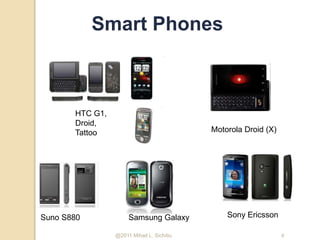
Smart Phones 
HTC G1, 
Droid, 
Tattoo Motorola Droid (X) 
Suno S880 Samsung Galaxy Sony Ericsson 
@2011 Mihail L. Sichitiu 4
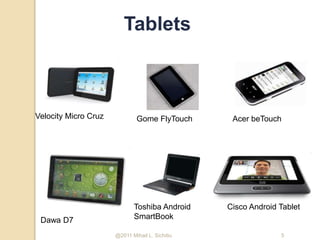
Tablets 
Velocity Micro Cruz Gome FlyTouch Acer beTouch 
@2011 Mihail L. Sichitiu 5 
Dawa D7 
Toshiba Android 
SmartBook 
Cisco Android Tablet
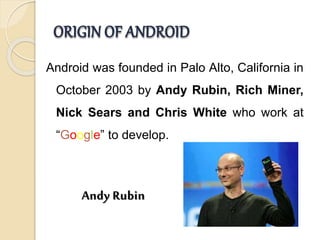
ORIGIN OF ANDROID 
Android was founded in Palo Alto, California in 
October 2003 by Andy Rubin, Rich Miner, 
Nick Sears and Chris White who work at 
“Google” to develop. 
Andy Rubin
ORIGIN OF ANDROID 
Android was purchased by the GOOGLE 
in AUGUST, 2005 for 50 million $. 
The open handset alliance, a group of 
several companies was formed -5 
November 2007 
Android beta released-12 November 
2007
 It’s consortium of several companies. 
 This group of companies are allowed 
to use source code of Android and 
develop applications.
Features of andriod 
 Andriod can run multiple apps at the same time 
 Also support optimized graphics VGA, 2D 
graphics and 3D graphics. 
 Andriod has better app market. 
 Andriod lets you change your setting faster. 
 It gives you more options to fit your budget 
 Andriod keeps information visible on your home 
screen. 
 Android also support java applications.
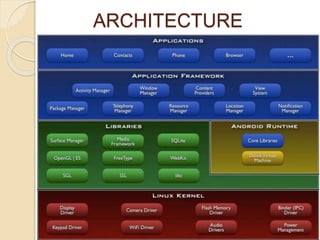
The Android Software Architecture 
 Linux kernel 
 Libraries 
 Android run time 
core libraries 
Dalvik virtual machine 
 application layer 
 application framework
ARCHITECTURE
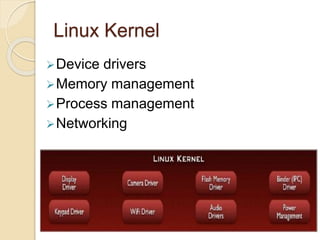
Linux Kernel 
Device drivers 
Memory management 
Process management 
Networking
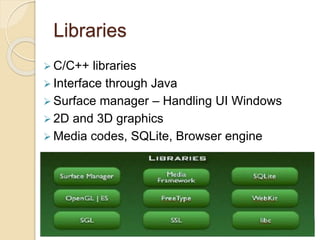
Libraries 
 C/C++ libraries 
 Interface through Java 
 Surface manager – Handling UI Windows 
 2D and 3D graphics 
Media codes, SQLite, Browser engine
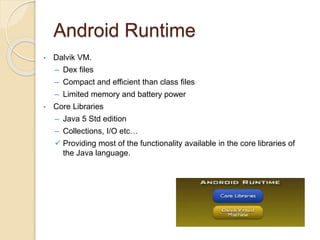
Android Runtime 
• Dalvik VM. 
– Dex files 
– Compact and efficient than class files 
– Limited memory and battery power 
• Core Libraries 
– Java 5 Std edition 
– Collections, I/O etc… 
 Providing most of the functionality available in the core libraries of 
the Java language.
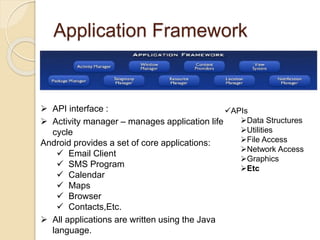
Application Framework 
 API interface : 
 Activity manager – manages application life 
cycle 
Android provides a set of core applications: 
 Email Client 
 SMS Program 
 Calendar 
 Maps 
 Browser 
 Contacts,Etc. 
 All applications are written using the Java 
language. 
APIs 
Data Structures 
Utilities 
File Access 
Network Access 
Graphics 
Etc
Versions of andriod 
 Andriod 1.0 23 September 2008 
 Andriod 1.1 9 February 2009 
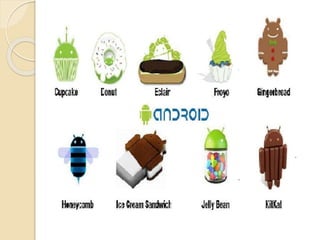
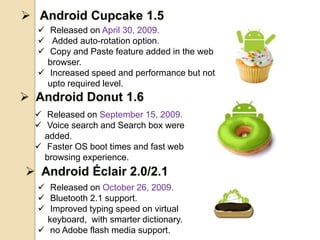
 Andriod 1.5 (Cupcake) 30 April 2009 
 Andriod 1.6 (Donut) 15 September 2009 
 Andriod 2.0 (Éclair) 26 October 2009 
 Andriod 2.2 (Froyo) 20 May 2010 
 Andriod 2.3 (Gingerbread) 6 December 2010 
 Andriod 3.0 (Honeycomb) 10 May 2011 
 Andriod 4.0 19 October 2011 
(Ice Cream Sandwich) 
 Andriod 4.1 ,4.2,4.3 13 July 2012 
(Jelly bean) 
 Andriod 4.4 (Kitkat) 31 October 2013
 Released on April 30, 2009. 
 Added auto-rotation option. 
 Copy and Paste feature added in the web 
browser. 
 Increased speed and performance but not 
upto required level. 
 Released on September 15, 2009. 
 Voice search and Search box were 
added. 
 Faster OS boot times and fast web 
browsing experience. 
 Released on October 26, 2009. 
 Bluetooth 2.1 support. 
 Improved typing speed on virtual 
keyboard, with smarter dictionary. 
 no Adobe flash media support.
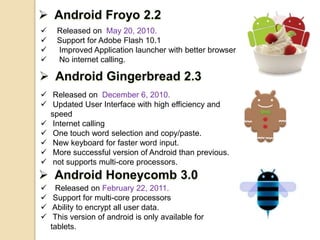
 Released on May 20, 2010. 
 Support for Adobe Flash 10.1 
 Improved Application launcher with better browser 
 No internet calling. 
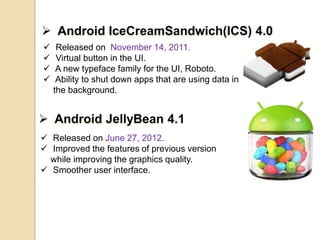
 Released on December 6, 2010. 
 Updated User Interface with high efficiency and 
speed 
 Internet calling 
 One touch word selection and copy/paste. 
 New keyboard for faster word input. 
 More successful version of Android than previous. 
 not supports multi-core processors. 
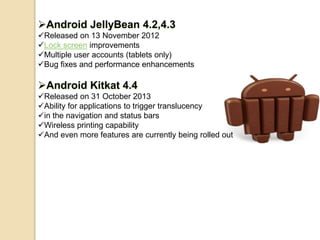
 Released on February 22, 2011. 
 Support for multi-core processors 
 Ability to encrypt all user data. 
 This version of android is only available for 
tablets.
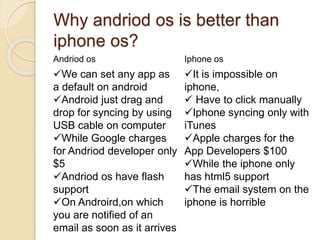
 Released on November 14, 2011. 
 Virtual button in the UI. 
 A new typeface family for the UI, Roboto. 
 Ability to shut down apps that are using data in 
the background. 
 Released on June 27, 2012. 
 Improved the features of previous version 
while improving the graphics quality. 
 Smoother user interface.
Android JellyBean 4.2,4.3 
Released on 13 November 2012 
Lock screen improvements 
Multiple user accounts (tablets only) 
Bug fixes and performance enhancements 
Android Kitkat 4.4 
Released on 31 October 2013 
Ability for applications to trigger translucency 
in the navigation and status bars 
Wireless printing capability 
And even more features are currently being rolled out
Why andriod os is better than 
iphone os? 
Andriod os Iphone os 
We can set any app as 
a default on android 
Android just drag and 
drop for syncing by using 
USB cable on computer 
While Google charges 
for Andriod developer only 
$5 
Andriod os have flash 
support 
On Androird,on which 
you are notified of an 
email as soon as it arrives 
It is impossible on 
iphone, 
 Have to click manually 
Iphone syncing only with 
iTunes 
Apple charges for the 
App Developers $100 
While the iphone only 
has html5 support 
The email system on the 
iphone is horrible
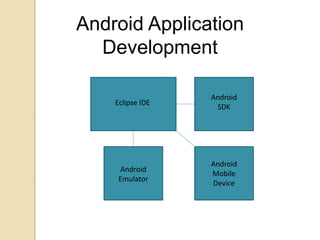
Android Application 
Development 
Eclipse IDE 
Android 
SDK 
Android 
Emulator 
Android 
Mobile 
Device
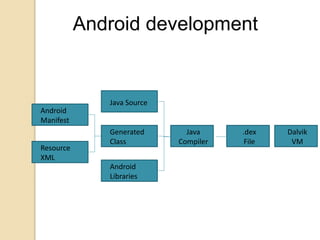
Android development 
Android 
Manifest 
Resource 
XML 
Java Source 
Generated 
Class 
Java 
Compiler 
Android 
Libraries 
.dex 
File 
Dalvik 
VM
SOFTWARE FEATURES 
 Integrated browser based on the open source 
Web Kit engine 
SQLite for relational data storage 
Media support for common audio, video, and 
still image formats 
 Dalvik Virtual Machine optimized for mobile 
devices
HARDWARE FEAUTURES 
Cellular networking : GSM, EDGE, 3G 
LAN : Bluetooth, and Wi-Fi 
Graphics Hardware Acceleration 
Camera, GPS and Compass 
Touch screen and accelerometer for 
motion sensing
Techniques for saving data 
◦ SQLite Databases: relational database library for 
storing and managing complex data 
◦ Files: you can create, write, and read files from the 
local storage or external media (SD Cards) 
 FileOutputStream, FileInputStream, and Resources 
classes.
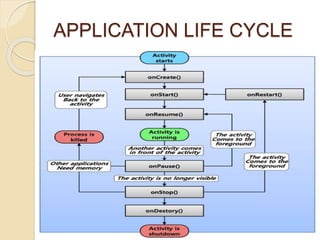
APPLICATION LIFE CYCLE
Life Cycle 
Each application runs in its own 
process. 
Each activity of an app is run in the 
apps process 
Processes are started and stopped as 
needed to run an apps components. 
Processes may be killed to reclaim 
needed resources. 
Killed apps may be restored to their 
last state when requested by the user
Andriod market 
 Andriod market is the online software 
store developed by Google for Andriod 
devices 
 Users to browse and download apps 
published by third party developer 
 As of october 2011 there were more 
than 4,00,000 apps available for Android 
 As of dec 2013 there were more than 
8,00,000 apps available for Android 
 Android has several famous apps like 
voice action, sky map,place 
directory,GPS,etc..,
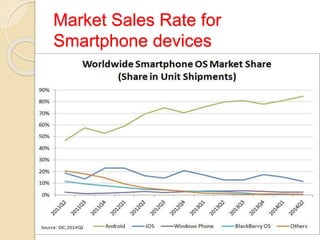
Market Sales Rate for 
Smartphone devices
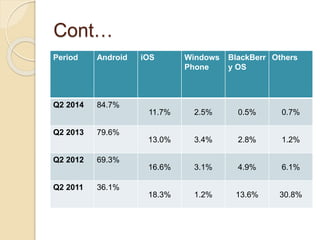
Cont… 
Period Android iOS Windows 
Phone 
BlackBerr 
y OS 
Others 
Q2 2014 84.7% 
11.7% 2.5% 0.5% 0.7% 
Q2 2013 79.6% 
13.0% 3.4% 2.8% 1.2% 
Q2 2012 69.3% 
16.6% 3.1% 4.9% 6.1% 
Q2 2011 36.1% 
18.3% 1.2% 13.6% 30.8%
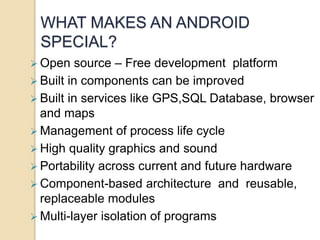
WHAT MAKES AN ANDROID 
SPECIAL? 
 Open source – Free development platform 
 Built in components can be improved 
 Built in services like GPS,SQL Database, browser 
and maps 
Management of process life cycle 
 High quality graphics and sound 
 Portability across current and future hardware 
Component-based architecture and reusable, 
replaceable modules 
 Multi-layer isolation of programs
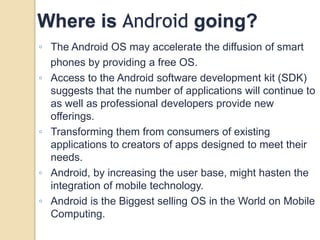
Where is Android going? 
◦ The Android OS may accelerate the diffusion of smart 
phones by providing a free OS. 
◦ Access to the Android software development kit (SDK) 
suggests that the number of applications will continue to 
as well as professional developers provide new 
offerings. 
◦ Transforming them from consumers of existing 
applications to creators of apps designed to meet their 
needs. 
◦ Android, by increasing the user base, might hasten the 
integration of mobile technology. 
◦ Android is the Biggest selling OS in the World on Mobile 
Computing.
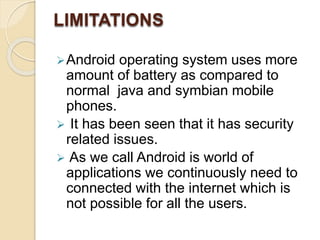
LIMITATIONS 
Android operating system uses more 
amount of battery as compared to 
normal java and symbian mobile 
phones. 
 It has been seen that it has security 
related issues. 
 As we call Android is world of 
applications we continuously need to 
connected with the internet which is 
not possible for all the users.
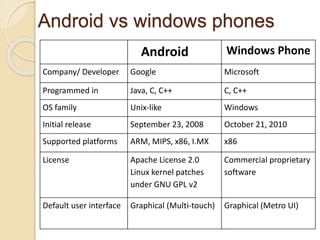
Android vs windows phones 
Androidroid Windows Phone 
Company/ Developer Google Microsoft 
Programmed in Java, C, C++ C, C++ 
OS family Unix-like Windows 
Initial release September 23, 2008 October 21, 2010 
Supported platforms ARM, MIPS, x86, I.MX x86 
License Apache License 2.0 
Linux kernel patches 
under GNU GPL v2 
Commercial proprietary 
software 
Default user interface Graphical (Multi-touch) Graphical (Metro UI)
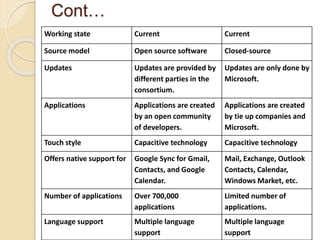
Cont… 
Working state Current Current 
Source model Open source software Closed-source 
Updates Updates are provided by 
different parties in the 
consortium. 
Updates are only done by 
Microsoft. 
Applications Applications are created 
by an open community 
of developers. 
Applications are created 
by tie up companies and 
Microsoft. 
Touch style Capacitive technology Capacitive technology 
Offers native support for Google Sync for Gmail, 
Contacts, and Google 
Calendar. 
Mail, Exchange, Outlook 
Contacts, Calendar, 
Windows Market, etc. 
Number of applications Over 700,000 
applications 
Limited number of 
applications. 
Language support Multiple language 
support 
Multiple language 
support
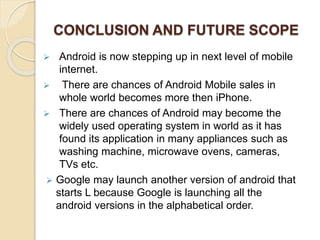
 Android is now stepping up in next level of mobile 
internet. 
 There are chances of Android Mobile sales in 
whole world becomes more then iPhone. 
 There are chances of Android may become the 
widely used operating system in world as it has 
found its application in many appliances such as 
washing machine, microwave ovens, cameras, 
TVs etc. 
 Google may launch another version of android that 
starts L because Google is launching all the 
android versions in the alphabetical order.
Thank You

Presentation on Android operating system

  • 1.
    Department Of ComputerScience Gulbarga University Gulbarga Presented By Salma Begum MCA 5th sem Under the Guidance of Shrikant G.K
  • 2.
    AGENDA  INTRODUCTION  ORGIN OF ANDROID  FEATURES OF ANDROID  ARCHITECHTURE OF ANDROID  VERSIONS OF ANDROID  SOFTWARE DEVELOPMENT  LIMITATIONS  APPLICATION LIFE CYCLE  FUTURE OF ANDROID
  • 3.
    Introduction Android isLinux based operating system for mobile devices. Android specially developed for applications There are more than 4,00,000 apps in android market The andriod is an open source
  • 4.
    Smart Phones HTCG1, Droid, Tattoo Motorola Droid (X) Suno S880 Samsung Galaxy Sony Ericsson @2011 Mihail L. Sichitiu 4
  • 5.
    Tablets Velocity MicroCruz Gome FlyTouch Acer beTouch @2011 Mihail L. Sichitiu 5 Dawa D7 Toshiba Android SmartBook Cisco Android Tablet
  • 6.
    ORIGIN OF ANDROID Android was founded in Palo Alto, California in October 2003 by Andy Rubin, Rich Miner, Nick Sears and Chris White who work at “Google” to develop. Andy Rubin
  • 7.
    ORIGIN OF ANDROID Android was purchased by the GOOGLE in AUGUST, 2005 for 50 million $. The open handset alliance, a group of several companies was formed -5 November 2007 Android beta released-12 November 2007
  • 8.
     It’s consortiumof several companies.  This group of companies are allowed to use source code of Android and develop applications.
  • 9.
    Features of andriod  Andriod can run multiple apps at the same time  Also support optimized graphics VGA, 2D graphics and 3D graphics.  Andriod has better app market.  Andriod lets you change your setting faster.  It gives you more options to fit your budget  Andriod keeps information visible on your home screen.  Android also support java applications.
  • 10.
    The Android SoftwareArchitecture  Linux kernel  Libraries  Android run time core libraries Dalvik virtual machine  application layer  application framework
  • 11.
  • 12.
    Linux Kernel Devicedrivers Memory management Process management Networking
  • 13.
    Libraries  C/C++libraries  Interface through Java  Surface manager – Handling UI Windows  2D and 3D graphics Media codes, SQLite, Browser engine
  • 14.
    Android Runtime •Dalvik VM. – Dex files – Compact and efficient than class files – Limited memory and battery power • Core Libraries – Java 5 Std edition – Collections, I/O etc…  Providing most of the functionality available in the core libraries of the Java language.
  • 15.
    Application Framework API interface :  Activity manager – manages application life cycle Android provides a set of core applications:  Email Client  SMS Program  Calendar  Maps  Browser  Contacts,Etc.  All applications are written using the Java language. APIs Data Structures Utilities File Access Network Access Graphics Etc
  • 16.
    Versions of andriod  Andriod 1.0 23 September 2008  Andriod 1.1 9 February 2009  Andriod 1.5 (Cupcake) 30 April 2009  Andriod 1.6 (Donut) 15 September 2009  Andriod 2.0 (Éclair) 26 October 2009  Andriod 2.2 (Froyo) 20 May 2010  Andriod 2.3 (Gingerbread) 6 December 2010  Andriod 3.0 (Honeycomb) 10 May 2011  Andriod 4.0 19 October 2011 (Ice Cream Sandwich)  Andriod 4.1 ,4.2,4.3 13 July 2012 (Jelly bean)  Andriod 4.4 (Kitkat) 31 October 2013
  • 18.
     Released onApril 30, 2009.  Added auto-rotation option.  Copy and Paste feature added in the web browser.  Increased speed and performance but not upto required level.  Released on September 15, 2009.  Voice search and Search box were added.  Faster OS boot times and fast web browsing experience.  Released on October 26, 2009.  Bluetooth 2.1 support.  Improved typing speed on virtual keyboard, with smarter dictionary.  no Adobe flash media support.
  • 19.
     Released onMay 20, 2010.  Support for Adobe Flash 10.1  Improved Application launcher with better browser  No internet calling.  Released on December 6, 2010.  Updated User Interface with high efficiency and speed  Internet calling  One touch word selection and copy/paste.  New keyboard for faster word input.  More successful version of Android than previous.  not supports multi-core processors.  Released on February 22, 2011.  Support for multi-core processors  Ability to encrypt all user data.  This version of android is only available for tablets.
  • 20.
     Released onNovember 14, 2011.  Virtual button in the UI.  A new typeface family for the UI, Roboto.  Ability to shut down apps that are using data in the background.  Released on June 27, 2012.  Improved the features of previous version while improving the graphics quality.  Smoother user interface.
  • 21.
    Android JellyBean 4.2,4.3 Released on 13 November 2012 Lock screen improvements Multiple user accounts (tablets only) Bug fixes and performance enhancements Android Kitkat 4.4 Released on 31 October 2013 Ability for applications to trigger translucency in the navigation and status bars Wireless printing capability And even more features are currently being rolled out
  • 22.
    Why andriod osis better than iphone os? Andriod os Iphone os We can set any app as a default on android Android just drag and drop for syncing by using USB cable on computer While Google charges for Andriod developer only $5 Andriod os have flash support On Androird,on which you are notified of an email as soon as it arrives It is impossible on iphone,  Have to click manually Iphone syncing only with iTunes Apple charges for the App Developers $100 While the iphone only has html5 support The email system on the iphone is horrible
  • 23.
    Android Application Development Eclipse IDE Android SDK Android Emulator Android Mobile Device
  • 24.
    Android development Android Manifest Resource XML Java Source Generated Class Java Compiler Android Libraries .dex File Dalvik VM
  • 25.
    SOFTWARE FEATURES Integrated browser based on the open source Web Kit engine SQLite for relational data storage Media support for common audio, video, and still image formats  Dalvik Virtual Machine optimized for mobile devices
  • 26.
    HARDWARE FEAUTURES Cellularnetworking : GSM, EDGE, 3G LAN : Bluetooth, and Wi-Fi Graphics Hardware Acceleration Camera, GPS and Compass Touch screen and accelerometer for motion sensing
  • 27.
    Techniques for savingdata ◦ SQLite Databases: relational database library for storing and managing complex data ◦ Files: you can create, write, and read files from the local storage or external media (SD Cards)  FileOutputStream, FileInputStream, and Resources classes.
  • 28.
  • 29.
    Life Cycle Eachapplication runs in its own process. Each activity of an app is run in the apps process Processes are started and stopped as needed to run an apps components. Processes may be killed to reclaim needed resources. Killed apps may be restored to their last state when requested by the user
  • 30.
    Andriod market Andriod market is the online software store developed by Google for Andriod devices  Users to browse and download apps published by third party developer  As of october 2011 there were more than 4,00,000 apps available for Android  As of dec 2013 there were more than 8,00,000 apps available for Android  Android has several famous apps like voice action, sky map,place directory,GPS,etc..,
  • 31.
    Market Sales Ratefor Smartphone devices
  • 32.
    Cont… Period AndroidiOS Windows Phone BlackBerr y OS Others Q2 2014 84.7% 11.7% 2.5% 0.5% 0.7% Q2 2013 79.6% 13.0% 3.4% 2.8% 1.2% Q2 2012 69.3% 16.6% 3.1% 4.9% 6.1% Q2 2011 36.1% 18.3% 1.2% 13.6% 30.8%
  • 33.
    WHAT MAKES ANANDROID SPECIAL?  Open source – Free development platform  Built in components can be improved  Built in services like GPS,SQL Database, browser and maps Management of process life cycle  High quality graphics and sound  Portability across current and future hardware Component-based architecture and reusable, replaceable modules  Multi-layer isolation of programs
  • 34.
    Where is Androidgoing? ◦ The Android OS may accelerate the diffusion of smart phones by providing a free OS. ◦ Access to the Android software development kit (SDK) suggests that the number of applications will continue to as well as professional developers provide new offerings. ◦ Transforming them from consumers of existing applications to creators of apps designed to meet their needs. ◦ Android, by increasing the user base, might hasten the integration of mobile technology. ◦ Android is the Biggest selling OS in the World on Mobile Computing.
  • 35.
    LIMITATIONS Android operatingsystem uses more amount of battery as compared to normal java and symbian mobile phones.  It has been seen that it has security related issues.  As we call Android is world of applications we continuously need to connected with the internet which is not possible for all the users.
  • 36.
    Android vs windowsphones Androidroid Windows Phone Company/ Developer Google Microsoft Programmed in Java, C, C++ C, C++ OS family Unix-like Windows Initial release September 23, 2008 October 21, 2010 Supported platforms ARM, MIPS, x86, I.MX x86 License Apache License 2.0 Linux kernel patches under GNU GPL v2 Commercial proprietary software Default user interface Graphical (Multi-touch) Graphical (Metro UI)
  • 37.
    Cont… Working stateCurrent Current Source model Open source software Closed-source Updates Updates are provided by different parties in the consortium. Updates are only done by Microsoft. Applications Applications are created by an open community of developers. Applications are created by tie up companies and Microsoft. Touch style Capacitive technology Capacitive technology Offers native support for Google Sync for Gmail, Contacts, and Google Calendar. Mail, Exchange, Outlook Contacts, Calendar, Windows Market, etc. Number of applications Over 700,000 applications Limited number of applications. Language support Multiple language support Multiple language support
  • 38.
     Android isnow stepping up in next level of mobile internet.  There are chances of Android Mobile sales in whole world becomes more then iPhone.  There are chances of Android may become the widely used operating system in world as it has found its application in many appliances such as washing machine, microwave ovens, cameras, TVs etc.  Google may launch another version of android that starts L because Google is launching all the android versions in the alphabetical order.

  • 40.