BRICK MASONARY
Prepared by
Er. Ankaj Kumar
Lecturer & Head
Civil Engg.Deptt.
INTRODUCTION
 BRICKS :-Brick is a building unit ,which is in the form
of rectangular block in which length to breadth ratio is
2 but height can be different.
 MASONARY :-Construction of building unit bonded
together with mortar.
 BRICK MASONRY:-The art of laying bricks in mortar
in a proper systematic manner gives homogeneous
mass which can withstand forces without
disintegration, called Brick masonry.
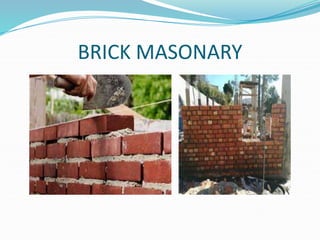
BRICK MASONARY
Brick Masonry-uniqueness
 FIRE RESISTANCE
 SIZE
 DURABILITY
 WORAKABILITY
 ECONOMICAL
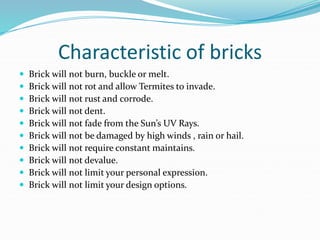
Characteristic of bricks
 Brick will not burn, buckle or melt.
 Brick will not rot and allow Termites to invade.
 Brick will not rust and corrode.
 Brick will not dent.
 Brick will not fade from the Sun’s UV Rays.
 Brick will not be damaged by high winds , rain or hail.
 Brick will not require constant maintains.
 Brick will not devalue.
 Brick will not limit your personal expression.
 Brick will not limit your design options.
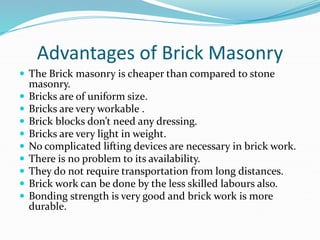
Advantages of Brick Masonry
 The Brick masonry is cheaper than compared to stone
masonry.
 Bricks are of uniform size.
 Bricks are very workable .
 Brick blocks don’t need any dressing.
 Bricks are very light in weight.
 No complicated lifting devices are necessary in brick work.
 There is no problem to its availability.
 They do not require transportation from long distances.
 Brick work can be done by the less skilled labours also.
 Bonding strength is very good and brick work is more
durable.
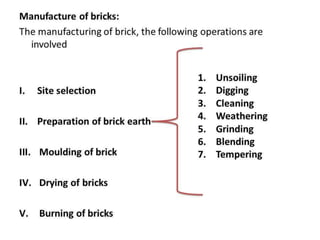
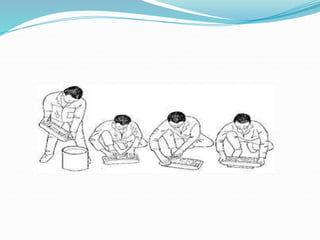
Manufacturing of Bricks
Types of Bricks used in Masonary Work
Traditional bricks –Length – 20 to 25 cm, Width – 10 to
13 cm, Height – 5 to 7.5 cm
common size – 23cm × 11.4cm × 7.6cm
Modular bricks –normal size – 20 × 10 × 10 cm
actual size – 19 × 9 × 9 cm
Bangladesh – 9.5 × 4.5 × 2.75 in
with mortar – 10 × 5 × 3 in
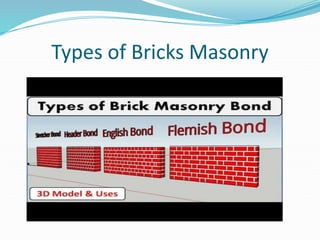
Types of Bricks Masonry
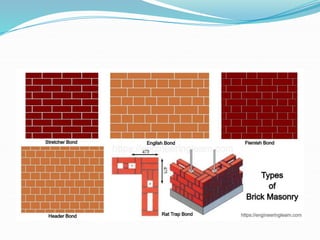
English Bond
 Bricks are laid in alternate courses of headers and
stretchers.
 There is a chance of penetration of damp through
transverse joints.
 Queen closures are inserted next to headers to produce
overlap.
 English bonds are the strongest but it is to be noted that
the continuous vertical joints are to be avoided.
 Appearance is not as good as Flemish bonds.
Flemish Bond
 This bond has one stretcher between headers, with the
headers centered over the stretchers in the course
below.
 When a course begins with a stretcher, the course will
ordinarily terminate with a stretcher at the other end.
 Brickwork that appears as Flemish bond from both the
front and rear is Double Flemish bond.
Header Bond
 Heading or Header Bond is laid on headers. Used for
round quick sweeps .
 Should never be used in straight work as it is very
week.
 This bond is used for facing of curved surface and
footings in foundations.
Stretcher Bond
 Bricks are laid in stretchers.
 Used in walls of half – brick in thickness.
 Due to its constant occurrence in the last position it is
also called Chimney Bond, Running Bond.
 This bond doesn’t develop proper internal bond.
Types of Bricks Masonary
 TYPES OF BRICKS MASONRY :
 Brick work in mud
 Brick work in cement
Brick Work In Mud
 The mud is used to fill up the joints.
 Thickness of the mortar joint is 12 mm.
 Cheapest
 Maximum height of wall is 4 m.
BRICK WORK IN CEMENT
 1st Class
 Cement of lime mortar is used.
 The surface and edges of bricks are sharp.
 The thickness of mortar joints doesn’t exceed 10mm
 2nd Class
 Ground moulded bricks are used.
 Bricks are rough and shape is slightly irregular.
 The thickness of mortar joint is 12 mm.
 3rd Class
 Bricks are not hard ,rough surface with distorted shape.
 Used for temporary structures.
 Used in places where rainfall is not heavy.
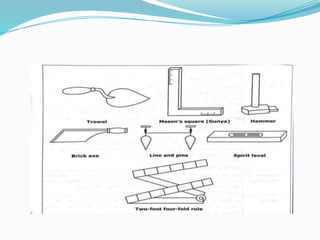
Tools used in Bricks Masonry
 Trowel
 Plumb bob
 Hammer
 Spirit level
 Mason square
 Steel tape
Bricks courses & closures
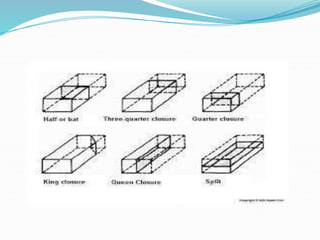
 QUEEN CLOSURE: A brick cut in half down its length.
 KING CLOSURE : A brick cut a corner & joining middle
points of width and length of the brick.
 THREE QUARTER BAT : A brick cut to three-quarters of its
length, and laid with its long, narrow side exposed.
 HALF BAT: A brick cut in half across its width and laid in
the wall structure.
 QUARTER BAT: A brick cut to a quarter of its length.
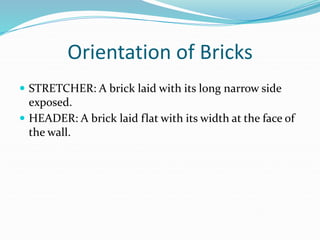
Orientation of Bricks
 STRETCHER: A brick laid with its long narrow side
exposed.
 HEADER: A brick laid flat with its width at the face of
the wall.
Rules for Good Brick Bonding
 Uniform in size.
 Bricks arranged uniformly throughout the wall.
 Bats are used as little as possible.
 The bricks in the interiors of wall laid as headers, that
is, across the wall.
 The lap not more than 2 and one-fourth(1/4) inches.
 The vertical joints in every other course should be
vertically over one another.
Qualities of Good Bricks
 Bricks should be uniform in shape & standard in size.
 Bricks should give a clear metallic ringing sound when struck with each
other.
 Bricks should show a bright homogeneous & free from voids.
 Bricks should be well brunt and possess sharp edges.
 Colour of the bricks should be uniform and bright.
 Bricks should be sufficiently hard & no impression should be left on
bricks surface when scratched with finger nail.
 Bricks should have crushing strength above 5.50N/mm”.
 The bricks should not break when it dropped from a height of about 1
m.
 The bricks should not absorb water more than 20% by weight when
soaked in cold water for 24 hrs.
 The bricks should not show any deposits of white salts when allowed to
CLASSIFICATION OF BRICKS
 FIRST CLASS BRICKS :-
 This are table moulded.
 Surface & edges are sharp, square ,smooth , straight.
 Well brunt & have uniform texture ,metallic ringing when struck against each other.
 Used for superior work.
 SECOND CLASS BRICKS :-
 This are ground moulded brick.
 Surface are rough.
 The quality of this bricks are inferior.
 THIRD CLASS BRICKS :-
 The surface & edges are rough.
 Does not create any metallic sound.
 Used for temporary & unimportant structure.
 FOURTH CLASS BRICKS :-
 This bricks are over brunt.
 Irregular shape & dark colour.
 Used in floor , foundation, roads.
Test for Bricks
 Absorption:- The brick should not absorb water more than 20% of dry weight.
 Crushing strength:- As per BIS 1077-1957 the minimum crushing strength of
bricks is 3.5 N/mm2
 Hardness :- Brick is treated to be sufficient hard if no impression could be made on
the surface of the brick by finger nail.
 Soundness :- Two bricks when struck with each other should emit metallic ringing
sound.
 Structure :- It should be homogeneous ,compact ,and free from any defects.
 Shape & size :- Standard size (190 X 90 X 90 mm) and shapes should be truly
rectangular with sharp edges and smooth surface.
Defects in brick masonry
 Sulphate attack :- Sulphate salts present in bricks work
react with alumina content of cement .It occur in
boundary walls.
 Crystallization of salts from bricks :- Occur in
masonry made out of brick which contain excessive
soluble salts.This phenomenon is also known as
efflorescence.
 Corrosion of embedded iron or steel :- Iron or steel
embedded in brick work gets corroded in the presence of
dampness .On corrosion the metal expands in volume
and tends to crack the brick work.
Conclusion
 Masonry boasts an impressive compressive strength
(vertical loads) but is much lower in tensile strength
unless reinforced.
 Brick masonry increases the thermal mass of a
building and thereby resists fire.
 Masonry tends to be heavy and must be built upon a
strong foundation, such as reinforced concrete, to
avoid settling and cracking.
Any Questions ?
THANKS

brickmasonry-230211140056-e3a1df36.pdf

  • 1.
    BRICK MASONARY Prepared by Er.Ankaj Kumar Lecturer & Head Civil Engg.Deptt.
  • 2.
    INTRODUCTION  BRICKS :-Brickis a building unit ,which is in the form of rectangular block in which length to breadth ratio is 2 but height can be different.  MASONARY :-Construction of building unit bonded together with mortar.  BRICK MASONRY:-The art of laying bricks in mortar in a proper systematic manner gives homogeneous mass which can withstand forces without disintegration, called Brick masonry.
  • 3.
  • 4.
    Brick Masonry-uniqueness  FIRERESISTANCE  SIZE  DURABILITY  WORAKABILITY  ECONOMICAL
  • 5.
    Characteristic of bricks Brick will not burn, buckle or melt.  Brick will not rot and allow Termites to invade.  Brick will not rust and corrode.  Brick will not dent.  Brick will not fade from the Sun’s UV Rays.  Brick will not be damaged by high winds , rain or hail.  Brick will not require constant maintains.  Brick will not devalue.  Brick will not limit your personal expression.  Brick will not limit your design options.
  • 6.
    Advantages of BrickMasonry  The Brick masonry is cheaper than compared to stone masonry.  Bricks are of uniform size.  Bricks are very workable .  Brick blocks don’t need any dressing.  Bricks are very light in weight.  No complicated lifting devices are necessary in brick work.  There is no problem to its availability.  They do not require transportation from long distances.  Brick work can be done by the less skilled labours also.  Bonding strength is very good and brick work is more durable.
  • 7.
  • 9.
    Types of Bricksused in Masonary Work Traditional bricks –Length – 20 to 25 cm, Width – 10 to 13 cm, Height – 5 to 7.5 cm common size – 23cm × 11.4cm × 7.6cm Modular bricks –normal size – 20 × 10 × 10 cm actual size – 19 × 9 × 9 cm Bangladesh – 9.5 × 4.5 × 2.75 in with mortar – 10 × 5 × 3 in
  • 10.
  • 11.
    English Bond  Bricksare laid in alternate courses of headers and stretchers.  There is a chance of penetration of damp through transverse joints.  Queen closures are inserted next to headers to produce overlap.  English bonds are the strongest but it is to be noted that the continuous vertical joints are to be avoided.  Appearance is not as good as Flemish bonds.
  • 12.
    Flemish Bond  Thisbond has one stretcher between headers, with the headers centered over the stretchers in the course below.  When a course begins with a stretcher, the course will ordinarily terminate with a stretcher at the other end.  Brickwork that appears as Flemish bond from both the front and rear is Double Flemish bond.
  • 13.
    Header Bond  Headingor Header Bond is laid on headers. Used for round quick sweeps .  Should never be used in straight work as it is very week.  This bond is used for facing of curved surface and footings in foundations.
  • 14.
    Stretcher Bond  Bricksare laid in stretchers.  Used in walls of half – brick in thickness.  Due to its constant occurrence in the last position it is also called Chimney Bond, Running Bond.  This bond doesn’t develop proper internal bond.
  • 16.
    Types of BricksMasonary  TYPES OF BRICKS MASONRY :  Brick work in mud  Brick work in cement
  • 17.
    Brick Work InMud  The mud is used to fill up the joints.  Thickness of the mortar joint is 12 mm.  Cheapest  Maximum height of wall is 4 m.
  • 18.
    BRICK WORK INCEMENT  1st Class  Cement of lime mortar is used.  The surface and edges of bricks are sharp.  The thickness of mortar joints doesn’t exceed 10mm  2nd Class  Ground moulded bricks are used.  Bricks are rough and shape is slightly irregular.  The thickness of mortar joint is 12 mm.  3rd Class  Bricks are not hard ,rough surface with distorted shape.  Used for temporary structures.  Used in places where rainfall is not heavy.
  • 19.
    Tools used inBricks Masonry  Trowel  Plumb bob  Hammer  Spirit level  Mason square  Steel tape
  • 21.
    Bricks courses &closures  QUEEN CLOSURE: A brick cut in half down its length.  KING CLOSURE : A brick cut a corner & joining middle points of width and length of the brick.  THREE QUARTER BAT : A brick cut to three-quarters of its length, and laid with its long, narrow side exposed.  HALF BAT: A brick cut in half across its width and laid in the wall structure.  QUARTER BAT: A brick cut to a quarter of its length.
  • 23.
    Orientation of Bricks STRETCHER: A brick laid with its long narrow side exposed.  HEADER: A brick laid flat with its width at the face of the wall.
  • 24.
    Rules for GoodBrick Bonding  Uniform in size.  Bricks arranged uniformly throughout the wall.  Bats are used as little as possible.  The bricks in the interiors of wall laid as headers, that is, across the wall.  The lap not more than 2 and one-fourth(1/4) inches.  The vertical joints in every other course should be vertically over one another.
  • 25.
    Qualities of GoodBricks  Bricks should be uniform in shape & standard in size.  Bricks should give a clear metallic ringing sound when struck with each other.  Bricks should show a bright homogeneous & free from voids.  Bricks should be well brunt and possess sharp edges.  Colour of the bricks should be uniform and bright.  Bricks should be sufficiently hard & no impression should be left on bricks surface when scratched with finger nail.  Bricks should have crushing strength above 5.50N/mm”.  The bricks should not break when it dropped from a height of about 1 m.  The bricks should not absorb water more than 20% by weight when soaked in cold water for 24 hrs.  The bricks should not show any deposits of white salts when allowed to
  • 26.
    CLASSIFICATION OF BRICKS FIRST CLASS BRICKS :-  This are table moulded.  Surface & edges are sharp, square ,smooth , straight.  Well brunt & have uniform texture ,metallic ringing when struck against each other.  Used for superior work.  SECOND CLASS BRICKS :-  This are ground moulded brick.  Surface are rough.  The quality of this bricks are inferior.  THIRD CLASS BRICKS :-  The surface & edges are rough.  Does not create any metallic sound.  Used for temporary & unimportant structure.  FOURTH CLASS BRICKS :-  This bricks are over brunt.  Irregular shape & dark colour.  Used in floor , foundation, roads.
  • 27.
    Test for Bricks Absorption:- The brick should not absorb water more than 20% of dry weight.  Crushing strength:- As per BIS 1077-1957 the minimum crushing strength of bricks is 3.5 N/mm2  Hardness :- Brick is treated to be sufficient hard if no impression could be made on the surface of the brick by finger nail.  Soundness :- Two bricks when struck with each other should emit metallic ringing sound.  Structure :- It should be homogeneous ,compact ,and free from any defects.  Shape & size :- Standard size (190 X 90 X 90 mm) and shapes should be truly rectangular with sharp edges and smooth surface.
  • 28.
    Defects in brickmasonry  Sulphate attack :- Sulphate salts present in bricks work react with alumina content of cement .It occur in boundary walls.  Crystallization of salts from bricks :- Occur in masonry made out of brick which contain excessive soluble salts.This phenomenon is also known as efflorescence.  Corrosion of embedded iron or steel :- Iron or steel embedded in brick work gets corroded in the presence of dampness .On corrosion the metal expands in volume and tends to crack the brick work.
  • 29.
    Conclusion  Masonry boastsan impressive compressive strength (vertical loads) but is much lower in tensile strength unless reinforced.  Brick masonry increases the thermal mass of a building and thereby resists fire.  Masonry tends to be heavy and must be built upon a strong foundation, such as reinforced concrete, to avoid settling and cracking.
  • 30.
  • 31.