Plastering
073 BCE 079
Mani Shrestha
Plastering
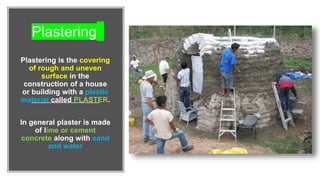
Plastering is the covering
of rough and uneven
surface in the
construction of a house
or building with a plastic
material called PLASTER.
In general plaster is made
of lime or cement
concrete along with sand
and water
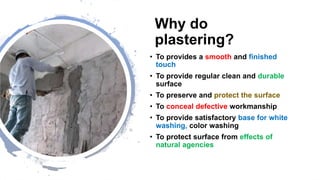
Why do
plastering?
• To provides a smooth and finished
touch
• To provide regular clean and durable
surface
• To preserve and protect the surface
• To conceal defective workmanship
• To provide satisfactory base for white
washing, color washing
• To protect surface from effects of
natural agencies
A good plaster is
• Cheap and economical
• Hard and durable
• Should adhere to surface firmly in
all weather conditions
• Should effectively resist moisture
entry from surface
• Should possess good workability
• Should be able to apply during all
weather conditions
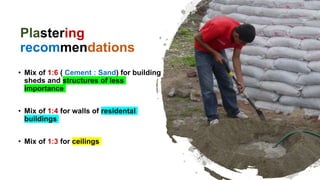
Plastering
recommendations
• Mix of 1:6 ( Cement : Sand) for building
sheds and structures of less
importance
• Mix of 1:4 for walls of residental
buildings
• Mix of 1:3 for ceilings
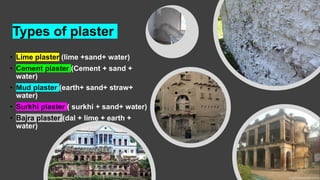
Types of plaster
• Lime plaster (lime +sand+ water)
• Cement plaster (Cement + sand +
water)
• Mud plaster (earth+ sand+ straw+
water)
• Surkhi plaster ( surkhi + sand+ water)
• Bajra plaster (dal + lime + earth +
water)
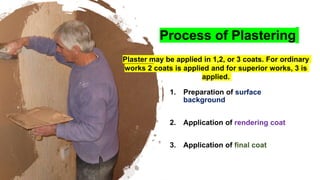
Process of Plastering
1. Preparation of surface
background
2. Application of rendering coat
3. Application of final coat
Plaster may be applied in 1,2, or 3 coats. For ordinary
works 2 coats is applied and for superior works, 3 is
applied.
Procedure for
Plastering1. Rack mortar joints to a depth of 20
mm
2. Clean the surface and water it well
3. Use stiff wire brush to remove all
dust
4. If surface to be plastered is very
rough and uneven, apply preliminary
coat before first coat .
5. Fix dots by using small amount of
plaster on a surface of 2m x 2m . This
helps to lay a uniform thickness of
plaster
6. Apply about 10-12 mm thick coat of
plaster
7. Finish the surface properly by using
a floating ruler

Plastering by mani

  • 1.
  • 2.
    Plastering Plastering is thecovering of rough and uneven surface in the construction of a house or building with a plastic material called PLASTER. In general plaster is made of lime or cement concrete along with sand and water
  • 3.
    Why do plastering? • Toprovides a smooth and finished touch • To provide regular clean and durable surface • To preserve and protect the surface • To conceal defective workmanship • To provide satisfactory base for white washing, color washing • To protect surface from effects of natural agencies
  • 4.
    A good plasteris • Cheap and economical • Hard and durable • Should adhere to surface firmly in all weather conditions • Should effectively resist moisture entry from surface • Should possess good workability • Should be able to apply during all weather conditions
  • 5.
    Plastering recommendations • Mix of1:6 ( Cement : Sand) for building sheds and structures of less importance • Mix of 1:4 for walls of residental buildings • Mix of 1:3 for ceilings
  • 6.
    Types of plaster •Lime plaster (lime +sand+ water) • Cement plaster (Cement + sand + water) • Mud plaster (earth+ sand+ straw+ water) • Surkhi plaster ( surkhi + sand+ water) • Bajra plaster (dal + lime + earth + water)
  • 7.
    Process of Plastering 1.Preparation of surface background 2. Application of rendering coat 3. Application of final coat Plaster may be applied in 1,2, or 3 coats. For ordinary works 2 coats is applied and for superior works, 3 is applied.
  • 8.
    Procedure for Plastering1. Rackmortar joints to a depth of 20 mm 2. Clean the surface and water it well 3. Use stiff wire brush to remove all dust 4. If surface to be plastered is very rough and uneven, apply preliminary coat before first coat . 5. Fix dots by using small amount of plaster on a surface of 2m x 2m . This helps to lay a uniform thickness of plaster 6. Apply about 10-12 mm thick coat of plaster 7. Finish the surface properly by using a floating ruler