Refrigeration and Air
Conditioning
Unit IV
Psychrometry and Air
Conditioning Load Estimation 
By 
N.S. AHER 
Assistant Professor 
Department of Mechanical Engineering, 
Sanjivani College of Engineering, Kopargaon 
 
• Psychrometry is the study of the properties of
mixtures of air and water vapour.
• Atmospheric air is a mixture of many gases plus
water vapour and a number of pollutants
• Moist air is a mixture of various gases that
constitute air and water vapour
• As mentioned before the air to be processed in
air conditioning systems is a mixture of dry air
and water vapour. While the composition of dry
air is constant, the amount of water vapour
present in the air may vary from zero to a
maximum depending upon the temperature and
pressure of the mixture (dry air + water vapour).  
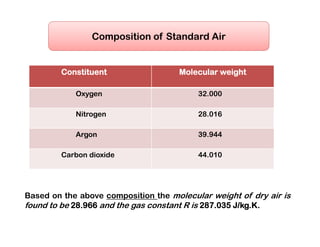
Constituent Molecular weight
Oxygen 32.000
Nitrogen 28.016
Argon 39.944
Carbon dioxide 44.010
Composition of Standard Air
Based on the above composition the molecular weight of dry air is
found to be 28.966 and the gas constant R is 287.035 J/kg.K.
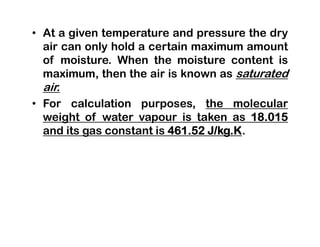
• At a given temperature and pressure the dry
air can only hold a certain maximum amount
of moisture. When the moisture content is
maximum, then the air is known as saturated
air.
• For calculation purposes, the molecular
weight of water vapour is taken as 18.015
and its gas constant is 461.52 J/kg.K.
 
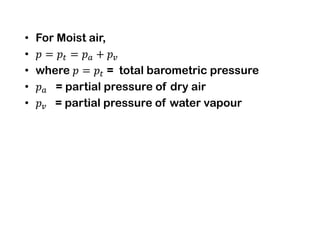
• For Moist air,
•
• where = total barometric pressure
• = partial pressure of dry air
• = partial pressure of water vapour
 
• Dry bulb temperature (DBT) is the temperature of the
moist air as measured by a standard thermometer or
other temperature measuring instruments
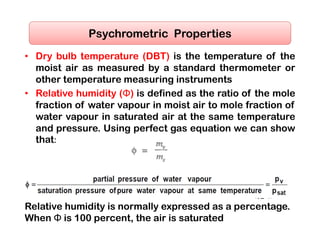
• Relative humidity (Φ) is defined as the ratio of the mole
fraction of water vapour in moist air to mole fraction of
water vapour in saturated air at the same temperature
and pressure. Using perfect gas equation we can show
that: 


Psychrometric Properties
Relative humidity is normally expressed as a percentage.
When Φ is 100 percent, the air is saturated
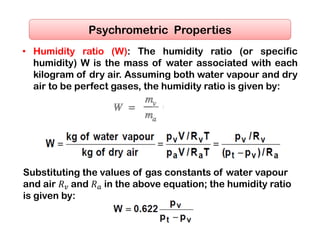
• Humidity ratio (W): The humidity ratio (or specific
humidity) W is the mass of water associated with each
kilogram of dry air. Assuming both water vapour and dry
air to be perfect gases, the humidity ratio is given by:
Psychrometric Properties
Substituting the values of gas constants of water vapour
and air 𝑅 and 𝑅 in the above equation; the humidity ratio
is given by:
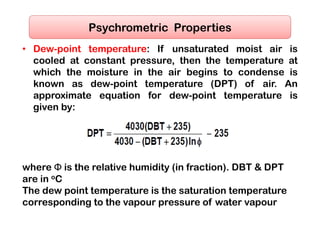
• Dew-point temperature: If unsaturated moist air is
cooled at constant pressure, then the temperature at
which the moisture in the air begins to condense is
known as dew-point temperature (DPT) of air. An
approximate equation for dew-point temperature is
given by:
Psychrometric Properties
where Φ is the relative humidity (in fraction). DBT & DPT
are in oC
The dew point temperature is the saturation temperature
corresponding to the vapour pressure of water vapour
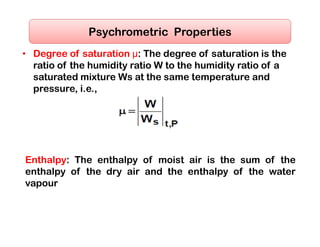
• Degree of saturation μ: The degree of saturation is the
ratio of the humidity ratio W to the humidity ratio of a
saturated mixture Ws at the same temperature and
pressure, i.e.,
Psychrometric Properties
Enthalpy: The enthalpy of moist air is the sum of the
enthalpy of the dry air and the enthalpy of the water
vapour
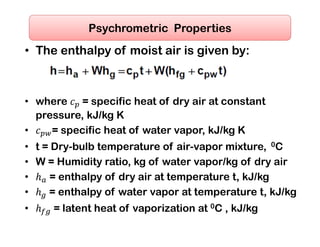
• The enthalpy of moist air is given by:
 
 
• where = specific heat of dry air at constant
pressure, kJ/kg K
• = specific heat of water vapor, kJ/kg K
• t = Dry-bulb temperature of air-vapor mixture, 0C
• W = Humidity ratio, kg of water vapor/kg of dry air
• = enthalpy of dry air at temperature t, kJ/kg
• = enthalpy of water vapor at temperature t, kJ/kg
• = latent heat of vaporization at 0C , kJ/kg
Psychrometric Properties
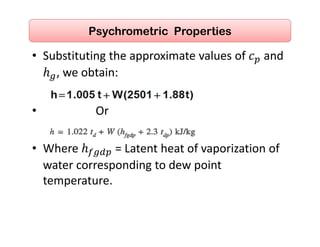
• Substituting the approximate values of   and 
, we obtain: 
 
•                   Or 
 
• Where   = Latent heat of vaporization of 
water corresponding to dew point 
temperature. 
Psychrometric Properties
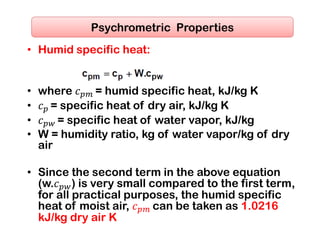
• Humid specific heat:
• where = humid specific heat, kJ/kg K
• = specific heat of dry air, kJ/kg K
• = specific heat of water vapor, kJ/kg
• W = humidity ratio, kg of water vapor/kg of dry
air
• Since the second term in the above equation
(w. ) is very small compared to the first term,
for all practical purposes, the humid specific
heat of moist air, can be taken as 1.0216
kJ/kg dry air K
Psychrometric Properties
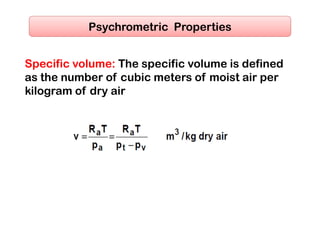
Specific volume: The specific volume is defined
as the number of cubic meters of moist air per
kilogram of dry air
Psychrometric Properties
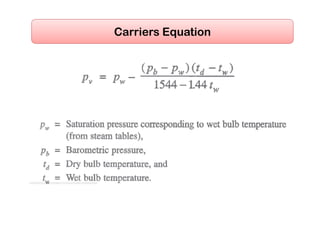
Carriers Equation
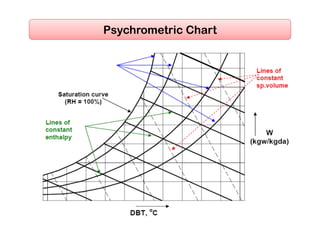
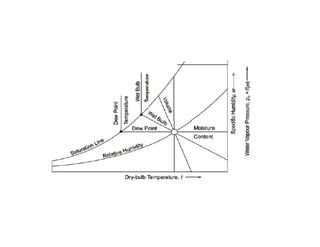
• A Psychrometric chart graphically represents
the thermodynamic properties of moist air.
Standard psychrometric charts are bounded by
the dry-bulb temperature line (abscissa) and the
vapour pressure or humidity ratio (ordinate).
The Left Hand Side of the psychrometric chart
is bounded by the saturation line.
• Psychrometric charts are readily available for
standard barometric pressure of 101.325 kPa at
sea level and for normal temperatures (0-50oC)
Psychrometric Chart
Psychrometric Chart
• Based on Gibbs’ phase rule, the thermodynamic
state of moist air is uniquely fixed if the
barometric pressure and two other independent
properties are known. This means that at a
given barometric pressure, the state of moist
air can be determined by measuring any two
independent properties. One of them could be
the dry-bulb temperature (DBT), as the
measurement of this temperature is fairly
simple and accurate.
• Compared to DPT, it is easier to measure the
wet-bulb temperature of moist air. Thus
knowing the dry-bulb and wet-bulb
temperatures from measurements, it is possible
to find the other properties of moist air
Measurement of psychrometric properties:
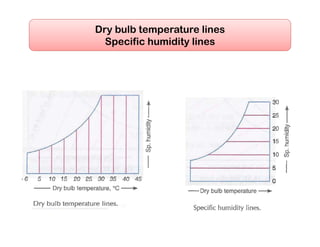
Dry bulb temperature lines
Specific humidity lines
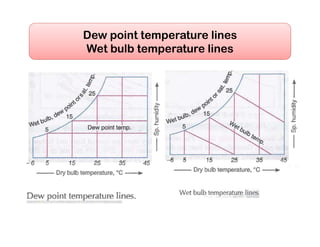
Dew point temperature lines
Wet bulb temperature lines
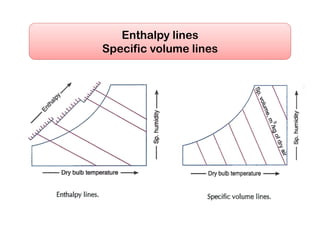
Enthalpy lines
Specific volume lines
Relative humidity lines
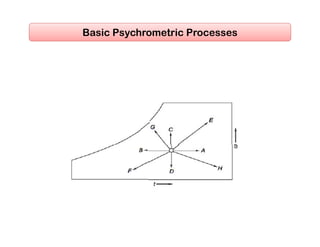
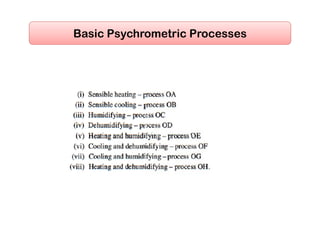
Basic Psychrometric Processes
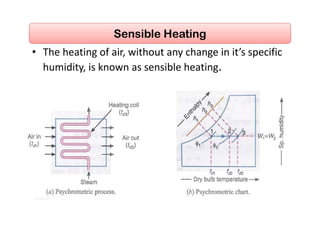
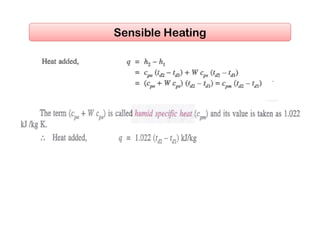
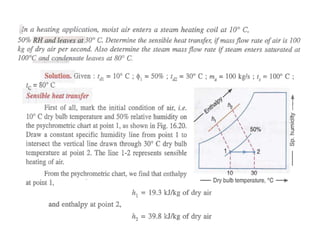
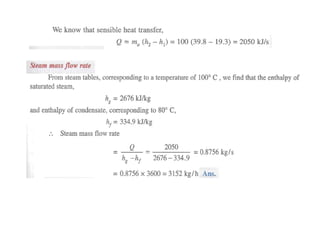
• The heating of air, without any change in it’s specific 
humidity, is known as sensible heating. 
Sensible Heating
Sensible Heating
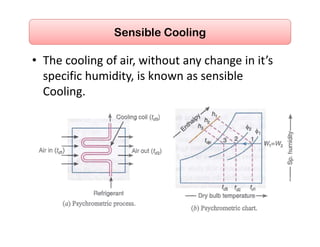
• The cooling of air, without any change in it’s 
specific humidity, is known as sensible 
Cooling. 
 
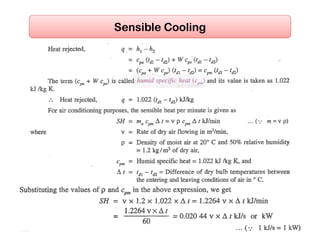
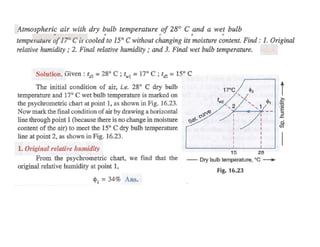
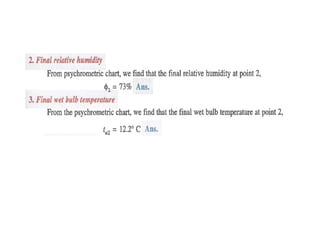
Sensible Cooling
Sensible Cooling
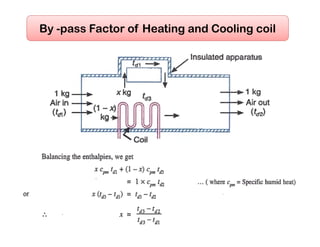
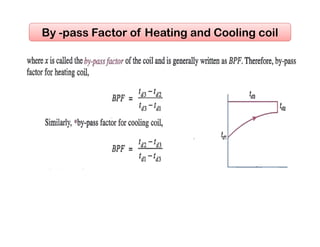
By -pass Factor of Heating and Cooling coil
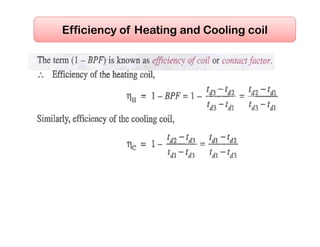
Efficiency of Heating and Cooling coil
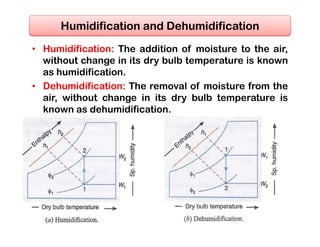
• Humidification: The addition of moisture to the air,
without change in its dry bulb temperature is known
as humidification.
• Dehumidification: The removal of moisture from the
air, without change in its dry bulb temperature is
known as dehumidification.
 
Humidification and DehumidificationHumidification and Dehumidification
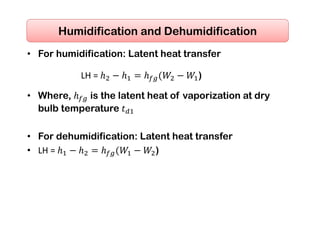
• For humidification: Latent heat transfer
• Where, ℎ is the latent heat of vaporization at dry
bulb temperature 𝑡
• For dehumidification: Latent heat transfer
• LH = ℎ ℎ ℎ 𝑊 𝑊 )
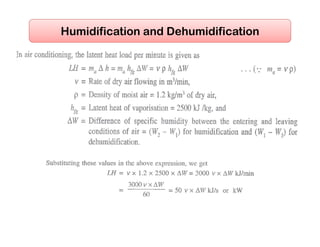
Humidification and Dehumidification
LH = ℎ ℎ ℎ 𝑊 𝑊 )
Humidification and Dehumidification
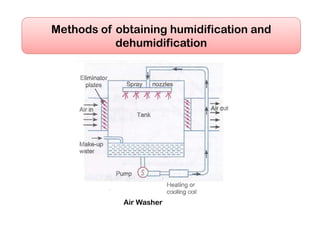
Methods of obtaining humidification and
dehumidification
Air Washer


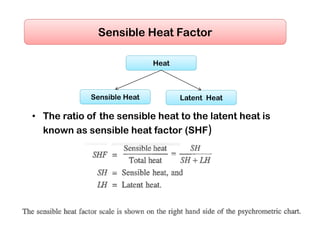
• The ratio of the sensible heat to the latent heat is
known as sensible heat factor (SHF) 
 
Sensible Heat Factor
Heat
Latent HeatSensible Heat
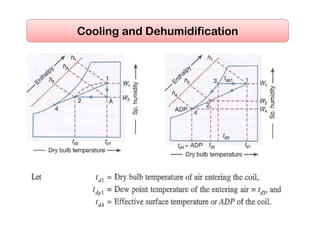
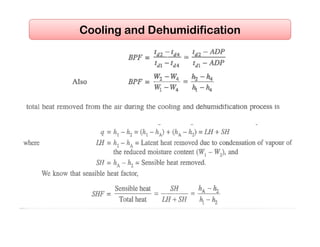
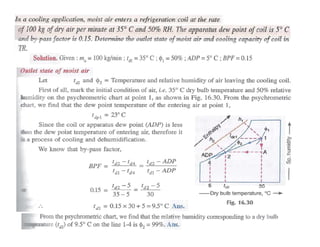
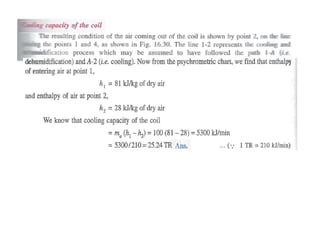
Cooling and Dehumidification
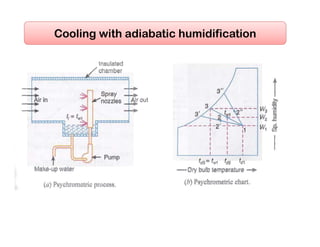
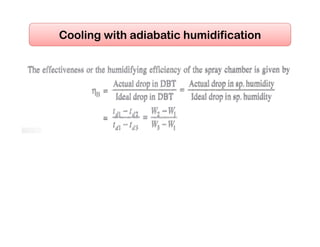
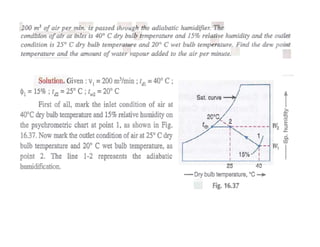
Cooling with adiabatic humidification
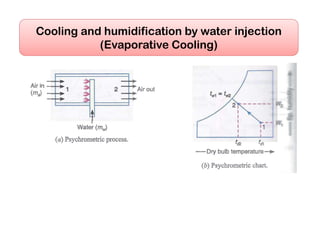
Cooling and humidification by water injection
(Evaporative Cooling)
Cooling and humidification by water injection
(Evaporative Cooling)
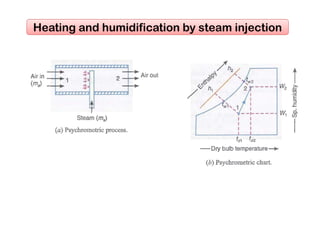
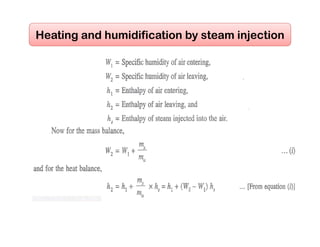
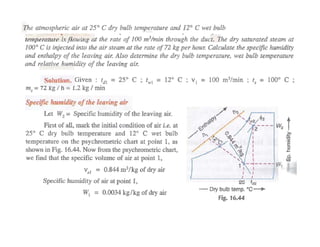
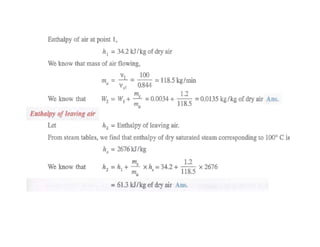
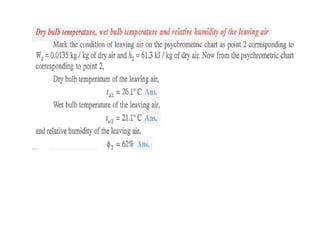
Heating and humidification by steam injection
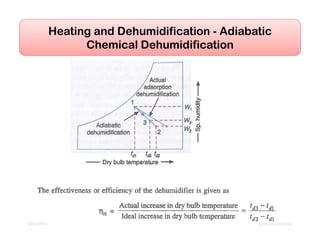
Heating and Dehumidification - Adiabatic
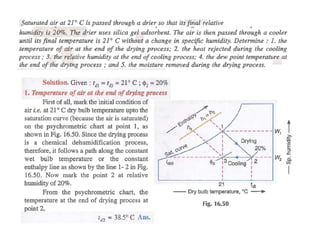
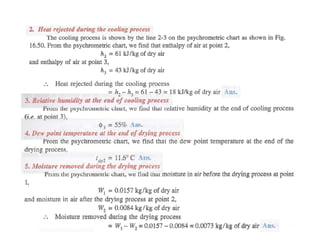
Chemical Dehumidification
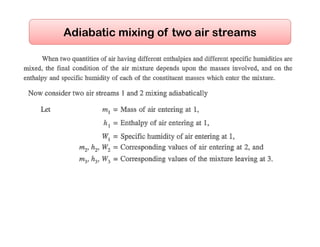
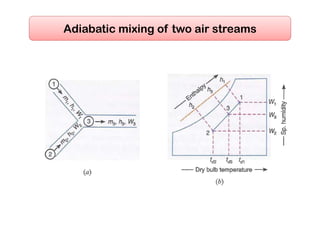
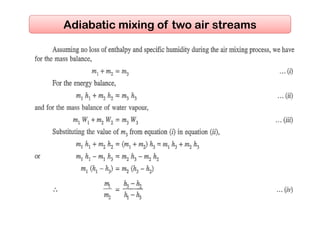
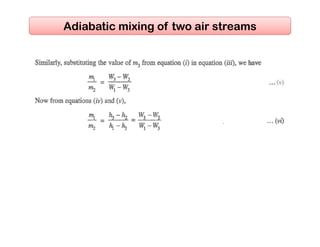
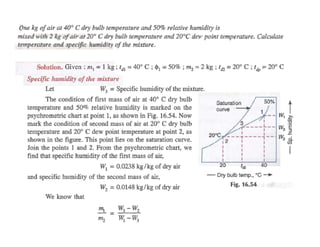
Adiabatic mixing of two air streams
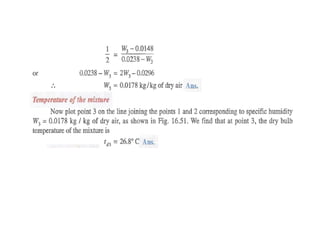
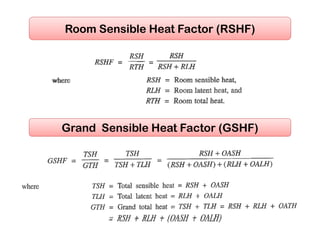
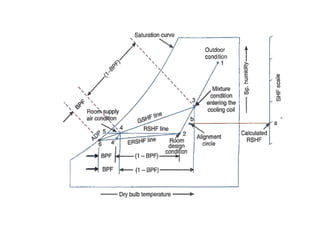
Room Sensible Heat Factor (RSHF)
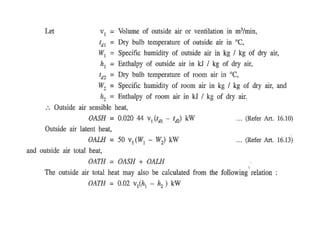
Grand Sensible Heat Factor (GSHF)
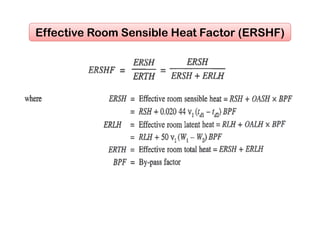
Effective Room Sensible Heat Factor (ERSHF)
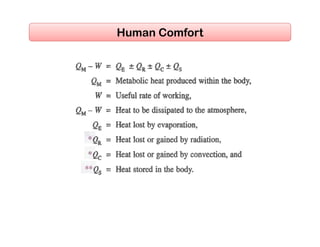
• Human Comfort: Human comfort is that condition of
mind, which expresses satisfaction with the thermal
environment.
• A human body feels comfortable when the heat
produced by t metabolism of human body is equal to
the sum of heat dissipated to the surroundings and
the heat stored in human body by raising the
temperature of body tissues.
Human Comfort
Human Comfort
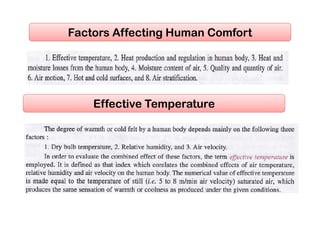
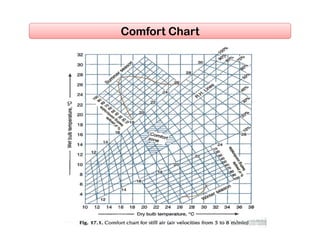
Factors Affecting Human Comfort
Effective Temperature
Comfort Chart
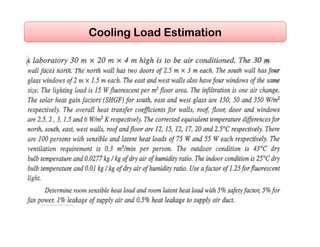
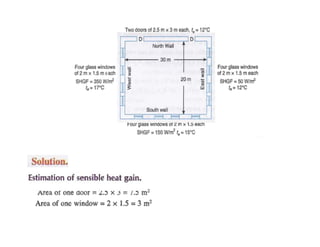
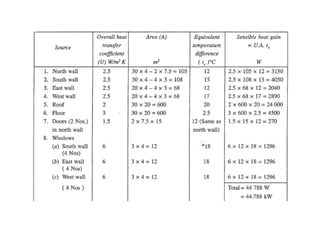
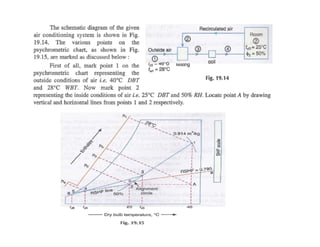
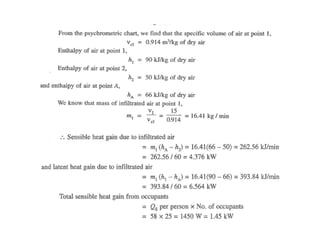
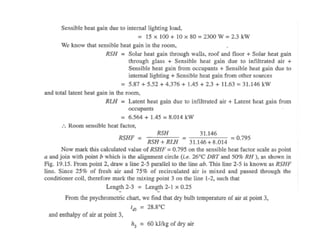
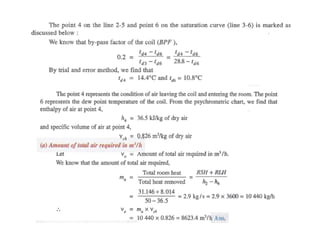
Cooling Load Estimation
Psychrometry and Air conditioning load estimation

Psychrometry and Air conditioning load estimation

  • 1.
    Refrigeration and Air Conditioning UnitIV Psychrometry and Air Conditioning Load Estimation  By  N.S. AHER  Assistant Professor  Department of Mechanical Engineering,  Sanjivani College of Engineering, Kopargaon   
  • 2.
    • Psychrometry isthe study of the properties of mixtures of air and water vapour. • Atmospheric air is a mixture of many gases plus water vapour and a number of pollutants • Moist air is a mixture of various gases that constitute air and water vapour • As mentioned before the air to be processed in air conditioning systems is a mixture of dry air and water vapour. While the composition of dry air is constant, the amount of water vapour present in the air may vary from zero to a maximum depending upon the temperature and pressure of the mixture (dry air + water vapour).  
  • 3.
    Constituent Molecular weight Oxygen32.000 Nitrogen 28.016 Argon 39.944 Carbon dioxide 44.010 Composition of Standard Air Based on the above composition the molecular weight of dry air is found to be 28.966 and the gas constant R is 287.035 J/kg.K.
  • 4.
    • At agiven temperature and pressure the dry air can only hold a certain maximum amount of moisture. When the moisture content is maximum, then the air is known as saturated air. • For calculation purposes, the molecular weight of water vapour is taken as 18.015 and its gas constant is 461.52 J/kg.K.  
  • 5.
    • For Moistair, • • where = total barometric pressure • = partial pressure of dry air • = partial pressure of water vapour  
  • 6.
    • Dry bulbtemperature (DBT) is the temperature of the moist air as measured by a standard thermometer or other temperature measuring instruments • Relative humidity (Φ) is defined as the ratio of the mole fraction of water vapour in moist air to mole fraction of water vapour in saturated air at the same temperature and pressure. Using perfect gas equation we can show that:              Psychrometric Properties Relative humidity is normally expressed as a percentage. When Φ is 100 percent, the air is saturated
  • 7.
    • Humidity ratio(W): The humidity ratio (or specific humidity) W is the mass of water associated with each kilogram of dry air. Assuming both water vapour and dry air to be perfect gases, the humidity ratio is given by: Psychrometric Properties Substituting the values of gas constants of water vapour and air 𝑅 and 𝑅 in the above equation; the humidity ratio is given by:
  • 8.
    • Dew-point temperature:If unsaturated moist air is cooled at constant pressure, then the temperature at which the moisture in the air begins to condense is known as dew-point temperature (DPT) of air. An approximate equation for dew-point temperature is given by: Psychrometric Properties where Φ is the relative humidity (in fraction). DBT & DPT are in oC The dew point temperature is the saturation temperature corresponding to the vapour pressure of water vapour
  • 9.
    • Degree ofsaturation μ: The degree of saturation is the ratio of the humidity ratio W to the humidity ratio of a saturated mixture Ws at the same temperature and pressure, i.e., Psychrometric Properties Enthalpy: The enthalpy of moist air is the sum of the enthalpy of the dry air and the enthalpy of the water vapour
  • 10.
    • The enthalpyof moist air is given by:     • where = specific heat of dry air at constant pressure, kJ/kg K • = specific heat of water vapor, kJ/kg K • t = Dry-bulb temperature of air-vapor mixture, 0C • W = Humidity ratio, kg of water vapor/kg of dry air • = enthalpy of dry air at temperature t, kJ/kg • = enthalpy of water vapor at temperature t, kJ/kg • = latent heat of vaporization at 0C , kJ/kg Psychrometric Properties
  • 11.
    • Substituting the approximate values of   and  , we obtain:    •                  Or    • Where   = Latent heat of vaporization of  water corresponding to dew point  temperature.  Psychrometric Properties
  • 12.
    • Humid specificheat: • where = humid specific heat, kJ/kg K • = specific heat of dry air, kJ/kg K • = specific heat of water vapor, kJ/kg • W = humidity ratio, kg of water vapor/kg of dry air • Since the second term in the above equation (w. ) is very small compared to the first term, for all practical purposes, the humid specific heat of moist air, can be taken as 1.0216 kJ/kg dry air K Psychrometric Properties
  • 13.
    Specific volume: Thespecific volume is defined as the number of cubic meters of moist air per kilogram of dry air Psychrometric Properties
  • 14.
  • 15.
    • A Psychrometricchart graphically represents the thermodynamic properties of moist air. Standard psychrometric charts are bounded by the dry-bulb temperature line (abscissa) and the vapour pressure or humidity ratio (ordinate). The Left Hand Side of the psychrometric chart is bounded by the saturation line. • Psychrometric charts are readily available for standard barometric pressure of 101.325 kPa at sea level and for normal temperatures (0-50oC) Psychrometric Chart
  • 16.
  • 18.
    • Based onGibbs’ phase rule, the thermodynamic state of moist air is uniquely fixed if the barometric pressure and two other independent properties are known. This means that at a given barometric pressure, the state of moist air can be determined by measuring any two independent properties. One of them could be the dry-bulb temperature (DBT), as the measurement of this temperature is fairly simple and accurate. • Compared to DPT, it is easier to measure the wet-bulb temperature of moist air. Thus knowing the dry-bulb and wet-bulb temperatures from measurements, it is possible to find the other properties of moist air Measurement of psychrometric properties:
  • 19.
    Dry bulb temperaturelines Specific humidity lines
  • 20.
    Dew point temperaturelines Wet bulb temperature lines
  • 21.
  • 22.
  • 23.
  • 24.
  • 30.
  • 31.
  • 34.
  • 35.
  • 38.
    By -pass Factorof Heating and Cooling coil
  • 39.
    By -pass Factorof Heating and Cooling coil
  • 40.
    Efficiency of Heatingand Cooling coil
  • 41.
    • Humidification: Theaddition of moisture to the air, without change in its dry bulb temperature is known as humidification. • Dehumidification: The removal of moisture from the air, without change in its dry bulb temperature is known as dehumidification.   Humidification and DehumidificationHumidification and Dehumidification
  • 42.
    • For humidification:Latent heat transfer • Where, ℎ is the latent heat of vaporization at dry bulb temperature 𝑡 • For dehumidification: Latent heat transfer • LH = ℎ ℎ ℎ 𝑊 𝑊 ) Humidification and Dehumidification LH = ℎ ℎ ℎ 𝑊 𝑊 )
  • 43.
  • 44.
    Methods of obtaininghumidification and dehumidification Air Washer
  • 45.
          • The ratioof the sensible heat to the latent heat is known as sensible heat factor (SHF)    Sensible Heat Factor Heat Latent HeatSensible Heat
  • 46.
  • 47.
  • 50.
    Cooling with adiabatichumidification
  • 51.
    Cooling with adiabatichumidification
  • 52.
    Cooling and humidificationby water injection (Evaporative Cooling)
  • 53.
    Cooling and humidificationby water injection (Evaporative Cooling)
  • 56.
    Heating and humidificationby steam injection
  • 57.
    Heating and humidificationby steam injection
  • 61.
    Heating and Dehumidification- Adiabatic Chemical Dehumidification
  • 64.
    Adiabatic mixing oftwo air streams
  • 65.
    Adiabatic mixing oftwo air streams
  • 66.
    Adiabatic mixing oftwo air streams
  • 67.
    Adiabatic mixing oftwo air streams
  • 70.
    Room Sensible HeatFactor (RSHF) Grand Sensible Heat Factor (GSHF)
  • 72.
    Effective Room SensibleHeat Factor (ERSHF)
  • 74.
    • Human Comfort:Human comfort is that condition of mind, which expresses satisfaction with the thermal environment. • A human body feels comfortable when the heat produced by t metabolism of human body is equal to the sum of heat dissipated to the surroundings and the heat stored in human body by raising the temperature of body tissues. Human Comfort
  • 75.
  • 76.
    Factors Affecting HumanComfort Effective Temperature
  • 77.
  • 78.