By Tushar Mistry
B.E. Mechanical
H – Heating
V – Ventilating
A – Air
C - Conditioning
What are we Going to Learn?
 Basics of refrigeration & HVAC
 Working cycles of HVAC
 Components of HVAC
 Functions of HVAC components
 Study Of Compressor & Condenser
 Study of Evaporator & Refrigerants
 Refrigerant handling and replacement
 Inspection & Breakdown Maintenance
 Malls, Hotel, Multiplex, Inspection & Breakdown
Maintenance
What is the purpose of HVAC ?
It conditions the air, transports it, and introduces it to
the conditioned space. It provides heating and cooling
from its central plant . It also controls and maintains
the temperature, humidity, air movement, air
cleanliness, sound level, and pressure differential in a
space within predetermined limits for the comfort and
health of the occupants of the conditioned space or for
the purpose of product processing.
What is TR?
 1 TR is amount of heat required to melt one
metric ton of ice in 24 hours.
 1 TR (Ton of Refrigeration) = 12000 BTU / hr
 1 TR (Ton of Refrigeration) = 3024 Kcal / hr
 1 TR (Ton of Refrigeration) = 3.51 KW
H - Heating
 Heat is a form of energy
 Molecules in motion
 Flows from a substance with more heat to one with less
heat
 Unit = Joule (J)
 W = J/S = N.M/S
Sensible Heat & latent Heat
 Sensible Heat
If heat added or removed from substance , it changes it
temperature then its called as sensible heat.
 Latent Heat
If heat is added or removed it changes the state of
substance then its called as latent heat.
Heat Transfer Modes
Conduction
Convection
Radiation
 Specific Heat
Amount of heat required to change a unit mass of
substance by one degree temperature.
 Saturation Temperature
Temperature for corresponding saturation pressure at
which the liquid boils into its vapour phase.
 Enthalpy
Total heat content of the system
V - Ventilation
A – Air
C - Conditioning
An air conditioning, or HVAC, system is composed of
components and equipment arranged in sequence to
condition the air, to transport it to the conditioned
space, and to control the indoor environmental
parameters of a specific space within required limits.
Basic Refrigeration Cycle
Classification of Air Conditioning
System
 According to Application
1) Comfort Air Conditioning Systems
2) Process Air Conditioning Systems
 According to Construction & Operating
Characteristics
HVAC
systems
Floor MountedPackage
AirCondition
Package Air
Conditioning
Ceiling Mounted Package
AirConditioning
Ductable
AC
Direct ExpansionSystem
Central Air
Conditioning
IndirectExpansion
System
Non Ductable
AC
Split Air
Condition
Cascade Split AC
(Ceiling Mounted)
Floor MountedSplit
AC
Wall Mounted SplitAC
WindowAir
Condition
15
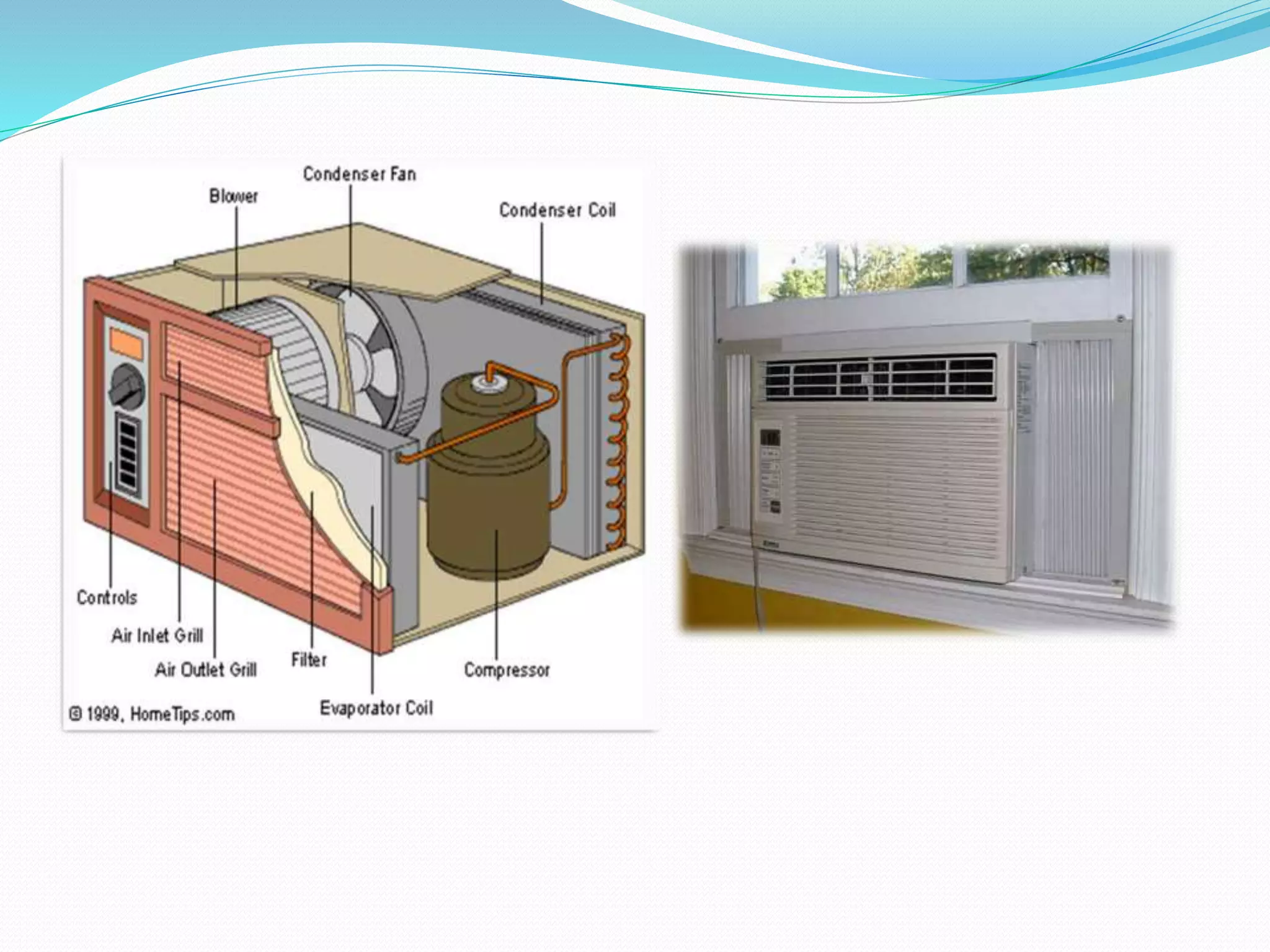
Windows Air Conditioning System
 Window air conditioners are one of the most commonly used
and cheapest type of air conditioners.
 To install one of these units, you need the space to make a slot in
the wall, and there should also be some open space behind the wall.
 Window air-conditioner units are reliable and simple-to-install
solution to keep a room cool while avoiding the costly construction of
a central air system.
 Better yet, when the summer heat dies down, these units can be
easily removed for storage, and you can use the window sill for other
purpose
Split Air-Conditioning System
The split air conditioner comprises of two parts: the
outdoorunitand the indoorunit
 The outdoor unit, fitted outside theroom, houses
components like the compressor, condenser and
expansionvalve.
 The indoor unit comprises the evaporator or cooling coil
and the cooling fan. For thisunit you don’t haveto make
anyslot in thewall of theroom.
 Further, the present day split units have aesthetic looks and
add to the beauty of the room. Thesplitairconditionercan
be used to cool one or tworooms
Central AC System
 Thecentral airconditioning plantsor thesystemsare
used when large buildings, hotels, theaters, airports,
shopping malls etc. are to be air conditioned completely.
 Thewindowand splitairconditioners are used for
single rooms orsmall officespaces.
 If the whole building is to be cooled it is not
economicallyviable toputwindow orsplitair
conditioner in each and everyroom.
 Further, thesesmall unitscannot satisfactorilycool the
large halls, auditoriums, receptions areasetc.
 Air System (AHU)
 Water System
 Central Plant
 Control System
Packaged AC System
 The window and split air conditioners are usually used forthe
small airconditioning capacitiesup to 5 tons.
 Thecentral airconditioning systemsareused for where the
cooling loads extend beyond 20tons.
 The packaged air conditioners are used for the cooling
capacities in between these twoextremes.
 The packaged airconditionersareavailable in the fixed rated
capacities of 3,5, 7, 10 and 15tons.
 These units are used commonly in places like restaurants,
telephone exchanges, homes,small halls, etc.
POTENTIALS AND CHALLENGES
 Providing a Healthy and Comfortable Indoor
Environment
 The Cleanest, Quietest, and Most Precise and Humid
Processing Environment
 Energy Use and Energy Efficiency
 Environmental Problems—CFCs and Global Warming
Goals of HVAC System
 Effectively control indoor environmental parameters,
usually to keep temperature and humidity within required
limits.
 Provide an adequate amount of outdoor ventilation air and
an acceptable indoor air quality.
 Use energy-efficient equipment and HVAC&R systems.
 Minimize ozone depletion and the global warming effect.
 Select cost-effective components and systems.
 Ensure proper maintenance, easy after-hour access, and
necessary fire protection and smoke control systems.
THANK YOU

Hvac introduction-Basics of HVAC

  • 1.
  • 2.
    H – Heating V– Ventilating A – Air C - Conditioning
  • 3.
    What are weGoing to Learn?  Basics of refrigeration & HVAC  Working cycles of HVAC  Components of HVAC  Functions of HVAC components  Study Of Compressor & Condenser  Study of Evaporator & Refrigerants  Refrigerant handling and replacement  Inspection & Breakdown Maintenance  Malls, Hotel, Multiplex, Inspection & Breakdown Maintenance
  • 4.
    What is thepurpose of HVAC ? It conditions the air, transports it, and introduces it to the conditioned space. It provides heating and cooling from its central plant . It also controls and maintains the temperature, humidity, air movement, air cleanliness, sound level, and pressure differential in a space within predetermined limits for the comfort and health of the occupants of the conditioned space or for the purpose of product processing.
  • 5.
    What is TR? 1 TR is amount of heat required to melt one metric ton of ice in 24 hours.  1 TR (Ton of Refrigeration) = 12000 BTU / hr  1 TR (Ton of Refrigeration) = 3024 Kcal / hr  1 TR (Ton of Refrigeration) = 3.51 KW
  • 6.
    H - Heating Heat is a form of energy  Molecules in motion  Flows from a substance with more heat to one with less heat  Unit = Joule (J)  W = J/S = N.M/S
  • 7.
    Sensible Heat &latent Heat  Sensible Heat If heat added or removed from substance , it changes it temperature then its called as sensible heat.  Latent Heat If heat is added or removed it changes the state of substance then its called as latent heat.
  • 9.
  • 10.
     Specific Heat Amountof heat required to change a unit mass of substance by one degree temperature.  Saturation Temperature Temperature for corresponding saturation pressure at which the liquid boils into its vapour phase.  Enthalpy Total heat content of the system
  • 11.
  • 12.
    A – Air C- Conditioning An air conditioning, or HVAC, system is composed of components and equipment arranged in sequence to condition the air, to transport it to the conditioned space, and to control the indoor environmental parameters of a specific space within required limits.
  • 13.
  • 14.
    Classification of AirConditioning System  According to Application 1) Comfort Air Conditioning Systems 2) Process Air Conditioning Systems  According to Construction & Operating Characteristics
  • 15.
    HVAC systems Floor MountedPackage AirCondition Package Air Conditioning CeilingMounted Package AirConditioning Ductable AC Direct ExpansionSystem Central Air Conditioning IndirectExpansion System Non Ductable AC Split Air Condition Cascade Split AC (Ceiling Mounted) Floor MountedSplit AC Wall Mounted SplitAC WindowAir Condition 15
  • 16.
    Windows Air ConditioningSystem  Window air conditioners are one of the most commonly used and cheapest type of air conditioners.  To install one of these units, you need the space to make a slot in the wall, and there should also be some open space behind the wall.  Window air-conditioner units are reliable and simple-to-install solution to keep a room cool while avoiding the costly construction of a central air system.  Better yet, when the summer heat dies down, these units can be easily removed for storage, and you can use the window sill for other purpose
  • 18.
    Split Air-Conditioning System Thesplit air conditioner comprises of two parts: the outdoorunitand the indoorunit  The outdoor unit, fitted outside theroom, houses components like the compressor, condenser and expansionvalve.  The indoor unit comprises the evaporator or cooling coil and the cooling fan. For thisunit you don’t haveto make anyslot in thewall of theroom.  Further, the present day split units have aesthetic looks and add to the beauty of the room. Thesplitairconditionercan be used to cool one or tworooms
  • 20.
    Central AC System Thecentral airconditioning plantsor thesystemsare used when large buildings, hotels, theaters, airports, shopping malls etc. are to be air conditioned completely.  Thewindowand splitairconditioners are used for single rooms orsmall officespaces.  If the whole building is to be cooled it is not economicallyviable toputwindow orsplitair conditioner in each and everyroom.  Further, thesesmall unitscannot satisfactorilycool the large halls, auditoriums, receptions areasetc.
  • 22.
     Air System(AHU)  Water System  Central Plant  Control System
  • 24.
    Packaged AC System The window and split air conditioners are usually used forthe small airconditioning capacitiesup to 5 tons.  Thecentral airconditioning systemsareused for where the cooling loads extend beyond 20tons.  The packaged air conditioners are used for the cooling capacities in between these twoextremes.  The packaged airconditionersareavailable in the fixed rated capacities of 3,5, 7, 10 and 15tons.  These units are used commonly in places like restaurants, telephone exchanges, homes,small halls, etc.
  • 26.
    POTENTIALS AND CHALLENGES Providing a Healthy and Comfortable Indoor Environment  The Cleanest, Quietest, and Most Precise and Humid Processing Environment  Energy Use and Energy Efficiency  Environmental Problems—CFCs and Global Warming
  • 27.
    Goals of HVACSystem  Effectively control indoor environmental parameters, usually to keep temperature and humidity within required limits.  Provide an adequate amount of outdoor ventilation air and an acceptable indoor air quality.  Use energy-efficient equipment and HVAC&R systems.  Minimize ozone depletion and the global warming effect.  Select cost-effective components and systems.  Ensure proper maintenance, easy after-hour access, and necessary fire protection and smoke control systems.
  • 30.