What is Transient Disturbance
 The term “transient” usually originates from electric circuit
theory where it describes voltage and current variation
from its present steady state to next steady state.
 In the power system, the term transient is usually used in a
different way. It denotes abrupt change in voltage and
current for short duration.
 Usually for duration less than the period of power system
voltage and current signal(50-60 Hz).
Why it is considered(Effects)
 Previously it was considered that transient disturbances are
only because of incorrect operation of circuit breakers and
switching of high voltage lines.
 Electronic equipment have very less voltage handling
capabilities.
 Temporal fluctuation produces parity error and interrupts
protection system
Causes of Transient disturbance
 Switching operation,faults, and other disturbances like
lightning.
 Shutdown of heavily loaded circuits.
 Necessary commutation of a high-powered network (e.g.
Pf correction).
Categorization(waveform shape)causes
 Oscillatory
 Impulsive
Oscillatory
Transients which shows damped oscillation with frequency
ranging from few kHz to several MHz resulting in
overshoot in respective voltage and current from its
expected values.
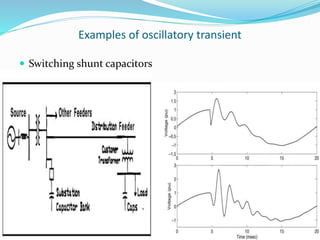
Examples of oscillatory transient
 Switching shunt capacitors
Cont..
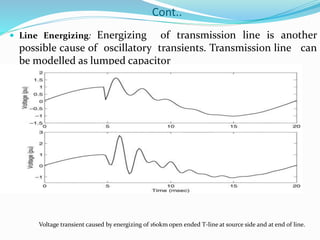
 Line Energizing: Energizing of transmission line is another
possible cause of oscillatory transients. Transmission line can
be modelled as lumped capacitor
Voltage transient caused by energizing of 160km open ended T-line at source side and at end of line.
Impulsive
 Impulsive transient is abrupt change in voltage ,current or
in both but only on one side (either +ve or –ve )
 Normally characterized by their rise and decay times.
 Quickly damped by resistive circuit elements and hence do
not propagate for from their origin point.
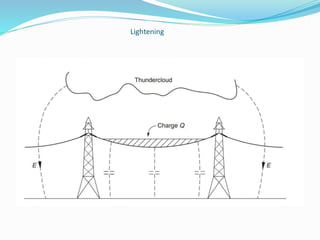
 The most common causes of impulsive transients are
lightning and electrostatic discharge.
cont..
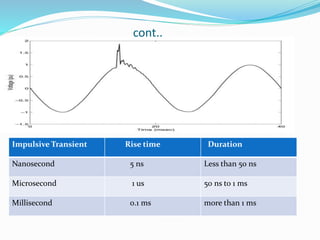
Impulsive Transient Rise time Duration
Nanosecond 5 ns Less than 50 ns
Microsecond 1 us 50 ns to 1 ms
Millisecond 0.1 ms more than 1 ms
Lightening
How it can be resolved
• For better power quality assessment ,we have to define new indices
(other than conventional) based on signal processing technique. As
present indices for transient disturbance analysis have limitations.
• Indices can also be defined on basis of time frequency analysis.
• Indices based on time domain analysis are crest factor , peak and RMS
value.
• Indices based on frequency domain are THD,Distortion Index ,K-factor.
These indices are defined in terms of Fourier series Coefficient.
THANK YOU

Introduction to Transient Disturbances of power system and its types

  • 1.
    What is TransientDisturbance  The term “transient” usually originates from electric circuit theory where it describes voltage and current variation from its present steady state to next steady state.  In the power system, the term transient is usually used in a different way. It denotes abrupt change in voltage and current for short duration.  Usually for duration less than the period of power system voltage and current signal(50-60 Hz).
  • 2.
    Why it isconsidered(Effects)  Previously it was considered that transient disturbances are only because of incorrect operation of circuit breakers and switching of high voltage lines.  Electronic equipment have very less voltage handling capabilities.  Temporal fluctuation produces parity error and interrupts protection system
  • 3.
    Causes of Transientdisturbance  Switching operation,faults, and other disturbances like lightning.  Shutdown of heavily loaded circuits.  Necessary commutation of a high-powered network (e.g. Pf correction).
  • 4.
    Categorization(waveform shape)causes  Oscillatory Impulsive Oscillatory Transients which shows damped oscillation with frequency ranging from few kHz to several MHz resulting in overshoot in respective voltage and current from its expected values.
  • 5.
    Examples of oscillatorytransient  Switching shunt capacitors
  • 6.
    Cont..  Line Energizing:Energizing of transmission line is another possible cause of oscillatory transients. Transmission line can be modelled as lumped capacitor Voltage transient caused by energizing of 160km open ended T-line at source side and at end of line.
  • 7.
    Impulsive  Impulsive transientis abrupt change in voltage ,current or in both but only on one side (either +ve or –ve )  Normally characterized by their rise and decay times.  Quickly damped by resistive circuit elements and hence do not propagate for from their origin point.  The most common causes of impulsive transients are lightning and electrostatic discharge.
  • 8.
    cont.. Impulsive Transient Risetime Duration Nanosecond 5 ns Less than 50 ns Microsecond 1 us 50 ns to 1 ms Millisecond 0.1 ms more than 1 ms
  • 9.
  • 10.
    How it canbe resolved • For better power quality assessment ,we have to define new indices (other than conventional) based on signal processing technique. As present indices for transient disturbance analysis have limitations. • Indices can also be defined on basis of time frequency analysis. • Indices based on time domain analysis are crest factor , peak and RMS value. • Indices based on frequency domain are THD,Distortion Index ,K-factor. These indices are defined in terms of Fourier series Coefficient.
  • 11.