Programmable Matter and Applications
Date 4th April 2016
• Introduction
• History
• Approaches to programmable matter
• Basic component/Examples
• Metamaterials
• Electropermanent magnet
• Claytronics
Content
Programmable matter is matter which has the ability to change its physical
properties (shape, density, moduli, conductivity, optical properties, etc.) in a
programmable fashion, based upon user input or autonomous sensing
Programmable matter is thus linked to the concept of a material which
inherently has the ability to perform information processing, networking
capability, power, actuation, programmable adhesion, sensing, and display
capabilities
Programmable matter
3/
water
- changing states in response to temperature isn't programmable.
 movie screen
- appears to have adjustable optical properties based on optical inputs, but it's
just reflecting.
 quartz
- really does have electrically adjustable shape, but no memory or processing.
Misconceptions
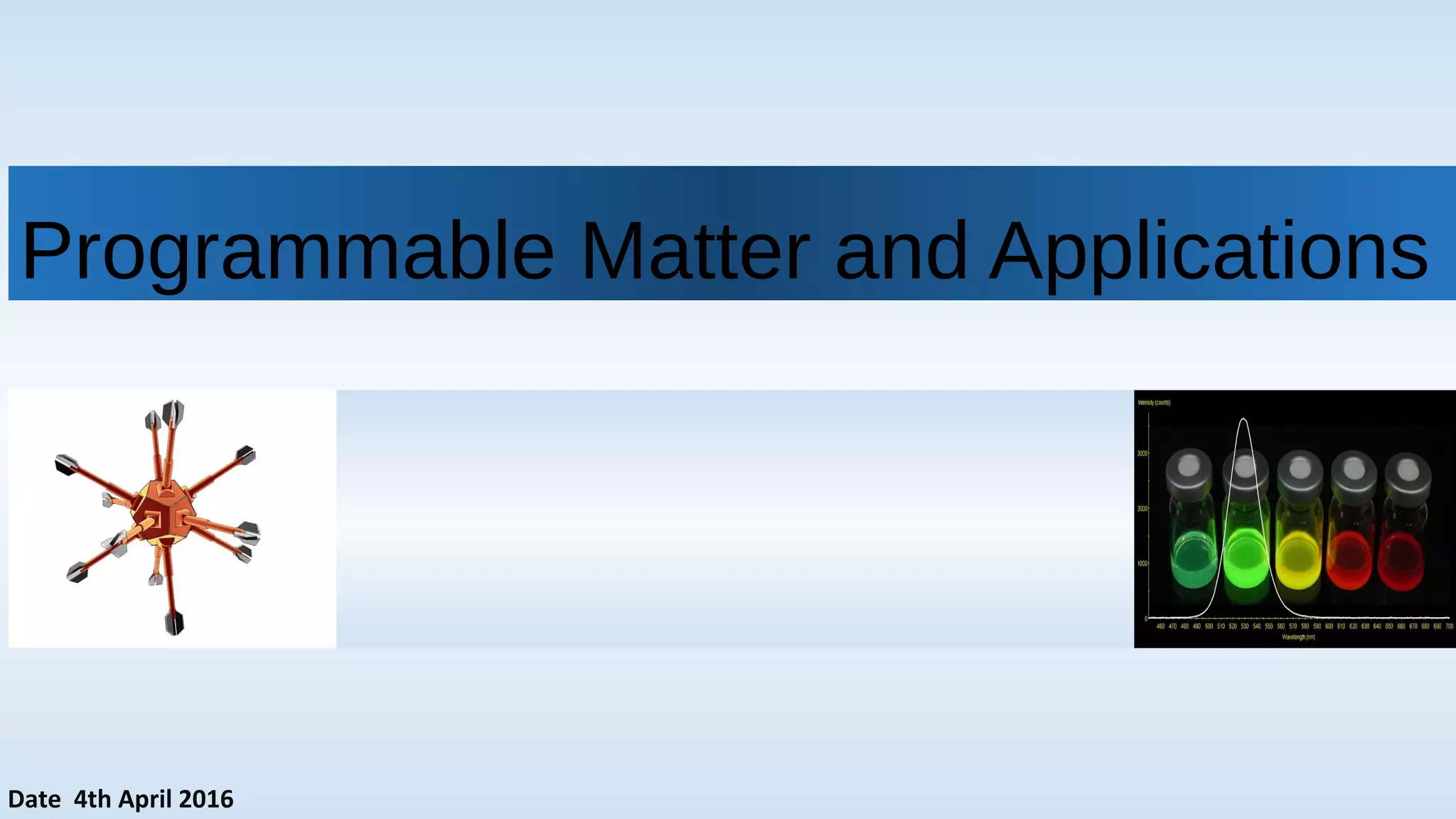
Programmable matter is a term originally used to refer to an ensemble of fine-grained
computing elements arranged in space
In the early 1990s, there was a significant amount of work in reconfigurable modular
robotics with a philosophy similar to programmable matter
As semiconductor technology, nanotechnology, and self-replicating machine technology
have advanced, the use of the term programmable matter has changed to reflect the
fact that it is possible to build an ensemble of elements which can be "programmed" to
change their physical properties in reality, not just in simulation.
History
5/
In one school of thought the programming could be external to the material and might be achieved by the "application of light, voltage,
electric or magnetic fields e.g. liquid crystal display(LCD)
A second school of thought is that the individual units of the ensemble can compute and the result of their computation is a change in the
ensemble's physical properties e.g. Claytronics
There are many proposed implementations of programmable matter. Scale is one key differentiator between different forms of
programmable matter
At one end of the spectrum reconfigurable modular robotics pursues a form of programmable matter where the individual units are in the
centimeter size range
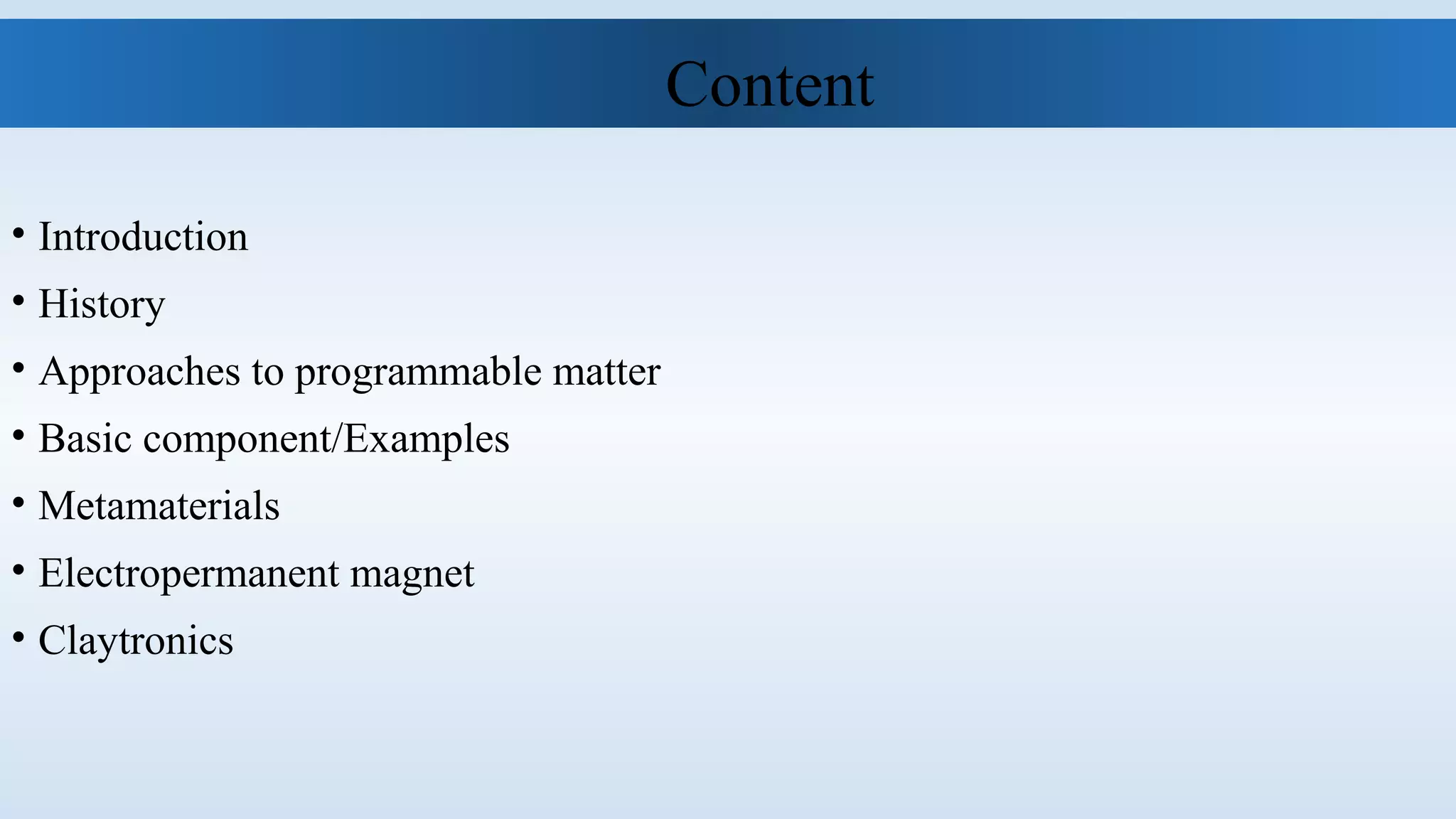
At the nanoscale end of the spectrum there are a tremendous number of different bases for programmable matter, ranging from shape
changing molecules to quantum dots
Approaches to PM
6/
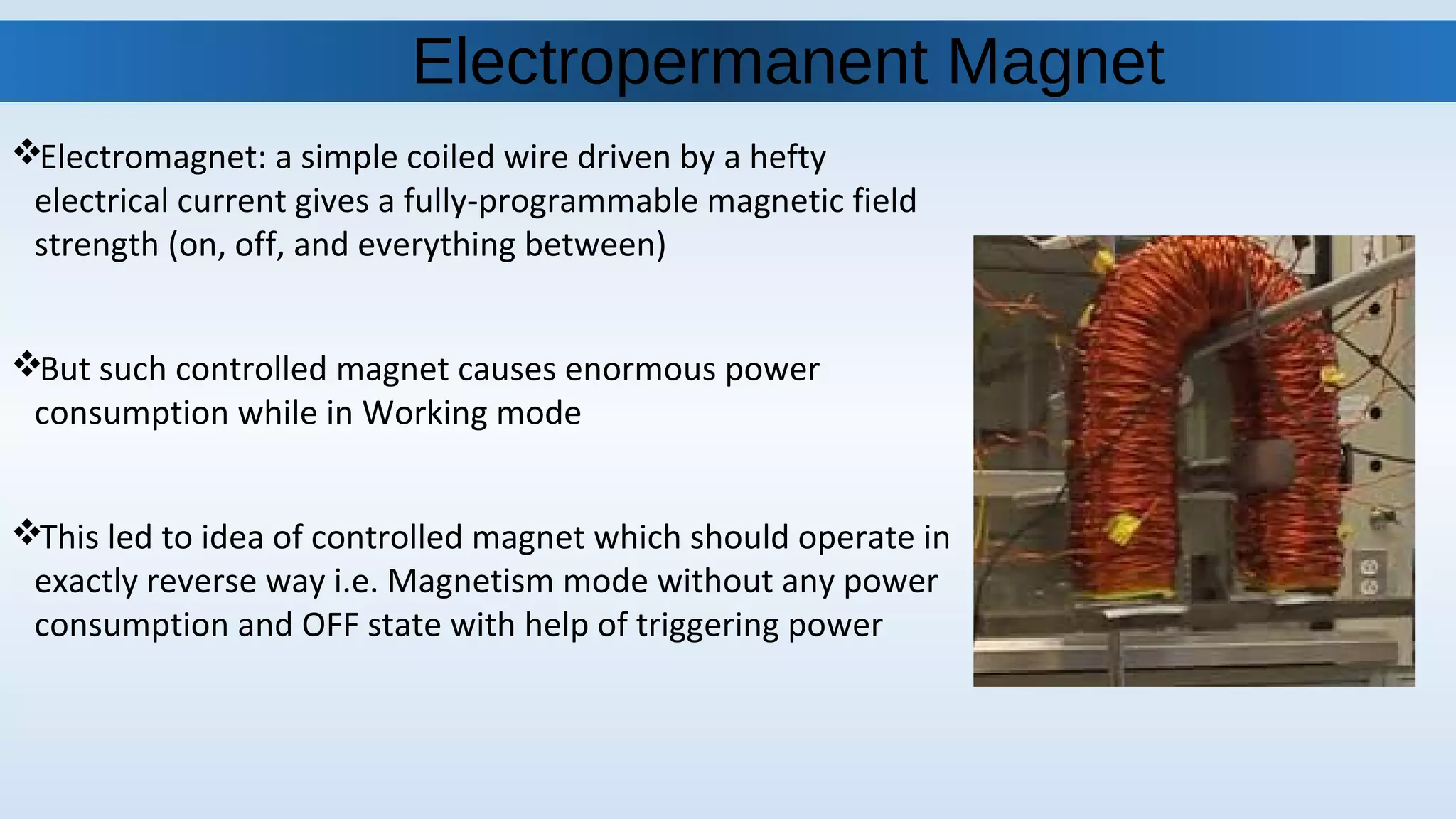
Electromagnet: a simple coiled wire driven by a hefty
electrical current gives a fully-programmable magnetic field
strength (on, off, and everything between)
But such controlled magnet causes enormous power
consumption while in Working mode
This led to idea of controlled magnet which should operate in
exactly reverse way i.e. Magnetism mode without any power
consumption and OFF state with help of triggering power
Electropermanent Magnet
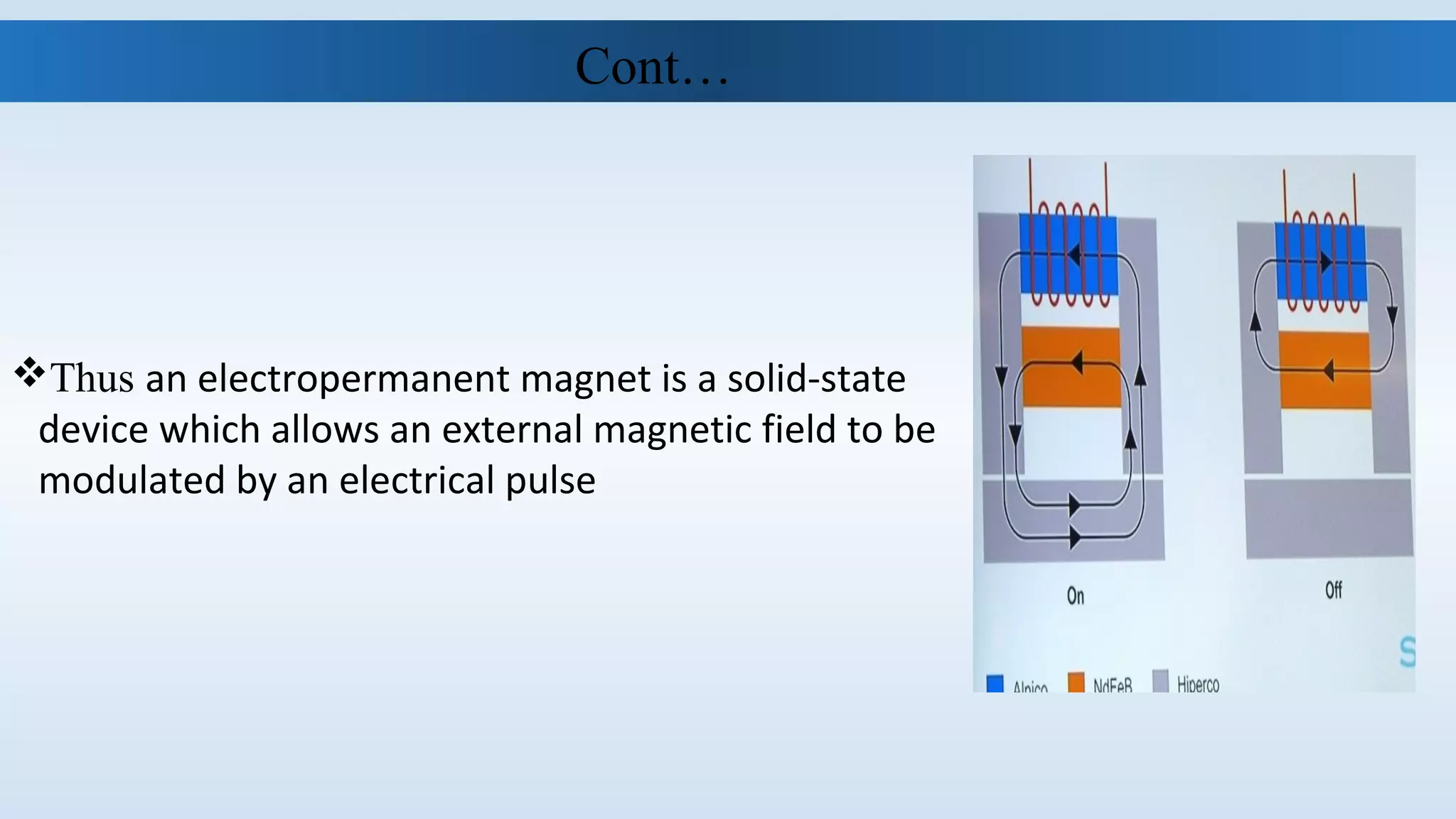
Thus an electropermanent magnet is a solid-state
device which allows an external magnetic field to be
modulated by an electrical pulse
Cont…
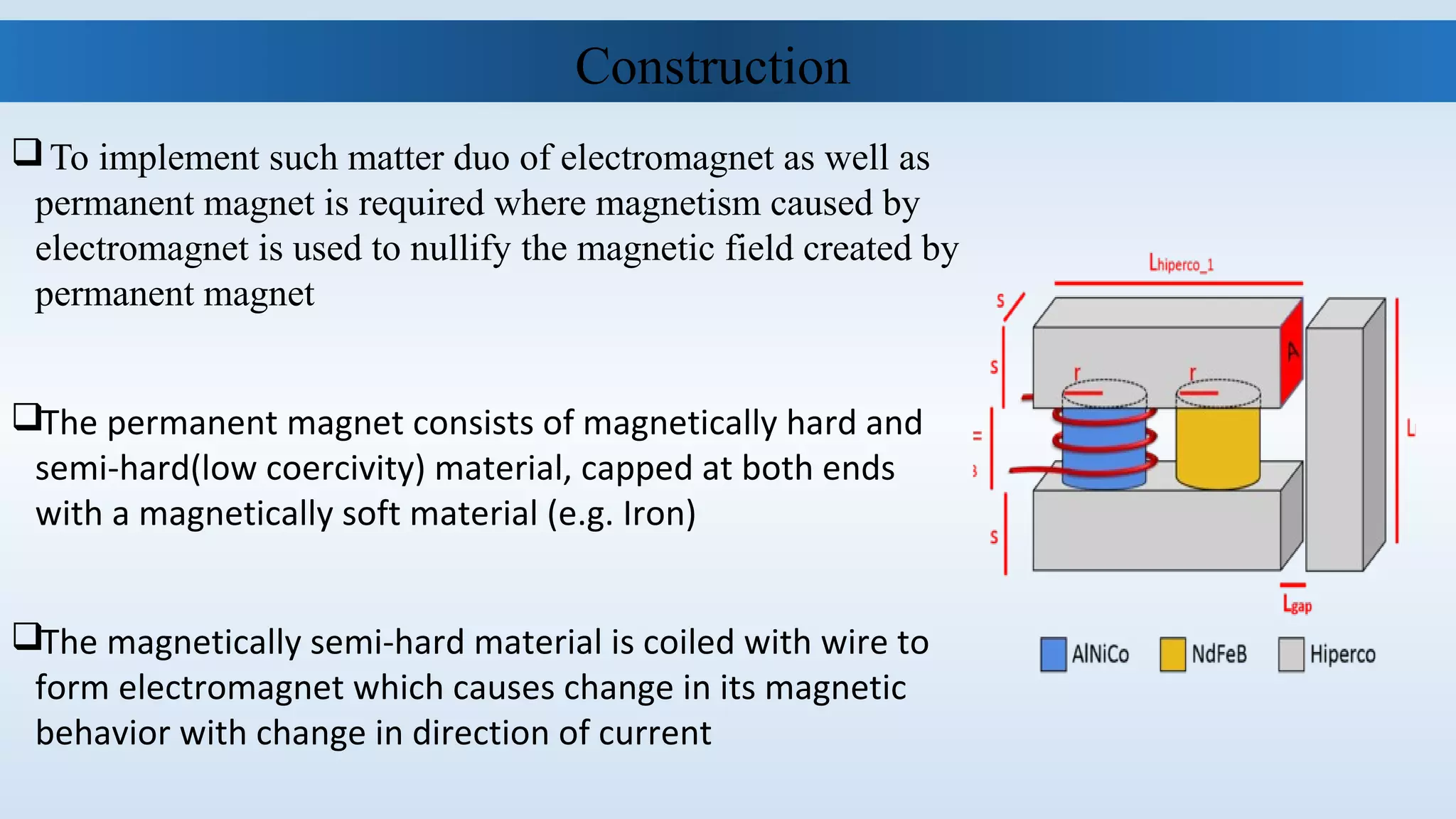
To implement such matter duo of electromagnet as well as
permanent magnet is required where magnetism caused by
electromagnet is used to nullify the magnetic field created by
permanent magnet
The permanent magnet consists of magnetically hard and
semi-hard(low coercivity) material, capped at both ends
with a magnetically soft material (e.g. Iron)
The magnetically semi-hard material is coiled with wire to
form electromagnet which causes change in its magnetic
behavior with change in direction of current
Construction
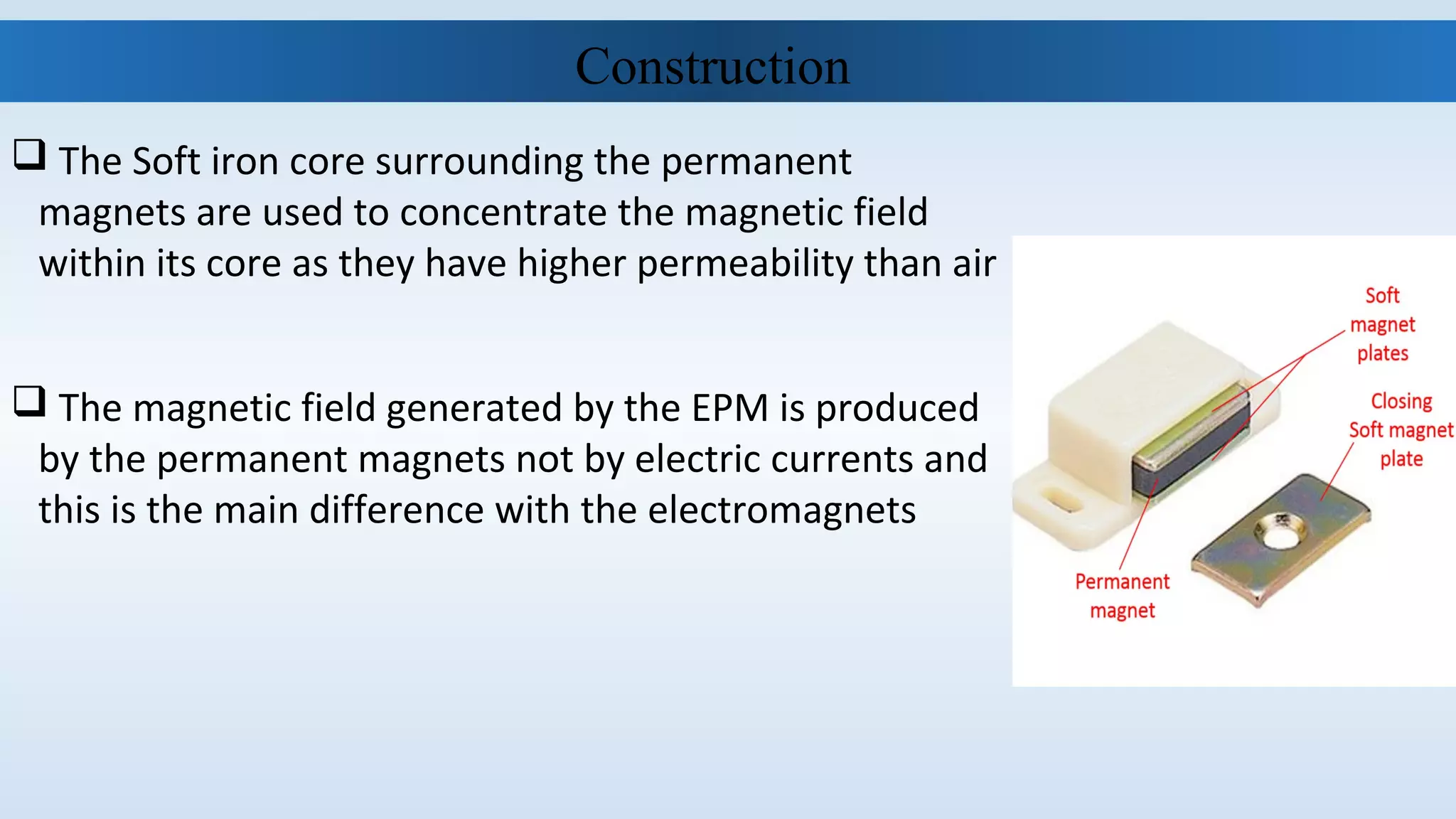
 The Soft iron core surrounding the permanent
magnets are used to concentrate the magnetic field
within its core as they have higher permeability than air
 The magnetic field generated by the EPM is produced
by the permanent magnets not by electric currents and
this is the main difference with the electromagnets
Construction
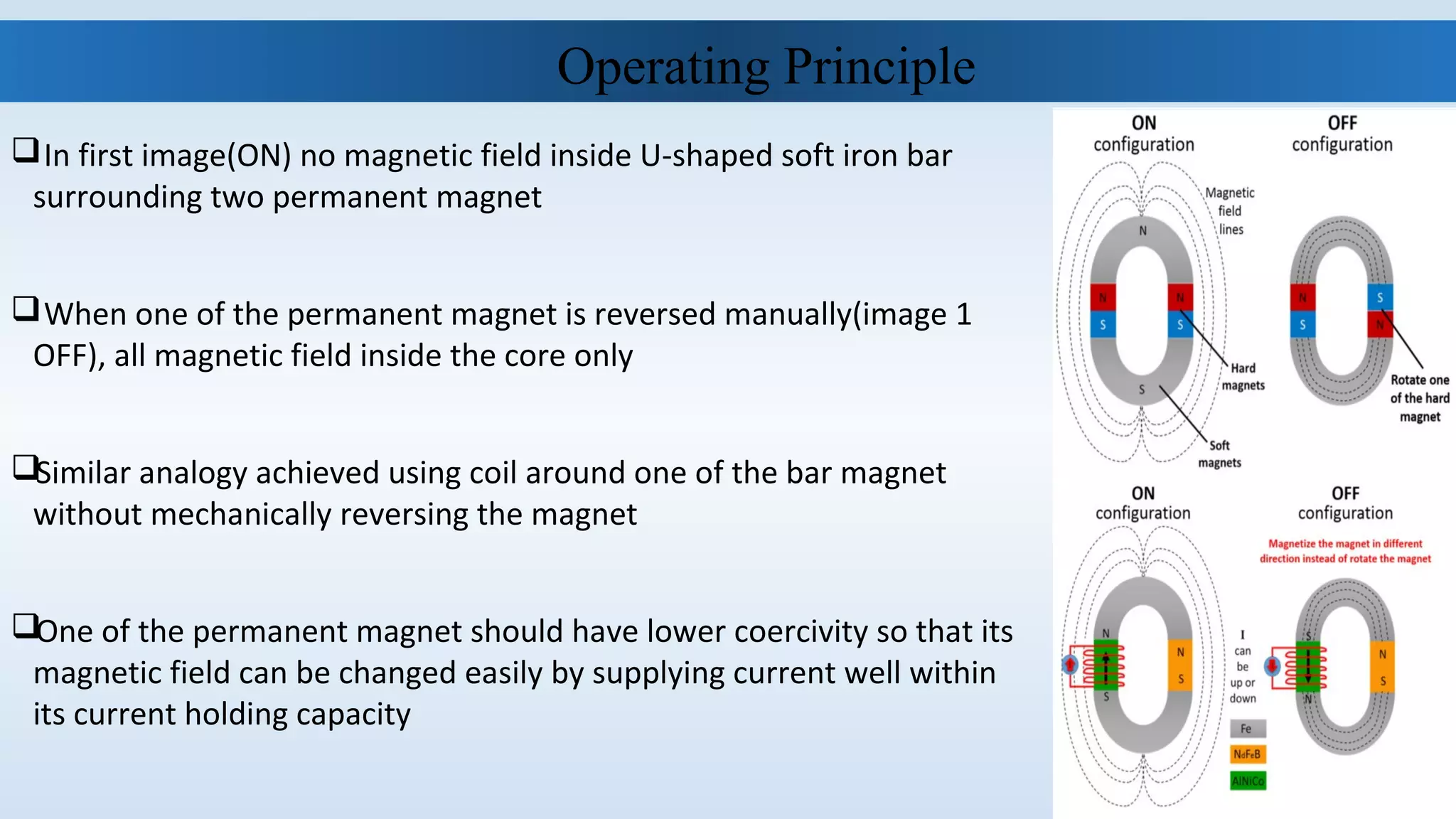
 In first image(ON) no magnetic field inside U-shaped soft iron bar 
surrounding two permanent magnet
 When one of the permanent magnet is reversed manually(image 1 
OFF), all magnetic field inside the core only
Similar analogy achieved using coil around one of the bar magnet 
without mechanically reversing the magnet
One of the permanent magnet should have lower coercivity so that its 
magnetic field can be changed easily by supplying current well within 
its current holding capacity
Operating Principle
Magnetic Circuit
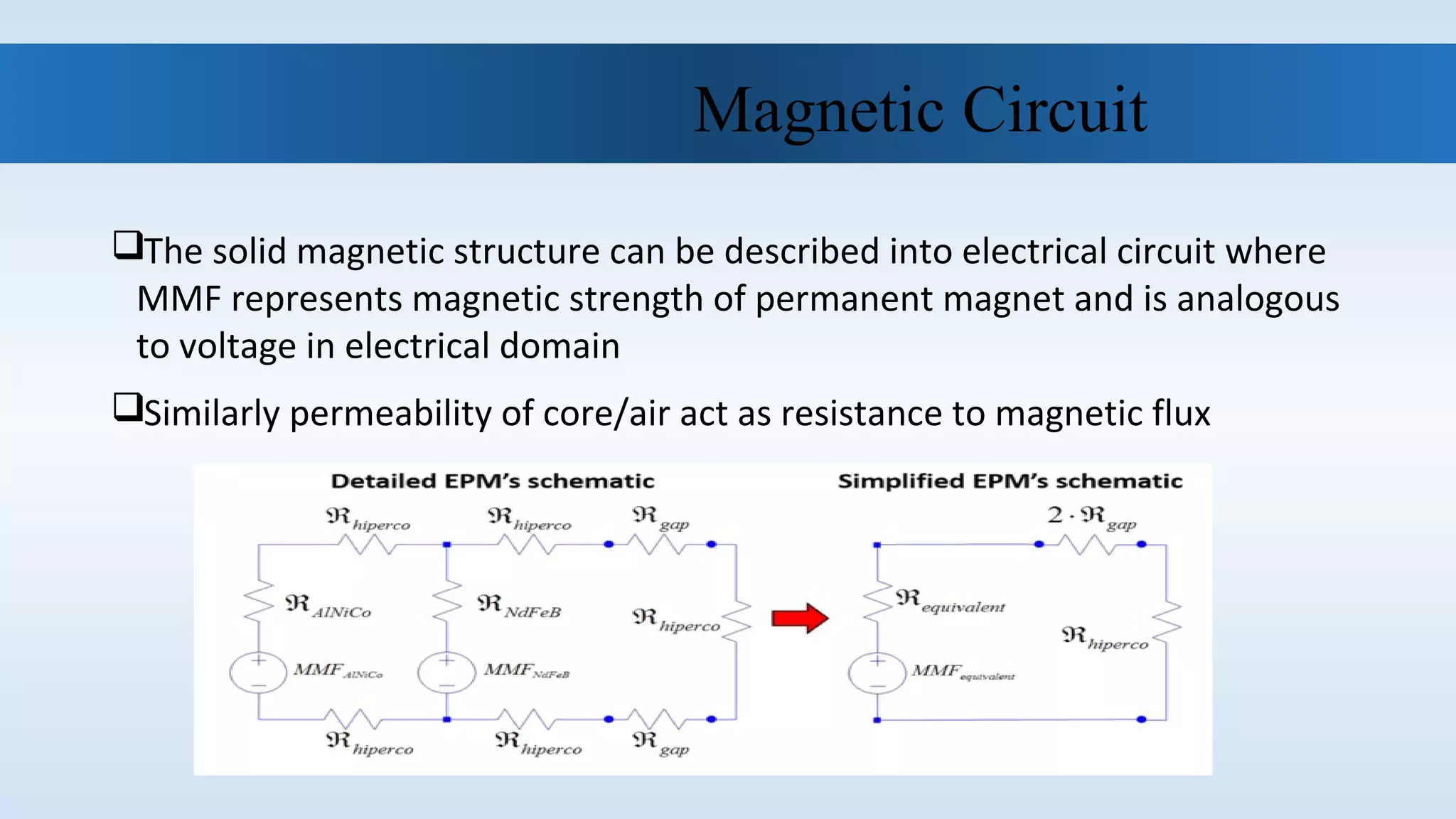
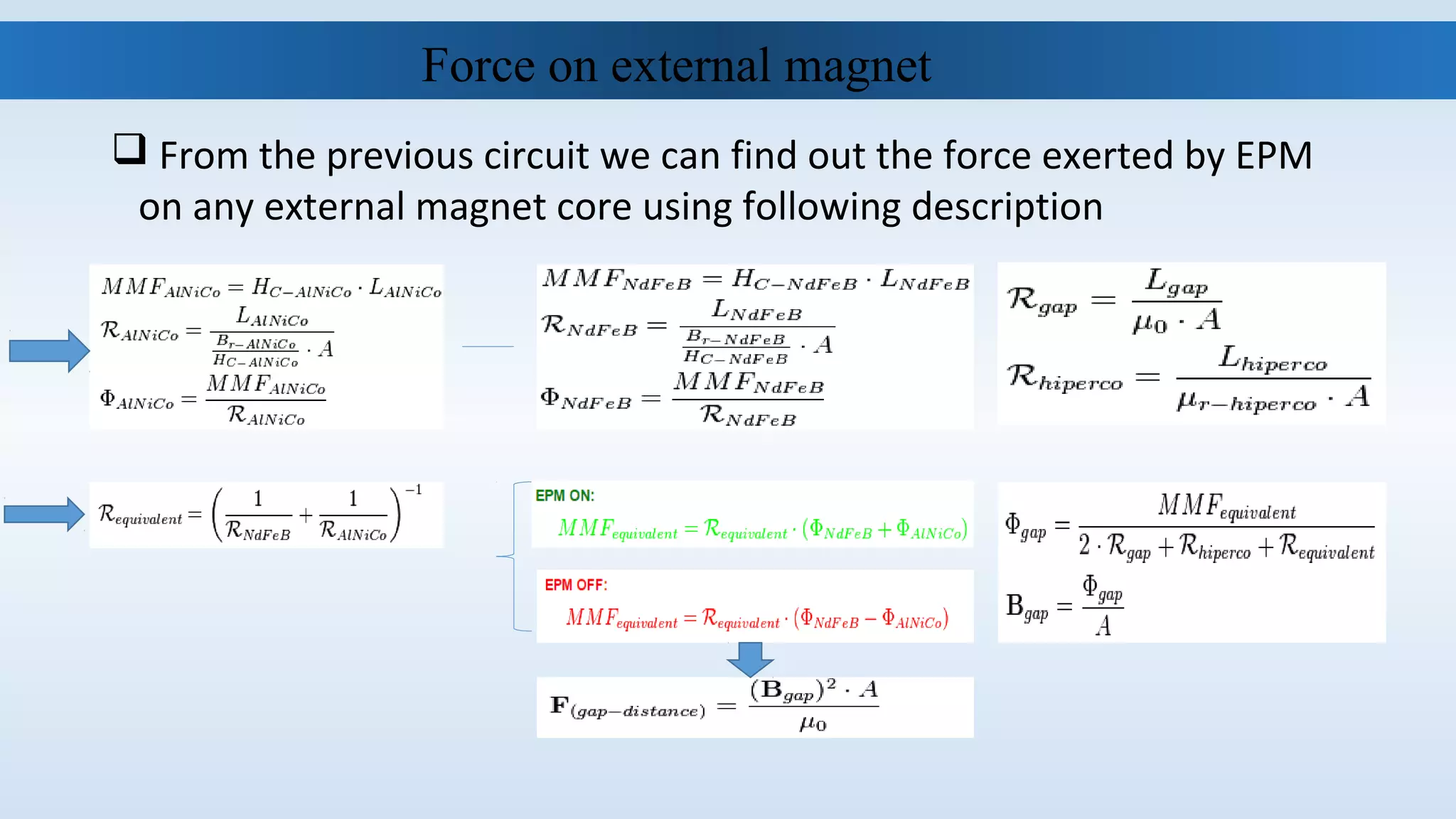
The solid magnetic structure can be described into electrical circuit where 
MMF represents magnetic strength of permanent magnet and is analogous 
to voltage in electrical domain 
Similarly permeability of core/air act as resistance to magnetic flux 
Force on external magnet
 From the previous circuit we can find out the force exerted by EPM 
on any external magnet core using following description
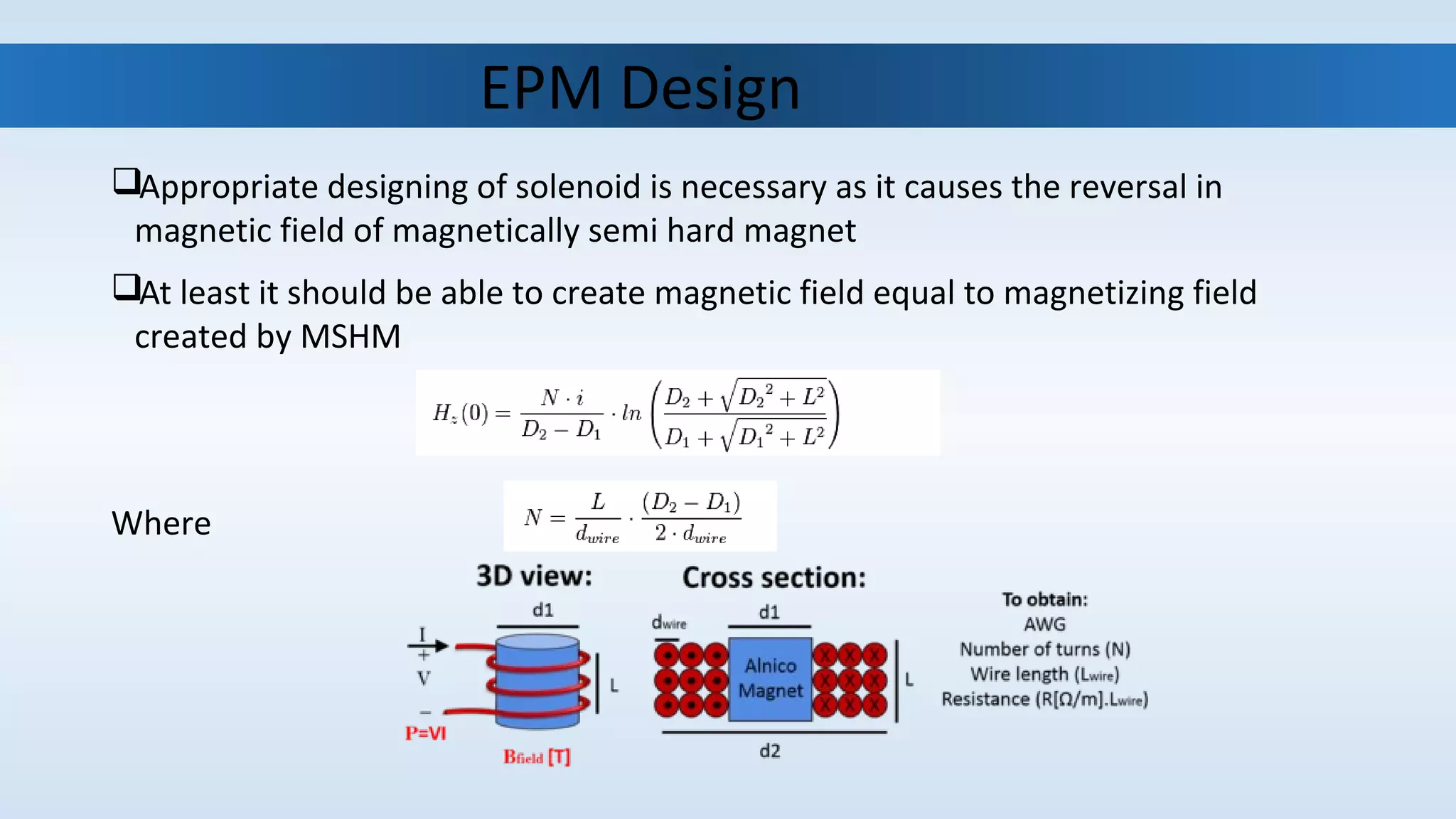
                               EPM Design
Appropriate designing of solenoid is necessary as it causes the reversal in 
magnetic field of magnetically semi hard magnet
At least it should be able to create magnetic field equal to magnetizing field 
created by MSHM
Where 
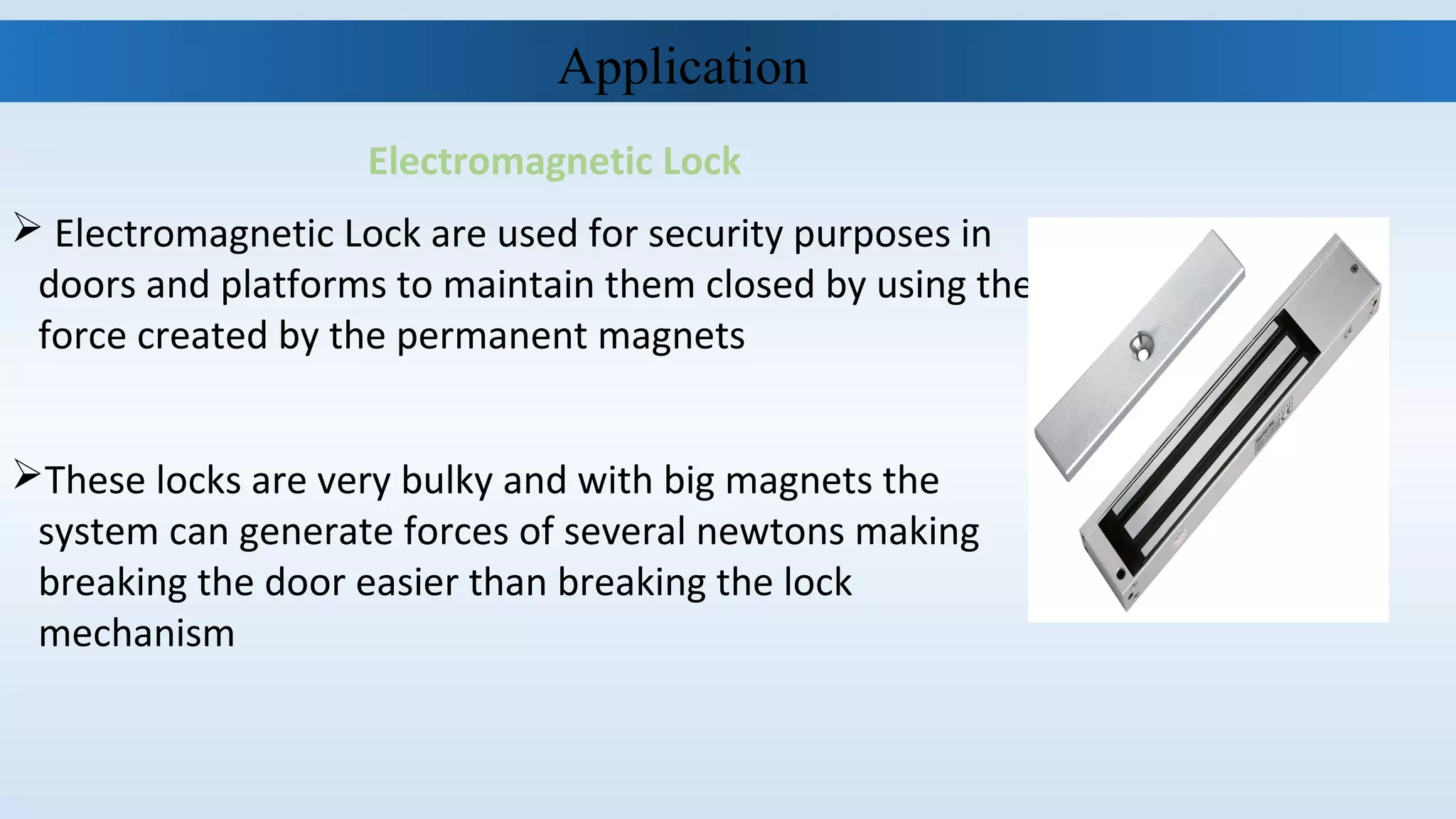
Electromagnetic Lock
 Electromagnetic Lock are used for security purposes in 
doors and platforms to maintain them closed by using the 
force created by the permanent magnets
 
These locks are very bulky and with big magnets the 
system can generate forces of several newtons making 
breaking the door easier than breaking the lock 
mechanism
Application
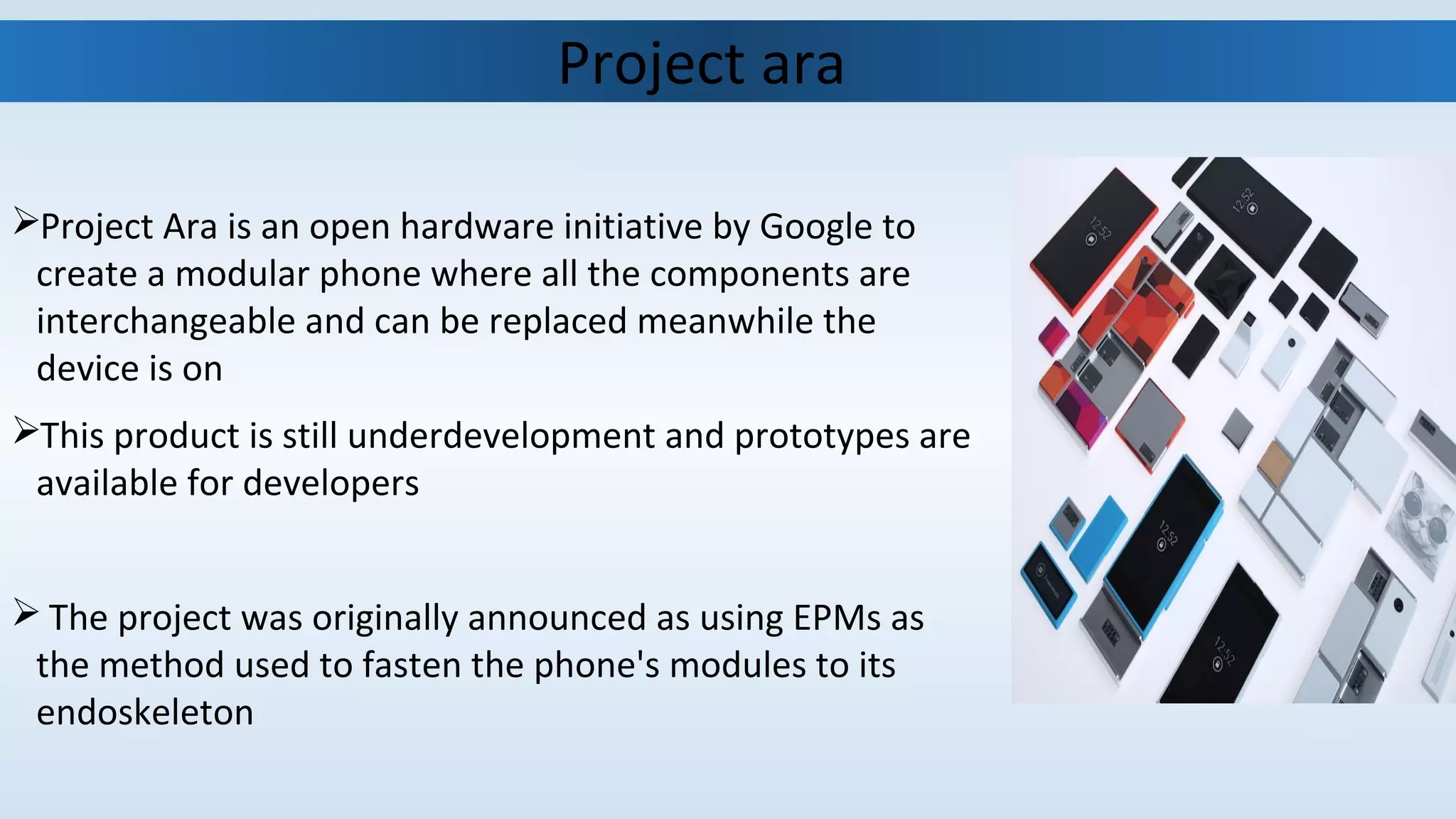
Project Ara is an open hardware initiative by Google to
create a modular phone where all the components are
interchangeable and can be replaced meanwhile the
device is on
This product is still underdevelopment and prototypes are
available for developers
 The project was originally announced as using EPMs as
the method used to fasten the phone's modules to its
endoskeleton
Project ara
Drone package delivery system
Gripping systems for drones have been starting to use EPM
for their configuration
Reconfigurable matter
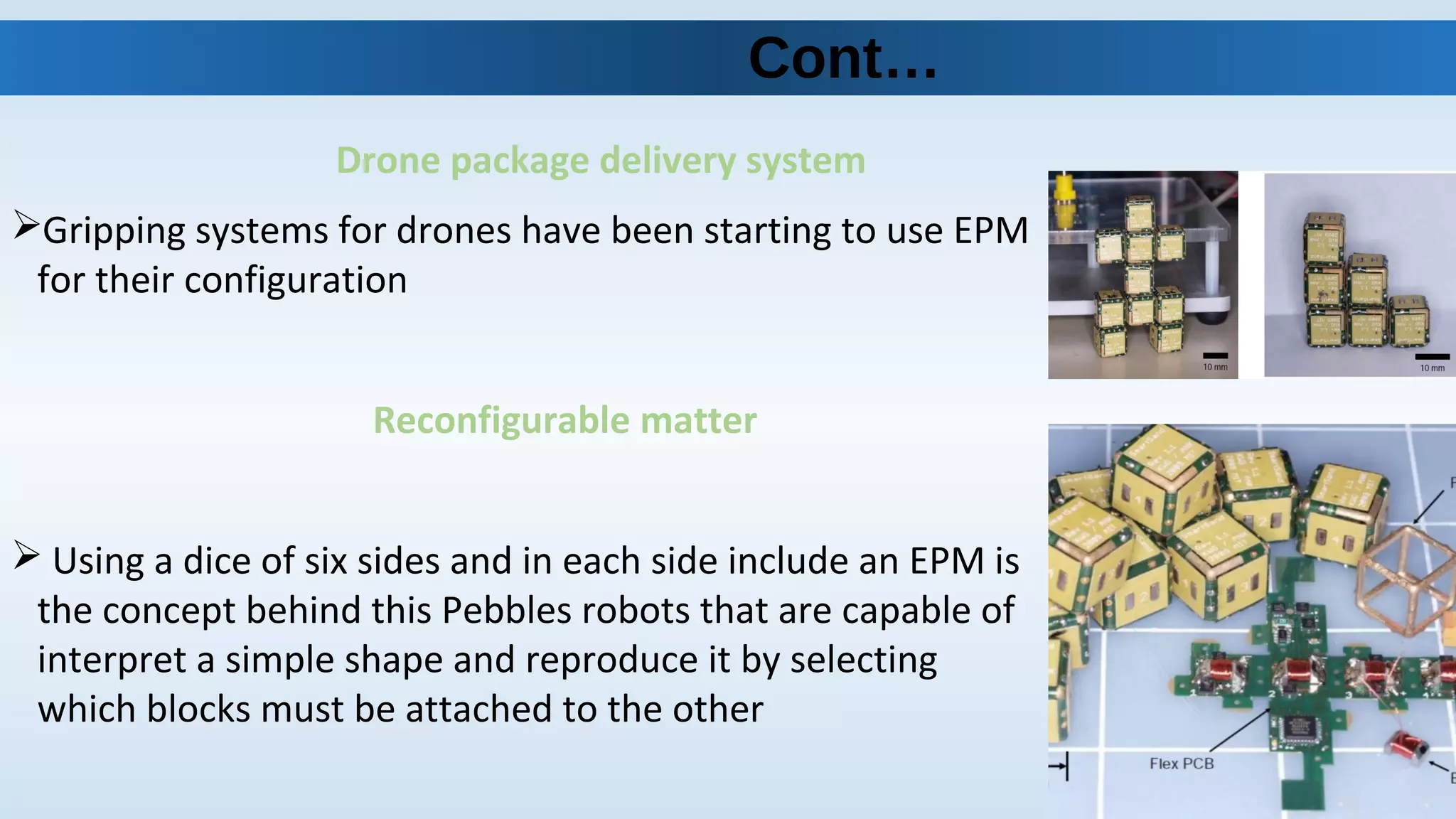
 Using a dice of six sides and in each side include an EPM is
the concept behind this Pebbles robots that are capable of
interpret a simple shape and reproduce it by selecting
which blocks must be attached to the other
Cont…

Programmable matter and applications

Editor's Notes

  • #2 <number>
  • #4 <number>
  • #6 <number>
  • #7 <number>
  • #17 <number>
  • #18 <number>