SWITCHING TRANSIENT 
PROBLEM WITH LOADS 
KKKL 4073 
POWER QUALITY 
LECTURER: PROF. MADYA DR M.A HANNAN 
BY NORALINA ABDUL AZIZ A117805
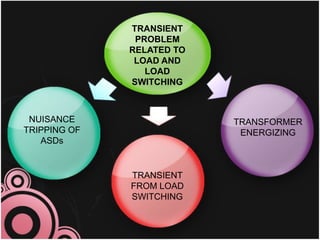
TRANSIENT 
PROBLEM 
RELATED TO 
LOAD AND 
LOAD 
SWITCHING 
NUISANCE 
TRIPPING OF 
ASDs 
TRANSIENT 
FROM LOAD 
SWITCHING 
TRANSFORMER 
ENERGIZING
NUISANCE TRIPPING OF ASDs 
• Most adjustable speed drives use voltage source inverter VSI 
design with a capacitor in the dc link 
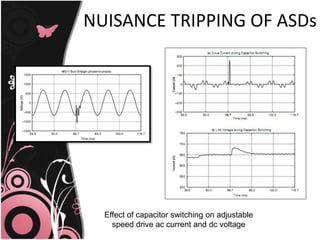
• But the control are sensitive to dc overvoltage and may trip the 
drive at the level as low as 117 percent 
• Since transient voltage due to utility capacitor switching exceed 
130 percent, the probability of nuisance tripping of the drive is 
high
NUISANCE TRIPPING OF ASDs 
Effect of capacitor switching on adjustable 
speed drive ac current and dc voltage
TRANSIENT FROM LOAD SWITCHING 
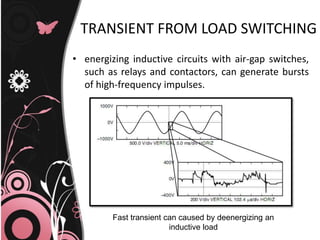
• energizing inductive circuits with air-gap switches, 
such as relays and contactors, can generate bursts 
of high-frequency impulses. 
Fast transient can caused by deenergizing an 
inductive load
TRANSIENT FROM LOAD SWITCHING 
• From figure it shown cites representative 15ms burst composed of 
impulses having 5ns rise times and 50ns durations 
• There is very little energy in these type of energy due to short 
duration, but they can interfere with the operation of electronic 
loads.
EXAMPLE 
• electrical fast transient (EFT) activity, producing spikes up to 1 
kV, is frequently due to cycling motors, such as air 
conditioners and elevators. 
• Transients as high as 3 kV can be caused by operation of arc 
welders and motor starters. 
• The duration of each impulse is short compared to the travel 
time of building wiring, thus the propagation of these 
impulses through the wiring can be analyzed with traveling 
wave theory. The impulses attenuate very quickly as they 
propagate through a building.
PROTECTION 
• Therefore, in most cases, the only protection needed is 
electrical separation. 
• Physical separation is also required because the high rate of 
rise allows these transients to couple into nearby sensitive 
equipment. 
• EFT suppression may be required with extremely sensitive 
equipment in close proximity to a disturbing load, such as a 
computer room. 
• High-frequency filters and isolation transformers can be used 
to protect against conduction of EFTs on power cables. 
• Shielding is required to prevent coupling into equipment and 
data lines.
TRANSFORMER ENERGIZING 
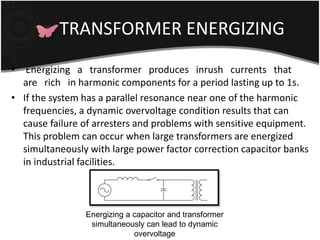
• Energizing a transformer produces inrush currents that 
are rich in harmonic components for a period lasting up to 1s. 
• If the system has a parallel resonance near one of the harmonic 
frequencies, a dynamic overvoltage condition results that can 
cause failure of arresters and problems with sensitive equipment. 
This problem can occur when large transformers are energized 
simultaneously with large power factor correction capacitor banks 
in industrial facilities. 
Energizing a capacitor and transformer 
simultaneously can lead to dynamic 
overvoltage
TRANSFORMER ENERGIZING 
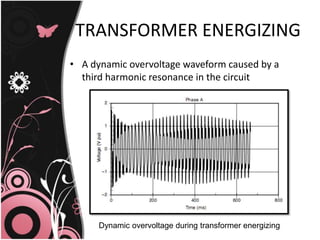
• A dynamic overvoltage waveform caused by a 
third harmonic resonance in the circuit 
Dynamic overvoltage during transformer energizing
TRANSFORMER ENERGIZING 
• After the expected initial transient, the voltage again swells to 
nearly 150 percent for many cycles until the losses and load damp 
out the oscillations. 
• This can place severe stress on some arresters and has been 
known to significantly shorten the life of capacitors. 
• This form of dynamic overvoltage problem can often be 
eliminated simply by not energizing the capacitor and 
transformer together. 
• One plant solved the problem by energizing the transformer first 
and not energizing the capacitor until load was about to be 
connected to the transformer.
THANKS FOR 
THE TIME

Switching Transient Problem with Loads

  • 1.
    SWITCHING TRANSIENT PROBLEMWITH LOADS KKKL 4073 POWER QUALITY LECTURER: PROF. MADYA DR M.A HANNAN BY NORALINA ABDUL AZIZ A117805
  • 2.
    TRANSIENT PROBLEM RELATEDTO LOAD AND LOAD SWITCHING NUISANCE TRIPPING OF ASDs TRANSIENT FROM LOAD SWITCHING TRANSFORMER ENERGIZING
  • 3.
    NUISANCE TRIPPING OFASDs • Most adjustable speed drives use voltage source inverter VSI design with a capacitor in the dc link • But the control are sensitive to dc overvoltage and may trip the drive at the level as low as 117 percent • Since transient voltage due to utility capacitor switching exceed 130 percent, the probability of nuisance tripping of the drive is high
  • 4.
    NUISANCE TRIPPING OFASDs Effect of capacitor switching on adjustable speed drive ac current and dc voltage
  • 5.
    TRANSIENT FROM LOADSWITCHING • energizing inductive circuits with air-gap switches, such as relays and contactors, can generate bursts of high-frequency impulses. Fast transient can caused by deenergizing an inductive load
  • 6.
    TRANSIENT FROM LOADSWITCHING • From figure it shown cites representative 15ms burst composed of impulses having 5ns rise times and 50ns durations • There is very little energy in these type of energy due to short duration, but they can interfere with the operation of electronic loads.
  • 7.
    EXAMPLE • electricalfast transient (EFT) activity, producing spikes up to 1 kV, is frequently due to cycling motors, such as air conditioners and elevators. • Transients as high as 3 kV can be caused by operation of arc welders and motor starters. • The duration of each impulse is short compared to the travel time of building wiring, thus the propagation of these impulses through the wiring can be analyzed with traveling wave theory. The impulses attenuate very quickly as they propagate through a building.
  • 8.
    PROTECTION • Therefore,in most cases, the only protection needed is electrical separation. • Physical separation is also required because the high rate of rise allows these transients to couple into nearby sensitive equipment. • EFT suppression may be required with extremely sensitive equipment in close proximity to a disturbing load, such as a computer room. • High-frequency filters and isolation transformers can be used to protect against conduction of EFTs on power cables. • Shielding is required to prevent coupling into equipment and data lines.
  • 9.
    TRANSFORMER ENERGIZING •Energizing a transformer produces inrush currents that are rich in harmonic components for a period lasting up to 1s. • If the system has a parallel resonance near one of the harmonic frequencies, a dynamic overvoltage condition results that can cause failure of arresters and problems with sensitive equipment. This problem can occur when large transformers are energized simultaneously with large power factor correction capacitor banks in industrial facilities. Energizing a capacitor and transformer simultaneously can lead to dynamic overvoltage
  • 10.
    TRANSFORMER ENERGIZING •A dynamic overvoltage waveform caused by a third harmonic resonance in the circuit Dynamic overvoltage during transformer energizing
  • 11.
    TRANSFORMER ENERGIZING •After the expected initial transient, the voltage again swells to nearly 150 percent for many cycles until the losses and load damp out the oscillations. • This can place severe stress on some arresters and has been known to significantly shorten the life of capacitors. • This form of dynamic overvoltage problem can often be eliminated simply by not energizing the capacitor and transformer together. • One plant solved the problem by energizing the transformer first and not energizing the capacitor until load was about to be connected to the transformer.
  • 12.